
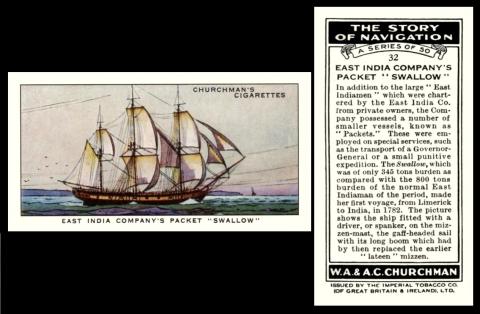
So here we have a card with several intriguing links, to both the Thackerays and to curry.
Firstly, as we found out already, the Thackerays were heavily involved with the East India Company, his father, and his grandmother on his mother`s side both being civil servants in their employ.
In addition, the East India Company also state, in several places, that they brought to this country the first ever curry powder, which was based on such a product enjoyed by their staff. In fact, this is completely incorrect, because there was no such thing as a curry powder at that time, the cooks would just mix a range of spices to their personal taste and gradually amend it to fit the taste of their diners. The first ever curry powder was invented to satisfy the cravings for Indian food from the military officers and ex goverment officials who had come to the end of their time in India and missed it, and wanted to at least be able to continue enjoying the same sort of food. And to satisfy demand, some enterprising merchants in London mixed up several random spices and sold under the name of Indian Curry Powder. When it was a hit, they continued.
As for this ship, the Swallow, she was a wooden packet ship, made for the British East India Company in India, to carry mail, parcels, and probably spices, and she was launched out of Bombay in 1779. We know that she made nine trips in their employ, starting in 1782 and ending in 1803. Then, the following year, she was bought by the Royal Navy, and rechristened H.M.S. Lilly and she sailed under that name until 1811, when she was sold. Then it gets really odd, as she disappears from all records, which makes some historians imagine she was involved in piracy.
She turns up again in 1814, when she is bought by a J. Lyney, of London, and returned to her original name of Swallow. More than that, though, he sailed her between India and the West Indies, under an East India Company license, until 1823, when she was wrecked en route to Calcutta with the loss of three crew.
Now this set is first described in our original Churchman`s reference book, RB10, published in 1948, as :
- 136. July 1937. 50. THE STORY OF NAVIGATION (titled series). Size 2 11/16" x 1 7/16" or 67 x 36 m/m. Numbered 1-50. Fronts printed by letterpress, 4-colour half tone process. Backs in dark green, with descriptions. Printed by Mardon, Son & Hall.
- 137. 1935. 12. THE STORY OF NAVIGATION (titled series). Similar format to (136) but size 3 5/16" x 2 9/20" or 80 x 52 m/m.
Yet again, this means that we are not looking for ships that were scuttled to form a shorter, larger set, because the larger set was issued two years earlier. However it is curious that we have no month date allied to the larger set.
We do know that the twelve original ships were :
- Sea-Going Ship of the Ancient Egyptians
- Roman War Galley
- A Viking Ship
- Columbus`s "Santa Maria"
- The "Harry Grace a Dieu"
- An Elizabethan Galleon
- A Maltese Galley
- Nelson`s "Victory"
- The "Comet"
- The "Great Eastern"
- Clipper Ship "Cutty Sark"
- The "Queen Mary"
By the time of our original World Tobacco Issues Index, this has been shortened, to :
- THE STORY OF NAVIGATION. Sm. C82-83
A. Small (50)
B. Large (12)