
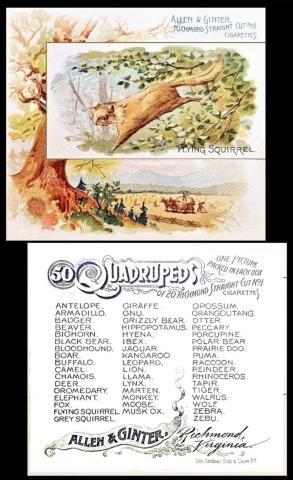
This is a rather odd squirrel, from America, and it is hard to tell from this card which of two types it is - the one in the northern states, called Glaucomys sabrinus, and the one in the southern states which is called Glaucomys volans. The problem is that the differences are hard to tell from this card - for the first is that whilst both are grey brown from the top, their bellies are different colours, the northern one having grey fur, and the southern ones having white fur - whilst the second is their size, the northern ones being about two inches longer.
One thing that is odd is that these squirrels do not actually fly. That would require them to flap some kind of rudimentary wing, and they do not, they simply leap from one tree into the air and as their legs and arms come out into a cross shape the membrane which appears between them acts as a kind of glider, and catches the currents in the air, propelling them forwards to their destination. And it's very effective, carrying them for as much as a hundred and fifty feet, if the air is on their side. That is not all because they can actually use their legs to steer themselves into better currents, or even to change direction. Then, when they reach where they want to be, they can actually stop themselves by moving their tail so that it blocks the current from carrying them on.
Our original World Tobacco Issues Index tells us something else interesting, and that is that this set was issued in two sizes, but not the whole story, which is that the small cards are but the card shaped section with the animal and the white background. All the scenery around this has been added on to, and only on to, the large card.
The listing in that book reads :
- QUADRUPEDS. Bkld. (50) ... A36-21
(a) Small. Ref. USA/21
(b) Large. Ref. USA/41
And this remains the same in our updated version, save a new card code, of A400-210.
The USA codes lead us to Jefferson Burdick, and his American Card Catalogue. He values the small size at just fifteen cents each, describing them simply as "21 - Quadrupeds (50)", but he likes the larger ones a little better, valuing them at thirty cents each; though it is the same listing for both sizes, save the different code of "41" for the larger version.
However since the last time I added any American tobacco cards I have acquired a new book, our RB.151, which covers North American Tobacco Issues. That not only relists the issues at the front, but has a handbook at the back which shows many coloured images of the cards. In there, under N.21, it says the following ;
- N.21 QUADRUPEDS. Issued by Allen & Ginter. Series of 50. Bkld.
A. Small size.
B. Extra Large size, showing additional artwork on the front (N.41)
A special printed album showing all the subjects was available in exchange for coupons (A.11). There is also a banner (G.15). A similar set, entitled "Zoo", was issued by Philadelpha Caramel Co. (E.218).
In the large size the subject "Zebra" can be found with or without caption on the front.
These "A", "G", and "E" numbers also relate to Jefferson Burdick. Taking them in order, the American Card Catalogue tells us that they are :
- "A.11 - Quadrupeds .... valued at $4"
"Tobacco Albums. Souvenir albums of this type, as issued by the tobacco companies, were probably intended to replace the individual cards if the smoker so desired, or at least enable him to own the entire collection of designs without the difficulty attendant to obtaining all the individual cards in a set. Later their popularity induced the tobacco companies to publish a few albums that had no card counterparts. All were given in exchange for coupons packed with the cigarettes, usually 75 or 100 coupons for each album. Only one album (A.40 - Kimball`s "Arms of Dominions") is made to hold the actual cards. All date in the 1888 - 1890 period.
Practically all albums, except Duke`s, are loose leaf cardboard pages with string binding, each page showing a few of the cards plus other decorative matter and plates. No expense was spared in their publication. A large proportion of those that have survived show some damage, especially on the outside covers. A few are so scarce that not a single example is known. Although catalog value has raised on many albums it probably does not yet reflect their actual scarcity in fine condition. Every collection should have a representation of thse show pieces."
- "G.15 - Quadrupeds (elephant) 13-1/2 x 42 ...valued at $15"
"Banners and Labels. Consumer advertising and insert cards were not the only methods used to attract the public. While radio and television were unheard of, and outdoor advertising in only an embryonic stage, the interiors of stores were used for banner and poster advertising to a greater extent than today. These large picture signs were an ever changing attraction for customers. Banners are paper hangers with a metal binding at top and bottom edges. The popular size was about 30 inches long but a few measured over five feet in length. Many were hung in windows since modern window trimming had not been developed. Some large prints were supplied in frames under glass.
The tobacco firms were prolific advertisers using a constant procession of banners, especially to publicize their current insert card sets. The usual design illustrates the card pictures with a large appropriate center picture. Condition should be good to merit these rates.
- E.218 - this is something that I cannot find in my edition of the American Card Catalogue, but it may have been added in a later edition than I own. Anyone who can supply it, and the header details, please do! Many thanks.