
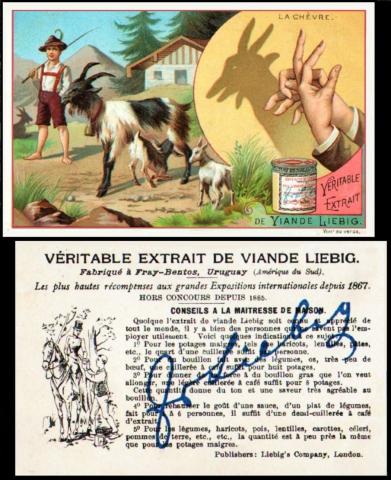
This card might have led you to a "goatee" beard, but we were again going along the horticultural route, and looking for goat`s beard, or Arunculus dioicus - a tall flowering plant with feathery flowers in the summer, leading to one of its other names, "bride`s feathers".
Strangely it is related to the rose.
These are often classed as silhouettes, but they are technically hand shadows (which is the translation of the German version "Handschatten" - a set we featured as our Card of the Day for the 23rd of December 2025).
For some reason our set translates to Chinese Shadows.
The other cards, and equally attractive they are, though I am not so keen on the hare one, are as follows :
- La Chèvre - the goat
- Le Chameau - the camel
- Le lièvre - the hare
- Le Paysan - literally the peasant, but used here for a farmer
- L'Indien - the Native Amerian
- L`oie - the goose
These are available in French (as "Ombres Chinois I), German (as Handschatten I), and Italian (as "Ombretto I" or "Ombre con le mani I")
And there is indeed a second set, "Ombres Chinois II", issued in 1893. which are catalogued as F.0388 and S.0387. The cards there are :
- Le Boeuf - the ox
- Le Canard - the duck
- Le Chauffeur - the coach driver
- Le Chien - the dog
- L`Elephant - the elephant
- L`Escargot- the snail
This is also available in the same three languages, French, German, and Italian