
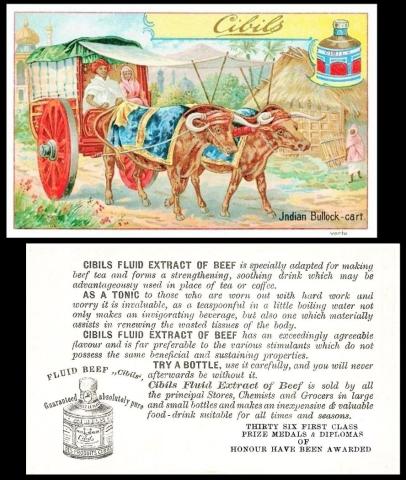
Here we still have an ox, but it is called a bullock, a word for exactly the same animal. but which is used more commonly in the United Kingdom, Australia, and India, as well as several other former colonies, dependencies, and dominions.
Now if you look between the two cart cards we used this week you will see that the wheel size varies considerably -
Tuesday`s card has smaller wheels, and they are much lighter by way of construction, as is the one or two passenger cart. Also the oxen are also different on Tuesday`s card, for they have humps on their backs. That is because these are a different breed, called a Zebu, a strange creature which is a direct descendent of the Indian Aurochs, an extinct species from which we almost certainly derive the name of "ox"
Today`s card shows a more traditional form of oxen, and a cart with much heavier, thicker constructed, and larger wheels. The cart is also more substantial, but that is necessarily why the wheels are larger, for the construction varies widely, depending on the terrain and the degree of sticky mud that the cart may need to push through.
And it seems very likely that Tuesday`s cart is a light run about for town use, whilst today`s is a more rural construction, in a region more affected by flooding. The backdrop on our card, with its thatched roof dwelling, also supports that. very well
The most curious thing about this card, though, is the title, look again and you will see that instead of "Indian" it starts with the letter "J". That is presumed to be a typesetter`s error, perhaps easily explained by the process of type setting, during which the single letter blocks are extracted from their individual compartments and firmed into place to make the word. It may even have been a simple lapse when the words were broken up and put back into the compartments, one "j" falling in amonsgst the "i"s. It is easy enough to do that. However it does not explain why such an error passed right through the printing process without being picked up.
Cibils is proving hard to research. I wonder if we have any specialists reading who would like to supply us with a note about them ?
All I know is that the product was billed as "Fluid Beef Extract - or Concentrated Beef Tea" - and that advertising mentions something rather curious, that being that it is "rich in the egg-white matters, while at the same time it is wholly free from glue."
It was also a prize winner at several International Exhibitions - the South American Continental Exhibition at Buenos Aires (March to July, 1882), the Berlin Exhibition of Hygiene (1882-1883), the International Colonial and Export Exhibition in Amsterdam (May to October 1883), The London International Universal Exhibition (1884) and the World`s Industrial and Cotton Centennial Exposition in New Orleans (December 1884 to June 1885).
Like Liebig`s, the beef came from South America, which could point to why the exhibition in Buenos Aires was their first.
And it was sold by chemists, in small bottles, as a medicine would have been.