
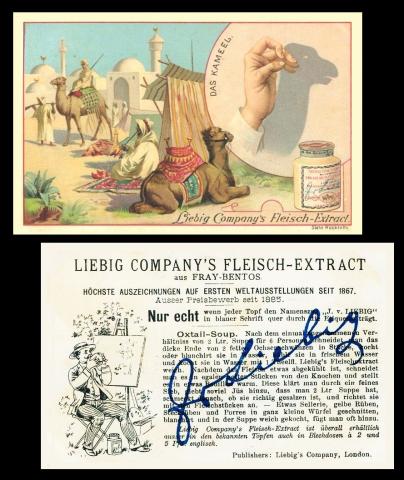
Now you may not realise this but not all camels are the same.
The one on our card today is a dromedary, also known as an Arabian camel, or, simply, a one-humped camel. They are the tallest of all camels, reaching two metres at the shoulder for the males and slightly shorter for the females. And, treated well, they can live for forty years.
This is the oldest type of camel, known to the Assyrians as "gammalu". In fact a very similar word to this "gamal", appears in the bible, just not in connection with the three wise men. These words are the root of the word "camel".
As for the word "dromedary", that refers to its speed, and it comes from the Greek word "dromas", which means fast running.
Lastly, the name of "Arabian" camel is not just because of where it lives - it actually celebrates the fact that the Arabs were the first to manage to domesticate the camel, in the third century B.C.
The earliest cards to feature an Arabian camel was issued with Abdul Cigarettes in 1881 - but the first set to use the title of "Dromedary" is Allen and Ginter`s 1888 set of "Wild Animals of the World".
Today`s card simply chooses "the camel". Now at first I thought we had already had this set, and we have, but this is the German version, which translates to Hand Shadows. (You can see the French version, which, for some reason, translates to Chinese Shadows, as our Card of the Day for the 1st of December 2025.
The cards in this German version are :
The other cards, and equally attractive they are, though I am not so keen on the hare one, are as follows :
- Die Ziege- the goat
- Das Kameel - the camel
- Der Hase- the hare
- Der Bauer - the farmer
- Der Indianer - the Native Amerian
- Die Gans - the goose
And there is indeed a second set, "Handschatten II", issued in 1893. which are catalogued as F.0388 and S.0387. The cards there are :
- Der Stier - the ox
- Die Ente - the duck
- Der Kutscher - the coach driver
- Der Hund - the dog
- Der Elephant - the elephant
- Die Schnecke - the snail
This is also available in the same three languages, French, German, and Italian