
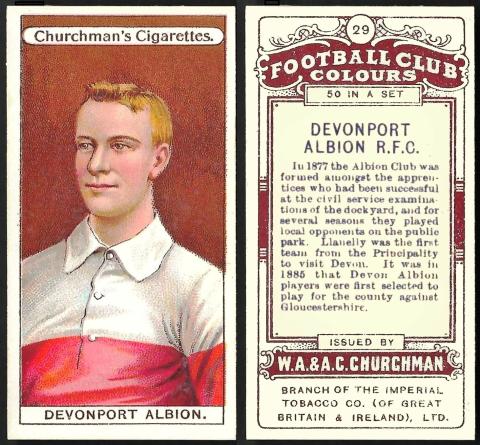
To start our week we have this card, which, along with its sibling, the same set but issued by Franklyn Davey and branded for `Loadstone Cgarettes` was issued in January 1909` - becoming the third oldest card in our January listing.
There is also a January connection to Devonport Albion, in that they signed the contract on their rental of Home Park in January 1893.
However, yet again this "Football Club Colour" is a rugby team - founded in 1876 by a group of dockyard apprentices. Mind you our card gives a different date, of 1877. It does add something that is usually absent from the history books though, and that is that it was only "the apprentices who had been successful at the civil service examinations of the dockyard" who were on the team.
Our card tells us that "for several seasons they played local opponents on the public park." That was Devonport Park, and they stayed there until 1887, when they moved to Beacon Park in Bladderley Lane. By this time they were becoming quite a renowned team, and, as our card tells us, "It was in 1885 that Devon Albion players were first selected to play for the country against Gloucestershire". This could have been the spur that saw them moving to that new ground, but also, in 1886, they had taken over another local team, Keyham.
Then, in 1893, they moved from Bladderley Lane and moved to a new, purpose built football ground, called Home Park, which they shared with local football team Home Park A.F.C.. Their first match, against Aberavon, was on the 1st of April 1893, which was, coincidentally, Easter Monday, and Devonport Albion won, in front of five thousand spectators. Their new home was a vast improvement, but they balked at the amount of rent which was being charged, £350 a season, and when re-negotiations broke down they decided to return to Bladderley Lane. And not so long after that the ground they had left was re-rented, to Plymouth R.F.C. It is not known whether they paid the same rent or not.
The Bladderly Lane site seems to have been vacated not long after that, and Devonport moved to Rectory Field. They were still there when the First World War broke out, on which a lot of the Devonport Albion players were sent off to war, many joining the Navy. After the war was over, the team was a shadow of its former self, for there had been many deaths and casualties, and so in 1920 it was decided to merge with Plymouth R.F.C. However, in rather a happy twist, the name of the team was changed, to Plymouth Albion R.F.C., and the club colours were also amalgamated, the green and white of Plymouth being joined by the red and white of Devonport Albion
The one thing we do not know is the identity of this player. So if anyone would like to have a go at that, please do!
This set is first recorded in our Cartophilic Reference Book No.10, devoted to The Cigarette Card Issues of W.A. & A.C. Churchman, published in 1948, as :
- 81. Jan. 1909. 50. FOOTBALL CLUB COLOURS. (titled series). Size 2 11/16" x 1 7/16" or 67 x 36 m/m. Numbered 1-50. Fronts lithographed in colour. Backs in brown, with descriptions. Printed by Mardon, Son & Hall. Also issued by Franklyn Davey and Ogdens.
Its next appearance comes in our World Tobacco Issues Index of 1956, which lists it as :
- FOOTBALL CLUB COLOURS. Sm. Nd. (50). See H.68. ... C82-20
And that is the same text as appears in our updated World Tobacco Issues Index , save a new card code, of C504-270.
By the way this Churchman version was also the first to be illustrated - in Cameric Notes and News, Vol.1, issue 6. Which I will scan asap.
As for a 1950s price comparison, in the London Cigarette Card Catalogue of 1950 the Churchman set was retailed at between 4/- and 12/- a card or £30 a set. The Ogden`s set, which was issued first, in May 1906, was much cheaper, being retailed at between 1/9d and 5/- a card or £12 a set, plus card fifty-one, only issued in the Ogden version, at 10/-. And the Franklyn Davey version was the most expensive of all, retailed at between 4/6d and 15/- a card or £37 a set.