
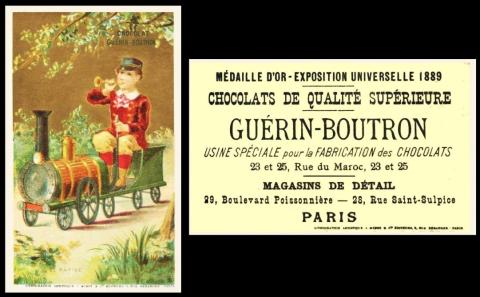
Here we have an extraordinarily grand model train, large enough for a child to ride, though it is possible it only existed in the mind of the artist, simply because this card carries a date of 1889, when Guerin-Boutron won a gold medal at the Universal Exposition in Paris - and it is recorded that the first toy trains were only retailed by Marklin, of Germany, in the early 1890s.
However it is known that toy trains had been scratch-built from wood or metal from the moment that real trains were invented, and that rich families could have conceivably had a carpenter made such a train as exists on our card. And this child is undoubtedly from a rich family, rich enough to ride to hounds and maybe even own a pack of their own, for he is attired in a miniature version of proper hunting "pinks", and blowing a tiny huntsman`s horn, an outfit that would have been costly, and very much a one off, made to measure.
We also know that from the 1840s, miniature railways for adults were built on large private estates, by and for the wealthy.
As for our card, we presume it is one of a set but have no idea of what that set comprises. Maybe you have a similar card though, which could complement ours and give us some idea ? If so, do let us know. There is no set title, though on the path at the bottom of the picture it does say "Le Rapide", which is French for "the fast [one]". And, curiously the words "Le Rapide" have come to mean the fast train, in transportation terminology.
There is another train-related link to "Le Rapide" too, as much later, starting in the mid 1920s, for it was the name of a French toy train manufacturing company founded by a Swiss man called Louis Roussy. And it turns out he has a cartophilic link too, for a member of his family actually owned our old friends Nestle, Peter, Cailler and Kohler.
Louis Roussy began with clockwork trains and then bought a factory in the early 1930s and diversified into lead soldiers, small cars, aeroplanes, and ships, even a construction system which used long strips and shapes, bolted together by the user into whichever model they fancy (just like Frank Hornby`s "Meccano").
There was, also, another thrilling link to our card, for his original logo was a diagonal shape in which a small boy was depicted riding on top of a model train, with the words "Le Rapide" below, in white, within a red bar. The name was to prove prophetic, for in 1934 they advertised that they were selling "le train marchant le plus vite dans le monde des jouets" (or the fastest moving train in the toy world). But this was electric , and it also gained most of its speed because although it was still die-cast, it was of much lighter construction, being pretty much a one piece body shell, the wheels and the internal workings, which, being electric, were substantially smaller than those needed for clockwork, key-wound models.
They were definitely innovators, and they took out several patents, on things that became industry standard, including continually simplifying the coupling method that linked the engine to the carriages, and, most importantly, discovering a means to reverse the mechanism so the toy would go backwards, eventually independently of touch, simply, as on a real train, by activating a lever by the side of the track - and, later still, by means of remote control, which they called "tele-inversion".
They thrived until the beginning of the Second World War, and then production halted - materials for making toys was needed for the war effort, and finding the money to buy necessities, like food, was more important than buying toys. British bombers also destroyed their factory at Trappes, along with many of the moulds, and lots of stock.
After the war, they had an offer from a Monsieur Chauvel, who agreed to keep the name, and maybe that was the clincher.
But he sold it on in 1961, to a company called JEP which is sometimes recorded as having been founded in 1899 by Messrs. Roussel and Dufrien as "Le Jouets de Paris" (or The Toys of Paris), rather a forward thinking company who outsourced the production of its merchandise to home workers and small companies.
In fact this is incorrect, because in 1909 that company filed for bankruptcy. The confusion is easy to understand though, as the JEP which bought our company was also founded in 1899, and ran on similar lines, outsourcing to local metal workers, under the company name of S.I.F., which stood for "La Société Industrielle de Ferblanterie" (and that last word means the making of tin-plate). They slowly changed their name through the decades, and also halted production, during the First World War, when their factory and their workers skill with casting had seen it become one of the centres for production of steel helmets. In 1928 they had hit on using the now long retired "JEP", and, under that name, after a Second World War, they had also successfully moved over to producing plastic models for a completely new generation of children. Sadly, though, this did not last, and only two years after buying out Le Rapide they stopped making 'O' gauge models and equipment, with the `HO` gauge ceasing two years after that, deciding to move into making small parts for full sized cars and lorries.