
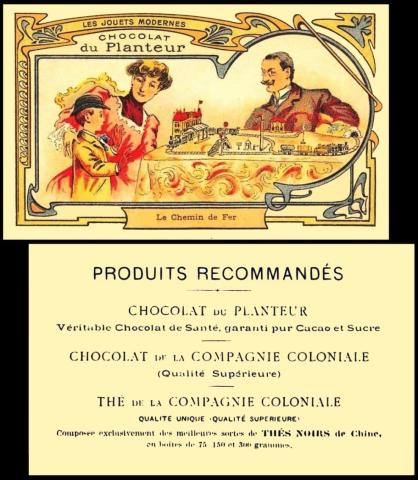
This is a typical railway layout, on a table top, the main benefit of which, at least to the model train-driver, is that it is always ready for action. However, you will often find them start out on the dining table and then be persuaded, in no mean terms, by the non model-train-drivers in the family, that it would be a much better idea to set it up in a spare bedroom, or the loft.
The idea of a train set was to encourage the skills of engineering the track into position and coupling the carriages together each time they were removed from the box. At first this was easy as the early tracks were all circular and the trains just went round and round. However in 1859 the Emperor Napoleon III built a railway in the grounds of Chateau de Sainte-Cloude, in Paris, for his three year old son. That used the same clockwork trains as other railways of the time but the track had an extra part which enabled one track to cross another, in a figure of eight, and that started the idea of making differently shaped railway layouts. It also meant that the user had to work out how to make the curves and straights but still fit them together at the end so that it was a continuous journey back to the start and round again, and that`s not as easy as it sounds.
Most model-train drivers start off with just the trains and the track, then they add. This is usually the result of going to a train fair or shop and seeing scenery (trees, hedges, mock grass), workings (signal arms, junctions, level crossings, bridges) or structures (a station, factories trackside, houses in the country, flats in the town).
Though you can run a very miniature layout in a box using the smallest scale of train, most model train-drivers soon outgrow it. Also that leaves little scope other than a continuous loop, which is really a backwards step, right backwards to when model train sets were first invented. Thinking "outside the box" brings in the main concepts of having more than one station, at which some trains stop and some pass by, branch lines, junctions, sidings, shunting yards and works.
If you find this all starting to what your appetite, then nip along to Hornby`s website, a page of which actually tells you everything you need to make a proper railway layout.
Returning to cards, the ones in this set are all very Art-Nouveau styled borders, but in differing colours, and the cards do have a tendency to browning. We have noticed that on most of them the set name is in a banner above the issuer`s name, but on some the set title are in diagonal boxes across the picture. We are not sure why but have noted this in the listing using (DB) However, they are still fascinating, and would be eagerly snapped up by a toy collector if they should come into contact with them.
So far we know of - a lot, so I will have to hold it here and come back later. The cards themselves are not numbered, but once I got over twenty I thought crikey, how many of these things are there. I now have sixty one, so it seems it may follow the normal practise of eighty four, but I now seem to be hitting all the same ones online and in catalogues and from European collector friends, so if you can add any, please do.
- L`Auto a Pedale et le Tricycle (pedal car and tricycle)
- L`Album d1Images (picture book)) - (DB)
- La Baignoire Enfants (doll`s bath) - (DB)
- Les Ballons Rouges (red balloons)
- Le Bateau a vapeur (steam yacht) - (DB)
- Le Bateau a Voiles [sailing yacht)
- Le Bebe Perfectionne (walking doll)
- La Bergerie (toy farmyard)
- La Boite a Musique (music box)
- La Boite de Couleurs {painting set)
- Le Canon de Bois (wooden cannon) - (DB)
- La Canon da Campagne (war cannon)
- La Charrette Anglaise (the English dog cart)
- La Chasse (toy huntsmen and hounds)
- Le Chemin de Fer (toy train) - (DB)
- Le Cheval (pull along horse)
- Cheval a Bascule et Cheval Mecanique (rocking horse and horse on wheels) - (DB)
- Le Cheval Jupon (horse costume with fake legs to side)
- Les Cheveaux de Courses (racehorse game) - (DB)
- La Chevre et la Mouton (goat and sheep) - (DB)
- Le Cirque (toy circus)
- Le Clairon et le cor de chasse (cornet and hunting horn) - (DB)
- La Construction et la Boite a Ouvrage (building bricks)
- La Crecelle (baby walker) - (DB)
- L`Epicerie (toy shop) - (DB)
- L`Escadre (ship models in a bowl)
- L`Etabli de Menuisier (carpenter`s workshop)
- La Ferme (toy farmyard)
- Le Fiacre et le Tramway Electrique (electric cab and tram) - (DB)
- La Folie, le Hochet (? and a baby`s rattle) - (DB)
- Le Fontaine et le Puits
- Le Fourneau (child`s cooking stove)
- Le Fort (toy fort and soldiers)
- Le Fusil et le Sabre d`Officier (guns and swords) - (DB)
- Les Jouets Parisiens (model figures) - (DB)
- La Lanterne Magique (magic lantern) - (DB)
- La Layette (doll`s clothes) - (DB)
- Le Menage (doll`s bedroom furniture)
- Le Metier a Tapisserie (tapestry on frame)
- La Panoplie (dressing up) - (DB)
- La Peche a la Ligne (indoor fishing, hook the [fake] fish) - (DB)
- Le Petit Piano (toy piano)
- La Polichinelle (puppet)
- Les Pompiers (toy Fire Brigade)
- Le Postillion (reins for one child to wear and one to drive) - (DB)
- Le Poupard (dolls) - (DB)
- La Poupee de Son (rag doll) - (DB)
- La Poupee Louis XV (a doll of the time of Louis XV)
- La Poupee Moyen Age (a doll of the Middle Ages)
- La Poupee Egyptienne (Ancient Egyptian doll) - (DB)
- Le Service de Table (tea set)
- Le Singe Grimpeur, Le Hanneton, le Canard, Le Toutou Sauteur (climbing monkey, cockchafer, duck, jumping dog) - (DB)
- Le Theatre (toy theatre) - (DB)
- Le Tir au Javelot (archery target) - (DB)
- Le Tir Eureka (shooting target) - (DB)
- Les Tombereaux (pull carts) - (DB)
- La Toupie a Musique et le Cab (musical spinning top, hansom cab)
- Le Toutou (dog on wheels)
- Le Tricycle a Petrole et Auto (ancient and modern model cars)
- Le Zootrope (zoetrope)
- La Voiture de la Poupee (doll`s pram) - (DB)
Now we also know there are other issuers of this set, because in the hunt we found :
- Au Paradis FLEURI
- Chocolat de L`UNION
- Chocolat LOUIT