
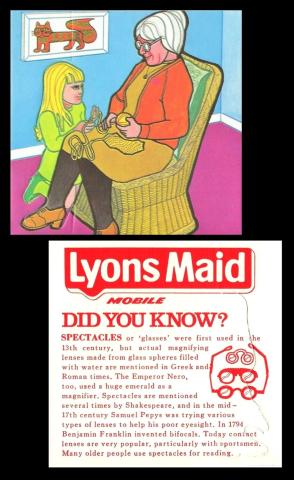
This is a great, and well researched card, telling us lots of fun truths about eye glasses, including the facts that :
- "magnifying lenses, made from glass spheres, were known to both the Greeks and Romans".
Roman philosopher Seneca the Younger is known to have favoured, and written of a glass sphere filled with water, held over text to make it larger. to magnify text and letters for easier reading. However it was simply to look through, it was not eyeglasses as such.
- "Nero used a giant emerald as a magnifier"
This only neglects to say that the emerald was polished. And we do not really know why he used it, because he was primarily seem with it at events in the Coliseum, so there is much debate as to whether he was making the action appear nearer, or just using the green to filter out the shine of the sun.
- "Shakespeare speaks of glasses in several of his plays"
These plays are "As You Like It", in which he mentions "spectacles on nose" ie without side-arms, in his famous "Seven Ages of Man" monologue - "Much Ado About Nothing" where Benedick speaks of still being young enough to "see without spectacles" - and "Coriolanus", when he speaks of a crowd looking at Coriolanus "with bleared sights, spectacled to see" . All of these are used to define old age, and they would simply have been magnifying glasses, to make things, and text, appear larger.
- "Samuel Pepys experimented with different lenses"
We still do not know much about Pepys` vision problems. They seem to stem from an incident when he was looking at a gun at close range, by which they probably mean a cannon, when it went off, and the flash injured his eye, or maybe even the gunpowder and spark. However, his sight was not aided by the fact that he wrote his diary in the evening, by candlelight, and we know his eyes were sensitive because one of his chief complaints is that they watered under strain. At first he resorted to the Roman and Greek method, a globe of glass, and he also tried using a pair of spectacles with tinted green lenses, which brings us back to Nero and his emerald. In 1668 he tried paper tubes, which concentrated the vision and eliminated the glare from outside, and this seems to have been his favoured method, though he was soon forced to abandon the writing of his diary. He did return to the tubes again, and added all manner of lenses inside them, colours and shapes, but nothing seemed to work, though even he noted that after times when he was forced to abandon all forms of trying to see, his eyes would slowly restore themselves.
- "Benjamin Franklin invented bifocals".
This is true, though many doubt it. He did it the hard way, getting hold of his glasses, removing the lenses and sawing them in half. This was to give him a top section for normal vision and a bottom section for a larger picture. He claimed that he did it so that he could lipread in French, and make sure they were not speaking ill of him or the rest of the government. The idea seems rather outlandish, and that is why it was probably discredited for so long. As for claims that they were already known of in Europe, and indeed in England, there is no evidence that any of those ever made their way to America, and it seems likely that all three were invented completely independently, though from the same desire, to fill a need.
It also has a picture of the development of the eyeglass, starting with the two magnifying glasses joined together, moving on to the ones with the clip to the nose, and finally to the invention of the arms, which at last kept the glasses on whilst you moved about.
This set does not appear in our original British Trade Index, or part two, it had to wait right until the third part, issued in the 1980s. And in there, it appears as :
- Did You Know ? 76 x 77. (12). See Db.455 ... LYO-62
The Db.455 takes us to the back of the book, where it is revealed that this is not the only version of this set. The entry actually reads :
- Db.455. DID YOU KNOW ?. Unnd. (12)
Lyons Set LYO-62, Mister Softee Set MJZ-13, Tonibell Set TNA-14
1. Belisha Beacons ...
2. Bicycles ...
3. Cameras ...
4. Clocks ...
5. Lighting ...
6. Money ...
7. Pens ...
8. Pillar Boxes ...
9. Spectacles ...
10. Telephones ...
11. Umbrellas ...
12. Zip Fasteners .
As for the Mister Softee version, we have already featured that, as a Card of the Day, on the 27th of March 2023.
The sticking point is the Tonibell version, for it is clearly shown as being this set of twelve cards in that original British Trade Index part two, yet all attempts to find it only seem to bring up another set entirely, which we speak of with the version by the Jersey Tobacco Company, as our Card of the Day for the 12th of May 2022, and that is entirely different to this square, cartoon format, set.