
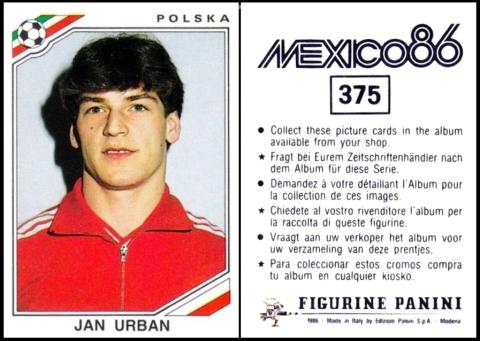
Jan Urban was born on the 14th of May, 1962, in Jaworzno, Poland. He was one of six children, born into a mining community, and he first played for the local team of Victoria Jaworzno, which is actually the oldest miner`s football club in the country, not withstanding the fact that it closed in 2011 - and that the new incarnation was only re-founded in 2014.
There is great confusion over Mr. Urban`s "rookie" card. Many collectors will tell you that it was Panini`s very hard to come by set of "Calciatori 1970-71", where he is shown with Riccardo Innocenti. This cannot be true though; firstly, because in 1971 our man was only nine years old - secondly, that he did not start with any team until the mining one, in 1980 - and thirdly, because though he did spend part of the 1990s as part of European teams, none were from Italy.
That seems to make our set his true "rookie" card, and it shows him at the 1986 World Cup, at which time he was playing for Gornik Zabrze S.A., and still in Poland. That was his second adult team, for he had previously been with Zaglebie Sosnowiec, between 1981 and 1985. In fact he had been on the Polish National team since 1985, and would stay with them until 1991.
In 1989 he moved to Spain, to join Club Atlético Osasuna, which is based in Pamplona. During this time he appeared on card 188 of Panini`s "Futbol Estrellas de la Liga", and card 198 of Mundicromo`s "Sport Futbol", though by the time this latter set hit the stores, in 1995, he had gone, though he was still in Spain, just playing with Real Valladolid Club de Futbol S.A.D., since 1994 This does not seem to have worked out though, and by the end of 1995 he was at yet another Spanish team, Club Deportivo Toledo S.A.D.
From there he went to Germany, to play for Verein fur Bewegungspiele e.V. Oldenburg. Yet again it was not long before he was moving on, but this time it seems to have been because he was offered a chance to play once more at Gornik Zabrze. And it was there that he ended his playing career, retiring in 1998.
Strangely, after his retirement, he went back to Spain, and rejoined Osasuna, but as the head coach at their youth training facility. He left in 2007, but only because his stint at Osasuna had led to an even better offer, to become head coach of a Polish team, Legia Warszawa. With him at the helm, the team won two major tournaments, the 2007-2008 Polish Cup and the 2008 Super Cup. He even became trainer and assistant to the Polish National team, then there was some kind of falling out, and he was sacked by Legia Warszawa in 2010.
Rather than this stopping his career, though, he had several offers from other Polish teams, which he accepted, and just a couple of years later he was welcomed back into the fold at Legia Warszawa. Then, in 2014, he returned to Osasuna but this did not end well; the team continued to lose and he seems to have been the scapegoat.
In fact he went back to Poland, and worked, on and off, for several teams, until 2025, when he got the call up to be manager of the Polish National team. And he is still their manager to this day.
As for our set, it is also known as "FIFA World Cup", though the album and packets firmly calls it "Mexico 86", albeit with a "World Cup" at the very bottom. There is no idea of how many stickers you got, or of the cost, on the packet, but we do know that the packets were twelve pence each.
According to the back cover of the album, they varied in price, depending on which country you were in - this suggests that the same album was sent to all the countries.
- Austria - five schillings
- Belgium 10 francs
- France - 3 francs
- Germany - 0.50 deutschmarks
- Greece - 20 drachmas
- Italy - 500 lira
- Morocco - 3 dirhams
- Netherlands - 75 cents
- Spain - 50 cents or 50 pesetas
- Sweden - 3.50 krone
- Turkey - 200 Turksh lira
- United Kingdom - 20p
There is also a box for Norway, but the price square section of that box is blank.
We also know that an album, and a packet of six stickers, was given away with every copy of "Shoot" magazine on the 24th of May, 1986. This makes those stickers technically cartophilic, but sadly it is impossible to tell which stickers they were.