
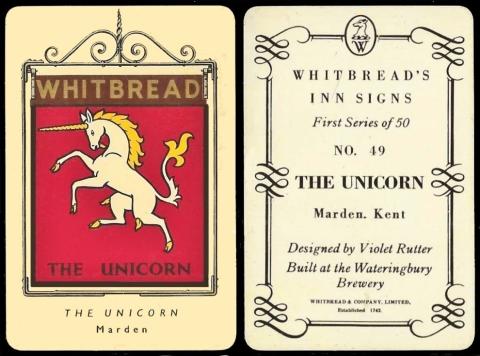
Here we have the mythical Unicorn, which strays a bit from the human subjects we have so far featured, but was offered me by reader Mr. Franks, and so I accepted, mainly because this was a first series card and it was going to be a Card of the Day, therefore a really great home page for the original five sets of this Whitbread issue. And its a unicorn, so I`m not turning one of those down - I even have unicorns on one of my bath towels... or is that T.M.I.....?
The Unicorn never really existed, and it is hard to imagine what could have been glimpsed and erroneously identified, for its horn is hugely long, much more so than a deer or rhinoceros, and it is, in addition, spirally twisted like a antelope, though totally in the wrong place. And we do not know how it came to be believed that it could only be approached and tamed by a truly virtuous maiden - which is the way it is generally depicted in art, and often with the Virgin Mary. However, the unicorn is neither male nor female, or possibly both, which in some way accounts for its acceptance as a symbol by the LGTBQIA+ community.
I am not totally convinced that its first representation in art comes from seals of the Indus Valley, about 2,000 B.C.for the body is all wrong, it is more like a bull, and the horn is curving, in the manner of a rope tying the poor creature whilst it awaits its fate. Though we do know that the Greeks believed the unicorn came from India, and even called it the one horned Indian ass. In fact Pliny calls it a monoceros, being the singular or the rhinoceros.
We do not know how it came to be the emblem, or at least one of the emblems, of Scotland - the other being the lion.
Not much is known about the Unicorn public house. It seems have at first been a private dwelling, and the first written reference to it being a public house was in 1861, when the publican was a Henry Mission, and it seems they also rented rooms. However the Mission family had been living there, on and off, since 1840. It seems to have then moved upmarket and become a public house and hotel, and in the 1880s it was on the coaching route, thanks to its location, right in the centre of Marden, and flanking the market place.
This page is now the home page for the first five series of Whitbread`s "Inn Signs", because this is from the first set of Whitbread "Inn Signs" to have been issued as proper cards - though they were not the first "cards" to be issued; those were black and white reproductions of inn signs, pretty much business cards, with the proprietor`s names on the reverse.
The cards of Series one were made of metal, and only of metal. There is a reason for this, for when the first and second set was produced, paper was still scarce, after the Second World War, but thin aluminium sheet was more readily available, and, it must be said, this material was almost certainly sold to Whitbread on the grounds that it looked and felt more like an actual inn sign.
The idea of the series began in 1949, when the Whitbread & Company Brewery, at Wateringbury, in Kent, thought it would be interesting to make collectable plaques of some of the signs which hung outside their public houses. The cards were given away, just handed over the counter when you bought a pint of beer. Now there are two schools of thought to that statement - the first has it that each card was only available at the inn where that sign hung, and to get the rest you had to travel to all the other public houses, and buy a beer - whilst other collectors say that the cards were left at each pub in bundles, and you just got the next one at random. The first becomes more likely when you realise that the inns are quite close together - the first ten being in Hastings and St. Leonards on Sea (in Sussex), cards eleven to fourteen from Rye, (also in Sussex), and cards fifteen to fifty from Kent.
The actual list of inn signs which make up Series one are as follows :
- THE G.I. Hastings
- WISHING TREE St. Leonards-on-Sea
- THE PRINCES Hastings
- THE FOUNTAIN Hastings
- OLD GOLDEN CROSS Hastings
- WARRIORS GATE St. Leonards-on-Sea
- BRITISH QUEEN St. Leonards-on-Sea
- DRIPPING SPRING St. Leonards-on-Sea
- MARINA INN St. Leonards-on-Sea
- NAGS HEAD St. Leonards-on-Sea
- WILLIAM THE CONQUEROR Rye Harbour
- QUEEN ADELAIDE Rye
- YPRES CASTLE Rye
- SHIP INN Winchelsea Beach
- BLACK HORSE Tenterden
- THE HARRIER Sandhurst
- OAK & IVY Hawkshurst
- KING WILLIAM IV Benenden
- THIS ANCIENT BORO` Tenterden
- ROYAL OAK Wrotham Heath
- THE STARTLED SAINT West Malling
- THE CRICKETERS Maidstone
- QUEEN`S HEAD Maidstone
- HARE & HOUNDS Maidstone
- BLACK LION Mereworth
- TORRINGTON ARMS Mereworth
- DUKE WITHOUT A HEAD Wateringbury
- NORTH POLE Wateringbury
- QUEEN`S HEAD Wateringbury
- KING`S HEAD Wateringbury
- THE PHOENIX Wateringbury
- THE HARROW Wateringbury
- THE TELEGRAPH Wateringbury
- RAILWAY HOTEL Nettlestead
- THE HOP POLE Nettlestead
- THE WOOLPACK Yalding
- TWO BREWERS Yalding
- TWO BREWERS Yalding (different to the above)
- CHESTNUT TREE Yalding
- THE HARP INN East Peckham
- THE MERRY BOYS East Peckham
- THE CHEQUERS Tudeley
- JOHN BRUNT V.C. Paddock Wood
- THE BULL Hunton
- KENT ARMS Fowl Hall
- PRINCE OF WALES Collier Street
- THE DUKE OF WELLINGTON Collier Street
- THE FOUNTAIN East Peckham
- THE UNICORN Marden
- THE RED LION Offham
In the second series, issued in 1950, which we speak of as our Card of the Day for the 1st of April 2025, they are again a mixture of inns in these two counties, Kent and Sussex. And in the third series, issued in 1951, one of which is our Card of the Day for the 17th of September 2024, they are solely from the county of Kent. The fourth series has not yet appeared on these pages, but the fifth has, just, for it was the Card of the Day only yesterday, on the 21st of January 2026.
Now it is often stated that this fifth was the end of that line - and that what came next was the so called "Special Issue of Four" which you can read about in our newsletter of the 12th of July 2025, though as it is a newsletter card you will have to scroll down to Monday, the 14th July. In any event, this is incorrect, as that "Special Issue of Four" was issued in 1951, and that means they push their way in between the Second and Third Series of the standard Inn Signs. The belief that these are later is also reinforced by our original British Trade Index part II, where all these seven sets are catalogued together, as :
INN SIGNS. Md. 76 x 51 ... WHI-1
- First Series. Nd. (50). On aluminium
- Second Series. Nd. (50). On aluminium
- Third Series. Nd. (50). On (a) aluminium (b) board
- Fourth Series. Nd. (50). On board
- Fifth Series. Nd. (50). On board
- Special issue of Four. Nd. (4). On board
- The Britannia Inn. Unnd. (1). On board
Note : Signs were also issued uncoloured by certain Inns on the backs of calling cards, as pin-ons, etc.
In our original British Trade Index part three, item 7 was updated, and a later edition of three cards issued in 1958 appeared. And it also expanded on the note at the end of the above listing - which are out of date order, for they came first, being designed as business cards, having the sign of the inn on the front and the proprietors details on the reverse. In fact a lot of collectors believe that it was the making of those that set the idea of making the coloured series off. That listing from British Trade Index three reads :
7. The Britannia Inn. Back (a) plain (b) printed, with reference to Brussels 1958 Exhibition.
8. Whitbread`s Inn Signs - 1958. On board. Series of 3.
1. Duke Without a Head
2. The Railway
3. The Startled Saint
9. Black and White reproductions, partly with proprietor`s names on reverse. 4 known.
1. Oak & Ivy - Hawkhurst
2. The Old Cock, Hildenborough
3. Spread Eagle, Chatham
4. Trafalgar Maid (back blank)
Section 9 is added to in our original British Trade Index part IV, with :
9. Black and White reproductions. Add :
5. Camden Hotel, Pembury
6. The Woolpack
This was the end of the line, for a while, but in 1973 the idea was restarted, with cards called "The History of Whitbread Inn Signs”. They will have a home page all their own, one day, but for the moment you can read about one of what would eventually become eleven sets with our Card of the Day for the 28th of November 2023
By the time of our updated British Trade Index, the five standard series, including our fifth, are listed as :
WHITBREAD & CO. Ltd.
Brewers. Issued 1950-1974. All 76 x 50. All issues are covered in this volume. The History and listing of numbered series is covered in full in the book "Collecting Whitbread Inn-Signs" by Cockell and Laming, 1996.
- WHITBREAD`S INN SIGNS. First Series. 1949. Nd. (50). On metal. ... WHI-150
- WHITBREAD`S INN SIGNS. Second Series. 1950. Nd. (50) On metal. ... WHI-160
- WHITBREAD`S INN SIGNS. Third Series. 1951-52. Nd. (50) On a) metal. b) card. A number of cards have been seen with square corners... WHI-170
- WHITBREAD`S INN SIGNS. Fourth Series. 1953. Nd. (50) 25 of this series are known with plain backs, Nos. 1, 4, 7, 8, 10, 12, 13, 15, 16, 19, 20, 24, 27, 28, 29, 31, 34, 35, 37, 38, 41, 43, 44, 46, 50. ... WHI-180
- WHITBREAD`S INN SIGNS. Fifth Series. 1955. Nd. (50) . ... WHI-190
That reference book about the signs was issued in 1996, and it is quite scarce. I am not sure whether the copy in our library is that or not though, as this is listed by another title, "Whitbread Inn-Signia". But I will find out.