
This week`s theme actually lasts all month, and its "No Mow May". This is a fairly recent initiative, run by Plantlife, and all they ask is that you keep your lawnmower in the shed or garage for this one month and allow the lawn its freedom. Technically that gives you your freedom as well, from mowing. However they also realise that this may be too much for some people, and so there is another way you can take part, simply by leaving a patch of lawn unmown, somewhere out of sight, behind a tree or hedge. This allows for wild flowers and weeds to spring up and nourish bees, butterflies and other insects, as well as birds. - and it also allows a habitat for birds and small mammals.
Not mowing your garden for one month will never replace all the meadows that have been lost to development of all kinds since the 1930s (some 97% of what we used to have in the British Isles) - but by joining forces, and making a long chain of gardens, with the help of your neighbours, we can do more than we imagine, especially if we decide that we will leave our new flower-filled grassland into June, or maybe even longer....
So why don`t more people agree to do this? Well it seems that they worry about the look of the garden, because they imagine that it will just turn into a green wilderness. In actual fact, it will not; it will release long hidden seeds all of its own accord, remnants from former gardens on that spot, plants blown in by the wind and brought in by them clinging to the scaly legs of little birds. And in less than a week some form of flowering plant will start to show its face amongst your newly un-mown lawn, starting with :

The Buttercup, which is one of the first plants to appear on an un-mown lawn, but be warned as its roots will spread right across your garden. It also has another problem for it grows along the surface, and can be hidden by other plants as they grow tall. But it is loved by butterflies, beetles and birds,
So Saturday the 2nd of May saw us start with this card, not just with a buttercup coloured background, but of Brentford Football Club, who marked their first season in the Premier League (2021-22) with a new away strip which was named to be in "buttercup yellow" - shirts, shorts, and socks - in the hope that the team would seldom, if ever, turn up to an away game and have to change to a third strip. In fact there are a few teams with a yellow strip, including Norwich and Watford, and only this year Southampton played in one in the FA Cup semi final against Manchester City - celebrating and commemorating the F.A. Cup final of 1976, fifty years ago, when they beat another Manchester side, United.
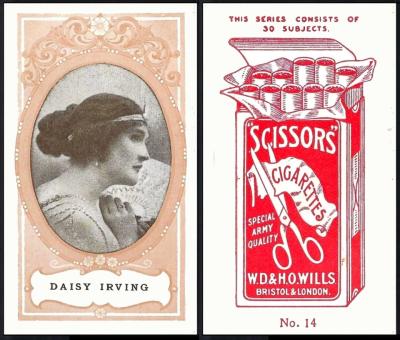
The Daisy will come along pretty soon, but you won`t get flowers in the first year, only leaves, which you will start to see within ten days after pressing the seeds into the soil. We call it the simple daisy, but it is anything but, for what you think of as a single yellow flower in the centre are hundreds of small pollen carriers, each a magnet for bees, butterflies, and beetles. And when they go to seed the birds will feast on them.
So on Sunday the 3rd of May we had Daisy Irving, shown here with a long feathered headdress that seems to come from her most famous role, as Angele Didier in the operetta "The Count of Luxembourg" - in in which she appears on many postcards. There is a problem though, because when the original London production opened, at Daly`s Theatre, in 1911, it starred Lily Elsie.

Clovers give you lovely ground cover, not to speak of all the hours of "pleasure" you will spend in trying to find one with four leaves. They also have white or pink flowers, which are most attractive.
Our card for Monday the 4th of April, marks the first appearance of Clover Dairies on our site - though I may add some more as I work back through the newsletters. Now there is something about the clover that I only just realised, and that is that in a set of playing cards, we have a suit called clubs, but in France they call that suit trefles, or trefoils/three leaved clovers. And to be honest it looks much more like a clover than a club, so does anyone know how we came to call them clubs and not clovers?
On which note, if anyone else would like to send us any information or scans from their collection which relates in any way to our theme of the week, please do - simply email us at webmaster@card-world.co.uk - and this is the same for any corrections, or for general cartophilic correspondence and chat.