
Hey, thanks for dropping by, and we hope you enjoy what we have found for you this week as we move ever further into February.
Lets start with a spot of musical fun, as today is World Ukulele Day. The ukulele looks a bit like a small guitar, but it is technically a member of the lute family, and it comes from Portugal. You will often find it is credited to be a Hawaiian instrument, and it did become very popular there, but it was not born there, it was brought over by three Portuguese cabinet makers who started to entertain the locals as a way of ingratiating themselves and then were presumably asked to make instruments for those they entertained. However the word “ukulele” is Hawaiian, it means “the jumping flea” and that was the nickname of a rather twitchy gentleman at the court of King Kalakaua, amongst whose many talents was being good at playing that instrument.
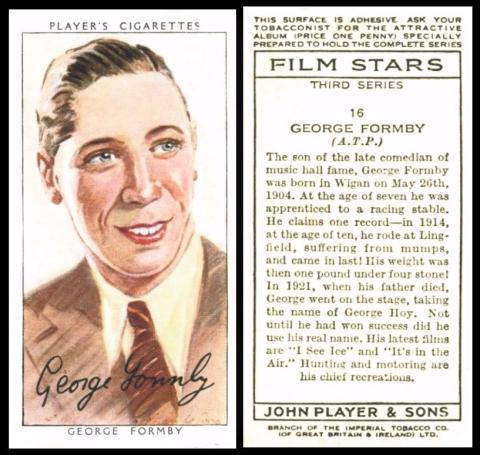
Alas I cannot find a ukulele on any card, but I can find the man most associated with the ukulele today, and that is George Formby, otherwise known as “The Ukulele Man”, although his was not the traditional mini guitar shape but the banjo variety. In fact he had a predecessor, Cliff Edwards, who was known as Ukulele Ike, and often billed as “The Hottest Man in Town”, presumably for the speed of his fingers, as he is decidedly un-hot looking to my eyes, though it is definitely true that beauty, and handsomeness, is very much a personal pleasure which cannot always be explained in a logical manner.
What George Formby added to the ukulele was spice, and his songs were just loaded with it, so much so that “When I'm Cleaning Windows” and “With My Little Stick Of Blackpool Rock” were banned by the BBC in the late 1930s for being too risque.
An artist`s impression of George Formby can be found in John Player Film Stars third series 16/50. This tells us he was “The son of the late comedian of music hall fame… was born in Wigan on May 26th, 1904 [and] at the age of seven was apprenticed to a racing stable. He claims one record – in 1914, at the age of ten, he rode at Lingfield, suffering from mumps, and came in last! His weight was then one pound under four stone.” And this still makes him the youngest ever professional jockey. It’s not very in focus but you can see this feat immortalised on the Daily Mirror
You can also find him on A & M Wix “Max Cigarettes” branded “Cinema Cavalcade” 175/250
And look out for a modern set by Prism Leisure, issued in 1993, which starts with his music hall father, George Formby, and tells us that was not his real name, that the then “James Booth” changed his name after seeing the name Formby on the side of a railway carriage. It is a really well crafted set, so good that it is often sold as single cards on internet auctions. But you can see all of the cards at the George Formby website and click on each picture to show it in a larger size. And there is another website well worth a visit, which is Walter Greenwood`s

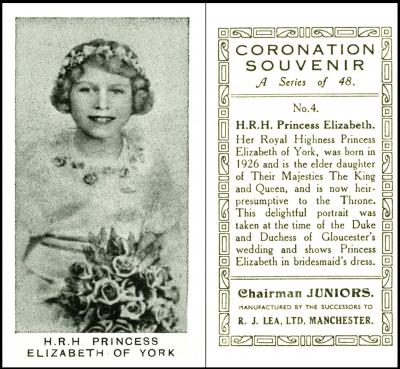
R. & J. Lea [tobacco : UK - Manchester] "Coronation Souvenir" (1937) 4/48
Today in 1952 Queen Elizabeth II succeeded her father King George VI to the British throne. In this she became not only Queen of the United Kingdom but what used to be known as the Commonwealth; Canada, Australia and New Zealand, plus many smaller areas. However the actual Coronation did not take place for over a year, to allow for mourning; it eventually took place on the 2nd of June 1953. When her father died she had been on a tour with her husband, Prince Philip, the Duke of Edinburgh. They had left England at the end of January and at the time the news came in they were in Kenya, at Treetops Lodge, a structure built into the tree canopy.
Her first appearance on cards seems to have been in 1935, in W.D. & H.O. Wills "The Reign of King George V" as card 36/50, which also shows her sister Princess Margaret. The pair also appear on Wills "Our King and Queen" (1937) 4/50 and 50/50. I wonder if she really ever imagined how their lives would turn out.
This year she will become the first British Monarch to ever have been on the throne for seventy years. To mark this, there will be no May Bank Holiday Weekend, instead it will be moved to June, when both Thursday 2 June and Friday 3 June will make a four-day weekend. So mark that in your diary now.
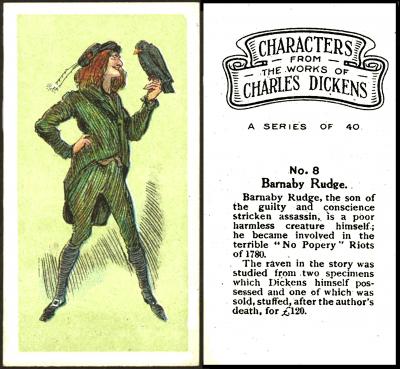
Anonymous - British American Tobacco [tobacco : O/S] "Characters from the Works of Charles Dickens" (1919) 8/40
Today is Charles Dickens Day, because it is his birthday. So lets have a look at a few cards which are a lot less visible than the more usually featured Players “Characters from Dickens”.
Our curious, but attractive, set has the characters on light green backgrounds, this is fairly hard to come by, for it was issued anonymously – but actually it was from the stable of British American Tobacco - ZB-15 Characters from the works of Charles Dickens : a series of 40.
Some say that the oldest card of him is Taddy`s “Autographs” series 1, issued in 1912, where he is number 9. It has a descriptive back which tells us he was “Born 1812, died 1870. One of the most popular novelists of the world He began life as a clerk and newspaper reporter : later he became editor of the “Daily News” and “Household Words”. His works include “Pickwick Papers”, “Oliver Twist” “David Copperfield” and many others”.
He also appeared in John Player “Authors and Poets” and that was issued in 1900, as card 17 of 20. It has a quote to the reverse, as do all the cards, this one is “Ah, if I had only brought a cigar with me, I think I could have established my identity.” I have not been able to find which book this comes from – anyone out there know?
And R & J Hill Ltd issued “Historic Places from Dickens Classics” a series of 50, which is all places associated with the writer, some are homes and places to do with him personally, whilst others are places that formed ideas for locations for his novels, all but card one which is a portrait of the great man himself. You can see all of those at The Charles Dickens Page And you can click on each card to see it larger.
Today is National Kite Flying Day. Kites are great, and all you need is a hill, and a strong wind, plus plenty of enthusiasm. It is miraculous how the simple pieces of cloth and wood soar into the breeze. It is also a good introduction into the history of flight, but more about that later. The first kites came from China, and one was brought back to Europe, as a souvenir, by Marco Polo. The Chinese used them in celebration but they were soon used for scientific experiments. In 1752, Benjamin Franklin sent one up in a thunderstorm; this is shown on Brooke Bond “Inventors and Inventions” 15/50, where it tells us that the intention was to produce a spark and show the electrical nature of the storm. It also tells us that whilst his experiment worked, others were electrocuted in the attempt. Later on, when the World went to War, kites were often used for targets for gunnery training, and you can see that on W.D. & H.O. Wills “Life in the Royal Navy” 18/50.
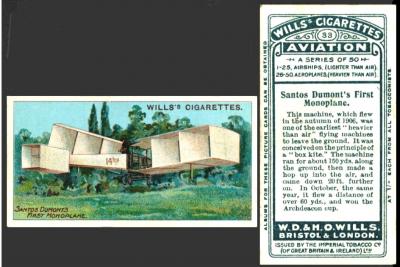
These are simple kites, but a nod must be given to another style of kite, the box kite, which has a rigid “box” shape construction. These were invented in 1893 by Lawrence Hargrave, an Englishman who had moved to Australia. A multiple of his kite, several strapped together, rose to a height of sixteen feet, and was soon attracting the attention of none less than Samuel Cody. It also attracted other attention, and few of us cannot see the link between the box kite and early aircraft, a fact which is reinforced by the nickname for these early machines, “kites”
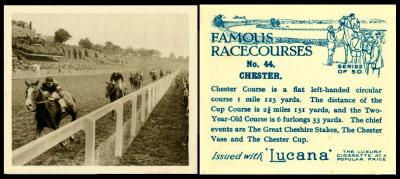
In 1540 the first race meet in England is supposed to have taken place. This was at Roodee Fields, in Chester. There is some support for this, as Chester Racecourse is still known as the Roodee, or Roody. and it is recognised by the Guinness World Records as the oldest racecourse still in operation, though there is a bit of doubt as to whether this date is correct – 1511 is thought to be when the first race was run. Another point in its favour is that the races were run on simply an open field, and Chester is the shortest racecourse on the calendar at just over a mile, which would point to it just being a field. In fact it was very much an open field until a grandstand was constructed in 1817, before then, as now, spectators would gather on the Chester City walls and simply watch for free. There is very little recorded about the early races, but in medieval times the prize was a set of bells for the horse`s bridle.
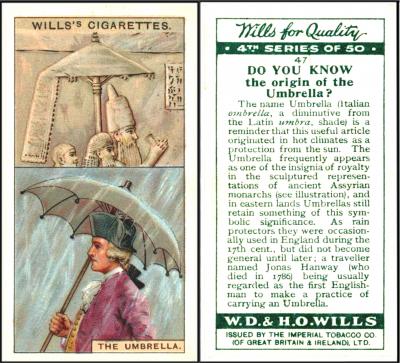
National Umbrella Day. So “Do You Know” the origin of the umbrella? W.D. & H.O. Wills tells us that it is an Italian word, umbra being Latin for shade. However it was not Italian in origin for they appear in Assyrian tomb carvings, where they are used as a symbol of royalty. It says that “in Eastern lands Umbrellas still retain some of this symbolic significance.” The card also tells us that they were first used in England in the 17 Century, but the first person who carried one regularly, and popularised them, was a traveller called Jonas Hanway. Now we assume that he is shown on the front of the card, for he has the same hairstyle. However it does not mention the fact that he founded the Marine Society which trained poor and neglected boys to serve in the Royal Navy, provided them with changes of clothing whilst at sea, and according to a tablet in Westminster Abbey he was also a benefactor to infants, and to women and girls who were, or would otherwise have ended up, making their living on the streets. The one thing I have not been able to find out is how he came to carry the umbrella. But one day I will.
The alternative to the umbrella is the parasol, which appears on some oriental cards and on the most charming set by Allen and Ginter, entitled “Parasol Drill”. This was issued in 1888, and the fifty cards show pretty girls with parasols – but they also refer to terms used for drilling in the military, so “In Review” shows a beauty gazing through a telescope. You can see these at http://www.codex99.com/design/parasol-drill.html
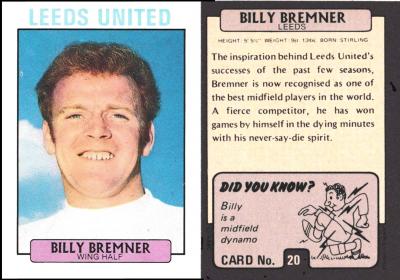
For National White Shirt Day we are returning to football here and celebrating Leeds United who played in an all white strip from 1961 to 1964, this was totally white! Not sure how the grass stains ever lifted, but the laundry staff are to be applauded. From 1964 to 1971 the strip was basically the same but they had a blue or yellow logo added to their chest, with the exception of one match, this being in August 1967 against Dynamo Zagreb, where they wore blue and orange banded socks. From 1972 until 1976 they also added blue flashes to their socks. It remains basically white to this day
A white shirt is supposed to show class, this comes simply because it was easier for a rich person to either buy a new shirt more often or to have the staff to keep it clean, someone who worked hard for a living in the grime of the everyday would find this harder, so they would often wear a lighter bluer shirt that showed less wear. In fact this is the origin of “white collar” and “blue collar” workers. A white shirt is also supposed to denote coolness, though I remain unconvinced, for clothing is just a cover, it is what is underneath that truly counts.
This week's Cards of the Day...
Saturday, 29th January 2022
![P644-204 : P/98 [tobacco : UK] Player " Football Caricatures by Mac" (September 1927) 25/50](/sites/default/files/styles/content_aligned/public/2022-01/29%20Mac%20Bob.jpg?itok=5WjgamQS)
standing for the “Bob Sleigh” (or sled), a popular Winter Olympic sport which has actually been included since the first ever event in 1924 ; yes, I agree, it was rather clutching at straws, but if anyone out there knows a footballer with some connection to the Winter Olympics, please do email us at webmaster@card-world.co.uk
The bobsled is featured in our Winter Olympics coverage above.
Sunday, 30th January 2022
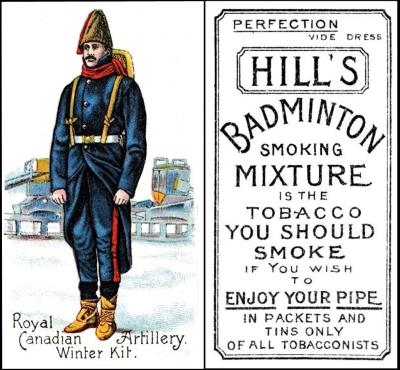
and the clues here were that the outfit was for the Royal CANADIAN Artillery WINTER Kit, for "Canadian" contestants have taken part in every "Winter" Olympics. And always won at least one medal. In 2018 they amassed twenty-nine of them, and in 2010 they won fourteen golds, setting a new record for the most golds won by a single country at a single event.
Monday, 31st January 2022
![D920-710 [tobacco : UK] J. Duncan & Co. Ltd “The Evolution of the Steamship” (1925) Un/50](/sites/default/files/styles/content_aligned/public/2022-01/31%20duncan.jpg?itok=35jjaE2_)
- and the steamship shown was S.S. OLYMPIC, the head of the fleet of the White Star Line's trio of Olympic-class liners, and the longest lived of them all. As well as being Titanic`s sister. Though actually she was not S.S. Olympic at all, she was R.M.S. Olympic..... a rather curious error that will be investigated !
Duncan were based in Glasgow.
Tuesday, 1st February 2022
![P246-525 [tobacco : UK] Pattrieouex "Celebrities in Sport" (1930) 25/50](/sites/default/files/styles/content_aligned/public/2022-02/1%20%20speed%20skating.jpg?itok=32braUbr)
Another detective story, and a bit of an insight into how I work.
Here we have “Skating”, and the man in the circle is named as J. Ferguson Pye. To make life easier for me, I will insert the whole text, which says he “Has been the British Champion (International Style) for the last six years. Won the Northern Cup (Manchester) three years in succession and then retired. Has held the British Championship with Miss E. Mackelt last six years for pair skating, and won Senior International at Vienna, 1924. He is competing in Olympic Games at St. Moritz, 1928, and for World Championship at Berlin, 1928.”
Now the first problem is that this card was chosen for our “Card of the Day” because of the image, which shows speed skating, and the 500 metres speed skating was the first event at the first “Winter Olympics”, held in Chamonix, France, on the 26th of January, 1924. It also saw the first ever golden medal given to the American Speed Skater, Charles Jewtraw. However the text has nothing at all to do with speed skating, it is all about ice skating, totally different, for ice skating is all about grace and less about power.
I used to ice skate, by the way, just another snippet for you all.
Now in case you are wondering why I said “Winter Olympics” in inverted commas, it was because that title was not given to these games until 1926; at the time these were taking place they were simply considered a Winter Sports Week.
Anyway, so the first thing I do is put the name into my search engine to find Mr J. Ferguson Pye, and to see if he moonlighted as a speed skater, and nothing at all comes up. Seriously nothing. It is like Mr. J. Ferguson Pye, and all of his skating records have been abducted by aliens.
So then I look at the Northern Cup. This mentions a Mancunian skater Sydney Wallwork, who won it in 1913, and 1914, and in that year he also won the inaugural pairs competition, with Ethel Muckelt, with whom he also won a pairs contest in Edinburgh that qualified them for the 1920 Antwerp Olympics.
Now this could be E. Mackelt, off our card, so I start looking for her as Mackelt and Muckelt, and it turns out that Pattrieouex got it wrong – Ethel Muckelt it was, she was also from Manchester, and I found out that after she appeared at Antwerp she left the steady arms of Sydney Wallwork, and took up with a younger man, Jack Page, with whom she won every pairs title up to 1931, took silver at the 1924 World Championships and was just off the podium at the 1924 Olympic Games. She was also second in the British Championships in 1926, beaten by Jack Page, because gender was ignored, men and women competed against each other.
That was all pretty exciting but J. Ferguson Pye is still awol….
Then a breakthrough, Friday morning, when I start working through Olympic records and come across something very unusual, because in one of them it says her partner was Jack F. Page.
So the hunt is on again, and I finally tracked down John Ferguson Page, born on the 27th of March, 1900, a British skater, individual and pairs “figure” skating, (never speed). It turns out that, like many famous Johns, he preferred to be called Jack. He was also born in Manchester (and died there in 1947). And he still holds the national record with eleven individual titles at British Championships. I also found out that he died by his own hand, gassing himself in his office. There are quite a lot of Olympians who committed suicide, we should be seriously shocked at how many.
The big question remains, how did Pattrieouex come to call him “Pye”? All I can think of is that the top to the “g” was missing and the typist thought “Paye” must be wrong, so extracted the “a”.
And it seems extraordinary that I can find no trace of anybody picking this one up before, for the card has been in existence almost a hundred years. And I cannot find him on any other card. Unless you know differently, and can supply us with the details. ....?
Wednesday, 2nd February 2022
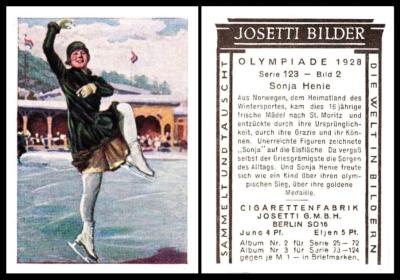
Here we have the world famous Norwegian figure skater Sonja Henie. She came from Norway, and her first Olympics was on the same rink as John Ferguson Page, in 1924. She was just eleven years old, the reigning Norwegian Champion, and she came plumb last. However in her next three Olympics she won gold (1928: St. Moritz, Switzerland - 1932: Lake Placid, New York - 1936: Garmisch Partenkirchen, Germany)
She was featured on many cigarette cards, especially in Europe, where she features quite heavily in a set called “Bulgaria-Sport-Photos” by Bulgaria Zigarettenfabrik of Dresden. And one of those cards has a link to more modern times as the photo on card 193/272 was also used by Brooke Bond as card 38/50 in “Olympic Greats”.
She also appears leaping above the ice on Pattrieouex “Sporting Events and Stars”, where it calls her “The undisputed holder of the World`s Figure Skating Championship, which she wrested from Frau Jaros Szabo at Oslo in 1927…” and on African Tobacco World of Sport #63 (1939)
What you may not know is that she also had another career, as a film star. Carreras Ltd shows us this in their set “Film & Stage Beauties” (1939) where she is card 18/54; at that time she was under contract to Twentieth Century Fox. Probably her best film is “Sun Valley Serenade”, (1941), where she appeared with Glenn Miller, just three years before his untimely death.
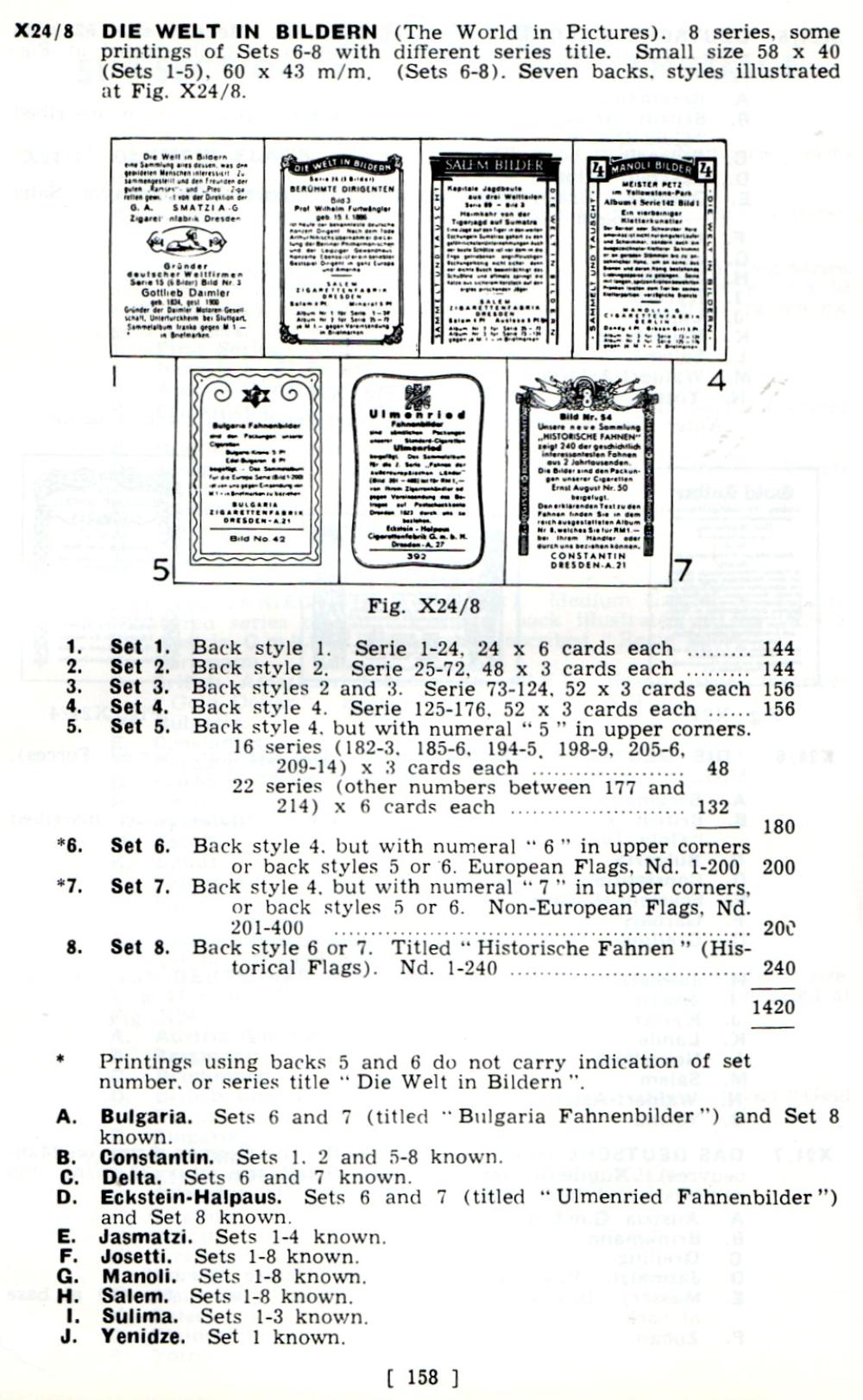
In our original World Tobacco Issues Index this group appears as :
DIE WELT IM BILDERN (The World in Pictures). Nd. See X24-8.F
1. Sets 1-5. Size 58 x 40
1. Serie 1-24. (144)
2. Serie 25-72. (144)
3. Serie 73-124. (156)
4. Serie 125-176. (156)
5. Serie 177-214. (180)
2. Sets 6-8. Size 60 x 43
6. European Flags. Nd. 1/200. (200)
7. Non-European Flags. Nd. 201-400. (200)
8. Titled “Historische Fahnen” (Historical Flags). Nd. 1/240. (240)
Now the “X” code, which is the only thing missing from our updated volume of the World Tobacco Issues Index, is a pointer to the handbook, which was originally a separate book to the World Tobacco Issues Index but then became combined. That lists all nine other issuers of this set, the parts they issued, and it also shows the back variations, so it is scanned below!
As we have featured one of these issuers before, we will also add in a link list -
- A. Bulgaria.
- B. Constantin
- C. Delta
- D. Eckstein-Halpaus
- E. Jasmatzi (newsletter 2023-09-02 - but first up, Sat.2nd Dec.2023)
- F. Josetti
- G. Manoli
- H. Salem (newsletter 2024-08-17 - on Saturday 17th August 2024)
- I. Sulima
- J. Yenidze
Thursday, 3rd February 2022
![D800-600 [tobacco : UK] Major Drapkin "Limericks" (June 1929) 2/50](/sites/default/files/styles/content_aligned/public/2022-02/03%20ski.jpg?itok=18mo5WWu)
We move on now to the 1948 Games, the first after the War, and where Alpine skiing is considered to have made its Olympic debut, even though there was actually skiing at the 1936 Olympics. The event saw Henri Oreiller of France winning one of each medals, gold, silver and bronze, making him the only three time winner at those games.
Two variants are available, the card stock that it is printed on is either white or cream. This set was also issued by Nicolas Sarony as "Saronicks" (S111-580) in the same month, June 1929 and that also has two variants, but in this case it is the dimensions of the card, as it can be found in the standard or medium sizes
Friday, 4th February 2022
![T045-500 [tobacco : UK] James Taddy & Co "Sports & Pastimes" (1912) Un/25](/sites/default/files/styles/content_aligned/public/2022-02/4%20toboggan.jpg?itok=CdlbgERa)
Tobogganing, showing here, is really the basis for bobsled, which has been a Winter Olympic Sport since 1924 – with the exception of 1960, in California, when the organisers decided it was too expensive to build a track - and both of these sports were the forerunners of the Luge, which was introduced in 1964.
It also gives me a chance to celebrate the Jamaican bobsled from 1998, because in all things I cheer wildly for those who have little in the way of help and everything in the way of obstacles, and come and do it anyway. And if you never saw it, the Jamaican team were the inspiration for the feel good movie "Cool Runnings."
Likewise, I have to give a cheer for Eddie "The Eagle" Edwards; he was also the subject of a movie “Eddie the Eagle (2016)”, and to find out what he is doing now, head over to grunge
This set is quite fascinating, and not just because it says "Series 1" without ever having been provided with a follow up. However you would not know how fascinating it is by simply looking at the listing in our World Tobacco Issues Index, which reads just :
SPORTS AND PASTIMES. Sm. Nd. (25) See H.225 ... T6-27.
It is that "H" number which tells of the full story, and as we have not featured the set before, this becomes the main page to which all the spurs will return. And from where you can in turn click and see the other versions.
Now H.225 reads as follows - though the dates and additional info within the square brackets has been added by me :
H.225. SPORTS AND PASTIMES SERIES 1 (titled series). Fronts in colour. Numbered series of 25.
Pre-1919.
- Anonymous - Plain backs - [actually issued by Teofani in 1924]
- Hudden [& Co. Ltd. of Bristol - 1926 - shown in the newsletter on Thursday 23rd of January]
- Redford [& Co. of London - 1906 - first ever version]
- Taddy [& Co. of London - 1912]
Post 1920.
- T.H. Collins [of Mansfield - 1923]
- Goodbody [T. P. & R. Goodbody, Dublin & London - 1925]
- Miranda Ltd [London - 1925]
Overseas :
- Anonymous - Teofani - inscribed "Smoke these cigarettes always [1924]
- Bucktrout [& Co. Ltd, Guernsey, Channel Islands - 1926]
- Sandorides - "Big Gun" Cigarettes [W. Sandorides & Co. Ltd, London - 1924]
Trade :
- James Almond & Sons [of Manchester - bread - 1925]
- Edmondson [Jonathan Edmondson & Co. Ltd of Liverpool - confectionery - 1916 - titled "Sports and Pastimes Series"]
- Evershed [& Son Ltd of Brighton - with "Dolphin" brand soap - 1914 - also titled "Sports and Pastimes Series"]
- Sword & Co [W. Sword & Co. of Coatbridge - Abernethy biscuits - 1926 - also as "Sports and Pastimes series"]
And that is all for now, but we have a bit of audience participation for you to take part in as on the 16th of February East Kent branch was founded. So lets see what we can all remember about them by then!
Have a great week, and stay safe out there so I can see you all next week