
Another week in which several problems not of my making halted production of this newsletter for way too long, but I guess I am made of strong stuff, and persevered - even if the bulk of it was completely empty until Friday afternoon.....
By the way, I am typing this on Hallowe`en, with my candles flickering away, and some very strange music encouraging me ever onwards - and I hope you will take advantage of a little trip down to our ever growing blog celebrating the festival as seen on cards.
And now, let us welcome our cast of characters, who saved me from the blankness....
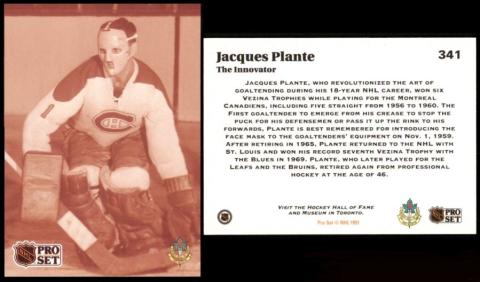
Pro Set [trade/commercial : cards : O/S - Dallas, Texas] "Les Cartes des Pros du Hockey" (1991) 341/615
Today in 1959 saw the first use of a face mask in ice hockey, by Joseph Jacques Omer Plante, goalkeeper for the Montreal Canadiens.
He was born on January the 17th, 1929, on a farm in Quebec, the first child, though he would go on to have ten siblings. It is said that he was playing hockey at the age of three, but that seems doubtful, but when he was five he fell from a ladder and landed awkwardly, breaking his hand, and it did not heal properly, in fact he only had it mended as an adult. That made it hard for him to hold a hockey stick, and led to him playing in goal, where no stick was required.
We know he first played on a proper team when he was twelve, and that by the time he was fifteen he was playing on five teams. He was first paid when he was not much older - fifty cents a game. Later on he was offered the sum of eighty dollars a week, by three teams, but his parents wanted him to stay in school, and he graduated with honours in 1947. However, the only job he could find was a clerk, which he took whllst waiting for better things. And they came within the month, an offer from the Quebec Citadelles hockey team, for eighty-five dollars a week.
At this point we must speak of his "Rookie" card. This is always said to be one of the "Bee Hive" hockey photos, over a thousand of them, which were issued in three groups through golden syrup for twenty years, starting in 1934 and ending in 1968. However you will often see it being sold as dating from 1934, and that is way too early for our man, who did not begin to play with the Quebec Citadelles until 1947 - plus, the uniform on the card is not theirs, it is for his next team, the Montreal Canadiens, whom he may have joined in 1949, but for whom he did not start to play until 1953, after their standard goaltender fractured his jaw.
Maybe because of this, Mr. Plante seems to have been very safety conscious, and he had been working on making the perfect protective mask for some time. There was already a mask available, made of plastic, but it was not popular, mainly because the efforts involved in sport caused sweat and steam to fog the mask. One of Mr. Plante`s first attempts at improving it was to cut a hole in the mask for the eyes, but also to release the steam that comes up the side of the nose. However he still had not made it work when, in April 1958, he was hit square in the forehead by a fast travelling puck.
Coincidentally a salesman for Fibreglass Canada was at the game, and watched the events, and probably sat with nothing to do but think, during the forty-five minutes that the game was delayed whilst Mr. Plante was removed from the rink and worked on behind the scenes. He came up with the idea of making a mask out of fibreglass, it would only take a mould of the wearer`s face, and for them to have the patience and the bravery to sit whilst it was applied, and wait whilst it dried. The very next day he wrote to Mr. Plante and outlined his idea, but there was no reply, not for a long time. Maybe he was thinking too, or maybe he was trying not to think about hockey at all, but suddenly he got in touch and said yes.
His face was moulded in late 1959, under medical supervision at the Montreal General Hospital. He wore a nylon stocking first, then gypsum was applied on top. That made the mould for the actual mask, which was made from strips of fibreglass and polyester resin.
The team coach was not as keen, he thought it would make him less able to see, and so he would not let him wear a mask in a game, though he wore it all the time in practise. But in November 1959 Mr. Plante had another incident, he was hit in the nose and mouth. And when he came back on the rink after treatment he was wearing the mask.
He was actually advised by the doctor that he ought not to play for several games, but the team had no other goalkeeper, and so a compromise was reached, our man agreed to play if he wore the mask. until his face was healed. And so he played. However he played on in the mask a while after that, and when he did agree to take it off, the team`s sudden run of luck came to an abrupt end - so the mask stayed on thenceforth.
Now we must say that he was not the first goalkeeper to wear a face mask, that honour goes to Clint Benedict of the Montreal Maroons, in 1930, who wore a leather mask to protect his broken nose, but our man popularised it.
He retired in 1965, but was tempted back three years later by the St Louis Bruins. He stayed there for two years and then was actually traded off to the Toronto Maple Leafs, followed, three years after that, by a spell with the Boston Bruins. Shortly after that came a change, for he joined the World Hockey Association as manager and coach of the Quebec Nordiques, but it seems he found that tiresome, he wanted to be back on the ice, and in 1974, when he was forty-five years old, he turns up doing just that, as goal keeper for the Edmonton Oilers. However he seems to have found that harder than he imagined, and he retired in 1975, after which he moved to Switzerland with his second wife. And he died there, on February the 27th, 1986, just after being diagnosed with stomach cancer. He is buried in Switzerland too.
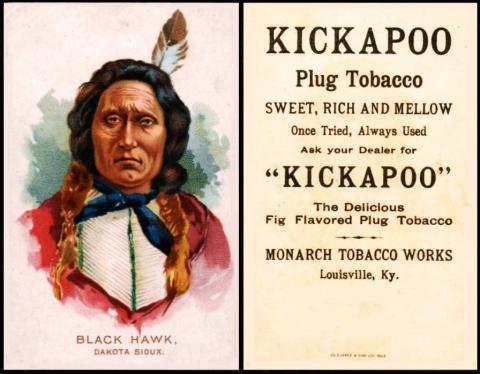
MONARCH Tobacco Works [tobacco : O/S - Louisville, Kentucky., U.S.A] "American Indian Chiefs" (1890) Unnd/4 - M126-1 : X2/570 : USA/570
Today, in 1889, North Dakota and South Dakota were both admitted to the Union.
Before that, at least from March the second, 1861, they were joined together, as the Territory of Dakota - and before that they were the northern part of the land which was acquired from the French in 1803, and the southern part of which was pretty much ceded to the Hudsons Bay Trading Company. However the name Dakota harks back to the original inhabitants, the Dakota branch of the great Sioux tribe, whose stewardship of the lands was ended in 1858, when Missouri became a state, and the Native American lands were taken by the government, without recompense, and probably without a lot of thought.
Therefore we chose to celebrate these original inhabitants, rather than the state which rose on their dreams - and here we have Black Hawk, born in about 1767, and earning his right to be chief by his courage in war and his loyalty to his men.
In 1812, and in 1832, he fought with the British in the hope of moving settlers away from the tribal lands, which ended badly in one way, for he was captured by the Americans and paraded as a trophy - though during his custody two interesting things happened. The first was that all the captives posed for portraits, and the second was that he was invited to tell the story of his life to a government interpreter, who had it published as a book in 1833, as "The Autobiography of Ma-Ka-Tai-Me-She-Kia-Kiak, or Black Hawk, Embracing the Traditions of his Nation" - now it may have been slightly embellished by Black Hawk, and the interpreter, but it remains one of the very few actual and contemporary accounts of Native ways of life and beliefs, and it was the first of them all.
On his release, he went to Iowa and lived with his people, they included him in meetings, but he seems to have lost a lot of his influence, and he was also frequently usurped by his great rival, Keokuk.
He died on October 3, 1838, after a short illness, and was buried without ceremony on a farm belonging to a settler who seems to have become his friend. The following year, though, he was dug up, quite illegally, so that his skeleton could be put on show. This was stopped by two of his sons, but they never got their father`s remains back, they were given to the governor of Iowa, who placed them with a historical society, and six years later they were amongst items that were destroyed in a massive fire. Or so the story goes, as it is thought that they were not in that place at all, but were instead given to a physician friend of the governor, who left them in turn to his partner, and then when both moved, they were found in the house by workers, thought rather creepy, and buried without ceremony somewhere in Burlington Cemetery.
When we published our original World Tobacco Issues Index in 1956 the entry for this issuer, and set, was as follows :
MONARCH Tobacco Works, Louisville, Ky., U.S.A.
Cards issued about 1890
- AMERICAN INDIAN CHIEFS (A). Lg. 100 x 68. Unnd. (4 known). See X2/570. Ref USA/570 ... M126-1
The X2 link leads us to the back of the book, where the following appears :
- X2/570 AMERICAN INDIAN CHIEFS. (A). Large size. Selection of subjects from the Allen & Ginter series under USA/2. Issued by Monarch Tobacco Works. Unnumbered. 4 known :-
1. Black Hawk - Sac & Fox
2. Geronimo
3. Keokuk
4. Red Cloud
There are some changes that need to be made to this. Firstly Black Hawk`s name is not followed by "Sac & Fox", as we show here it says "Dakota Sioux". The "Sac & Fox" actually belongs to Keokuk, and Geronimo`s card says "Apache". And presumably Red Cloud`s is followed by "Dakota Sioux", as on the Allen & Ginter version.
By the time of our updated World Tobacco Issues Index, published in the year 2000, there has been a bit of a change, and the entry now reads
MONARCH Tobacco Works, Louisville, Ky., U.S.A.
Cards issued about 1890
- AMERICAN INDIAN CHIEFS (A). Lg. 100 x 68. Unnd. (4 known). Ref USA/570 ... M789-150
- THE SEASONS. Lg. 108 x 60. Girls, without captions. Unnd (12). Ref USA/561
The one thing which puzzles me is why these four alone were chosen - and it seems unlikely that any more are out there, or they would have turned up by now. In addition none of the tribes featured ever lived in Kentucky.
As for Monarch Tobacco, that was started by three brothers, Basil, John, and Marcus Doerhoefer, plus E.J. Coggeshall who had just left the National Tobacco Works, it being unclear whether he left for another reason, or whether he was tempted away to join the brothers. There was also a man called dePauw, who had connections with lots of tobacco companies, which greased the company`s wheels very smoothly right from the start. They started by making "plug" chewing tobacco in 1901, ending up with a four storey building at the corner of West 30th and Madison Streets, which encompassed offices, stores, stripping and processing units, wrapping and pressing lines, and going on up to the top floor where the materials were laid on long table to dry out naturally.
Their top selling brands were “Kickapoo,” as on our card, plus “Wineberry,” "Lucky Dream,” and “Premium Fig.” Fig is also mentioned on our card, and it is still used today in the making of tobacco, though only for scent, which adds a sweet, fruity, and exotic tone. This is not why they mention it though, for when this card was issued it was the leaves of a plant called the flddle-leaf fig which were dried and used as the wrapping around the tobacco to make the cigars. As for "Kickapoo", they were Native Americans too, but from Wisconsin and Illinois, not Kentucky.
The company ended rather abruptly, and sadly, in 1910, after a lawsuit, two years earlier, which was started by Monarch Tobacco in response to their belief that the Mengel Box Company was artificially inflating the price charged for the tobacco boxes they supplied. This led to the discovery that the box company was partially controlled by the American Tobacco Company. Now I have not been able to find out what the result of that suit was, but in November 1910 the Monarch Tobacco Company went into receivership, and was bought by American Tobacco. They did keep the name, briefly, incorporating it into the rather awkward "American Tobacco Monarch", but then used the premises only for storage, until they built a larger warehouse in Louisville, Kentucky.
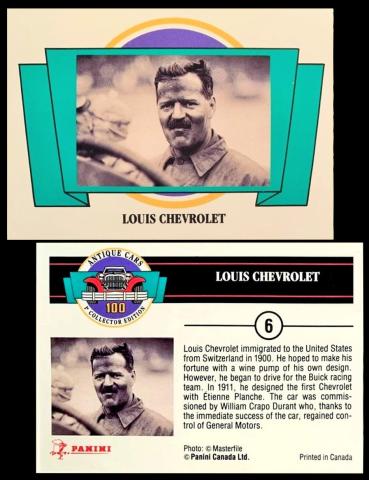
Figurine Panini [trade/commercial : cards and stickers : O/S - Italy] "Antique Cars" (1992) 6/100
Today in 1911, two more brothers, Louis Joseph, and his older brother Arthur Chevrolet, plus the founder of General Motors, William Crapo Durant, ( who was unsurprisingly known as "Billy"), started a company called the Chevrolet Motor Car Company. They also had partners, car maker William Little and Dr. Edwin R. Campbell, Durant`s son-in-law of Durant.
Our card starts the tale of very well, as it tells us that "Louis Chevrolet immigrated to the United States from Switzerland in 1900". He was then aged twenty-two. However he had already moved several times, once, with his father, a watchmaker, to Burgundy in France, where he became enormously interested in bicycle racing and the sciences behind it - but it was his invention of a mechanical wine pump, built with the components from a broken one cylinder motor and a tricycle, which started him on the route to developing cars and engines. Then he moved to Paris, and worked at several mechanics in and around the area.
In 1900 he did indeed emigrate, all the way to Montreal in Quebec, but he then moved on to New York, eventually working for the French car manufacturer de Dion Bouton. It was here that he started racing, in a Fiat, then moved to a Buick, and this is where Mr. Durant enters the picture, for he owned Buick at that time. And he liked our man a lot, asking him to work on many projects, in fact he is credited as one of the co-designers of the 1910 Buick 60 Special, which he also raced; there were only two ever built, and his blew a tire and rolled at Indianapolis in June of that year. It was repaired, but nobody seems to know what happened to it after that. What is supposed to be the other one, because it shows no signs of mending, does survive, and is on display at the Sloan Museum in Michigan - which is named after a long serving C.E.O. of General Motors, Alfred P. Sloan.
After the race cracks started to appear in the friendship between our man and Mr. Durant, though it is not thought to be as a result of that race. Eventually things had got so bad that our man sold Mr. Durant all his shares and walked away. He kept racing, and created a new car, the Cornelian. which he drove in the 1915 Indianapolis 500. He then went off and founded the Frontenac Motor Corporation in order to make parts which would basically convert a Model T Ford into a racing car - and he drove one of those cars to victory at Indianapolis in 1920.
In 1927 he became interested in aircraft, and designed an engine, starting a company called Chevrolair, but it was not a great success and killed forever by the Great Depression. Then, in 1941 he had a heart attack, and died, but he was already in a bad way, having had a leg amputated due to a complication of arteriosclerosis, in which fats and cholesterol clog the arteries and stop the blood from completing its assigned course about the body.
Our set was issued in Canada, and billed as a chance to "Discover the World`s first cars and the innovative spirit of those who brought them to us."
There was also a kind of promo card which, if you got one, allowed you to select ten free cards to complete your collection, but you had to return the card and it does not appear you got it back, or maybe because you filled it out with the numbers you wanted and the details of your name and address it was simply discarded on return. Either way they are scarce.
There were also two checklists, which reveal that the set was divided into sections. These covered cards 1-45 and cards 46-100. The first ten cards are "The Innovators", company heads, Gianni Agnelli of Fiat, Henry Ford, Enzo Ferrari, Karl Benz, Ettore Bugatti, Louis Chevrolet, Charles Stuart Rolls and Henry Royce, Walter Owen Bentley, Frederick and August Duesenberg, and Gottlieb Daimler. It then goes through the years, in date order. starting with the Benz Tricycle of 1886, one of six "First Real Automobiles" and ending that checklist with "The Great Depression" and card 45, the Bentley 8 Liter of 1931. The second checklist continues with "The Great Depression" and the Packard 840 Big Eight, also of 1931.
If there is a fault with the set is demonstrated here, as after 1938 it is rather rushed, cars of "The Second World War" being just twelve, from cards 85 to 96, and cars of "The Post War World" numbering only four, and ending with the Ferrari 166 Mille Miglia Barchetta of 1950. I would rather they had expanded the pre-war cars to fill the entire checklists, and had a second set covering the cars of 1939 to the date of issue. But for all that it is a very attractive set.
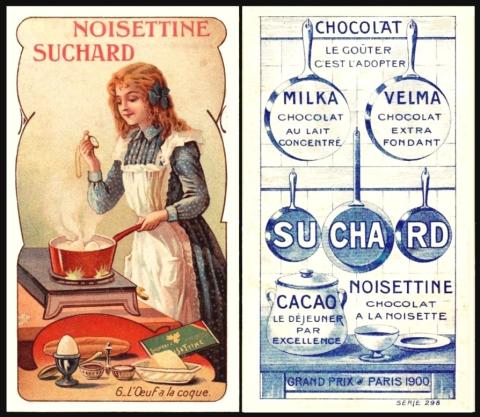
Suchard [trade : chocolate : O/S Switzerland] "Cuisiniers" / cooks - series 298 (19??) Un/6
So I have at last abandoned the Newport Rising, for now (too much researching and no cards) and am going to bring you a blast from the past, but hopefully not literally.
You see today, in 1963, a children`s toy, made by Kenner, and called "The Easy Bake Oven" went on sale. There was a choice of colours, yellow (Harvest Gold) or blue, and every one they made was sold out by the end of that Christmas, so in 1964 they made three times as many, and also added a popcorn popping attachment which enhanced any ovens sold last year.
Before I gallop on, yes, this was a working oven, on a smaller scale. It had a pair of incandescent light bulbs for the heating source, and it came with pans and cake mix. Cake mix was also available separately. You had to add only water, and put the pan into the oven through a slot - and after cooking a cake comes out the other end. If you don`t believe me, check out YouTube, where there are loads of people demonstrating theirs. (Barry Lewis` is especially funny)
This was, of course, not the first ever child`s oven, they had been made since Victorian times, and not all of them were safe - there was one sold by Lionel in the 1930s, which had two electric burners, and in the 1950s many contained fibreglass. However our one was an amazing success, seeing none other than Betty Crocker providing special cake mixes for it, and even Jim Henson designing a special Muppet style character for it. By 1971 it was available in four colours, sunshine yellow, lime green, sky blue and burnt orange and by the end of the decade poppy red was also available. By the end of the 1970s the design was very different though, and it was reflecting the shift to microwave style ovens.
Once Kenner was bought by Hasbro in 1991 the oven continued to be made, and improved, slowly turning it into more of a microwave. However, there were a lot of problems in the early 2000s, concerning a new model, which saw complaints of crush injuries, involving the front loading door, and burns. It was given an age advisory of only for children over eight years old, and all those models which had already been sold were offered a retrofitting kit, a plastic grate which prevented small fingers entering the oven. However in July 2007 the complaints were still coming in - and almost a hundred thousand ovens had to be recalled. After that, the ovens were re-designed, and the light bulbs replaced by a heating element. And these are still made today, though you can also find the originals online, and at fairs and markets.
This set also features children cooking, with proper ovens. It is usually known as "Les Cuisiniers" or the cooks, and look at that battery of pans on the reverse side.
The cards in the set are quite elusive, but so far I know of :
- L`Omelette (omelettes) - girl
- Les Crepes (pancakes) - boy
- L`Oeuf a la coque (boiled eggs) - girl
- Les Salades (salad) -- boy
- Les Beignets (deep fried pastries) - girl
- Le Cafe (coffee) - boy
In fact when I started I thought it a set of six, but then found card eleven, so I added another six numbers.

Cinemagazine Edition [trade : magazines : O/S - Paris, France] "Film Star Postcards" (1925) 390/2100+
Onwards and upwards, and today in 1925 saw the release of one of the most highly rated silent films ever, "The Big Parade" starring John Gilbert and our featured star Renee Adoree
She was born Jeanne de la Fonte in Lille, France, on the 30th of September 1898, to parents who were circus performers. She followed them, becoming skilled at acrobatics and dancing, and eventually as a bareback rider, and they toured throughout Europe. However during a tour of Belgium the family were caught up in the First World War.
It is unclear what happened after that, but she is next heard of after the war, in Australia, touring with a vaudeville act which were not her parents. From that she went into movies, a film called "£500 Reward", directed, written by, and starring Claude Flemming. It was his fourth film and her first. She is actually billed as "Rene Adoree (of the Magleys)", which was the troupe that she was touring with. However this disproves the theory that the Fox Studio changed her name only in 1920.
This led her to New York, and a vaudeville musical, on stage, which started out as "Oh Uncle" and segued into "Oh What a Girl". In 1920 she had an offer of another film, "The Strongest", which saw her joining the Fox Studio. This led her to meeting and marrying Tom Moore, and the two co-starring in her second American film, "Made in Heaven". However the marriage was not, and they divorced in 1924.
Less than a year later, she filmed "The Big Parade", regarded as her greatest role ever, in which she plays a French girl who falls in love with a soldier, played by John Gilbert, who is traumatised by what he has seen. She seems to have connected with John Gilbert in many ways, and they starred together in eight further films, but though he married four times it was never to her. In fact there is a strong rumour that they were engaged in 1927, after he had given up on ever marrying Greta Garbo, and she forced his hand by saying she was to marry William Sherman Gill. As he did not respond she did indeed get married, but two years later they were divorced, it becoming final on the third of March, 1929. And sadly, she found John Gilbert was already in a relationship with Ina Claire, who he would marry on the ninth of May 1929.
Her health was never good, a combination of the circus life, the touring, and the cold of the nights out in a caravan beneath the stars. And we will probably never know what happened during the time she was caught up in the First World War. She frequently suffered with chest infection, and by the time she started to film a talkie with Ramon Novarro, called "Call of the Flesh", in 1930, she had been diagnosed with tuberculosis. Her doctor actually advised that she quit the picture, but she insisted on fulfilling her contract, and that made the situation worse. She left the set and went straight to Arizona, where she was in a sanitarium for two years. This was thought to have restored her, and she left in April 1933, but she quickly relapsed and died on the 5th of October, just a few days after her thirty-fifth birthday
Our card is not her "Rookie" card, not by a long way, that honour goes to the American Caramel Company set of "Movie Stars" (E.123), issued in 1921, in conjunction with her second film, "Made in Heaven", and we know that because the card cites her as "Star in Goldwyn Pictures", and they produced that film in that year.
To close, you may be thinking that this item is not even cartophilic, it is just a postcards, but wait ... for if you look, this is the original, full size, image, from which her picture , as used on the set of Societe Job "Film Stars", was derived.
And you can see that for yourself at the Trading Card Database/RASJ. Where, if you look closer still, along the arm of her dress, you will see it credits "Cinemagazine" in small white letters.
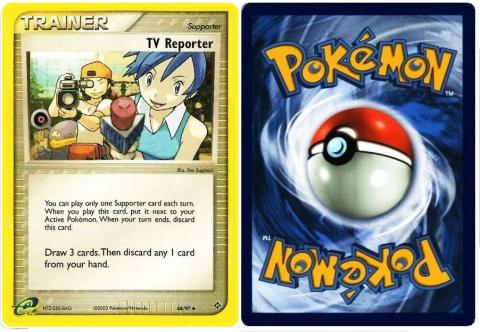
Pokemon/Nintendo [trade/commercial : cards : O/S] "Pokemon characters" (2003) 88/97
For our penultimate card of the week, I am going to introduce you to Nancy Wiggington, the first female BBC national news reader, though on screen she was billed as Nan Winton.
She is also a centenary lady, as she was born today in 1925, in Portsmouth.
When she was just fifteen her mother died, and she had to leave school to run the house. This did not last too long and she joined the Land Army - which makes it sound rather like she ran away. The Land Army girls introduced her to the theatre, which she loved, and she managed to find a spot on a touring company which entertained the troops, and took her out to Italy. That only lasted for a short while after the war had come to an end so someone suggested she apply to the the Royal Academy of Dramatic Art. She did, and was accepted. This led to all kinds of interesting things, including a short stint as a demonstrator at the Ideal Home Exhibition. Whilst there she was spotted by the BBC, who employed her behind the scenes.
She may have stayed there, if it were not for ITV, which started in 1955, and, as just one of its attractions, offered a female newsreader, Barbara Mandrell. Not to be outdone, BBC started out with Armine Sandford, on BBC West in 1957, and, when that was not decried, they asked Nancy Wiggington. She first sat at the news desk on screen on the twentieth of June 1960, but there were lots of internal rumblings and she was removed in March 1961. At that time the BBC said that she was unpopular with the public, but she recalled having nothing but warm messages and friendly support from them, it was the BBC themselves who were prone to be snippy. However, it was their loss, as she moved to ITV, where they welcomed her, as a news reporter and interviewer, with open arms.
She moved to Dorset after her retirement, and died on the eleventh of May, 2019, after a fall.
I had the worst time trying to find a card of a lady reporter, but then one of my contacts mentioned they had one, and here it is. I did not, however, expect it to be a Japanese card. But in Pokemon some of the trainers are indeed young women who are working as television reporters, who first started to appear in 2006 with the Generation IV games. They went on to specialise in the training of Pokemon who either flew, or conducted electricity.
And. in another nod to our original story, if you have a card of a cameraman and a card of a reporter, they make a pair, and the reporter is renamed, to an interviewer.
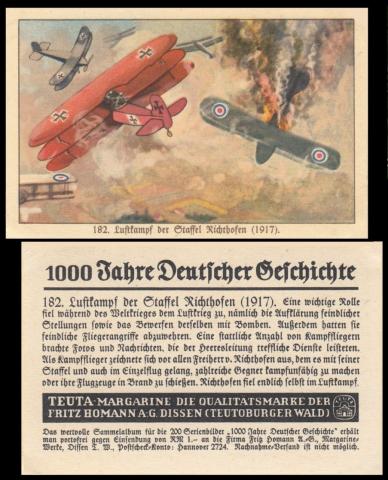
Fritz Homann A.G. [trade : margarine : O/S - Dissen, Germany] "1000 Jahre Deutscher Geschicte" / a thousand years of German history (1934) 182/200
Well I have to say I never thought I would get here by today, but here I am, with some gaps in the card gen and codes, and still lacking five pictures. But hey its only 6 p.m. on Friday night, that ought to be do-able...
I also took a long time to confirm this date, and only did so by looking at the original letter, online, which proved it to be true.
So we can close with another centenary, the announcement that the French were to unearth and repatriate the body of the Red Baron to his native Germany.
You see, after the crash in which he died, his body had been taken into the care of the Allied Forces, and been given a full military funeral at a cemetery near Amiens. In the early 1920s, a new military cemetery was opened at Fricourt, to where the body was removed, but this created some flak amongst the locals, and it was decided to move the Germans back home. So within the month his youngest brother had been advised that the body was ready for collection. He hoped that he could bury it at Schweidnitz, with several other relatives including his father, but the German government stepped in and wanted it buried at the Invalidenfriedhof Cemetery in Berlin, amongst the military heroes and past leaders, and the family agreed, especially as the body would in that way receive a state funeral.
Despite this it did not rest in peace. During the Second World War a huge new tombstone was levered into place, marking Richthofen as a hero of the Third Reich, and during the Cold War this was not only vandalised but frequently caught in the crossfire between the military and people hoping to flee East Germany through the graveyard.
Finally, in 1975, the body was again moved, to Wiesbaden, where other members of the family were interred.
This card is another by Fritz Homann, who you can read much more about with our Card of the Day for the 24th of November 2024.
And it shows our man doing what he loved best, flying with supreme skill amongst the clouds, and evading his pursuers, which ultimately he failed to do...
This week's Cards of the Day...
.... celebrated all our red headed readers, with an annual event, every November the 5th, called #NationalLoveYourRedHairDay.
As to why that date was chosen, well I think it was perhaps because, like fireworks, you cannot help to notice a the brightness and colour of a red headed person, whether they were born with it, whether it came from a salon, or even whether it came from a home dye kit.
The truth is that the salon and the home kit are much more likely - as less than two per cent of the people in the entire World are true redheads.
And something I didn`t know is that true redheads are often left handed.
Saturday, 25th October 2025
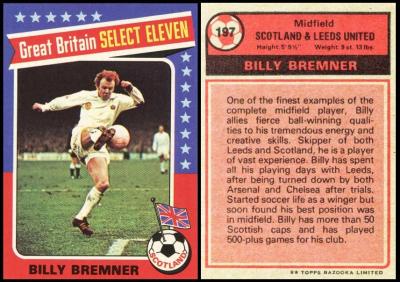
When I put in "red hair footballer" the first name I got was Billy Bremner, who seems to have been immortalised in all manner of football chants because of it !
And we have had the second name that popped up, Alan Ball, before, as our Card of the Day for the 27th of August, 2022
Billy Bremner was born on the 9th of December, 1942, in Raploch, Stirling, Scotland. It is said that he left school in 1959, in order to sign for Leeds United, starting with the juniors and making his first senior team appearance on the 20th of January 1960. However he had been playing football for some time then, with Gowanhill. And in 1957 he had been given a trial for the Stirling Schoolboys County team, which led to his actual international debut, aged just fifteen, against Northern Ireland Schoolboys, in March 1958.
He was not tall, only 5` 5", but everyone knew his hair, and they also knew it marked him out as a fierce competitor. Eventually he would rise to become the captain of both Leeds United and Scotland, and with him on board Leeds United not only got to the First Division, but to the F.A. Cup Final in 1972.
He stayed at Leeds United right until 1976, during which time he got married (in 1962) - sixteen years and five hundred and eighty-seven appearances. Then, suddenly, he signed for Hull City, where he remained for just two years. Then there was a gap in his playing, whilst he managed Doncaster Rovers, starting in 1978. He stayed there until 1985, and played for them too, for two years, starting in 1980. He then left, to manage Leeds United, something he could not turn down, but only stayed until 1988, before returning to Doncaster Rovers again in 1989. Then in 1991 he announced his retirement.
He had always been a keen writer, and much enjoyed the activity. In fact it had all begun in the 1970s, when he had been offered a job on "Shoot" magazine, under a pseudonym. He thought it would be a one off, but it proved to be a very popular column. And when he retired he went on the speaking circuit for a while. However, in 1997, he was hospitalised with pneumonia, and on his return he died, two days before his birthday, from complications arising from a sudden heart attack. He was only fifty four years old.
This set looks typically American, but there is a lot of variation on the card style. Cards 1 to 63, (with the exception of card 32 - a checklist, of cards 1-131) have a rounded corner picture and the outside backgrounds are in an assortment of two colours, some being much more distinct than others. Cards 64 to 68, however, are called "Double Centurions", this being in a banner at the top. Those players are Ron Davies of Manchester United, Ken Wagstaff of Hull City, Kevin Hector of Derby County, Francis Lee of Derby County, and Geoff Hurst of Stoke City. Card 69 returns to the original style with the bi-coloured border, and you might be expecting that they go on until card 131, as the checklist suggests, but they actually continue until card 190, which is the first card like ours, headed "Great Britain Select Eleven". Those cards are of Mike Channon (better known as "Mick") of England, Malcolm MacDonald, of England, Leighton James of Wales, Colin Todd of England, David Nish of England, Emlyn Hughes of England (?), Phil Thompson of England, Billy Bremner of Scotland, Colin Bell of England, Alan Hudson of England, Peter Shilton of England, and Paul Madeley of England. Then from card 202 you are just starting to think it is back to square one all over again, with the bi-coloured borders, when along comes card 204, the checklist for cards 133 to 220. But its just a blip, the bi-coloured borders continue all over again for the last sixteen cards.
In fact Billy Bremner appears twice in this set, another reason for picking it - as card 1, for Leeds, and as card 197, our card.
Now on the wrappers for this set it not only, thrillingly, says "Picture Cards & Bubble Gum" but it promises "Larger cards! More Players". This is a bit misleading, as they were not referring to a set of their own, but to the fact that in 1975 A. & B.C. Gum had gone out of business and left Topps with the idea to sell their own cards, not license them A. & B.C. And, if you are a Topps fan, you will see that this design is very similar to the set of baseball cards from the same year. They also took something else from A. & B.C. and that was splitting the set into two, one English (our set of 220 cards) and one Scottish (with just 88 cards).
There is also an address, "Topps Bazooka Limited, Billericay, Essex"
Sunday, 26th October 2025
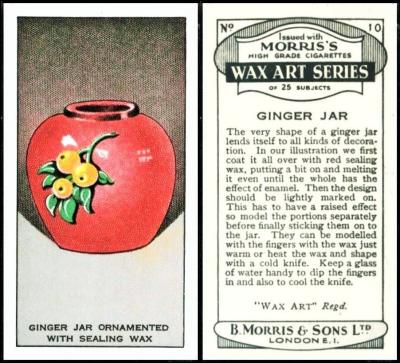
So here we have "ginger", which is often a rather mocking nickname, though it is true that girls, and boys, tease the ones they secretly like the most. I tried to find out more, but all I kept seeing was that it reflects the similarity in color between a ginger root, which can be reddish. I am not sure about that, there is only one ginger which is red, and it is only grown in the Pacific Islands. So it seems unlikely.
As far as wax art, I first imagined this started in the 1920s, I even found several books on the subject by Davids Bros. Inc of New York, who managed to get Woolworths to distribute the colours in their stores.
However, further research told me that the technique of painting with a melted wax is much more ancient, and it was well known enough to the Romans that they were using it to paint and embellish portraits of the dead by 100 A.D. The clue is in the word though, as it comes from the Greek, "enkaustikos", meaning to burn one substance into another, and we know that Greek ships were not only made waterproof with melted beeswax, but that many were embellished with spare wax, in patterns and shapes. Homer mentions just this, in the Iliad, in about 800 B.C.
Wax Art owes its origins to sealing wax, which was an early attempt at preventing anyone opening and reading your mail without you knowing. What you did was write your letter, melt a circle of wax across the flap of the envelope, and press your signet ring in the centre. Any attempt to open the letter would break the wax, which by then was set hard, and disturb your monogram.
The Romans did all this, using a blackish material akin to bitumen. The practise died out with their departure, but seems to have been rediscovered in the Middle Ages, especially within the Church, where it is said they used beeswax, but it is more likely they just used remnants of the candles, as they grew too small for the altar. And the Church were affixing what came to be known as "Papal Bulls" to documents relating to the Pope since the 12th century, these being seals of lead
The first coloured wax appeared in the sixteenth century, and this was red. It stood out much better on the letters, which were yellow or white, and so it was much easier to tell if there was only a crack to tell that someone had attempted entry.
As for our set, little is known. It appears in our original World Tobacco Issues Index as simply
- WAX ART SERIES. Sm. 67 x 36. Nd. (25) ... M142-35
Monday, 27th October 2025
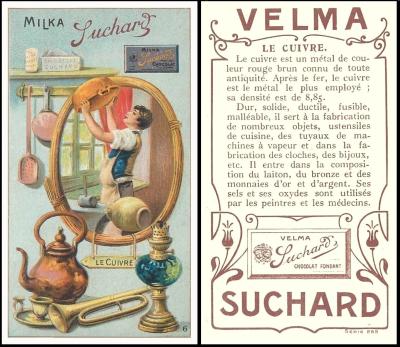
This card gave us a much nicer word for a redhead, and that is copper. This is the most golden of the reds, which range from dark red, which, if you are really lucky, is almost mauve - down to strawberry, which is almost blond. I was going to have a butterfly, so many of which are called "copper" because of the colour of their wings, but then someone sent me this, which I really liked - and it saved me hunting.
On the face of it, you would not think that a set on metal would be very interesting, but these not only have the people, and the different trades, the small vignettes around the frame are rather interesting thematically - and many would be of great interest to someone who collects antiques or jewellery.
Take card number one, for gold, and it contains a necklace with pendant, a pile of sovereigns, a stick pin, a watch, and even the word "L`Or" is made into a brooch, whilst in the frame, which is a bangle, the jeweller sits at his work table, crafting away.
Card number four, for iron, even has the frame as a horseshoe, with the blacksmith toiling away by his flame, and outside the frame is a companion set for the fire, a pot, a flat iron, a mallet and what looks to be a carriage wheel chock.
And card number eight, for lead, shows a pendulum clock with its leaden weights, the lead balls used to weight a fishing net, and even ammunition, three lead shot and a pair of cartridges - whilst this frame shows a plumber at work with his tools on a pipe and tap. In fact, the pipe curves round to make the frame.
To close, there is an even bigger surprise on card 12, for at the top is an airship, the sides proudly emblazoned "ZEPPELIN X". This refers to the "X" Class, the first of which was the LZ 112, also known as L.70, first flown on the first of July 1918. That only lasted a month and five days, before being shot down over the North Sea. But the final Zeppelin X was L.72, which first flew on the 9th of July 1920, and was given over to the French as reparations for the war just four days later. In fact the French used her, renamed her "Dixmude", and flew her until December 1923, when she exploded with a loss of all fifty two people aboard. And that was a worse loss of life than the Hindenburg in 1937 (36 lives lost) or even the R.101 in 1930 (forty-eight lives lost). However it was not the worst airship disaster of all time, that came in 1933 with the loss of the USS Akron, in which only three survived of the seventy six people aboard.
On to a list of the cards, complete with their translations, which is :
- L`Or [gold]
- L`Argent [silver]
- Le Platine [platinum]
- Le Fer [iron]
- Le Bronze [bronze]
- Le Cuivre [copper]
- L`Etain [tin]
- Plomb [lead]
- Le Nickel [nickel]
- Le Zinc [zinc]
- Le Mercure [mercury]
- L`Aluminium
And this is definitely a set well worth adding to any collection.
Tuesday, 28th October 2025

You may well be asking what this card is doing, and let me tell you.
For despite most people connecting red hair to Ireland, Scotland actually has slightly more redheads. And both these regions have way more than England, which counts them as only two per cent of the population - Scotland and Ireland ranging from five to fifteen per cent. This could well be down to genetics though, because almost half the people in Scotland carry the gene for red-headed-ness, which explains why sometimes a redhead is born to a family with none in living memory.
And the best place to spot a redhead in the whole world is reputedly Edinburgh.
Which is why this card got the nod.
It also ties a loop though, for we have used one of the sets from this issuer before - but only in a newsletter, so now we can start this home page for them.
So far all the sets we know of were issued in France, with chocolate, giving the address of 61 rue Boissiere, Paris, in the 16th arrondissement. These are :
- Conquete de Space
- Costumes - Types - Races - 1st series (144 cards, 1-144)
- Costumes - Types - Races - 2nd series (144 cards, 145-289)
- La Case de Oncle Tom
- La France Merveilleuse
- Les Bienfaiteurs de L`Humanite
- Notre Univers
- Les Voyages Interplanetaires [in newsletter, scroll down to Saturday 8th of June]
- Le Travail des Hommes
- Races (72 cards, 1-72)
However the movement started in Switzerland In 1864, with a textile industrialist called Jean Jenny-Ryffel, who formed the first ever consumer co-operative in that country. out of Schwanden. In fact he used the seven principles of the Rochdale Pioneers, the founders of the English Co-Op movement.
The idea took off and in 1890, by which time many similar societies had been formed, several of them joined together under the name of Verband Schweizerischer Konsumvereine. In France this was known as La Union Suisse des Sociétés de Consommation, which appears on our card - and that proves it was issued before 1969, when the group was renamed to Coop Genossenschaft in Switzerland and Coop Societe Coopérative in France.
Each set also had a special album, and the company also exchanged double cards at the rate of three unwanted cards for every one off your wants list - or you could send a stamped addressed envelope to their address if you did not have any spare cards.
Wednesday, 29th October 2025
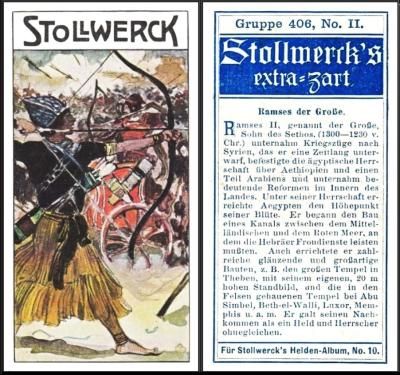
Although red hair is found in prehistory, in many places, one of the earliest famous figures to have been described as a redhead was Ramesses II, the second Pharoah of Egypt, who became known as Ramesses the Great, or just "The Great Pharoah". In fact during his lifetime he was worshipped as a god. And he was so renowned that even the Greeks had a name for him, Ozymandias.
He gained his fame through not only the length of his reign, sixty-six years, (longer than all but Pepi II, who reigned for ninety years), but also through his building works, and his military successes, fifteen wars, all of which he took part in himself and all of which he won - save one, the thirteenth century B.C, Battle of Kadesh, which it is regarded neither the Egyptians nor the Hittite won, in fact it ended in peace, and more than that in the signing of a peace treaty, the first one ever to have been arranged and signed.
Ramesses II became Pharoah in May 1279 B.C., and died in 1213 B.C.
He lived into his early nineties, we are not really sure of a firm age, then he was buried, with great ceremony, in the Valley of the Kings, but it was later moved, to safeguard it, and only unearthed in 1881. This was when it was first discovered that the mummy still retained hair on his head, and noted that it had been dyed to a reddish colour with the henna and other materials used in embalming. However in 1976 a further investigation was performed on the mummy and it was discovered that the redness of the hair was the true and natural colour. That fact was interesting in many ways, not least that at the time our man was alive the god Set was connected with red-haired peoples. Indeed Ramesses` grandfather had been the High Priest of Set in the reign of Amenhotep II, and his father had been given the Pharoah name of Seti I, which means follower, of Set.
This is an interesting set and very well drawn. The list of cards is :
- - I - Cheops
- - II - Ramses der Grosse
- - III - Psammetich
- - IV - Semiramis
- - V - Salmanassar
- - VI - Nebukadnezar
Thursday, 30th October 2025
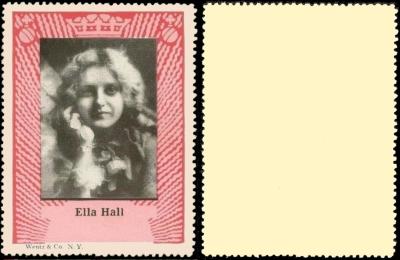
Here we have one of the earliest screen "redheads", or at least one of the earliest I have not introduced to you before.
Ella Hall was born on March the 17th, 1896, whilst her mother, Mary Hall, aged just nineteen, was still hoping to become a famous actress. The birth put the dampers on that, a bit, but it did inspire the family to move to Hollywood, which sounds as if it were in the hope that little Ella may have more luck. And she did, appearing on the stage as a very small child. However she did no films until 1910, when she was signed to Biograph Studios. Here she certainly had some work, loads of short one or two reelers, as a fleeting glance, and sometimes more.
In 1915, she moved to Universal Studios, which is the reason she is here, for in 1917 she starred in a movie called "Polly Redhead". This was billed as "The famous Pollyooly stories by Edgar Jepson come to life". I have not been able to find out much about them except that they were first published in the UK, in 1911, by Mills and Boon, which suggests they were romances, but if you look at them online they now seem come under children`s books. Maybe that gentle kind of "romance" is sadly no longer what modern ladies desire.
Ella had rather a stormy time romantically, she loved the high life, which usually means fast living and expensive tastes. For a long time she was on and off with Robert Zigler Leonard, a film maker, whom she had met in 1914 when they both starred in a serial called "The Master Key". He directed it as well as played the lead - and he cast her in several other films, when they were together, you can kind of tell how the relationship was going by the fact that she comes and goes. In 1916, he replaced her in a film called "The Plow Girl", with Mae Murray, but Ella was back in his next film, released in July 1916, which is rather tellingly called "The Love Girl". And in March 1917 he starred Ella in "Polly Redhead"
Then, in June 1917, Universal Studios held a gala, at which Ella Hall turned up on the arm of another Universal Star, Emory Johnson. They had actually starred together in 1916 in a film called "My LIttle Boy", though this sat on the shelf a while and was not released until December 1917. Anyway at some time during the gala they stood up and announced they were getting married . They were indeed married, on September the 6th, 1917, (and, by the way, "The Plow Girl" was released in November 1917), after which she moved into his house with his mother.
In August 1918, Robert Leonard married Mae Murray.
Ella had her first child in January 1919, her second in September 1920, and a third in April 1923. However after that things declined, the couple were frequently in the papers, and not in a good way, and they separated. She actually filed for divorce, citing his mother`s interference, but in 1926 their second son was killed in a road accident and they seem to have got back together, albeit temporarily. She also had another child in 1929, but then they separated again and in 1930 they divorced for good, though they never seem to have stopped fighting..
In 1933 she left the film industry forever and took a job in a dress shop. She remarried in 1934, to a Charles Clow but that was annulled in 1936 because he was actually still legally married to his first wife. There was a rumour that they would make it legal and wed again, but they never did. And she died on September the third, 1981, at the age of eighty-five
This is one of those tiny little poster stamps, printed by Wentz & Co. of New York, and later Berlin, where they were Wentz & Co. G.m.b.H. They made loads of them, featuring cinema stars as well as advertisements for many different companies, but we are no closer to learning much of their story - though they do have an even better connection to cartophily than this stamp, as their name appears on Liggett & Myers "Fairy Tale Stamps", issued with Piedmont Cigarettes.
Friday, 31st October 2025
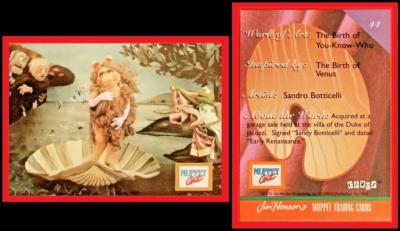
The original painting that this amusing skit is adapted from dates from the Italian Renaissance, and it was created between 1485 and 1486. Its original title was "La Nascita di Venere", but we know it better as The Birth of Venus. It shows Venus, goddess of beauty and love, emerging from a scallop shell on Cyprus. ”, the composition actually shows the goddess of love and beauty arriving on land, on the island of Cyprus.
However on our card Miss Piggy, in a long blonde wig, portrays Venus - and instead of the west wind, Zephyr, and the nymph, Chloris, who blow her safe to shore that job is performed by Statler and Waldorf - whilst flying in to cover her modesty is not one of the goddesses known as the Horai, but Kermit the Frog.
We believe it was commissioned from the artist Sandro Botticelli by a member of the Medici family, simply because the first time it appears is some time later, in 1550, at the Medici Villa.
This set was divided into a number of categories, and you can see those, plus images of all the cards at MuppetFandom/JHMTC.
As far as the belief that this is the first ever set devoted to the muppets, that is not true - that honour goes to a set issued in Sweden, called "The Muppet Show", and also it was a completely legal set, as on the reverse of the packets it cites "(c) Jim Henson 1976, 1977, 1978". Another misconception is that this Swedish set was issued by Samlarsaker, but that word simply translates to "Collectibles".
Well it is now half past nine on Friday night. I have added all the cards and written most of the descriptions, with just a bit of tidying to do.
I imagine that my strength came from the thoughts of the people who so enjoy reading these newsletters.
And I am delighted that I kept on plugging away and can bring you what you wanted and what you were waiting for.
With luck, my next week may be easier, but sometimes it is rather fun to have a target that is so elusive to chase, for there is no thrill in an easy win; at least not as much as in the satisfaction of managing to do or to catch the quite impossible...
Good night, dear readers. Enjoy your weekend, and may you find treasure, whether that be a card to cross from your wants list, or a card from a set you never met before that you really want to add, or just more information about the cards you are researching.
And so to bed.