
Another newsletter, hot off the press, despite the fact that some of these events were not the ones with which I started, and then there was quite a lot of research, and also many biographies. However here it is, for which I am well pleased.
But as its quite late, lets start with our cast of characters (and waffle no more) - which are a see-through scientist, a child`s condenser, a Lancashire Lad, a military mystery man, an early swinger, a pleasing practise, and a medical miracle....
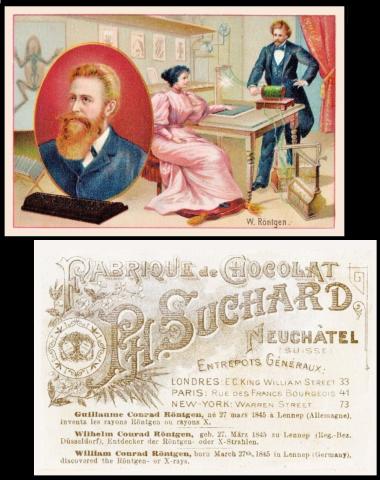
P. H. SUCHARD [trade : chocolate : O/S - Neuchatel, Switzerland] "Inventeurs"/ inventors - S.54 (19??) Un/12
This day started out as the 1925 release of "The Eagle" starring Rudolph Valentino, a film which does not seem to appear on any cards.
So instead of that we are going to chat about our "see-through scientist", Wilhelm Conrad Röntgen, complete with a very nice "Movember Moustache" to start us off.
He was born in Prussia on the 27th of March, 1845, then, when he was three years old his parents moved to Holland, to be where his mother`s family was, but despite the fact that they had relatives there, they never seem to have become Dutch; instead, they are listed as being "stateless", which classes them almost as refugees, and denied them many rights that would have been theirs. In fact he is listed as being "stateless" for another forty years, a very long time indeed.
More curious still is the fact that, in 1888, he moved to Germany, and became a German.
Whilst he was in Holland, he enrolled at the Technical School in Utrecht, and was there for two years. Then there was another strange event, for he was expelled for drawing one of the teachers, and not allowed to finish his diploma. He protested adamantly that it was not even his drawing, but his pleas were not heard, even though it seems a very minor event over which to destroy a future. It is recorded that this decision also meant that he could not go to Utrecht University as a full time student, only as a visitor - but I am not entirely sure about that, I think it was more due to his not being officially listed as Dutch, in which case he would have not been a resident of the country, only a visitor.
He then discovered that if he moved to Switzerland, he could go to University there, and so he did. Again this is confusing, for at no time is he listed as being a Swiss resident, but maybe their rules were a little more friendly. After he graduated, he took a job as a lecturer at a French University, and stayed there for five years, save a brief stint at an agricultural college in Germany. He would return to Germany in 1879, to teach physics, and it was during his time there that he decided to become a German citizen.
It was at his laboratory, in the University of Wurzberg, that his startling discovery occurred, quite by accident. He was experimenting with passing electricity through a vacuum tube, and suddenly he saw glowing light. He later repeated the experiment, adding an electrostatic charge, and he again saw the same light. He called them simply rays, adding the "X" because even then it stood for something unknown, or which could not be explained.
In 1901 he was awarded the first Nobel Prize for Physics, but turned down the chance to deliver a lecture about his discovery. He also refused the money, giving it to the University in whose laboratory he has first observed the phenonenon - and he never patented his discovery.
Despite his affection for Germany, he did consider emigrating, and even accepted a post at Columbia University in New York. He also bought the tickets, but he never left, things kept getting in the way, and then Europe descended into the chaos of the First World War, and it was too late to leave. And by the time the war was over, inflation was rife, and he slid slowly into bankruptcy, before he died, on the 19th of February, 1923, of cancer
He is thought to appear on relatively few cards, only two cigarette card sets.
The first is the 1924 Millhoff "Men of Genius", which is notable for two facts, neither of which turn out to true, the first being that it is his "rookie" card, which it is not, for he he features quite heavily on continental chromos - and the second being that he is wrongly named on the front as "Wilhelm Konrad von Rontgen", whereas the "K" is the normal German spelling of Conrad, and this only proves the picture used for the card must have been taken from a German image.
The second is the 1929 Hill`s "Scientific Inventions and Discoveries", which was issued under the guise of "Spinet House".
Just a few of those continental chromos are :
- Emile BONZEL`s "Les Decouvertes de L`electricitie" - card 18 (showing his machine only - and also issued by other firms)
- ECKSTEIN`s "Die Grossen der Weltgeschicte" - card 195
- ENVER BEY`s "Geistesgrossen aller Zeiten" - unnumbered card
- GUERIN Boutron`s "Les Inventions Modernes" - card
- GUTERMANN`s "Beruhmte Manner" - card 53
- Fritz HOMANN`s "Geschichte Unserer Welt" - card 193
- Echte WAGNER`s "Erfinder" - album one, series 19, card 3
Our Suchard set is another, and it is a very well drawn set of twelve cards, with a mini biography on each back in three languages, French, German, and English. The inventors featured are :
- Eugene Chevreul - [fatty acids]
- Louis Jacques Mande Daguerre - [photography]
- Thomas Edison - [phonograph]
- Jean Gutenberg - [printing]
- Elias Howe - [the sewing machine]
- Les Freres Montgolfier, Joseph, Etienne - [balloon flight]
- Sam. Finley Breese Morse - [morse code]
- Isaac Newton - [the solar system]
- Louis Pasteur - [vaccination]
- W. Rontgen - [X-rays]
- Berthold Schwarz - [gunpowder]
- George Stevenson - [the locomotive]
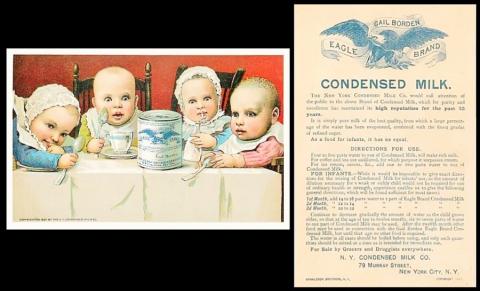
Gail BORDEN [trade : condensed milk : O/S - New York, USA] "Advertisement card - four babies" (1900?) Un/??
Our "child`s condenser" is a very interesting tale indeed, and the first surprising fact is that Gail Borden was a man. He was born in 1801, near New York, and when he was just a teenager the whole family moved to Kentucky, not because they had fallen on hard times, but because the father was a town planner and architect, and he had been commissioned to plan the entire city of Covington.
Gail Borden started out thinking he would also be a town planner, but became a teacher instead, and moved to a cattle farm in Texas in 1829. He seems to have found that a bit boring, as he started to become involved in politics and legal affairs, and he must have been skilled because in 1833 he helped to set down the first draft of the Constitution for the Republic of Texas. He also started a newspaper, "The Telegraph and Texas Land Register", but he ran out of money and had to sell up. Then he fell into town planning again, and we can thank him for the cities of Galveston and Houston, as well as for the first ever map of Texas.
You may have thought this would have been enough, but in 1861 he met a man called Jeremiah Millbank, and together they started a new company, The New York Condensed Milk Company. It seems that they were aware of the fact that whilst country folk had cows to milk, townspeople did not. This meant that the milk could not be fresh every day, and if it was stored for too long it soured. The solution to this had been known for centuries, and it was even written of by Marco Polo, in the thirteenth century, on his discovery that the Tatars carried a small quantity of milk paste, which they mixed with water when needed, and were able to drink.
By combining this idea with the product of the cattle farm, the duo hit on a product which was cow`s milk, but made smaller (hence the "condensed") by removing all the water and adding sugar. The sugar was mostly as a preservative, enabling many cans to be bought and stored and only opened and used when they were needed.
They opened their first factory in the same year they met, 1861, and they made their name by contracting to supply the Union Armies during the American Civil War, which began in that year.
However it was as a product for children that its fame lasted, for it was seen as a way to bring sickly infants through a myriad of diseases. Today this would be unacceptable, mainly due to the high sugar content, which we know leads to obesity, tooth decay, diabetes, and constipation, or the reverse; and because of the very low protein and calcium base. In fact, there are now guidelines that say it should not be given to young children at all from the ages of one to three.
Mr. Borden did not let his successes stop him continually inventing new things. He changed his machinery, very slightly, and was able to condense fruit, coffee, and cocoa. He also made beef extract, another boon for sick children. Outside the factory, he was heavily into education and charity work, building schools and churches, and changing the map of a town, which was then called Borden, where he lived and in which he died, on January the 11th, 1874, aged seventy-three. He was then taken to New York to be buried, which seems a bit odd, because you would have thought he liked where he lived.
His company continues though, and is still going strong, as Borden Dairy - and still uses the same logo, of Elsie the cow, who first appeared in 1936.
Now I cannot lie, I find this card really creepy, these are hardly cute little babies, their eyes glazed over, trying to outdo each other in grasping for the tin, or pulling off the table cloth. The only bit of levity is provided by the fact that one of them looks extraordinarily like Tom Allen, and he is even clutching his Bake Off Extra "Star Baker Spoon"....
Most of the cards do play on the connection between babies and health, and you will also find the cards with the same back as this, but in Spanish. And they would make a fascinating collection.
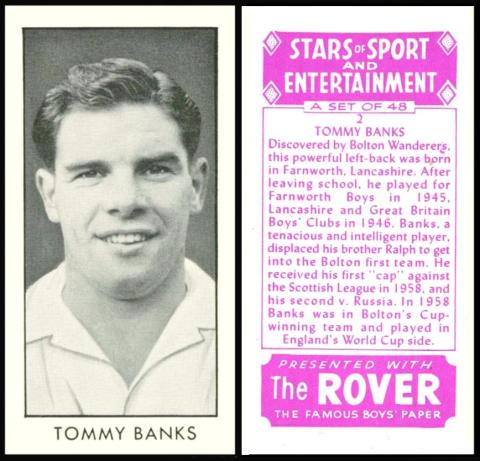
D.C. THOMSON [trade : periodicals : UK] "Stars of Sport and Entertainment" (1960) 2/48 - TH0-665.2 : THO-213.2
Our "Lancashire Lad" is Tommy Banks, born today, in 1929, at Farnworth, in Lancashire., which is now part of Greater Manchester.
He was the son of a coal miner, and he seems to have gone straight to Bolton Wanderers at the age of eighteen in 1947, staying there right until 1961, during which he was on the team which won the F.A. Cup in 1958, beating Manchester United 2-0, both goals being scored by Nat Lofthouse. Our man was a competent player, but it is universally regarded that the offer for him to join the England squad for the 1958 FIFA World Cup came only because so many players were killed in the Munich Air Disaster.
That year also marks the appearance of his "rookie" cards, for there are two, both issued in 1958, and as yet we do not know which was issued first - but we might when I start to work through the magazines, as one may be listed in the new issues column before the others.
The first candidate is number forty-three of A & B.C. Chewing Gum`s "Footballers", which tells us that his nickname was "Bankie", as well as giving his place of birth. It also says that he "...has played for Bolton since 1946" though, which suggests he sat on the bench a bit. Then, to close, it says a fact that probably nobody reading this knows, and that is ; "A great comedian off the field as you will see when you realise that for his favourite sportsman he chose "Pigalle Wonder". When his playing days are over he is hoping to own a poultry farm, and if he does, I`m sure he will be the only poultry farmer who is able to make his own chickens laugh." Pigalle Wonder, by the way, was a greyhound.
The second candidate is card number twenty three of Cadet Sweets` "Footballers", which uses the same picture as on the 1959 and 1960 versions. All list him as "(Bolton and England") but the 1958 and 1959 versions have an identical text, which tells us "...He had a really good Cup Final but really came into his own in the World Cup. Should win many more Caps".
In 1961, he joined Altrincham, a non-league side. The reason for this is sometimes said to be payback for his involvement in the fight for footballers` rights and better pay, but it seems more likely to be what we read on the 1960 version of the Cadet Sweets set, that being the fact that : "Tough-tackling Banks spent 1959-60 in the background, after a troublesome injury caused him to lose the left back spot he had made his own with both club and country. Made six appearances for England"
Two years later he went to Bangor City, and he retired in 1967. After that little is known of his life, until he died, with dementia, in Bolton, on the thirteenth of June 2024, aged ninety-four.
Our set is recorded in our original British Trade Index part two as :
- STARS OF SPORT AND ENTERTAINMENT. Sm. 68 x 37, issued in horizontal strips of 4. Black portraits. Two series, each Nd. 1/24. (48) ... THO-213
1. Inscribed "Hotspur" (24)
2. Inscribed "Rover" (24)
It is slightly different in our updated British Trade Index, and supplies us with the date of issue :
- STARS OF SPORT AND ENTERTAINMENT. (H)(R). 1960. Sm. 68 x 37, issued in horizontal strips of 4. Black portraits. Nd. (48) 24 Hotspur 24 Rover ... THO-665
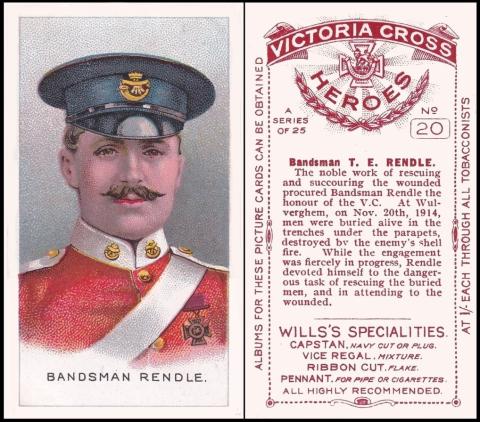
W.D. & H.O. WILLS [tobacco : UK - Bristol] "Victoria Cross Heroes" - Specialities (March 1915) 20/25 - W675-379.B : W/109.B
Our "military mystery man" was actually much more of a mystery than I ever imagined, so I am very pleased that I picked him for our annual Armistice Day practise of picking a military man and tracing their story.
So here is Bandsman Rendle - complete with another Movember Moustache - and he was indeed chosen because he was the first moustachioed soldier I found. The back gives us another clue, for it calls him Bandsman T. E. Rendle. Those initials allowed me find Thomas Edward Rendle, who was born in Bedminster, near Bristol, on the 14th of December, 1884.
During the First World War, he was a bandsman, as showing here, signed to the first Battalion of The Duke of Cornwall`s Light Infantry, and, when he was twenty nine years old, he won the Victoria Cross.
On the card, which is rather hard to see, being red, small, and a little blurred, it tells us : "The noble work of rescuing and succouring the wounded procured Bandsman Rendle the honour of the V.C. At Wulverghem, on Nov. 20th, 1914, men were buried alive in the trenches under the parapets, destroyed by the enemy`s shell fire. While the engagement was fiercely in progress, Rendle devoted himself to the dangerous task of rescuing the buried men, and in attending to the wounded."
I actually found the London Gazette which featured the notice of the award, from which it seems pretty certain the above was taken. This was published on the 11th of January, 1915, by the War Office, and it reads : "His Majesty the KING has been graciously pleased to approve of the grant of the Victoria Cross to No. 7079 Bandsman Thomas Edward Rendle, 1st Battalion, The Duke of Cornwall's Light Infantry, for his conspicuous bravery, specified below: — For conspicuous bravery on the 20th November, near Wulverghem, when he attended to the wounded under very heavy shell and rifle fire, and rescued men from the trenches in which they had been buried by the blowing in of the parapets by the fire of the enemy's heavy howitzers."
A slightly smaller version of this also appears on card 51 of Gallaher`s "The Great War Victoria Cross Heroes", in the third Series of twenty-five cards, and that reads : "Bandsman Thomas E. Rendle V.C. (1st Batt. Duke of Cornwall's Light Infantry) won this honour for conspicuous bravery at Wulverghem on the 20th Nov., 1914, when he rescued men from shattered trenches and attended to the wounded under a heavy shell and rifle fire". This Gallaher card is important for another reason though, as it shows him not in red, but in khaki, and that means he would have been at the front not as a bandsman, but as a helper, most usually a stretcher bearer, or extra manpower.
He is also seen in khaki on a very decorative silk issued by Robert Sinclair, which inserts his portrait inside a golden laurel wreath - this does not have much of a description, but what it lacks in size it well makes up for in content, for it tells us that : "Lance-Corporal T. E. Rendle, V.C., of the Duke of Cornwall's Light Infantry, won the Victoria Cross for rescuing Lieutenant Colebrook under heavy fire."
Picking just one man out and naming him seemed rather odd, because the other cards mention collapsed trenches and lots of men, so I tried to look up Lt. Colebrook and whilst I could find he was a Special Reserve from the third Hampshire Regiment, there seems to be nothing about him and even less about him being one of several men rescued. Then I stumbled on something even more curious, which is the account of the incident, which appeared in a book, published in 1917 - this was written by G.A. Leask and digitised some time later. And reading this seriously makes me think that our man must have taken part in two brave rescues, and not just the one on our card..
As well as winning the Victoria Cross, which he wears on this card, he was also raised to the rank of Sergeant. After the war, he emigrated to South Africa, and became the bandmaster of the Duke of Edinburgh`s Own Rifles, which is still in existence, but renamed to Chief Langalibalele Rifles. He died, in Cape Town, on the 1st of June 1946, aged just sixty-one.
And as for his Victoria Cross, it is displayed in at the Duke of Cornwall's Light Infantry Museum in Bodmin, Cornwall.
This set is a variant of a set that was issued several times, and you can see the `Scissors` branded version, issued in January 1915, as our Card of the Day for the 28th of December, 2025. You can also investigate the "Havelock" one, for it is another Card of the Day, for the 1st of March, 2026.
This set was only ever issued overseas, and you will find it first described in one of our original Wills booklets, part three, where the text reads ;
- 109. 25. VICTORIA CROSS HEROES. Size 64 x 37 m/m. Fronts lithographed in colour ; backs with descriptive text.
AUSTRALIAN ISSUES :-
A. Red backs, with "Havelock" advertisement
B. Red-brown backs, with "Wills`s Specialities" advertisement
"SCISSORS" ISSUES :-
C. Red backs, with upright "Scissors" packet"
Varieties :- card No.21 is found (a) with front "Captain", back "Major" Reynolds (b) with front and back "Major" Reynolds.
"GENERAL OVERSEAS ISSUE :-
D. Blue backs, anonymous
I have not yet examined the blue anonymous issue, but I am struck by how our set, and the `Scissors` version both have small Victoria Crosses at the end of the chain beneath the title, whilst the `Havelock` one is totally different, managing to fit a huge Victoria Cross in between the words saying "Victoria Cross" and the line saying "Heroes".
By the time of our original World Tobacco Issues Index, these sets have been dispersed, the `Scissors` branded Indian version , and the anonymous one being relocated. The two Australian ones do remain together, and are entered as :
- VICTORIA CROSS HEROES. Sm. 64 x 37. Nd. (25) See W/109 ... W62-247
A. `Havelock` back. Brand issue.
B. `Wills`s Specialities` back
In our updated World Tobacco Issues Index, the Australian versions are listed as
- 25. VICTORIA CROSS HEROES. Sm. 64 x 37. Nd. (25) See W/109 ... W675-379
A. `Havelock` back. Brand issue. B. `Wills`s Specialities` back
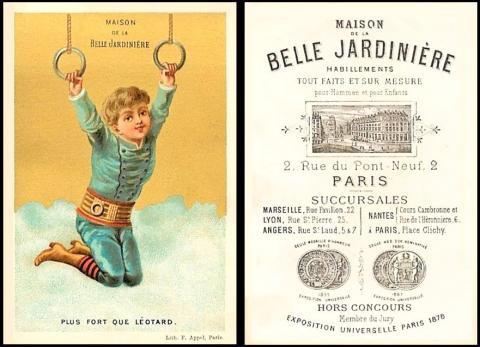
Maison La Belle Jardiniere [trade : department store : O/S - Paris, France] "Advertising Card" (1875? )
As for our early swinger, here he is. For today, in 1859, a man called Jules Leotard performed on the flying trapeze for the first time.
He was born about 1842, in Toulouse, France, and he was the son of a gymnastics teacher. Despite that, or maybe because of it, young Jules was advised by his father to become a lawyer. But it was too late, he loved the thrill of leaping in the air and somersaulting, which was his favourite thing of all; it was no surprise that it was he who first performed a complete mid-air somersault between leaving one swinging bar and grasping to another.
At this point we must say that Leotard did not invent the trapeze, the word was known half a century, at least, before he was born. What he did was make gymnastics into show business, staging the scenes, pretending to be in more risk than he was, and wearing a tight one piece garment which showed off his physique to grand effect, and came to be known as a Leotard. However it was not the short body style we have today,, akin to a swimsuit - his had long arms and legs, simply to lessen the chafing effect, or even burns, from the ropes if he should misjudge, and it was also skin tight for no other reason than any loose cloth could bunch up or become caught in the ropes. It was certainly nothing like the elaborate costume on our card, and it would never have had heeled boots, again for safety reasons.
Now before we leap on, there is a major error with this card, for it shows him on rings, and not on a trapeze. For a trapeze is a short, horizontal bar, attached to the ceiling, in mid air, and the name even refers to the shape, the bar, the supports and the ceiling forming a geometrical shape known as a trapezoid, this being a polygon with four sides and four angles, in which no sides are parallel.
As for the wording on the front of the card, "plus fort que Leotard", that translates to stronger than Leotard, presumably referring to their strong reputation, or strong sales ? But the only date on this card is 1875, by which time Leotard was dead, for he died of smallpox, in 1870.
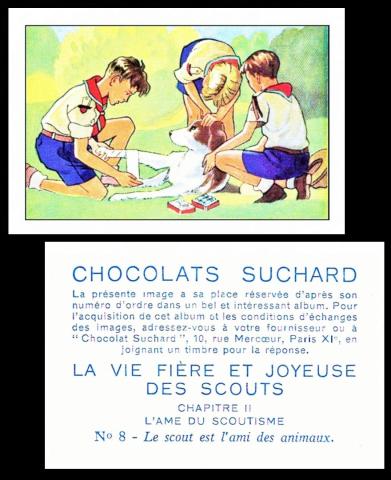
Chocolats SUCHARD [trade : chocolate : O/S - Paris, France] "La Vie Fiere et Joyeuse des Scouts" / the proud and happy life of Scouts (1951) 2.8/200
Our "pleasing practise" was kindness, for today, and every thirteenth of November, we celebrate #WorldKindnessDay - or #KindnessDayUK.
That is nothing to do with the belief that the thirteenth is often regarded as unlucky, it simply refers to the fact that on that day, in 1998, the first ever World Kindness Movement conference started, in Tokyo - though it also harked back to a speech, delivered to graduating students of Tokyo University by their President, Seiji Kaya, which included the words “I want all of you to be brave in practicing ‘small kindness,’ thereby creating a wave of kindness that will someday wash over all of Japanese society.”
That President would go on to become the President of a group called The Small Kindness Movement - and that now has members in thirty-five different countries across the planet. It aims for a world in which good deeds have as much news coverage as disasters, natural or man made.
And maybe one day this will happen.
Kindness is actually defined as doing something for another without expecting a reward of any sort, and this was encouraged by Robert Baden Powell, the founder of the Scouting movement; who wrote his original Scout Laws in 1908. These formed a system of rules that every Scout would promise to follow, and there amongst these, as number six, is "A Scout is a friend to animals. He should save them as far as possible from pain, and should not kill any animal unnecessarily, even if it is only a fly – for it is one of God's creatures."
This law still remains worldwide in many countries which have a Scouting presence, though less likely in the Far East - however, it is subtly changing as we come to terms with the fact that we face an uncertain future, and many countries now also include protection of the environment, and plant life, instead of only the animals.
This card is from a different style of Suchard set to those we usually feature, mainly because it is later in date, by several decades.
The illustrations are by Pierre Joubert, a French artist, born in 1910. Some sources say he was heavily involved with the beginning of scouting in France, whilst others say he was a scout who drew on his experiences for his drawings and then became more involved in the movement. However we know that his scout drawings were first published, in a scouting magazine, in 1926, when he was still a teenager, and that fact seems to disprove he had anything to do with starting the idea of scouting.
The set was designed to fit in an album, with a spiral binding, and squares in which to affix the cards, ten cards per page over twenty pages, with the text printed beside. And do be aware that it begins with a card of Baden Powell. However the numbering is rather confusing because each page starts again from number one, and if you look again at our card you will see that it is number 8 of the second section, for under the title it says "Chapitre II - L'âme du Scoutisme" (which means chapter two - the Soul of Scouting) - followed by "No.8 - Le Scout est l`ami des animaux". Those chapters are :
- I - Les Origines du Scoutisme - [the origins of scouting] - cards 1.1 to 1.10 -
- II - L'âme du Scoutisme - [the soul of scouting] - cards 2.1 to 2.10
- III - Une rude Leçon - [a harsh lesson] - cards 3.1 to 3.10
- IV - Une chasse Tragique - [a tragic hunt] - cards 4.1 to 4.10
- V - La Scoute - [the girl scout] - cards 5.1 to 5.10
- VI - Le Campisme - [camping] - cards 6.1 o 6.10
- VII - A la conquête des badges -[the quest for badges] - cards 7.1 to 7.10
- VIII - Scoutisme Marin - [the sea scouts] - cards= 8.1 to 8.10
- IX - Le Scoutisme Français - [scouting in France] - cards 9.1 to 9.10
- X - Le Scoutisme Féminin - [girl scouts] - cards 10.1 to 10.10
- XI - Le Jamboree - [the grand jamboree] - cards 11.1 to 11.10
- XII - Un grand ‘Routier' - [the French explorer; Rene Caille] - cards 12.1 to 12.10
- XIII - L'enfance de Bertrand - [Bertrand`s childhood] - cards 13.1 to 13.10
- XIV - Le loup de Gubbio - [the wolf of Gubbio, tamed by St Francis of Assisi] - cards 14.1 to 14.10
- XV - Une héroïne de 16 ans [a heroine of just sixteen ; Elisabeth Cazotte, who saved her father from the mob during the French Revolution] - cards 15.1 to 15.10
- XVI - La sagesse couronnée - [the crowning of wisdom] - cards 16.1 to 16.10
- XVII - Laquelle des trois ? - [which of the three?] - cards 17.1 to 17.10
- XVIII - Conclusion - [conclusion] - cards 18.1 to 18.10
- XIX - Chant fédéral - [the Federa Song] - cards 19.1 to 19.10
- XX - Va, Scout de France - [Go, scout of France] - cards 20.1 to 20.10
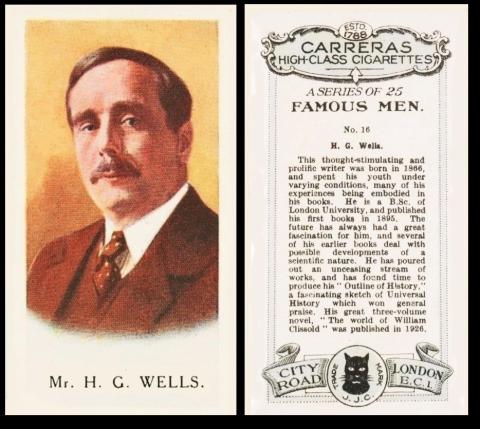
CARRERAS Ltd [tobacco : UK - London] "Famous Men" (1927) 16/25 - C151-450 : C18-79
Our "medical miracle" is yet another Movember Moustache. For today is #WorldDiabetesDay. And I expect several of our readers are wondering why we have this card at all, so I will tell you.
The truth is that the charity and advice service that is today called Diabetes UK started out as The Diabetic Association, and was set up, in 1934, by two diabetics, the doctor R. D. Lawrence and the author H. G. Wells.
Mr. Wells's diabetes diagnosis came late, in his early sixties, around 1930, and he was amazed , and shocked, at how little information was available to him regarding diabetes. Then, in July 1931, he found a new doctor, R. D. Lawrence. Doctor Lawrence had been diagnosed with diabetes in 1920, when there was no effective treatment, and his life had literally been saved by the discovery of insulin. Together the two men started to work on setting up a group of fellow diabetics starting a group whose aim was to make insulin more readily accessible to the public. However this developed, and quickly, into studying the disease, and informing the patients as well as many doctors, then to work on treatments and solutions. financial situation.
The group then campaigned for the creation of a proper health service for all, and that would eventually become our National Health Service.
Insulin is a hormone produced quite naturally in the pancreas, which regulates the amount of glucose, a kind of sugar, in blood. And for many of us we do not even notice it going about its work. The problem is that some people do not make enough, or their bodies actually destroy the cells that make the insulin, and so their glucose builds up, which leads to diabetes.
The cells that make the insulin were discovered by 1920, but it took until November of that year for the Canadian surgeon Frederick Banting, Professor John MacLeod, and student Charles Best to remove some, from a dog. Then in January 1922 came the first use on a human, the fourteen year old Leonard Thompson. And it not only worked, but it saved his life.
However, it was not actually called "insulin" until May 1922, when a paper was presented at a meeting of the Association of American Physicians in Washington. Then the real miracle happened, because on the 23rd of January, 1923, the three creators were awarded American patents for insulin, and the production process. And they sold their patents to the University of Toronto, for just a dollar each, so that everyone, all over the world, could one day benefit from their discovery.
In October 1923, Messrs. Banting and Macleod were jointly awarded the 1923 Nobel Prize in Physiology or Medicine. This came with prize money, and so Banting split his half of that with the student Best, and Macleod his half with James Collip, a biochemist, who had joined the group in 1921 with the aim of purifying insulin so it would be safe enough to be tested in humans.
As for our set, it appears in our original World Tobacco Issues Index under section 2.D of our Carreras listing, reserved for General Export Issues. However the entry is rather short, just :
- FAMOUS MEN . Sm. Coloured halftones. Nd. (250 ... C18-79
And that is the exact same entry as appears in our updated World Tobacco Issues Index, save a new card code of C151-450
This week's Cards of the Day...
This week we are going to revisit a very important theme, and that is Movember - a whole month dedicated to men`s health, revolving around moustaches for the most part, but there are also many ways you can get involved HERE
If any of our readers are taking part, we wish you all the best.
And we hope that every reader will take time to read about this event, and all the things it aims to support men through.
We will also try to feature as many moustaches as we possibly can throughout the month, just to keep you on track.
So our clue cards this week were :
Saturday, 1st November 2025
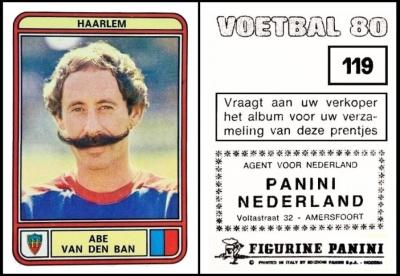
We started our Movember Moustaches with this spectacular one belonging to Dutch footballer Arberth "Abe" van den Ban, who was born on 14 October 1946 in Zaanstad. He played sports as a child but not football until he was older; in fact his first football team was Zaanlandsche Football Club, of Zaandam, in 1965, when he was nineteen. He stayed with them for five years, before moving about half an hour`s drive away to AZ Alkmaar. Whilst there he appeared on his rookie card, though there is some debate as to which of two cards he appeared on in that year should have that honour - for there is a set of stickers issued by Vanderhout, called "Voetbalsterren in Aktie", or footballers in action, and a set of cards issued in Holland by Monty Gum which are known as "Eredivisie 1971 Top-Voetballers". This is further complicated by the fact that some collectors do not consider stickers as cartophilic, in which case the Mont Gum cards will get the nod.
In 1972 our man moved on to FC Amsterdam, a brand new club which was only started on the 20th of June 1972 when two clubs merged, those being Blau Wit (which means "blue-white") and Door Wilskracht Sterk. Then, in 1976, he moved again, to HFC Haarlem, which is the strip he wears on our card, as well as on card 102 of Panini`s "Voetbal 78"., and card 142 of their "Voetbal 82". Then, in 1982 he decided to retire. He moved into the hospitality industry, working at hotels and restaurants, which he seemed to enjoy very much.
This was the third year that Dutch football had been commemorated by Panini stickers, the first being in 1978. The truth behind this is that the 1970s was truly the decade when the Dutch squad forst really came to prominence, reaching the final of two World Cups, losing to West Germany in 1974 by two goals to one, and to Argentina in 1978 by three goals to one, though that was in extra time. It is almost certain that this suggested these sets, as they were first issued that same year, 1978.
A full checklist for the set can be found at The Cartophilic Info Exchange/V80
The packet for this set is very striking, showing an artist`s impression of a player at full stretch across the Dutch flag - and the same image was actually used for all the early sets issued in Holland, starting with "Voetbal 78" in 1978, it was only the colour of the packet that changed each year, though later the flag was changed to just diagonal shading. The packet colours, etc, are :
- Voetbal 78 - gold, with Dutch flag background - 25 cents for 6 Aanklevende Prentjes (clinging pictures)
- Voetbal 79 - red, with Dutch flag background - 25 cents for 6 Aanklevende Prentjes (clinging pictures)
- Voetbal 80 - blue, with Dutch flag background - 35 cents for 6 Zelflevende Prentjes (self adhesive pictures)
- Voetbal 81- cream, with Dutch flag background - 35 cents for 5 Zelflevende Prentjes (self adhesive pictures)
- Voetbal 82 - yellow, with Dutch flag background - 35 cents for 4 Zelflevende Prentjes (self adhesive pictures)
- Voetbal 83 - pink check, with Dutch flag background - 35 cents for 6 Zelflevende Prentjes (self adhesive pictures) and a starburst shape offering a free album
- Voetbal 84 - orange check, with Dutch flag background - 35 cents for 4 Zelflevende Prentjes (self adhesive pictures) and a starburst shape offering a free album
- Voetbal 85 - light blue check, with Dutch flag background - 35 cents for 3 Zelflevende Prentjes (self adhesive pictures) and a starburst shape offering a free album
- Voetbal 86 - yellow, with Dutch flag background - 50 cents for 6 Zelflevende Prentjes (self adhesive pictures) and a starburst shape offering a free album
- Voetbal 87 - blue check, with Dutch flag background - 50 cents for 6 Zelflevende Prentjes (self adhesive pictures) but no starburst shape offering a free album
- Voetbal 88 - green check, with Dutch flag background - 50 cents for 6 Zelflevende Prentjes (self adhesive pictures) but no starburst shape offering a free album
- Voetbal 89 - grey, with diagonal shading in the background - 50 cents for 6 Zelflevende Prentjes (self adhesive pictures) but no starburst shape offering a free album
- Voetbal 90 - orange, with diagonal shading in the background - 50 cents for 6 Zelflevende Prentjes (self adhesive pictures) but no starburst shape offering a free album
This was the last year that the art drawn player appeared on the packets, in 1991 he was replaced by a real action shot.
Sunday, 2nd November 2025
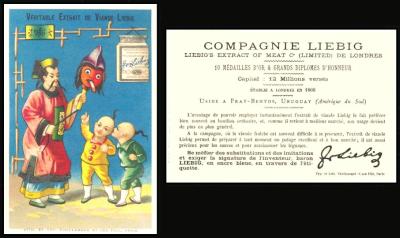
Here we have a moustache which has led to some confusion. You see today it is known as a "Fu Manchu", after a series of films based on the detective stories of Sax Rohmer, though there is no mention of him being moustachioed in the books or in the first film adaptation, in 1923, with Harry Agar Lyons.
The first "Fu Manchu" to sport facial hair was "The Mysterious Dr. Fu Manchu, released in 1929, and starring Warner Oland, however it was only a comb style moustacje and did not extend below or beyond the mouth.
Yet the definition of a Fu Manchu moustache hinges on it extending below the mouth into the chin, and sometimes downwards into thin air. And this sort of moustache was first seen on Fu Manchu only with the 1932 film "The Mask of Fu Manchu", starring Boris Karloff, rather a mishmash of a film, even managing to drag in poor Genghis Khan.
This set is often seen as a bit of a mishmash as well, for it comprises six cards with an Oriental theme, all but one of which has a pot of Liebig product in the image - and they all have different background colours. Some people do not think that the card without the Liebig pot belongs to this set at all, but they cannot suggest any that that are interlopers in any other sets and may fit here in this one instead.
The cards are
- two women at a stall, Liebig pot on table - purple background
- woman in straw hat showing puppet doll on stick to two children, Liebig pots are used as lanterns - green background
- woman with two children, one of whom has a large balloon with a face on it, Liebig jar hanging from a green wall sash - yellow background
- two children? looking at huge Liebig jar on feet - red background
- man showing mask to two children, liebig jar as lantern on wall
- man with long pigtail being pulled by grumpy white dog, no Liebig jar - browny-gold background
As for part one of this series, F.070 or S.071, issued in 1878, it is entirely different, and is also, rather confusingly, known as simply Scenes Chinoises, or Chinese scenes. The cards have a picture of at least one person within a gilded frame, whilst outside are pastel colours and small images of flowers. And all of those have a Liebig pot.
Monday, 3rd November 2025
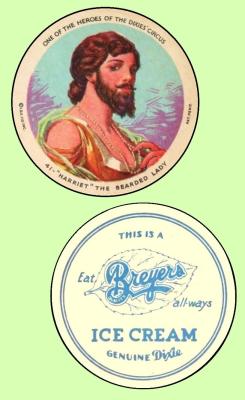
I had this card simply because otherwise it is going to be a very masculine week, and this is an interesting subject, for here we have a "Bearded Lady", and look, she has a moustache too.
This is but an artist`s impression, and there never was a "Harriet. the Bearded Lady", she was but a character in a radio show, conjured up across the airwaves for the delight of the audience, who sat enthralled.
Now this piece has to start with the truth, which is that most of the so called "bearded ladies" at the circus were not. They were either men dressed as ladies, or ladies wearing false hairpieces. However, there are ladies who are just extra hairy, though for the most part it is fine laguno hair, and very much less unnoticeable to anyone else. The problem arises when the hair is darker, and whilst areas which can be concealed whilst clothed (the back, stomach, and legs) are less concerning, other parts are always visible (the arms, chin and upper lip). The main reason for this is two fold, genetics - because some races have more hair than others, and of a darker hue - or polycystic ovary syndrome - which leads to an excess of the male hormone testosterone.
This card falls into a grey area, for some people do not call it cartophilic, yet it was given away, and with a product, for it is a lid from a tub of ice cream, and what is more it lists the ice cream as well as the issuer, Dixie, who were actually the Individual Drinking Cup Company, Inc.
There are twenty-four lids in the set, and each shows a character from the National Broadcasting Company`s, or NBC`s, radio programme "Dixie`s Circus", so technically these are radio collectables too. It must have been a fun show, but I imagine it was not a room filled with animals, but one or two people doing all the voices and impersonations. The wording around the edge also varies, you can get them saying either
- "One of the 24 Animal Heroes of Bob Sherwood’s Radio Stories / Over the WJZ Chain Every Friday Evening" - title in picture
- "One of the 24 Animal Heroes of Dixies` Circus Radio Stories / Over the WJZ Chain Every Saturday Evening" - title in picture
- "One of the Animal Heroes of the Dixies` Circus" - the title being removed to below the image in the white border
- “One of the Heroes of the Dixies’ Circus.” - the title being removed to below the image in the white border
As for dating them, the show began in 1928 on Friday nights, with Robert Edmund "Uncle Bob" Sherwood, who had actually been a clown at P.T. Barnum`s Circus, as well as been involved with motion pictures; in fact in 1915 he was listed as a co-author on a book called "Charles Chaplin's Funny Sayings", and the two seem to have been good friends. Later the radio show moved to Saturday nights and changed its name to "Dixie`s Circus", though Bob Sherwood continued to present right until the radio show was cancelled in 1931, and he did not die until 1946.
It seems that the first twenty four cards were issued more than once, first advertising the radio show on Friday nights, and then changing it to Saturdays, before being altered again, probably in 1931, to remove all trace of the radio show. This seems to have been when the final cards were issued, with the human performers, as I have not found a single card from the human section linking it to the radio show..
The cards are quite elusive, but these are all the ones we know of so far, and the list also includes a note as to which ice cream appears on the reverse, because there are more than one :
- - "Caesar" The Lion (front 2) - Breyer / Reid`s
- - "Sheetah" The Tiger
(front 2) - Breyer`s / Hershey`s / Huber`s / Supplee
(front 3) - Supplee - - "Midnight" The Leopard (front 2) - Breyer`s / Castles / Hoffman`s / Philadelphia Dairy Products / Supplee
- - "Zira" the Panther
(front 2) - Breyer`s / Supplee / Philadelphia Dairy Products
(front 3) - Arctic - - "Queen" The Elephant (front 2) - Breyer`s / Philadelphia Dairy Products
- - "Rollo" the Rhino
(front 2) - Breyer`s / Castles / Horton`s / Philadelphia Dairy Products
(front 3) - Breyer`s - - "Old Mary" The Giraffe
(front 2) - Philadelphia Dairy Products / Reid`s
(front 3) - Always Best - - "Henry" The Hyena (front 2) - Breyer`s / Reid`s / Supplee
- - "Scotty" The Fox Terrier (front 2) - Breyer`s / Huber`s / Supplee
- - "Daniel" The Chimpanzee (front 2) - Breyer`s / Horton`s / Philadelphia Dairy Products
- - "Olympia" The Hippo - (front 2) - Breyer`s / Horton`s
- - "Ossy" The Llama
(front 2) - Breyer / Castles / Philadelphia Dairy Products
(front 3) - Breyer / Supplee - - "Sammy" The Sea Lion
(front 2) - Castles / Reid`s / Supplee
(front 3) - Always Best / Huber`s - - "Emperor" The Horse (front 2) - Breyer / Supplee / Philadelphia Dairy Products
- - "Nannette" The Kangaroo
(front 2) - Reid`s / Supplee
(front 3) - Hubert`s - - "Omar" The Camel
(front 2) - Breyer`s / Horton`s / Neuman`s / Philadelphia Dairy Products / Reid`s
(front 3) - Supplee - - "Zeb" The Zebu
(front 2) - Castles / Hoffman`s / Horton`s
(front 3) - Huber`s - - "Cuffy" The Bear
(front 2) - Philadelphia Dairy Products
(front 3) - Southern Creameries / Supplee - - "Wally" The Wolf (front 2) - Breyer`s
- - "Stripes" The Zebra (front 2) - Breyer`s / Castles / Horton`s / Philadelphia Dairy Products
- - "Tillie" The Tapir (front 2) - Breyer`s / Castles / Supplee
- - "Jimmie" The Fox
(front 2) - Breyer / Castles / Philadelphia Dairy Products
(front 3) - Huber`s / Philadelphia Dairy Products / Velvet - - "Billie" The Bison (front 2) - Breyer`s / Supplee
- - "Bobby" The Lynx (front 2) - Breyer`s / Derroit Creameries / Philadelphia Dairy Products / Supplee
- - "Alex" The Ibex (front 3) - Breyer`s / Purity / Supplee
- - "Hooks" The Water Buffalo (front 3) - Breyer`s / Reid`s / Southern Creameries
- - "Bill" The Elk (front 3) - Huber`s / Southern Creameries
- - "Whitey" The Polar Bear (front 3) - Horton`s / Supplee
- - "Toughy" The Wild Boar (front 3) - Purity
- - "Twister" The Rocky Mountain Sheep (front 3) - Castles
- - "Slinky" The Civet (front 3) - Schrauth`s
- - "Sambo" The Black Panther (front 3) - Huber`s / Supplee
- - "Teddy" The Moose (front 3) - Castles
- - "Gunner" The Gnu (front 3) - Breyer / Horton`s
- - "Andy" The Chamois (front 3) - Breyer``s / Castles
- - "Jocko" The Monkey (front 3) - Always Best / Purity
- - "Bucky" The Animal Trainer (front 4) - Supplee
- - "Myrna" The Snake Charmer (front 4) - Supplee
- - "Dick" The Ring Master (front 4) - Breyer`s / Huber`s
- - "Zanelly" The Acrobat (front 4) - Rieck`s / Southern Creameries
- - "Harriet" The Bearded Lady (front 4) - Breyer`s
- - "Freddy" The India Rubber Man (front 4) - Horton`s
- - "Jubilo" The Band Master (front 4) - Huber`s / Supplee
- - "Alf" The Clown (front 4) - Huber`s
- - "Tiny Tim" The Midget (front 4) - Bartholomay / Reid`s / Schrauth`s
- - "Maria" The Equestrienne - (front 4) - Breyer`s / Huber`s
- - "Jenny" The Fat Lady - (front 4) - Horton`s / Huber`s
- - "Solly" The Sword Swallower (front 4) - Schrauth`s
Tuesday, 4th November 2025
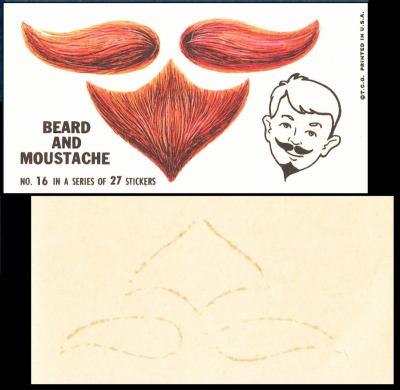
Moving on from the often fake Bearded Lady, here we have a fake moustache, though I am not sure this would deceive anyone for very long.
However if we presume this card would have been originally picked out of the packet by someone in their early teens, they may have already had some thin facial hair, because it can start to appear from the age of ten, starting with the skin at the corners of the upper lip. And I imagine that the ones who had found that were the most anxious to give this sticker a whirl and see what they may look like if it kept on growing. And their hair would indeed keep on growing, getting thicker, but not necessarily darker, because that depends very much on your hair colour, and it would become the beginnings of a moustache, right across the top lip, by roughly about the time they were fourteen. From there it starts to spread, forming sideburns and perhaps a tuft beneath the middle of the lower lip. And as you near the second half of your teenage years these start to join together, forming a full beard which comes down past your ears and encompasses your chin and lips. At which point I have to say that some young men take longer to complete this process, because of all kinds of factors, including genetics, nutrition, and health - and some men remain without facial hair for all their lives.
To really identify these stickers you need to find them in the packet, for that is the only place they are titled as "Disgusting Disguises". However if you get them in a mixed lot you will be luckier, as the cards do have that title on the reverse. The packet also tells us that they came "with 1 stick bubble gum", so they are true trade cards, but more than that it says "Plus skin stickers in every pack" - and today we show you one of those skin stickers. As to whether they were considered to be titled "Disgusting Disguises" or "Skin Stickers", that is entirely up to the collector and their whims. And if I am being honest, not all of the cards or the stickers could even be called disgusting, most are just a little bit of fun.
I knew we featured the cards a while ago but I took ages to find them (though I even knew it was the skull earrings). Now I have found them I know why I could not, for what I used were A & B.C. Gum`s British version, licensed through Topps, and renamed to "Crazy Disguises", and we featured them in the newsletter of the 31st of August, 2024, as the diary date for Monday, the 2nd of September.
I have to say that the cards are fairly easy to acquire, but these stickers are not - possibly because they were used for their intended purpose until they fell off during play, never to be seen again, or they were removed forcibly when it was time for bed or school and thrown away.
I have also been unable to find a checklist for the stickers anywhere else to link to, most places that I usually use only mentioning the cards. However there are only twenty-seven stickers, which are easy enough to list - and they are ;
- Monster Fingernails
- Creepy Crawlers
- Accidents
- Scalp Wound
- Dragonfly & Caterpillar (same as card 25)
- Safety Pin & Razor Blade
- Anchor and Mermaid
- Flies and Bees
- Hearts
- Arrow Target & Nail
- Butterflies
- Scar Face (same as card 22)
- Beetles and Flying Ant
- Devil`s Disguise
- Traffic Signs #1
- Beard and Moustache
- Spiders and Ants
- Loser`s Kit (same as card 26)
- Eyes
- Flowers
- Good Luck
- Scar-Face (same as card 12)
- Big Eyes
- Traffic Signs #2
- Dragonfly & Caterpillar (same as card 5)
- Loser`s Kit (same as card 18)
- Moth and Butterfly
I am not sure why there are several repeats, unless it was presumed these would be the most used of all. And as they are identical, save the number, that is another burden on the collector, who needs to check the numbers even more carefully than usual.
Wednesday, 5th November 2025
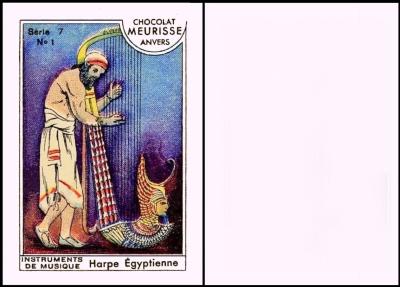
Now we have this card because the earliest surviving representation of a moustache is on a painted limestone statue of a man called Rahotep, who was an Egyptian prince, in about 2500 B.C.
The important word there, though, is "surviving" because the first ever man who roamed the earth would undoubtedly have been hairy, and probably as hairy as any bear, he just never thought to paint that fact - or maybe he did, and we just have yet to discover it.
However, if you look at this card, the player also has a moustache. That means that the wearing of such things must have been much more widespread, than just for royalty.
As far as the instrument ,which is called "Egyptian Harp" on this card, it is also known as an arched harp, or a bow harp, from its shape, which is basically a triangle but with only two sides, those which contact the player, leaving the side that is not against them open. Bow harp was the first name of all, and it referred to the military bow weapon, which this resembled.
However they did not start in Egypt, they arrived there from Mesopotamia, and they got them from Persia, who had them from around 3000 B.C. Strangely, at almost the same time, the Sumerians invented something similar, and theirs spread to Greece and the islands, before turning up in India.
We do not know how it got to India, and there is a theory that they actually invented it all on their own, as a third totally unconnected invention of exactly the same thing.
The cards in this set cover much ground. They are
- Harpe Egyptienne [Egyptian harp]
- Lyre Grecque [Greek lyre]
- La Flute [flute]
- La Trompette Thebaine [Theban trumpet]
- La Guitare [guitar]
- La Mandoline [mandolin]
- La Cornmuse [bagpipes]
- L`Accordeon [accordion]
- Le Cornet a pistons [cornet]
- La Contrebasse [double bass]
- Le Violon [violin]
- Le Piano a Queue [grand piano]
Thursday, 6th November 2025
Strangely, although the earliest representation of a moustache was, as we found out only yesterday, from Egypt, the word "moustache" derives from Greek, of the Hellenistic period, around 300 B.C.
There is lots of debate about this though, as the word it comes from, which is anglicised to "mullon", actually means only lip, and not the hair that rides above it. Even the next development of that word, which was "mustax", and certainly provides the sound of our word most admirably, again only means lip, though it is more specific, and only refers to the upper lip, with again no mention of any hairiness.
We do know that Ancient Greeks wore moustaches though, as is displayed on our card, and that they were seen as a sign of strength, virility, and wisdom. That was why they were mostly associated with soldiers, and with scholars. They were also left alone, unless the wearer was in mourning, in which case they were removed, to show that he was not at full strength, and unable to conduct business. This also seems to be where the idea of punishing prisoners and wrong-doers by forcing them to shave their beards came from, which ostensibly weakened their strength.
When the Romans came through Europe, all this changed, as they were clean shaven, and devoted much time and effort to keeping so. Indeed, the fashion was to have as little body hair as possible. So when a boy started growing a beard it was a major event, not because he could wear the beard, but because it would have to be removed, a cause for huge parties, and a celebratory "first shave". For this would use special decorative razors, of copper and iron, which were rather like the planes we use to shave wood, and any hairs that escaped this device were rubbed away with a pumice stone.
By the way, Julius Caesar seems to have been quite addicted to shaving, he did it more than once a day, whether he needed to or not, and he also enjoyed having his beard plucked out, with tweezers.
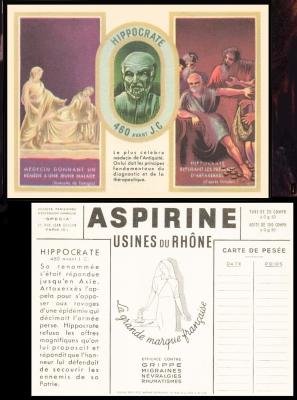
The man in the middle of our card, Hippocrates, was born on the island of Kos around 460 B.C. and he would have been well known to the issuers of our card, for he was a physician, who to this day is referred to as the Father of Medicine, and who introduced so many things to the science that we still use today - clinical studies, tests and trials, the treatment and diagnosis of diseases, the idea of internal medicine, or surgery, the study of the brain, and of the bones. And to this day all doctors celebrate him when they take the Hippocratic Oath, which he actually wrote, rather than it just being named in his honour.
Strangely, then, that he does not appear on that many early cards. His "rookie" card is generally regarded only to have come in 1908, as part of Stollwerck`s "Die Weisen und ihre grossten Schuler", or wise men and their greatest students. Then there is reportedly nothing, until 1958, when he appears of Liebig`s "Savants Celebres de L`Antiquite", more wise men, but this time of antiquity. Then he disappears, until almost the beginning of the twenty first century, or so we are led to believe, as our card today is definitely from the mid twentieth century, if not earlier.
This is an unusual item, a "Carte de Pesee" - meaning card of weights, and look, there is a column printed, into which you filled in the date and your weight. This is a far different system than our weight cards, which only recorded a one time weight and expected you to keep it safe until your next trip to the weighing machine, and then to compare it.
As far as "Aspirine Usines du Rhone", that all started with a German chemist called Felix Hoffman, who discovered the drug aspirin in 1897. By 1899 it was on the market. Then in 1908 it was launched in France, under the brand name "Rhodine", by the Societe Chimique des Usines du Rhone, whose name also appears on this card, top left of the reverse. In fact they issued many hundreds, if not thousands, of cards, with a picture on one side and the text and weight recording section on the reverse.
The Societe Chimique des Usines du Rhone actually has a longer story than Felix Hoffman`s, for they can be traced back to 1801, and a dyer and cotton weaver, from Switzerland, called Samuel Debar. He died in 1856 and left the business to his nephew, Marc Gilliard, and his accountant, Jean-Marie Cartier.
They would eventually buy up another company, also a dyer, called Renard Freres, who had developed the first organic artificial dyes, including red, which had so far proved impossible to reproduce with any stability. I have to say that I do wonder if the name of the firm refers not to brothers, but to the red, because Renard is French for fox, an animal of reddish hue. Gilliard and Carter may have bought out the company, and the patents, but they also gained a partner, a man called Monnet, who was a very skilful dyer, and possibly even the creator of that elusive red. With him aboard, they certainly soon made a name for themselves regarding the quality of their dyes, and for a range of new colours, a green of almost turquoise hue, a violet, and a deep dark blue which they called Paris Blue but we know today as Prussian Blue.
In 1895 they had become so famous that they became a public limited company, at which point they decided to change the name of the company, from their names to Societe Chimique des Usines de Rhone. That means the Chemical Company of the Rhone Factories, which is a bit of a mouthful, and they must have thought that too, for it was often abbreviated to the acronym S.C.U.R.
.
Friday, 7th November 2025
The Roman practise, of shaving off their facial hair, seems to have outlasted them in Europe for a long time. However at the end of the twelfth century it started to make a comeback, as what was known as a "circle beard", but was almost certainly a beard joined to a moustache.
The moustache alone seems to have been quite unknown until the fourteenth century, when it appears the practise was revived by the Knights. It also seems likely that they did this for a similar reason than the Greeks, for strength and virility. However it does not seem to have spread to the general public, and it remained restricted to royalty, and the upper classes, throughout the Tudor period.
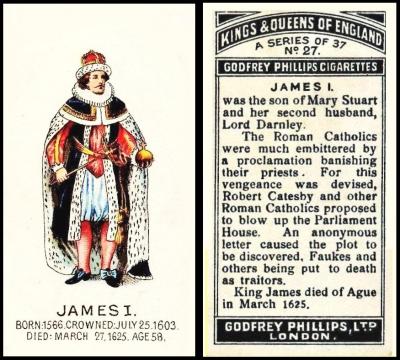
That all changed when Elizabeth the First took the throne, as she could not grow a moustache or a beard, and this seems to be why James I, her cousin, King of Scotland, and now successor to the English throne, cultivated his facial hair - in order to stress that things would be different now a man was in charge. Though he was also rather vain, and liked the thought his moustache made him more attractive.
Once he took the throne, it seems that everyone started growing moustaches, whatever their social standing. And his son, King Charles I, would raise the moustache to even more popular acclaim, even sitting for a very unusual portrait in which his moustache can be seen, and admired, from the front and both sides all at once. Sadly his lavish lifestyle came to an abrupt end, and he was executed, aged forty-eight, on the thirtieth of January, 1649.
_-_Google_Art_Project.jpg)
This set looks ancient, and yet it was only released in 1925. There is a theory that it sat on the shelf for a long while before being released, and this is actually supported by the fact that the most modern royal on it is Queen Victoria, who died in 1901. She was succeeded by King Edward VII, who does not appear here, and he was followed by another King, George V., who had been on the throne for fifteen years when this set was released, and is missing from it too.
It is also a complete mish-mash as far as the timeline of the cards goes, for they are :
- Mary (wife of William III)
- Edward VI
- George IV
- Mary II
- Victoria
- Henry VII
- Stephen
- Richard III
- Henry VIII
- Edward I
- George I
- Edward III
- Anne
- George II
- Henry II
- Elizabeth
- William III
- Richard III
- William I
- John
- Henry VI
- Charles I
- Edward II
- William IV
- Oliver Cromwell
- William II
- James I
- Henry I
- Edward V
- George III
- Henry V
- Edward IV
- Henry VI
- Charles II
- Henry III
- Richard I
- James II
There is something else that you may not have noticed on our card, and that is a mis-spelling, regarding the Gunpowder Plot, where it states "An anonymous letter caused the plot to be discovered, Faukes and others being put to death as traitors." - but his name was Fawkes, not Faukes. And this seems an uncharacteristic error for such a large and prominent firm as Godfrey Phillips. However, there is mention of another lapse in checking, in its first appearance in our original Godfrey Phillips reference book, RB.13, published in 1949, which reads :
- 97. 37 KINGS & QUEENS OF ENGLAND. Small cards, size 67 x 36 m/m. Fronts lithographed in colour. Backs in black, with descriptive text. 1922-1940 issue (issued ? 1925). Nos. 1 and 4 have the descriptive text transposed ; when this error was discovered these two cards were withdrawn from circulation.Post cards are known based on the same originals as were used for this series.
The transposition is a reasonable error as those cards are both Queen Marys. However I would like to know more about the post cards.
Now I am calling it a day (or a night, more correctly). The only thing left to do is to add some of the card codes and material from the reference books and I will do that tomorrow. All in all the newsletter came together very well, and it has been one of my favourites of all time.
And now to bed, to recuperate, and plan next week`s newsletter, already.....