
Welcome to another weekend, and another newsletter - in whch, for once, every one of the diary dates I wrote down first are here, without a single substitution due to an incorrectly reported date, or my inability to track down any suitable cards.
As that gave me more time I was able to go back and do more work on tracking down more November cards, as well as numbering the sets that were issued in each month instead of bulleting them - so we have a total.
But more about that later.....for its time to chat about our first diary date...
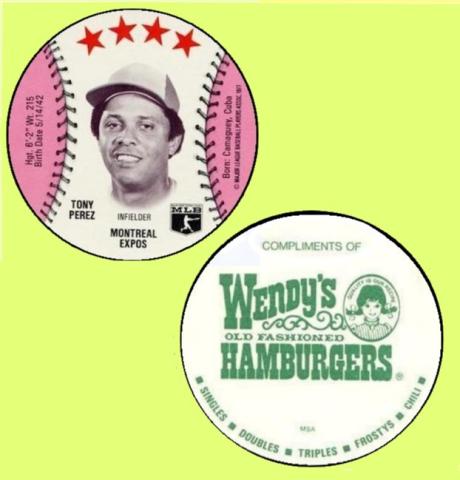
Wendy`s [trade : restaurants : O/S - Columbus, Ohio"] "Baseball Discs" (1977) Un/70
Let us start with food, for today, in 1969, saw the opening of the first ever "Wendy`s" Restaurant, in Columbus, Ohio.
This was almost thirty years after the world`s first McDonalds, which opened in 1940 in San Bernardino, California, and likes to think it invented everything. However, we know that the idea of the "drive through" came from Wendy`s, whose first “Pick-Up Window” opened in 1970 - whereas the first McDonald's drive-through was not until 1975.
Best of all, Wendy`s issued cards.
It looks like this is their first set, and it comprised seventy circular cards, each 3 3/8" in diameter, which looked like a baseball, complete with stitching, in the centre of which was a baseball player, and the side panels of which contained vital statistics. The reverse is plain-ish, just an advertisement for Wendy`s. They seem to be universally known as "Wendy`s Discs", which does them no favours with collectors, especially not with ones who search for baseball cards. Plus, it also means that it makes it harder for a collector to link these to the other versions of the set, which were issued by Chilly Willee Frozen Drinks, Dairy Isle Ice Cream, Detroit Caesars Pitching Centre, Holiday Inn Hotels, Saga, and Zip`s Ice Cream.
The fact that a lot of these, and all the first ones I discovered, seem to have been ice cream made me consider that these were the lids. However the "Saga" ones had no idea of what they sold, they simply say the cards are "A Collectors and Traders Item" - however, they also issued a second set, in 1978, which says they are "Responsible Partners with Students, Parents, and Educators", which means they must have been in the education business. Then I found the other ones, which were not ice cream either.
Then I hit on the most important set of all, Mike Schechter Associates, Inc., of Westchester in New York. And the reverse of their discs advertise that they can provide "Customized Sports Discs" with "Major League Baseball Players, NBA Players, NFL Players, Professional Men and Women Tennis Players, and other people, places and things." Therefore these were the originators of this series, the others merely picked it up and supplied the advertising.
However there was a slight problem with this theory, as Dairy Isle also issued two sets, and their first, which is almost identical in design to our set, was released in 1976. More than that, they then issued this same set we feature today in 1977.
This led us to further investigate Mike Schechter Associates, Inc. and it turns out that they were indeed the originators of the idea, with their first set of baseball discs being issued in 1975. However they were blank backed, as were the discs for 1976. which is the same set as Dairy Isle. This leads to the theory that either Dairy Isle saw the blank backed cards and asked for ones with their name on, or that Mike Schechter did some canvassing. This is backed up by the knowledge that in 1977 Mike Schechter issued a set with their name on, and also blank backed cards - which may indeed have been left overs that were never sold. After that, though, the company seems to have disappeared, right until 1981, when they issued a set of similar cards but different subjects, also with plain backs (though we know these were issued with Sunbeam Bread). In the same year, they issued ones with their own branding, offering to supply "Baseball, Basketball, and Football Players for Your Promotion, on Paper, Plastic and Glass Products". However, there was a change of address, they were now in Connecticut, not New York.
Then there was another gap, until 1987, when they issued another set of baseball discs with a photo image of the player inside a solid circular border. These had no address, but a promotional offer reveals the address to be back in New York. After that, there was a set every year, until 1990. And after that, nothing.
We know more about our featured player, Tony Perez - or, more correctly, Atanasio "Tony" Pérez Rigal.
He was born in Cuba on May the fourteenth, 1942, and his first baseball team was the works one for the sugar refinery in which his father worked. Somehow, when he was seventeen years old, he was spotted by a scout for the Cincinnati Reds, and signed up.
They flew him to Florida, and he took part in Spring Training, which led to a spot on the junior team. From there, he graduated to the senior squad, in 1964, and he stayed there until 1976. After that, he moved on to the Montreal Expos, which is the team on our card, but only stayed there for three years before moving to the Boston Red Sox in 1980. They sold him to the Philadelphia Phillies, in 1983, but he did not see the season out; instead he moved back to the Cincinnati Reds, and there he stayed; and after he retired from playing in 1986, he became their coach, and, in 1993, their manager. However, in 2001 he was suddenly fired - though he was almost immediately hired, by the Florida Marlins, and he was their manager until 2017.
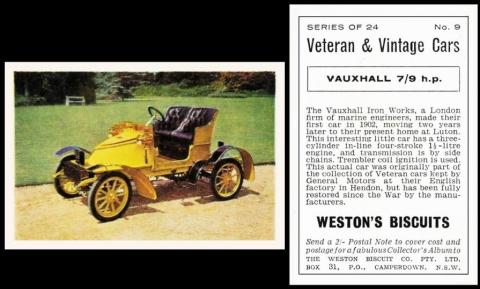
The WESTON Biscuit Co. Pty. Ltd. [trade : biscuits : O/S - Camperdown, NSW, Australia] "Veteran & Vintage Cars" (1962) 9/24 - WE6-3.1.1
Today, one hundred years ago, in 1925, saw Vauxhall Motors sold to America.
The company had been founded in 1857 by Alexander Wilson, a Scottish engineer who made pumps and marine engines. Then, in 1903, they built a car, quite a basic one, with tiller steering, and only two forward gears, no reverse. This was upgraded the following year to allow for a reverse gear, and to add a steering wheel. By 1907 they had relocated to Luton, and changed the company name to "Vauxhall Motors". And the following year they entered a Scottish Reliability Trial, run by the Royal Automobile Club, which was a great success - they were over half a minute faster up the steep hills than any other entrant, and this, more than anything, made their name as a solid, reliable car, and led to their first production model, the "A-Type", being released in 1908.
They remained successful throughout the First World War, though most of their production was given over to the military. However, after the Armistice, there were lots of rivals, and cheaper. And so, today, in 1925, Vauxhall was acquired by General Motors, for two and a half million dollars.
Now when I started this I waxed lyrical about the British "Weston`s" only to find that the card was issued in Australia. Now I have the right book, the Australian and New Zealand Index, RB.30, published in 1983. I can tell you that Weston`s issued both cards, like our set, and package issues, which came on the wrappers of "Wagon Wheels" chocolate covered biscuits. The entry for our set turns it into a group, which is listed as follows :
- Veteran & Vintage Cars. See D.419, British Trade Index Part II, page 228 ... WE6-3
1. 77 x 51. "Series of 24". Nd. 1/24
2. 73 x 50. "Second Series". Nd. 1/24
D.419 is an interesting link, as the "D" stands for duplicate, in other words sets issued by more than one company. And that text reads ;
- D.419. VETERAN & VINTAGE CARS. Medium size.1st (Nd. 1/24) and 2nd (Nd. 1/24)
Montagu Motor Museum - set MOM-1
Western`s Biscuits - overseas issue, Australia.
Gliding over the fact that this entry got the name of our issuer wrong, I have now had a look at the other version, which has, at the bottom, beneath the text, "These cars can be seen at the / MONTAGU MOTOR MUSEUM / BEAULIEU * HAMPSHIRE / Open Daily throughout the Year."
There is another curious fact though, for on some of these cards, reference is made to the museum - for instance on card 19, in the second series, of the 1924 Morris Cowley, the text ends with "This 1924 model has lived in and around the New Forest, England, all its life, and has competed in many rallies since it went to the Montagu Motor Museum in 1964." And on card 21, in the second series, of the 1929 "Golden Arrow", that text ends "It was presented to the Montagu Motor Museum by Castrol Ltd." There are not that many cards online of the Weston series, but I have discovered card 10 of the first series, of the Renault 20/30 h.p., which ends with "When it first came to Beaulieu, the cars were still housed in the Hall of Palace House, and as it was too big to go in, it was kept in the coach house, and brought out only at fine weekends". This seems to suggest that the Beaulieu version came first - but makes us none the wiser as to how it came to be issued in Australia....
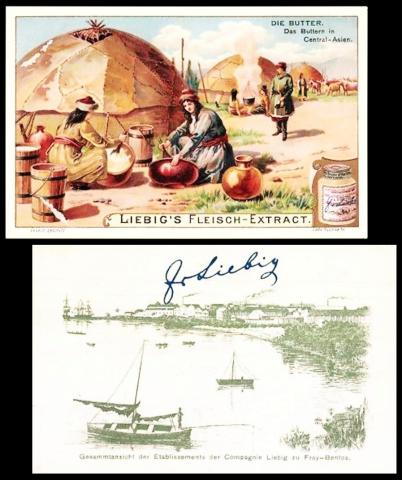
Liebig [trade : meat extract : O/S - South America] "Die Butter" / butter (1904) F.761 : S.0760
Today, and every November the seventeenth, is #NationalButterDay. And butter is vegetarian, as a product made from milk - but it is not vegan.
Butter is simply made, and you can even do it at home - just by whipping up cream and taking the liquid away from the solid part. Then you take that solid, squeeze it into a block, and cool it. However, this special day recognising it as something to be celebrated did not happen until 2021, after a campaign by the Associated Milk Producers Inc., a cooperative owned by dairy farmers from Dakota, Nebraska, Minnesota, Iowa, and Wisconsin. And they had very unlikely help, from a Korean boy band called BTS, who, quite unknowing of the new day, released a single called "Butter", which appeared on the Tonight Show on November the 17th. Someone on the show did the research and discovered the new day, and even wished all the viewers of this amazingly popular show a very happy National Butter Day.
As for the United Kingdom, our top two butters are Anchor, and Lurpak, both of which are now part of Arla Foods. Anchor has its origins in Wiltshire, since 1886 - but Lurpak is a Danish brand, and more recent, being founded by a co-operative in 1901.
This set shows butter making in various countries -
- America
- Armenia
- The Alps
- Central Asia
- Holland
- Russia.
It was issued in France (as "Le Beurre"), Germany (as "Die Butter") and Italy (as "Il Burro") - and reputedly in Holland too but I have not yet found that.
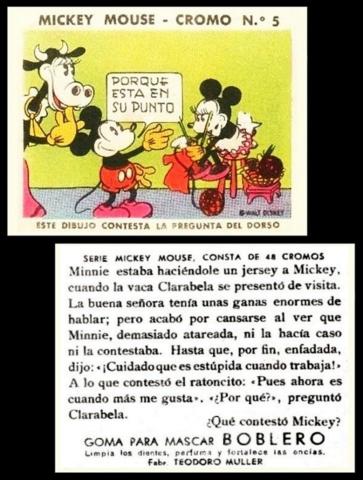
Teodoro MULLER [trade : gum : O/S - France] "Micky Mouse Cromos" (1940s?) 5/48
Today is universally regarded as the birthday of Minnie Mouse, though that is not strictly true, for it was actually the release date of the film "Steamboat Willie", in which she made her debut - alongside another mouse, called Mickey, whose first film this was too.
Although we know her as "Minnie", her actual name was Minerva, much as "Mickey" was at first called Mortimer. She was his girlfriend, but she was also a musician, a singer and a songwriter, who never quite made it, possibly because she was too busy keeping Mickey out of trouble, or maybe because the studio did not want her to overshadow him. Then, in the 1930s, she started to fade away into the background as more characters were developed.
It took until the 1980s for her to return to the small screen, in "Mickey`s Christmas Carol". This almost certainly led to her being featured in "Who Framed Roger Rabbit" in 1988, and to an American musical television spectacular called "Totally Minnie".
On January 22, 2018, she was given a star on the Hollywood Walk of Fame, though it remains a mystery as to why she had not been celebrated at the same time as Mickey Mouse, who received his on November 18, 1978. Even stranger, he got his star for "Steamboat Willie", which had been released on that very day, fifty years before....
As to her "rookie" card, that is a very tortuous tale.
Most collectors will tell you that it was a South American set issued in 1935 by Goma Mascar Boblero. However, translating this into Spanish gives you literally "gum, chew, bubble" and not an issuer at all. If you look closely at the cards, right down the bottom is another name "Fab. Teodoro Muller". The "Fab" actually means maker or issuer, and Mr. Muller turns out to be Theodore Muller, a gum manufacturer from Colombe in France.
There is something else about this set though, for in the same year it was also issued, in English, by Gum. Inc, in America, and by O-Pee-Chee, in Canada. Given what we know of Gum Inc., it is starting to seem more likely that their version may have actually been issued first, and that is backed up by another fact, which is that just after the Second World War Theodore Muller obtained the license to reproduce some of the 1930s Gum Inc. sets, including "Pirates", and "G-Men and Heroes", and to circulate them in France and Belgium, as well as in Spain and Portugal. That seems to suggest that his version of this Mickey and Minnie Mouse set was actually issued in Spain or Portugal, in the 1940s - leaving the way clear for Gum Inc,`s original to be the true Minnie Mouse "rookie" card.
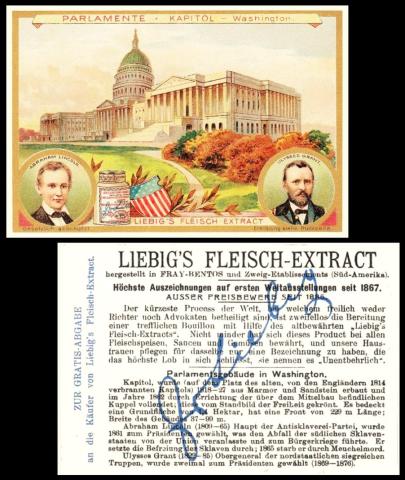
Liebig [trade : Meat extract : O/S - South America] "Parliamente" / parliament buildings (1904) Un/6 - F.790 : S.790
Today in 1863, President Abraham Lincoln stood at a cemetery which had, just four months earlier, been the site of the Battle of Gettysburg, and delivered a speech which would go down in history, despite the fact it was less than three hundred words and took him less than two minutes to deliver.
The full text was as follows : "Four score and seven years ago our fathers brought forth on this continent, a new nation, conceived in Liberty, and dedicated to the proposition that all men are created equal. Now we are engaged in a great civil war, testing whether that nation, or any nation so conceived and so dedicated, can long endure. We are met on a great battle-field of that war. We have come to dedicate a portion of that field, as a final resting place for those who here gave their lives that that nation might live. It is altogether fitting and proper that we should do this. But, in a larger sense, we can not dedicate - we can not consecrate - we can not hallow - this ground. The brave men, living and dead, who struggled here, have consecrated it, far above our poor power to add or detract. The world will little note, nor long remember what we say here, but it can never forget what they did here. It is for us the living, rather, to be dedicated here to the unfinished work which they who fought here have thus far so nobly advanced. It is rather for us to be here dedicated to the great task remaining before us -- that from these honored dead we take increased devotion to that cause for which they gave the last full measure of devotion - that we here highly resolve that these dead shall not have died in vain - that this nation, under God, shall have a new birth of freedom - and that government of the people, by the people, for the people, shall not perish from the earth. Abraham Lincoln November 19, 1863"
Now there are doubters, as always, who claim that his speech differed, and in one way they may be right, as five different forms of the address are known to exist, and it is presumed that others were discarded. In addition, President Lincoln was not well - he was actually suffering from the early stages of smallpox - so he may well have missed bits out. However this is the only version which bears his name and signature. And nobody is still alive to claim that they know what he said because they were there.
As for our set it was issued several times, in Dutch (as Parlementen), French (as Palais Legislatifs), German, (as Parlamente) and Italian (as Parlamenti). The cards are un-numbered, but the subjects are :
- Berlin
- London
- Paris
- Rome
- Vienna
- Washington
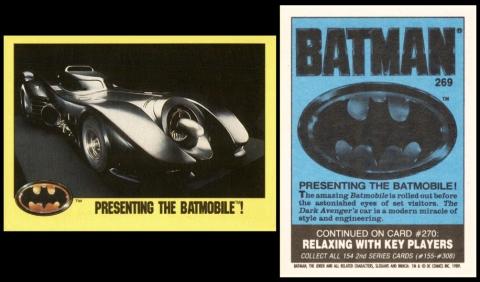
Topps [trade : bubble gum : O/S - USA] "Batman Movie" series two (1989) 247/264
Centenary time again, for today, in 1925, a man called George Barris was born. He would gain fame for building cars, or rather for customising them, especially for the movies and television.
His first major projects was two cars for the tv series "The Munsters, namely the Munster Koach, and the Drag-U-La. These were built in 1964.
Two years later, he built the Batmobile, out of his own Lincoln Futura, which he had picked up knowing it would be useful one day. In fact it was lucky, as the television studio did not give him enough time to create anything from scratch, as he woudl have liked. And he kept it, right until 2013, when it was sold at auction.
It first appears on cards seven, eleven, and twenty-five of Topps` "Bat Laffs" in 1966, which actually had two printings, for you can find it with and without "See the BATMAN Motion Picture release by 20th Century Fox" - and this film was released, in America, on the 16th of December 1966, though the back would have been altered earlier to act as promotion. Curiously it appears that not all the cards can be found with the film wording - and the O-Pee-Chee Canadian version of the set did not advertise the film at all, nor did the Scanlens one, but perhaps because that was issued in Australia in 1967.
As to the actual comic book car, it had first appeared in May 1939 in "Detective Comics", though it was not named as "The Batmobile" until 1941. It was not black though, it was red, though it did have bat like wings. I have not been able to find out when it first changed colour, but in 2011 the vehicle became slightly more rectangular, and much more heavily armoured.
Our Batmobile dates from between those times, and was heavily influenced by the director of the 1989 movie, Tim Burton. As his film was a much darker version of the comic books, he wanted a harder-looking car, which owed much to tanks and aircraft.
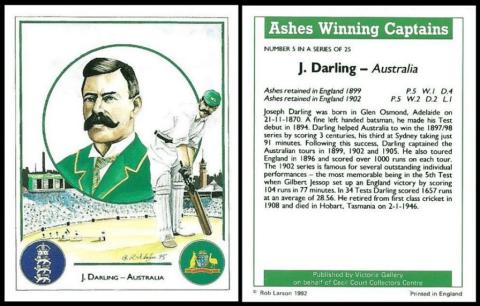
Victoria Gallery [trade/commercial : cards : UK] "Ashes Winning Captains" (1993) 5/25
And so we close - with Joseph "Joe" Darling, who was born today in 1870.
He made his name as a cricketer, a batsman, who was part of the Australian touring team which visited England in 1896, 1899, 1902 and 1905, being Captain of all but the first. And he was the first to reach the total of five hundred runs during a Test.
However he was also, and primarily, a farmer, which held him back from playing more cricket, for he saw farming as his job and cricket as his pastime. This was partially due to his upbringing, for his father did not approve of him playing sport and sent him to agricultural college as quickly as he could, then found him a job, as manager of a wheat farm, in South Australia, where he was born. During this time he was selected for the County team, but his father would not allow him to play.
After two years, he returned to Adelaide, opened a sports shop, and started playing cricket. This seems to suggest his father had either moved or died.
In 1905 he retired from cricket and relocated to Tasmania and farmed sheep for wool, as well as becoming heavily involved in agricultural legislation. This led him to politics, and he was on the Tasmanian Parliament until he died, after surgery for a ruptured gall bladder, in 1946. He was survived by his wife and twelve of his fifteen children.
His "rookie" card seems to be Kinnear`s "Australian Cricketers, which was issued in 1899, during his second Test. However we cannot be sure that it was the "rookie", as two other cards were issued the same year, both by Ogden`s, as part of the plain backed set known as "Cricketers and Sportsmen". One of these shows him alone, and the other shows him with Benjamin Wardill, who organised and managed the 1899 and 1902 Australian tours to England (as well as the 1886 one).
This is a much more modern set, and it can cause confusion, as the Australian players have green backed cards whilst the England players have blue ones. The backgrounds are either of Lords or Sydney Cricket Grounds, which adds a little extra. They were drawn by Rob Larson, who did several other sets for Victoria Gallery.
Something you may not realise is that though it is usually sold just as a set of cards, it did originally come in a case, which showed the urn that holds "The Ashes" and also quoted the original poem which is on that urn. However this seems to now be very scarce - the theory is that buyers preferred to rehouse the cards in the albums with their other cards, and put the case somewhere for safe keeping, and then it was lost.
This week's Cards of the Day...
As we are now into November it is time to find out about the sets we know to have been issued in this month. These all appear in our blog post, "A Cartophilic Year" - which has now had a bit of a change so that the sets are now numbered, not bulleted. Therefore we know that there were seventy-three sets issued in the Novembers starting with the 1903 set of John Player "Celebrated Bridges", and finishing in 1939 with W.D. and H.O. Wills`"Association Footballers", without the framelines to the reverse, which were issued in Great Britain and in Ireland as the final sets to be circulated before cards were stopped by the Second World War,
The most prolific month of all remains June, with ninety three issues positively identified to have arrived between 1904 and 1939
Now when I wrote this up for on Monday I said the most popular years for November issues were 1910, 1914, and 1928, each with five issues. However, after more research, we now know that there were five issues in the Novembers of 1925 and 1939 as well. And there were actually six sets issued in 1928, not five, these being Churchman`s "Famous Railway Trains" (the first large sized series of twelve cards), plus Wills` "A Sporting Holiday in New Zealand" (in standard and medium size), " Modes of Conveyance" (Four Aces` brand), "Picturesque People of the Empire", and "Wonders of the Sea". However that only ties it with November 1937, which also saw the issue of six sets - these being two series of Ardath`s "Real Photographs - A Continuous Series of General Interest" (the third series of views, and the Fourth series of Film and Stage Stars), Lambert & Butler`s "Keep Fit" [in newsletter, scroll down to Saturday 17 September], two versions of John Player`s "R.A.F. Badges" (with, and without motto), and Wills "Garden Hints" (the Channel Islands issue).
So our clue cards this week were :
Saturday, 8th November 2025
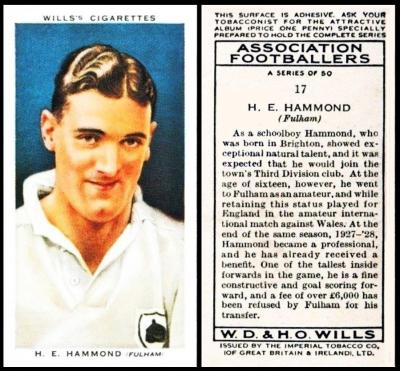
This was not the last set ever issued, but our man, Herbert Edward "Jim" Hammond , shown as a football player with Fulham Football Club, was born on the 7th of November, 1907, in Brighton, And he definitely appears to have a shadow of a Movember Moustache.
He and he was keen on all sports from an early age. His senior career started with Lewes Football Club, then, in 1928, he was signed by Fulham. He stayed with them until 1938, and then retired. He was also a cricketer, for Sussex, and later an umpire.
Sadly he appears on few cards, so it is hard to find out much about him. His "Rookie" card was one of those tall, thin, ones, which were issued with "Topical Times", in about 1932. However these cards have no text at all, the backs are blank.
He then appears on number 57 of the Gallaher/Illingworth/Pattrieouex "Footballers in Action", issued in 1934, where it chooses to only call him "J. Hammond", making it easy to miss. That does have a text, a short one, which tells us he is "Also a promising all-rounder for Sussex Cricket Club. Has a reputation of being able to control anything round. Possesses great height, unusual ball control and a terrific shot. Opened this season in sensational form by appearing at centre-forward and registering a brilliant hat trick"
Our card comes next, in November 1935. That tells us he was "expected to join [Brighton]`s Third Division club. At the age of sixteen, however, he went to Fulham as an amateur, and while retaining this status played for England in the amateur international match against Wales.". It goes on to tell us that "At the end of the same season, 1927-28, Hammond became a professional." - as well as saying he is "One of the tallest inside forwards in the game". Lastly, the card suggests why he stayed at Fulham so long, for it tells us that "a fee of over £6,000 has been refused for his transfer."
That card is quickly followed by Carreras` "Popular Footballers", number 7, issued in 1936, which uses the same picture as our set but removes the badge on his strip. This is one of the best biographies, and tells us he is "an inside left...played in 40 games last season (1934-5) and was his club`s top scorer with 22 goals. Sussex County Cricketer. Brighton born, 27 years ago. Now in eighth season with Fulham with whom he started his professional career. Is 6 ft. 1 in., and weighs 12 1/2 stones.
He died on the sixteenth of June, 1985, at the age of seventy-seven.
Our set first appears in our original reference book RB.16, "The Cigarette Card Issues of W.D. & H.O. Wills Parts I, II, and III (revised) and Part IV", published in 1950. The entry reads :
- 134. 50. ASSOCIATION FOOTBALLERS - "Frameline" back (1936). Fronts printed by letterpress in colour. Backs in grey, with descriptive text, adhesive. Special album issued. Issued 1936.
A. Home issue. with special Album and I.T.C. Clauses
B. Channel Islands and General Overseas issues. No Album or I.T.C. Clauses
Now in our original World Tobacco Issues Index it gets a bit confusing. The first set you will find, if you work from the start of the Wills listing, is in section 2.B., for issues 1922 to 1939, but this is an Irish issue, and nothing to do with our set at all. However, it is there because it does not have adhesive backs. Those cards, which do include our set, forms section 2.C, which is described as "issues 1934-39. Cards with adhesive backs. Special albums issued unless stated." Our set is entered as :
- ASSOCIATION FOOTBALLERS. Sm. Nd. ... W62-192
A. Back with framelines. (50). See W/134.A
B. Back without framelines (50) See W/135.A
As for the Channel Islands version, that has to wait until section 5.D, for "English Language issues, 1935-39. Issued chiefly in Channel Islands and Malta". It is described as "ASSOCIATION FOOTBALLERS. Sm. Nd. (50). Adhesive Back. See W/134.B... W62-492
In our updated World Tobacco Issues Index this system is followed again, the Irish issue, which is for the non framelined set, coming first, and our cards again waiting until section 2.C, where they are entered as :
- ASSOCIATION FOOTBALLERS. Sm. Nd. ... W675-235
A. Back with framelines. (50). See W/134.A
B. Back without framelines (50). No album issued. See W/135.A
As for the Channel Islands version, that has to wait right until section 6.D, for "English Language issues, 1935-39. Issued chiefly in Channel Islands and Malta" - where it is described as "ASSOCIATION FOOTBALLERS. Sm. Nd. (50). Adhesive Back. See W/134.B... W62-492
Sunday, 9th November 2025
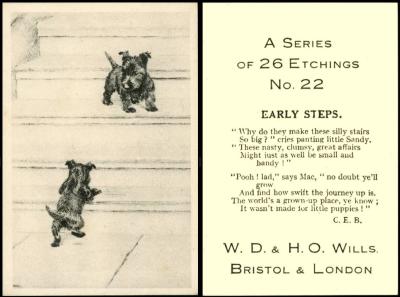
Our second November set was chosen because it will allow us to explore this set and all its various versions.
it is also it is a lovely set, and even better in this larger format than the standard sized one which is more readily available, and which we featured in our newsletter for the 13th of August, 2022, as the diary date for Thursday the 18th of August. This is the larger version, variously described as medium or large.
It first appears in our original reference book RB.16, "The Cigarette Card Issues of W.D. & H.O. Wills Parts I, II, and III (revised) and Part IV", published in 1950. That entry reveals it to be a much more complex issue that we could fit into a newsletter, so I have been waiting to use one as a Card of the Day ever since. It reads :
- 196. 26. ETCHINGS (of dogs). Fronts printed by gravure in black and white. Backs in black. Nos. 12, 13, 17, 19, 21, 22, 23, and 25 are vertical, other numbers in horizontal format. Export issue, between 1925-30.
- GENERAL OVERSEAS ISSUES
A. Small cards, size 69 x 37 m/m. Wills` name at base of back
B. Medium cards, size 78 x 54 m/m. Wills` name at base of back. A and B are known to have been issued in New Zealand, and were probably also issued elsewhere
C. Small cards, size 69 x 37 m/m. "Gold Flake Cigarettes" above Wills` name at base of back
D. Small cards, size 69 x 37 m/m. Anonymous issue
- DUTCH LANGUAGE ISSUES - entitled "Een Serie Van 26 Plaatjes". Small cards, size 69 x 37 m/m. Backs in Dutch, Wills` name at base.
E. With framelines to back, numbered top right.
F. Without framelines to back, numbered top left. Cards of this printing have been seen with back in dark brown.
This listing is updated in RB.19, "The Cigarette Card Issues of W.D. & H.O. Wills Parts I to IV (revised) and Part V", published in 1951, to add :
- 196. ETCHINGS (of dogs) - see page 139.
This series is known in the B.A.T. records as "Kirmse Dogs". Series A and B were issued in November 1925, series D in October 1927.
This single word is the key to a lot more informations, for it allows us to discover Marguerite Louisa Kirmse, born in Bournemouth, on the 14th of December, 1885 to a German father and a Swiss mother. They ran a private school, and taught both her and her slightly older sister, Elizabeth Persis Esperance Kirmse. Both became very talented artists, specialising in animal subjects, mostly dogs. However, Marguerite Kirmse went to the Royal Academy of Music, did not seem to enjoy it and was regularly upbraided for drawing rather than studying. Then, in 1910, aged twenty-five, she went on holiday to America - and did not come back. In 1921 she started etching, using a strong acid to cut deep lines in metal, which are then filled with ink and printed. She started with dogs, and it became her speciality, giving her an income from her work and leading her to find a husband, George C. Cole, who ran a kennels in Connecticut. She died on the twelfth of December 1954.
Returning to our sets, they next appear in our reference book RB.16, devoted to the issues of the British American Tobacco Company, and that adds another issuer. That text reads :
- 200-196. ETCHINGS (of dogs). The recording in W/196 is summarised and ameded below.
A . Wills` Overseas Issue
1. Small cards
2. Medium cards
B. Wills` Gold Flake Cigarettes issue. Small cards
C. Wills` overseas Issue, with Dutch language back. Small cards.
1. Back with frameline
2. Back without frameline
D. Anonymous issue, with letterpress on back. Small cards.
E. Lambert & Butler overseas issue. Medium cards. Back inscribed "Trumpeter Smoking Tobacco - Lambert & Butler, England
By the time of our original World Tobacco Issues Index, though, these sets are all split up. The Wills sets at A., B., and C. above are now in section five of the Wills listing, as :
- ETCHINGS (of dogs). Black and white gravures. Nd. (26). See RB.21/200-196 ... W62-445. .
A. Back with Wills` name at base, no brand quoted. Size (a) small (b) medium 80 x 54
B. Back with Wills` name and "Gold Flake Cigarettes". Small size.
You will find the Dutch issues under section 5.F, for "Dutch Language issues, issued in Dutch speaking areas, 1925-27" - as "ETCHINGS (of dogs). Sm. Black and white gravures. Nd. (26). See RB.21/200-196.C. (a) Back with framelines, in black (b) Back without framelines ... W62-514.
The set that was formerly "D" is now listed at the back of the book under "Anonymous Issues (1) - with letterpress on back", as "ETCHINGS (of dogs). Sm. Black and white gravures. Nd. (26). See RB.21/200-196.D ... ZB6-24". We also know these were issued through British American Tobacco.
As for "E", this does not appear in our original Lambert & Butler reference book RB.9 because that was only for home issues, not export ones. It does, however, appear in the original World Tobacco Issues Index, under Lamber & Butler section 3, for "English Language Issues. 1924-28. Chiefly in New Zealand". as : "ETCHINGS OF DOGS (A). Md. 80 x 54. Black and white. Nd. (26). See RB.21/200-196.E ... L8-91".
Our updated World Tobacco Issues Index lists the Wills versions in section 6.B of the Wills listing, for "English Language issues 1923-30. Issued chiefly in New Zealand, some series in Malaya. Malta and elsewhere". It is recorded as :
- ETCHINGS (of dogs). Black and white gravures. Nd. (26). See RB.21/200-196 ... W62-641 .
A. Back with Wills` name at base, no brand quoted. Size (a) small (b) medium 80 x 54
B. Back with Wills` name and "Gold Flake Cigarettes". Small size.
The Dutch issues are under section 6.F, for "Dutch Language issues, issued in Dutch speaking areas, 1925-27" - as "ETCHINGS (of dogs). Sm. Black and white gravures. Nd. (26). See RB.21/200-196.C. (a) Back with framelines, in black (b) Back without framelines, in (A) black (B) brown ... W675-727
The anonymous set that was formerly "D", remains at the back of the book under "Anonymous Issues (1) - with letterpress on back", as "ETCHINGS (of dogs). Sm. Black and white gravures. Nd. (26). See RB.21/200-196.D ... ZB07-280".
There has been quite a change to the Lambert & Butler version though, and that is now listed as : "ETCHINGS OF DOGS (A). B & W. Nd. (26). See RB.21/200-196.E. Issued in Denmark. (A) Sm. 68 x 36. Back with "Viking Navy Cut Cigarettes" (B) Md. 80 x 54. Back with "Trumpeter Smoking Tobacco". Numbering different from above... L073-780"
Monday, 10th November 2025
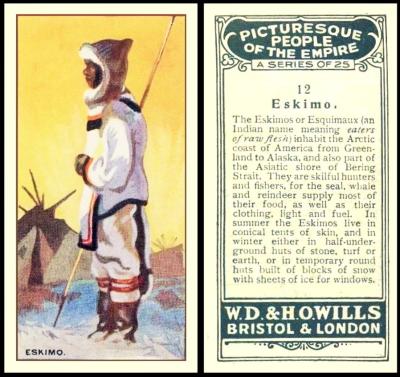
Here we have our third November issue, and again a set with lots of variations that we can now begin to explore.
The first thing I have to say is that today this card would need to be altered, and the man renamed to an Inuit, in order not to offend. The main reason for this is that the name on this card was not of their choosing, it was one imposed on them, by people who took over their lands. Then there is the simple fact that Alaska is home to many people, you cannot lump them all together under one name.
There seems to be few actual representations of the Inuit growing beards and moustaches. This is partially because the Inuit, and Native Americans, remove their facial hair, to stop it freezing. Curiously, though, it is also known that they suffer less from baldness as they age than the rest of the western world, which makes you think that the hair must be fairly strong, and take diligent work to remove so well. In addition, the Inuit diet is mostly comprised of sea life, which is rich in fat and protein , which is good for growing hair - though this has a sad side effect of lowering their bone mass and making them more prone to osteoporosis.
Our original reference book RB.16 – The Cigarette Card Issues of W.D. & H.O. Wills Parts I, II, and III (revised) and Part IV, published in 1950, lists this set as :
- 288. 25 PICTURESQUE PEOPLE OF THE EMPIRE. Fronts printed by letterpress in colour. Backs in grey, with descriptive text. Issued in New Zealand, between 1925-1930. Similar series issued by Ogden, Player, and United Tobacco Companies, (South) Ltd., South Africa.
By comparing the various versions, we know that the Wills version was produced by a different printing method (namely letterpress) to the Ogden`s set (which was lithographed). This may lead you to think that the Wills version was produced overseas, but it was not, for the printing date appears in the list in the Wills Works magazine, and that only listed sets printed in Great Britain and shipped abroad for issue, November 1928.
In our next reference book, which was RB.17, covering the issues of the British American Tobacco Company, published in 1952, the set is listed as :
- 200-288 PICTURESQUE PEOPLE OF THE EMPIRE. The recordings in W/288, RB.15/131 and RB.17/147 are summarised below.
A. Wills` Overseas issue
B. Player Overseas issue, with `Drumhead` cigarettes.
C. U.T.C. issue
D. Ogden Home issue.
In the front index of this book they confirm that the Wills issue was circulated in New Zealand, but they only give a year of issue, namely 1928.
It next appears in our original World Tobacco Issues Index, under section 5, for "Other Export issues" and sub-section 5.B, for "English Language Issues, 1923-30. Issued chiefly in New Zealand, some series in Malaya, Malta, and elsewhere". And it is recorded as :
- PICTURESQUE PEOPLE OF THE EMPIRE. Sm. Nd. (25). See RB.21/200-288.A ... W62-463
This text is the same in our updated World Tobacco Issues Index, but under section 6, because Wills had issued more sets in Great Britain after the publication of our original World Tobacco Issues Index, and these took space five, shunting the overseas issues along until after. The only difference in the listing though is a new card code, of W675-665.
Tuesday, 11th November 2025
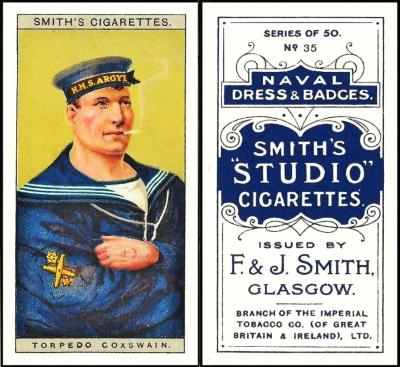
This turned out to be an intriguing story, but let us start at the beginning, in the early 1870s when the Seaman Torpedoman first arrived as a job in the military branch of the Royal Navy.
The reason for this was the arrival of what was known as the Whitehead Torpedo, which was introduced into the Royal Navy in 1871. At first there was no set man to handle it, then suddenly in 1874 a number of Seaman Gunners were selected and trained on how to work with torpedos, though they were still expected to work with standard guns as well. They did get extra pay though, a penny a day.
Our man, however, is actually a Torpedo Boat Coxswain, rather than a torpedo handler, and he would have manned the steam-powered torpedo boats. That means he would also have been either a Leading Seaman, or a Petty Officer Second Class, and he would also have had extra pay, of twopence a day. We know all this because of the badge, which, on the Wills version is described as "two crossed torpedoes with a star below and a steering wheel above, the latter indicating the ability of the man holding it to take charge of a small torpedo boat such as large ships carry. Chief and other petty officers, (whether Gunnery or Torpedo) are eligible for the rating, which carries extra pay of 7d. a day"
As for his tally, or the band of black on his hat, that leads us to H.M.S. Argyll, one of the six "Devonshire" Class armoured cruisers that were assigned to the Channel Fleet, and transferred to the Atlantic Fleet in 1909. She also had a brush with royalty in 1911, when she escorted the Royal Yacht to India, with King George V aboard.
Her life changed dramatically in 1914, when she became part of the Grand Fleet; however she never got to see enemy action, she ran aground and was completely wrecked, on the Bell Rock, off the coast of Angus, Scotland, on the 28th of October 1915. There were no injuries and no loss of life. However it was a strange incident, as it was caused by the fact that the Bell Rock Lighthouse was kept unlit until requested, in order not to assist the enemy. Our ship did send in and ask for light, but the light was never switched on.
As always, Smith`s issued this set in almost all of their brands, and also issued it twice. First of all, they issued it without any mention of the Imperial Tobacco Company, but with a descriptive text on the back. Then they reissued it, as on our card, with reference to the Imperial Tobacco Company, but without a descriptive text.
Our section of the set first appears in our original World Tobacco Issues Index as :
- NAVAL DRESS & BADGES. Sm. Nd. (50). See H.172, Ha.172, and X1/H.172. Multi backed. ... S84-12
(b) Back without descriptive text, with I.T.C. Clause. 8 backs.
(A) Glasgow Mixture - Mild, Medium & Full
(B) "Orchestra" Cigarettes
(C) "Pinewood" Cigarettes
(D) Squaw Thick Black Tobacco
(E) "Studio" Cigarettes
(F) Sun Cured Mixture
This is exactly the same text as appears in our updated World Tobacco Issues Index, save a new card code of S548-300
Wednesday, 12th November 2025
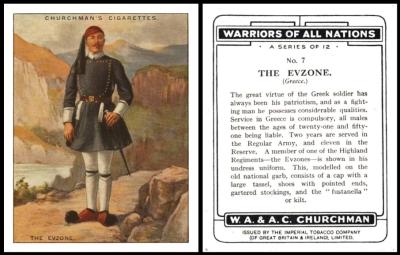
The Evzones have a long story, and started out in Ancient Greece. They were even mentioned in Homer`s "Iliad", and it is thought he was the first to name them Evzonos, which translates to being always ready for action. In those times they were a vital part of the fighting force, foot soldiers with light arms, able to wage war on outlying troops - but these days, those powers have been reduced, and they are just ceremonial, taking part in parades, providing escorts for visiting dignitaries, or guarding the Greek Tomb of the Unknown Soldier and the Presidential Mansion..
Before we race on, we must point out that this distinctive, and, some may say, strange, or even un-military, costume is a recent alteration, dating only from the 1830s. Prior to that the men wore standard uniforms, trousers, coats and tall hats, the only difference being the colour of the embroidery on their jackets and the plume in their hat.
In keeping with our Movember Moustaches, you will see our man sports one, which is a badge of honour, and means he has completed over a hundred hours of guard duty. However he is not allowed a beard, and this is rigorously enforced, so much so that they have to shave four times a day, and against the grain too.
This set first appears in our original reference book to Churchman issues, RB.10 published in 1948, as part of a group. Since we have apparently not featured any of the variations before, and also because the large sized first series set was actually issued first of all, this will be the home page for the group.
So the group listing, from that reference book RB.10 is as follows :
- 144. (Dec. 1929) 25 WARRIORS OF ALL NATIONS (titled series). Size 2 11/16" x 1 7/16", or 67 x 36 m/m. Numbered 1-25. Fronts printed by letterpress, 4-colour half-tone process. Backs in dark grey with descriptions. Printed by Mardon, Son & Hall. Also issued by B.A.T. (overseas)
- 145. (Nov. 1929) 12 WARRIORS OF ALL NATIONS. Similar format to (144), but size 3 5/16" x 2 9/20" or 80 x 62 m/m
- 145. (May 1931) 12 WARRIORS OF ALL NATIONS. Inscribed "2nd Series of 12". other detail as (145), but different subjects.
The mention of B.A.T. sends us off to RB.21, which is a fascinating little booklet, dealing with all the issues under the aegis of British American Tobacco, many of which were also issued in the U.K.by more familiar names. And again, we are not disappointed, for the listing for this set adds another two overseas versions. The entire entry reads :
- 210-144. WARRIORS OF ALL NATIONS
A. Anonymous issue, with letterpress on back.
1. Crossed swords at base, and inscribed "A Series of 25 now being packed with these Cigarettes"
2. Gilt Panel at base, inscribed "High Class Cigarettes"
B. Churchman Home issues.
1. Small cards, series of 25
2. Large cards, series of 12
3. Large cards, 2nd Series of 12
The front index of this volume tells us that both the anonymous versions were issued much later, in 1937. It also says that the version with the crossed swords was issued in South Africa, and the version with the gold panel was issued in Malta.
By the time our original World Tobacco Issues Index was published, in 1956, this group were forever parted. The anonymous ones can be found at the back of the book, under "Anonymous Issues (1) with letterpress on back" and "with references to Tobacco", under section 1.C, for "issues 1919-40" and sub section D, for "Overseas Issues Through B.A.T.". The text for these reads :
- WARRIORS OF ALL NATIONS. Sm. 68 x 36. Nd. (25.) See RB.21/210-144.A and X.21/210-144. ... ZA8-36
(a). Inscribed at base of back "A Series of 25 now being packed with these Cigarettes" with crossed swords below. Issued in S. Africa.
(b). Inscribed at base of back "High Grade Cigarettes" overprinted on gilt panel.
I have checked and RB.21 definitely quotes "High Class", whilst this entry says "High Grade". However what I should have done was to look at the entry under X.21/210-144, which reads "WARRIORS OF ALL NATIONS. The Anonymous printing under A.2 in RB.21/210-144, with gilt panel at base, is inscribed "High GRADE Cigarettes" ( not "High CLASS").
Whilst the entry for our Churchman trio in our original World Tobacco Issues Index was much reduced, to
- WARRIORS OF ALL NATIONS. Nd. See RB.21/210-144.B. ... C82-86
A. Small (25)
B. Large - (1.) "A Series of 25" - (2), "2nd Series of 25"
And this is repeated in our updated version of the World Tobacco Issues Index, save reducing the words Small to "Sm" and large to "Lg." - and adding a new card code of C504-675. As far as the two anonymous versions, the text is again identical, save the removal of the X.21/210-144 code, which was in the handbook for the original World Tobacco Issues Index, and when the update was done all these little discoveries and changes were incorporated in the main body of the text. They also have a new card code though, namely ZA08-870 a and b.
Now you have probably noticed that two lots of twelve do not make twenty-five. As to the card which was added, I have no idea. For though I know all the cards in the first series, which we feature today, and which are ;
- The "Aussie" (card 7 of the small size set)
- The Dervish (card 14 of the small size set)
- The Soudanese (card 15 of the small size set)
- A Soldier of the French Foreign Legion (card 16 of the small size set)
- The “Poilu” (card 17 of the small size set)
- "Tommy Atkins" (card 2 of the small size set)
- The Evzone (card 19 of the small size set)
- The Ghoorka (card 8 of the small size set)
- The Pathan (card 9 of the small size set)
- A Warrior of Old Japan (card 21 of the small size set)
- The “Doughboy” (card 25 of the small size set)
- The Zulu (card 4 of the small size set)
The second series is much scarcer, and I have only been able to find a few online, which are ;
- An Askari of the K.A.R. (card 3 of the small size set)
- The Belgian (card 13 of the small size set)
- The Sikh (card 10 of the small size set)
- The Hungarian (card 12 of the small size set)
- The Turk (card 24 of the small size set)
- The Maori (card 11 of the small size set)
So if anyone can fill in any gaps, please do!
Thursday, 13th November 2025
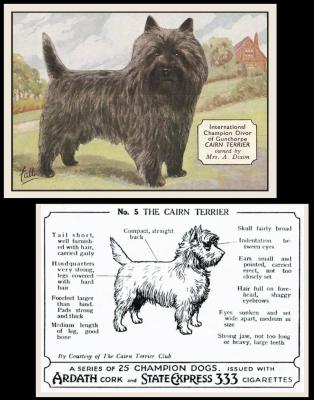
Here we have a lovely Cairn Terrier, all the way from the Scottish Highlands and the Isle of Skye. Before 1873 it was one of many dogs collectively known as "Scottish Terriers",. However, on its first attempt at gaining a unique identity, in the early 1900s, under the name of a "short-haired Skye Terrier", met with opposition from the Skye Terrier Club, who feared that it would dilute their bloodlines if the two were allowed to join together. This led to the new name of a Cairn Terrier, under which it successfully applied to the American Kennel Club for registration in 1903. For some reason no application was made to the Kennel Club here in Great Britain until 1912, at which time there were just over a hundred and thirty dogs.
In 1917 there was another change, when the American Kennel Club clamped down on the exhibition of white coloured Cairn Terrier, and required them to move to classes with its cousin, the "West Highland Terrier", whose first breed specific club had been founded in 1904, though at that time it was known as either the Roseneath Terrier, or the Pittenweem Terrier, with the breed only being renamed to a "West Highland Terrier" in 1909.
Sadly I have been unable to trace very much about this fine specimen, Divor of Gunthorpe, only that he was American, Canadian, and English Champion, and the first Cairn to hold all three of those worthy titles. I know that Gunthorpe is a village in Nottinghamshire, on the River Trent, presumably with links to the owner, Mrs. A. Dixon, who was also a renowned judge. As for the breeder, that seems to be looking like it was Mrs. Betty Hyslop, from Brockville, Ontario, in Canada, who was renowned for breeding both Cairn Terriers and Great Danes, which led to her dogs being given the bloodline name of "Cairndania".
This set first appears under "Notes on Current Series" in Volume two, number 15 of The London Cigarette Card Company`s "Cigarette card News" magazine, dated December 1934. That entry was written by Mr. C. L. Porter, and it reads :
- Ardath Tobacco Co., Ltd. Champion Dogs. 25 large cards. To my mind, the best of this month`s issues. Quite excellent coloured reproductions of celebrated prize winners. There have been other dog issues of equal merit so far as the actual pictures are concerned, but this series has the unique feature of giving the correct points of each breed on the back with illustrated diagrams. I can recommend this series to all dog lovers, and it should be in all general collections.
It is next described in our original reference book to the Ardath issues, RB.6, published in 1943, as
- November 1934. 25. CHAMPION DOGS (titled series). Size 3 3/4" x 2 5/8".. Numbered 1-25. Printed 4 colours from half-tone blocks,black frame lines, white margin. Backs printed in black, showing outline of dog with championship points. Captioned "issued with Ardath Cork & State Express 333 Cigarettes". Also issued abroad.
Strangely, it is also featured in our original reference book to the issues by British AmericanTobacco, as :
- 370. CHAMPION DOGS. Extra large cards, size 95 x 67 m/m. Front in colour. Back in black, diagram of dog in centre with prominent features pin pointed. Numbered series of 25.
A. Anonymous issue, with letterpress on back. Panel at base inscribed "No. ... of a Series of 25 Championship Dogs."
B. Ardath issue. Panel at base inscribed "A Series of 25 Championship Dogs. Issued with Ardath Cork & State Express 333 Cigarettes
The front index reveals the anonymous version to have been issued in South Africa, in 1934 - though this does raise the question as to why it comes first in the entry.
In our original World Tobacco Issues Index, these two are separated. The Ardath issue appears in the main body of the text, as ;
- CHAMPION DOGS. Lg. Nd. (25) See RB.21/370.B ... A72-17
However the anonymous issue is at the back of the book, under "Anonymous Issues (1) with Letterpress on back" as :
- CHAMPION DOGS. Lg. 94 x 67. Nd. (25) See RB.21/370. Issued in S. Africa. Special album issued, inscribed with Westminster name ... ZB6-14
Both these entries remain the same in our updated version of that work, with just new card codes, Ardath`s becoming A745-280, and the anonymous version altering to ZB07-190
Friday, 14th November 2025
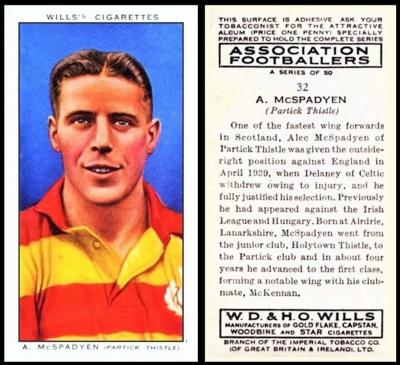
Our man today, Alexander McCluckie McSpadyen, was born on the nineteenth of December, 1914, at Holytown, near Motherwell.
He started playing football as a child, but his first team came late, and that was Chapelhall Juveniles, slightly odd, as by the time he played for them he was nineteen, hardly a juvenile. He did not stay long, as he was scouted for Newarthill Hearts, and then for his proper home team, of Holytown United. He stayed there until 1935, when he was scouted by Partick Thistle.
He much enjoyed it there, though his career was broken by the Second World War, when he was just getting into his prime. I have not been able to find out whether he was called up, and what he did, but I do know that he played for Aberdeen, as a visiting guest, in those curious wartime matches which pitted local men against regimental teams, often with assistance from a known footballer who was billeted in the area, or just passing through. And he also played in the "Army Internationals", which were regular events between Scotland and England, but, rather strangely, did not count bloodlines, only whether the men were serving in Scottish regiments or English ones - and since there were more English regiments, they invariably won. However this means he must have served in the Army, which ruins my thought that he was in a reserved occupation, though it is still odd that a fit footballer would not have been sent to serve his country overseas. .
After the war he went back to Partick Thistle, until 1948, when he suddenly signed for Portadown, in County Armagh. I have not been able to trace any league match he played in whilst he was at Portadown, and he only stayed there until 1949. Then he went back to Holytown, as a trainer, until the club closed in 1950.
As for this card, it is first catalogued in our original reference book RB.16, which covered "The Cigarette Card Issues of W.D. & H.O. Wills Parts I, II, and III (revised) and Part IV". The editor was Edward Wharton-Tigar, and it was published in 1950 as a limited edition of five hundred copies. I have no idea why it waited until then to be listed, the first Wills book being published in 1942 (albeit devoted to thirty-one early issues)
The entry reads ;
- 135. 50. ASSOCIATION FOOTBALLERS -"No Framelines" back. (1939). Fronts printed by letterpress in colour. Backs in grey, with descriptive text. Special album and I.T.C. Clauses. Issued 1939.
A. Home issue, adhesive. Back headed "This surface is adhesive". Four brands, ["Gold Flake", "Capstan", "Woodbine" and "Star") at base
B. Irish issue, non-adhesive. Backs headed "Albums for Wills` Picture cards...." No brands at base.
From the printing dates listed in the Wills "Works" magazine, we know that the Home issue was the final set to be issued, in 1939, before cards were stopped by the Second World War. However, and sadly, there is no date included in those lists for the Irish issue, which probably means it was printed over there.
As for the last set on the "overseas" list of printing dates, that is Wills` "Speed", the Channel Islands version, which was printed in September 1938. Since that was circulated one month prior to the home issue, we imagine that the Irish version of our set may have first emerged from a packet in October 1939.
Curiously, by the time of our World Tobacco Issues Index, both the 1935 "framelined" set and our set have been combined, and entered under section 2.C, which deals with the adhesive backed cards :
- ASSOCIATION FOOTBALLERS. Sm. Nd. ...W62-192
1. Back with framelines (50), See W/123.A
2. Back without framelines (50), See W/135.A
The irish issue is removed, and actually moved before our sets - to section 2.B, which deals with the non-adhesive backed cards. The text for that is ; "ASSOCIATION FOOTBALLERS. Sm. Nd.. (50). Irish issue. See W/135.B...W62-116".
This placement continues in our updated World Tobacco Issues Index, in which the text is identical, save new card codes, namely W675-235 for the Home issue, and W675-152 for the Irish version.
And so, with not that much to add in the morning, we close the book for this week, and go to sleep, lulled by raindrops, for it has been a very wet day that continued into the evening and its still going strong. That also made the night dark even earlier.
I have to say, on such a day, I am not a fan of winter....
Anyway, "Tomorrow is Another Day", and perhaps it will be a dry one. If not I will get the amendments done earlier and maybe some other indoor things as well. I shall not be bored, and that is a given.
Thanks for coming along, and tuning in. I hope you were rewarded, and inspired. And now, you too, must turn in, and go to sleep.