
As we prepare to say farewell, at least for this year, to the merry month of November, and leap headlong into the often chilly December, so shall we begin to bring you a selection of festive delights, scattered amongst the usual diary dates.
As I sit and type of this preamble, I look at the calendar and see that there are but twenty-seven sleeps to Christmas. If you are undecided of what to buy yourself, or maybe a card-curious friend, do make use of our branch and club meetings, the dates of which can be found at our online diary. Whichever you select, you are sure to find a wide range of ideas, at very keen prices, and also save postage on bulky items like storage or even the kind of modern sets which have upwards of six hundred cards. And many have tea and coffee, so you can make a day of it.
By the way, we are now adding next year`s dates to this page, though there are a few gaps awaiting arrival. We even have 2027 dates from East Anglia, so there is no excuse for double booking on those dates.
Enough preamble, for the action beckons, enticingly, below.....
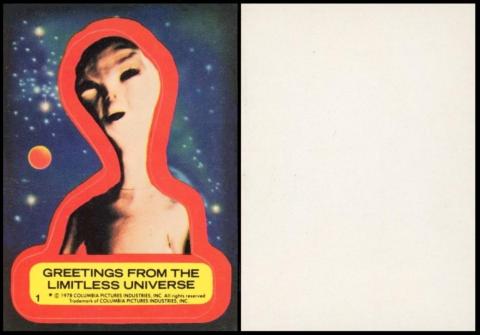
Topps? [trade : bubble gum : O/S - USA] "Close Encounters of the Third Kind" - stickers (1978) 1/11
We will start with a little nod to Christmas, because today is #ElectronicGreetingsDay. And, more and more, the writing and posting of traditional cards, in envelopes, is fading away. This is, of course, mainly due to the cost of post, which is no longer a penny a stamp. However, although the hand written card is often treasured, for a long time, an electronic message can be just as special, and you can send them more often. You can even just send a hi and an emoji, with which thought, we really ought to do that more, don`t you think?
So, as with everything, good and bad.
It is said that the first electronic greeting card was sent in 1993, from a site at the Media Laboratory at The Massachusetts Institute of Technology, or M.I.T Media Lab. It was actually called an Electric Postcard.
Before that though, and that explains why I have this sticker as our illustration, in 1977 two phonograph records were produced, and one sent out into space with each of the Voyager Spacecraft. They contained sounds and images which showed Earth and its inhabitants, and the dream was that one day a member of a far distant, alien, tribe, would find the discs, play them, and come to find us, or maybe even save us. It had a little message on it too, namely "This is a present from a small, distant world, a token of our sounds, our science, our images, our music, our thoughts and our feelings. We are attempting to survive our time so we may live into yours." and it was signed by the then President, Jimmy Carter.
Times move on, and today, it is doubtful that any visitors would receive such a warm welcome; they would probably send down a scout and not like what we were doing to this planet at all, and warp speed quickly away, if they were not seized and detained for daring to be different.
Of course, the inspiration for this issue came from a motion picture, of the same name, released in 1977, though the director, Steven Spielberg, had wanted to make it since 1973. There was never a sequel, nor a prequel, though there are three versions available, the original, as seen in cinemas, the special edition, which is noted because you actually get to see inside the ship (but it is a very brief look), and the director`s cut, which may have seven minutes of extra footage, but cuts other scenes, so somehow ends up shorter than the original. It still stands as one of the best Science Fiction films ever to be made, and also one of the most believable.
As for the title, that refers back to the UFOlogist J. Allen Hynek, who said that a close encounter of the first kind was to see a UFO, of the second kind was to be left with physical evidence, and of the third kind was to see with your own eyes a living alien lifeform.
Strangely, despite its great success at the time, the film was not at all well covered on cards, and the only other version we know of was a set of twenty four cards issued with and by Wonder Bread, also in 1978 - though it was given two printings, one with yellow lettering and one with white.
Our card, is a sticker. one of eleven. These were circulated in wax packets with several cards (I have not been able to find out how many) and "one stick of bubble gum". so they are true trade cards.
Now if you look at the cards, they have either one, two, or no stars or asterisks in the caption beneath the picture. Reputedly if there are no stars they are the Topps original issue - if there is one star they are the Topps reissue, from when stocks started to dwindle but enthusiasm for collecting them still remained and strong - and if there are two stars, then they are Scanlens. However, there is a big problem with this theory, as some of the stickers have two stars, but we know that Scanlens only issued the cards, they did not issue the stickers. And this is proven by the fact that their version of the packet only says "Movie Photo Cards", whereas the Topps version of the packet says "Movie Photo Cards - extra sticker in every pack".
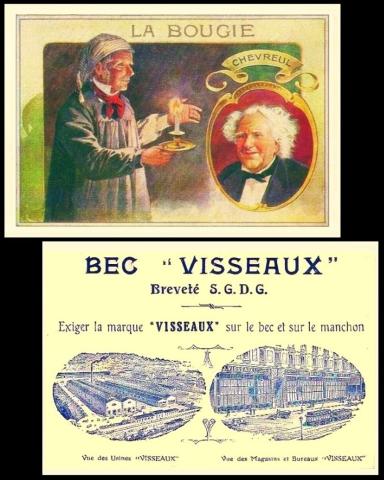
Visseaux [trade : lamps : O/S - France] "Histoire de l'Eclairage" / history of lighting (1920s) 1/?
Today is the first Sunday of Advent, when Christians light the first candle of their advent wreath, a purple one, in the name of hope. In fact this is slightly incorrect, as the candle can be any shade from blue to violet, which are the special colours, in the Anglican, Lutheran, and Methodist churches, of the robes worn on this one day of the year.
As far as "hope", that is a strange emotion, and often mocked. To many it means having a desire for something to happen or someone to come into their life, which remains constant, sometimes forever, despite the fairly low chance of such ever occurring, and in spite of the well meaning friends, or not, who tell the one who hopes that they are wasting their time. However, without that small dream, to nourish, and incubate, very often the hoper would give up on life entirely - they would become "hope"-less, even in despair. And sometimes, against all odds, the hoper will see their dream come true; though often these have not simply sat and hoped, they have put themselves out there, and followed paths that had led them to attaining what they so desired, to standing beside the one they dreamed to meet.
You will find a very famous painting by George Frederic Watts, (who suffered much with depression), called "Hope" as part of W.D. & H.O. Wills` "British School of Painting", card 18/25. It shows a maiden, blindfolded, with a one stringed lyre. There is no explanation of what the work means, so we have the opportunity to think about that all on our own.
Today is also the day that a lot of people believe is the first day they can erect their Christmas tree but this is slightly skewed, for there is no official date for that - they have it confused with the lighting of a "Chrismon" tree, a living tree which is hung with religious symbols relating to Christianity, and only ever decorated with those, in white and gold alone.
We picked this card because it did seem to be a hopeful one, without knowing anything of Chevreul or of Visseaux.
Michel Eugene Chevreul was a French chemist, from a long line of surgeons, whose first research, into animal fats, and their properties, led to great improvement in the manufacture of soap and candles, and isolated margaric, stearic, and oleic fatty acids. He was also the first person to spot that the urine of diabetics had significantly more glucose than normal. And he lived until he was a hundred and two years old.
Jacques Visseaux was the son of a hardware merchant, born on April the twelfth, 1872, in Lyon, France. After leaving college he started selling gas mantles, and learned of their faults. He therefore decided to solve these problems with a brand new style of burner. That led to a factory, which opened in 1900, but was destroyed by fire in December 1905. Instead of giving up, he built a better, larger factory, on another site, in Vaise. The mantles were amazingly popular and were exported worldwide, especially after 1910, when the firm won two gold medals at the Brussels Exhibition. After the First World War a second factory was built, entirely to make electric light bulbs, and then another, for radio tubes.However eventually the firm was bought out, by I.T.T. of America.
I called this set "Inventeurs" at first, but it only includes those who were associated with lights and lighting, so that was changed . The ones I know of so far, citing the top title first, then the inventor or caption on the inset, are :
- La Bougie - Chevreul
- La Chandelle - Premier Reverbere a Chandelle
- Lampe a Double Courant d`air - Argand
- La Torche - Jadis
- Petrole - Puits de Petrole
- Quinquet - 1er Reverbere a l`Huile
And I think this may be the set, of six cards.
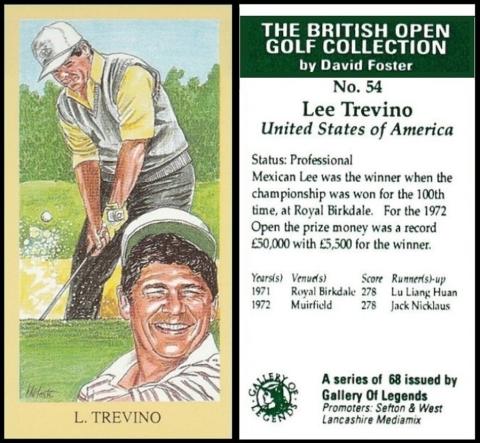
Gallery of Legends [trade/commercial : UK] "The British Open Golf Collection" (1999) 54/68
Today, in 1939, Lee Buck Trevino was born in Garland, Texas. His family was of Mexican origin, and he never really knew his father, who left when little Lee was very small, on which his grandfather stepped up and helped to raise him.
It seems that he did not attend school very much, for he had to work, all kinds of odd jobs, for cash, including picking and packing in the cotton fields. An uncle seems to have encouraged him to use his time more pleasurably and gave him a few old golf balls and a second hand club, and was surprised when he showed a talent almost immediately. This was also a surprise to our man, who developed a passion for the sport, so much so that he would practise after hours in local clubs. That led to him being discovered, but rather than reprimanded, to being offered a job, as a caddy. The best thing about that was that he could practise golf any time he was not working, he did not have to sneak in after hours. And the other caddies, and some of the players, helped him improve his game.
When he was seventeen he enlisted in the U.S Marines, where he spent four years as a machine gunner. He also travelled the world. He left in 1960 and immediately got a job in a golf club, where he ran the shop, did a little caddying, and also had a chance to teach. He also played a lot of golf and qualified for the U,S, Open in 1966, in which he came fifty-fourth. He was shocked that this also came with prize money, of six hundred dollars. The following year he was fifth, and that earned him ten times as much. In 1968 he won, beating Jack Nicklaus, the returning champion, and winning thirty thousand dollars.
He was married three times, and has six children (one of whom, Daniel, is also a golfer, on the PGA tour). His first marriage was when he was just twenty three, and that ended in a divorce less than a year later. He remarried in 1964 and that lasted until 1983. Later that same year he married again and they are still together.
Strangely, he has featured on relatively few cards. Most people regard the 1970 set of "Our Heroes Flik Cards" by Venorlandus, in association with the TV programme "World of Sport" as being his true "rookie" card. The reverse of this tells us he is a Sagittarius, and is known as "Supermex". At the time of issue he has "won the U.S. Open twice (1968, 1971) ... the British Open twice (1971,1972) ... the Canadian Open twice (1971, 1977) and U.S. P.G.A. [in]1974. In 1971 Trevino achieved the "hat trick" of winning British, U.S,, and Canadian Open titles. He is one of the U.S. tour`s dollar millionaires"
Most of his later cards were issued by Pro-Set, who released sets of the P.G.A. Tour from 1990 to 1992.
Our set is by "Gallery of Legends", an issuer about whom I can discover nothing, save that it was issued to commemorate the 1998 Open, which was held at Royal Birkdale. It also seems to have been their only issue. The clue may be in the other wording, "Sefton & West Lancashire Mediamix", which was part of the Liverpool Daily Post and Echo.
As for David Foster, he is responsible for the excellent artwork - though some collectors believe him to have been the issuer.
There is one thing that is not apparent from this card, as it is a set of seventy-two, not sixty-eight. These first sixty-eight cards depict every champion from 1860 until the present day, but then there are single cards of the champion`s belt buckle, the claret jug trophy, acknowledgments and a list of the players who won the event more than once - starting with Harry Vardon, a six time winner.
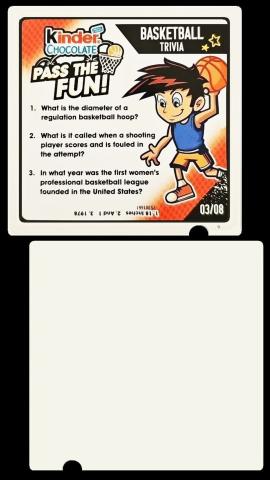
Ferrero [trade : chocolate : O/S - Italy] "Pass The Fun" (2025) Un/8
On this day we celebrate #PlayBasketballDay, which is primarily for those who play on an amateur level, or even less than that - hence our card.. It truly is a day for them, rather than the professionals; for those who have a hoop in the garden, or just watch, without the slightest dream of being on the court, and, in many cases, love the game all the more.
The earliest set of basketball cards seems to be often reported as Bowman`s 1948 set, of seventy two square and coloured cards, a mixture of portraits and action shots. There were five cards and bubble gum in each pack, and it is from that pack that we get the title of the set, because it does not appear on the cards. This may be the earliest set to be devoted to the sport, but it is not the earliest set to show it, not by a long way, as our Card of the Day for the 2nd of July 2024 proves.
Our card was issued in square packs of chocolate, and you got one card in each pack. Every card had quiz questions about basketball, and the answers were at the bottom. There was also a contest, which expired on the thirtieth of June, 2025.
However the reader who supplied this card tells me it was only an American issue, hence the basketball theme. And this is supported by the fact that nine-time NBA All-Star, Paul George, was the figurehead of the promotion.
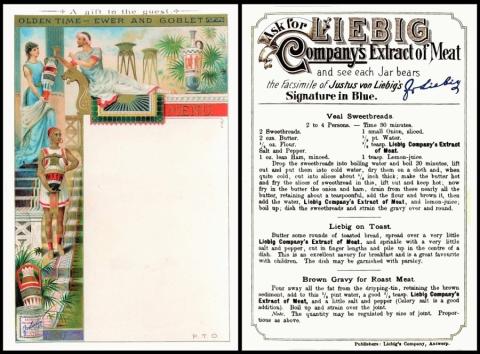
Liebig [trade : meat extract : O/S - South America] "Menu Cards"
I am sitting, rather awkwardly, as nipper has most of the sofa, and typing this on what has become known as Black Friday, when we are supposed to race out and replace the perfectly good things we already have indoors with more modern items. Or, alternatively, as more and more of us are coming to call it, "Buy Nothing Day".
It is with that in mind that I have selected to celebrate another alternative, which is #MakeAGiftDay, and that happens today. Making a gift takes time, and love, and very often it fulfils a particular need or fancy of that very person that only you, and them, know about. It does not have to be something difficult, like knitting a jumper, it can be as small as a calendar using photos of the fun times you have together, or some poetry or uplifting thoughts which they can keep close at hand, and which they will treasure all the more, if they are a worthy friend.
At this time of year you will often find your local library runs crafting sessions, and many of these offer instruction, I know in this locality there are plenty which offer sessions on knitting and crocheting, seed and bulb planting, and Christmas wreath, tag and card making. All have a website, and if you are not a member it is free to join.
Best of all, as Christmas nears, they are places to make new friends and get warmth without using your own heating.
And they are often looking for volunteers, including with the upkeep of their gardens, a rather rewarding thing to do, and something which anyone can take part in
Our card is a menu, showing the gift of water to a thirsty diner - because gifts can be actions, not just things. Often you will find these with writing on, perhaps even a list of the foods to be served, for they were designed as menus, or as place settings, in which case they bear a name, and I have to say I prefer them with writing, for it brings a little flavour of a time long past that I am being allowed to enter and experience. Many of them have a food or drink theme, directly or indirectly, including ours which shows a girl bringing a ewer to replenish the glass held in the man`s hand, but others show scenes or views. They are available in several languages, and it is estimated that there are over five thousand different ones to collect, including more elaborate ones which open out and have a front, two inner sides, and a back, all highly decorated. There are also round ones, in the image of china plates.
At the top of our menu it has an inscription "A Gift to the Guest" - but this is not related to the set, as it appears on many menus, of all different subjects. Our set seems to have something to do with the underwording, of "Olden Time - Ewer and Goblet" - but I have not been able to find the rest of the set.

Topps Allen & Ginter [trade/commercial : cards : O/S - USA] "Save Room For Dessert" (September 2023) 6/15
Now today is #NationalCookieDay - which led me on a journey to discover what a cookie is. On the surface it is the American for biscuit, but that is not quite the case, as a cookie is usually thicker and chewier, whilst a biscuit is kind of hard and often thin. Also it appears that cookies are way higher in sugar and fats, packed with fruit, chocolate chips, peanut butter, and/or nuts.
Oddly the word "cookie" seems to be Scottish, where it means a plain bun, so perhaps this alludes to the fact that a biscuit cookie is rounded and fatter than a biscuit. However there is a theory that the Americans get the word from "koek" or cake, a Dutch word, which makes sense when you consider both the Pennsylvania Dutch, and the fact that New York was originally called New Amsterdam.
Our card tells us that cookies came from Persia, which seems to be true. Apparently they spread rapidly through Europe after the Muslims conquered Spain, and by the fourteenth century, seven centuries on from their origin, they were widespread throughout.
This card is another of those small oddities which accompanied a baseball set, of six hundred and sixty base cards - and it is one of forty such sub-sets. I wonder if there is anyone who "collects them all" these days. or whether, like me, they just go for their favourites, becoming ever more akin to "type collectors" than to completers of sets.
As for the other, often extraordinarily calorific, cards in our set, they are as follows :
- Cheesecake
- Gummy Bears
- Root Beer Float
- Apple Pie
- Brownies
- Cookies
- Ice Cream Sundae
- Chocolate Mousse
- Creme Brulee
- Flan
- S`mores
- Cupcakes
- Fudge
- Carrot Cake
- Milkshake
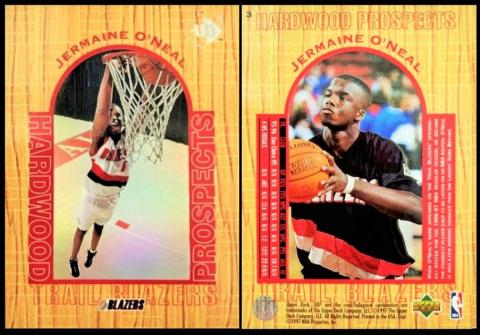
Upper Deck [trade/commercial : cards@ O/S - USA] "Hardwood Prospects - UD-3" (1996) 3/60
Here we have Jermaine Lee O`Neal, who, today, in 1996, the same year this card was issued, became the youngest player in the National Basketball Association, on making his debut, with the Portland Trail Blazers, at the age of eighteen years and fifty-three days.
Since then a younger player has come along, Andrew Bynum, whose debut, with the Los Angeles Lakers, came just six days after his eighteenth birthday.
At one time this would not have been allowed, for N.B.A. players used to have to come from a college squad, and they also had to go to college for four years. This all started to change in the 1970s, when underclassmen were allowed to join, and that led to High School players also being eligible, if they showed promise. And now you can ask to join the N.B.A. the moment you graduate.
Returning to our man, he was born on October the 13th, 1978, and he also joined the draft for the N.B.A. straight out of High School. he joined the Portland Trail Blazers but was under used and was traded to the Indiana Pacers in the year 2000. There he proved a very valuable player but was still traded, to the Toronto Raptors, in 2008. That started a spell of quick changes, and by 2013 he had seen service with Miami Heat, the Boston Celtics, the Phoenix Suns and the Golden State Warriors. Whilst he was there he hurt his wrist, and was out of action for two months. After a few games, though, he decided to step back, and spend more time with his wife and two children, both of whom are interested in sport. He has also moved into music and television, as a producer rather than a performer. And he is head basketball coach at an Academy in Texas.
According to the Trading Card Database/JON, at the time of typing this he appears on 3,120 cards. It is impossible to say which is his rookie card, for there are many sets issued in 1996, of which ours is only one. However I like the wood effect, and also the fact that the title of the set contains the word "Prospects" - which is why we have this here.
This week's Cards of the Day...
Well, in case you did not guess, this week we are going to have a look at some of the sets which we know to have been first issued in Decembers past.
When I started, there was only five cards in our listing, namely ;
DECEMBER
- 1904 - Ogden "Birds Eggs"
- 1910 - Wills "Calendar for 1911"
- 1933 - Lambert & Butler "A History of Aviation" - brown back [in newsletter, scroll down to Wednesday 23 August]
- 1936 - Ardath "Britain`s Defenders"
- 1939 - Ardath "Real Photographs - A Continuous Series of General Interest - Series Nine", Film and Stage Stars (large size)
...the last two cards from which started out without links, these being added during the week.
However, I have been hunting through the reference books and catalogues since then, and am delighted to announce that it has grown quite a bit since then, there now being of sixty sets, which you can see in the main calendar blogs, entitled "A Cartophilic Year".
However, Ogden`s "Birds Eggs" remains the earliest set proven to have been issued in this month. Unless you know of an earlier one? And the most modern set that we have so far positively tied to December is Ardath "Real Photographs - A Continuous Series of General Interest - Series Nine", Film and Stage Stars (large size), from December 1939
As for the December in which most sets were issued, that would be a tie, between 1923 and 1926, each of which saw seven sets starting to circulate.
Saturday, 22nd November 2025
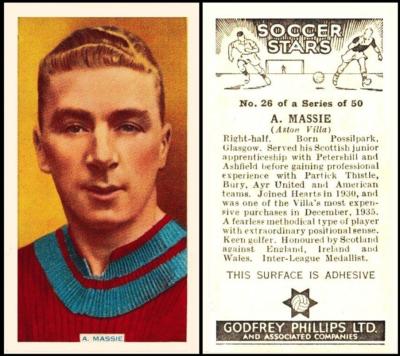
This was rather a hard one, as I was still engrossed in the newsletter and completely forgot that there was a Card of the Day still to do. However, in the nick of time, aided by a scan of just the front, which went on as is, but was replaced the next morning, we have Alex Massie, in the Aston Villa strip, and he joined that team in December 1935. And if you knew that, very well done.
Alexander Massie was born in Possilpark, part of Glasgow, Scotland, on the thirteenth of March, 1906.
His first football team was a local one, Shawfield Juniors, and he played for several other teams before moving across the border into England in January 1927 to play for Bury. However, less than a year later found him in America, playing for Bethlehem Steel. You may not have heard of them, but In 1913, they opened the first stadium in America to have seats, and a year later the owner of the steel company after whom they were named went out hunting English and Scottish players to join his club. Obviously one of his targets was our man.
He only stayed in America for just over a year and in 1930 he turned up in Ireland, playing for Dolphin Football Club.
This did not last too long either, and by the end of the year he was back in Scotland, in a Heart of Midlothian strip. During his time there he was featured on what most collectors consider his "rookie" card, D.C. Thomson`s 1932 set of "Star Footballers (Scottish)", issued with "Adventure". That card gives us his vital statistics "Height 5 ft. 10 ins. - Weight 11 st. 1 lb." and says his other clubs were "Ayr United, Bury, and U.S.A. Clubs", but curiously it says he was born in Ayr. It does not mention that he also played for Scotland, though. For that we have to wait for his next cartophilic appearances,
- card 31 of Mitchell`s 1934 set of "Scottish Footballers
- card 25 of Hignetts 1935 set of "Football Caricatures"
(this set also being issued by Ogden`s, in the same year) - card 28 of John Sinclair`s 1935 "English & Scottish Football Stars"
- card 31 of Mitchell`s 1935 set of "Scottish Football Snaps"
- card 4 of Carreras` 1936 set of "Popular Footballers"
These were all issued whilst he was still part of Heart of Midlothian. .However, the last one must have been slightly behind the times, for in December 1935, he moved to Aston Villa, which is where our card finds him. He retired in 1945, but went straight into becoming the team`s manager, staying there until 1950, when he moved down to manage Torquay United. Though he stayed with them for under a year, he seems to have enjoyed managing, and moved on, in that capacity, to Hereford United, Hertford Town, and Welwyn Garden City.
He died on the twentieth of September, 1977.
Now if you look for this set in our original reference book to the issues of Godfrey Phillips, RB.13, issued in 1949, you will find the following wording : "SOCCER STARS - see item 66"
That leads you to a curious fact, for this set was actually issued three times, albeit with some cards different in each case. The entry for this group in our original Godfrey Phillips reference book is therefore :
- 66. FAMOUS FOOTBALLERS, INTERNATIONAL CAPS. and SOCCER STARS. Small cards, size 67 x 37 m/m. Fronts printed by letterpress in colour. Backs with descriptive text, adhesive
A. 50. FAMOUS FOOTBALLERS. Backs per Fig,10 in grey brown; Phillips` name does not appear on the cards, which are thus anonymous. Issued 1936.
B. 50. INTERNATIONAL CAPS. Backs in brown, Issued 1936. Subjects differ from A at Nos. 19, 21, 31, and 34
C. 50. SOCCER STARS. Backs in sepia. Issued 1937. Subjects differ from A at Nos. 2, 3, 5, 8, 10, 13, 17, 20, 23, 25, 30, 32, 39, 41, 42, and 46 - 49.
There is a total of 75 different players in these series.
The substitutions on our set are as follows -
- 2 - in - Walter Boyes of West Bromwich Albion - out - B. Williams of Everton
- 3 - in - Jack Bowers of Derby County - out - T Griffith of Aston Villa
- 5 - in - Joe Bambrick of Chelsea - out - C Jones of Birmingham
- 8 - in - Fred Worrall of Portsmouth - out - J. Bray of Manchester City
- 10 - in - Tommy Walker of Heart of Midlothian - out - R John of Arsenal
- 11 - in - Ralph Birkett, Middlesborough - out - F. Keenor, Tunbridge Wells Rangers
- 12 - in - Peter Doherty of Manchester City - out - L Jones of Coventry City
- 13 - in - Harry Hanford of Sheffield Wednesday - out - C Britton of Everton
- 17 - in - Ted Sagar of Everton - out - T Mills of Leicester City
- 20 - in - Jimmy Simpson of Rangers - out - Crayston of Arsenal
- 23 - in - Bob Mc Phail of Rangers - out - W. Evans of Tottenham Hotspur
- 26 - in - Alex Massie of Aston Villa - out - R. Westwood of Bolton Wanderers
- 30 - in - Jimmy Connor of Sunderland - out - D. Duncan of Derby County
- 32 - in - Jimmy McGrory of Celtic - out - S. Lawrence of Swansea Town
- 39 - in - Willis Edwards of Leeds United - out - E. Bowden of Arsenal
- 41 - in - William Richardson of West Bromwich Albion - out - J Jackson of Chelsea
- 42 - in - Tom Cooper of Liverpool - out - T Waring of Burnley
- 46 - in - Ellis Rimmer of Sheffield Wednesday - out - J . Allen of Aston Villa
- 47 - in - Lewis Stoker of Birmingham City - out - P Gallacher of Sunderland
- 48 - in - Charlie Napier of Derby County - out - A James of Arsenal
- 49 - in - Harold Hobbis, Charlton Athletic - out - N. Dewar, Sheffield Wednesday
By the time of our original World Tobacco Issues Index, in 1956, the sets are parted, and ours is catalogued as :
- SOCCER STARS. Sm. Nd. (50). See RB.13/66.C ... P50-124
And this entry is more or less the same in our updated volume, apart from the reference to RB.13. So it reads :
- SOCCER STARS. Sm. Nd. (50). ... P521-476
Sunday, 23rd November 2025
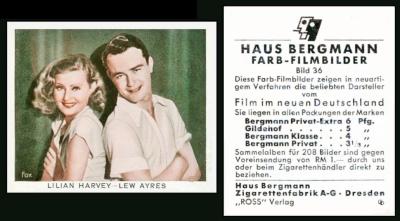
This card celebrates Lewis Frederick Ayres III was born in Minneapolis, America, on December the twenty-eighth, 1908. His parents divorced when he was still young and he moved to California with his mother and what are described as half-siblings, so maybe that is a clue to the divorce.
At first our man wanted to be a musician, in fact he worked with several big bands, and they sometimes supplied the music for films, which seems to have given him the idea to act, as well, for he seems to have never completely given up being a musician. Anyway he was reputedly spotted at a nightclub, perhaps whilst he was performing as a musician, and given a screen test to co-star with Great Garbo in "The Kiss", released in 1929. Two other films were released in that year, in which he was but an extra, and unbilled, which might at first suggest that these must have been made before his starring role - they were "Big News" and "Compromised". However, investigating "The Kiss" unearths the fact that he was not the star of that film at all, he played a teenager that she meets, quite innocently, at a dog show, though he did get fifth billing on the screen credits. And he must have been memorable, as from that film he was cast in one of his greatest roles.
That film was "All Quiet on the Western Front", released in 1930. He was billed as Lewis Ayres, and he played a German soldier, but it was very much an anti-war film, and the theme stayed with him - he was a conscientious objector throughout the Second World War, serving as a medic and chaplain`s assistant, though he still went out to the Pacific, where he was often under heavy attack. He also gave every penny of his war wages to the American Red Cross.
Immediately after "All Quiet on the Western Front" was made, he moved from Universal Studios to Fox, and it is whilst he was at Fox that he appeared in the film on our card, "My Weakness", released in 1933, and co-starring Lilian Harvey as a servant who he bets he can make into a lady and marry off to his bachelor brother. It is not very exciting, except for the fact that it was one of the first films to use the word gay in its modern meaning, though sadly the Studio Relations Committee censors wimped out and muted the sound at that point..
He then moved to Republic, because they offered him a chance as a director. But he soon left, for Paramount, and then to M.G.M., which he joined in 1938. There he was given the chance to bring Max Brandt`s very popular 1930s hospital novels to the screen, which he did, very successfully, for nine films, and then again in the 1950s on radio. The first of these was "Young Doctor Kildare", in 1938.
By this time he had been married twice. His first wife was actress Lola Lane, they were wed from 1931 until 1933, though by all reports they were seldom together. He then married Ginger Rogers, in 1934, but that only lasted two years, though they did not formally divorce until 1940.
After the Second World War he returned to films. and then to television. He was also offered the chance to bring Dr. Kildare to the small screen, but he refused. This may have been because he was offered the older man`s part, which would eventually be given to Raymond Massey, though there is another story that he was opposed to the cigarette advertising which was part of the show.
He did appear the small screen though, as a guest star on almost every big television show you could think of, right into the 1990s. And he also married again, in 1964, this time more successfully, to Diana Hall, to whom he remained wed until his death, aged eighty-eight years and two days, on December the thirtieth, 1996. They also had a son, his only child, born in 1968.
This set first appears in our original World Tobacco Issues Index as :
- FARB-FILMBILDER (Film Pictures). Md. 62 x 52. Nd. (208). See X21/262.B ... B60-10
The first thing there is that "Farb-Filmbilder" actually translates to colour film pictures, and as there is no mention of them being coloured in the entry, it suggests that they were not physically examined for the World Tobacco Issues Index, only sent in as word of mouth, with no picture. However the "X" code reveals that the set was not only issued by Bergmann, though being a German set you expect many more other issuers than you actually get, for it simply reads as follows :
- X21/262,. CINEMA STARS. This series of 208 was issued as follows : -
A. B.A.T. Brand issue, inscribed "Mascot Cigarettes". Unnumbered. Subjects listed under RB.21/262. Back with framelines measuring (a) 58 x 49 m/m (b) 50 x 42 m/m. Possibly vari-backed.
B. Bergmann. German language issue, titled "Farb-Filmbilder". Numbered.
The remarks under RB.21/262 about the inscription "Ross" below framelines are incorrect and should be deleted.
If you look back to B.A.T. in this book, their version is listed under section 2.M for "Mascot" Cigarettes. Includes brand issue, without name of firm. Issued period 1925-1930, possibly in Germany" with an entry of "CINEMA STARS - "FARB-FILMBILDER" (A). Md. 62 x 53. Unnd. (208) Brand issue. Possibly vari-backed. A. Back with framelines 58 x 49 m/m. B. Back with framelines 50 x 42 m/m.... B116-202"
Now when they appear in our updated World Tobacco Issues Index, there is no link at all to the B.A.T. Brand issue, all it says is :
- FARB-FILMBILDER (Coloured Film Pictures). Md. 62 x 52. Nd. (208). ... B317-325
However the B.A.T. version is still there, now listed under section 2.N, for "Mascot" Cigarettes. with the same heading and entry as above.
Monday, 24th November 2025
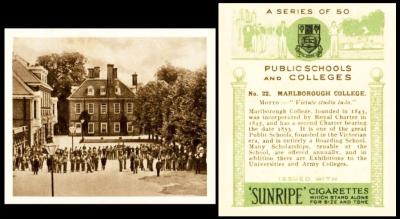
This card was also issued in December, but, at least to me, it suggests the end of term, the final one of which comes along in this month. And after that, there is no school, until the next year.... which always makes it sound a longer time than it actually is!
Marlborough College was opened in August 1843, for the sole purpose of providing education the sons of clergymen. Indeed it was founded by a group of clergymen. However, it has rather irreligious beginnings, for the building was originally the Castle Inn public house.
It opened with a hundred and ninety-nine students, but it was intended to eventually have a capacity of five hundred. The cost of schooling was thirty-guineas a year, but it had been decided to also admit the sons of gentlemen, who would pay more, fifty guineas a year, in order to subsidise the costs. Girls were not admitted until 1968, but only into the Sixth Form - it took until 1989 until it was fully co-educational.
As for why I chose this card out of the two hundred and twenty-five that are possible, the throngs of children suggested that it was the end of term, something that happens in December every year.
This set is part of a longer group, which is catalogued in our original reference boook of the issues of R. & J. Hill, RB.2, published in 1942. The entry reads :
- 1923. 50. PUBLIC SCHOOLS AND COLLEGES (titled series). Size 2 3/4" x 1 1/2". Numbered 1-50. Inscribed, "Series of 50". Fronts, printed in brown by photogravure, no subject titles, but white margins, Backs, printed in green and black with descriptions in black. No maker`s name, but "Issued with `Sunripe` Cigarettes which stand alone in size and tone." Printed by Ripley & Co. London
- 1923. 50. PUBLIC SCHOOLS AND COLLEGES (titled series). Size 3 1/8" x 2 3/4". Numbered 1-50. Fronts and backs exactly the same as preceding series, only difference being size. Printed by Ripley & Co. London
- 75. PUBLIC SCHOOLS AND COLLEGES (titled series). Size 2 3/4" x 1 1/2". Numbered 1-75. Similar to the above, but with 25 additional subjects. Inscribed "A Series of 75".
- 75. PUBLIC SCHOOLS AND COLLEGES (titled series). Size 3 1/8" x 2 3/4". Numbered 1-75. Similar to the above, except for size. Inscribed "A Series of 75". Both sets printed by Ripley & Co. London
However, as you probably noticed, none of these entries have card codes. That means that the first official number had to wait until our World Tobacco Issues Index, published fourteen years later, where it is catalogued as :
- PUBLIC SCHOOLS AND COLLEGES. Brown gravures. "Sunripe" brand issues. Nd. See Ha.575 ...H46-61
A. "A Series of 50". Size (a) small (b) large
B. "A Series of 75". Size (a) small (b) large
By the time of our updated World Tobacco Issues Index, published in the year 2000, the entry is only very slightly different, and now reads :
- PUBLIC SCHOOLS AND COLLEGES. Brown gravures. "Sunripe" brand issues. Nd. See Ha.575 ...H554-550
A. "A Series of 50". Size (a) Sm. (b) Lg.
B. "A Series of 75". Size (a) Sm. (b) Lg.
Tuesday, 25th November 2025
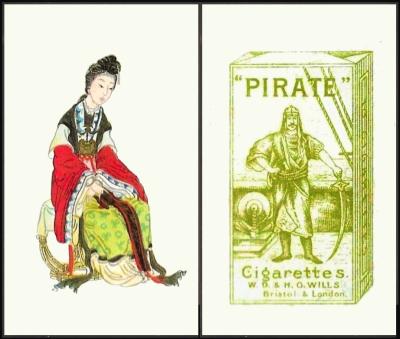
So you may have noticed that this lady is not the same one as we started with. I got the wrong set, but fear not, her second series that had the all too brief outing will appear later, elsewhere. Nothing is wasted.
I did not notice, but was told by a reader, for which many thanks. Though I may have noticed when I wrote it up, for the two sets are pictured in our original reference book to "The Cigarette Card Issues of W.D. & H.O. Wills Parts I to IV (revised) and Part V" (RB.19, published in 1951). I am not sure how well it will reproduce though.
Anyway the listing, of both, as we do not appear to have featured either before, reads :
CHINESE BEAUTIES (adopted title). Unnumbered. Fronts lithographed in colour. Backs in green, with illustration of closed "Pirate" packet. 50 subjects illustrated in Figs. 102 and 103. "Pirate" issues.
- 362. 1st Series of 25. Issued December, 1907. Nos. 1-25 in Fig.102.
A. Vertical back format, see Fig.100.A ("Dot" in "C", "10 Cigarettes" top to bottom)
B. Vertical back format, see Fig.100.B ("Dot" in "C", "Bristol and London" off centre to right. "10 Cigarettes" bottom to top)
C. Vertical back format, see Fig.100.C (No "Dot" in "C")
D. Horizontal back format, small "Pirate" packet on left, Chinese characters in line on right.
Similar issues by B.A.T. with "Eagle Bird" Cigarettes (both vertical and horizontal back format) and Murai ("Peacock" Cigarettes)
- 363. 25. 2nd Series of 25. Issued April 1909. Nos. 26-50 in Fig.103.
The illustration is made up from cards without framelines, but there is a series WITH FRAMELINES under B. below.
A. Vertical back format, see Fig.100.A ("Dot" in "C", "10 Cigarettes" top to bottom
B. Vertical back format, see Fig.100.B ("Dot" in "C", "Bristol and London" off centre to right. "10 Cigarettes" bottom to top)
I. Fronts without framelines (as illustrated in Fig.97)
II. Fronts WITH framelines
Similar series issued by B.A.T. with "Eagle Bird" Cigarettes (vertical back format only)
If you thought that confusing, here is the entry from our reference book to the issues of the British American Tobacco Company (RB.21, published in 1952.
- 200-362 . CHINESE BEAUTIES. The recordings in W/362 and W/363 are summarised and extended below -
I. 1st Series of 25, illustrated in W/362, Fig.102 (Nos.1/25)
Wills` Pirate Issues:
A. Back in vertical format, see Fig.100.A of RB.19
B. Back in vertical format, see Fig.100.B of RB.19
C. Back in vertical format, see Fig.100.C of RB.19
D. Back in horizontal format, small "Pirate" packet on left
Eagle Bird Issues :
E. Back in vertical format, see Fig.200-17.G.
F. Back in horizontal format, small "Eagle Bird" packet on left
Murai Issues
G. Back in vertical format, with open "Peacock" packet
II. 2nd Series of 25, illustrated in W/363, Fig.103 (Nos.26/50)
Wills` Pirate Issues:
A. Front without framelines, back as Fig.100.A of RB.19
B. Front without framelines, back as Fig.100.B of RB.19
C. Front with framelines, back as Fig.100.B of RB.19
Eagle Bird Issues :
D. Front without framelines
E. Front with framelines
III. 3rd Series of 25, illustrated at Fig.200-362.III (Nos.1/25)
A. B.C.C. [British Cigarette Company] issue. Red back, pearl bordered design, see Fig. 200-17.F
III. 4th Series of 25, illustrated at Fig.200-362.IV (Nos. 76-100)
A. Atlas issue. Green back, with illustration of "Atlas" packet
Now by the time of our original World Tobacco Issues Index, this has been altered, dramatically, to simply read :
- CHINESE BEAUTIES (A). Sm. 63 x 36, Unnd. (50). See W/362-3 and RB21/200-362. ... W62-315
A. Back with closed packet, "10 Cigarettes" reading top to bottom. Subjects 1/50.
B. Back with closed packet, "10 Cigarettes" reading bottom to top. Dot in "C" of "Cigarettes". Subjects 1/25 fronts without framelines, 26/50 fronts (a) with (b) without framelines.
C. Back with closed packet. As (B) but without dot. Subjects 1/25
D. Back in horizontal format, closed packet on left, Chinese characters on right. Subjects 1/25
This is identical in our updated World Tobacco Issues Index, save the card code, which is now W675-452
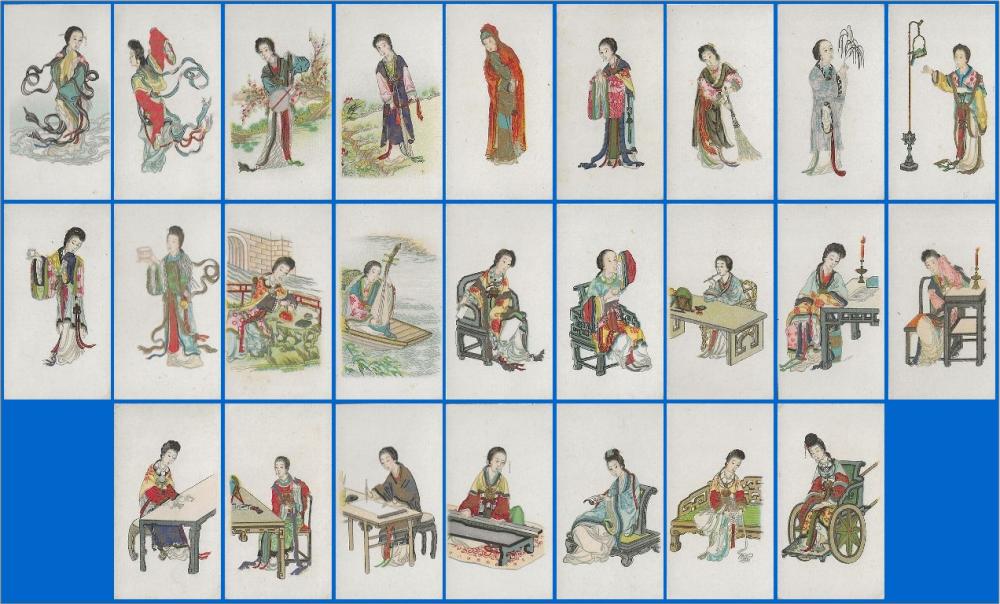
Now I am indebted to our "Wills Specialist", who has taken the time and trouble to scan all the fronts, split into cards 1-25 and 26-50. And here they are :
Cards 1-25

Cards 26-50
Wednesday, 26th November 2025
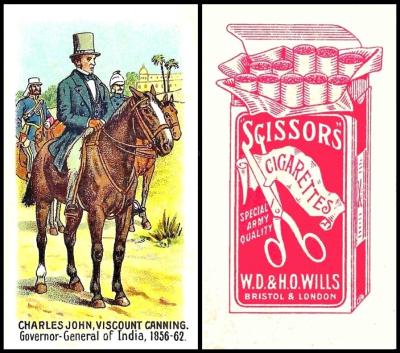
Here we have "Charles John, Viscount Canning, Governor General of India, 1856-62". He was a conservative politician, who became Viceroy of India, and he came from important political stock, his father being George Canning, Foreign Secretary, twice, Chancellor of the Exchequer, and also Prime Minister of Great Britain, but not for long, only from the twelfth of April to the eighth of August 1827, when he died, of pneumonia.
His third son, our man, was the first Earl Canning, because that title was created for him whilst he was the Viceroy of India. Sadly both Viscount Canning and Earl Canning are now defunct titles, for our man had no children to inherit them, although he did have a wife, from 1835, the artist Charlotte Canning, nee Stuart, who died, of Malaria, in 1861.
Our man, and his wife, sailed to India at the end of 1855 and took up his posting in February 1856. India was already showing signs of discontent, and in 1857 these came to the fore, with events which are now known as the rebellion, or mutiny, of 1857. He seems to have been sympathetic, in many ways, to the plight of the native Indians, which was both popular in India and unpopular back at home. There were fears that he would resign, but these seem to have been assuaged by his becoming Viceroy of India; though some historians believe this was purely so the Indians retained a man they did not mind, rather than sending someone else who could easily have made war begin again.
After the death of his wife, he was very shocked, and decided to remove to England, which he reached in April 1862. The following month saw him become a Knight of the Garter, but he died, in London, on the seventeenth of June.
I have to say that did not realise what an attractive set this was, I imagined it, from the title, and the date, to be black and white portraits, rather than these lovely coloured cards. And as an additional bonus, the Governors-General are all on horseback. To be honest, the description which appears in our original reference book to "The Cigarette Card Issues of W.D. & H.O. Wills Parts I, II, and III (revised) and Part IV" (RB.16 – published in 1950) also makes it appear rather bland, listing it as :
- 229. 25. GOVERNORS-GENERAL OF INDIA (adopted title). Size 63 x 36 m/m. Unnumbered. Fronts lithographed in colour. Backs in red, with illustration of open "Scissors" packet, no other letterpress. "Scissors" issue, 1911.
Each card bears the subject`s name below picture, followed by "Governor-General of India..". In the listing below, surnames or titles only are given, with the years of Governor-Generalship.
1. Hastings, 1774-75
2. Cornwallis, 1786-93
3. Teignmouth, 1793-98
4. Wellesley, 1798-1805
5. Elliott, 1807-13
6. Hastings, 1813-23
7. Amherst, 1823-28
8. Bentinck, 1834-35
9. Auckland, 1836-42
10. Ellenborough, 1842-44
11. Hardinge, 1844-48
12. Dalhousie, 1848-56
13. Canning, 1856-62
14. Elgin. 1862-3
15. Lawrence, 1864-69
16. Mayo, 1869-72
17. Northbrook, 1872-76
18. Lytton, 1876-80
19. Ripon, 1880-84
20. Dufferin, 1884-88
21. Lansdowne, 1888-94
22. Elgin, 1894-99
23. Curzon, 1899-1905
24. Minto, 1905-16
25. Hardinge, 1910
This is greatly reduced in our original World Tobacco Issues Index, where it simply reads :
- GOVERNORS-GENERAL OF INDIA (A). Size 63 x 36 m/m. Unnd. (50). See W/229 ... W62-358
And this text is reprinted exactly in our updated World Tobacco Issues Index, save for a new card code, of W675-501
Thursday, 27th November 2025
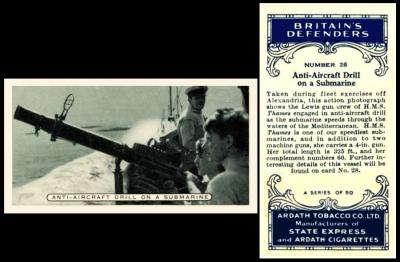
When I see cards like this, I often wonder if the people on it ever opened a packet of cigarettes and found themselves, or whether their shipmates did, which presumably resulted in more than a little teasing.
In 1936 it was pretty certain that war was on the cards for in early March of that year German troops had entered the Rhineland, in a clear violation of the Treaty of Versailles. And though at that time Britain and France did not take a stand against it, they must have known that once one breach is made, another will surely follow.
This card is surprisingly detailed in its description, naming H.M.S. Thames, and telling us she is off Alexandria, during fleet exercises. She also appears on card 28, risen above the waves, where we are told she is "The first of the class of four submarines which bears her name ... was launched in January 1932, and completed 18 months later at a cost of just over £500,000. She made naval history in that she was the first submarine to exceed 21 knots on the surface [though] she actually reached 22 1/2 knots on her trials."
In actual fact the class was called the River Class and her siblings were HMS Severn and HMS Clyde, all built by Vickers Armstrong, in Barrow.
HMS Thames was launched on the 26th of February, 1932, and was sent to Malta. In August 1939 she was assigned to the ninth Submarine Flotilla as part of the Home Fleet, endeavouring to intercept U-Boats and other Axis invaders. In 1940 she was sent to Norway, and in July of that year she sank the German torpedo boat Luchs.
After that, nothing is known, save that on the third of August she was reported as "overdue", and then "lost". It is presumed, but not proven, that she may have struck a mine, with the loss of all hands, including, presumably, the young men on this card, whose names, whatever they were, are recorded on the Dundee International Submarine Memorial, Dundee being her operating base, and at the Royal Navy Submarine Museum at Gosport.
This set is first catalogued in our original reference book to the issues of the Ardath Tobacco Co. Ltd (RB.6, published in 1943) as :
- December 1936. 50. BRITAIN`S DEFENDERS (titled series). Size 1 7/16" x 2 11/16". Numbered 1-50. Printed in 2 colours from half tone blocks in green, white margins, varnished, subject titles inset, Backs printed in bronze blue, titled, with descriptions, adhesive. Also issued in New Zealand to H.M. Ships and abroad. Printed by Mardon, Son & Hall, Bristol.
Its next appearance comes in our reference book to the issues of The British American Tobacco Company, RB.21, published in 1952. That tells us something rather curious, for it is entered as :
- 463. MODERN WARFARE or BRITAIN`S DEFENDERS. Small cards, size 68 x 36 m/m. Front in green-black letterpress, varnished. Back with descriptive text. Numbered series of 50.
A. Anonymous issue, with letterpress on back. Back in grey. Titled "Modern Warfare"
B. Ardath issue. Back in blue, adhesive. Titled "Britain`s Defenders"
The front index tells us the anonymous version was issued in Malta, in 1936, and presumably, because it appears as the "A" version, before the Ardath one.
In our original World Tobacco Issues Index the Ardath version appears as :
- BRITAIN`S DEFENDERS. Sm. Dark green. Nd. (50). See RB.21/463.B ... A72-14
And this text is repeated in the updated version of that work, with just a new card code, of A745-250.
Whilst the anonymous version is at the back of the book, listed as :
- MODERN WARFARE. Sm. Greenish-black. Nd. (50). See RB.21/463.A ... ZB6-49
And this text is repeated in the updated version, with the new card code of ZB07-525
Friday, 28th November 2025
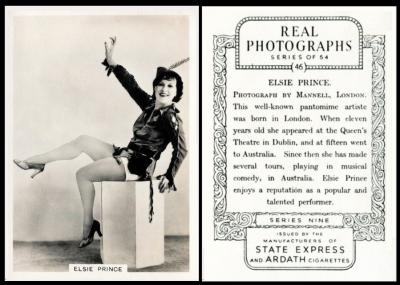
Here we have Elsie Prince, who was born November 27, 1902 in London. She is mostly remembered today for three films, "Satan in Sydney (1918), "A Lucky Sweep" (1932), and "Seaside Concert Parties" (1947). And she died in Yorkshire in April 1988.
Our card reveals a lot more though, and not just of her shapely legs, for it tells us that she was heavily involved in pantomime. The full text reads "This well-known pantomime artiste was born in London. When eleven years old she appeared at the Queen`s Theatre in Dublin, and at fifteen went to Australia. Since then she has made several tours, playing in musical comedy, in Australia. Elsie Prince enjoys a reputation as a popular and talented performer".
This is not her only cartophilic appearance, either, for she can also be found as
- card 44 of The Imperial Tobacco Company of Canada`s "Famous English Actresses" issued in 1924
- card 17 of Lambert & Butler`s "Types of Modern Beauty", a set which was issued in New Zealand, and in 1927.
The first of these cards adds quite a lot to our knowledge, for it tells us she "started her stage career at the age of 10 years, playing the part of "Little Miss Nobody" in a Dublin (Ireland) pantomime, making a big success, and played the same part for the four following years. In 1920 played the part of "Aladdin" at the London (Eng.) Hippodrome, and this last season completes the fifth consecutive year that she has played principal boy in "Aladdin"
Sadly the Lambert and Butler card has nothing in the way of details about her, it only tells us that "This real coloured photograph is one of a series of 50 now being packed with these cigarettes".
Returning to "Aladdin", its full title was "Aladdin and the Wonderful Lamp" and it premiered at the Hippodrome on the 21st of December, 1920. It was written by Laurie Wyle and F. Maxwell-Stewart, with lyrics by Clifford Harris, Valentine and Donovan Parsons, and music by James W. Tate, under the direction of Julian Jones. It starred Lupino Lane as "Pekoe", Nellie Wallace as "Widow Twankey" and, for the evening performances, Phyllis Dare as Princess Badr-al-Budur - Gertrude Lawrence taking that role for the matinees.It did not close for that season until the tenth of April, 1921, which is an amazingly long run for what is generally regarded as "Christmas" entertainment.
She also had two sisters who were also stage actresses - Kitty (or maybe Katherine, who I have not traced) and Edna (born May the eighth 1904, died in 1954). Edna also worked in films, including the 1930 production of "Harmony Heaven".
Our set is rather elusive too, and it appears in our original reference book to the issues of Ardath Tobacco Co. Ltd (RB.10, published in 1943) as a different issuing date to the one usually given, of December, 1939. The write up reveals that there was more than one version, too - and it reads :
- Oct.1938. 54 REAL PHOTOGRAPHS (titled series). "Series Nine". Size 3 3/4" x 2 1/2". Numbered 1-54. Black and white photographs of Film Stars, titled, with white margins. Backs printed in black, titled, with descriptions. Issued with Ardath Cigarettes in Cyprus. Issued to HM Ships in November 1938.
- Oct.1938. 54 REAL PHOTOGRAPHS (titled series). "Series Nine". Size 3 3/4" x 2 1/2". Numbered 1-54. Black and white photographs of Film Stars, titled, with white margins. Backs printed in black, titled, with descriptions. Issued with State Express and Ardath Cigarettes abroad. Issued to HM Ships in November 1938. Subjects the same as the above set.
In our original World Tobacco Issues Index the set is simply described as :
- REAL PHOTOGRAPHS - Miscellaneous with Series Numbers.Black and white photos. Nd. ... A72-59
16. "Series Nine". Film and Stage Stars. (54) Size (a) medium (b) large
And so I close, for another night, and also another week. This newsletter has gone very well and all these dates are what I originally wrote down on my notepad, there were no wrong dates on further examination, and I found it relatively easy to track down a card for each one. This was good, as my time this week has been limited, even more than usual.
Have a great weekend, and I will return next week, with fourteen new cards. What they will be, and cover, who knows. But I do know that I will have fun finding out....