
Well here we are, rapidly approaching the weekend, so it`s almost time for another newsletter.
Now next week`s edition will be the last one before Christmas Day, for it will go live on the 20th of December. So if you have any unusual Christmas cigarette and trade cards, do let us know, or send us a scan of back and front - to webmaster@card-world.co.uk - and we would also be interested in any unusual calendar related cards for the New Year 2026.
This week has, as usual, seen me fitting the newsletter into lots of other things, and then a bit of a rush at the end. I did try the system I mentioned, doing two days at a time, and it worked really well for the first two days but then a lot of things came along and I got nothing done. So the card codes and reference book data was added on Saturday.
Anyway, lets get started with the first diary date of the week, which is...
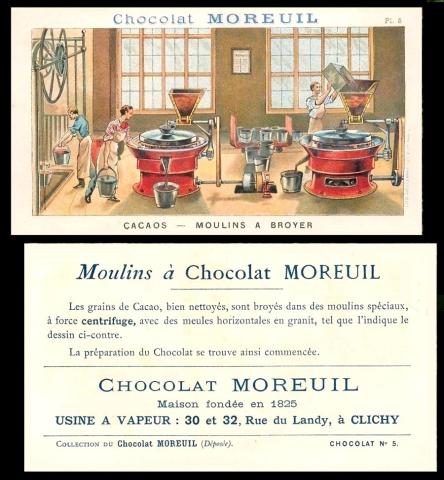
Chocolat MOREUIL [trade : chocolate : O/S - Clichy, France] "Fabrication du Chocolat" (1920?) 3/6
Today, and every November the 13th, is #NationalCocoaDay.
Technically that refers to cocoa, the drink, and not hot chocolate, for actually the two are different - cocoa being made with cocoa powder, and hot chocolate being made with ground chocolate. The thing is that both have their roots in cocoa, which is a bean, a seed, grown on a tree, the Theobroma cacao, or cacao tree, first discovered by the Amazonians, where the trees are native.
Eventually the drink spread all the way along the corridor between North and South America. It was used in religious and spiritual ceremonies, and the beans were not only treasured, but used for bartering, and also instead of money.
The Spanish brought it to Europe, and the West Indies, some time in the 1600s, and the Europeans took it to Asia and Africa.
They used it for drinking, though we know the South and Central Americans dried it and ate it - which is not too hard a process to recreate at home. You just get a cacao pod, open it (with a hammer), remove the seeds, and put them in a jar with a tightly closing lid for a week. Then you tip them out on a clean surface, preferably above the ground,, and leave them in the sun to dry. (If you don`t live in a hot country you can also do this in the oven). Then you roast them, over a fire, or back in the oven, and when they are cool enough, you remove the shells and the innards go in a food processor. That gives a kind of liquid which you then heat, cool, and heat again, then pour on to a flat surface to harden and dry. Before the 1830s, this was then cut up into sections - but in that year moulds were invented, with which you could make bars and then more complex shapes.
This set was issued by Chocolat Moreuil, who were founded in 1825 in Clichy-la-Garenne, and it shows the stages of how the cacao was converted into chocolate. Our card shows the grinding mills which makes the product smooth, the industrial equivalent of the food processor.
- Cacaos - Aspirateurs, Trieurs et Epierreurs
- Cacaos - Torrefaction (Le Sirocco)
- Cacaos - Concasseurs, Decortiquers
- Cacaos - Moulins a Broyer
- Melangeurs
- Broyeuses pour Affiner
- Refroidissoirs
- Pliage
- Expeditions - [packing and despatching the product]
The most interesting card shows "Le Sirocco", which was a French Roaster, rather a coup for the company. However, they did not invent it, that honour goes to a Monsieur Mottant, of Bar-le-Duc, who started to make them in the year 1890 - and it therefore seems likely that Moreuil had the first one in their area, and perhaps allowed it to be assumed that they had made it from scratch.
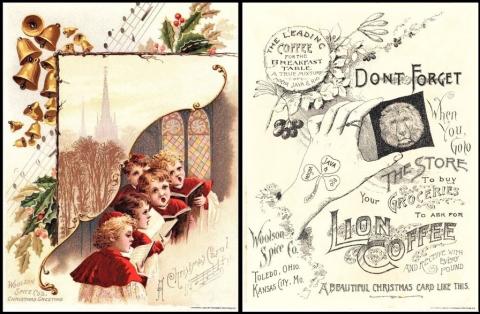
Woolson Spice Co. [trade : grocery : OS : Toledo & Kansas City, USA] Christmas Card (1891) 1/1
Chocolate makes rather an exciting Christmas present, but it is best , as could be said with everything, if you take some time to discover what your recipient is into. With chocolate that, dare I say, "boils down" to dark, milk, or white, even before you delve into the internal or external flavours.
As for our second diary card, that celebrates the fact that today is #WorldChoralDay - we have just given it a little topical Christmassy twist. This is indeed a worldwide event, on the second Sunday in December, and it has been celebrated since 1990, so today will be its thirty-fifth anniversary.
The idea behind it is a simple one, an attempt to unite with song and hope that hearing the harmony of the voices makes for peace between not just the nation, but even the local people you could speak to every day, if those initial barriers were broken.
In fact, this card is a very good analogy, for every Christmas as people sit in Church they are struck by a thought that it is a shame this fellow feeling and togetherness will not last for very long. Maybe it is the beauty and serenity of the stained glass windows, or the harmonising of all the different voices that combine to make the choir, their voices complimenting each other; and also there is the knowledge that many of these Churches have endured through many events which may have reduced them to rubble, but they were, for the most part, rebuilt, and rebuilt all the stronger
This card is not part of a set, as the back tells us - it says "DON`T FORGET When You Go to THE STORE To buy Your GROCERIES TO ASK FOR LION COFFEE AND RECEIVE WITH EVERY POUND A BEAUTIFUL CHRISTMAS CARD LIKE THIS."
No wonder that the Woolson Spice Co, of Toledo, Ohio, and Kansas City, Missouri, could claim that theirs was "the leading coffee for the breakfast table".
Now I cannot actually see if this date at the bottom was 1881 or 1891, but it suggests that in that year there were more than one design of these cards being handed out. In addition on some cards it actually gives a date of this promotion, the one I am looking at now online says "Between Oct.15th and Christmas Day". That`s a very long time indeed to run such a promotion !
We have not yet featured a Woolson card as a Card of the Day, but another did appear in the newsletter which was published on Christmas Eve, 2022, as the card for Christmas Day, which, that year, was on a Sunday.

Rittenhouse [trade/commercial : cards : O/S - USA] "Twin Peaks" (22 August 2018) 57/90
Today in 1990, thirty five years ago, Special Agent Denise Bryson of the Drug Enforcement Administration arrived in the small town of Twin Peaks, in order to investigate Dale Cooper`s involvement in a batch of missing drugs. The two had met before, even worked together, in Tijuana, but circumstances, and another undercover operation, had led the former Dennis Bryson to realise he had been living a lie as a man.
Despite Twin Peaks being a strange programme, with a mix of every emotion, this situation was treated with total respect, and a great deal of understanding and acceptance. And I do have to wonder whether if the show was remade today, this would all be changed, for the worse.
For everyone who felt themselves stuck in lives they did not really want, or did not even know what they wanted, Denise Bryson was kind of a guiding light, an encouraging force. I thought they were amazing. And best of all, they not only found out where the drugs had gone, but it was later revealed that they had become the chief of staff at the F.B.I. Which is kind of empowerment at its finest.
Perhaps it was the charm, or the sensitivity, of the actor who played the role, or maybe it was just that they were still relatively open to exploring the possibilities of the part. It probably also helped that they had not yet started to make a name for themselves, though they had been appearing on screen for ten years, and on the stage before that.
Denise Bryson is not a stranger to cards, but they are a niche market, so they can turn up in odds boxes, in which case you will get a bargain.
Now the card we show today is not their earliest cartophilic appearance - that came in 2007, on number 45 of the so-called "Gold Box Postcards", which were included in a box with a set of DVDs showing the series and intended for home viewing.
Their second appearance was in 2018, on the four promo cards for the set we show today, but you need to turn those over, because the fronts only show different scenes from the series, it is the reverse which shows eight of the autographed cards which were available when you bought a boxful of packets at once - simply because the ratio of insertion was one autograph card in every twelve packs. However, to complicate things, some of the cards are actually cartophilic, for they were given away with the Non Sport Update magazine, and at the Philadelphia non-sports show. And there is also a card which was sent to you if you ordered an official binder.
Our card today is from the base set, in which there are four cards - numbers 56, 57, 59 and 60. Some collectors include cards 61 and 62, though they are only mentioned, not shown. Each of these has a parallel card, with a number, from 1 to 99, on the back - as well as there being four even rarer "printing plate" cards for each card, showing the scene in just one colour, these being black, cyan, magenta and yellow.
As for why we have card 57, that is I like it best, of "all" the ones I have. Though 'I like all four, mainly because they are quite anonymous, no actor`s names appear at all. And to me, this is card collecting at its purest form, for pleasure, not hunting for someone who is now famous and buying it to sell on at a much higher price.
There are also three other cards allied to this set. We have already mentioned the Autograph Card, which is shown on the reverse of the promo cards - and if you are less able to afford the high prices charged for the autograph itself, the promo would suffice. There is also a Character Card, numbered CC.16. Lastly they appear on a Quote card, numbered Q.11, which is quite scarce as though it shows Denise Bryson on one side, both quotes come from Gordon Cole, played by David Lynch himself.
You may also find a card called “Twin Peaks - Original Stars", but that does not belong to the above set, it was issued in 2019. It is printed on a linen finish stock. and Denise Bryson just squeezes in as the final card, number S27.
In 2025, a new set was issued, called “Twin Peaks” : The Log Lady Chronicles". It tells the story again, but from a different viewpoint, though many of the scenes on the original Rittenhouse set are reused. Oddly we only have two cards of Denise Bryson - card 37 (which re-uses the image on the original card 56), and card 49 (which reuses the image on the original card 59). However it does have a really interesting parallel set, called "Then and Now", which shows the stars, in costume, as they appeared at first and then from the third series, which is either known as "Twin Peaks - The Return" or "Twin Peaks - A Limited Event Series". That premiered on Showtime on May the 21st, 2017, and it within that series that it is revealed that Denise Bryson is now the chief of staff at the F.B.I - and I did debate whether to use that card here. Again Denise Bryson is the final card, TN.18 - though there is a TN.19, of Betty Briggs, but it was a "reward card", not technically part of the standard set.
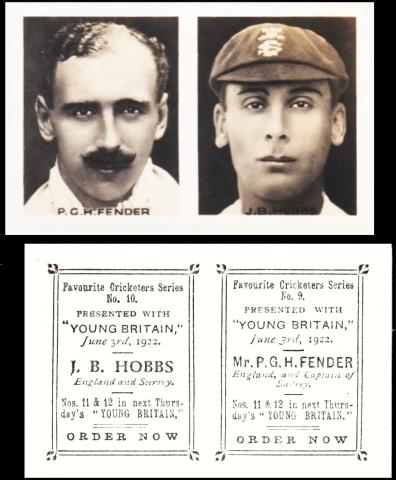
AMALGAMATED Press - "Young Britain" [trade : periodicals : UK] "Favourite Cricketers Series" (May 6th to August 12th, 1922) 10 & 11/30 - YOU-030 : YOU-1
John Berry "Jack" Hobbs was born today in 1882, in Cambridge, and would eventually have eleven siblings.
His father was a tradesman, who fitted tiles to roofs, and possibly made them too - but who was also heavily involved with cricket, but not as a player, he was the groundsman at Jesus College, and also stood service as umpire.
To many extents, this helped our man immensely, as when his father taught him how to play cricket, it was from the eye of someone who knew about ground conditions, how play could be affected by weather, and most of all, the rules of the game.
Sadly his father died, of pneumonia, in 1902, after which our man took over his grounds keeping and umpiring duties.
Fate is a strange thing, for it may have well been that he was subsumed by those, and remained content to knock a ball about in his spare time. However, in 1903, one of the Surrey players heard of him and sent a man up to bowl for him. This performance, on what was practically just a field, led to an offer from the Surrey team - with whom he first played in 1905, due to the fact that you had to be either born, or living in a country for two years before you could join the team.
The move probably prompted him into another change, for he had been courting a local Cambridge girl, the daughter of the local shoemaker/mender, since 1900. They were married, in Cambridge, in 1906, and they went on to have four children.
Now his "rookie" card is almost certainly card 67 of Wills` "Prominent Australian and English Cricketers" (1907) but which one is not known as there are two versions - one shows him facing the camera in a white shirt, with more natural tones to his face - whilst the other shows him with a brown tie and his face is more in shadow. He does look younger on the card without the tie though.
In that same year he was selected to tour Australia. It was not a great experience, as he was seasick all the way.
His first cartophilic biography comes just after this (for all the previous cards had been without descriptive backs) - on Wills` "Cricketers" 1908, which reads "He first appeared in first class cricket in 1905, and immediately earned his place amongst the leading batsmen of the day by scoring 1,317 runs in the season. He followed this up by getting 1,913 runs in 1906 and 2,135 in 1907. He has made ten centuries, and his excellent batting was recognised by the M.C.C. authorities by a place in the English team visiting Australia in 1907, when he obtained an average of 42 runs in 20 innings. A capital field"
By the outbreak of the First World War he was one of the top players. Then his war service started in a munitions factory, though we think it was in admin, rather than the making of the bombs. He was then conscripted, into the Royal Flying Corps, but stayed in England until September 1918, and was only then sent to France, by which time he had been subsumed into the newly formed Royal Air Force.
This card was issued in 1922, which is when he returned to cricket. He had been demobbed in 1919, then suffered ill health and an operation. And he continued to be affected by ill health right from 1926 until 1930, being unfit for several test matches. And then there were other problems. In 1930 he toured India with a private team which fell foul of the cricketing authorities, so much so that they refused to add the runs he scored to his lifetime total. And though he was not a player on the controversial "Bodyline" Tour of 1932, he had gone as a journalist, he hit the headlines for refusing to come out and condemn the practise, though he did so later.
Then, in February 1935, he announced his retirement. He continued to write for the press, and he had a sports shop, but his wife became unwell, and he spent more and more time looking after her. She died in March 1963, and he died just a few months later, on the 21st of December, aged eighty-one.
Our card is actually quite unusual, as you usually find it cut into two cards, as was the intention. It looks rather odd in our picture as well, for the description appears to be beneath the wrong man, however when the card is turned over it is in the right place.
In our original British Trade Index it is listed under "Y" for "Young Britain", which makes it the last entry before the anonymous issues. However we know that "Young Britain" was published by Amalgamated Press. The entry reads :
"YOUNG BRITAIN"
Periodical. Cards dated 1922.
- FAVOURITE CRICKETERS SERIES. Sm. 70 x 44. Black glossy photos, two photos on each card. Nd. 1/2. 3/4. etc. to 29/30 (15). Dated 6-5-22 to 12-8-22 ... YOU-1
By the time of our updated millennium edition of the British Trade Index the set was no longer last (eight more issuers having been discovered, the last of which was "Zoo Life". a 1940s magazine), and more cards had been discovered for "Young Britain" (a set of six cards of "British Racers", and three large supplements on paper). The entry for our set is also slightly different, and now reads :
"YOUNG BRITAIN"
Periodical. Dated 1919 - 22.
- FAVOURITE CRICKETERS SERIES. Sm. 70 x 44. Black glossy photos, two to each card. Nd. (30) as 1/2. 3/4. etc. Dated 6-5-22 to 12-8-22 ... YOU-030
As for "Young Britain", it was first issued on the 14th of June, 1919, and it seems quite elusive to track down much more than that - but i will have another go on the weekend...
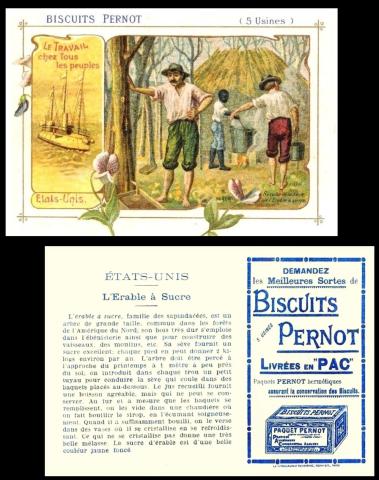
Biscuits PERNOT [trade : biscuits : O/S - France] "Le Travail chez tous les Peuples" / work of all the peoples of the World (???) Un/
Today is #NationalMapleSyrupDay - and not just in Canada, though they use the leaf for their emblem, and, along with America, produce the most.
Maple syrup has its roots in a natural substance called xylem sap - which I have to say does not sound very appetising. It is produced by most types of maple tree, but especially from one called the sugar maple.
The tree makes it as a by-product of its efforts to keep warm and store enough energy and food to get through times of cold and darkness. During the light and warm times when it is photosynthesising, not all the glucose produced is used, but rather than stopping production, the tree keeps making, and the excess is sent down through its branches and trunk to the roots, then stored as a kind of starch and water mixture.
Then, in the spring, when the sap rises, the starch is converted to a kind of sweet, even sugary substance that comes back up the trunk. At this time along comes the pesky human, who makes a hole in the tree and steals the starch. The human then heats it up, to remove the water, and is left with a sticky syrup, which they consume, or, for the most part, sell.
Humans have actually been doing this, without the selling part (though there was almost certainly bartering), for many centuries. The Native Americans did it first, by making cuts into the trees and refining this technique to stick hollow reeds into the trunks to act as a gutter and ensure that more of the substance went in a pot than had done when they let it trickle down the tree.Then they boiled it, in clay pots, over fires.
When European invaders came, they must have learned these tricks by fair means or probably by foul ones, though reputedly Jacques Cartier cut down a tree and discovered the liquid in the early to mid sixteenth century whilst on his voyages, and brought it back to Europe. And we know that by 1680 the Europeans were out in North America making a business of it. In fact until the 1930s, North America was the main area of collection and production, Canada, and mostly Quebec, only superseding this in the 1990s.
This set was issued by several manufacturers, and also in an anonymous form, which may more correctly have been sold off as unprinted remainders.
The manufacturers we know of so far are :
- Biscuits Pernot
- Chicorée Belle Jardinière
And the cards that make up the set, or those we know so far, are :
- Abyssinie - Pilage du Sorgho
- Algerie - Moulin a Olives en Kabylie
- Allemagne - Recolte du Houblon
- Australia - Tonte des Moutons
- Birmanie - Sculpteurs
- Bresil - Recolte de la Canne a Sucre
- Cafrerie - Construction d`une Hutte
- Canada - Recolte de la Glace a Montreal
- Chine - Tepiquage du Riz
- Etats-Unis - L`Erable a Sucre
- France - Vendange
- Groenland - Construction d`un Traineau
- Inde - Moulins a Canne a Sucre
- Japon - Eventailliste
- Madagascar - Porteuses d`Eau
- Martinique - Recolte du Cafe
- Mexique - Recolte de Pulque
- Nue Guinee - Construction d`une Pirogue
- Perou - Chercheurs d`Or
- Russie - Abatage des Arbres
- Serbie - Confection de Tapis
- Suisse - Traite des Vaches
- Terre-Neuve - Tranchage et Sechage de la Morue
- Tonkin - Un Tourneur [reverse just says "Tourneur"]
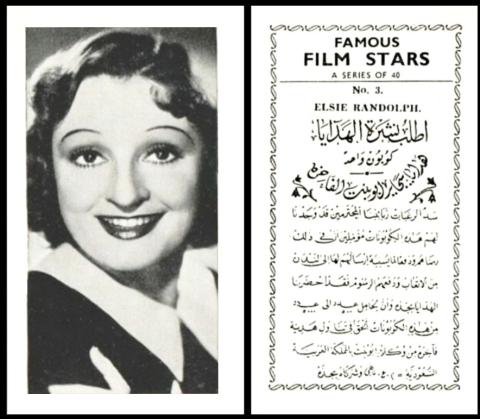
Anonymous - R. & J. Hill [tobacco : UK - London] "Famous Film Stars" - Arabic issue (1938) 3/40 -H554-725 : H.634-1.A : H46-85 : X1/Ha.634
Today is #UnitedNationsArabicLanguageDay.
We have, briefly, mentioned this before in our newsletters - most notably in the one for the 19th of April 2025 (as our diary date for Sunday the 20th of April) when we listed the six dates set up in 2010 by the United Nations as days to celebrate one of their official languages. And at that time we said that Arabic had become an official language on December the 18th 1973.
Now we can expand that thought and tell you that in terms of the most widely used language, Arabic is fifth, behind English, Chinese, Hindi, and Spanish. Though we must point out that English only comes first because of the number of people who speak it as a second language rather than a mother tongue - if we removed those "adopted" numbers from the equation, Chinese would be first, especially if we used all branches of that language. And, curiously, the figures for Arabic speakers are also massaged, if not even misrepresented, for tables of world usage seem to base themselves not on Arabic in general, but on Modern Standard Arabic, which is the literary form rather than the colloquial, and is mostly taught in schools, where it "tidies up" the regional dialects into something more forced. If simple Arabic and all its wonderful variations was counted, it would almost certainly come in a lot higher in any usage tables. Additionally, this would also swell if it added in those who seldom speak Arabic in their daily lives, but know it because it is the sacred language of Islam, in which their holy books are written.
What you may not know is that the spread of the language began a long way back. This is evident in the roots of many other global languages, especially with respect to the words used in the sciences and the arts. Spanish is one of the most alike, because it was under the control of the Muslims for about seven hundred years, until 1492, when Catholicism took over - but all around the Mediterranean you will find Arabic influences, almost certainly due to trading links.
As far as written Arabic, as we feature on our card, it has some curiosities. Firstly it is written from right to left, backwards to our way of thinking. Secondly they do not capitalise their letters. Thirdly, they use dots, above and below the letters, to denote the sound that letter has in pronunciation. And lastly, their alphabet has twenty eight letters, though one of these represents a pause a the end of each word, and some scholars do not consider that as a letter, just a punctuation mark.
Our featured lady is Elsie Florence Killick, whose stage name was Elsie Randolph, and she was born, in London, on the 9th of December, 1904.
Her first film was "Rich and Strange", released in 1931, and written and directed by Alfred Hitchcock. And forty years later she would also work with him, in a film called "Frenzy", released in 1972.
After "Rich and Strange" she made a couple of movies, then, in 1933, she was cast in "Yes Mr. Brown", which teamed her with Jack Buchanan. They had already worked together, on the stage, in a 1924 farce called "Boodle", and this revived their friendship; they would work together on stage and screen lots of times and became quite a couple, though only on screen.
He had married In 1915 to a Bulgarian singer called Drageva. They never seemed to live together, and the marriage was annulled in 1920. It seems likely that it was her way of staying in England, rather than having to be deported, or imprisoned as an enemy. He never mentioned her again, but he did marry again in the late 1940s.
Elsie Randolph married late, in 1946, to Leopold Vernon Page, a stockbroker, and they were together until his death, (two years after that of Jack Buchanan), in 1959. She gave up acting on her marriage, but returned to it after he died, perhaps for something to take her mind off her loss. this time, her career took her on to television, as guest appearances on many famous shows.
She died on the 15th of October 1982, aged seventy-seven.
Sarony`s "Cinema Stars", card 18, issued in 1933, tells us that she "Commenced stage career in chorus of provincial revue under twelve years of age. Toured for two years, afterwards appearing in London. Recently started in talkies, including Life Goes On (with Hugh Wakefield) Yes Mr. Brown (with Jack Buchanan), Night of the Garter (Sydney Howard). At present making talkie of That`s a Good Girl (with Jack Buchanan)". This text also appears on the 1934 set of "Cinema Stars", (known as Set 7), issued by United Kingdom Tobacco.
Our card is described in our original reference book to the issues of R. & J. Hill (RB.2, published in 1942), in a most confusing way, (to be honest I only understood it when I looked at the entry in the handbook to the Original World Tobacco Issues Index). The confusion comes because there are six sets of "Famous Film Stars", all remarkably similar - however if we discount the first set which is all in English, and the two sets of fifty, and the set of a hundred which was the two sets of fifty combined, you are left with two sets of forty, described as :
- 40. FAMOUS FILM STARS (titled series). Size 2 9/16" x 1 3/8". Numbered 1-40. Fronts as above... [printed black only from half-tone blocks - black and white - with margins, no subject titles] ... Backs, printed in black, wording in Arabic. No maker`s name appears. Export issue. Printed by W. Oliver, London.
- 40. FAMOUS FILM STARS (titled series). Size 2 5/8" x 1 1/2". Numbered 1-40. Subjects out of "Modern Beauties". Fronts printed black only from half-tone blocks - black and white - with margins, and varnished to give a glossy appearance. Backs, printed in black, wording in Arabic. No maker`s name appears. Export issue. Printed by W. Oliver, London.
What makes this even odder is that by the time of our original World Tobacco Issues Index the entry has been reduced to simply :
- FAMOUS FILM STARS. Sm. 66 x 37. Black and white, Nd. (40). See X1/Ha.634 ... H46-85
(This is more or less repeated in the updated version of that work, except the handbook code is amended to H.634-1.A, and the card code has become H554-725
The "X" number is the entry in the handbook to that original World Tobacco Issues Index, and it is so much easier to follow, and describes only the Arabic issues as :
- X1/Ha.634 HILL`S ARABIC ISSUES. Front in black and white, without captions. Four backs, illustrated at Fig. X1/Ha.634
1. Head and shoulder portraits. Titled "Famous Film Stars". Numbered series of 40.
A. Hill issue with back in English. See Back 1.
B. Anonymous issue, with series title in English, other printing in Arabic.See Back 2
2. Full length portraits.
A. Hill issue with back in English. See Back 3. Numbered series of 50 titled "Modern Beauties".
B. Anonymous issue, with series title "Famous Film Stars" in English, other printing in Arabic.Numbered series of 40. See Back 4. The back is very similar to Back 2 except that the caption in English is omitted.
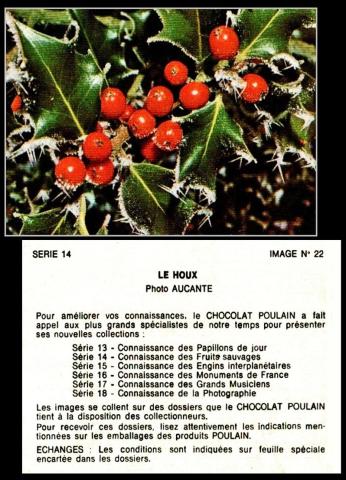
Chocolat POULAIN [trade : chocolate : O/S - France] "Connaissance des Fruites Sauvage" - series 14 (19??) 22/??
To close we have a double whammy, as it is both #HollyDay and #LookForAnEvergreenDay.
Now I know that holly featured on three cards in our newsletter for the 11th of December 2021, but we seem not to have waxed lyrical about the plant there - the first clue card speaking more of the subject, footballer George Holley, and the final card also showing mistletoe so only needs reslanting. The only other card was the one for Thursday the 9th of December, John Player`s "Irish Place Names" second series (April 1929), the text of which told us that “Cuillinn”, shortened to “Cullen”, in an Irish place name, shows that there is holly in the area".
Therefore today is the day we discuss of the holly, which saves me hunting any longer for a better subject.
They are part of the Ilex family, which contains some five hundred and seventy species. Today many people are going for the species which have a white or light yellow edge to the leaf, but they come in all shapes, and heights, some only reaching three feet tall and others over eight.
Something you may not realise, with different coloured berries, including black orange, white and yellow. The red berry is the best known mainly because it adds another colour to a Christmas card or wreath. These berries are not just pretty, they are winter food for birds.
Their downside may be that their leaves are so prickly, but this has led to their popularity as hedging in areas where security is required. They are actually spiky for a reason, it gives the tree protection against animal damage. You could trim these off to above the height of your children or dogs - or you could grow a non-prickly form, like many of the Japanese ones, which have excitingly dark leaves and small black fruit. Be careful though as there is a Japanese version called Ilex cornuta ‘Rotunda’ dwarf, which is the prickliest of all.
I have been unable to identify the first time holly appeared on a card, but I think that it would have been on a trade card, like ours, perhaps even the one by Arm and Hammer, mentioned above, which I will rewrite to reflect the mistletoe asap. As far as cigarette cards a front runner must be card 34 of Gallaher`s "Woodland Tree Series", issued in 1912.
We have featured cards from other sets in this "Knowledge" series before -
- Connaissance des Grands Musiciens - S.17 (1974) - Tuesday 4 March 2025 - https://csgb.co.uk/publications/newsletter/2025-03-01
- Connaissance du Sports - S.38 (19??) - Thursday 3 July 2025 - https://csgb.co.uk/publications/newsletter/2025-06-28
- Connaissance du Grands noms du Sport - S.44 (19??) - Friday 5 September 2025 - https://csgb.co.uk/publications/newsletter/2025-08-30
. They are lovely cards, but sadly there is either a very short description or none at all.
This week's Cards of the Day...
As Christmas nears, we are going to look at some of the unsung heroes of the Christmas story. And first up we have the humble donkey, which is a popular, and easy, child`s nativity costume, being only a head with long ears, a brown jumper and trousers, and black shoes.
Sadly there is no proof that the Virgin Mary rode a donkey to Bethlehem, a distance of over seventy miles. Then there is the slight problem that there is no donkey mentioned in regards to this story in the Holy Bible - it only turns up in a book called "The Protoevangelium of James", which was written some time around 145 A.D., and suddenly introduces the idea that Joseph used a donkey to bring the Virgin Mary to Bethlehem.
Saturday, 6th December 2025
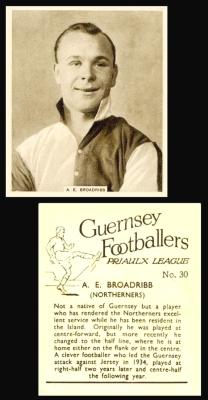
Our first card referred to the Guernsey International Football team, whose nickname is "The Donkeys". As to why, well it refers to a little bit of gentle teasing which goes on between the Channel Islanders - the nickname for Guernsey islanders being "Les Anes", which means the donkeys, and which people of Jersey use because the inhabitants of Guernsey are so stubborn about any decisions that involve the other islands. However, Guernsey folk seem to have taken it another way, that being that they are strong willed - and they use it amongst themselves too.
As far as the nickname given to Jersey inhabitants by Guernsey ones, that is "Les Crapauds", meaning toads. And Guernsey folk swear that is because there is a type of toad, the spiny toad, which is only found in Jersey....
These cards show footballers from the Priaulx League, which is the senior league on the island of Guernsey. The name comes from a man, Mr. O. Priaulx of Bury St. Edmunds, who donated £5 so they could have their first ever trophy.
Up until 2016, it was administered by the Guernsey Football Association, and affiliated to the English Football Association, but not included in the English leagues. At the end of the season the winners of the Priaulx League go head to head against the winners of the senior league on the Isle of Jersey, who are also affiliated to the English F.A. but once more take part in no matches on the British mainland. The winners of this inter-island match win a trophy called the Upton Park Trophy, which was donated to the Guernsey Football Association in 1906, by Upton Park Football Club of London, to mark ten years of their tour of the Channel Islands.
By 1906 there had been several finals, the first being won by the Band Company of the 2nd. Battalion of the Royal Fusiliers, in 1893-4. For several years the competition had a strong military presence, reflecting the number of men stationed on the islands. This was due to its proximity to France, with whom there had been several skirmishes and outright wars in the 19th century. In fact it was not until 1914 that the last British garrison was withdrawn, and only then because the men were sent off to fight in the First World War.
The first team with no connection to the forces to win the trophy was the Northerners Athletic Club in 1900. They retained the title the following year, Grange took it in 1902, and the Northerners rallied and won again in 1903. Then it returned to having military winners, save the three times that Northerners lifted the trophy, these being in 1908, 1910 and 1913. At the start of the First World War, football was cancelled for the duration. And since then there have been no more military winners.
Our man seems rather elusive online, so we only have the biography which appears on this card. That starts with the information that he was "Not a native of Guernsey, but a player who has rendered the Northerners excellent service whilst he has been resident in the Island." It then continues with "Originally he was played at centre-forward, but more recently he changed to the half line, where he is at home either on the flank or in the centre. A clever footballer who led the Guernsey attack against Jersey in 1934, played at right half two years later and centre-half the following year"
The teams represented in the set are as follows :
- Nos. 1 - 13: - Rangers
- Nos. 14 - 24 - Athletics
- Nos. 25 - 36 - Northerners
- Nos. 37 - 47 - Belgraves
- Nos. 48 - 58 - St Martins
- Nos. 59 - 69 - Sylvans
- Nos. 70 - 80 - Sherwood Foresters
The set is first described in our reference book to the issues of the British American Tobacco Company, RB.21, published in 1952, amongst several sets issued by Bucktrout. However there seems nothing to suggest that our set was issued by them, the grouping is merely because the cards all show footballers.
Our set is described as :
- 290-3 Guernsey Footballers - Priaulx League. Large cards, size 77 x 64 m/m. Front in brown. Back per Fig.290-3 in brown. Numbered series of 80. Anonymous issue, with letterpress on back.
In our original World Tobacco Issues Index, the set is at the back of the book, amongst the other anonymous cards of section 2, with letterpress on the back, but without reference to tobacco, and sub-section 2.C.b for issues between 1919 and 1940, issued overseas through B.A.T. It is described as :
- GUERNSEY FOOTBALLERS - PRIAULX LEAGUE. Lg. 77 x 54, Brown. Nd. (80). See RB.21/290.3 ... ZB6-34
It is virtually the same text in the updated version of this book, but it adds in "Issued in Channel Islands only" and changes the card code to ZB07-360
Sunday, 7th December 2025
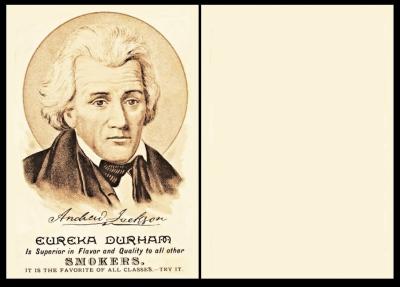
The reason for this card is that Andrew Jackson and Martin Van Buren founded what would become the Democratic Party of the United States of America, on January the 8th, 1828, in Baltimore, Maryland. And since 1853 every president has either been a Democrat or a Republican.
Each of these parties are represented with a symbol, of an animal, the Republican one being an elephant, and the Democrat one being a donkey. The elephant began during Abraham Lincoln`s presidential electioneering campaign in 1860, when it was used in a newspaper. And the donkey was used even earlier, by our man Andrew Jackson, who was called a donkey by his opponents and had the symbol of one printed on his campaign posters.
As far as the card, well that is going to be a bit of a jigsaw puzzle because nobody seems to know who Eureka Tobacco is. Some even connect it with Lorillard, who did indeed sell "Eureka Plug", for five cents a chew. However Durham, North Carolina, was a huge tobacco making area, not just the headquarters of W. Duke and Sons, but of W. T. Blackwell & Co., plus many smaller operations.
As to why we have called it "American Presidents", well that is because the same set was issued by J. S. Larkin & Co., with "Sweet Home Soap", in 1885 - and their set of twenty-two cards shows the following, all of whom were American Presidents :
- John Adams
- John Quincy Adams
- Chester A. Arthur
- James Buchanan
- Grover Cleveland
- Millard Fillmore
- James A. Garfield
- Ulysses S. Grant
- William H. Harrison
- Rutherford B. Hayes
- Andrew Jackson
- Thomas Jefferson
- Andrew Johnson
- Abraham Lincoln
- James Madison
- James Monroe
- Franklin Pierce
- James K. Polk
- Zachary Taylor
- John Tyler
- Martin Van Buren
- George Washington
These twenty-two names run up to Grover Cleveland, who was elected in 1885, and it is possibly the reason the set was issued. He was succeeded by Benjamin Harrison, in 1889, who lost his seat in 1893 to Grover Cleveland again.
Monday, 8th December 2025
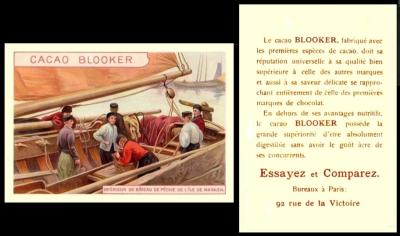
Another fiendish clue, but at one time fishing boats used small winches, often steam powered, to pull their heavy nets up from the sea, or to raise and lower the sails. And those small winches are called "donkeys", either steam-donkeys, or donkey-engines.
They were also used in timber cutting, logging, and down mines, in extremes of temperature or confined spaces which would have made it impossible to use an actual donkey, but paying homage to the way that a donkey performs the same task, over and over, without complaint.
This led to some very funny terminology. The steam boiler and engine connected to the winch was mounted on a sledge, so that it could be dragged, and that was called a "donkey-sled". On mining and logging sites the donkey engine was in a building, which became known as the "donkey-house". The man who operated the engine was usually called the donkey-man, just as he would have been if his charge had been a real donkey. And he wore thick coats with leather patches on the shoulders, which gave rise to the term "donkey-jacket"
We say "chocolate" but Blooker only made it as cocoa powder in drinking chocolate form, not for eating.
The firm was founded, in Amsterdam, in 1814 by John Blooker.
It is as yet unclear whether these cards are a set showing views of the Ile de Marken, or whether they are part of a larger set of general Dutch Views.
The seven cards we know of so far are :
- Canal avec Passerelle Ile de Marken - a bridge over a canal
- Interieur de Bateau de Peche de l`Ile de Marken - close up view of fishermen on boat
- La Demande en Marriage Ile de Marken - man and woman by house, boat behind
- Le boulanger - the baker - a man with a horse cart
- Les Tricoteuses Ile de Marken - five women and a baby, some knitting
- Marchand de poission - fish market - a dog cart and small boy
- Port de l`Ile de Marken - fishing boats in a harbour
Tuesday, 9th December 2025
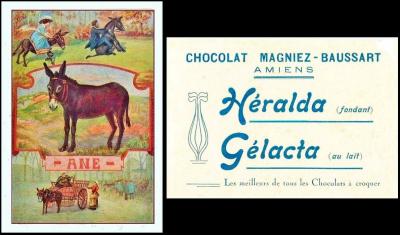
This card ties in with the Guernsey Footballers as it uses the same word "Ane" that the Jersey folk call the Guernsey ones, proving that though the military were garrisoned on the Channel Islands to guard against French invasion, those islands had many French ways, and links, already.
Its manufacturer is little known in the United Kingdom, but they issued many cards. It all began in 1859, with Monsieur Paul Frédéric "Ernest" Magniez, who was born in 1851, and started a chocolate factory on Place Gambetta, Amiens. It was not a large site, and it was quickly outgrown. By 1870 they were removed to Rue Deberly, and in 1899 to Rue Colbert.
In 1905 his daughter Pauline was married, to a man called Adolphe Alphonse Marie Georges Poulain, who would take over the company on Monsieur Magniez`s death.
I have not tied this Poulain to the Poulain chocolate dynasty yet, but it seems very likely as Victor Auguste Poulain`s factory gained Limited Company status in 1893. And I have no idea of where the Baussart ties in.
By 1906, when the company took part in the Amiens International Exhibition, they were thriving, not just in sales but with the mechanisation of their chocolate production - their latest patent being a machine which passed fillings beneath machines that covered them, all over, with chocolate, a great improvement on hand-dipping, which did not result in such a smooth finish, and was much slower.
This card seems to suggest that there were more animals, but I have failed to find a single one. If you know of any, do let us know.
Wednesday, 10th December 2025

This card shows the African Wild Ass, which is believed to be the ancestor of today`s donkey.
Originally they were to be found across the desert regions of that continent, all the way into Egypt and the Sudan, but today they seem more concentrated in Eritrea, Ethiopia and Somalia, and their numbers are dwindling, fast, to the point that soon there may only be five hundred left to wander.
Like the donkey, they are small, but can get to the size of a pony, about fourteen hands. They are much lighter though. This card shows a brownish colour. slightly darker than a dun, but they are mostly light grey or a very light fawn, this card is much too colourful. They share that colouration with most donkeys, and also have the same dorsal stripe of darker brown or black hair along their spine. However only the wild asses found in the Nubian region have that line branch down their shoulders, to form a cross when viewed from above without a blanket or a rider; something that also appears in the donkey; whilst those from Somalia have striped legs, something which occasionally shows up in the donkey, proof that they share bloodlines, somewhere along the evolutionary chain, with the zebra family.
This set is first catalogued by Jefferson Burdick, as :
- T.29 - Animals. (80). Hassan, Lg.
40 each, with and without back description, also plain backs. Issued abroad with Cross Cut or Chinese backs.
He values them at five cents a card.
We first record it in our reference book to the issues of the British American Tobacco Company, RB.21, published in 1952. It is filed in "Group 6 - Other Multi-Area Series",as :
- 299. ANIMALS. (Adopted title). Large cards, size 82 x 64 m/m. Front in colour. Unnumbered series of 80, listed in American Book of Checklists, under T.29
A. Cross-Cut Cigarettes issue. Back per Fig 299.2 in brown
B. U.S.A. 20th Century issue, Burdick T.29. "Hassan" back in grey-black, 40 subjects with advertisement back, 40 with descriptive text, as illustrated in Fig. 299.1
in our original World Tobacco Issues Index they are listed as follows :
- ANIMALS (A). Lg. 82 x 64. Unnd. (80). See ABC/T.29 and X21/299.B. Ref. USA/T.29 ... A54-4
(a) "Hassan" brand issue
1. Back with descriptive text (40)
2. Back without descriptive text (40)
(b) Plain back. Front with "Factory 25" wording
Curiously section a.1 (with the descriptive text), are in vertical format, back and front whilst section a.2 (without the descriptive text and with the "Hassan" advert) are in horizontal format, back and front.
Now the entry at X21/299, which is in the accompanying handbook to the World Tobacco Index, throws up a huge can of worms, because it reads :
- X21/299 ANIMALS. Large size. There are further Chinese printings of this series and all printings known are summarised below. The 80 subjects are listed in ABC under T.29
A. B.A.T. "Cross Cut Cigarettes". Back illustrated at Fig.299-2 in RB.21. Unnumbered series of 80
B. A.T.C. Group issues. Reference USA/29. Unnumbered series of 80
(a) "Hassan" back in two styles. See RB.21/299.B
(b) Plain back. Front inscribed with "Factory 25" wording
C. Anonymous Chinese issues, with front per No.1 at Fig. X21/299 caption in Chinese. Numbered series of 22
(a) Plain back. Size 84 x 64
(b) Back in Chinese, per No.2 at Fig. X21/299, in brown. This is the untraced set C.18 on page 54 of RB.21. Size (A) medium, 66 x 51 (b) large, 84 x 64. The back is known as "Sundry Back 57.A", see set ZE6-1 in the World Index.
Lastly, in our updated version of the World Index they appear as :
- ANIMALS (A). Lg. 82 x 64. Unnd. (80). Ref. USA/T.29 ... A565-008
(a) "Hassan" brand issue, F.30 and 649
1. Back with descriptive text (40)
2. Back without descriptive text (40)
(b) Plain back. Front with "Factory 25" wording (40 - as printing a.2
Only one of these above references mention the fact that this set was also issued as a trade set. That was Jefferson Burdick who knew of the Weber Baking Company of Irvington, New Jersey, and catalogued them as :
- D.9 - ANIMALS. (80). Weber Bros, as T.29
He valued them at only three cents each, though it is curious that he cross references them here to, but not from, the tobacco version.
Today we know that there are more trade versions - by Gridley Butter of Wisconsin, and Krug Baking Company of Jamaica - but that Jamaica is in New York, the "L.I." in the address standing for Long Island (though it is actually in Queens).
We also know that on the Weber version the card of the African Wild Ass is facing the other way to our card - hence we have this list of all the cards, on which the variations will eventually be noted.
- Addax (Hass.L )
- African Bush Pig (desc. R)
- African Jumping Hare (Hass.)
- African Sea-Eagle (desc.)
- African Wild Ass (Hass.)
- Arabian or Sacred Baboon (desc.)
- Arabian Thorny-Tailed Lizard (desc.)
- Baboon (Hass.)
- Banded Mongoose (desc.)
- Bataleur Eagle (desc.)
- Black-Backed Jackal (Hass.)
- Bruchell's Zebra (Hass.)
- Brush Tail Porcupine (desc.)
- Brush Tailed Porcupine
- Bushbuck (desc.)
- Cat (desc.)
- Cape Buffalo (Hass.)
- Cape Hunting Dog (Hass.)
- Cape Oribi (desc.)
- Cheetah (desc.)
- Chimpanzee (Hass.)
- Civet-Cat (Hass.)
- Dorcas Gazelle (Hass.)
- Eland (Hass.)
- Elephant (Hass.)
- Fennec (Hass.)
- Fischer's Chameleon (desc.)
- Fraser's Flying Squirrel (desc.)
- Genet (desc.)
- Nubian Genet
- Giraffe (Hass.)
- Goliath Heron (desc.)
- Gorilla (Hass.)
- Guereza Monkey (desc.)
- Guib (advertising backs)
- Hartebeest (Hass.)
- Hippopotamus (Hass.)
- Hooded Cobra (desc.)
- Horned Guinea Raven (desc.)
- Impala (desc.)
- Jabiru (desc.)
- King Crane (Hass.)
- King Vulture (Hass.)
- Klipspringer (desc.)
- Konzi (desc.)
- Kudu (desc.)
- Lalande's Dog (desc.)
- Lechwe (desc.)
- Leopard (Hass.)
- Lion and Lioness (Hass.)
- Magot Macacus inuus Magot or Barbary Macaque
- Mandrill (Hass.)
- Marabou (Hass.)
- Meerkat (desc.)
- Nile Crocodile (Hass.)
- Okapi (desc.)
- Orang Utan (Hass.)
- Ostrich (Hass.)
- Porcupine (Hass.)
- Red River Hog (Hass.)
- Rhinoceros (Hass.)
- Ring-Tailed Lemur (desc.)
- Roan Antelope (desc.)
- Ruppell's Vulture (desc.)
- Sable Antelope (Hass.) (desc.)
- Secretary Vulture (desc.)
- Serval (desc.)
- Snake Hawk (desc.)
- South African Fox (desc.)
- Spotted Hyena (Hass.)
- Springbok (Hass.)
- Striped Hyena (Hass.)
- Tiger (Hass.)
- Vulture-Like Guinea Fowl (desc.)
- Wart-Hog (Hass.)
- Water Buck (Hass.)
- Water Chevrotain (Hass.)
- White Bearded Gnu (desc.)
- White Tailed Mongoose (desc.)
- White-Tailed Galago (desc.)
- Wildebeest (Hass.)
Thursday, 11th December 2025
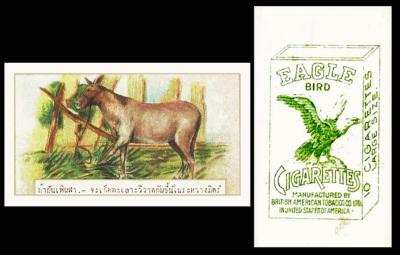
So we now know a lot more about this set than when we started, including the proper title, which is not "Animals and Birds" as I had been told. And that explains a lot, tincluding my belief that the title was incorrect, as there are other items, as you will see from the still partial list below.
- Bandicoot rats
- Bear being restrained by man
- Bee
- Birds eggs in a nest
- Camel
- Chicken house with slope for entry
- Donkey
- Horse
- Leopard chased by man
- Lion
- Man cooking a meal
- Man weeding a grave
- Pig
- Rabbits
- Sambar (often wrongly identified as elk or moose)
- Sheep
- Spider
- Water melon
- Well with wooden high cover
- Wild pig being restrained by a man
- Wolf being restrained by shepherd
- Woman with bowl, two boys swimming
The set first appears in our original reference book to the British American Tobacco Company (RB.21, published in 1952) as
- 491-3. SIAMESE DREAMS AND THEIR MEANING (adopted title). Front per Fig.491-3, whole 50 cards illustrated at Fig.491-3.A. Series of 50. Previously known as "Series D"
The front index tells us that they were issued in Siam, India, Malaya and China.
By the time of our original World Tobacco Issues Index, the set was listed as :
- SIAMESE DREAMS AND THEIR MEANING (A). (50). See RB.21/491-3 ... B116-162
And this text remains the entry in our updated version of the World Tobacco Issues Index, save the card code, which is now B705-600
Friday, 12th December 2025
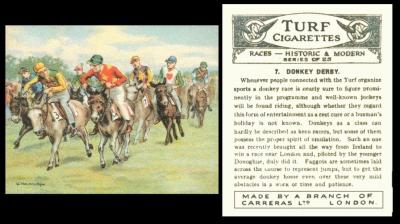
If you look online you will be told that the earliest Donkey Derby was at the 1928 Kingsbridge Show in Devon, but that cannot be right as our set was issued the year before.
The interesting thing about our card comes near the end, where it says "Donkeys as a class can hardly be described as keen racers, but some of them possess the proper spirit of emulation. Such an one was recently brought all the way from Ireland to win a race near London and, piloted by the younger Donoghue, duly did it."
That "younger Donoghue" was Steve Donaghue`s brother, George, who died in 1926, aged thirty-seven.
However Steve Donoghue has a huge connection with donkey derbies, and not just as a rider, for during the 1920s and 1930s he actually organised them too, to raise money for charities, especially St. Dunstan`s. Mind you I have yet to find out his connection to St. Dunstan`s, which is a charity for blinded ex-service personnel. What he did was arrange for a squadron of donkeys to be brought to a fete, and then make his fellow jockeys turn up and ride them. Of course there was much fun in seeing these champion jockeys struggle to make the wilful donkey even move off the starting line. He also made sure that the newsreel cameras were there to capture the races, and you can still see several of them online at Pathe News.
The set is listed in our original World Tobacco Issues Index under Carreras section 2.B - "TURF CIGARETTES" ISSUES. 1925-27. Inscribed "Made by a Branch of Carreras ...". Issued through the Boguslavsky branch. Except for Set C-18-23 [Races - Historic and Modern] all cards are very highly glazed on fronts." It is described as :
- RACES - HISTORIC & MODERN. Nd. ... C18-23
A. Small. (25)
B. Large. (25)
C. Cabinet Size (12)
As for the entry in our updated World Tobacco Issues Index, that is identical, save a new card code, of C151-170
The sizes are given in both volumes as "Small size 67-68 x 35-37 m/m., medium 67-70 x 60, cabinet size 133-135 x 69-71 m/m., unless stated".
What none of these books tell you is the identity of the artist, but I can now divulge that it was William Hounsom Byles, a Londoner, who was born in 1872. He first exhibited at the Royal Academy in 1894, and was made a member of the Royal Society of British Artists in 1901. During the First World War he joined The Artist`s Rifles, and 1916 was commissioned into the Royal Army Service Corps.
Click on the images below to view and purchase our paintings by William Hounsom-Byles…
As for the cards in this large size, they are as follows
- Flat Racing (Horse) (100 years ago)
- Flat Racing (Horse) (modern)
- Steeple-chasing
- Hurdle Races
- Point-to-Point Races
- Pony Races
- Donkey Derby
- Bending Races
- Trotting and Pacing Races
- Mexican Horse Races
- Hungarian Horse Races
- Races in Paraguay
- Flat Racing on Ice
- Riderless Horse Races in Italy
- Ski-Joring
- Cossack Horse Races
- Trottting Races on Ice
- Russian Sleigh Races
- Roman Chariot Races
- Steeple-Chases for Allied Officers
- Canadian Dogsleigh Races
- Camel Races
- The First Steeple-Chase on Record
- Greek Horse Races
- Gondola Races
And there we take our leave, before I fall asleep on the keyboard all over again.
Be back next week..... and hope to see you here!