
Saturday, all over again, and with it we have another newsletter, more or less on time and with more or less the subjects and cards I started with, though there was a little spot of panic regarding one of the cards, about which more later...
This week I again tried the new system of getting the subjects, writing them up, and only then hunting cards. That explains why two of the cards do not actually show the person I wrote about, and one was changed to bring someone in who was not mentioned at first but was hurriedly connected in a kind of very loose way. Again, more about those as we go along..
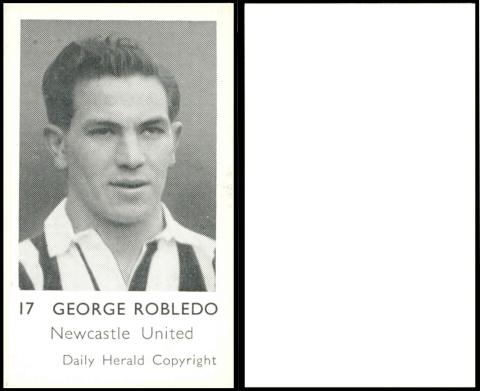
DAILY Herald [trade : newspaper : UK] "Footballers" - untitled - light print version (1951) 17/32 - DAI-180.3.1.b : DAA-2
Let us begin our week with the story of The Football Association of Chile, and a centenary. The Football Association of Chile was actually founded on the 19th of June, 1895, and for a time went along well, at least until, in 1909, it had a bit of a row with the newly founded Federacion Sportiva Nacional, whose intent was to ensure that all sports played within Chile honoured the history and culture of that country. The first thing that happened was that The Football Association of Chile changed its name, either willingly, or maybe not, to El Asociacion de Football de Chile. And, under that name, in 1913, it applied to join FIFA, something that was granted it in 1914.
That led to the first ever South American Football competition, El Campeonato Sudamericano de Futbol, in 1916. This was open to all countries in the continent, but was held in Argentina, which was celebrating another centenary that year, of the Argentine Declaration of Independence. The competition was run by the four footballing governing bodies within South America, from Argentina, Brazil, Chile and Uruguay, who joined together under the name of CONMEBOL, (the Confederacion Sudamericana de Futbol - which, yes, is a rather clunky acronym).
In the early nineteen-twenties, a rival group appeared, based in Santiago, calling itself the Federacion de Football de Chile. Then, as you might imagine, there was some wrangling. And it got so bad that FIFA removed Chile from their ranks in 1925. Nobody really wanted that though, and so today, in 1926, the two warring Chilean groups got together and agreed to a merger, of sorts, under the name of Federacion de Football de Chile.
Now you would think that Chilean football would appear in lots of early sets but so far I have not found any. But I did stumble on the first Chilean footballer to appear on a British card, and changed this in order to bring him in. His name was Jorge Robledo Oliver, though he played under the name of George Robledo, and his first card, in 1947, was Barratt & Co.`s "Famous Footballers", which shows him playing for Barnsley.
He also turned out to have been the first non-British-registered, or "foreign" player to be top of the goal-scoring league tables in England, though his mother was actually English, and had met his father when the two of them started working together in a copper mine at Iquique. The family then emigrated to Brampton, in Yorkshire, in 1932, when he was only five.
On leaving school he became a coal miner, and got a part time gig, strictly as an amateur, with Huddersfield Town F.C.`s second team. His move to Barnsley reputedly happened during the Second World War but he did not play for them until football resumed in 1946. Then, in 1949, he made the break to the First Division when he was signed by Newcastle United, along with his brother, Ted. In fact Newcastle United had only wanted George, but he refused to go without Ted. During this time he became the first South American to play in the F.A. Cup Final, and also the first to be on the winning team, for Newcastle United beat Blackpool by two Jackie Milburn goals to nil. That was in 1951, and the following year our man was also part of the F.A. Cup Final, against Arsenal, who lost one nil, that single goal being supplied by George Robledo.
However in 1953 Ted Robledo was released from his contract and sold to a Chilean team called Club Social y Deportivo Colo-Colo, of Santiago. George could have stayed at Newcastle United, but chose to follow his brother, sticking together, once more.
In 1956, George Robledo was chosen to become the President of the Professional Footballers Trade Union in Chile. He was, at that time, still playing for Colo-Colo, but left in 1958 and did not return to football until 1959, the year he also got married. His new team was Club Deportivo O`Higgins, in Rancagua, near Santiago. And it was whilst he was playing there that he retired in 1961.
George died on the 1st of April 1989, just before his sixty-third birthday. He was still struggling with the fact that in December 1970, tragedy struck the family, as his brother Ted somehow fell from an oil tanker into the sea, near Dubai - the circumstances were never, and probably will never, be known - and the body was never found.
I am delighted to bring you this card as it ties in with our Card of the Day from last Saturday the 17th of January 2026, where you can see the full text from our British Trade Indexes, as by using this version here you can much more easily compare the two.
However in its first appearance, in our British Trade Index part two, we thought there was but one set, listed as :
DAILY HERALD
Cards inscribed "Daily Herald Copyright". Issued about 1948-50
- FOOTBALLERS (A). Sm. 61 x 37. Black. Nd. (32) ... DAA-2
It was only in our updated British Trade Index that things changed, and that listing reads :
- SPORT STARS. 61 x 37. Black. Nd. Issued in three series with special albums for each series inscribed "Sporting Publicity (Leeds), "Sport Stars", with titles of the three sets, Subjects listed on front cover of each album. ... DAI-180
3. Soccer Stars. Nd. (32). Two printings. See also under "Sportfoto", SPO-130. All three issues are listed at HD-7 to illustrate the differences.
1. 1951/2. "Daily Herald Copyright" at base, player`s name in a) bold thick, b) thin letters. See HD-7.A
2. 1953/4. As above, "SPORTFOTO" beneath, in a) bold, thick, b) thin letters. See HD-7.B
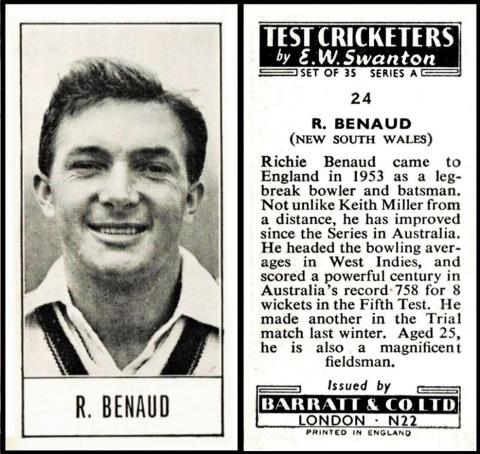
BARRATT & Co. Ltd [trade : confectionery : UK - London N.22] "Test Cricketers by E.W Swanton - Series A" (1956) 24/35 - BAR-740 : BAR-93
Today in 1952 saw the Test debut of Richie Benaud. He had been born in Penrith, New South Wales, Australia, on the 6th of October 1930, and his father was a renowned cricketer for the local club, which is how our man was introduced to the game. In fact his brother, John, would also become a Test cricketer for Australia.
He first played proper cricket at school, and his early training stood him in good stead for he soon made the state youth team and first took the field, as an adult, for New South Wales in 1948. But in a match shortly after that he was struck in the head by a ball, just above the eye, and after investigation he was ruled out of the rest of the season with a fractured skull.
His first true Test Match, today, in 1952, saw him taking the field against the West Indies.He had already played them, but only on a tour match, not in a Test when emotions were much higher.
Then, in 1953, he was again struck by a ball, in the mouth. He was told by the doctors that if it had been higher it may have reopened his last fracture, and possibly killed him. They mentioned retirement, but he chose to play on. He had already set the date for his wedding, not so long after that match, and was married looking rather like a mummy, swathed in bandages across his face.
In fact he did not retire until 1964, but he did slow down in the late 1950s. In fact he had the opportunity in 1956 to attend a training course, for presenters, run by the BBC. He much enjoyed that, and it also led to a job, reporting for the News of The World. That was followed by his moving into commentating, at first on radio, and then on television, where he stayed until 2005. And he also wrote several books on cricket.
There were many reasons for his deciding to leave, but chief amongst them was that he wanted to go home, to Australia, where he had already lined up a commentating job.
He died in his sleep on the 10th of April 2015, though he had been diagnosed with cancer less than six months before. He was eighty-four years old.
Our card is pretty intriguing, but for a reason you almost certainly do not know - that is because the text was written by E.W. Swanton, a famous cricketing author. It was released in 1956, and in under ten years from its issue, our man had divorced his first wife, with whom he had two sons, and married a lady called Daphne Surfleet. Now Daphne Surfleet actually worked for Mr. Swanton, which seems to suggest that without these cards the two may never have crossed paths. Alas, we will never know for sure. But it does seem a pretty big coincidence..
Our set is catalogued first in our original British Trade Index part two, as :
- TEST CRICKETERS BY E.W. SWANTON. Black. Series A. Nd. (35) ... BAR-93
There was a series B, and it is listed immediately below, as :
- TEST CRICKETERS, SERIES B. Black. Nd. (48) ... BAR-94
Nothing else appears on these sets in the other original Trade Index volumes, and only slightly more information, though, usefully, the date of issue, is added by our updated British Trade Index,where the listing reads :
- TEST CRICKETERS BY E.W. SWANTON. Series A. 1956. 65 x 35. Black. Nd. (35) ... BAR-740
- TEST CRICKETERS, SERIES B. 1957. 65 x 35. Black. Nd. (48) ... BAR-745
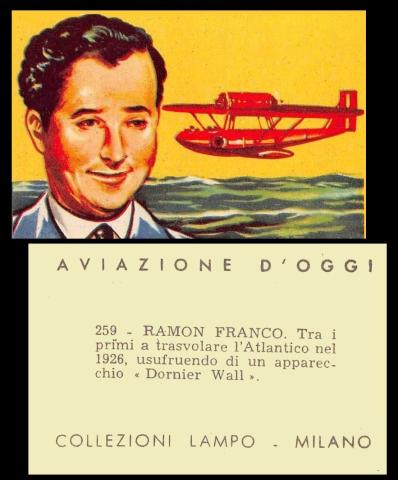
Collezioni LAMPO [trade : cards : O/S - Milan, Italy] "Aviazione d`Oggi" / aviation of today (1959) 259/?
Centenary number two tells of Ramon Franco Bahamonde, a Galician aviator, and brother of General Franco, who, on this day in 1926 set off on a Trans-Atlantic flight from Las Palmas to Buenos Aires with several stop overs.
He had been born on the second of February, 1896, at Ferrol Naval Station. Little is known of his early years, though I may be able to glean those from his brother`s life. We do know that in 1914 Ramon Franco joined the infantry and was sent to Morocco.
Then, in 1920, he joined the Spanish Air Force. This was a time of discovery and exploration, of breaking boundaries and records.
The trip we celebrate today started out on the twenty-second of January 1926, when a Dornier Do J flying boat, christened "Plus Ultra", lifted off from Palos de la Frontera, the same town from which Christopher Columbus had left in 1492. And it landed for the last time in Buenos Aires, almost sixty hours later. Amazingly the aeroplane still survives, in a museum in Buenos Aires, but sadly the original dreams of restoring it to flying condition have not yet come to pass.
At the time Ramon Franco was a national hero, but he soon used his fame to protest against the current government, so much so that he spent some time in prison - before he escaped. In 1930 he was almost arrested again for an air drop of pro-Republican propaganda. Instead he fled to Portugal, and only came back in 1931 when a democratic government was in power.
Under that regime he was quite the leader, (can it be just coincidence that their motto was also "Plus Ultra"?), and he was given rule over aeronautics, but there were suspicions that he was plotting revolution, and he lost his job. He was then sent to Washington D.C. as air attache, and only returned to Spain when his brother was starting to make a name for himself in the Nationalist movement.
Then on October the 28th, 1938, it was announced he had been killed, when his seaplane had crashed off the shores of Majorca. There are many conflicting stories about what actually happened, and even about why he was in the area. Some still believe that he was mistaken for his brother, or that it was thought his brother was on board; some even believe his brother arranged it. But this far distant we shall never know, at least not more than a guess.
As far as our issuer, "Lampo", that is actually a trading name for Lotario Vecchi, who returned to Italy from Spain in the late 1940s, and started a publishing house, called "Astra", and bought a company called "Lampo" a couple of years later. His first set was called "Animali di tutto il mondo", or animals of all the world. And for a long time he was very successful, but in the 1960s he started to have competition. He tried changing the name, several times, though always retained some mention of "Lampo", and even relocating to ever smaller premises, but the last set was issued in 1978, after which he was forced out by even bigger competitors, like Panini.
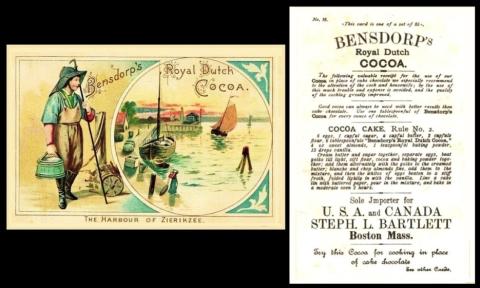
BENSDORP Cocoa [trade : cocoa : O/S - Holland] "Dutch Scenes" (1900?)
Here is a reason to be cheerful, as today is #NationalChocolateCakeDay.
I am not sure why the mention of chocolate cake is so enticing for there is nothing too difficult about making the most basic of chocolate cakes, it is only the addition of the cocoa powder, or even just some drinking chocolate powder.
In fact that is what happened in the seventeenth century, when either for an experiment, or accidentally, some cocoa powder was mixed in with a standard cake recipe.
The fist person to mechanise this process was someone we all know well, Coenrad van Houten, and he did that quite some time after, in 1828. The machine split the fat and the cocoa liquid, making a mass of solid matter which could be cut into sections and then ground into a fine powder. And therefore it is him we have to thank for turning chocolate from something which was reserved purely for the rich into something anyone could afford and enjoy.
This card is for Bensdorp, founded in 1849 by Gerardus Bensdorp, newly returned from Europe, where he had been employed in several chocolate factories. However there seems little information on him - at the moment, anyway.
Now I would have thought there would have been more chocolate cakes on cards, but strangely not. And I started out with one which was a gentle brown, almost mousse-like in consistently - which, on further examination, turned out to be blancmange. I am not sure why the fact it was shaped with ribbed sides, aka straight from a jelly mould, failed to alert me to that possibility a great deal earlier, but there you go.
However I am delighted to say that this new card was supplied me at the very last minute, by one of my faithful contacts.
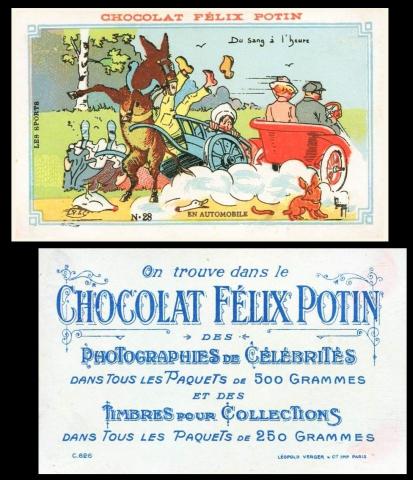
Felix POTIN [trade : chocolate : O/S - Paris, France] "Les Sports" (1900?)
Today in 1896 a man called Walter Arnold, of East Peckham, Kent, became the first person to be convicted of speeding. His fine was one shilling, plus costs - and his crime was to be spotted driving his Benz horseless carriage at 8 mph, when the speed limit was just 2 mph. And he was reputedly caught after a chase by a policeman on a bicycle.
This all took place in Paddock Wood, and Mr. Arnold was not just a motorist, he was the local Benz dealer, as well as the proprietor of a company manufacturing vehicles under his own name, called Arnold Motor Carriages. In fact it is believed that he allowed the case to go to court because it would make the papers and people may seek him out in order to buy one of his cars. And it actually made the London Daily News, which was a pretty big thing.
There were several crimes that eventually saw him in the dock at Tunbridge Wells, but the most important one was not the speed, it was the basic one of using a carriage without a locomotive horse. The fine for that was five shillings, plus two pounds and eleven pence in costs. On each of the other counts he was fined a shilling with nine shillings costs, these being his breakneck speed, his not having at least three people with the vehicle, his not having a man walking in front, and lastly for his not having his name and address on the vehicle.
If we look at the Locomotive Acts we get a great insight into many of these charges, and also feel some sympathy for a judge asked to pass a sentence on a car when the laws all pertained to railway trains.
Legislation began with the Locomotive Act of 1861, which set down their permitted use, size, weight, and operation, and also the fact that the vehicles must have two men in charge at all times, with a third brought in when there were more than two carriages or wagons. It also set the rates of toll roads, which varied rather in different areas. Lastly, it set a speed limit of five miles an hour in towns, and ten miles an hour in the country. And it not only banned them from using suspension bridges, but stated that they needed consent to cross other bridges or roadways that were shared with local non locomotive transport.
That was updated with the Locomotives Act 1865 which started to locate and regulate the actual tracks and roadways, and give them county and borough boundaries, in an effort not to put all the burden of legislation on one area. It is chiefly notable for lowering the speed limit to two miles an hour in built up areas and four miles an hour in the country, plus a subtle change that permitted the locomotive to share common ground provided two men were in charge of the locomotive and one was walking sixty yards ahead, waving a red flag. For this reason this Act is known as "The Red Flag Act"
It was soon realised that the name needed to change, which led to the Highways and Locomotives (Amendment) Act 1878. This Act gave powers for county authorities to charge licensing fees of up to £10 a vehicle per annum, and removed the need for the man in front to wave a red flag, though he was still to walk in front, at a distance of twenty yards, to inform and assist any non-powered traffic. It was suspected the Act might raise, or restore the speed limits, but it did not.
All the other licensing regulations came in with the Locomotives Act of 1898 which brought in the requirement to carry plates showing the licence number and the area from which the vehicle had come. Importantly it brought in a new class of "light locomotives", in other words vehicles weighing less than three tons. Most of the regulations from the previous Acts no longer applied to these, which was a bit of a shame for Mr Walter Armold, as it would have removed his need for having three men, and also allowed him to get off scot free from the speeding, for the speed limit on these smaller vehicles was set at fourteen miles an hour - notwithstanding that local authorities could set lower speed limits at places they deemed necessary, with their local knowledge.
It seems tempting to think that this was done simply not to tie the courts up with hundreds of motorists, but it does seem telling that it was passed just two years after what we could call Mr Arnold`s showcase trial.
This card at first seems humorous, but I did not notice the poor goose in the left hand corner, and now its all I can see. It is one of a series under the title of "Les Sports", though again perhaps hobbies and pastimes would be more appropriate.
19. Les Pecheurs - man in river
22. Les Pecheurs - fishing - a man and a talking fish
23. Les Pecheurs - fishing - a family on a riverbank
26. En Automobile - in the river
27. En Automobile - a perilous hill descent
28. En Automobile - speeding and frightening a horse (or donkey)
31. En Aeroplane - watched by horses
32. En Aeroplane - monoplane and binoculars
33. En Aeropjane - monoplane in a tree
40. A Bicyclette - coming across a herd of cows
41. A Bicyclette - large lady being propelled by smal man
42. A Bicyclette - running into boxes
55. Canotage - rowing - two men
56. Canotage - long boats each of four men
57. Canotage - rowing - one man
58. Canotage - yachting
60. Canotage - man standing on small punt
61. Sous Marins - two sailors and a buoy
65. Sous Marins - two men atop a submarine
66. Sous Marins - man in top hat atop a submarine with Captain
67. Course des Camelots
68. Un Cross-Country (course-d`obstacles)
69. Course a pied - men on box carts at finishing line
70. Course des Tonneliers - barrel rolling
72. Course a pied - sack race
79. Patinage - ice skating - man through the ice
83. Patinage - ice skating - crowd with fish below
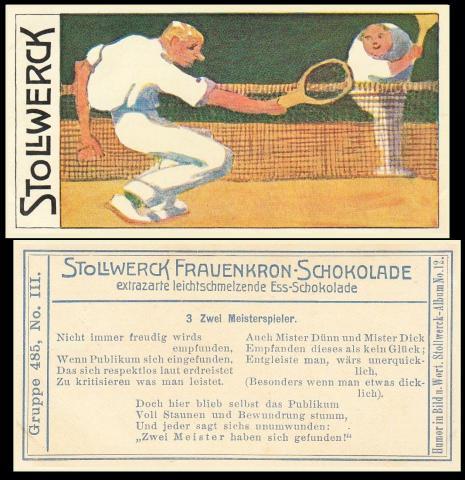
Gebruder STOLLWERCK [trade : chocolate : O/S - Germany] Dick und Dunn / thick and thin (1900?) Album 12, Gruppe 485 No.11
And yet another centenary, we have the birth of Bob Falkenburg, today, in 1926, in New York City, who won the 1948 Wimbledon Mens Singles title, and would go on to start a restaurant in Rio de Janeiro called simply "Bob`s" which would grow into a chain.
His love of tennis came from his family, for both his mother and father were keen players, and they taught all three of their children. They also moved about a bit, to Los Angeles, and then to South America. In fact his mother won the Brazilian State Tennis Championship in 1927. As soon as little Bob was able to hold the racquet he was playing tennis, and he was signed up to the local club before he could even play. In fact he won the junior tournament at another club in Bel Air when he was just eleven.
Bob and his brother Tom often entered doubles matches, and in the 1940s they were pretty much unbeatable at college level; they even won the United States Doubles at Forest Hills in 1944. However in that year Bob Falkenburg enlisted in the Air Force. There is no word of where he served but it seems to have been at home, for his name appears regularly in tennis tournaments.
After the war was ended he enrolled in the University of Southern California. But in 1947 he fell in love with a Brazilian girl, and they moved back to Brazil, setting up home in Rio de Janeiro and even changing his nationality in 1949.
By that time he was a regular at Wimbledon, winning the men`s doubles for the first time in 1947, and the men`s singles in 1948. After that he was offered a contract to turn professional, for the not inconsiderable sum of S100,000 -annually, not as a lump sum - but he turned it down. He never said why, but there were several reasons, he did not like touring, he wanted more free time to develop his golfing, (which he was also very good at, playing in, and winning, many international tournaments), and also he had children by then, who did not want to leave.
However he did miss the tennis, and on a whim, in 1952, he decided to open an ice cream store near Copacabana beach. This was a big gamble, as there were no ice cream shops there, and actually his was the first soft serve ice cream ever to be seen in Brazil. But it was a hit, straight away, in all the papers and magazines, which led to him being asked for proper meals.
He could have ignored that, but he decided to try, and see where it went. He started to cook the food he remembered from his New York childhood; hamburgers, hot dogs, and milkshakes in a variety of flavours and colours.
Brazilians had never seen anything like it, and everyone wanted to try it, from the man and woman in the street to the rich and famous - and that led to his opening twelve stores.
In 1970 the family were tired of Brazil and moved back to Los Angeles. For a while the restaurants were run by proxy, but then he received an offer, which he took, for the whole lot, and he accepted.
Today, owned by Nestle, the chain is over six hundred strong, and not just in Brazil.
He kept himself active in retirement, and still played golf. He was also the president of the Bel Air Country Club, where he had won that junior tournament back in 1937. And he died on January the 6th, 2022, aged ninety-five.
Unfortunately there seems to be no cards of Mr. Falkenburg, I now know. So we have gone for this one, until I can find one, or am told of one. This set is German and tells of the adventures of two men, one tall and thin and one small and rotund, perhaps the precursors of Laurel and Hardy, though, strangely, Laurel and Hardy are known in Germany as Dick and Doof - most uncomplimentarily, for Dick means fat and thick, and stands for Oliver Hardy`s character, and Doof just means stupid, and stands for Stan Laurel`s.
This set is all about tennis, and the cards are entitled
- Vorbereitungen
- Zum Angriff bereit
- Zwei Meisterspieler
- Spannung
- Schluss
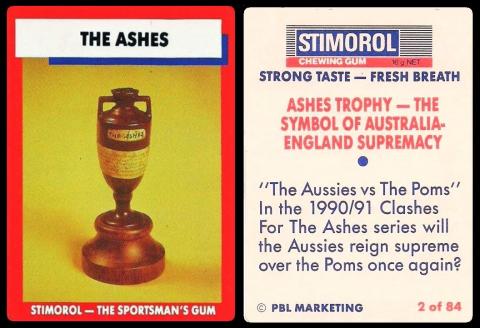
Scanlens [trade : bubble gum : O/S - Australia] "Cricket - The Aussies vs The Poms" (1990) 2/84
To close, we tell the tale of how today, in 1883, the England cricket team were presented with a tiny trophy.
But let us first go back to the start of the saga. In 1882 the Australian cricket team visited England, and did the unthinkable, they won, on British soil. That match was on the twenty ninth of August, and on the second of September a mock obituary appeared in The Sporting Times, which read "In Affectionate Remembrance of ENGLISH CRICKET, which died at the Oval on 29th August, 1882. Deeply lamented by a large circle of sorrowing friends and acquaintances. R.I.P. N.B.—The body will be cremated and the ashes taken to Australia."
In fact that was a second obituary, for one had been published on the thirty-first of August, in a magazine called Cricket: A Weekly Record of The Game - and that read "Sacred to the memory of England`s Supremacy in the Cricket-Field, which expired on the 29th day of August, at the Oval. Its end was Peate."
A little explanation here, as Peate was a cricketer, Edmund "Ted" Peate, a Yorkshire man, and the last England batsman of the day, and he needed just ten runs to win. Earlier in 1882 he had gained much respect by beating the record number of wickets taken over any county cricket season, with an astonishing two hundred and fourteen, and even W.G. Grace considered him the best slow bowler of England. However he only got two wickets before he was bowled out by Henry Frederick "Harry" Boyle, the son of a gold prospector (though he was not just that, he founded Sydney Flat Cricket Club, and made their Ground, from scratch, with a few other men, efforts which were reflected when, in 2023, it was named after him)
These were read, and considered, by the captain of the England Cricket team, The Hon. Ivo Bligh, and he declared that he would go out to Australia and get those ashes back. In fact he made it into a personal crusade. And it must have also been well known to the Australians, for at some point during that tour he was presented with a little urn, in which were ashes.
Now we have lots of complications.
Firstly we do not really know when the urn was presented, some records say at a garden party, and others that it was on Sydney Cricket Ground during the third match of the series. This suggests there may have been two urns, because the original urn is said to have been of silver, yet the one which survives to this day in the museum of the Marylebone Cricket Club, and was presented by The Hon. Ivo Bligh`s widow in 1927, is terracotta. This gives us a further complexity as that terracotta urn has two labels, a hand written one at the top which simply says "THE ASHES" and a printed verse at the bottom, cut out of the Melbourne Punch, copy dated February the first, 1883, and reading ""When Ivo goes back with the urn, the urn, Studds, Steel, Read and Tylecote return, return; The welkin will ring loud, The great crowd will feel proud Seeing Barlow and Bates with the urn, the urn. And the rest coming home with the urn.". The names on this second label refer to Charles Thomas Studd, Allan Gibson Steel, Walter William Read, Edward Ferdinando Sutton Tylecote, Richard Gorton "Dick" Barlow, and Willie "Billy" Bates, all of whom took part in that tour of 1882-1883.
The oddest thing of all is that the urn remained hidden away until January the 29th, 1921, when a photograph of it appeared in the Illustrated London News. This is the terracotta urn with both the labels, and the caption simply reads "Containing "The Ashes" of English Cricket : an urn in the possession of Lord Darnley". And actually Wisden`s first account of the Ashes story comes in their 1922 edition.
As for the contents of the urn, they were long disputed, but were proven, more or less, by an x-ray, done in 2006, to be the ashes of a cricket ball. This x-ray also proved something else, that the urn was very fragile and had several breaks.
That actually reinforced the Marylebone Cricket Club`s decision to never allow it to be given over as a trophy, despite repeated entreaties nor to ever allow it out of the museum (though actually they had, and, more than that, had sent it to Australia, in 1988, and 2006). This is despite the fact that they do not actually own the trophy, it was only given them for safe keeping by the widow of The Hon. Ivo Bligh, and is still technically owned by his descendants. But starting in 1998 the Marylebone Cricket Club did agree to commission Waterford Crystal to make a larger replica which would be given to the winning team of each Test Series.
I thought I had used this set before but had not - that was our Card of the Day for the 7th of September 2025, and it was Scanlens "Cricket Series" (1988)
This week's Cards of the Day...
gave us new week, and a new theme, though it is somewhat allied to last week`s, for it is in celebration of #NationalImaginationDay, which happens annually on January the 19th. Imagination is sometimes seen as something to suppress, but we need it to make sadness bearable, and hope possible. And sometimes it is the only way that some of us can survive at all.
On another tack, many of today`s inventions and radical changes have only come about through someone`s imagination, plus the strength and perseverance that they showed to make them happen.
Today, and for the rest of the week, at least, don`t use "what if" as a negative, but as a positive. Take inspiration in your fictional and television heroes, and see what you can accomplish.
We are going to have a look at some of these fictional heroes, plus a few myths and legends; so lets start with :
Saturday, 17th January 2026
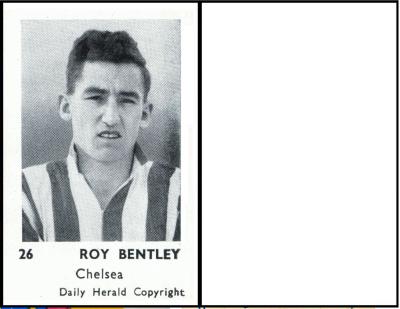
Here we have an actual footballer called Roy, but as we were going to delve into the realms of imagination, we were thinking of Roy of the Rovers, who, sadly, I could not find on a card.
Roy Race played for Melchester Rovers, and he took the field in 1954, in the "Tiger" comic. He was so popular that he ended up with his own comic. Then, for some reason, and rather shockingly for a children`s comic, he was injured in a helicopter crash and could no longer play football. The action then switched to his son who also played for Melchester Rovers, and took the field in his stead. This may well have been done to make the character younger, and not so out of touch with its also younger audience, but why not just retire our Roy, peacefully, to a bungalow in the country, overlooking a football field. Especially as our Roy did come back later, as manager of Melchester United, with his son still playing on.
This card shows an actual Roy, Roy Thomas Frank Bentley, shown here in his Chelsea strip.
In fact he played for several teams, starting with his local team, Bristol City in 1939, though, almost certainly due to the date, he made not a single appearance for them, and only took the field once football resumed in 1946, by which time he had been signed by Newcastle United, and become married. He had spent the Second World War in the Royal Navy. And he stayed with Newcastle United two years, during which he played in the F.A. Cup semi final for the first time.
He then moved to Chelsea in 1948, on advice from his doctor, and possibly inspired by Tommy Lawton, who had also moved there to ease a similar lung problem. It seems likely that this was a side effect of our man`s Royal Naval service, but not of Tommy Lawton`s who had served in the Army. With Chelsea he made his first appearance on a cigarette card, Carreras "Turf"`s 1948 set of "Footballers". most of his appearances on the field, some three hundred and twenty four matches, and he also got the nod to play for England, gathering twelve caps.
In 1956 he moved again, but not that far away, for he went to Fulham. And he ended his career in 1962 after two years at Queen`s Park Rangers.
After he retired from them, he became a manager, first with Reading and then to Swansea City. He moved to Essex after that, but came back to Reading, which is where he died, on the 20th of April, 2018, aged ninety-three, and the last surviving player from the 1950 World Cup Squad.
This set first appears in our British Trade Index part two, as just one set :
DAILY HERALD
Cards inscribed "Daily Herald Copyright". Issued about 1948-50
- FOOTBALLERS (A). Sm. 61 x 37. Black. Nd. (32) ... DAA-2
There is an update in our British Trade Index part three, which tells us that special albums were issued for each of their three sets ("Cricketers", "Footballers", and "Turf Personalities"). These were inscribed "Sporting Publicity (Leeds)", with the cards in the set enumerated on the inside front cover.
Now by the time of our updated British Trade Index, all was changed. The three sets are now listed, with another title, as :
- SPORT STARS. 61 x 37. Black. Nd. Issued in three series with special albums for each series inscribed "Sporting Publicity (Leeds), "Sport Stars", with titles of the three sets, Subjects listed on front cover of each album. ... DAI-180
- Cricket Stars. Nd. (32). Two printings for numbers 1/22 :
1. Daily Herald Copyright" at base
2. As above, with "Sportfoto" added beneath
Nos. 23/32 are anonymous, numbered, titled "Past Masters", and are black line drawings.
- Racing Personalities. Nd. (32)
- Soccer Stars. Nd. (32). Two printings. See also under "Sportfoto", SPO-130. All three issues are listed at HD-7 to illustrate the differences.
1. 1951/2. "Daily Herald Copyright" at base, player`s name in a) bold thick, b) thin letters. See HD-7.A
2. 1953/4. As above, "SPORTFOTO" beneath, in a) bold, thick, b) thin letters. See HD-7.B
There could be a case for believing that the difference between the two versions of our set was simply lighter ink, but you can decide that for yourself, as we feature the b. version with the thin letters as our diary date this week for Saturday the 24th of January.
Sunday, 18th January 2026
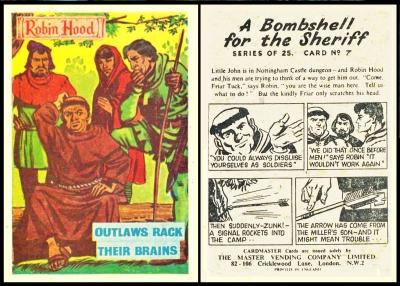
Now I have spoken of Robin Hood in passing, but not told of his tale.
Something we all think we know was that he was an outlaw, but also a hero; loved by the poor, to whom he brought clothing, food, and money - but hated by the rich, whose worldly goods those had been.
It is said Robin Hood was first immortalised in folk ballads in the fourteenth century. That was "The Vision of Piers the Plowman", by William Langland, written in 1377 - but if you read that it clearly states that the tales of Robyn Hood were well known, and had been for some time. That leads credence to the belief that he was actually from a much earlier time, maybe even a Saxon Earl.
As for what else we think he know about him, all is come from legend - the green of the clothing he wore (which is unlikely), the fact that he was born in Lockersley (though there never was a place of that name), and that he was based in Sherwood Forest (possibly).
Even his band of outlaws and the love of his life, the noblewoman, Maid Marian were all embroidered into the story as it gathered momentum - Friar Tuck coming along in 1475, heedless of the fact that during the reign of King Richard the first all kinds of religion were banned - Maid Marian only appearing in the sixteenth century as a simple shepherdess.
At first his only companion is Little John, who began in "The Vision of Piers the Plowman", by William Langland, written in 1377, and we even think that this character was at first the hero of the story, with Robin Hood coming into the story, as an interloper, much later.
Robin Hood first appears on cards in 1924, as card number three of Carreras`s "Highwaymen". The text there tells us that he "Was the hero of a group of old English Ballads. Represented as an outlaw and a robber, but in reality of a gallant and generous nature. His familiar haunts were the Forests of Sherwood and Barnsdale. Unrivalled with the bow and quarterstaff, and generous to the poor, and all honest men in distress."
His next appearance is as the star of a set called "Robin Hood", a set of thirty cards issued by Typhoo Tea, in 1926. The text there tells us that he was "Born Locksley in Yorkshire, (or Notts.) about 1160. Reported to have been Earl of Huntingdon. His company consisted of 100 archers. He frequented Barnsdale and Sherwood Forests, and according to some, Plompton Park in Cumberland. He took from the rich only, and charitably fed the poor".
The following year, he can be found on card 9 of E. & S. C.W.S.` "Peeps into History", a humorous look into the past. The front shows the Merry Men, and Maid Marian, enjoying a tea break, with china cups. Maid Marian even has a saucer. The text there says "Robin Hood and His Merry Men. A.D. 1195. The name of Robin Hood even to-day suggests a picture of freedom and happiness. Whether this is true or not is a matter of conjecture, but we do know he contributed much to the history of "Merry England". How much merrier they might have been had they known the joys of C.W.S. Tea, and particularly "DIGESTIVE TEA TIPS" ! The cup that cheers."
Though Robin Hood had appeared in five silent films already, we think that the above sets were all inspired by the 1922 version which starred Douglas Fairbanks as the Earl of Huntingdon, with Enid Bennett as Lady Marian Fitzwalter.
The set first appears in our British Trade Index part two, as :
The MASTER Vending Co., Ltd., London, N.W.3
or The Master Vending Machine Co. Cards issued 1958-60. Large size 95-96 x 65-66 m/m. Includes cards inscribed "Cardmaster" without firm`s name. Albums issued.
- A BOMBSHELL FOR THE SHERIFF. Lg. Nd. (25) ... MCA-1
In our updated version, it appears as :
- A BOMBSHELL FOR THE SHERIFF. 1959. Nd. (25) ... MAS-140
In fact since writing this I have discovered there were two Master Vending sets featuring Robin Hood, in a very similar style, the other set being called "Taxing The Sheriff", and being present in both Trade Indexes, just not linked to our set in any way, and, because the sets are listed in alphabetical order, some way further down. It was issued in the same year, and may even have come first. That is recorded in our original British Trade Index part two, without any mention of Robin Hood, which how I missed it, the entry simply reading :
- TAXING THE SHERIFF. 1959. Nd. (25) ... MCA-6
And in our updated version, it appears as :
- TAXING THE SHERIFF. 1959. Nd. (25) Backs are small sketches of Robin Hood ... MAS-190
Monday, 19th January 2026
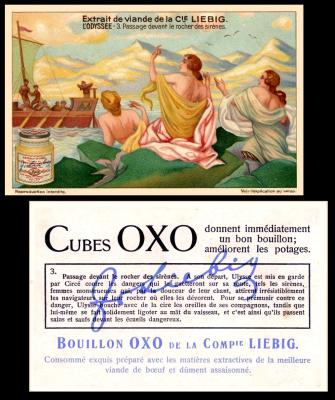
Here we have the sirens, known to all Greek sailors, and feared, for their song could drive a man so mad that his only chance was to tie himself to the mast of his ship so that he could not jump in the sea and swim to be with them. And yet not only did they not exist, there were variations of what they looked like, where they lived, and even what their song sounded like.
This card is especially apt, as it is the story of Homer`s Odyssey, and that was where the sirens first appeared in literature. It seems that he had heard the tales of them, but had no idea of what they were like, so he chose not to describe them. There is something very interesting though, because the root of the Greek word for sirens leads you back not to mean beautiful singing women, but to mean ropes, and bindings, such as Odysseus uses to tie himself to the mast, away from temptation.
Unfortunately you cannot see on this card, but the Sirens were not mermaids, with curving fish-like tails, at least not until things got a bit confused in the Middle Ages. At that time pictures of sirens and mermaids both had fish tails, but sirens were associated with sin and lustful temptation (an association the word still has today) and mermaids were associated with luring sailors to their deaths at sea.
Actually, in Ancient Greek and Roman accounts the sirens were beautiful ladies on the top half, but with a bird`s wings, legs and tail, and claws on their scaly feet, and, especially in Greece, that bird was an owl. Strangely, this bird woman also appears in other cultures, Indian, Russian and Persian - and the Russians even called her Sirin.
Both Ovid and Virgil said that they hung out on three small rocky islands that were therefore called Sirenum Scopuli. However it was never actually tied down as to where these islands were, other than somewhere in the Mediterranean, off the coast of Italy or Greece.
The cards in this set, at least in the French version, are :
- Fuite de l`ile des Cyclopes [Escape from the Island of the Cyclops]
- Hermes apportant l`herbe enchantee a Ulysse [Hermes bringing the enchanted herb to Ulysses
- Passage devant le rocher des sirenes [Passing by the Sirens' Rock]
- Ulysse construisant le radeau pour rentree dans son pays [Ulysses building a raft to return to his country]
- Ulysse sauve par Leucothee [Ulysses saved by Leucothea]
- L`epreuve de l`arc d`Ulysse [The test of Odysseus' bow]
it is also available in Italian, as L'Odissea
Tuesday, 20th January 2026
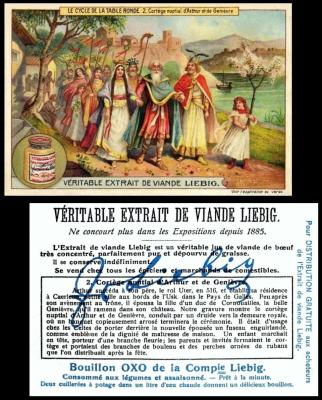
As a nation, we have long been inspired by the tales of King Arthur, his Round Table, his valiant knights, his love for the Lady Guinevere.
However there is very little fact to these epics, and though there had been several early works attempting to tell the story of this land, not one had mention of his name. There is a tantalising clue in one of these though, a work called "De Excidio et Conquestu Britanniae" (or On the Ruin and Conquest of Britain), for whilst it does not mention Arthur, and ascribes some of his deeds to several people, it does speak of a Romano-British leader called Ambrosius Aurelanius, nicknamed "Bear" from the bearskin he wore about him - and Bear, when translated to Latin, is arctus, though, in Celtic, it is a similar word, artos, and both of these are very close to Arthur.
The earliest mention of an Arthur is only in passing, it is a Welsh poem called "Y Gododdin", which tells of a warrior called Gwawrddur who was skilled, "but no Arthur". However it does not elaborate on this Arthur, nor tell us why he was more skilled. Then, in another Welsh manuscript, we suddenly hear of how, during the Battle of Badon, Arthur had been victorious, and stopped the Saxon progress - which brings us back to Ambrosius Aurelianus all over again, as he was one of the staunchest fighters at the battle of Mount Badon.
This Welsh connection is intriguing, though, and even reflected in our set, where card number one translates to "Arthur defends Wales, his Homeland".
Most of the things we think we know about King Arthur were not written down until the middle ages, when a cleric, Geoffrey of Monmouth, wrote a book called "Historia Regum Britanniae", which attempted to tell the stories of the Kings of England. And here is where we learn of Lady Guinevere, Lancelot, and the wizard Merlin, as well as his birth, at Tintagel, his famed castle, though named as Caerleon, not Camelot, and his trusty sword, here called Caliburn, not Excalibur. And it also tells of his death, and removal to Avalon, though where Avalon is is unclear.
As for the Round Table, that appears in a much later work, by Chrétien de Troyes, who also gave us the quest for the Holy Grail, in a separate poem, both written towards the end of the twelfth century This was expanded on by Thomas Malory, with his "Morte d`Arthur", published in 1486. He set Camelot in Winchester, and it was a very popular work, so much so that Henry VII`s new baby was christened Prince Arthur. It seems that Henry VII was much enamoured with the Arthurian legends, and told of them to both his children. Sadly his dream that Prince Arthur would become King Arthur was not to be, he died young - but we can tell of the effects that the tales had on his brother, Henry VIII, as he was obsessed with Edward III`s Round Table at Winchester, and not only had it repainted, but in doing so set an image of himself squarely at the top, where King Arthur would have sat.
It is possible that our cards were suggested by the success of a book, also published in 1910, called "Stories of King Arthur" by A. L. Haydon, with plates by Arthur Rackham. Sadly not much seems to be known of Mr. Haydon, and he died in 1910, quite young, for he had only been born in 1872.
The cards are :
- Arthur defend le pays de Galles, sa patrie (Arthur defends Wales, his homeland)
- Cortege nuptial d`Arthur et de Genievre (The wedding procession of Arthur and Guinevere)
- La Table Ronde (The Round Table)
- Arthur debarque en Irlande et exige un tribute (Arthur lands in Ireland and demands tribute)
- Perceval depart a la recherche d`aventures (Perceval sets off in search of adventure)
- Mort d`Arthur (The death of Arthur)
And they are also available in Italian, as "Il Ciclo di Artu".
Wednesday, 21st January 2026
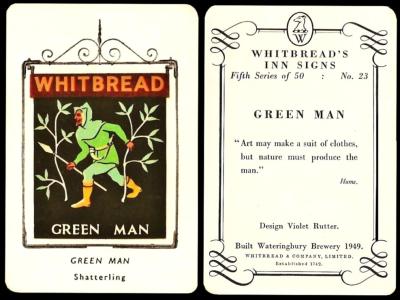
This Green Man seems to owe much to Robin Hood, but the more usual Green Man is just his head, either made from, or encapsulated in, foliage, and in that he symbolises how in springtime nature bursts forth, with unquenchable force, covering all in its path. It means that everything on this earth is not static, it has its time to be born, and its time to die. It is a very popular pagan symbol, and all round the globe, and it is almost exclusively a male, and always just a head, though women`s heads do, very rarely, appear.
There seems to be a link with King Arthur too, or at least to the Green Knight, who both tormented and advised Sir Gawain, both before Sir Gawain decapitated him, and then after he had picked up his head and ridden away, requesting they meet in a year and a day`s time.
Returning to our figure, he appears to be a different type of Green Man, and nothing to do with foliage, but in actual fact he too is usually represented in parades and pageants by a local villager dressed in a costume of leaves and moss, who most often dances at the front of these, clearing the onlookers out of the way, and sometimes demanding money, or forfeits. The latter is reminiscent of the trials that the Green Knight would set Sir Gawain; and research proves that this version of the Green Man is indeed linked to Sir Gawain, as well as to another figure called Jack in the Green, who is lauded in Derbyshire on May Day, being covered in foliage and flowers and led through the streets on a horse. Sometimes Jack in the Green also has a lady friend, who traditionally was a man in woman`s clothing. And at the end of the ceremony, the wreath about his head is removed, and pushed down on a pinnacle of the Church tower, in an act which is also said to symbolise the beheading of that Green Knight, by Sir Gawain.
As for the Green Man in Shatterling, near Ashford in Kent, it started out as a farm, in 1728, owned by Lt. Colonel Christopher Kien, who also lived at Kensington Palace in London. He then leased it to a local farmer, and in 1744, when he died, the lease was passed to his widow, and she seems to have allowed the farmer to stay on, not just that, but was gracious enough, on his death, to allow it to the widow. By that time though, one of the outbuildings was being used as an ale house, with all the correct legal papers, and had been since 1740, though there was possibly a bit of double dealing going on for the ale house was listed as being in the parish of Staple, rather than at Shatterling.
It seems to have stayed with several generations of the same farmer`s family too, even after widow Kien had prepared for her death by leasing it to a Samuel Joynes, then by leaving it to the Coussemaker family who seem no relation, but in 1788 it is recorded as being left to a George Kien Hayward Cousemaker, so there must be some link to the Kien family.
At some time after that date there was some trouble with the ale house, and it was closed. In fact it was more than closed, because a codicil was reportedly added to the deeds stating stating that it could never be an ale house again. However in 1820 this was challenged, by a Filmer Larkins, and though he was not allowed to open the former ale house in the outbuildings, he was allowed to convert the house into one. We also have rather enlightening details, suggesting that the trouble was not revellers as I was thinking, for in the license it states that the ales sold could not be adulterated, or sold from pots of illegal measure. Only then does it go on to stress that there could be no gaming, nor drunkenness, and that known thieves could not be served. The premises at that time were owned by the daughter of George Kien Hayward Cousemaker, and she supported the application for a full license in 1826, after the trial period was over. However she sold it in 1841, to a John Dadds of Wingham, and he sold it, pretty much straight away, to a George Collard, from Staple, who was a licensed victualler.
Whitbread came along in 1955, which is the year this set was issued, and the "Green Man" was amongst several public houses which they gained on taking over a company called Combined Brewery Holdings. And they kept it until 1972, when they sold it on as a Free House. In 1996 it was renamed to "The Frog and Orange". That was auctioned in 2021, and it seems likely the premises will be demolished and the land used for housing. But it seems that this was later changed to only two houses not the several which were originally imagined, and nothing yet has begun.
As for our card, it is from the fifth set in a group of cards which we discuss fully with our Card of the Day for the 1st of April, 2025 (but not for long as it is getting ready to move!).
This fifth series (and also the fourth) differs from the first few in they chooses not to display the name of the county. And there is another difference too, for the fourth and fifth were only available on card, not on aluminium. And this fifth series was the last one in this group, until the "Special Issue of Four" in 1951, which you can read about in our newsletter of the 12th of July 2025.
In our original British Trade Index part II, these six, and the one off card of "The Britannia Inn" are catalogued together. The entry for our set reads
WHITBREAD & CO. Ltd.
Brewers. Issued 1950-1958.
- INN SIGNS. Md. 76 x 51 ... WHI-1
5. Fifth Series. Nd. (50). On board
By the time of our updated British Trade Index, our set is listed as :
WHITBREAD & CO. Ltd.
Brewers. Issued 1950-1974. All 76 x 50.
- WHITBREAD`S INN SIGNS. Fifth Series. 1955. Nd. (50). ... WHI-190
As far as the inns which had their signs immortalised, they were as follows :
- ADMIRAL HARVEY Ramsgate
- ARMY & NAVY Rainham
- BAILIFF`S SERGEANT Dymchurch
- THE BELL Hythe
- BRENT`S TAVERN Faversham
- THE BRICKMAKERS Deal
- BRITANNIA Milton Regis
- THE BULL INN Sissinghurst
- BURNT OAK Gillingham
- CARDINAL`S ERROR Tonbridge
- CARPENTERS` ARMS Canterbury
- CECIL ARMS Strood
- THE CHEQUERS Biddenden
- THE CHEQUERS High Halden
- CLARENDON INN Sandgate
- CLOTHWORKERS` ARMS Sutton Valence
- DENMARK ARMS Rochester
- DUCHESS OF KENT Dover
- DUKE OF CUMBERLAND Barham
- FALSTAFF TAP Canterbury
- THE GEORGE Folkestone
- THE GRAPES Milton Regis
- GREEN MAN Shatterling
- THE HARP Tunbridge Wells
- HOP POLES Canterbury
- KING`S HEAD Hythe
- MAN OF KENT Crundale
- NAG`S HEAD St. Leonard`s-on-Sea
- NELSON`S HEAD Hythe
- NEWCASTLE INN Ewell Minnis
- OLD GOLDEN CROSS Hastings
- PIER HOTEL Herne Bay
- RAILWAY HOTEL Gillingham
- RED LION Stodmarsh
- ROYAL DRAGOON Canterbury
- ROYAL OAK Bonnington
- ROYAL OAK Iden Green
- SHIP CENTURION Whitstable
- SHIP HOTEL New Romney
- SHREW BESHREWED Hersden
- SPREAD EAGLE Chatham
- TRAFALGAR MAID Chatham
- TRUE BRITON Folkestone
- WHITE HORSE Tonbridge
- THE WINDMILL Cranbrook
- WOODLAND TAVERN Gillingham
- THE WOODMAN East Malling
- THE WOOLPACK Goudhurst
- THE YORK Chatham
- YPRES CASTLE Rye
Thursday, 22nd January 2026
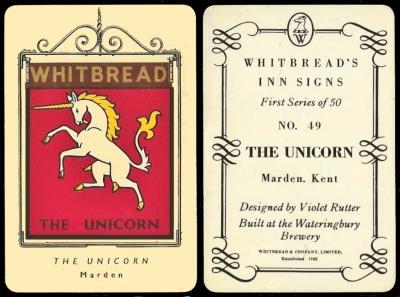
Here we have the mythical Unicorn, which strays a bit from the human subjects we have so far featured, but was offered me by reader Mr. Franks, and so I accepted, mainly because this was a first series card and it was going to be a Card of the Day, therefore a really great home page for the original five sets of this Whitbread issue. And its a unicorn, so I`m not turning one of those down - I even have unicorns on one of my bath towels... or is that T.M.I.....?
The Unicorn never really existed, and it is hard to imagine what could have been glimpsed and erroneously identified, for its horn is hugely long, much more so than a deer or rhinoceros, and it is, in addition, spirally twisted like a antelope, though totally in the wrong place. And we do not know how it came to be believed that it could only be approached and tamed by a truly virtuous maiden - which is the way it is generally depicted in art, and often with the Virgin Mary. However, the unicorn is neither male nor female, or possibly both, which in some way accounts for its acceptance as a symbol by the LGTBQIA+ community.
I am not totally convinced that its first representation in art comes from seals of the Indus Valley, about 2,000 B.C.for the body is all wrong, it is more like a bull, and the horn is curving, in the manner of a rope tying the poor creature whilst it awaits its fate. Though we do know that the Greeks believed the unicorn came from India, and even called it the one horned Indian ass. In fact Pliny calls it a monoceros, being the singular or the rhinoceros.
We do not know how it came to be the emblem, or at least one of the emblems, of Scotland - the other being the lion.
Not much is known about the Unicorn public house. It seems have at first been a private dwelling, and the first written reference to it being a public house was in 1861, when the publican was a Henry Mission, and it seems they also rented rooms. However the Mission family had been living there, on and off, since 1840. It seems to have then moved upmarket and become a public house and hotel, and in the 1880s it was on the coaching route, thanks to its location, right in the centre of Marden, and flanking the market place.
This page is now the home page for the first five series of Whitbread`s "Inn Signs", because this is from the first set of Whitbread "Inn Signs" to have been issued as proper cards - though they were not the first "cards" to be issued; those were black and white reproductions of inn signs, pretty much business cards, with the proprietor`s names on the reverse.
The cards of Series one were made of metal, and only of metal. There is a reason for this, for when the first and second set was produced, paper was still scarce, after the Second World War, but thin aluminium sheet was more readily available, and, it must be said, this material was almost certainly sold to Whitbread on the grounds that it looked and felt more like an actual inn sign.
The idea of the series began in 1949, when the Whitbread & Company Brewery, at Wateringbury, in Kent, thought it would be interesting to make collectable plaques of some of the signs which hung outside their public houses. The cards were given away, just handed over the counter when you bought a pint of beer. Now there are two schools of thought to that statement - the first has it that each card was only available at the inn where that sign hung, and to get the rest you had to travel to all the other public houses, and buy a beer - whilst other collectors say that the cards were left at each pub in bundles, and you just got the next one at random. The first becomes more likely when you realise that the inns are quite close together - the first ten being in Hastings and St. Leonards on Sea (in Sussex), cards eleven to fourteen from Rye, (also in Sussex), and cards fifteen to fifty from Kent.
The actual list of inn signs which make up Series one are as follows :
- THE G.I. Hastings
- WISHING TREE St. Leonards-on-Sea
- THE PRINCES Hastings
- THE FOUNTAIN Hastings
- OLD GOLDEN CROSS Hastings
- WARRIORS GATE St. Leonards-on-Sea
- BRITISH QUEEN St. Leonards-on-Sea
- DRIPPING SPRING St. Leonards-on-Sea
- MARINA INN St. Leonards-on-Sea
- NAGS HEAD St. Leonards-on-Sea
- WILLIAM THE CONQUEROR Rye Harbour
- QUEEN ADELAIDE Rye
- YPRES CASTLE Rye
- SHIP INN Winchelsea Beach
- BLACK HORSE Tenterden
- THE HARRIER Sandhurst
- OAK & IVY Hawkshurst
- KING WILLIAM IV Benenden
- THIS ANCIENT BORO` Tenterden
- ROYAL OAK Wrotham Heath
- THE STARTLED SAINT West Malling
- THE CRICKETERS Maidstone
- QUEEN`S HEAD Maidstone
- HARE & HOUNDS Maidstone
- BLACK LION Mereworth
- TORRINGTON ARMS Mereworth
- DUKE WITHOUT A HEAD Wateringbury
- NORTH POLE Wateringbury
- QUEEN`S HEAD Wateringbury
- KING`S HEAD Wateringbury
- THE PHOENIX Wateringbury
- THE HARROW Wateringbury
- THE TELEGRAPH Wateringbury
- RAILWAY HOTEL Nettlestead
- THE HOP POLE Nettlestead
- THE WOOLPACK Yalding
- TWO BREWERS Yalding
- TWO BREWERS Yalding (different to the above)
- CHESTNUT TREE Yalding
- THE HARP INN East Peckham
- THE MERRY BOYS East Peckham
- THE CHEQUERS Tudeley
- JOHN BRUNT V.C. Paddock Wood
- THE BULL Hunton
- KENT ARMS Fowl Hall
- PRINCE OF WALES Collier Street
- THE DUKE OF WELLINGTON Collier Street
- THE FOUNTAIN East Peckham
- THE UNICORN Marden
- THE RED LION Offham
In the second series, issued in 1950, which we speak of as our Card of the Day for the 1st of April 2025, they are again a mixture of inns in these two counties, Kent and Sussex. And in the third series, issued in 1951, one of which is our Card of the Day for the 17th of September 2024, they are solely from the county of Kent. The fourth series has not yet appeared on these pages, but the fifth has, just, for it was the Card of the Day only yesterday, on the 21st of January 2026.
Now it is often stated that this fifth was the end of that line - and that what came next was the so called "Special Issue of Four" which you can read about in our newsletter of the 12th of July 2025, though as it is a newsletter card you will have to scroll down to Monday, the 14th July. In any event, this is incorrect, as that "Special Issue of Four" was issued in 1951, and that means they push their way in between the Second and Third Series of the standard Inn Signs. The belief that these are later is also reinforced by our original British Trade Index part II, where all these seven sets are catalogued together, as :
INN SIGNS. Md. 76 x 51 ... WHI-1
- First Series. Nd. (50). On aluminium
- Second Series. Nd. (50). On aluminium
- Third Series. Nd. (50). On (a) aluminium (b) board
- Fourth Series. Nd. (50). On board
- Fifth Series. Nd. (50). On board
- Special issue of Four. Nd. (4). On board
- The Britannia Inn. Unnd. (1). On board
Note : Signs were also issued uncoloured by certain Inns on the backs of calling cards, as pin-ons, etc.
In our original British Trade Index part three, item 7 was updated, and a later edition of three cards issued in 1958 appeared. And it also expanded on the note at the end of the above listing - which are out of date order, for they came first, being designed as business cards, having the sign of the inn on the front and the proprietors details on the reverse. In fact a lot of collectors believe that it was the making of those that set the idea of making the coloured series off. That listing from British Trade Index three reads :
7. The Britannia Inn. Back (a) plain (b) printed, with reference to Brussels 1958 Exhibition.
8. Whitbread`s Inn Signs - 1958. On board. Series of 3.
1. Duke Without a Head
2. The Railway
3. The Startled Saint
9. Black and White reproductions, partly with proprietor`s names on reverse. 4 known.
1. Oak & Ivy - Hawkhurst
2. The Old Cock, Hildenborough
3. Spread Eagle, Chatham
4. Trafalgar Maid (back blank)
Section 9 is added to in our original British Trade Index part IV, with :
9. Black and White reproductions. Add :
5. Camden Hotel, Pembury
6. The Woolpack
This was the end of the line, for a while, but in 1973 the idea was restarted, with cards called "The History of Whitbread Inn Signs”. They will have a home page all their own, one day, but for the moment you can read about one of what would eventually become eleven sets with our Card of the Day for the 28th of November 2023
By the time of our updated British Trade Index, the five standard series, including our fifth, are listed as :
WHITBREAD & CO. Ltd.
Brewers. Issued 1950-1974. All 76 x 50. All issues are covered in this volume. The History and listing of numbered series is covered in full in the book "Collecting Whitbread Inn-Signs" by Cockell and Laming, 1996.
- WHITBREAD`S INN SIGNS. First Series. 1949. Nd. (50). On metal. ... WHI-150
- WHITBREAD`S INN SIGNS. Second Series. 1950. Nd. (50) On metal. ... WHI-160
- WHITBREAD`S INN SIGNS. Third Series. 1951-52. Nd. (50) On a) metal. b) card. A number of cards have been seen with square corners... WHI-170
- WHITBREAD`S INN SIGNS. Fourth Series. 1953. Nd. (50) 25 of this series are known with plain backs, Nos. 1, 4, 7, 8, 10, 12, 13, 15, 16, 19, 20, 24, 27, 28, 29, 31, 34, 35, 37, 38, 41, 43, 44, 46, 50. ... WHI-180
- WHITBREAD`S INN SIGNS. Fifth Series. 1955. Nd. (50) . ... WHI-190
That reference book about the signs was issued in 1996, and it is quite scarce. I am not sure whether the copy in our library is that or not though, as this is listed by another title, "Whitbread Inn-Signia". But I will find out.
Friday, 23rd January 2026
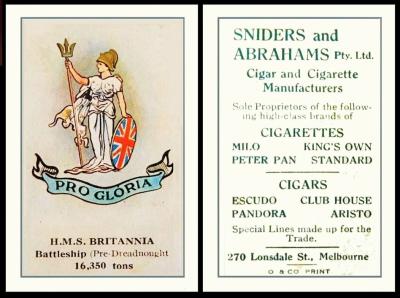
Here we have Britannia, the national symbol of England, so much so that she appears on our coinage.
We do not know why she was decided to be a woman, especially as she wears robes and a helmet, and carries the warlike, masculine tools of the shield and trident. But we do know that her first appearance on a coin was in 119 A.D, during the reign of Emperor Hadrian, where she is seated, but only holds a spear. There is a connection you may not realise though, for Britannia was the name that the Romans gave this land under their occupation, and it is also from where our calling it Britain developed.
Britannia was soon forgotten after the Romans left Britain, and only resurfaced in the time of John Dee, who resurrected her to stunning effect, kneeling before Queen Elizabeth I, begging that she strengthen the Navy, for an illustration in his book "General and Rare Memorials Pertayning to the Perfect Arte of Navigation", published in 1577. This contradicts the popular belief that James I added her connection to the sea by mistaking the rocks on which she stands as waves - though James II also used her, on coinage, at the time of the War against the Dutch in 1665, as well as on the medal struck to mark the end of that War in 1667, a medal which, for the first time, adds her shield. As for the lion that she often stands beside, this was added in the First World War, which is why there is no lion on this card.
As to who modelled for her, it is said to have originally been Frances Teresa Stewart, Duchess of Richmond and Lennox, who was well known at court, but not well known enough to Charles II, in his opinion, for she consistently refused to become his mistress. There is a theory that immortalising her on this coin was a further attempt to sway her, but that too failed.
The earliest twentieth century version, from 1901, was modelled from the Chancellor of the Exchequer`s daughter, aged just seventeen - but it was not popular, and ceased to be minted just ten years later. In 1936, when George VI came to power, Britannia returned, along with a trident, not a spear, and, rather incongrously, a lighthouse in the background. And today though she is not on the coins in general circulation, we do still have Britannia, on the bullion coins that bear her name.
This set first appears in our original Australasian Miscellaneouys Booklet, RB.20, published in 1951 as :
- 18. CRESTS OF BRITISH WARSHIPS (adopted title). Size 67 x 43 m/m. Fronts per Fig.18 in colour, grey background. Backs (type 5) in (A) Blue (B) Green, both colours found on matt and semi glossy board. Unnumbered series of 64. Each caption commences with "H.M.S" -
- Achilles (1907)
- Africa (1906)
- Agamemnon (1908)
- Albemarle (1903)
- Antrim (1903)
- Argyll (1904)
- Bellerophon (1909)
- Berwick (1903)
- Birmingham (1914)
- Black Prince (1908)
- Britannia (1906)
- Caernarvon (1905)
- Collingwood (1910)
- Commonwealth (1905)
- Conqueror (1912)
- Cormwall (1902)
- Defence (1909)
- Devonshire (1905)
- Dominion (1905)
- Drake (1902)
- Dreadnought (1906)
- Dublin (1913)
- Dukeof Edinburgh (1906)
- Essex (1903)
- Exmouth (1903)
- Glasgow (1910)
- Hampshire (1905)
- Hercules (1911)
- Hibernia (1906)
- Hindustan (1905)
- Indefatigable (1911)
- Indomitable (1908)
- Inflexible (1908)
- Invincible (1909)
- ron Duke (1913)
- Irresistible (1901)
- King Alfred (1903)
- King Edward VII (1905)
- King George V (1912)
- Lion (1912)
- London (1902)
- Marlborough (1914)
- Melbourne (1913)
- Monarch (1912)
- Natal (1907)
- Neptune (1911)
- New Zealand (1912)
- Princess Royal (1912)
- Queen (1904)
- Queen Elizabeth (1915)
- Queen Mary (1912)
- Roxburgh (1905)
- Shannon (1908)
- Southampton (1913)
- Spitfire (1912)
- Swiftsure (1904)
- Temeraire (1909)
- Thunderer (1912)
- Triumph (1904)
- Vanguard (1910)
- Warrior (1907)
- Weymouth (1911)
- Yarmouth (1912)
- Zealandia (1905
Dates in parentheses show when the ships were commissioned - this information does not appear on the cards. The latest is the "Queen Elizabeth", launched in 1913 and completed in 1915. Her crest would probably not have been decided until shortly before she was commissioned. The series obviously would not have included ships recently sunk, and several prominent ships sunk between September and November, 1914, are omitted. The series thus appears to have been issued early in 1915
Again this listing includes numbers when the cards are unnumbered, but I guess in this case it matters not.
By the time of our original World Tobacco Issues Index the set is slightly altered, and now reads :
- CRESTS OF BRITISH WARSHIPS (A). Sm. 67 x 43. Unnd. (64) See RB.20/18. ... S88-15
A. Back in blue
B. Back in green
And this remains identical in our updated World Tobacco Issues Index, save a new card code of S587-130
And so we temporarily close the book on another newsletter, but without the gen from the reference books in some cases. They will be added in over the weekend, in amidst my writing an article for our printed magazine.
Thank you for popping by, and I hope you were entertained, amused, and educated ? And I will see you all next week, same time, same spot on the dial......