
This week I have had a lot of fun writing the newsletter and it is almost finished well on time, at the moment it is 5 p.m. on Friday night and I only have the titling to accomplish. I have even done the card codes and the extractions from the reference books. However I freely admit that this was aided by a lot of rain, during which even nipper refused to go out on a walk and much preferred laying on the sofa, half on my lap, and snoring....
Now you may have noticed that there has been a subtle change to these newsletters as I now record any changes to the website here, for posterity, rather than in the news-feed which is overwritten and disappears.
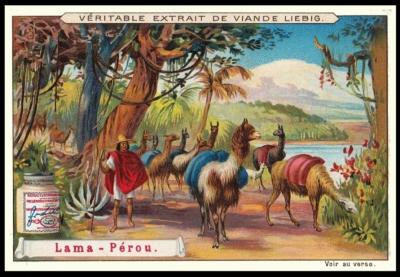
So since our last edition, I am delighted to be able to announce that we have located our llama - thanks to reader and frequent correspondent Mr. Stuart Arnold. I knew it was by Liebig but not the set, which he tells me is called "Betes de Somme et D`Utile" - Fada number F.0580, and Sanguinetti number S.602. The title translates to beasts of burden, and the set was issued in 1899. So all this information has now been added to the diary date for Monday the 9th of December in our newsletter of the 7th of December 2024, along with a list of all the subjects in the set. And all the cards from that newsletter have now been added to the index and gallery.
I`m still stymied with starting the next newsletter back though, as the very first card is a double of a set already listed in the gallery. The date revolves around the centenary, in 1924, at least, of the day that the Cleveland Bulldogs beat the Chicago Bears in the National Football League. So I used a generic bulldog, simply because cards of the Cleveland Bulldogs are non existent. If I went back in time, before they were the Cleveland Bulldogs they were the Cleveland Indians, but they don`t seem to be on cards either; they changed their name to avoid confusion with the baseball team in 1923. Then they changed their name again in 1928 when they moved to Detroit and became the Detroit Wolverines. And less than a year later the owner of the New York Giants bought Benny Friedman and the rest of the team, absorbing them into the New York Giants. However Benny Friedman was not part of the team at the time of our centenary match. So I may have to spend my weekend poring over football stats......
On to this newsletter now, and our first diary date, which is :
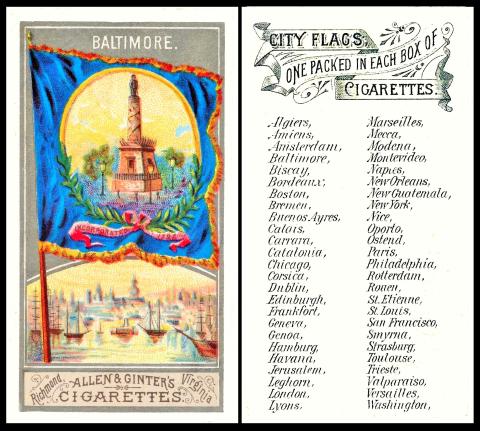
Allen & Ginter [tobacco : O/S - USA] "City Flags" (1888) Bk/50 - A400-060 A36-6 : USA/6
Today in 1817, Baltimore installed, and illuminated its very first gaslight, on the junction of Market and Lemon Streets. This made Baltimore the first city in America to be so lit - but not the first in the world, by a long way.
Illumination with gas is kind of a by-product, and it is produced from many different types of gas, some natural and some man-made. It works through combustion, either mixing one gas with another, or by heating a kind of gauze cage known as a mantle. And every night someone, called a lamp lighter, would walk through the streets with a long pole (or in some cases a ladder) illuminating the gas.
The first ever record of gas providing light comes from China, nearly two thousand years ago. The gas would flow through bamboo pipes and a lit flame would be held at the open end. However the idea of illumination by gas did not reach Britain until the late eighteenth century , when a William Murdoch invented a lantern with a gas filled jet and used it to light several rooms of his house and his workshop. He was an interesting character, for he worked at Soho Foundry, with Matthew Boulton and James Watt - and he was the first to illuminate the exterior of a building, in 1802.
There is debate as to the site of the first gas powered street lamps, for both are cited as taking place in 1806. One of the sites was in Great Britain, at Chapel Street, in Salford, and another was in Newport, Rhode Island, in America. And they came to London in 1813, when Westminster Bridge was entirely lit by gas lamps.
If we return to Baltimore, In America, it seems that the spark, as it were, was lit by the use of gas lighting at Rembrandt Peale`s History Museum, in 1816. Mr. Peale was influenced by his brother in this, for he had already used gas lighting in Philadelphia. Our Mr. Peale would go on to found the Gas Light Company of Baltimore, and it was his light that illuminated our lamp, today in 1817. However, not long after that he ran into difficulty and the business foundered.
Eventually gas would fall from favour, and be replaced by electric lights, and many of the gas street lamps would be converted to electricity, or removed. In fact every one has gone from Baltimore, save one, at the junction of North Holliday Street and East Baltimore Streets - which are the new names for Market and Lemon Streets. A few do remain even in Great Britain, and they are the ones you see in location filming, though most are replicas, constructed on site on set.
I chose this card by default, as in could not find anything else, but when I looked closer at it around the plinth of the statue at the top of the card there are actually lamp posts.
The statue, after much searching, turns out to be the Battle Monument, which commemorates the soldiers and officers that lost their lives defending Baltimore from its British invaders, in three separate actions, the Battle of Baltimore itself, the Battle of North Point, and the Bombardment of Fort McHenry, all three of which took place in mid September 1814. And it is both the oldest stone monument, and the first public war memorial in the United States.
The set is first catalogued by Jefferson Burdick as :
- 6 - CITY FLAGS. (50)
and he values them at twenty cents a card.
By the time of our original World Tobacco Issues Index, we record it as :
- CITY FLAGS. Sm. Bkld. (50). Ref. USA/6 ... A36-6
And, in fact all the first section of thirty-four sets have the same USA reference number as they do our card code. The only difference is that Mr. Burdick puts the larger sized version of the set in a different section,whereas we combine them together.
It is entered exactly the same in our updated World Tobacco Issues Index, but for our card code, which has been updated to A400-060
If you look at the back of our card you can see that the Cities are all over the world, not just from America - there are ones from Africa, Asia, Europe, and South America.
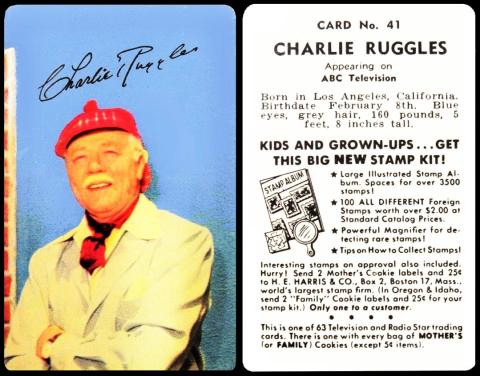
MOTHER`S Cookies [trade : biscuits : O/S - USA] "Television and Radio Star Trading Cards" (1952) 41/63 - D.77
Today, in 1886, saw the birthday of Charles Sherman Ruggles, in Los Angeles, California.
He started out intending to become a doctor, but somehow found himself on the stage. His first part was in "Nathan Hale", in 1905, which had originally been on Broadway, where it opened in 1899, and which told the story of a soldier of that name who was a soldier and also a spy for the Continental Army during the Revolutionary War, until he was caught, and executed by the British, after which he became a local and American hero.
By 1912, our man was appearing at the Alcazar Theatre in San Francisco, as part of the "stock" company, which basically meant doing anything from backstage to playing parts. His best known stage appearance was a curious film based on a story by L. Frank Baum, and also dealing with the magical land of Oz; this was called "The Tik-Tok man of Oz",and deals with the story of Ozma. You may be thinking that we now have "Wicked", which is very successful, perhaps Ozma is also due a revival - but sadly the manuscript does not survive, save as an initial rough draft that would need a great deal of coaxing into a proper story.
During this time he married a fellow thespian, and talented singer, called Adele Rowland, but the marriage did not last and they were only married for two years, divorcing in 1916. Some time later he married again, she appears to have been nothing to do with show business and they were very happy, but she sadly died in 1941.
Charlie Ruggles had moved into film in the late 1920s. His first part was in "Gentleman of the Press", released in 1929 and starring Walter Huston and Kay Francis. One of the reporters, if you watch very closely, is Brian Donlevy. Our man played it for laughs, as a reporter who is slightly the worse for drink. That set the scene for the rest of his career, with laughter, and sometimes pathos too.
In 1942, he met another lady, and married for a third time. Then, in 1944, just on a whim, he moved into radio, with "The Charlie Ruggles Show", and it was a great success, but only lasted one summer, at least on radio - for later on, from 1949 until 1952, it was the inspiration for a television series in which he also starred. And not so long after that he also had another starring role in a sitcom called "The World of Mr. Sweeney. That ran from 1954, and was on for five days a week, but it was hard work (he was in his late fifties by then), and it only lasted a year. He enjoyed television though, and decided to take guest star roles, which he threw himself into with gusto.
He died of cancer on December 23, 1970, at the age of eighty-four, leaving behind his third wife. He is buried at Forest Lawn, in California. His brother, Wesley, who died in 1972, lies nearby - he had started out as an actor but moved into directing, which he liked much better.
A fascinating fact about Charlie Ruggles is that he has three stars on the Hollywood Walk of Fame - one for film, one for television, and one for radio. This is only beaten by Gene Autry, who, amazingly has five (for film, live performances, radio, recording, and television) - and by Bob Hope, Tony Martin, Roy Rogers and Mickey Rooney with four. He is only equalled in his three by Jack Benny, Danny Kaye and Frank Sinatra.
As for our set, it is recorded by Jefferson Burdick in his American Card Catalogue as :
- D.77 - Television and Radio Stars (63) pl. cd. st. Mother`s Cookies
I have no idea what those abbreviations are for, only "cd" which must be coloured. He values the cards at three cents each, and makes no distinction between them though we know that whilst a lot of the stars on this set are now quite unknown, it also includes people who are as famous as ever, namely William Bendix, Harry James, Groucho Marx, Ray Milland, Ginger Rogers, Barbara Stanwyck, Fay Wray, and Loretta Young.
The full cast list is :
- Marjorie Lord
- Ozzie Nelson
- Harriet Nelson
- Ricky Nelson
- Ralph Edwards
- Groucho Marx
- Willard Waterman
- Vance Colvig
- Lois Collier
- Janet Waldo
- Martha Tilton
- David Nelson
- Elena Verdugo
- Edward Arnold
- Danny Thomas
- Mary McAdoo
- Joan Caulfield
- Ernest Ford
- Jerry Colonna
- Bill Williams
- Hillary Brooke
- Jack Kirkwood
- Art Baker
- Rod Cameron
- Frank De Vol
- Jack McElroy
- Madeleine Burkette
- William Bendix
- Betty J. Taylor
- Julie Bishop
- Sam Edwards
- George Jessel
- Ginger Rogers
- Don De Fore
- Loretta Young
- Tom Harmon
- Jack Owens
- Alvino Rey
- Curt Massey
- Mary Ann Owens
- Charlie Ruggles
- Harry James
- Jim Jordan
- Natalie Wood
- Joan Davis
- Barry Nelson
- Barbara Stanwyck
- Ray Milland
- Bobby Hyatt
- Marian Jordan
- Fay Wray
- Lawrence Welk
- Joan Shawlee
- Phyllis Avery
- Connie Haines
- Sheldon Leonard
- Connie Russell
- Paul Hartman
- Judy Canova
- Lurene Tuttle
- Barbara Britton
- Leon Ames
- Jack Smith
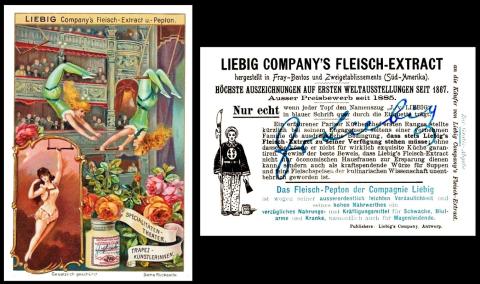
LIEBIG [trade : meat extract : O/S : South America] "Jeux de Cirque" / circus tricks (1898) F.577 : S.577
Our next card is a centenary, marking the fact that today, in 1926, saw the birth of Norma Neilson, professionally known as La Norma.
She was born in Randers, Denmark, to a huge family which would eventually have eleven children, five boys and six girls. Her father worked at the local cinema, as the projectionist, and their grandparents were farmers, who would take the children out there in the summers when they were away from school. Whilst at the farm they helped out, though little Norma was not so keen on that, and they were also allowed lots of freedom. All the children were keen on the circus, possibly because there were several travelling circuses that toured Denmark on a regular basis, and the young Neilson children would often be seen staging the various events. However little Norma wanted to be a ballerina, and after pestering her parents non stop they sent her to ballet school.
Whilst at the ballet school the story gets a bit confusing, and there are two stories that do not seem to be linked. The first says that, quite out of the blue, she was asked if she would be interested in partnering in a balancing act in a circus. She thought it sounded fun, but it did not work out as the partner was much larger, and though the intention was that a smaller partner would make the lifting easier, in fact the logistics were all wrong and it did not work out at all. However the circus bug had bitten and she asked the lady who had made her the offer to teach her the trapeze. But then there are other stories which tell that she was asked to partner an act in a circus with a young girl, in an act called the Florita Sisters. In this story little Norma was taken off to Copenhagen and treated most unfairly, even punished if she could not perform the trick straight off.
What we do know was that her debut was in her home town, at the Variete Maxim, and she was fourteen or fifteen. That seems to discount the second, darker story, though when she was sixteen we know that she did perform in Copenhagen, under the name of La Norma. So perhaps both stories are true, but the first came first, and only when she was trained as an aerialist did she head off to Copenhagen. That would certainly make a lot of sense, and explain why she was good enough to partner another girl in a trapeze act, something you could not do without quite a bit of training. There is something else that has come to light, too, and that is that once Germany occupied Denmark the circus she was with, Circus Altenberg, decided to leave and go off on tour - and we know that the original Florita Sisters were Emile Altenberg and her daughter.
The circus stayed away until the war was over, moving around the unoccupied areas of the Netherlands. Then she met a Frenchman called Andre Fox, and he encouraged her to leave the Altenbergs, which she did. She also fell in love with, and married Monsieur Fox. However she also loved the circus, so in 1949 he managed to sign her up with Ringling Brothers and Barnum and Bailey Circus, on which they moved to the United States. She was a great hit, for her beauty, her grace, which owed a lot to her ballet training, and also because she refused to use a safety net.
In 1951 she left Ringling Brothers and Barnum and Bailey Circus, and also appeared in a film, though few people knew - the film was "The Greatest Show on Earth", and she doubled for Betty Hutton during the more hazardous trapeze scenes. But she did appear as herself later on, in the 1960s, as part of a television documentary series called "Project 20", in the episode concerning circuses. And she also continued to make appearances at other circuses, right across America.
In 1974, after her son was paralyzed in a scooter accident, she announced her retirement, but she remained involved with the circus, and repaid the favour done her so many years ago by training budding aerialists, especially girls. She also went into making circus ceramic sculptures, which are now highly prized. And it appears at the time of writing this she is still alive, and living in Sarasota, an area which used to be best known as the winter home of the Ringling Brothers and Barnum and Bailey Circus
This series was issued in German, as "Specialitaten - Theatre" (which translates to Variety Acts). You will find the title on the ribbon, one part of which has the title and the other part of which tells of what is going on.
The cards in this third series show
- Acrobatics
French - Acrobates
German - Gymnastiker
- Balancing and Juggling
French - Equilibristes et Jongleurs
German - Uilibristen-gleure
- Dog Handling
French - Chiens Savants
German - Hunde-Dresseur
- Riding a Bull
French - Taureaux Dresses
German - Stierbandiger
- Sharpshooting Act (off a tightrope)
French - Tir sur une Corde Tendue
German - Kunstschutze
- Trapeze
French - Exercices sur le Trapeze
German - Trapez-kunstlerinnen
The one thing I do not know, or should that be two, is the identity of parts one and two if this is series three. So if anyone knows the card codes of those sets either in the Fada or the Sanguinetti versions, do please let us know
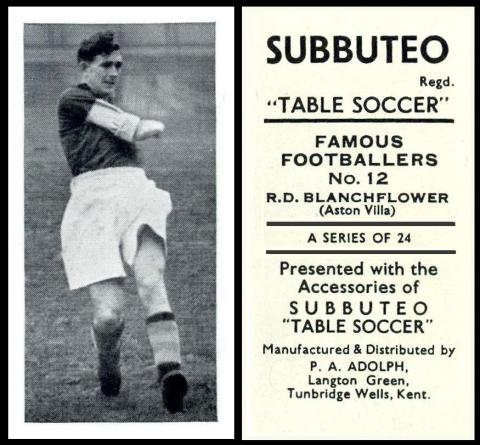
P.A. ADOLPH [trade : toys : Uk - Tunbridge Wells, Kent] "Famous Footballers" (1952) 12/24 - ADP-1.A.1
Onwards, to another centenary, the birth, today, in 1926, of Robert Dennis "Danny" Blanchflower.
He was born in Belfast, and would eventually be one of five children. Unusually, his mother was the footballer in the family, but she seems to have encouraged him to leave school and get a proper job, which he did, at Gallaher`s cigarette factory, as an apprentice electrician. He was there when the Second World War broke out and was joined on to their Air Raid Warden team, being too young to enlist. However one day in 1943 he got dressed up, lied about his age, and joined the RAF. They sent him to train as a navigator, presumably on the bombers, up in Scotland. One of the team building exercises was football, and he proved surprisingly good. He was eventually sent off to Canada, but too late to play any part in the war, as he only arrived in 1945.
In 1946 he was demobbed and returned to Gallaher`s. He also joined a local football team, Glentoran, but then, in 1949, he had an offer from the English team, Barnsley, which he accepted. his transfer fee was £6,000, quite a lot for a twenty-three year old. It is kind of understandable that there are no cards of his time at Glentoran, but there seems to also be none from Barnsley.
By 1951 he had moved to Aston Villa, for a fee of £15,000 - and in the same year his younger brother, John had joined Manchester United, where he would stay all his career, until it was ended, very prematurely, by injuries sustained in the Munich Air Disaster.
Danny Blanchflower was a bit more restless, and in 1954 he signed for Tottenham Hotspur. Whilst there he was twice voted Footballer of the Year. He enjoyed his time at Tottenham Hotspur, though they did loan him out, back to Canada, where he briefly played for Toronto City. During this time he also played for, and captained, Northern Ireland. But in 1964 he retired, at the age of just thirty-eight - though he did not leave football entirely, coaching at Tottenham Hotspur, managing Northern Ireland and Chelsea, and also playing three matches in South Africa. And he would also go on to have a successful career as a journalist and TV commentator.
Sadly in the late 1980s he began to suffer with what would later be formally diagnosed as Alzheimer`s and Parkinson`s diseases. He moved to a nursing home, but died, of pneumonia, aged just sixty-seven, on the ninth of December, 1999.
Our card is usually known as having been issued by "Subbuteo", but that was a brand. The truth is revealed in our original British Trade Index part two, where it is listed as :
P.A. ADOLPH, Tunbridge Wells
Subbuteo "Table Soccer". Cards issued 1952.
- FAMOUS FOOTBALLERS. Sm. Black. Nd. ... ADP-1
A. Size 67 x 35 matt - (1) "A Series of 24"
(2) "Second Series of 24", Nd. 25/4
B. Size 67 x 39, glossy. "A Series of 50". As "A", two added.
In our updated British Trade Index, it is listed in reverse order, kind of oddly, but for a reason, as it turns out that the series of fifty was issued first. So that entry reads :
P.A. ADOLPH, Tunbridge Wells
Subbuteo "Table Soccer". Cards issued 1953-4.
- FAMOUS FOOTBALLERS. Nd. Black. Two series. ... ADO-040
1. 1953. 67 x 39. Glossy. "A Series of 50". Same subjects as below, with two additions
2. 1954. 67 x 35. Matt, issued as a) "A Series of 24" (1/24), b) "Second Series of 24" (25/48)
It reads oddly because the first version ought to have ended with the "...50" and the second series have carried the wording "Same subjects as above, but with two less cards". Don`t you think?
And as for what the two cards are, well I can tell you - they show S [Sydney] Normaton of Bury (he is card number 21) and R. [Ron] Wylie of Notts County (he is card number 50). I have no idea why they were excised though.
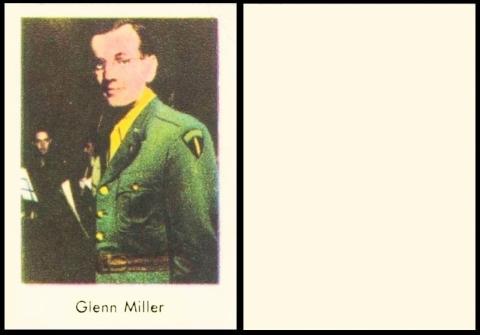
ANONYMOUS [trade : gum : O/S - Holland] "Varldsberomda Jazzstjarnor i Glanzbilder" / world famous jazz stars in glossy pictures (1958) Un/50
Today in 1942 the first ever "Gold Record" was presented by RCA Victor to mark the sale of over a million records of any one song, though by the time it was presented it had almost sold one and a quarter million records And that record was "Chattanooga Choo Choo", by Glen Miller and his Orchestra.
The song was written by Mack Gordon and composed by Harry Warren, and it got its major impetus through its inclusion in a film, released on August the 21st, 1941, called "Sun Valley Serenade". The plot of that was rather thin, but it involved a band leader called Phil Corey (played by Glenn Miller), who decided that he would step up and adopt a war refugee child for the publicity it would bring. However when the child comes she is rather older than expected, almost a woman, and the pianist in the band (played by John Payne) has a brief flirtation with her, which does not go down well with his girlfriend. Most of the rest of the film revolves around a booking for the band at Sun Valley ski resort in Idaho, where Sonja Henie gets to put on her skates and show her talents.
There is also an airing of several other Glenn Miller tunes, including Moonlight Serenade and In the Mood. However the Chattanooga Choo Choo scene is quite odd, as it segues into a railway station set, with Dorothy Dandridge and the Nicholas Brothers in a tap dancing routine.
The film was nominated for several Academy Awards, including Best Original Song for Chattanooga Choo Choo - but won none. The Best Original Song award went to "The Last Time I saw Paris" from "Lady Be Good", written by Jerome Kern and Oscar Hammerstein II.
Despite their popularity, the Glenn Miller Orchestra only made one other movie, "Orchestra Wives" in 1942. In the same year Glenn Miller volunteered for service in the military. He started by entertaining the troops, but also served in the US Army Air Force. Then, in December 1944 the aircraft he was in went missing somewhere in the English Channel between England and France. Nothing was ever found, and he was declared dead on December the 16th 1945, a year and a day from the time the aeroplane took off.
Sadly he appears on very few cards, mostly the anonymous ones with the plain backs which we refer to as "Dutch Gum". Those were all issued in the 1950s as a result of his life story being turned unto a movie, "The Glenn Miller Story", starring James Stewart That was released in February 1954, and did lead to quite a bit of revival in his music. And it also won an Academy Award, for Best Sound Recording.
Our card, if it is spotted as just a card, is not just anonymous but untitled. However the reader who supplied it says that the title was on the pack. a curious thick red and black construction with a hole in the front through which you could see the central portion of one card. He says that someone told him this originally had cellophane too, but it was not well stuck and most are long gone. On the top of the packets it says "10 Varldsberomda" which translates to 10 World Famous - then at the bottom it continues with "Jazzstjarnor i glansbilder" which translates to the rest of the title, namely Jazz Stars in Glossy Pictures.
This is a set which is often discounted because for the most part you just come across a few odd cards of people who are not really known outside Holland - but if you strike lucky you will realise that the full set contains some great jazz names, as you can see from this list, supplied by the same reader who sent the card.
- Ernestine Anderson
- Louis Armstrong
- Count Basie
- Hacke Bjorksten
- Simon Brehm
- Benny Carter
- June Christy
- Buddy de Franco
- Arne Domnerius and Raffe Blomqvist
- Billy Eckstine
- Roy Eldridge
- Rolf Ericson
- Erroll Garner
- Terry Gibbs
- Lars Gullin and Lili-Babs Svenson
- Bobby Hackett
- Lionel Hampton
- Bill Harris and Ray Brown
- Coleman Hawkins
- Billie Holliday (close up)
- Billie Holliday Iat microphone in green dress)
- Lena Horne
- Illinois Jaquett
- Frank Jensen
- Bibi Johns
- Eddie Jones
- Stan Kenton
- Barney Kessel
- Peggy Lee
- Herbie Mann
- Timmy McPartland (sic - ought to be Jimmy)
- Mezz Mezzrow
- Glenn Miller
- Winniefied Attwell (sic - ought to be Winifred)
- Red Norvo
- Charlie Parker
- Patachou
- Oscar Peterson
- Systrama Rosenblom
- Tony Scott
- Arwell Shaw
- Charlie Shawers
- Horace Silver
- Mugsy Spanier
- Artur Rolen
- Reinhold Svenson
- Owe Tornqvist and Ullabella
- Charlie Ventura
- Sara Waughan (sic - ought to be Vaughan)
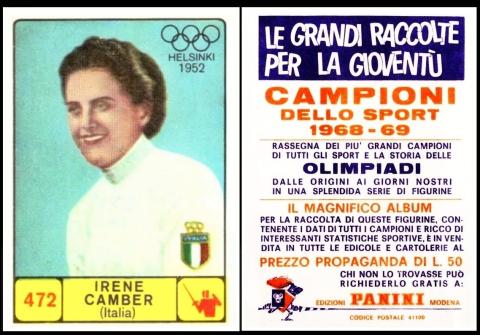
Figurine PANINI [trade : stickers : O/S - Italy] "Le Grandi Raccolte per la Gioventu" / the great collection for youngsters (1969) 472/511
In yet another centenary, today, in 1926, Irene Camber was born, in Trieste, Italy, the daughter of poet Giulio Camber Barni, who was also a lawyer, and a soldier.
Strangely her sporting career was decided by accident, for she was proving to be quite an adept skier and gymnast when one day, aged just eight, she took a wrong turn and found herself not in the gymnasium with her sister, but with her brother, who was learning fencing, very grudgingly. However his sport thrilled her instantly, and she immediately signed up.
Sport also sustained her when her father was under investigation for his politics, and his poems were seized. He was called up to the military in 1938, and fought in Albania. Whilst he was there, in 1940, aged just fourteen, she won her first fencing victory, but never got to tell him in person, as he died, in November 1941, after a fall from a horse, whilst away at the war.
During the war, life was hard, especially as at that time a woman`s place was in the home, administering to her husband and children, not playing at sport. In addition, she was interested in what was traditionally a man`s sport, a training exercise for war. Then there were the frequent enemy bombings, the lack of nourishing food, and the risk of being seen as someone who was strong enough to serve their country and go to war. Yet, through all that, she continued to train, often at home, and sometimes in secret, all the time hoping that nobody would reveal of her secrets, and in 1942 she reached the finals of the Italian national championships in the foil event.
After that, the war in Europe was all consuming, and it was not until 1947 that she picked up a foil again, whilst at University, where she was studying industrial chemistry at the University of Padua. She also had the great luck to find a teacher who was not against woman and men training together and she was regularly pitted against male opponents, which taught her so much more than she would have ever learned if restricted to women only matches.
In 1948, she graduated with a Bachelor of Science in Industrial Chemistry in 1948, and a lifelong job at the Montedison chemical corporation. The same year saw her competing at the Olympic Games, in London, at the women`s individual foil event, where she was defeated in the semi finals by Ilona Ilek of Hungary. She believed that it was because her studies had taken her away from practise, and that might indeed have been true, but if anything it fired her up, and in 1952, at Helsinki, she won the individual foil class, beating Ilona Elek - which made her the first Italian woman to win gold in the sport of fencing.
She would go on to win many European fencing championships, including the 1953 World Championship in Brussels, but in 1956 she took a break to get married, to a chartered accountant called Gian Giacomo Corno. 1956. However that had the side effect of making her miss the Melbourne Olympics, because she was pregnant with her first of three sons.
She loved being married and almost gave up sport. Maybe she would have if not for the fact that the 1960 Olympics were so close at hand, being sited at Rome. And so she returned, as part of the team event, where they won bronze. She was also on the team in Tokyo in 1964.
After that she wanted to slow down, and moved into coaching, rising to the heights of coaching the Italian Olympic team for the Munich Olympics, where one of her students won the gold medal.
That means that this set was almost certainly issued for the 1968 Olympics in Mexico City, which were held between the 12th and the 27th of October. They were notable for being the first ever Olympics to be held in South America, But, sadly, this seems to be her only cartophilic representation.
We do not know much about Irene Camber after her retirement, only that her husband died in 2014, and she was very close to her children and grand children, with whom she died, in Lissone, in Italy, on the twenty-third of February, 2024, aged ninety-eight
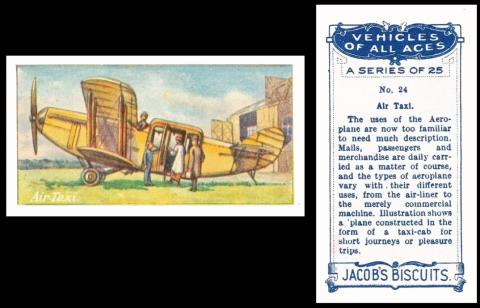
JACOB & Co. [trade : biscuits : UK] "Vehicles of All Ages" (1924) 24/25 - JAC-320 : HX-111 : JAJ-2 : D.10
And now we must close this section - with another centenary, as today in 1926, the first American Air Mail stamp was issued by the U.S. Department of the Post Office in accordance with the Air Mail Act of 1925.
That needs a bit of explaining as when I looked into it further I discovered that it was not the first air mail stamp, that had come along in 1918, and it was a set of three stamps each showing a Curtiss "Jenny" biplane, upside down - and that though there were three, the first of them to be issued was the twenty four cent stamp.
What our date celebrates is a dark blue and light blue stamp that ostensibly shows a map of the world, but if you examine closely has two aeroplanes, one at each edge , right in the middle of each side, about to fly towards each other. Just over forty two thousand of them were printed, and the first was issued on February the 13th 1926. It was valid for ten cents, and that was the fee, per ounce of weight, for up to a thousand miles of carriage. In fact, just like the 1918 stamps, there were three colours, our ten cent blue, plus a fifteen cent brown, for an extra distance, of up to five hundred miles, and a twenty cent yellowy-green which covered distances of over fifteen hundred miles.
And in case you are wondering, the distance coast to coast, from Georgia to Washington State, is two thousand eight hundred miles.
As to why they needed different colours, I found that out too, and it was to speed up sorting, for they only needed to look at the colour not squint at the price.
I even know what the aeroplanes on the stamps are - they are de Havilland DH-4 single-engine biplanes, which were the mainstay of the airmail delivery service. However finding one on a card proved quite impossible, so we went for this, which does mention air mail on the back, and is a set we have not featured before.
It is first recorded in our original British Trade Index, RB.25, published in 1962 - which was actually titled as the Index of British Non-Tobacco Issues up to 1945. And it appears as :
JACOB & CO.
Biscuits. Cards issued 1924-25
- VEHICLES OF ALL AGES. Sm. 68 x 37. Nd. (25). See D.10 ... JAJ-2
D.10 is in the back of the book and it refers to sets which were duplicated, in other words also issued by another. In the case of this set that other version was by W. Sword & Co., of Coatbridge, whose stock in trade was Abernethy biscuits. And I will endeavour to find you one and add it here.
By the time of our updated British Trade Index, the set is described as
JACOB & CO.
Biscuits. Cards issued 1924-25
- VEHICLES OF ALL AGES. 1924. 68 x 37. Nd. (25). See HX-111 ... JAC-320
The handbook code here simply says the same as above, that the set was issued by W. Sword of Coatbridge.
This week's Cards of the Day...
brought us into February, so we thought we would have some fun with food, just in time for #NationalPizzaDay, which will be on Monday the 9th of February. i have to say that this was one of the most enjoyable weeks too, and it is surprising how many early cards you can add to a collection on the theme.
Saturday, 31st January 2026
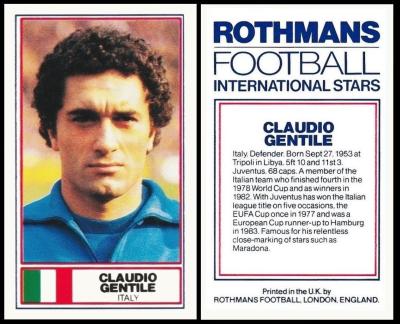
Our first clue card gave us Italy, which is universally regarded as the home of pizza - and we can also credit the Italians with taking pizza to America with them when they emigrated.
That`s not all, though, as the early Romans, who were named after Rome, Italy, used to make a flat bread called panis focacius (and yes, that is the origin of foccaccia bread), and pile it with toppings.
Then we also have the fact that the first use of the word "pizza" was in Gaeta, which today is a seaside holiday resort, but, in Roman times, was a heavily fortified city.
Lastly, even the word "pizza" harks back to the Roman word "pinsere", to pound, or stamp, referring to the way the dough is thrown and then pounded down with the hands and fingers.
Our man is Claudio Gentile, and he was born on September 27, 1953. The card then tells us that he was born in Tripoli, Libya, but a little bit of research proves that in 1911, during the Italo-Turkish War, Tripoli was occupied by the Italian forces, and that they somehow held control right until 1943, even changing its name to Italian Libya. However our man was not even born for another decade after that, which makes me think his parents, or grandparents, must have been Italian, and he got in the Italian team through that. And in actual fact it turns out that his parents were Sicilian.
When he was eight, they moved to France, and this is where he first played football, for a club I cannot find called Arona. Then, in the early 1970s, he was snapped up by the Società Sportiva Dilettantistica Varese Calcio, in Lombardy. However a little bit of research into this club tells us a lot, for it was primarily staffed and run by Italians, so it seems likely that a lot of Italians were living in the area. And it was, to all intents and purposes, an Italian team. Sadly the turnstiles squeaked for the last time in 2019, and the club is no more.
In 1973 he moved to Juventus, and relocated to Turin. He played over four hundred games with Juventus, including UEFA Cup and European Cup Winners Cup finals, and also joined the Italian National Team, with whom he competed in the several World Cups and European Championships.
About the time this card was issued, in 1984, he signed for Associazione Calcio Firenze Fiorentina, in Florence, then moved to Piacenza, in Emilia-Romagna, and it was whilst he was playing there that he retired from football in 1988. However he did not step away entirely, just side-stepped into coaching, for the Italian Under-21s, and the Olympic squad for the 2004 Games in Athens.
This card was supplied us by a reader, who also poses a question, and that is regarding the title of the set - for if you look at the large heading at the top of the cards, they read "Rothmans Football International Stars", with a line between the words "Rothmans" and "Football", and so one might presume Rothmans to be the issuer and the set to be called "Football International Stars". However, if you look down the bottom it actually says "Printed in the U.K. by Rothmans Football, London, England" and that seems to suggest that the set ought to just be called "International Stars".
Anyway, whilst you ponder on that, here is a list of all fifty cards :
- Manuel Amoros (France)
- Giancarlo Antognoni (Italy)
- Ossie Ardiles (Argentina)
- Batista (Brazil)
- Franz Beckenbauer (West Germany)
- George Best (Northern Ireland)
- Maxime Bossis (France)
- Paul Breitner (West Germany)
- Trevor Brooking (England)
- Cerezo (Brazil)
- Bruno Conti (Italy)
- Johan Cruyff (Holland)
- Ramon Diaz (Argentina)
- Dirceu (Brazil)
- Eder (Brazil)
- Falcao (Brazil)
- Ubaldo Matildo Fillol (Argentina)
- Trevor Francis (England)
- Claudio Gentile (Italy)
- Alain Giresse (France)
- Ancesco Graziani (Italy)
- Glenn Hoddle (England)
- Junior (Brazil)
- Manfred Kaltz (West Germany)
- Kevin Keegan (England)
- Mario Kempes (Argentina)
- Pierre Littbarski (West Germany)
- Diego Maradona (Argentina)
- Bobby Moore (England)
- Hansi Muller (West Germany)
- Daniel Passarella (Argentina)
- Pele (Brazil)
- Michel Platini (France)
- Bryan Robson (England)
- Dominique Rocheteau (France)
- Paolo Rossi (Italy)
- Karl-Heinz Rummenigge (West Germany)
- Harald 'Toni' Schumacher (West Germany)
- Bernd Schuster (West Germany)
- Peter Shilton (England)
- Didier Six (France)
- Socrates (Brazil)
- Uli Stielike (West Germany)
- Alberto Tarantini (Argentina)
- Marco Tardelli (Italy)
- Marius Tresor (France)
- Ray Wilkins (England)
- Tony Woodcock (England)
- Zico (Brazil)
- Dino Zoff (Italy)
As the set was issued in 1984 it does not appear in our original World Tobacco Issues Index, only in the updated version. That tells us that Rothmans actually had three distinctly separate card-issuing eras, firstly between 1925 and 1940, which are detailed in our original World Tobacco Issues Index, then an issue in the 1950s and 1960s called "Rare Banknotes Collection", which is one of the few sets of cigarette cards devoted to banknotes, and which we talk of in more length in our newsletter of the 26th of February 2022 (scroll down to Saturday, 26th February). Our set is part of the third incarnation, which is recorded as "Issues in 1970s and 80s", and they are :
- Canterbury Bankstown District Rugly League Football Club
- Consulate Country Living cards
- Puzzle Card Series
- Rothmans African Educational Series
plus our set, which is described as :
- ROTHMANS FOOTBALL INTERNATIONAL STARS. Sm. 75 x 45. Unnd (50) See H.638 ... R785-780
Sunday, 1st February 2026
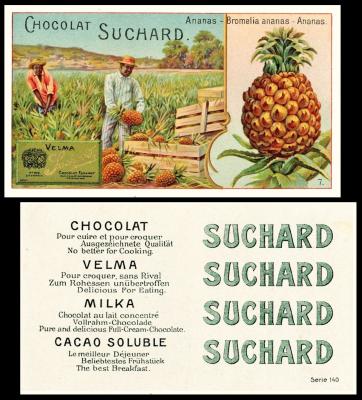
Our second clue card brought us to a huge quandary, whether, or not, pineapple and pizza ought ever to be combined.
I think, like most things, if you enjoy it, why not. Though pineapple is usually combined with ham, which I do not eat.
Actually the proper name of a pizza with pineapple is a "Hawaiian" - and it was invented in Ontario, Canada, by a man called Sam Panopoulos, who wondered if, just like Chinese food, something sweet would go with something sour. As far as the name, that came from the fact that the pineapple was not freshly cut, it was out of a tin, a tin that bore the name "Hawaiian Pineapple Company".
Today fifty-six per cent of Americans do not think that pineapple and pizza go together - but they hate anchovies even more. On the other hand Australians rate pineapple pizza very highly.
This card is full of information, for it gives the name of the fruit in French, Latin, and German, and the pictures show the fruit being grown or harvested, as well as the fruit itself, with the leaves and sometimes the flowers
The set consists of the following fruits ;
- Cacao - Theobroma Cacao - Kakao
- Canne a Sucre - Saccarum Officinarum - Zuckerrohr
- Vanille - Vanilla Planifolium - Vanille
- Cafe - Coffee Arabica - Kaffee
- The - Thea Chinensis - Thee
- Banane - Musa Sapentium - Banane
- Ananas - Bromelia ananas - Ananas
- Noix de Coco - Cocos Nucifera - Kokosnuss
- Orange - Citrus Oranium - Orange
- Citron - Citrus Medica - Citrone
- Datte - Phoenix Dactylifera - Dattel
- Figue - Ficus Carica - Feige
Monday, 2nd February 2026
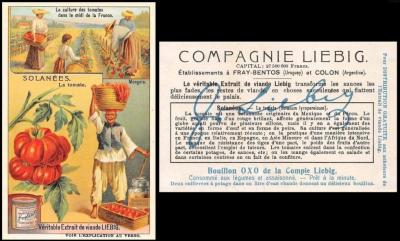
and lastly, came our third clue card, which shows a tomato, something universally associated with pizza, both as a sauce immediately on the base for the other layers to stick on, and as whole tomatoes on top as decoration.
The first person to mention tomatoes and pizza together was the writer Alexandre Dumas, in 1853, where he writes about what we today call street food, and he was in Naples at the time.
The earliest recipe for tomato sauce was published in 1694, and it was being added to pasta, as a tangy flavouring, to liven it up, by the late 1830s, so it seems very likely that someone thought it would also jazz up a flatbread...
This is a very intriguing set, which proves that the tomato is an oddity indeed. In fact the six plants used in this series have almost two thousand seven hundred brothers and sisters, some of which we much enjoy eating, and others of which could kill us. However, you have to be careful with them all, for even eating a potato "in the green" could be fatal, whereas once fully ripe, and cooked, they are completely harmless.
The family is called Solanaceae, and it is more commonly known as the Nightshades.
Despite the European imagery on this set, the family originated in South America, and spread widely, so much so that you can find one of them on every continent except Antarctica, and on a wide variety of climactic, altitudinal, and soil conditions. Not just that, but some crawl along the ground only inches high, and others grow up into trees, whilst some are even grown for their beautiful flowers, not their edible crops. Most curious of all is that they manufacture their own pesticide, to keep insects and predators at bay.
Our French version shows :
- La Belladone [deadly nightshade]
- La Pomme di Terre [potato]
- La Tomate [tomato]
- Le Dature Stramoine [jimson weed]
- Le Piment [pimentoes]
- Le Tabac de Virginie [Virginia tobacco]
The cards are also available in Italian, as "Solanee" in which case the cards, in the same order as above, are
- La Belladonna
- La Patata:
- Il Pomodoro
- Il Stramonio
- Il Capsico
- Il Tabacco di Virginia
and in German as "Nachtschatten-Gewäch" in which case the cards, in the same order as above, are
- Gemeine Tollkirsche
- Kartoffelpflanze
- Liebesapfel
- Gemeiner Stechapfel
- Spanischer Pfeffer
- Virginischer Tabak
Tuesday, 3rd February 2026
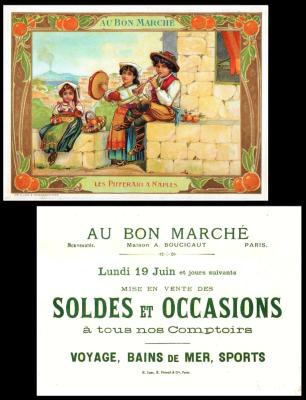
I knew I had forgotten something, and that was why this card is here. It shows Naples, and pizza is connected with Naples in many ways, not least the fact that one of the most popular pizzas is named after it. We call that a Neapolitan, but in Italy they call it Pizza Napoleteana, and in Naples itself they call it Pizza Napulitana.
It is also the truth that pizza was born in the city of Naples, in the eighteenth century, and, rumour has it, something was done differently that turned a flatbread piled with toppings into something with crusty raised sides and the cheese melted way beyond anything anyone had ever experienced before. However tomatoes were not part of the mix then, it was only garlic and cheese, plus the rather dubious offerings of lard and salt. Once the taste was "out there", (shall I say, for after all I am writing this om my birthday!) the punters went wild and it was being sold in the street from all manner of vendors, called pizzaiolos, some of whom just wandered about with them on trays, and some of whom made themselves little covered stands. The name given to those vendors says it all, for "aioli" means garlic and oil, though the question is how a word in Spanish was being used so openly in Italian.
As for the first true pizzeria, with tables and chairs, that also has its roots in Naples - though at first it was but a chair, perhaps supplied ad hoc by a vendor to someone they felt needed a sit down. That appears to have been in the 1830s, and pretty soon if you wanted more business you supplied chairs and then tables, The reason behind this is easy to understand; if someone buys a pizza and walks away, they get anything else they want to add to their meal along their travels, if you sit them down they will ask of it from you,....
Today, we know this pizza as being of a soft, wheaten dough, both fat, and sugar free. and packed with mozzarella cheese and tomatoes, traditionally of the San Marzano breed, which thrive on the volcanic soil that surrounds Mount Vesuvius (also shown on this card).
This card is intriguing because you can also find this image, of "les pifferari di Naples" (or the pipers of Naples) with the standard advertising back showing the department store. However this card was specially printed for a sale of goods - indeed, the biggest words translate to "Sales and Bargains" and this is followed by "at all our counters". Though this card specifies "voyage, bains de mer, sports", which is travel, sea bathing, and sports.
Starting with the date on it, that is Lundi (or Monday) 19th of Juin (or June), so I did some calendar checking and discovered that was only the case in 1899, 1905, and 1911. I kind of favour the first, but am open to hearing what you think.
Wednesday, 4th February 2026
So to another of the pizzas of Naples, Pizza Margherita, which tends to be served in rounds, not slices, and which has a raised edge. That is made of basil, buffalo mozzarella, and tomatoes- or, if you have not noticed already, the colours of the Italian flag, green, white and red.
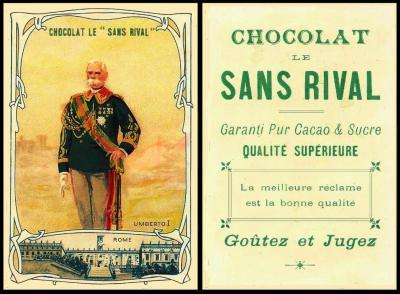
As for our card, it is rather devious, for actually it is not the man portrayed, King Umberto I, that we celebrate today, it is his wife - or, it may be his wife, as many think this story apocryphical. But if we are willing to go with it, on the 10th of June, 1889, his wife, Queen Margherita, paid a visit to the Royal Palace of Capodimonte.
Then the story gets a little foggy, because some versions say that the palace commissioned Raffaela Esposito, without her knowing, to create a pizza just like the Italian flag in her honour, whilst others say that several varieties of pizza were simply on the menu, and she chose, or just preferred, the one in those colours. And so it was named after her, then, and now. And the same event led to Raffaela Esposito becoming known as the inventor of pizza, which he was not - though he was the first person to be known by name for making it. In any event, this sort of pizza was well known in Naples, almost a century before, and in 1866 it was included in a book by Francesco de Bourcard, as one of the traditions of Naples. That kind of rules out that the pizza of the flag was created for Queen Margherita, but not that she may have said she liked it best - even if, in doing so, she was only being patriotic.
You can also find King Umberto I on the rather long-windedly titled, but unnumbered, Kinney set of "50 International Cards - Combining Portrait of Ruler, Flag and Highest Order of the Various Countries of the World", issued in 1888, and the Allen & Ginter set of 50 "World`s Sovereigns", issued one year later.
As for his Queen, she does also appear as part of Felix Potin`s "Celebrites Contemporaines" but its black and white and this one I use of her husband is much more fun, and more colourful.
The set appears to be European royals, and so far I know of :
- Alphonse XIII - place not named (1886-1941)
- Don Carlos - Lisbonne (1889-1908)
- Francois-Joseph - Luxembourg (?)
- Oscar II - Stockholm (1872-1905)
- Umberto I - Rome (1878-1900)
- Victoria - Windsor (1837-1901).
- Wilhelmine - Haye (1890-1948)
We also know that the set was issued by other companies
- Chocolat de la Grande Trappe - no idea of location - chocolate
- La Kabiline - no idea of location - dyes
- Le Cafe de Malt, Kneipp - Usine a Juvisy sur Orge, France - coffee
- Le Sans Rival - chocolate
And if anyone can add any more of either the royals or the issuers, do please let us know
Thursday, 5th February 2026
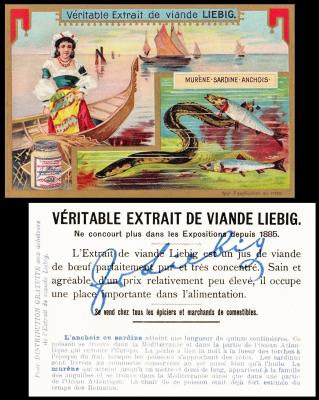
We have not left Naples yet, for today our pizza is Pizza Napoli, which is the same as a Margherita Pizza, but with the addition of anchovies, and sometimes, but not always, capers.
However you can now get seafood pizzas with all manner of items tumbled aboard it - and, if like me, you are allergic to tomatoes, the seafood ones are the ones with the least tomato. In fact the last time I went out for a pizza, they made one for me which was entirely without any tomato at all. That was at Prezzo, so I am giving them a free plug. Thanks guys.
Seafood pizzas are generally known as "Frutti del Mare", which translates to "Fruit of the Sea", and can contain anything that comes ashore, including squid or squid rings, prawns, scampi, mussels, clams and several varieties of fish, kind of the catch of the day in pizza form.
This set was available in Dutch, French, German and Italian. I would have quite liked an Italian one, but could not find one - however this may get swopped in the future if I come across one.
Oddly, the Italian and German sets are different in style to the French version. In the box at the top on the French version there are the words : "Veritable Extrait de viande LIEBIG" - but on the French and German that box holds the title of the set (the Italian being "Ghiottonerie di mare e di fiume" - and the German being "Delicatessen aus Meeren u. Flussen"). In addition, on the French version, the fish names are contained in little tinted boxes, whilst the boxes on the German and Italian versions contain the Liebig details, removed from the top (the Italian being "Vero Estratto di Carne Liebig", and the German being "Liebig`s Fleisch Extract") - and that means on these versions, the fish names are removed to being beside the fish, as part of the picture, which makes them really hard to read.
The cards in the versions so far examined are:
- Shrimps and Lobsters -
French : Crevettes, Homards
German - Krabben, Hummer
Italian - Granchiolini, Gambere di Mare
- Sturgeon
French - Esturgeon, Sterlet, Caviar
German - Ston, Sterlet
Italian - Storigne, Storioncello
- Mussels and Oysters
French - Moules, Huitres
German - Miesmuschel, Auster
Italian - Datteri di Mare, Ostriche
- Eels, Sardines, Anchovies
French - Murene, Sardine, Anchois
German - Murane, Sardine, Sardelle oder Anchovis
Italian - Murena, Sardina, Acciuga
- Salmon
French - Saumon
German - Lachs
Italian - Salmone
- Turtles
French - Tortue
German - Riesen-Schildkrote
Italian - Tartaruga
Friday, 6th February 2026
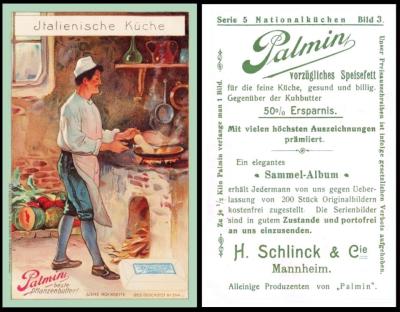
To close our week`s adventure into the world of the pizza, here we have a cook from Italy who, it is said, is cooking just that very thing,
Palmin is a vegetable-based cooking fat that replaces the animal based versions, primarily lard. It is often described as "Pflanzen-Butter", which means butter made of plants. However the name "Palmin" is just the brand, the substance was manufactured by H. Schlink & Cie of Mannheim.
The story of butter substitutes goes right back to 1869, when food was, for some reason I have yet to discover, in short supply. Now I have looked it up I have discovered that there was a combination of reasons - a growth in population, a bad couple of years for farmers, and the first grumblings of the Franco Prussian War, which would erupt in earnest late the following year.
Napoleon III, at that time the self-endowed Emperor of France, wanted to solve the problem, especially with respect to the armed forces, who needed food, he thought, more than anyone. So he offered a grand prize to anyone who could come up with an alternative to butter. The winner was a man with the rather extraordinary name of Hippolyte Mege-Mouries, and he made his substance out of beef tallow and olive oil. He called it Oleomargarine, his own combination of "oleum" (the olive oil) and "margarite" (which means shiny). You will notice that the beef bit was not mentioned. Napoleon liked the substance but not the name, it was too long, and so he ditched the first four letters - and we use his word, margarine, to this day.
These sets were designed to fit in an album which displayed an entire set of six cards per page. More than that though, they quite amazingly cut the corner slots dependent on whether the sets, in order, were horizontal or vertical, therefore avoiding the awkwardness of having to turn the album every time the cards are a different way around in their design.
Now you will often find this set described as "Cooks", or as "Cooking", but the word "Kuche" actually directly translates to "Kitchens". It is a set of six, which are :
- Deutsche Kuche (German Cook)
- Oesterreichische Kuche (Austrian Cook)
- Jtalianische Kuche (italian Cook)
- Hollandische Kuche (Dutch Cook)
- Franzosische Kuche (French Cook)
- Americanische Kuche (American Cook)