
Last week I uploaded the newsletter in the waiting room of the Animal Hospital, with nipper, who had a bout of gastric trouble. And we had to go back there again since. But since then, touch wood, things have started to return to normal at both ends, though we still await the results of the samples.
It`s not been so hot this week, thankfully, but more is almost certainly on the way, that`s the price we pay for abusing the planet, or, more correctly, for our ancestors doing so.
Website News :
So I didn`t do much indexing of the back issues over the weekend, only two, possibly because the earliest, for the 6th of May, 2023, had two sets that when I went to type them in the index were already there.
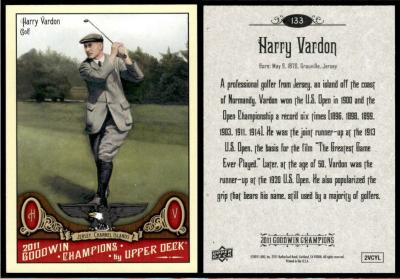
One of these was Millhoff`s "Famous Golfers", and in the end I replaced the interloper and left the one alone which was already there. The reason for that was just because it was easier to get a card of Harry Vardon. However one day I hope to replace the other as well, which is of Bobby Jones, because the event we actually celebrate is the fact that unknown golfer, Cyril Walker, beat Bobby Jones to win the U.S. Open. Unfortunately, Mr. Walker only appears on one card, issued in 1926 by Spalding Athletics, and I know nobody who has that in their collection. But does a reader? And would they be prepared to share it with us, which they can do quite anonymously? If so, please get in touch with us at webmaster@card-world.co.uk. The second duplicate was John Player`s "Cricketers 1938", and that was much easier, as I just swapped the Arthur Wellard in that set for the card of him from John Player`s "Cricketers 1930".
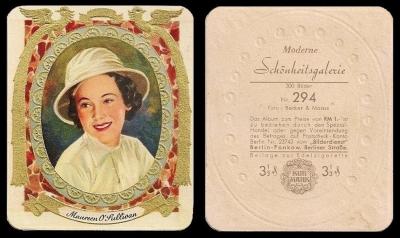
Newsletter two, for the 13th of May, 2023, only had one set to change, Abdulla`s "Modern Beauties", and even when I wrote the text I knew it was already used elsewhere, but I couldn`t find another card of Maureen O`Sullivan in time. However this time I was more lucky, or maybe just know more people, and so the new diary card for Wednesday, 17th May 2023 now shows her in the pith helmet she wore, so fetchingly, in "Tarzan and the Ape Man", released in 1932. And it was issued by Garbaty of Germany in 1934 as part of the set entitled "Moderne Schonheitsgalerie - Folge I"
What`s On This Week:
our regular round up of events and auctions....
- Sunday the 12th of July : HANTS & SURREY - All Day Quarterly Fair from 10 am until 4 pm at Normandy Village Hall, Manor Fruit Farm, Glaziers Lane, Normandy, GU3 2DD.
Free admission to all collectors
- Saturday the 18th of July : EAST ANGLIA - from 8.30 a.m. to 3.30 p.m. - with auction at 11 p.m at Roydon Village Hall, High Road, Roydon, Diss, Norfolk IP22 5RB
EACC members free with annual subscription. Visitors £3 admission each time.
now to our newsletter...
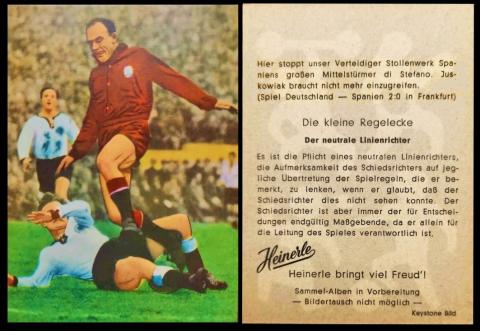
Heinerle [trade : gum : O/S - West Germany] "Fussball" (1959) Un/??
Let us start with a centenary, of the birth of this man, Alfredo di Stefano, today in 1926.
Alfredo Stefano Di Stefano Laulhe was born in Buenos Aires, and started playing football as a youngster, cheered on by his father, who had been a renowned defender from Club Atletico River Plate. Our man`s first team is always said to be Club Social y Deportivo Progresista, which he joined in 1940, but he had played street football, and also been part of a local team in Barracas called "Unidos y Venceremos", though as that means United and Victorious perhaps it was more of a slogan than a team name.
He was at Club Social y Deportivo Progresista for three years, after which, encouraged by his father, he moved to Club Atletico River Plate - and it also seems that his father had written a letter or two to his old team making it happen. Our man got on well there, and they kept him when he grew too old to play in the juniors, though there was not really room on the senior team, but they got over that by loaning him to Club Atletico Huracan for the 1946 season, and then taking him back.
In 1947 he first played for his National team, Argentina. And he may have stayed with Club Atletico River Plate forever, but in 1949 there was a footballers' strike in Argentina, and he accepted an offer from Millonarios Futbol Club, a Colombian club, based in Bogota. At that time he also had several offers from Spanish teams, but FIFA refused to allow him leave to accept them, reportedly fearing that he would join the Spanish National team instead of Argentina. Instead of that he joined the Colombian National Team, in 1951, which were not allied to FIFA
Then, in 1953, he was signed by Real Madrid, where he became their top player, scoring in every European Cup Final between 1956 and 1960. In 1956 he also successfully gained Spanish citizenship, so he was able to play for Spain from the end of January 1957.
Our card comes from these good times, as it was issued in 1959.
However, after Real Madrid lost the Championship Cup Final in 1964 (against Inter Milan), the team president was uncertain; he felt Di Stéfano was getting rather old, but he was very popular with the fans, so it was decided to keep our man on, but as part of the coaching staff instead of on the pitch. This was naturally not accepted, and instead he moved to Reial Club Deportiu Espanyol de Barcelona, S.A.D., though he also had offers from British teams, and he stayed there until retiring, aged just forty.
After retiring, he returned to Argentina and started coaching Boca Juniors, taking them to several titles. That led him to receiving offers from Spain and he started to manage several junior and senior teams. In 1981 he returned to River Plate, and throughout the 1980s he split his time between Spain and Argentina, ending up managing Real Madrid twice, between 1982 and 1984, and 1990 and 1991. After that he stayed in Spain, and one of his proudest moments was being made the honorary president of Real Madrid. And he died in Madrid, on the 7th of July, 2014
Heinerle are a bit of a mystery, but they apparently started issuing cards with their gum in the late 1950s, and issued several sets of football. This is an action shot, but our man also appears as a portrait, head and shoulders.
As far as the title I have been told that it is simply "Fussball", the title that I used, "Die kleine Regelecke" merely being the name of the sub-series. It is also believed that it was issued to celebrate the World Cup of 1958, which was played in Sweden, and the host country made the final only to be beaten by Brazil, as their first ever win.
The other man on this card is Erich Juskowiak, and he played for West Germany. Now we know that West Germany played Spain in 1958, but not as a World Cup match, just as an international friendly on the 19th of March, but that could have been a little teaser for the World Cup which started in June. And we also know that both these men were in the respective squads for that game.
But if we have a Heinerle specialist do please get in touch !
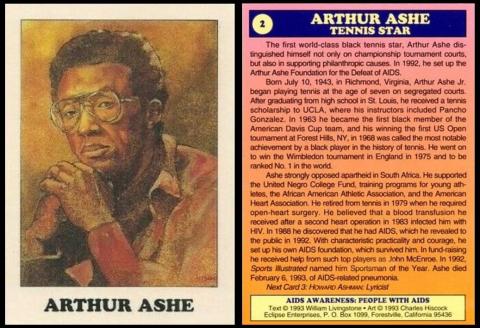
ECLIPSE Enterprises [trade/commercial : cards and books : O/S - Forestville, California, USA] "Aids Awareness Trading Cards" (1993) 2/110
Arthur Robert Ashe Jr., the first African American ever to be selected for the American Davis Cup team, and the first ever to win the Singles Final at Wimbledon, was born today in 1943.
He was born in Richmond Virginia, and he could trace his lineage directly to a West African woman who was taken to America as a slave in 1735, and ended up being owned by the Governor of North Carolina.
When he was six his mother died, leaving his father to raise two children. His father worked two jobs and was also a Special Policeman. He was strict with the children, but encouraged them to channel their emotions and their energy into sport, any sport they liked, but not American football, which he thought too dangerous.(I have been unable to find out if anyone in the father`s family was ever injured in such a way, but it seems likely).
The trio lived in the caretakers cottage at Brookfield Park, which had plenty of sports facilities, including baseball, basketball, swimming and tennis, and the boys tried them all, however our man seems to have immediately shown a talent for tennis, which he began at the age of seven, and this was encouraged by his father. It is not known whether his father arranged it, but one day a tennis instructor for a local university saw him and offered to teach him in his spare time. As part of this he was signed up for tennis tournaments, to improve his style in the field as it were, and eventually he was taken to meet a man who coached a girl called Althea Neale Gibson. The two were taught many things, but also the coach knew that the pair of them were destined to change the game, and would be forever remembered, and so he also taught them never to argue a point with a player or an umpire, always to be polite, maybe even humble.
In 1956, Althea Gibson became the first Black player to win any Grand Slam event, namely the French Open. And in 1957 and 1958 she won the ladies singles trophy at Wimbledon - she also won the U.S. Nationals in 1958, which was the forerunner of the U.S. Open. In 1958, Arthur Ashe also became the first African-American to play in the Maryland Boys Championship. But this was followed by tightening of the rules - and suddenly he was banned from competing against white players, even from using some of the practise courts he had been free to use before.
His salvation came from his being given a tennis scholarship to the University of California in Los Angeles. He also became a member of the Reserve Officers' Training Corps, which meant that in exchange for his tuition money he agreed to enter the military after his graduation, and in 1966 he joined the US Army. However he never saw active combat, he was assigned to the Military Academy at West Point, and served as admin support and data processing.
He also continued to play tennis, moving slowly into better and better events and winning more of them. In 1963 he was selected for the American Davis Cup Team. Two years later he was ranked number three of all American players, and started playing overseas. In 1968 he won the U.S. Open, but in order to stay on the Davis Cup team, as well as be eligible to take leave from the army to play tennis, he had to remain an amateur, and so he could not accept the prize money, which was given to the runner up. All he ended up receiving were his expenses, of twenty dollars.
With this in mind I am sure that he must have appeared on a card before 1970-71, which is when what is generally considered his "Rookie" card was issued. That is Panini`s "Campioni dello Sport" issued in Italy, where he is card 333 out of 360.
The 1970s saw him becoming disillusioned with many of the practises that occurred behind the scenes and the way the sport was run. That led to him becoming involved with creating a new organisation, the Association of Tennis Professionals - and in 1974 he was elected its president. The following year he won the mens singles at Wimbledon, defeating the favourite, and returning champion, Jimmy Connors.
In the late 1970s Arthur Ashe started to suffer injuries; he hurt his foot in 1977 and had quadruple bypass heart surgery in 1979, and after that he decided to retire, at the age of thirty-six. In the early 1980s he found out that the heart surgery was flawed, and so in 1983 he had a second heart surgery to correct the failings. In 1988 he went to the doctors with loss of feeling in his arm and screening discovered he had AIDS. Investigation proved that during the transfusion for that second operation he had been given blood that was infected with the AIDS virus.
He was quite open about this, dedicating the rest of his life to raising awareness of the illness, and also fighting for the other victims who had also become infected during surgeries performed before March 1985 - for it was only in that month that it was announced that from now on all donated blood was be screened for HIV antibodies before it was allowed to be used - before that date it was not tested, and the only safeguard was that people donating were asked to abstain from dong so if they thought they had any form of infection.
Arthur Ashe died, aged forty-nine, on February the sixth, 1993. In June of that year he was posthumously awarded the Presidential Medal of Freedom, for his campaign for AIDS victims, and for his fight for civil rights.
There are quite a few cards of him as a tennis player, but I was drawn to this one, which shows him in quiet reflection. It turns out to be from a set called "AIDS Awareness Trading Cards", issued in 1993, and split into sections featuring people who had the disease, those who fought for rights for other people with it, then telling of facts and myths about the disease, showing some of the symptoms, and lastly telling the story of how it was spreading across the world, with demographics. It is a very well thought out set, and it is sad that it is mainly known for the stars and personalities, which are often split off and sold separately, lessening the impact that the whole set has as one.
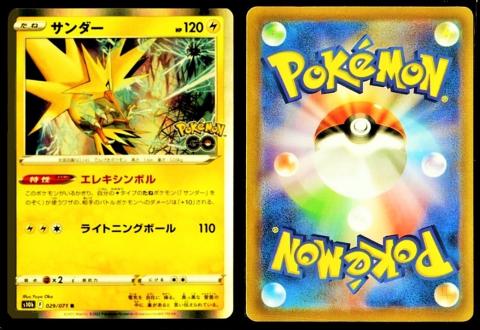
The POKEMON Company [trade/commercial : cards : O/S - Roppongi, Minato, Tokyo, Japan] "Pokemon Go" (2016?) 120/??
Today in 2016 Pokemon Go was released in America and the Antipodes - but not in the United Kingdom, we had to wait until the fourteenth of this month.
In case you are as baffled as me by what Pokemon Go even is, well it is a game for your smartphone. You upload the app and it takes you into a parallel reality in which pokemon characters actually exist, in a three dimensional form, and by using the GPS and camera on your phone you can find, catch, and train these little characters. You do that by staring at the screen as you walk along, and suddenly a Pokemon will appear. If you tap it before it disappears, you can then flick a ball at it and you will have captured it.
The ball, by the way, is a special ball, a Pokeball, which is what appears on the reverse of this card.
You can also see certain places have been designated on the map as Pokestops, and when you get there a circle will appear on the screen; spin the circle and you will get a freebie, all kinds of things, from extra catching ammunition to training aids and helpful magic. There are also other places, Pokegyms and Pokestops, where you can somehow join up with other players, either in your location or on the other side of the world.
And all I am thinking is about how much data allowance all this is leaching from your phone, and how big the bill is going to be at the end of the month...
Now this card was sent to me as a scan, its in Japanese, and I don`t know much else - apart from the fact that if you look in the right hand bottom corner of the picture it says "Pokemon GO". But I have now found out that the character is Zapdos, and I`ll pursue that angle in the morning. And if anyone can help with a date, please do!
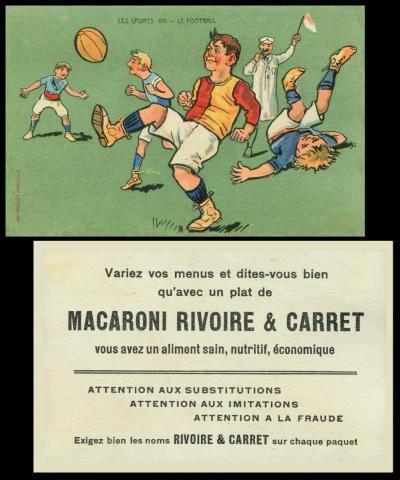
RIVOIRE et Carret [trade : macaroni : O/S - Lyon, France] "Les Sports" (1920s?) Un/??
As those were long, lets close the week with as many fun days as we can - starting with #NationalMacaroniDay, which is celebrated every year on July 7, though I have been unable to find out why this day was chosen.
Macaroni is not just a generic term for pasta, though it is one of the most popular varieties, especially in the universal soother and cheerer-up, called macaroni cheese.
Its made with wheat, and it does not contain eggs, and it is a great help to modern exclusionary diets because it is high protein, though it is also high gluten. As for the name, that`s nothing to do with the shape, which is technically known as elbow pasta, because you can get "macaroni" in many shapes, though, confusingly you can get the same shapes in other types of pasta dough. For it is the dough that actually supplies the name, being made of semolina, water, and "00" flour, and nothing else. Semolina is also a type of flour, but it is made of a harder wheat called "durum", an ancient grain that was first cultivated about 7000 BCE. Its name comes from Latin, and it actually means hard. Once ground it is a pale yellow colour and similar in consistency to cornmeal.
By the way, if you are reading this in America, the above may not be true, for other grains are also lumped in as "semolina", including corn and rice.
The main reason for the use of proper semolina is the gluten, which holds that pasta together strongly enough to hold the walls of the tube shapes apart and stop them collapsing inwardly even after it is cooked and sauce is added. Some say it also helps the sauce stick better to its surface.
The first mention of a meal that resembles modern macaroni comes in the 8th century A.D., being eaten by Arab traders, and it is they who brought it to Italy (now considered its home). Because of the length of their journeys, the traders would carry dried lengths of durum wheat and water, and the pieces were often broken into smaller sizes during the trip, which made them quicker to cook and easier to package, and so they began cutting it up before packing it in their bags. References before that are only to "sheets of dough" which are more like lasagne. Even when Hephaestus mythically made pasta he made it as "long strands", which we call spaghetti.
Macaroni on cards is harder to find, but its there - as card 15 of Players "Products of the World" (1908), where it is shown coming from Italy, and pictured drying on racks in the open air. The text tells us that "Macaroni is prepared from hard wheat flour, which is mixed into a stiff paste with water and then made into thick tubes (macaroni), fine thin threads (vermicelli), or other fanciful forms (Italian pasta). As an article of food it is highly nutritious, and may be kept any length of time without deterioration. The principal manufacturing centres are Leghorn, Naples, Turin and Genoa in Italy, and the Auvergne in France."
Now I was intrigued by the last words, so I looked them up - and, yes, in the nineteenth century, after the Napoleonic Wars, the Limagne plain was suddenly turned into a centre for producing durum wheat. It came about because Swiss soldiers were stationed in the area and suddenly realised that the area had perfect soil and other conditions for growing durum wheat. And what began as barrack room conjecture led to two of them staying on and starting to grow wheat, which was a great success.
And it is in Europe that you find most macaroni cards, issued by the manufacturers of the actual pasta products, though the fronts are seldom anything to do with them. It is the backs, behind the scenes, and literally, which speak of the macaroni itself.
One major issuer was ours, Rivoire et Carret, which was founded in 1860 in Lyon, by two cousins, Claudius Rivoire (1835-1895) and Jean-Marie Carret (1829-1913). It was actually the first pasta in France to be commercially made, branded, and sold - formerly pasta was home made and home eaten, or bought loose at the grocery store. However there is something else important, as Rivoire et Carret used durum wheat semolina. And they also dried it with hot air, not by hanging it on racks, which made for more uniform drying, and a smoother pasta.
In 1968, the firm was still family run, but it was a relatively small company in comparison to other newcomers, and Europe was fast changing, especially as the governments of Europe prepared to join a Common Market. So the Carret family approached another family pasta company, Lustucru, and asked for a merger. That was duly done, and the merged company became Rivoire et Carret et Lustucru. But in 1971 Lustucru bought them out, and in the year 2000 the Rivoire et Carret name suddenly disappeared.
However there is a happy ending, because two years later, Pastacorp bought out Lustucru - and in 2012 they began once more making pasta branded as Rivoire et Carret, to great acclaim. And so the name lives on !
This card is titled "Le Football" but look at the shape of that ball, its more rugger than soccer.
The other cards I know of so far are :
- I - Les Courses
- II
- III
- IV
- V
- VI
- VII - Le Canotage
- VIII
- IX
- X - Le Plongeon (La Natation)
- XI
- XII - La Peche de Fond
- XIII
- XIV - La Lutte
- XV - L`Escrime
- XVI - Le Football
- XVII - Le Patinage
- XVIII - Le Glissade
- XIX - L`Hydrotherapie
- XX - Le Billiard
- XXI - L`Aerostation
- XXII - L`Automobilsme
- XXIII - Le Cyclisme
- XXIV - Le Rallye Paper
- XXV - Le Tennis
- XXVI -
- XXVII - La Boxe
- XXVIII - L`Alpinisme
- XXIX - La Chasse
- XXX -
- XXXI - La Boulomanie
- XXXII - La Gymnastique
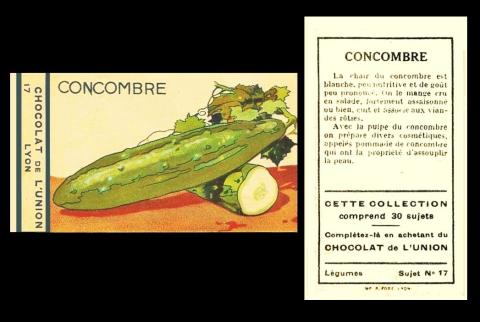
Chocolat de L`UNION [trade : chocolate : O/S - Lyon, France] "Legumes" (1920s?) 17/30
More food now, as today, and every July the 8th is #NationalCucumberSaladDay.
We know a bit more about the origins of this day, because today a tik-tok-er, Logan Moffitt, first made a cucumber salad that went totally viral. I have not been able to find the year, and only ever visited tik-tok once. The contents of the recipe were a whole cucumber, spring onions, sesame oil, sesame seeds, soy sauce, fish sauce., MSG, and sugar.
At the time he was twenty-three years old, and already known as the "cucumber salad guy", and later the "cucumber king". And he is still immensely popular, adding many recipes since, and amassing millions of followers worldwide.
His is a very Asian-inspired recipe, which you can find at oodles of places online, and in the spirit of the fact that this is his day, perhaps you should give it a whirl.
However a classic English cucumber salad comprises just a few slices, with thinly sliced onion, a vinaigrette made of either apple cider, rice, or standard white vinegar, dill, salt and black pepper.
Now I cannot lie, I could not find a card of a cucumber salad, but this is a very pleasing one of a cucumber on its own. and it comes from a very attractive set, which I will list for you tomorrow, just so I finish the rest. But if I finish early it may well be here!
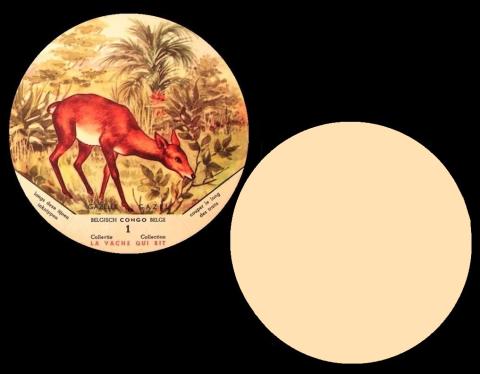
Fromageries BEL [trade : cheese : O/S - France] "Belgisch Congo Belge" (1955) 1/?
Today, in many countries, it is #InternationalGazelleDay, a day to ponder on the plight of these graceful creatures - which I have only mentioned before as either being part of a list of other cards in the set I was cataloguing, or in conjunction with the fact that another name for the Saluki dog is the Gazelle Hound.
The first thing I discovered is that there are lots of Gazelles, in a genus called Gazella. The name comes from Arabic, which translated from pictorial script reads gazal. It seems to have slowly moved through Europe as more travellers went to Arabia, and then to England in the 1600s.
They are widespread in their location, mainly in Africa, but also in Asia and India, with sub species that are located in small groups in Mongolia and Tibet, far away from any other.
As to their general description, they are not very tall, the largest standing at three and a half feet, at the shoulder, and most are light brown. They eat only plants and leaves, and prefer them to be small and easily digestible
One thing they all have in common is their great speed, some reaching 60 m.p.h in short bursts or 30 m.p.h for considerable distances.
This is what makes them such a target for hunters, who see it as a great mark of distinction to be able to aim and hit something that runs so fast. They have no interest, like native hunters, in feeding the meat to their families, to save them from starvation, and the only one who benefits are the scavenger animals, who are happy to eat a free meal so carelessly left out in the open desert beneath the sun.
Nobody seems to know a date for these, or how many is in the set. I will add it to the listing list for tomorrow and see whether I can fathom at least the latter. Our card is number 1, and I can tell you that it is not all animals, so it will be a fun one to work on.
I had a bit of time today so here is the start of a list, and feel free to add any you have !
By the way, the first few cards actually have the words "Langs deze lijnen inknippen / couper le langdes traits" in the white border, but this means cut along these lines. On those cards the title is in the image along the straight line right ihn the middle - and they are very hard to read...
10 Babouin Baviaan
22 Gypatie (Vautour) / Lammergier
from here the title goes into the two side wings of the border and the cutting instructions go above the line into the picture
34 De Nyenge (Danser) / Le Nyenge (Danseur)
42 Bangigo Xylophoon Speler / Joueur de Xylophone Bangongo
44. Wever de Ketting / Gereedmakende / Tisserand
53 Bakuba Beeldsnidher / Scuplteur Bakuba
59 Vuur Door Wrijving / Feu par Friction
60 Bakuba Orkest / Orchestre Bakuba
61 Slangalsvogel / Anhinga ou oiseaux-serpent
72. Pracht Vliegenvanger / Terpsiphone Speciosa
131 Dansers Mayogo en Mangbetu / Danseurs Mayogo et Mangbetu
132 Watutsi Dansen / Danses des Watutsi
143 Congo Stroom Deverdorp / Fleuve Congo Village des Rives

Henri WINTERMANS (U.K.) Ltd. [tobacco : UK] "Disappearing Rain Forest" (1991) 26/30
And lastly we close with #NationalCapybaraDay.
Now this event is a very special one, because we know why it is celebrated on this date, and that is to remember an internet sensation for all the right reasons.
His name was Caplin Rous, and the surname was an acronym for Rodent Of Unusual Size. You see, he was a capybara, cared for by his loving owner, Melanie Typaldos, in Buda, Texas, and she documented his life for scientific reasons, from the time he was born, on the 10th of July 2007, to the time he died in 2011.
She also started a foundation to fund training for vets, so that if they came across a capybara they would know its vital signs, and what it needed, and she also turned her research into the species into a online resource centre, which discovered, amongst other things, the way to safely anaethetise capybaras so they have a greater chance of surviving medical treatment.
In the wild, capybaras come from South America, and they are the biggest and heaviest rodent in the world. They have webbed feet and their eyes and nostrils are high up, which are immediate clues that they spend much of their time in water, and they can stay there unobserved by man or predator. They can also hold their breath for five minutes. They use the water to cool down, and evade capture, but their food source is also there, because they live on aquatic plants, preferring the soft ones below the water to the rougher ones on top.
This set doesn`t appear in our original World tobnacco Issues Index, because that was published in 1956. But then it didn`t seem to appear in our updated World Tobacco Issues Index either, though it was issued in 1984. Then I was told its not listed under Players, because by the time it was listed "Grandee was being run by Henri Wintermans. And it is indeed listed under their name as
Henri WINTERMANS (U.K.) Ltd.
Successors to Player with "Grandee" Cigars. Cards issued 1991-93. Special albums issued .
- DISAPPEARING RAIN FOREST. Md. 89 x 50. Nd. (30) ... W780-200
- WONDERS OF NATURE. Md. 89 x 50. Nd. (30) ... W780-900
This week's Cards of the Day...
This week we are looking forward a bit, with our regular round-up of cards issued in a given month, and this time the calendar turns to July, which it will do on Wednesday.
Half a year gone, already, and I have no idea where.
Now July is not a very full month, with only sixty-seven issues, though we added another this week. And, by the way, June still tops the table of sets issued in a single month, with ninety-nine. However, July is a very good month in another way, because we seem to have shown a substantial amount of the sets already, over forty. And more will undoubtedly turn up as I work back through the rest of the newsletters, just like the earliest July issue of all that we have so far proven, which is Churchman`s "Interesting Buildings", from 1905, which we have now located and added a link to.
In addition, the cards for for this week`s selection were chosen because they filled the earliest gaps. And that means the earliest sixteen sets to be issued in the month of July are all illustrated in the website and recorded at https://csgb.co.uk/research/blog/cartophilic-year.
But we remain stymied by Player`s "Bygone Beauties" in the small size, which seems quite elusive. That will have to wait until I can acquire a scan of front and back from one of our readers.....
Saturday, 27th June 2026
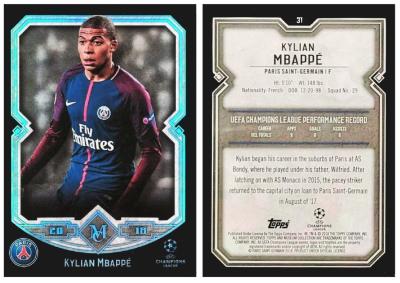
This set was indeed issued in July 2017, and its claim to fame is that it is Kylian Mbappe`s "Rookie" card, as well as the fact that his is the only "Rookie" in the entire set - at least at the moment, but you will have to read on to find out more about that.
Kylian Mbappe Lottin was born on the 20th of December 1998, in Paris to a sporting family, his father, Wilfrid, being a football coach and his mother, who is also his agent, being a handball player. This rubbed off on to his younger brother and adopted older brother, and they were also football stars.
Strangely, our man does not seem to have played for any team before he joined the second team of Association Sportive de Monaco Football Club in 2015. We have not yet found him on any squad cards with the Monaco team, but if we did that would be very exciting, as it would alter his "Rookie" card.. Not long after that he was playing for both their second and first teams.
Two years later they loaned him to Paris St. Germain, which is where he was playing when this card was released, and in 2018 that team signed him up, for a reputed sum of a hundred and eighty million euros. I`m not entirely sure that figure can ever be justified with so many people in need of the basics just to keep alive, but he did become became their all-time top goalscorer, scoring two hundred and fifty six times.
In 2017 he also made his first appearance for the French International team, and at the 2018 World Cup Final he became only the second teenager to score a goal at that stage of the contest. The other, of course, was Pele.
In 2024, he joined Real Madrid Club de Futbol, on a free transfer, and he remains there today.
This set was originally advertised as being available at hobby stores in May 2018, but it did not arrive until July the 20th.
There are several sets of inserts, and four sets of parallel cards, which are the same as ours but have different colours on the inner frames where our card is blue. The other colours are Emerald, Gold, Ruby and Sapphire, the last of which leads to a bit of confusion, because that is also a blue, but it is much shinier. And also the cards have prefixes before their numbers, Emerald`s being SN1, Gold`s SN50, Ruby`s SN25, and Sapphire`s SN75
Sunday, 28th June 2026
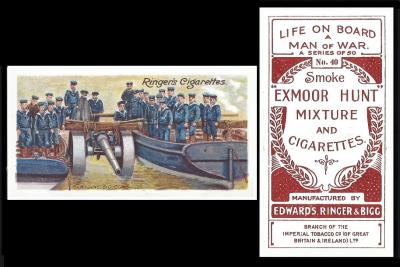
This July set is catalogued first in our original World Tobacco Issues Index as :
- LIFE ON BOARD A MAN OF WAR. Sm. Nd. (50). See H.38 ... E14-18
And this is the same wording in our updated World Tobacco Issues Index, save a new card code, of E265-400
As far as H.38, that`s in the handbook, and the entry reads :
- H.38. LIFE ON BOARD A MAN OF WAR or BRITISH MAN OF WAR SERIES (titled series). Fronts in colour. Numbered (except Player), but order differs from listing below. Series of 50.
Pre-1919
Bigg - Titled "Life on Board a Man of War"
Edwards, Ringer & Bigg - Titled "Life on Board a Man of War"
Player - Titled "Life on Board a Man of War in 1805 and 1905", unnumbered
Overseas
Anonymous - Titled "British Man of War Series of 50". Plain back. Recorded in Burdick under C.49, page 41, as issued by Imperial Tobacco Co. of Canada
There then follows a list, but only of the unnumbered Player set so I have changed it to allow for the inclusion of the Bigg and the Edwards, Ringer and Bigg numbered versions.The Player set is also split into twenty-four subjects showing life in 1805 and twenty-six showing it in 1905, which is rather unwieldy, so I have chosen to list them all in alphabetical order and just give the date from the Player`s set.
| Bigg/ERB | title on card [of Player`s un-numbered set] |
| No. 49 - | - 6 Inch Gun in Action [1905] |
| No. 15 | - A Boarding Party [1805] |
| No. 13 | - A Court Martial [1805] |
| No. 21 | - A Night Attack [1805] |
| No. 18 | - A Powder Monkey [1805] |
| No. 26 | - A Quiet Game of Cards [1905] |
| No. 5 | - At The Wheel [1805] |
| No. 16 | - Between Decks during a Fight [1805] |
| No. 34 | - Cleaning up after Coaling [1905] |
| No. 10 | - Crossing the Line [1805] |
| No. 11 | - "Fiddlers Green" [1805] |
| No. 39 | - Firing 9.2 Q.F [1905] |
| No. 23 | - Firing a Gun [1805] |
| No. 41 | - Firing Exercise [1905] |
| No. 6 | - Fore-Castle Yarns [1805] |
| No. 36 | - Gymnastics, Whale Island [1905] |
| No. 32 | - Hauling a Rope [1905] |
| No. 19 | - Heaving the Lead [1805] |
| No. 28 | - Heaving the Lead [1905] |
| No. 2 | - Heaving the Log [1805] |
| No. 1 | - Hoisting Signals [1805] |
| No. 20 | - In the Mizzen Top [1805] |
| No. 40 | - Landing Big Guns [1905] |
| No. 47 | - Light Gun Drill [1905] |
| No. 4 | - Manning the Yards [1805] |
| No. 24 | - Man-O`War Cook [1805] |
| No. 44 | - Marines at Rifle Drill [1905] |
| No. 37 | - Maxim Gun [1905] |
| No. 38 | - Maxim Practise [1905] |
| No. 8 | - Paying Off Pennant [1805] |
| No. 22 | - Poop Lights of Three-Decker [1805] |
| No. 39 | - Prepare to Ram [1905] |
| No. 3 | - Press-Gang at Work [1805] |
| No. 7 | - Prize-Money [1805] |
| No. 42 | - Ready to Salute [1905] |
| No. 14 | - Receiving the Swords of Vanquished Foes [1805] |
| No. 12 | - Reeling the Sail [1805] |
| No. 30 | - Sail Makers [1905] |
| No. 43 | - Serving out Rum [1905] |
| No. 9 | - Ship`s Belfry [1805] |
| No. 46 | - Signalling [1905] |
| No. 29 | - Single-Stick Drill [1905] |
| No. 50 | - Smoke Head-Gear [1905] |
| No. 17 | - Swivel in Man-of-War`s Top [1805] |
| No. 48 | - The After-Barbette [1905] |
| No. 33 | - The Bugler [1905] |
| No. 35 | - The Ship`s Barbers [1905] |
| No. 45 | - The Wounded Man [1905] |
| No. 27 | - Using Sewing Machines [1905] |
| No. 31 | - Working a Nordenfelt Gun [1905] |
Now if we look at the London Cigarette Card catalogue for the same year as the handbook, we find the following :
- W.O. Bigg - odds from 8/6 to 25/-, sets at £60
- Edwards, Ringer and Bigg - odds from 6/6 to 20/-, sets at £50 - and this is where we get the issue date, of July 1905
- John Player - odds from 1/6 to 4/-, sets at £10 - and this is where we get their issue date, of October 1905
So that destroys the oft held belief that Player`s issued their set first and Edwards, Ringer and Bigg copied it...The only thing we don`t know is when W.O. Bigg issued theirs.
Monday, 29th June 2026
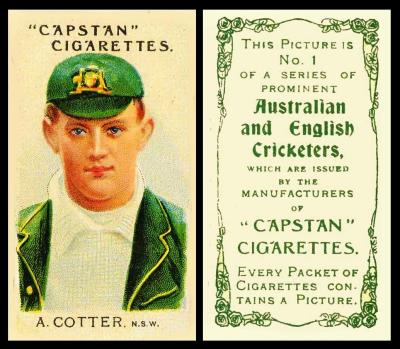
Here we have the first part of a two part set, the other will come along tomorrow, and the front will already be visible when this can be read.
But let`s start with our man, billed as "A. Cotter, N.S.W." whose story turns out to be a fascinating, and poignant, one, of a life cut short.
His name was Albert "Tibby" (or, in some references "Tibbie") Cotter, and he was born on the 3rd of December 1883. His skill at cricket was first spotted at school in Sydney, so much so that by the age of eighteen he had already been signed up to play for his county, New South Wales. Two years later, he was on the international field, bowling for Australia, a team he continued to play with for nine years and twenty-one tests. He was not always popular, and in 1905 his delivery to, of all people, Dr. W. G. Grace, is often claimed to have been the origination of the idea of aiming straight at the opponent that was later developed into the infamous practise of "Bodyline" bowling.
In April 1915 he enlisted in the Australian Imperial Forces - perhaps through seeing a particularly rousing poster and believing it was his duty, or perhaps because someone pressured him into it, as we know that once he had joined there was a lot of rousing propaganda about how a leading sportsman like him had joined up. He was sent to the 1st Australian Light Horse Regiment, and he joined them at Gallipoli, arriving near the end of the campaign and finding that much of their war was being spent as foot soldiers, dug in to trenches, though there were a few mounted charges, most notably the one from Pope`s Hill on August the 7th 1915.
Later he moved to the 12th Australian Light Horse Regiment, which also served at Gallipoli, and was at the second Battle of Gaza, on the 17th-19th April, 1917. At the end of October of that year there was another charge, at the Battle of Beersheba, on the 31st of October. Then there is confusion, as there probably was in real life, and not just to our story, because it is recorded that as the troops dismounted he was shot at close range by a Turkish soldier, whilst other reports say that he was attending the men, as a stretcher bearer, and shot mistakenly. Further research proves that he was actually supposed to be serving as a stretcher bearer, but managed to convince another man to change places, fearing that it could the last "charge" of the war. And, unfortunately for him, it was just that.
His body was brought back to Australia and buried at Waverley Cemetery in what seems to be a family plot. It is also a sad one, for the headstone, which is an extraordinarily long one, has three stone books each apparently pinned up as flat and open, and the first of these reveal that his brother, John, was also killed in action in on the 4th of October 1917, whilst serving in France, (though research proves it was actually in Belgium that he died), and two other people, an Arthur Dale, married to our man`s sister who was "killed accidentally" on the 30th of May 1921, and an L.S.O. Edwin Cotter who was also "killed accidentally" on the 14th of December 1929. I cannot find the first one of these two at all, and he has no military rank, but the second does have a military rank, which basically means he was either killed in a vehicular crash, a weapons malfunction, or another kind of equipment failure, just not killed on the battlefield, so he cannot be recorded as "killed in action" even though he was still serving his country at the time. One clue may be that rank, as it is L.S.O., or Landing Signal Operator, which today means the people who guide the aeroplanes back on to the deck of an aircraft carrier from the ground. Now though Australia’s first dedicated aircraft carrier was H.M.A.S. Albatross, not commissioned until 1929, the job was the same when aeroplanes came in to land on an airstrip on the ground, and we know that the Australian Flying Corps were in action in the Middle East from 1915 to 1918. So it is not inconceivable that he was struck by an aircraft as it failed to land.
However I have done a bit more research on that, and it seems both were actually killed in different railway incidents, Arthur Dale being run over by a train almost halfway between two stations, and being discovered "frightfully mutilated", and L.S.O. Edwin Cotter "falling from a train" en route to Sydney.
The next book records his father and mother, who seem to have had more peaceable ends, dying at the ages of 83 and 84 respectively, and the last book is for another brother, William Henry, his wife, and their daughter.
I`m glad this was a Card of the Day, it is already way too long for a diary date description, and now we have the card chat...!
This set first appears in part three of our original Wills reference booklets, as part of a cricketers group listing, described as :
- 59. CRICKETERS - Australian Issue
H. 50 Prominent AUSTRALIAN AND ENGLISH CRICKETERS. Size 67 x 35 m/m. Numbered on backs. See Fig. 41.H. Fronts lithographed in colours; backs in green, thick board.
In the original World Tobacco Issues Index the set is still listed under the large group of "Cricketer Series", but the entry is slightly different. That reads :
- CRICKETER SERIES (A). Sm. ... W62-221
4. 1907-1908 issues. Titled "Prominent Australian and English Cricketers". "Capstan" brand issues. See W/59 H and I.
(i) - Nos. 1/50. Size 66 - 67 x 35
(ii) - Nos.51/73. Size 63-64 x 36
A. Fronts with letterpress in grey. Nos. 51/73
B. Fronts with letterpress in reddish-brown. Nos. 66/73, same subjects as A, different portraits and numbers
The only difference to the above in our updated World Tobacco Issues Index is that the final word is changed to "numbering" - and, of course, there is a new card code, for the group, of W675-347
Tuesday, 30th June 2026
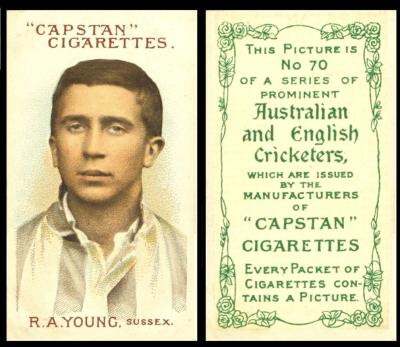
Now this is definitely not a July issue, but it follows on neatly from yesterday`s set as a quick reference. As for when it was issued, the Wills Works Magazine cites both yesterday,`s and today`s, as being out in July 1907, but the first Test was not played until the 13th to the 19th of December 1907, which seems rather a gap. And also we know that the man on this card was one of those added to the original set, subsequently, when it was announced that they would be on the Test team. So all we really need to know is when the team for the Test were announced. And we know it was probably issued no later than February, as the fifth and final Test was played between the 21st and 27th of February, 1908.
Let us pick up the card story, first, because the listing we added yesterday from the original Wills reference booklet part three continues with the following
- 59. CRICKETERS - Australian Issue
I. 23 .Prominent AUSTRALIAN AND ENGLISH CRICKETERS. Size 64 x 36 m/m. Numbered 51-73 on backs. See Fig. 41.I. Fronts lithographed in colour, subject titles in grey; backs in green, thin board.
Nos. 66-73 were issued in two forms (a) original issue, as cards Nos. 51-65, with grey captions (b) re-issue with red brown captions. The eight subjects are the same in both issues but portraits were changed in the re-issue and numbers altered -
no. - (a) original issue [grey caption to front] - (b) re-issue [red caption to front] 66. - F. L. Fane (Essex) - A.O. Jones, Nottingham 67. - J. B. Hobbs (Surrey) - J. N. Crawford, Surrey 68. - J. Hardstaff (Nottinghamshire) - F. L. Fane, Essex 69. - A..O. Jones, (Nottinghamshire), Captain - J. Hardstaff, Nottinghamshire 70. - J. N. Crawford (Surrey) - R. A. Young, Sussex 71. - R. A. Young (Sussex) - S. F. Barnes, Stafford 72. - S. Barnes (Staffordshire) - J. B. Hobbs, Surrey 74. - J. Humphries (Derbyshire) - J. Humphries, Derby The above eight players were all members of the M.C.C. Team which toured Australia in 1907-8, and the balance of the touring side are represented in the cards under item H. It appears probable, therefore, that item H was issued in 1907, and item I, 1907-8
So there is one thing to discuss from that entry, the numbering, which ends with "74" and skips 73. That is a typing error, as the cards of J. Humphries are both numbered 73.
In the original World Tobacco Issues Index the set is still listed under the large group of "Cricketer Series", but the entry is slightly different. That reads :
- CRICKETER SERIES (A). Sm. ... W62-221
4. 1907-1908 issues. Titled "Prominent Australian and English Cricketers". "Capstan" brand issues. See W/59 H and I.
(i) - Nos. 1/50. Size 66 - 67 x 35
(ii) - Nos.51/73. Size 63-64 x 36
A. Fronts with letterpress in grey. Nos. 51/73
B. Fronts with letterpress in reddish-brown. Nos. 66/73, same subjects as A, different portraits and numbers
As to why we chose the re-issue, well that was because the caption is in a different colour, so it shows the difference more strikingly, but fear not, for here is the original card 71, of our man, R.A. Young, so that technically means both sets are contained in this one listing, and also both are pictured within it.
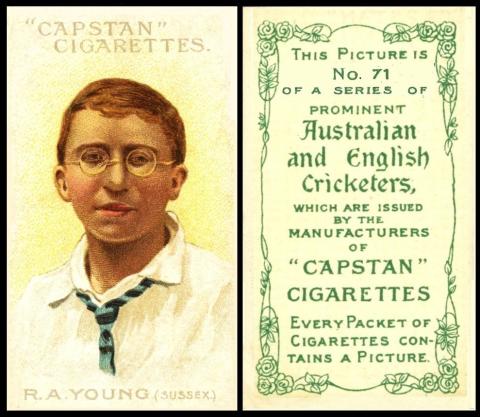
Now looking at the two I think the reason for the re-issue might have been simply that this first version, with the caption and more importantly the name of the issuer, are extraordinaily light and hard to see. Look back to the top and see how they stand out much clearer. But why they changed the numbers and the order is a bit more hard to fathom - unless the grey fronted ones were sent out to Australia as printed cards by Wills, which we know they were as we have a month date in the Wills Works Magazine, and the re-issue, for which there is no date in that publication, was hastily done in Australia, without the artwork, and maybe when all the cards had been circulated. This theory would both account for the new pictures, and for the new numbering. What do you think?????
Wednesday, 1st July 2026
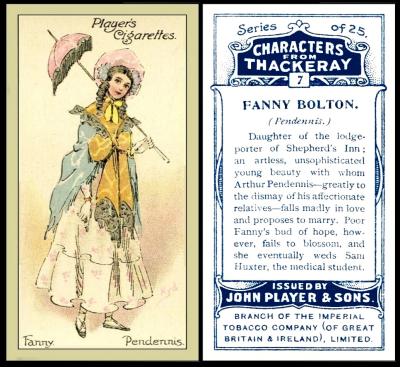
here we have gentle but naive Fanny Bolton, the daughter of the proprietor of the Shepherd's Lane Inn. She meets Arthur “Pen” Pendennis, quite by chance, and the two begin a slow dalliance, despite the fact that he is somewhat above her station. However we know that he is kind and gentle too, and the two would probably have become amazing friends, if never lovers. He has "lived a bit" though, having had a bit of a crush on an actress, done pretty awfully at University, moved to London and been seen with all the right people as a "Man About Town", had a little stab at journalism, and found himself becoming a Member of Parliament. Despite this, he seems very attracted to the idea of giving it all up and going with Miss Bolton, until one of his friends puts him off her, and maybe even dobs them in to his beloved mother. And so what could have been the perfect coupling is lost - he goes on to marry his adopted sister, which was great for her as she always fancied him a bit, whilst Fanny marries a Mr. Huxter, who calls himself a surgeon but is only a medical assistant. Later, however, there is revealed to be a bit of a twist, for the friend who spilt the beans was none other than this Mr. Huxter, whose coarse and boorish ways had long ago alienated him from his former friendship with Arthur Pendennis - and we are left to wonder if the revealing of the relationship to the mother was not a deliberate ploy to gain the hand of fair Fanny.
This set follows on from the two small sized sets of "Characters from Dickens", these being a First Series, issued in March 1912, a Second Series issued in October 1912, and ten extra large cards, which were originally issued in June 1914, and which we have yet to feature on our website. They did not just follow in in as much as being characters from literature, either, for they are also in exactly the same format of design, and all were from drawings by "Kyd" (J. Clayton Clarke).
Now “Kyd”, was but a monogram, and a pseudonymous one at that, for it hid an artist called J. Clayton Clarke. And, thrillingly, he has another cartophilic claim to fame too, for he illustrated the set of "Votaries of the Weed" for Gallaher. But you can read more about him with the Card of the Day for the First Series, of the Dickens set, so as not to slow this one down any further.
Our set is first described in our original reference book RB.17, issued in 1950, and devoted to the issues of John Player. There it is entered as :
- 49 25 CHARACTERS FROM THACKERAY. Small cards drawn by "Kyd" (J. Clayton Clarke). Fronts in colour. Backs in grey, with descriptive text. Home issue, July 1913.
That is much shortened in our original World Tobacco Issues Index, to simply
- CHARACTERS FROM THACKERAY. Sm Nd. (25) ... P72-26
And this text is carried over identically to our updated World Tobacco Issues Index, with only a new card code
- CHARACTERS FROM THACKERAY. Sm Nd. (25) ... P644-062
Strangely this set had no second series, and was never reprinted by John Player, not even when the Dickens sets (with which it is uniform) were, in 1923.
The characters and their books are as follows :
- Lady Southdown - Vanity Fair
- Lord Gules - Book of Snobs
- Harry Esmond - Esmond
- Cocksure - Book of Snobs
- Fred Bayham - The Newcomes
- Tom Tusher - Esmond
- Fanny Pendennis [reverse says "Fanny Bolton (Pendennis)"
- Lady Castlewood - Esmond
- Dr. Portman - Pendennis
- The Marquis of Steyne - Vanity Fair
- Jos Sedley - Vanity Fair
- Barnes Newcome - The Newcomes
- Becky Sharp - Vanity Fair
- Major Pendennis - Pendennis
- Dobbin - Vanity Fair
- Mr. Moss - The Newcomes
- Capt. Costigan - The Newcomes
- Ensign MacShane - Catherine
- Mr. Goldmore - Book of Snobs
- The O`Dowd - Book of Snobs
- Mr. Gandish - The Newcomes
- Rawdon Crawley - Vanity Fair
- Col. Newcome - The Newcomes
- C, J. Yellowplush - The Yellowplush Papers
- Hon. Mr. Deuceace - The Yellowplush Papers
Just like the Players sets of Dickens Characters, this seems to follow no rhyme nor reason, and simply adds characters when they think of them, rather than keeping the books from one character following on in a small group together.
As for why this set was issued, researchers seem to feel it may have been to tie in with a book, "In Thackeray`s London", by Francis Hopkinson Smith, the first edition of which was published in the same year 1913. I am not so sure, as that book was American, published by Doubleday, and it is a rather small tome, bound in grey cloth. Francis Hopkinson Smith was also American, an author and an artist, both of which are combined to good effect in the book - but he was also an engineer, and it was he who built the foundation for the Statue of Liberty.
Thursday, 2nd July 2026
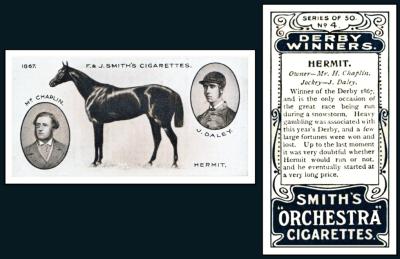
I picked this card simply because of the fact that the reverse mentions this race as being "the only occasion of the great race being run during a snowstorm".
And that turns out to be true, though the severity seems not to have been as bad as the papers reported. But we do know that on May the 22nd, 1867, Derby Day was run in a mixture of freezing winds, sleet, and heavy snow, and that the bad weather led to not only ten false starts, but by the race itself starting in earnest almost an hour later than had been intended.
As for the characters on the front,
- Mr. Chaplin - This was actually The Right Honourable The Viscount Henry Chaplin, a member of the Privy Council. Aged just twenty-one, he had inherited vast sums from his uncle, which led to him being considered one of England`s most eligible bachelors. Another on that list was Harry Hastings, his best friend, at least of the time, because they fell out, big time, over a woman. Her name was Lady Florence Paget, and though she was a little in love with both men, she had accepted our man`s proposal. It was to be the wedding of the year, until a month beforehand, when she went into Marshall and Snelgrove and exited by another door, straight into the waiting cab, and presumably arms, of Harry Hastings, for they were married that day, after which she wrote our man a letter saying they would never have been happy together. But the feud festered on; Harry Hastings was bidding on our horse Hermit when our man suddenly joined in to trump him, and at the Derby Harry Hastings put almost all his savings on Hermit losing, only to be the loser himself. This is also mentioned on our card, where it says "Heavy gambling was associated with this year`s Derby and a few large fortunes were won and lost". Harry Hastings died the following year, and his widow wrote to our man begging forgiveness (and maybe a second chance, for now she was not just a widow, she was a penniless one) but he never spoke to her again, nor answered any of the letters that she repeatedly sent.
- J Daley - John Daley was born in 1846 in Newmarket, and his father was a racehorse trainer, which is how he probably got drafted in. His major claim to fame is winning the Epsom Derby, our race on our horse, and also the Epsom Oaks, on Hippia, both in the same year, However he grew too tall and heavy and was forced to retire in 1870, after winning the Two Thousand Guineas race, for which he was actually overweight. He died twenty years later.
- Hermit was by Newminster, (the 1851 winner of the St. Leger) out of Seclusion, and he was foaled in 1864. He was bred by William Blenkiron, probably the most famous breeder of the age, and put up for auction in 1865. He was sold, for a thousand guineas, to Captain James Octavius Machell, who was, or who was in the process of becoming, racing manager for a man called Henry Chaplin. Hermit first ran in April 1866. He was thought to be an interesting prospect for the Derby but had some kind of incident in training shortly before it which led to his form being downgraded. This was his only Derby win but he did win the St. James Palace Stakes in the same year, though it was to be his last one at racing, for he suffered badly after running three times in three days at Doncaster, coming in more than once with a bleeding nose and mouth and being completely exhausted. After that, he retired to stud, where he had an even more illustrious career, and would go on to be the leading sire, and the leading broodmare sire, in Great Britain and Ireland, several times. Now the decision to send him out to stud seemed odd to me, because it is very often the case that this form of nasal bleeding, which is also taking place on the inside too, is genetic, and after searching the archives I did indeed find that both his mother and his father had been reported as suffering it, so it almost certainly popped up later in more than a few of his children. And guess what, the "incident in training" also turns out to be severe bleeding from the nose. And he lives on, though he died on the 29th of April 1890 - for his skeleton is at the Royal Veterinary College in London, and has been used to train generations of students. And it seems likely that this picture of the him comes from a painting, by Harry Hall, done in the 1870s.
The cataloguing of this set actually begins in Cartophilic World, which was the official Cartophilic Society publication between March 1943 and November/December 1964. It may have continued, but in 1965 we took the Cameric Cigarette Card Club beneath our wings, and began again with volume one, number one of "The Cartophilic Notes and News", a title which combined our “Cartophilic World”, with their “Cameric Notes and News”. That entry is right at the back of volume 3, number 33, in the edition dated for November 1945, and it reads as follows :
F. & J. SMITH (continued)
"DERBY WINNERS" - series of fifty.
Another "duplex" series consisting of pictures of Derby winners from 1864 to 1912 with photo of owner and trainer inset. Date of issue approximately July, 1913.
ADVERTISEMENTS ON CARD BACKS
- "Squaw" Thick Black Tobacco
- "Pinewood" Cigarettes
- Glasgow Mixture, Mild, Medium, and Full
- "Orchestra" Cigarettes
- Auld Brig Flake
- "Studio" Cigarettes
- "Studio" Cigarettes
- Wild Geranium Cigarettes
- "Pinewood" Cigarettes
- "Albion" Gold Flake Cigarettes
- "Albion" Gold Flake Cigarettes
- Glasgow Mixture, Mild, Medium, and Full
- "Orchestra" Cigarettes
- Goodwill Virginia
- "Kashan" Cigarettes
- "Pinewood" Cigarettes
- Sun Cured Mixture
- No. 1 Mixture
- "Squaw" Thick Black Tobacco
- "Albion" Gold Flake Cigarettes
- "Orchestra" Cigarettes
- "Pinewood" Cigarettes
- Auld Brig Flake
- "Studio" Cigarettes
- "Pinewood" Cigarettes
- "Pinewood" Cigarettes
- Sun Cured Mixture
- "Orchestra" Cigarettes
- Cut Golden Bar "Twilight" Brand
- "Albion" Gold Flake Cigarettes
- Glasgow Mixture, Mild, Medium, and Full
- Goodwill Virginia
- "Kashan" Cigarettes
- Cut Golden Bar "Twilight" Brand
- Glasgow Mixture, Mild, Medium, and Full
- "Studio" Cigarettes
- "Pinewood" Cigarettes
- Wild Geranium Cigarettes
- "Orchestra" Cigarettes
- "Kashan" Cigarettes
- Glasgow Mixture, Mild, Medium, and Full
- Glasgow Mixture, Mild, Medium, and Full
- "Studio" Cigarettes
- "Pinewood" Cigarettes
- "Pinewood" Cigarettes
- "Albion" Gold Flake Cigarettes
- No. 1 Mixture
- No. 1 Mixture
- Glasgow Mixture, Mild, Medium, and Full
- "Pinewood" Cigarettes
By the time of our original World Tobacco Issues Index it is therefore recorded as :
- DERBY WINNERS. Sm. Brown. Nd. (50). Vari-backed, 14 wordings - see C.W., page 264 ... S84-6
However, and sadly, because the chance of tracking down back issues of "The Cartophilic World" has grown ever smaller with the passing of time, the entry in our updated World Tobacco Issues Index is simply recorded as :
- DERBY WINNERS. Sm. Brown. Nd. (50). Vari-backed, 14 wordings ... S548-150
Friday, 3rd July 2026
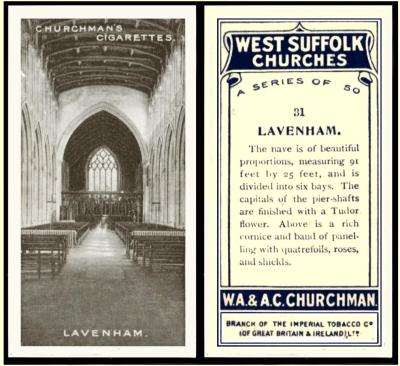
This is one of only three vertical cards in the whole set, and it is the only one to show an interior. More than that, the exterior of this church is shown too, on card 30, where it tells us that Lavenham is "An ancient town, near Sudbury. Population 2,018. The Church of St. Peter and St. Paul is a fine example of late Perpendicular, the chancel being older. It has a magnificent west tower, and a splendid east window. Undoubtedly an earlier Church stood here. A view of the interior is given on No.31"
I have not found a connection between Churchman and Lavenham, but it just seems off that this Church was singled out to get two cards. But maybe we have a Churchman specialist who does know of a link between the two.
The set is first described in our original reference book RB.10, devoted to Churchman issues. The listing reads ;
- 152. July 1919. WEST SUFFOLK CHURCHES (titled series). Size 2 11/16" x 1 7/16" or 67 x 36 m/m. Numbered 1-50. Fronts printed by letterpress, half-tone in one printing, in sepia, Backs in blue. Printed by Mardon, Son & Hall
By the time of our original World Tobacco Issues Index, it has been rather reduced, to just :
- WEST SUFFOLK CHURCHES. Sm. Sepia. Nd. (50) ... C82-90
There is something I picked up on as it is not in section 2.A, obviously, for that is for sets issued between 1903 and 1917, but it is the next section 2.B. However, this is dated as being for cards issued 1922 to 1939, and that contradicts the dating given above of July 1919. And this has not been changed in the updated World Tobacco Issues Index, where everything about the listing remains the same, save a new card code of C504-700
And there you go, we pretty much made it, with just a few lists and titles AWOL. They will go on over the weekend, and quicker with your help. The email as always is webmaster@card-world.co.uk.
Thanks for tuning in, and I hope you enjoyed it. I`m glad that this week we were able to feature a few more cigarette cards, which have been a bit absent of late, simply because they take longer to describe, and I don`t always have that sort of time.
But its getting late, so time to turn in, perchance to dream.......