
Hi everyone, and here we are at the end of another week, for most of which mum has been in hospital, so lots of phone calls, and sortings out, and worrying...
Website News :
I have still had a bit of spare time to work on indexing the back issues and most of them were easy, by which I mean I didn`t go to put any cards in the index and find them already there with a later date. So I got through the 10th of February 2023, the 18th of February 2023, the 25th of February 2023, the 4th of March 2023, the 11th of March 2023 and the 18th of March 2023 - another forty-two cards. By next week I really hope to be entering 2022, but that really depends on other calls on my time. However as I see the end approaching I am definitely speeding up and cracking on...
This Week`s Events...
Its going to be a bit cloudier this week, so its a good time to go exploring. And there are quite a lot of branch and club events this week, namely :
Saturday the 18th of July -
-
East Anglia - from 8.30 a.m. to 3.30 p.m., with auction at 11 a.m., at Roydon Village Hall, High Road, Roydon, Diss, Norfolk IP22 5RB. East Anglia club members get in free, visitors pay £3 admission fee. But it`s a great day out, and a very friendly group.
Monday the 20th of July -
-
London - from 5 p.m, with auction, of approximately 100 lots, starting at 6 p.m - that`s held upstairs at The Carpenters Arms” 12, Seymour Place, Marble Arch, Central London W1E 7NE. And this one is free entry to all collectors, so if you work in London why not go and have a look round on your way back home
Thursday the 23rd of July -
-
Nottingham & East Midlands - from 7.30 until 9.30 p.m. at West Bridgford Social Club, Rectory Road, West Bridgford NG2 6BG.
Sunday the 26th of July - two events
-
Hants & Dorset - from 12.30 p.m. until 4.30 p.m. at Fryers Field Pavilion, Bond Avenue, West Moors, Ferndown, Dorset BH22 OLJ. This is a great one for general collectors as it offers all manner of ephemera - cigarette cards, trade cards, football cards, stickers, postcards, and often other related memorabilia, dating from the 1900s (and sometimes earlier) right up to today. Refreshments are also available. And its free entry for all collectors
-
Lea Valley - from 9 a.m. until 2.00 p.m., with an auction at 1 p.m. at The Village Hall, North Weald High Street, CM16 6DH. Three or four dealers ateend and there is lots of convivial chatting and swopping. Admission here is £2 per person
And so without any more of my waffling, let`s have a look at what we found for you this week...
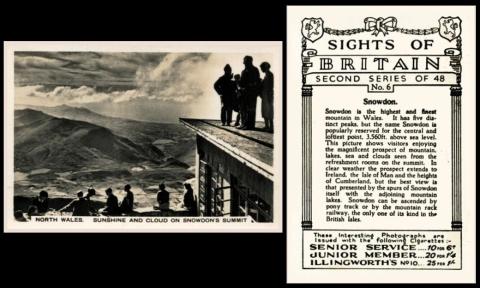
PATTRIEOUEX [tobacco : UK - Manchester] "Sights of Britain" - second series (1936) 6/48 - P246-735.2 : P18-75.2.
Let us get this newsletter up and running with the Ras Yr Wyddfa, or the Snowdon Race, first held fifty years ago tomorrow, and forty years after this card was issued, on the 19th of July 1976.
The course is but ten miles long, but it is literally uphill all the way, right to the top, when you are greeted with the vista on our card.
It all began with an idea, as great things often do, a race held in conjunction with the annual Llanberis Carnival. The organiser never expected eighty six people to enter, from right across the country, and right across Great Britain - nor for the winning time to be just over an hour and twelve minutes - and definitely not for television to get involved and ask to screen it, which they have done every year since 1986.
We featured Snowdon before, but only in conjunction with the railway. And first we will deal with "Yr Wyddfa", because that is what the Welsh call Snowdon. It`s the highest mountain in Wales, and the highest in Britain below that point. In fact the only higher mountains are in the Scottish Highlands. As a quick comparison, Snowdon is 3560 feet above sea level and Ben Nevis is 4413 feet.
Its height used to make it very peaceful, but nowadays it is seen as a bit of a challenge for lots of mountaineers, and that runs the risk of ruining its fragile eco system, the reason why was designated a National Nature Reserve in 1951. However its whole existence is due to ruin, for it was once a volcanic hot bed, and then covered by glaciers.
And its popularity/downfall may be due to the fact that Sir Edmund Hillary trained there before going on to climb Mount Everest, which is also becoming a target for the many.
Our set is one of those which were issued through "Senior Service", and they form the bulk of section three of the Pattreiouex listing in our original World Tobacco Issues Index, the "Photographic Series, issued 1930-39". In fact there were three sets of "Sights of Britain", described as :
- SIGHTS OF BRITAIN. Md. "Senior Service, Junior Member, Illingworth" brand issues ... P18-75
1. "Series of 48"
2. "Second Series of 48" Two printings.
3. "Third Series of 48"
This is identical in our updated version, but there is, of course, an updated card code of P246-735 1., 2., and 3
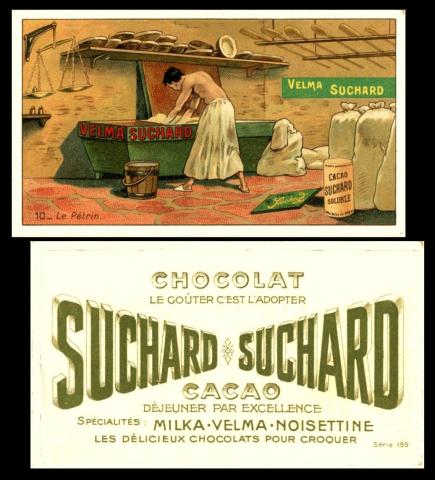
Chocolat SUCHARD [trade : chocolate : O/S - Switzerland] "La Plus Belle Histoire du Pain" / the most beautiful history of bread - S.189 (1956) 10/12
Today we celebrate the birth of Judy Woodford Reed, though we are not sure when she was born. All we really know about her is that in 1870 she appears on a census for the first time, which some believe was shortly after she became freed from slavery, and that, on September the 23rd, 1884, she may have become the first African American woman to be given an American patent, number 305,474, for an improved dough kneader and roller, the improvement relating to the rollers, in order that the dough mixed more evenly.
That census recorded her as a forty-four year old seamstress with a husband and five children. Her husband died some time before 1885, and she moved, along with her children, to Washington.
There are a couple of disputes over whether or not she was the first African American patent holder. One of them is because that patent was signed with a cross, denoting that she could not read or write, and if she could not do that it is pondered whether she did the inventing, but we all know that for inventing you do not have to be able to read and write, just have the curiosity to work things out. The other is that the patent office at that time did not collect any statistics about the background of the inventor, so there may well have been other African American women who invented things from scratch, or adapted previous inventions, and in that case we will never know who they were.
We do know that until 1863 it was actually against the law to teach slaves to read and write, or for slaves to know how to do those things. And both their teachers and the literate slaves could be punished by death.
We do know that Judy Reed opened a door, and that on July the 14th, 1885, another African American woman was granted a patent, and that she was able to sign her name thereto. Her name was Sarah E. Goode and she lived in Chicago. And her invention was a bed that folded into a cabinet, keeping out of the way until it was needed for sleeping on.
I thought that someone, somewhere, must have immortalised Judy Reed on a card, but I had no luck. However, this set shows bread being made, and our card shows it being kneaded by hand, by a person who would have much appreciated her invention..
The title of the set sounds a bit over described, but it actually goes in an album with the same "La Plus Belle Histoire" prefix to form a collection called "La Plus Belle Histoire des Temps au Berceau de la Creation", or the most beautiful history of time at the cradle of creation .
The cards that make up our set end at a baker`s shop where the finished loaves are retailed, but the journey takes us through :
- La Semence
- Le Roulage apres les gelees
- La Moisso
- La Moissonneuse - lieuse
- Le Battage au Fleau
- Le Moulin a Vent
- Le Moulin a Eau
- Le Petrin
- Le Four
- La Boulangerie
I can`t find cards 1 or 7, so if you have those do let us know.
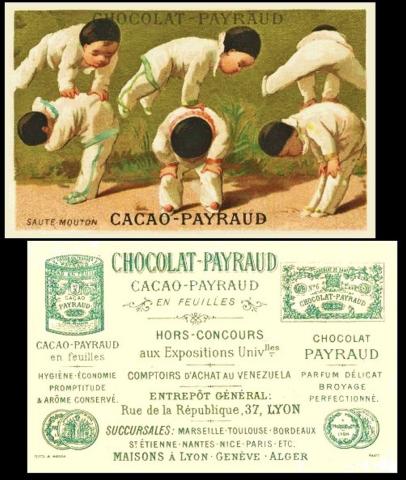
Cacao PAYRAUD [trade : confectionery : O/S - France] "Pierrots" (1900?) Un/??
Today is #WorldJumpDay, and it commemorates an idea that never actually worked but may have, and still might.
That idea was that if sixty million people in the Western Hemisphere could all jump in the air, and land at the very same time, the orbit of the earth may change just enough to extend daylight hours, and even out the climate, right across the world.
Sadly it never had the desired effect, though some people still believe that either not enough people took part, or that the landing was not controlled enough to get the desired result.
Jumping starts off as a fun activity for children, and continues into school, then, after leaving school, unless you are an athlete, it is all forgotten. But why? For it takes no special equipment and can be done at any time, even in your house, and it can be as high as just a hop. More than that though, it makes you happy, for few can be glum when they are leaping about like a child.
There is something else about a simple jumping exercise though - it`s healthy. They make you work for it, increasing your breathing and heart rate, making you and your muscles stronger, and burning off calories and fat exceedingly well. And, strangely, research has found that the simple act of jumping less than ten times a day can increase bone density and even prevent osteoporosis.
This card shows pierrots, getting off to a good start, and all leaping together, or at least half of them. I have a suspicion that this card was also issued by Liebig, but I could not find it in time.
You will find a little biography of Chocolat Payraud with our Card of the Day for the 10th of June, 2024, but with a very different, die cut card.
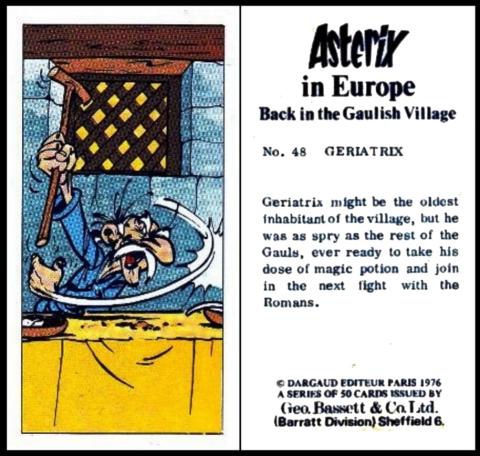
Geo. BASSETT & Co. Ltd [trade : confectionery ; UK - Sheffield] "Asterix in Europe" (1977) 48/50 - BAS-13
A centenary now, of the birth of a man called Simon Jacques Eugene Berryer, better known as "Sim", He was born n France, high in the mountains of the Pyrenees, and at the time of his birth his father was working for a man called Abel Gance, currently directing his epic masterpiece "Napoleon".
Our man`s talent was in comedy, and he won his first award for comedy in 1939, aged thirteen, simply by pulling funny faces. Not long after that he was running a comedy group with the title of "Sim-Art". In 1941 his parents heard about a cinema coming on to the market at the town of Ancenis, and they agreed to take it on, moving there full time in 1942. Their son stayed at school but also became the cinema projectionist out of hours.
Five years later, because the cinema was doing very well, his father decided to start a film production company. To do that they sold the cinema, and most of the other things they owned, but the company did not go well and all was lost. They just had about enough money to return to Ancenis to live, though they most likely rented, but they never managed to get their cinema back.
By that time our man, their son, was married, and working at a projectionist in Rennes, the town where the film production company had been based. The cinema that he worked at also had live entertainment, and of high quality, including Edith Piaf and Maurice Chevalier. And he teamed up with a fellow theatre enthusiast to form an act called Etty et Balta, an act about two clowns.
That does not seem to have lasted very long because by the mid 1950s he was back as a solo artist, perfomring comedy monologues and appearing as a female impersonator. We know that he must have been very good because he appeared at Madam Arthur in Montmartre.
The 1960s saw him discovering television, a whole new audience, at first behind the scenes but then in front of the cameras. He was very successful on television and appeared on many talk shows, but in 1999 he took on what would become his most loved role of all, Geriatrix, (or in French Ageconomix), the almost centenarian oldest inhabitant of Village des Irreductibles Gaulois. His first appearance was in the 1999 film "Asterix and Obelisk Take on Caesar", which, at the time of release, was the most expensive film ever made in France, but luckily it was a huge box office hit and there was a sequel, "Asterix and Obelisk : Mission Cleopatra" released in 2002. However our man was not in that, his next appearance came in the 2008 follow up, and third movie, "Asterix at the Olympic Games".
That was his final film appearance, as he died on the 6th of September, 2009, aged eighty-three.
This set first appears in our original British Trade Index part three, as :
- Asterix in Europe. Nd (50), ... BAS-13
It is not in our updated British Trade Index, because that stops at 1970, so its next appearance comes in our latest volume, the British Trade Index for cards issued between 1971 and the year 2000. That records it as :
- Asterix in Europe. Cards with album. Issued 1977. Size (A). 65 x35. Nd. (50), ... BAS-190
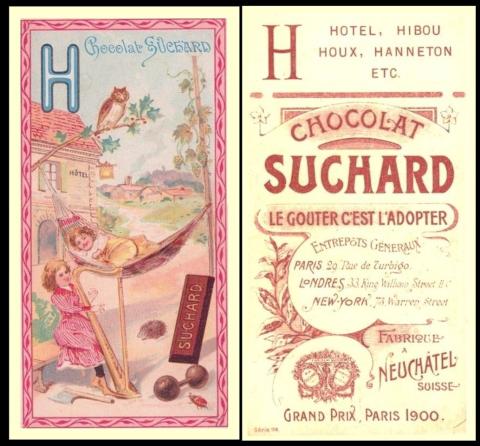
Chocolat SUCHARD [trade : chocolate : O/S - Switzerland] "Lettres du Alphabet" / letters of the alphabet - Serie 114 (114 1900?) 8/26
Today we celebrate the fact that every July the 22nd is National Hammock Day. Though I have been unable to find out why.
There are said to be two types of hammock, the one that soldiers and sailors sleep in, and the type in which ladies artfully pose - and that after wars they find themselves in surplus and are sold off as ornaments for the garden.
The story of the hammock is much longer than that, and more tortuous. Its name comes from Spanish, "hamaca", but they took that from "hamaka", a universal term used across the Caribbean, the Antilles. the Leeward Islands, British Guiana, Venuzuela, South America and Surinam. That range almost certainly leads to the idea that the items were spotted during the time of the conquistadors, and the name subtly changed. We also think that the explorers realised that they were less cumbersome to carry than beds or sleeping bags, and this spread to the forces, especially on board ships, where space was little and the decks were needed to be kept free for most of the day but this was not so important at night.
As for the story that the hammock was invented by Greek politican Alcibiades, we are not so sure. We do have records of him enjoying having a bed that hung from ropes, but nowhere does it say that it was shaped like a sling or that it went lower when his weight was added. And it is never mentioned that he fell out of it, which is what usually happens to me.

Cigarettenfabrik JOSETTI [tobacco : O/S - Berlin Germany] "Josetti Filmbilder" - series 3 (1935) 631/816 - J915-400.3 : J34-9.3 : X24/20-2
On this day, in 1884, Theodor Friedrich Emil Janenz was born in Rorschach, Switzerland. And his big claim to fame is that, under his film name, of Emil Jannings, he was the first ever winner of the Academy Award for Best Actor, at a time when it was given for a body of work and not a single performance, just two of those films being "The Last Command" and "The Way of All Flesh". And he remains the only German winner of the Best Actor statue.
Though there is a legend that he was not actually the winner of the vote, that being the canine actor Rin Tin Tin, but the statue was awarded to Emil Jannings, the runner up, so nobody could poke fun at the seriousness of the ceremony.
He did well in the silent era, but in his first talking picture, released in 1930, he was seriously overshadowed by his co-star. That film was "Der Blaue Engel", or the blue angel, and his co-star was Marlene Dietrich.
He stayed on in Germany and was offered a chance to keep making pictures, but on a propaganda basis, and he accepted, making a range of patriotic films for Germany that would ultimately lead him to be labelled a sympathiser and collaborator. He was allowed to move to America after the end of the war, but the stain of his last decade went with him and he never worked as an actor again.
He eventually went back to Europe and settled in Austria, renouncing his American citizenship and becoming a Austrian citizen in 1947. But he died just three years later, in 1950, aged just sixty-five, leaving behind three ex-wives, a daughter, a widow, and his Academy Award, which is now at the Berlin Filmmuseum
This set is the scarcer black and white version, the one that usually appears at auctions being the coloured version with the gold borders, called "Bunten Filmbilder". It actually turns out to be the third series, which explains the numbering. It appears in our original World Tobacco Issues Index as :
- JOSETTI FILMBILDER (Josetti`s Film Pictures). Sm. 60 x 40. See X24/20-2. ... J34-9
1. Nd. 1/272. (272). Front in
(a) black and white
(b) mauve tinted
2. Nd. 273/544 (272). Front in black and white. Back
(a) quoting one album only
(b) quoting Albums 1 and 2
3. Nd. 545/816 (272). Front in black and white.
The reference to X24/20-2 takes us to the reverse of the book, where it is revealed that this was part of a much larger group with several issuers. That entry reads as follows :
- X24/20. FILM STAR SERIES - JASMATZI / JOSETTI / SALEM. Two groups of series, all small size, 60 x 40 m/m. Semi glossy front in black and white, except printing 2-2 (b)
1. Photographic Series : -
1. Set 1. Nd. 1-240
A. Jasmatzi. Back per No.1 at Fig. X24/20, titled "Ramses-Filmfotos" at top, inscribed at base "Ramses-Film-Serie 1". Numerals
(a) plain
(b) preceded by "Nr."
2. Set 3. Nd. 241-480
A. Jasmatzi. Back per No.2 at Fig. X24/20, titled "Ramses-Filmfotos" at top, inscribed at base "Serie 3". (Nr.241-480)
B. Salem. Back per No.3 at Fig. X24/20, titled "Salem Filmbilder" at top, inscribed at base "Serie Nr. III". Text refers to Nos..241-480
2. Letterpress Series : -
1. Set 1. Nd. 1-272. Back per No.4 at Fig. X24/20.
A. Josetti.
(a) black and white
(b) mauve tinted
2. Set 2. Nd. 273-544. Back in style of No.4 at Fig. X24/20.
A. Josetti. Two backs
(a) text refers to Josetti Filmalben
(b) text refers to Film Album Nr. 1 and Nr. 2
3. Set 3. Nd. 545-816
A. Josetti. Back per No.4 at Fig. X24/20, titled "Josetti Filmbilder"
B. Jasmatzi. Back per No.6 at Fig. X24/20, titled "Ramses Filmbilder Serie A"
I`ll add the picture in asap.
Our updated World Tobacco Issues Index slightly alters this, to :
- JOSETTI FILMBILDER (Josetti`s Film Pictures). Sm. 60 x 40. ... J915-400
1. Nd. 1/272. (272). Front in
(a) black and white
(b) mauve tinted
There are some differences of subject and detail between the two printings.
2. Nd. 273/544 (272). Front in black and white. Back
(a) quoting one album only
(b) quoting albums 1 and 2
3. Nd. 545/816 (272). Front in black and white.
There is no longer a cross reference to the other issuers.
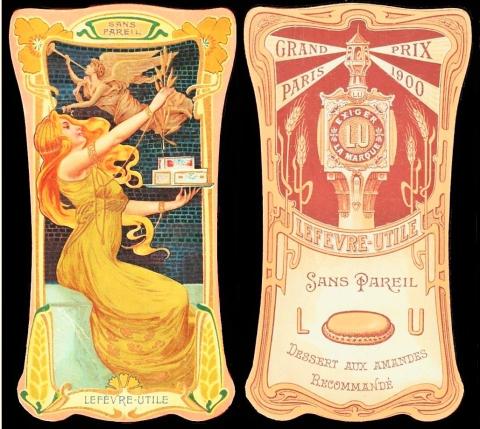
LEFEVRE_Utile [trade : biscuits : O/S - France] - shaped Art Nouveau advertising card (1900) 1/??
Today we celebrate an artist who was responsible for some of the most beautiful cards in the world, and his name was Alfons Maria Mucha. Today would have been his birthday too, for he was born on this day in 1860, at a place called Ivancice, in Moravia, which was once part of the Austrian Empire. Today it still exists, but as part of the Czach Republic.
His family had five other children, on not much income, his father was a court usher, which simply was an administrator at the local court, and his mother seems to have stayed at home with her children, though she was the daughter of a flour miller, and perhaps she still helped out there, if she had time. All the children`s names began with "A", like his mother`s, which was Amalie.
It does not seem like anyone else in the family were at all artistic but young Alfons was always drawing and his talent was soon noticed by a local merchant, who presented him with some paper. He was also talented at music, and he would have liked to have studied it professionally but there was not the money. However his music teacher came to his rescue and sent him to join the choir of St. Thomas` Abbey, formerly the home of none other than Gregor Mendel, the geneticist. Unfortunately our man arrived too late, and another boy had just arrived to fill the space. That boy was Leos Janacek, and he would go on to become a world famous musician and teacher - and he may not have done if our man had got there earlier. Instead a place was found at the Cathedral of St. Peter and Paul, which was a more religious atmosphere, and almost turned our man to the church.
We are really not sure how, but fate drove him to be asked to design some posters for a patriotic rally, and he suddenly realised he had found his true calling. It was not without setbacks, all he could find was a job designing theatre scenery, and when he applied to the Academy of Fine Arts in Prague they not only rejected him but pretty much told him that art was not for him.
He returned, dejectedly, to painting scenery, and that led to an offer to go to Vienna. Whilst there he became impressed with the work of an Austrian artist called Hans Makart, historical paintings, lavished with gold. And he also discovered photography. But in 1881 there was a fire at one of the largest theatres that he worked for and he had to leave Vienna in search of work. That took him back to Moravia, and to employment by a tombstone maker, who taught him how to carve the letters into the stones, and though it was not where he wanted to be he soon realised that by copying the shading and incising actions of the chisels he could make his art even sharper and cleaner. Whist developing that he got a commission, a local nobleman, with a castle, that needed brightening up with some historical murals. That gave him the chance to combine his memories of the grand works of Hans Makart and his new outlining techniques. Sadly these works were also destroyed by fire in 1948, all we have are his trial pieces.
The nobleman took our man to Munich, and paid all his living expenses and tuition fees for the Munich Academy of Fine Arts. During that time he gained another commission, for a Roman Catholic Church in America. He did think of travelling out there, but instead he moved to Paris, in 1887. Here he found employment as an artist for several magazines, which led to further commissions from people who may never have seen his work. One of these was a new magazine, "Art et Decoration" which was the first magazine to feature what would become known as Art Nouveau (or new art). It also led to him designing a poster for Sarah Bernhardt, truly larger than life, with an arch framing her head, a feature which would appear throughout the rest of his artistic endeavours. He also went on to design many posters, programmes, and even costumes and adornments for Sarah Bernhard, as well as set designs, at which he had lots of former experience. Best of all, for us, he designed posters for many products, including Societe Job and other tobacco related manufacturers, plus drinks and foods, including Lefevre Utile, whose card we feature today.
In 1906 he was married, in Prague, and the two were frequent visitors to America, in fact their first child was born there. Here he painted, but also taught, and he had a studio in New York, near Central Park. But he also had a huge commission for back home, and returned to Prague in 1910 to paint murals for the Mayor.
For almost the rest of his life he was obsessed by a series of paintings telling the story of tje Slav people. He worked on them all through the First World War and they were shown from 1919 until 1928 when they were taken down, rolled, and put into storage. Shortly after that things started to change in Europe and war loomed. He started work on another set of paintings, but in 1939 he was arrested and interrogated and he never recovered. He died, of pmeumonia, on the fourteenth of July, 1939.
This week's Cards of the Day...
made a return journey to South Asia, to celebrate #SouthAsianHeritageMonth - simply because last time we featured the event it was very flag based, and did not give any flavour of the wonderful, and colourful people who inhabit those zones. So this time we have been looking at those, and at their heritage - for it is not all about a place, it is more about the stories, cultures, and contributions of people whose roots began in one of the eight countries which form South Asia - Afghanistan, Bangladesh, Bhutan, India, the Maldives, Nepal, Pakistan, and Sri Lanka.
Saturday, 11th July 2026
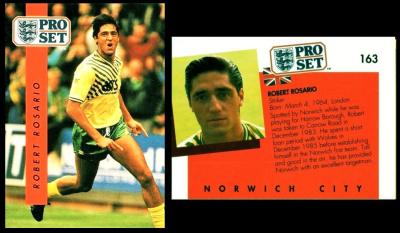
Our first clue card gave us Robert Rosario, the first British Asian to play in the Premier League, when his team of the time, Coventry City, played Middlesborough, on the 15th of August 1992. Strangely Middlesborough also have the distinction of being the opposing side when Frank Soo, the first Chinese footballer in the English Football League, ran out on to the field for Stoke City, in November 1933.
Robert Rosario was definitely born on the 4th of March, 1966, but seems to have been born in several locations, depending on which search engine is your favourite, as I have found his birthplace cited as Harrow, Hillingdon, Hammersmith, and London. There is also constant confusion as to his first youth team, some say this was Harrow Borough, and then he signed for Hillingdon Borough, and others have those teams in reverse.
His father was an Anglo-Indian, born in Calcutta, and his mother was German. They came to England before he was born.
His first senior side was Norwich City, which he joined in 1983. They loaned him out to Wolverhampton Wanderers in 1985, in which year he also became an England Under 19, but Norwich took him back shortly after and he stayed there even after he became part of the England Under 21 Squad in 1987.
It was not until 1991 that he was transferred to Coventry City, and his first card there is the 1991-92 Pro Set series. That card tells us that Coventry City paid £600,000 for him. He also appears on Panini`s "Football 93" in a Coventry City strip, but his next card is not until Merlin`s "Premier League 95", and he is suddenly in a Nottingham Forest shirt. He had actually moved there in 1993, simply because Coventry City had a run of bad luck and needed the money that selling him would bring.
He did think about retiring at that point, and maybe with hindsight he wished he had, because he was plagued with injury at Nottingham Forest. Instead of that he agreed to be loaned, right across the world, to America, to play for Greensboro Dynamo. It was expected that he would return to our shores but he did not, he signed for Carolina Dynamo in 1997, Charleston Battery in 1998, and returned to Carolina Dynamo in 1999. He retired whilst he was there, in the year 2000, but the following year he came back to manage them.
Contrary to popular belief, this is not his "Rookie" card, that honour goes to the Panini`s "Football 85", who quote his birthplace as Hammersmith, and his first club as Hillingdon Borough.
The packets for this set, which sold for 30p in the United Kingdom and 35p in the Republic of Ireland, bill them as "Collector Cards", though they do say that they are "The Official Card of the Football Association".
Sunday, 12th July 2026
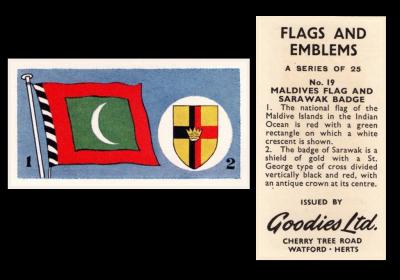
So I have decided to keep our second clue, because we never had a flag of the Maldives last time round, or , to be honest, even mentioned that country at all. And it also gave us a little known variant of a familiar set, by Goodies of Watford. But, most importantly, this is a Card of the Day, and its the black backed version which is the first Goodies set to ever be listed in any of our reference books - and so it can perfectly form the home page for all the Goodies issues.
For some reason this card has the flag of the Maldives but also the badge of Sarawak, which is not South Asian at all, and they share no land border. In fact there are thousands of miles between them, and an ocean. The only thing they do have in common is that technically they both fall inside "Asia".
This Flag of the Republic of Maldives has a lot of meaning. The red ;rectangle is for the blood of the nation's heroes, who are, and have been, willing to sacrifice their last drip of blood to defend their nation. The green rectangle is for the peace that they hope these selfless acts will maintain. And the white crescent moon is for Islam, the state religion.
It has not always been this flag though, at first it was simply red, and then a black and white striped section was added to the section nearest the flagpole. The crescent moon arrived sometime between 1926 and 1932 on instructions from Abdul Majeed, the current Prime Minister. In 1953, the Maldives gained the status of becoming a Republic, and the flag changed, resulting in the national flag being lost and the crescent reversed. Strangely when the Maldives were restored to a Sultanate in 1954 the national flag did not reappear, but a Sultanate flag was constructed, with a large five pointed star within the internal curvature of the crescent moon. Today that remains, as the Presidential flag.
When the Maldives gained independence from the United Kingdom in 1965, the black and white hoist was removed, on both the state flag and the Sultanate flag, giving the flags their modern form.
Goodies puzzled me, because there seemed no trace of them at all in Watford, even though these cards are addressed for "Cherry Tree Road" - however now I have got the reference books out I see they are listed in our original British Trade Index part two as also being in Bristol and that was more profitable, giving me an address of "Greenbank, Bristol 5".
The full listing in our original British Trade Index part two for Goodies is :
GOODIES Ltd., Watford & Bristol
Cards issued 1961-67.
- FLAGS & EMBLEMS. Sm. 68 x 36. Nd. (25).See D.282. ... GOT-1
Back in (a) black
(b) red.
- THE MONKEES. Sm. 66 x 35. Black , Nd. ...GOT-2
1. "First Series of 25". Black
2. "Second Series of 25", Nd. 1/25. Coloured.
- PREHISTORIC ANIMALS . Sm. 66 x 35. Nd. 25 ...GOT-3
- WIDE WORLD - PEOPLE OF OTHER LANDS. Sm. 65 x 33. Nd. (25) ...GOT-4
Now the only missing info from this is the fact that our set has siblings, as denoted by the reference "See D.282". That takes us to the back of the same book, where it is revealed that the set can be found in four formats,, namely :
D.282. FLAGS AND EMBLEMS. Nd. (25)
- Amaran Tea - Set AME-4
- Goodies Ltd. - Set GOT-1
- A.S. Prior - Set PTO-4
- Anonymous, Letterpress back
These all seem identical to our listing save the one from A.S. Prior, [issued with fish and chips, which sounds rather messy], for their set is listed as being 68 x 35 m/m not 68 x 36 m/m.
Now despite the fact that the listing in our British Trade Index part one says "Cards issued 1961-67.", this is only because that book was released in 1969. Our British Trade Index, part three, brings the story up to date, or at least to 1986, by listing quite a quantity of other sets, namely :
GOODIES Ltd. - GOT in II.
- Doctor Who and the Daleks. 68 x 36. Nd. (50). Issued 1969 .....GOT-6
- Indian Tribes. 68 x 36. Nd. (25). Issued 1969 .....GOT-7
- Mini Monsters. 68 x 36. Nd. (25). Issued 1970 .....GOT-8
- Olympics. 68 x 36. Nd. (24). Issued 1972 .....GOT-9
- Pirates. 68 x 36. Nd. (25). Issued 1970 .....GOT-10
- Robbers & Thieves. 68 x 36. Nd. (25). Issued 1971 .....GOT-11
- Vanishing Animals. 68 x 36. Nd. (25). Issued 1971 .....GOT-12
- Weapons through the Ages. 68 x 36. Nd. (25). Issued 1970 .....GOT-13
- Wicked Monarchs. 68 x 36. Nd. (25). Issued 1973 .....GOT-14
- Wild LIfe. 68 x 36. Nd. (25). Issued 1969 .....GOT-15
- World Cup. 68 x 36. Nd. (25). Issued 1974 .....GOT-16
That was the last entry in the four original British Trade Indexes for Goodies, save in the fourth book where their issues are cross referenced as being included in books two and three.
Our next British Trade Index was an updated volume which collated all the information from those four original books, and so the sets are in a slightly different order. It also provides all the dates of issue, and therefore reads as :
GOODIES Ltd., Watford & Bristol
Confectionery, Sweet Cigarettes. Issued 1961-71. Later issues in post 1970 volume.
- DOCTOR WHO AND THE DALEKS. 1969. 68 x 36. Nd. (50). .....GOO-150
- FLAGS & EMBLEMS. 1963. 68 x 36. Nd. (25).See HX-17. ... GOO-160
Back in (a) black
(b) red.
- INDIAN TRIBES.1969. 68 x 36. Nd. (25).....GOO-170
- MINI MONSTERS. 1970. 68 x 36. Nd. (25). Cards issued in packs of Sweet Cigarettes. Set of 4 packs, displaying different insect "monsters" .....GOO-190
- THE MONKEES. 1967/68. 66 x 35. Black , Nd. ...GOO-200
1. "First Series of 25". Black
2. "Second Series of 25", Nd. 1/25. Coloured.
- OLYMPICS. 1971. 68 x 36. Nd. (24)......GOO-210
- PIRATES. 1970. 68 x 36. Nd. (25). Issued 1970 .....GOO-210
- PREHISTORIC ANIMALS . 1968.. 66 x 35. Nd. 25 ...GOO~-220
- ROBBERS & THIEVES. 1971. 68 x 36. Nd. (25). ....GOO-230
- VANISHING ANIMALS. 1971. 68 x 36. Nd. (25). .....GOO-240
- WEAPONS THROUGH THE AGES. 1970.. 68 x 36. Nd. (25)......GOO-250
- WIDE WORLD - PEOPLE OF OTHER LANDS. 1968. Sm. 65 x 33. Nd. (25) ...GOO-260
- WILD LIFE. 1969. 68 x 36. Nd. (25). .....GOO-270
We also know that the "Pirates" set had different boxes - showing, respectively, Blackbeard, Barbarossa, Koxinga, and Mary Read.
Two sets are missing, from this list, "Wicked Monarchs" and "World Cup", but we will deal with those in a minute, because the reference "See HX-17" takes us to a separate book, the handbook, where the information is more or less the same as D.282 :
HX-17. FLAGS AND EMBLEMS. Nd. (25) Issued by :
- Amaran Tea - See AMB-100
- Anonymous, Titled text back - See ZAF-120
- Goodies Ltd. - See GOO-160
- A.S. Prior - See PRI-540
Now back to the two missing sets, for they are part of the " Later issues in post 1970 volume". In fact six sets are there, and the full listing reads :
GOODIES Ltd., Watford & Bristol (Sweet Cigarettes)
- OLYMPICS. Issued 1971. Size (A). 65 x 33. Nd. (25)......GOO-200
- ROBBERS & THIEVES. Issued 1971. Size (A). 65 x 33. Nd. (25). ....GOO-230
- VANISHING ANIMALS. Album issued. Issued 1971. Size (A). 65 x 33. Nd. (25). .....GOO-240
- WICKED MONARCHS. Album issued. Issued 1973. Size (A). 65 x 33. Nd. (25). .....GOO-255
- WIDE WORLD - PEOPLE OF OTHER LANDS. Reissued in 1972 on white board.
Issued 1972. Size (A). 65 x 33. Nd. (25). .....GOO-260
- WORLD CUP `74. Issued 1974. Size (A). 68 x 36 Nd. (25). .....GOO-280
Monday, 13th July 2026
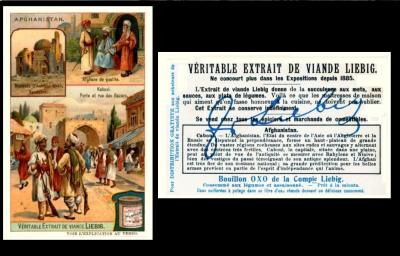
And lastly we gave you this card showing the inhabitants of Afghanistan, and two of their important cities, Kandahar and Kabul. There have been people in that region since Paleolithic times, and its location led to it becoming a major centre for all manner of trade, which is probably why the market place at Kabul is shown as one of the scenes - the others being the Mosque of Achmad Scia at Kandahar and a trio of tribesmen in the mountains.
Many people have tried to conquer the area, even before Alexander the Great, and it remains an area which is frequently fought over, possibly why the Afghan people are regarded as such tough opponents.
The reason behind the issuing of this set seems to be related to an Anglo-Russian treaty, which was signed on August the 31st, 1907. That laid down that the British government agreed not to attempt to change the current political position within Afghanistan, nor to take sides in the shaurie between Afghanistan and Russia, nor to attempt to occupy any part of Afghanistan themselves, as laid down in the Treaty of Kabul, signed in March of that year.
This set was issued in the French, German and Italian language, and comprises the following cards :
Important Afghans / Kabul. Bazaar Gate and Street / Ahmed Shah`s Mosque, Kandahar
- French - Afghans de qualite / Kaboul. Porte et rue des Bazars / Mosquee d'Achmed Shah, Kandahar
- German - Kabul-Tor v. Basarstrasse / Vornehme Afghanen
- Italian - Afghans de qualite / Mosquee d'Achmed Shah, Kandahar / Kaboul Porte et rue des Bazars
Citadel at Herat / Tomb of Shah Rukh / A gunsmith in Herat
- French - Citadelle de Herat / Tombeau du Shah Rukh / Armurier a Herat
- German - Ziladelle von Herat / Schwertschlaifer in Herat
- Italian - Citadelle de Herat / Armurier a Herat / Tombeau du Shah Rukh
In the Bolan Pass / Afghan houses
- French - Dans le defile de Bolan / Maisons Afghanes
- German - Im Bolan-Pass / Afghanische Wohnhauser
- Italian - Nel passaggio di Bolan / Case d'abibazione degli afgani
Kandahar / Mullah preaching war
- French - Kandahar / Mollah preshant la guerre
- German - Kandahar / Mullah den Krleg predigend
- Italian - Kandahar / Mollah prechant la guerre
Gate at Bala-Hissar / the Khyber Pass /
- French - Porto de Bala-Hissar / Passe de Khaiber
- German - Ter von Bala Hisser / Typee der Afghanischen Armea
- Italian - Porte de Bala-Hissar / Passe de Khaiber / Types de l'armee afghane
- French - Village de tribe nomade sur le Helmand / Chute de la riviere Kaboul
- German - Nomadendorf der Hilman / Wasserfall des Kabul
- Italian - Village de tribu nomade sur le Hilmend / Chute de la riviere Kaboul
Tuesday, 14th July 2026
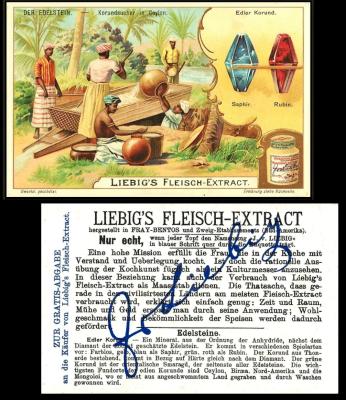
Ceylon has rather a reputation for being a good site to find jewels, and the mines there were first worked in the Stone Age. This card shows just two of the over forty types of stone that can be mined there, sapphires and rubies.
It is said that King Solomon courted the Queen of Sheba with jewels from that area, but the truth is that she courted him first, because she knew of his fame and reputation. She also went to him, at Jerusalem, and asked him lots of questions. plying him with gold, spices, and precious stones. Then he gave her the Ceylon sapphires, at which she left, and went back home. They never seem to have had a relationship, or even met again, but he was probably not too bothered as he already had seven hundred wives and three hundred concubines. However, above all, one of his wives had his heart, and that was a lady called the Shulammite woman. We don`t even know her name, but we do know that the Song of Solomon was written to describe how much they loved each other. I could say that it`s just a shame that she remains such a mystery - but sometimes romances that nobody else know about are the best of all...
It seems to me that we usually feature the French / Belgian editions of these Liebig cards, so here, for a change, we have a German one. There is also an Italian one, by the name of "Pietre Preziose", which actually translates to precious stones. It is a most attractive set, showing the stone in a kind of dissected view, still partially inside the rock, and also a larger picture of it being mined or worked on to make it into a jewel.
The cards are :
- Das Schliefen der Sterne - Smaragd
- In der Opalgruber in Ungarn - Opal
- Korundsucher - Ceylon - Edler Korund - Saphir - Rubin
- Schliefmuhle in Bohmen - Granat
- Topasfels (Schneckenstein Sachsen) - Hauptfundort der Topase - Topas
- Turkisgruben bei Mesched (Persien) - Turkis
Wednesday, 15th July 2026
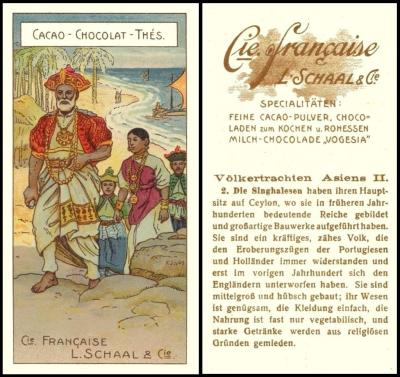
The people of the current country of Sri Lanka date back to prehistory, but though we know they were there, we know very little about them, right up until the 6th century BC when a great migration of peoples across Russia and down towards India began to occur. And it is their language that forms the basis of the languages of the Indian region, as far out as to the islands, including those of the Maldives, and what we today call Sri Lanka.
There were actually two series of these cards, namely :
"Volkertrachten Asiens I"
- Syrien
- Borneo
- Die Samerjeden
- Die Japaner
- Die Kirgisen
- Birma
"Volkertrachten Asiens I"
- Die Indier
- Die Singhalesen
- Die Turkmenen
- Die Chinesen
Thursday, 16th July 2026
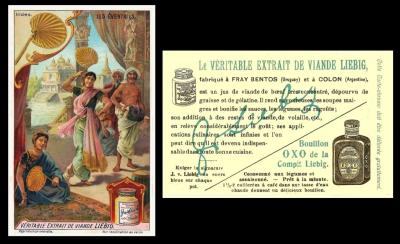
So apologies for this, I forgot to press schedule, it was there but did not show up until I noticed, which was when I was coming in to add the back to what turned out to be the non existent front.
This card teels a bit of an untruth, for India is not a single nation, it is home to over 1.4 billion people, and there are many languages spoken, over twenty, with Hindi and Bengali being the two most widely spoken tongues. Unsurprisingly, given the above fact, the largest number of people follow the Hindu religion, but many also follow Islam, because India has one of the biggest of all Muslim populations. Then there are Buddhists, Jains, Parsis, Punjabis, Sikhs, and Zoroastrians, as well as Christians. Sufice to say that a card purporting to show "India" would only show a very small proportion of its flavour.
This set shows fans, the hand held type, not the ones who follow their favourite star. It`s also available in Italian, as "I Ventagli", and its a very attractive set, with a top corner inset showing a typical fan of that country and the main picture being people of that country using the fan, though some of them are using more flourish than others.
There is an "odd one out", which is modern times, and it shows people in a box at the opera, rather than a country.
The countries are
| English | - French | - Italian |
| Ancent Egypt | - Egypte | - Egitto |
| Arabia | - Arabe | - Arabia |
| India | - Indes | - Indie |
| Japan | - Japon | - Giappone |
| Modern Times | - Moderne | - Moderno |
| Persia | - Perse | - Persia |
Friday, 17th July 2026
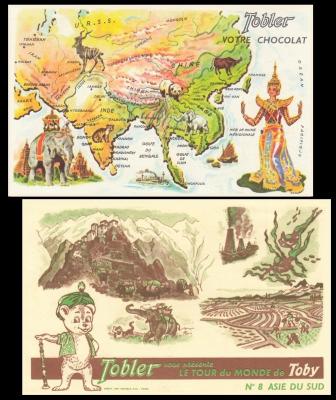
I have been unable to find the date of these cards, or any more about "Toby" the bear, but I did discover that a bear, the symbol of Bern, where Tobler comes from, can still be found amongst the mountains of the design on the Toberone box.
Toblerone’ was first made in 1908, where Theodor Tobler and his cousin Emil Baumann started making chocolate with almonds, milk, honey and nougat, and they called it “Toblerone” because that is a blend of Theodor Tobler`s surname and half of the Italian word for nougat, which is "torrone,”.
These cards are postcard size and each shows a colour map on one side with a brown and green collage of drawings of scenes from that region on the other.
The cards are :
- Europe Occidentale
- Europe Orientale
- Amerique du Nord
- Amerique du Sud
- Afrique du Nord
- Afrique du Sud
- Asie du Nord
- Asie du Sud
- Malaisie
- Australasie
We know there was also a set showing a tour of France, so maybe more are yet to find.
Well I have to say I did much better with that than I imagined, and now everything save the write up on the Josetti set is completed. And hopefully things will be calmer next week, though I still have a lot of sorting out to accomplish, and a lot of tidying and recycling must take place before mum is released from hospital, something about which I know little, she may not even be allowed to come back here at all.
Anyway thanks for sticking with me, and I hope you enjoyed your read. I`ll be back again next week, hopefully, with another ramble, and I`d love you all to come along....