
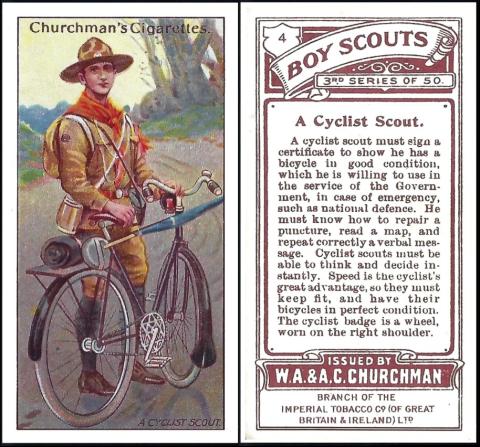
As far as the cyclist scout, the text on all the cards make much of the fact that this is a boy who stood a very good chance of becoming involved in war, if he was not already there when this version of the set was issued, in 1916. It even starts by saying that "A cyclist scout must sign a certificate to show he has a bicycle in good condition, which he is willing to use in the service of the Government, in case of emergency, such as national defence. He must know how to repair a puncture, read a map, and repeat correctly a verbal message."
Many, especially older, scouts, did go out to the front, or serve at sea (most notably John Travers Cornwell, a scout who was killed in action aged just sixteen and a half). Most of the time they were used to deliver messages to and from the trenches and HQ. However many of them, especially those of younger ages, served in the British Isles. Chief amongst these was being assigned to their local coastguard station, waiting for signs of invasion. They were trained to spot anything unusual, and then either send a message by signal or by semaphore, or cycle back to the station and deliver it in person.
It is believed that approximately eight thousand boy scouts lost their lives during the First World War whilst serving in the armed forces. These were mostly older boys, but we know that younger boy scouts were also killed on the home front, including George Harland Taylor, hit by shrapnel during the German Naval Bombardment of Scarborough, on December the 16th, 1914. We just do not have an accurate record of how many. And there seems to be no record at all of how many were killed during the Second World War, which seems to be a great scandal.
This is a set with a huge story, which all begins with our Card of the Day for the 27th of July, 2022 - which shows one of the cards from this set, but issued by, and branded for Ogden`s, and not only that, issued as the Ogden`s first series.
Reprinting this in a new format was not so different, the back being more or less identical apart from the "Churchman" and "Ogden" wording, and it was also aided by the fact that this third series had actually been the first set issued by Ogden - who would start the first set with card one, but then run them continuously, one after the other, from number one to number two hundred and fifty. Churchman actually chose to stick to one format, and each of their sets begins at card one and ends at card fifty
Though, oddly, Churchman chose to issue their third series twice, once with a brown back and once with a blue back.
The Churchman cards were issued later than the original sets by Ogden, which started in January 1911 and went through to September 1914.
They are recorded first in our original Churchman reference book RB.10, issued in 1948, with a very lengthy and detailed description that you can read at the home page for this group. that being with the Card of the Day for the 31st of December 2025. The write up for our third series, brown back printing, as showing here, is as follows
- 23. Oct. 1916. 50. BOY SCOUTS. Inscribed "3rd series of 50". Other detail as (21) -
which reads : "50. BOY SCOUTS (titled series). Size 2 11/16" x 1 7/16" or 67 x 36 m/m. Numbered 1-50. Fronts lithographed in colour. Backs in brown, with descriptions. Printed by Mardon, Son & Hall)
- but different subjects. Also issued by Ogden (Boy Scouts, 1st Series). Note : Cards 39/40 have backs transposed.
We know that the London Cigarette Card Company retailed the two versions as follows in their 1950 catalogue -
- series 3, brown back, odds from 3/6 to 10/-, but no complete sets
- series 3, blue back, odds from 12/6 to 35/-, but no complete sets
From our original Churchman reference book, they are moved to our original World Tobacco Issues Index, where the listing, much shortened, for the group is :
- BOY SCOUTS. Sm. See H.62 ... C82-14
3. "3rd Series of 50". Nd. (50). Back in (A) brown (B) blue
This is repeated, exactly, in our updated World Tobacco Issues Index, save a new card code, of C504-210