
Hoadley's Chocolates was named after a man, Abel Hoadley who was actually English. He started a company in Melbourne in 1889, to make and bottle jam, then expanded into preserved fruits, candies, and crystallised peel. We are not sure whether he owned the orchards at Burwood, and then used the products, or diversified into buying orchards. Whichever, the fruit side of the business was booming almost immediately, and by 1901 he was running four preserving factories in the area.
The problem was that fruit is seasonal. That issue was solved when he heard of a factory up for sale. This had been owned by Dillon Burrows & Co., which but ten years before had been one of the, if not the largest confectionery firm in Australia. It is not clear whether the factory came with the equipment still inside, but something made our man decide to have a go at making chocolate to fill the seasons when the fruit was still swelling, and not ready to pick.
In 1910, Abel Hoadley sold his jam business, and just three years later he started anew as Hoadley`s Chocolates. However Abel Hoadley retired that same year, stepping aside for his four sons. Oddly all of them were given, or chose to assume, admin roles, employing managers and staff to make the actual chocolates.
Their first product was "Violet Milk Chocolates", named after their mother`s favourite flower, and in the same year they introduced "Violet Crumble". The latter was the first Hoadley product to be sold interstate. However there was lots of competition in the confectionery industry at that time, and Hoadley`s started to be left behind.
Now it is often said that the thing that saved them, rather thrillingly for us, was cards - but that is incorrect, for Hoadleys had a long backstory of issuing cards, starting before the First World War, with two untitled sets. One of these uses images borrowed from Sniders and Abrahams set of "Jokes Illustrated", whilst the other actually used Sniders and Abraham`s cards of "Melbourne Buildings", covering up the name with a label. They then issued another set of "Great War Leaders", combining cards from two Sniders and Abrahams sets. And finally they produced a set all of their own, known as "Loyalty Series" though it too is untitled; this comes in two styles, Flags of the Allies and a card of King George V.
It is more likely that what saved them was the decision to re-issue cards in the early 1920s, especially the sporting ones, which showed cricket and football, as well as a set which traced the history of the Australian Nation.
We do know that by the late 1940s / early 1950s the raise in their business allowed them to introduce more ranges, including something called a Polly Waffle, a tube made of waffle wafer, filled with marshmallow and then covered in chocolate. However in 1972 Hoadley`s was bought out by Rowntree`s. It seems to have been an amicable buy, and the names were merged, with the company becoming Rowntree Hoadley Ltd. The product range was altered though, and new sweets introduced, not all of which were chocolate. Then, for some reason, they sold out to Nestle, who abandoned the Rowntree and the Hoadley, and sold off the rights to some of their best loved products, including Violet Crumble and Polly Waffle. These two were bought by Menz, a fellow confectioner, whose desire it was to bring them back into production. And that did happen in 2018/19.
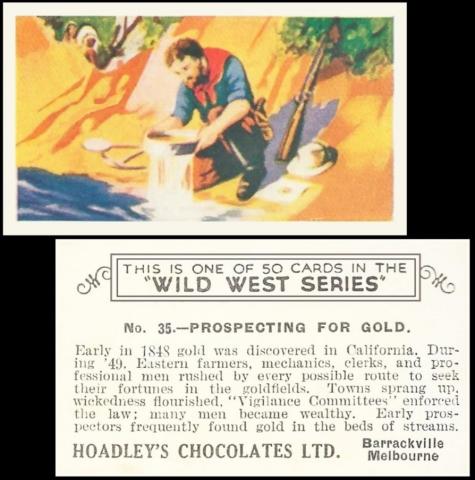
This is an unusual set, which deals with the Wild West of America - and looking at our card, of a gold panner, makes me wonder why they did not feature the Australian goldfields and their stories. It is also curious because it has the appearance of a much later trade set, and yet it was issued even before the Second World War had started.
As for the rather unusual card code, that is because this set is only listed in our original Australian and New Zealand Index, published in 1983 as RB.30.
There is a checklist of this set online, at Jeff Allender`s House of Checklists/ HWW