
Welcome to our random round-up for this week. Which I not only started earlier but finished on time. That is quite a miracle in these strange days I am currently living through.
Despite that there is an awful lot of fun below, and some most unusual cards, a mixture of early ones and more modern ones, and also some proper cigarette cards which I am guilty of not always including if I find myself strapped for time and know I am not going to get a chance to fill in the gen from the reference books, especially the huge ones, like the Wills` and the Ogden`s - though we did have quite a few lengthy descriptions in our Cards of the Day this week, which I hope you enjoyed.
Anyway, let us make a start with our newsletter, and introduce the first diary card of the week, which is :

W.D. & H.O. Wills [tobacco : UK - Bristol] "Hurlers" (1927) 11/50 - W675-186 : W62-148 : W/238 [RB.16/138]
This was the first subject I wrote down last Sunday but since then there has been a change of card and a lot of wrangling with it, and I remain not totally happy with the result.
Anyway it starts the newsletter straight off with a centenary, which is always fun, and this one is pretty frantic, sometimes, too, for today, in 1925, saw the founding, by the Gaelic Athletic Association, of the National Hurling League.
This was to be a yearly competition featuring teams from Ireland and England, and in many ways it based itself on the Football Association`s idea of seeing the teams with the most points promoted and the teams that, for whatever reason, were not doing so good, relegated to the league below. In many ways, though it seems unfair to those at the other end, this is a good system, for there is nothing quite like seeing "your team" rising up the ranks and making it into the league above.
Today this league is of five divisions, and each of those has seven teams. And it remains for players and teams from Ireland and from England. It is sponsored, right now, by Allianz, though, for some reason at least in recent years all its sponsors have come from the insurance field.
The tale of it all came about, though, is rather curious, because hurling had been played for some time, and there had also, since 1887, been an All-Ireland Championship. But that ran through the summer months only, and most years was all over by September. It was suggested that there could be a winter version, and some say this suggestion came because the counties were starting to organise friendly matches over which the governing body had neither control of nor access to any funds from.
Therefore, today, in 1925, saw the first, trial, event begin, with just seven teams, these being all Irish teams, from Cork, Dublin, Galway, Kilkenny, Laois, Limerick and Tipperary. They played each other just once, and then at the end of all that the top two teams, who were Cork and Dublin, went head to head, with Cork being the winner.
Things changed slightly in 1928, with more teams joining, making twelve in all, which resulted in the event being split into two leagues, an Eastern Division (teams from Leinster) and a South Western Division (from Munster and Galway). This meant that the final was one team from each section. And so it remained until 1934, when suddenly it was joined back together into one league again. However in 1937 it was decided to revert to more than one division again, and in 1938 there were actually three, for the number of teams had risen to thirteen, which perhaps was seen as unlucky.
The sport appears, briefly, on number 10 of W.A. & A.C. Churchman`s "Sports & Games in Many Lands", (1929), where it tells us that hurling is "the national game of Ireland, which is of great antiquity, resembles hockey, and is usually played by sides of 17 players." And best of all the front of that card shows "...an episode in the All-Ireland Hurling Final, 1927, played by Dublin and Cork".
However our set comprises fifty cards, entirely of of Hurlers, including our man, Walter "Wattie" Dunphy, born on the twelfth of March, 1896, who first played for Kilkenny in 1922, and in the same year, captained them to the All Ireland title. He also played with a team that I think has one of the most romantic names ever, Mooncoin. That turns out to be the name of the town in which he was born, as the second of ten children who would eventually grow up on the family farm. Four of these boys would also go on to become renowned hurlers, though one would give up his sport and become a priest.
The set first appears in our reference book RB.16 "The Cigarette Card Issues of W.D. & H.O. Wills Parts I, II, and III (revised) and Part IV", published in 1950, but with rather a short description, namely :
- 238. HURLERS. Fronts printed by letterpress in black and white. Backs in grey with descriptive text. Irish issue, 1927.
As for the month of issue, we have no idea, for it did not appear in the list of printing dates which was published in the Wills Works Magazine, and that means it was printed in Ireland, rather than being printed in this country and transported across for circulation.
By the time of our World Tobacco Issues Index, in 1956, the listing read :
- HURLERS. Sm. Black and white. Nd. (50), Irish Issue... W62-148
And the only difference to this entry in the updated version of this work is a new card code, of W675-186
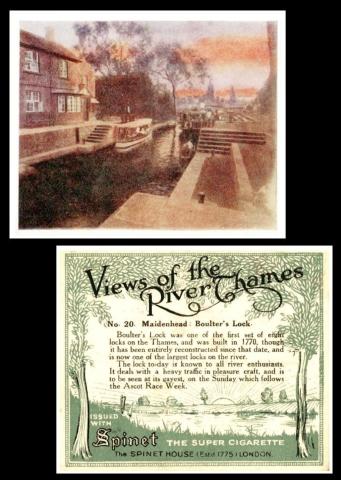
R. & J. HILL [tobacco : UK - London] "Views of The River Thames" (1924) 20/50 - H554-570.A : H46-65.
This date started out as something rather curious, a Robert Johnson eating a whole bushel of tomatoes to prove they were safe to eat. I even had a great card of a tomato, but then nobody seems to know what the event occurred, save that it was some time in 1820, somewhere between June the 28th and September 25th, or maybe one of the several other dates that are quoted in between.
Anyway, luckily for me, today is actually World River Day. Now you may wonder why I have not travelled the world and shown you a river from another continent? And there is a very good reason for that - a very simple one, too, for though we can be righteously shocked by the state of these far flung rivers when we see them on television or in the newspapers, there is not much that we can do to save them. However, we can go and join a work party at our local river, pick litter from its banks as we walk our dogs and report any fly tipping or pollution to the local council. Those are really simple things and cost you absolutely nothing. And maybe if everyone around the world did that, we could let it be known to the polluters etc that we did care and we were doing something about it - on which note the polluters are often large companies who ought to know better, and might take more notice if we stopped using their services or buying what they make.
And there is something else you may not think of - every river in the world leads to another, or to a sea. Take our river, the Thames. It is fed by no fewer than thirty eight other waterways, the largest being the Kennet in Berkshire, but others slithering in from Buckinghamshire, Gloucestershire Oxfordshire, Surrey, and Wiltshire, as well as from the suburbs of London, from where they often hide, quite hidden, beneath the city, out of sight and out of human knowledge, until they emerge into the mighty Thames. And then, eventually they all reach the Thames estuary, to begin mingling with the North Sea.
This turned out to be a much more complex set than I imagined, and it first appears in our original reference book RB.2, published in 1942, and devoted to the issues of R. & J. Hill. It is recorded as :
- 1924. 50. VIEWS OF THE RIVER THAMES (titled series). Size 2 9/16" x 1 7/16". Numbered 1-50. Fronts, printed three colour letterpress from half-tone blocks, white margins, but untitled for subjects. Backs, printed in deep green, with descriptions and "Issued with Spinet Round Cork Tipped Cigarettes, The Spinet House"..
This series can also be collected with the backs printed in yellow green. It was issued as two sets of twenty five with a period in between. Printed by Ripley & Co. London
- 1924. 50. VIEWS OF THE RIVER THAMES (titled series). Size 3 3/16" x 2 5/16" approx.. Numbered 1-50. Fronts, printed by three colour letterpress from half-tone blocks, white margins, but untitled for subjects. Backs, printed in deep green, with descriptions and "Issued with Spinet Round Cork Tipped Cigarettes, The Spinet House". Same subjects as small cards.
This series can also be collected with the backs printed in yellow green. It was issued as two sets of twenty five with a period in between. Printed by Ripley & Co. London
- 50. VIEWS OF THE RIVER THAMES (titled series). Size 3 3/16" x 2 5/16" approx.. Numbered 1-50. Fronts, subjects same as above, but printed on THICK card and grained. Backs, printed in two colours, black and blue green, with descriptions in black and "Issued with Spinet the Super Cigarette, The Spinet House". Printed by Ripley & Co. London
Oddly, in our original World Tobacco Issues Index it is listed twice, once as "THE RIVER THAMES - see under "Views of the River Thames", and once as :
- VIEWS OF THE RIVER THAMES. Nd. (50). Inscribed "The Spinet House" without name of firm. Special album issued. ... H46-65
A. Small, 64 x 37
B. Large, 81 x 66. Back in (a) green (b) green and black, different format.
This entry, and the cross reference from "THE RIVER THAMES remains the same in our updated World Tobacco Issues Index - save a new card code, of H554-570.

ARDATH Tobacco Co. Ltd. [tobacco : UK - London] "Real Photographs of Famous Landmarks" (August 1939) 7/36 - A745-690.B : A72-60.B
This was another quick change midstream - I tell you it is any wonder I finished this at all. This date started off as the first live coast to coast sporting event to be televised right across America, which was not until 1951. It was college football, Duke versus Pittsburgh, but I just could not find any card I liked the look of and had not used before.
I was saved by the fact that today in 1011 Vikings captured Canterbury and took the Archbishop prisoner. His name was Aelfheah, and we think he was born in Gloucestershire, about 953, because the first record of him comes shortly after that at a monastery in Deerhurst, from where he went to Bath. Later on, definitely before 982, when he was only twenty nine years old, he would become the Abbot at Bath, and two years later he is recorded as being the Bishop of Winchester, and we also think that he had some connection with Glastonbury. Whilst he was at Winchester he arranged for much improvement to the Cathedral, and several other churches in the area, as well as having his predecessor`s body moved to a grander tomb right inside the Cathedral.
Now it was whilst he was at Winchester that he first met the Vikings, specifically a man who we call Olaf Tryggyason, who would later become the King of Norway, as Olaf 1. Aelfheah wanted to sit down and talk to the Vikings, and they seem to have discussed Christianity, indeed it is said that Olaf converted to that faith, and that he also agreed never to raid or to fight with Britain again.
In 1006, Aelfheah was made Archbishop of Canterbury. He agreed to this on one rather odd condition, and that was that he needed to be able to take the head of St. Swithun, former Bishop of Winchester with him. Now Swithun had died in 862, so I am not going to swell long on the state of him or of his head, especially as he had been buried in a simple grave outside in the churchyard, and he had also been dug up, twice, in 971 and moved inside, and then elsewhere in the old Minster - and we know that the second time he was dug up his head was removed, and placed in a shrine on the altar. Anyway the Church agreed and Aelfheah took it with him to Canterbury. And it seems likely that he even took the head to Rome the following year to get his official vestments from Pope John XVIII. We also know that he was also robbed on the way home, but for some reason (!) the thieves left the head behind. But it seems to have disappeared in 1538, when King Henry VIII ordered the shrine of St. Swithun, and most of Winchester Cathedral, to be destroyed.
Anyway returning to Aelfheah, in 1011 the Vikings came back. Now it does not seem that they went back on their word, but that they had been swayed to the dark side by a man called Aelfmar, whose life had actually been saved by Aelfheah. From the 8th to the 29th of September they surrounded Canterbury, and virtually destroyed it. And after they had removed Aelfheah they also burned the Cathedral to the ground. They held him prisoner for several months, whilst he refused to allow anyone to pay his ransom, and the Vikings killed him in 1012, in Greenwich, on the site of what today is called the Church of Saint Alfege (another, more anglicised name for Aelfheah) - though he was buried not there, but in the Old St. Paul`s Cathedral, and, in 1023, his body was moved back to Canterbury, by King Canute. Then, in 1078, he was made a saint, by Pope Gregory VII.
Our card is from one of those curious sets which were issued just at the start of the Second World War, when one would have thought prominent landmarks ought to have not been so prominently displayed or freely available.
The set is first described in our reference book to the issues of the Ardath Tobacco Co., RB.6, issued in 1943. This entry is rather strange as it was only as I typed it that I realised there was any connection to the set directly above, so both are now copied in. They read :
- Aug. 1939. 36. REAL PHOTOGRAPHS (titled series). Size 3 1/8" x 2 3/4". Numbered 1-36. Black and white photographs of Views, mostly London, titled, white margins. Backs printed in black, with descriptions. Issued with State Express and Ardath Cigarettes. Issued to H.M.Ships and home. Issued abroad in September 1939.
- Aug. 1939. 36. REAL PHOTOGRAPHS OF FAMOUS LANDMARKS (titled series). Large size 3 3/4" x 2 5/8". Numbered 1-36. Black and white photographs of Views, mostly London, titled, white margins. Backs printed in black, with descriptions. Issued with State Express and Ardath Cigarettes to H.M.Ships and home. Subjects the same as the set above. Issued abroad in September 1939.
By the time of our original World Tobacco Issues Index, the two are grouped together, as :
- REAL PHOTOGRAPHS or REAL PHOTOGRAPHS OF FAMOUS LANDMARKS. Black and white photos. Nd. (36). ... A72-60
A. Large, 80 x 69. Titled "Real Photographs"
B. Large, 94 x 67. Titled "Real Photographs of Famous Landmarks"
This too remains identical in our updated World Tobacco Issues Index, except for the new card code of A745-690
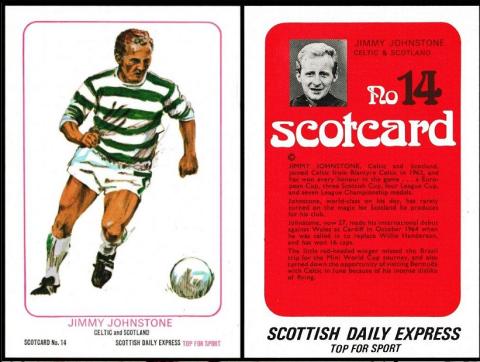
Scottish Daily Express [trade ; newspapers : UK - Glasgow, Scotland] "Scotcards" (1972) 14/24 - SCO-270 : SCX-4
Two football cards in one week, but today in 1944 saw the birth of this man, James Connolly "Jimmy" Johnstone, in Viewpark, North Lanarkshire, Scotland.
He was the fifth, and last child born to his family, and his footballing potential was spotted at primary school, where, rather coincidentally, their P.E. teacher had a friend who played for Celtic, and this connection led to little Jimmy being allowed to hang around the ground, acting as a runner, or even a ball boy from time to time, though he never got to play any football. That came much later, after he had temporarily quit, but then was suddenly offered a playing contract.
His first appearance for them was in March 1963, and the team lost 6-0, but it was a spirited match and it fired up his heart on playing all the more. And in fact this fighting spirit was much in evidence when he turned out for Celtic in the Scottish Cup Final later the same year.
One fact that ought to be better known, as it did affect his playing, was that he was terrified of flying, and had several premonitions that made him cancel appearances. he somehow managed to accept a contract, in 1975, with the San Jose Earthquakes in America, but only stayed a year as flying to the matches was as normal to them as taking a train or coach is in Great Britain. He returned and got a contract with Sheffield United, still within 1975, and stayed there for two years before joining Dundee United for one season, 1977-1978, after which he retired.
In 2001 he was diagnosed with motor neurone disease, a disease which would eventually take his life in March 2006, aged just sixty-one. He is commemorated with a statue at the main entrance to the Celtic home ground, and also another on the site of his former school.
The backs of these cards, in their rather lairy red, make seeing the description very difficult, and they are also not that popular with collectors because of it. However if you have the actual card it is slightly clearer, and I am thankful to the reader who spent the time to copy it out so i can share that it reads :
"JIMMY JOHNSTONE, Celtic and Scotland, joined Celtic from Blantyre Celtic in 1962, and has won every honour in the game ... a European Cup, three Scottish Cup, four League Cup, and seven League Championship medals.
Johnstone, world-class on his day, has rarely turned on the magic for Scotland he produces for his club.
Johnstone, now 27 made his international debut against Wales in Cardiff in October 1964 when he was called in to replace Willie Henderson, and has won 16 caps.
The little red-headed winger missed the Brazil trip for the Mini World Cup journey and also turned down the opportunity of visiting Bermuda with Celtic in June because of his intense dislike of flying."
This set first appears in our original British Trade Index part three, published in 1986 as RB.31. It is catalogued as :
- Scotcard - Scottish Footballers (A).112 x 76. Nd. (24). ... SCX-4
In our updated version, the text is slightly altered, to read
- Scotcard. 1971. (A).112 x 76. Scottish Footballers. Nd. (24). ... SC0-270
One of our footballing friends has also given us this list of the footballers who make up the set :
- Billy Bremner (Leeds and Scotland)
- John Brownlie (Hibs and Scotland)
- Martin Buchan (Manchester United and Scotland)
- Bobby Clake (Aberdeen and Scotland)
- Kenny Dalglish (Celtic and Scotland)
- Donald Ford (Hearts)
- Alex Forsyth (Partick Thistle)
- Archie Gemmell (Derby and Scotland)
- John Grieg (Rangers and Scotland)
- Asa Hartford (West Bromwich Albion and Scotland)
- Alistair Hunter (Kilmarnock and Scotland)
- Sandy Jardine (Rangers and Scotland)
- Derek Johnstone (Rangers and Scotland)
- Jimmy Johnstone (Celtic and Scotland)
- Denis Law (Manchester United and Scotland)
- Peter Lorimer (Leeds United and Scotland)
- Lou Macari (Celtic and Scotland)
- Billy McNeil (Celtic and Scotland)
- Bobby Murdoch (Celtic and Scotland)
- Iain Phillip (Dundee)
- Dave Smith (Rangers and Scotland)
- Pat Stanton (Hibs and Scotland)
- Colin Stein (Rangers and Scotland)
- Bob Wilson (Arsenal and Scotland)

Topps Allen & Ginter [trade/commercial : cards : O/S - USA] "Ballpark Bites" (2024) 25/30
This was another date that I started with right at the outset though I did not imagine I would find such a good card as this. However it took a very long time, so I abandoned any idea of making it a theme of the week, though I did think it would be fun, until I started looking for cards.
So today is not only Sausage Day, and National Sausage Day, it is the start of Sausage Month.
I must start by saying that there are all types of sausage, not just for carnivores, as you can get vegetarian sausages as well (and they are great - I have some in my freezer right now and may well have a couple with rice for dinner). However here we do have the meat-lovers version, a Polish Sausage
This card is what is known as a "mini", and it measures just 1 1/2" x 2 5/8". The set celebrates the weird and wonderful array of food that people eat when they go to watch sports, particularly baseball, which is why it was an insert with the main baseball set.
There are thirty culinary delights in the set which are all prefixed with the code "BB", and they are
- Hot Dog
- Corn Dog
- Popcorn
- Chicken Tenders
- Chili Dog
- Crab Mac and Cheese
- Cheeseburger
- Pulled Pork Sandwich
- Cheesesteak
- BBQ Brisket Sandwich
- Nachos
- Pickle
- Cotton Candy
- Cheese Curds
- Churros
- Waffle Fries
- Ice Cream
- Skyline Chilli
- Cuban Sandwich
- Poutine
- Fish and Chips
- Corn on the Cob
- Pizza
- Tater Tots
- Polish Sausage
- Italian Sausage
- Bratwurst
- Chorizo
- Corned Beef Sandwich
- Steak Sandwich.
Now if you are bored over the weekend you can sit and rank these in order of delight. I think I will take BB-6, followed by a BB-17. I would have gone for a goodly helping of BB-12s but not the sort shown on the card which are what we call gherkins, and I am not so fond of those, I like pickled onions best!
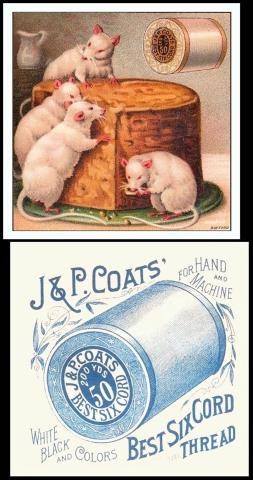
J. & P. Coats [trade : sewing threads : UK - Paisley, Scotland] "Mice" (1900?) Un/??
The penultimate tale in our week of delights shares have the strange tale of the Nottingham cheese riot, something which occurred in 1766, and was the result of a sudden price rise.
This event is also known as the Great Cheese Riot, and it broke out when Lincolnshire traders, who were stalling out at the Nottingham Goose Fair, started buying up what were thought to be too vast a proportion of the local cheeses.
At the time there were local food shortages and throughout the country it was realised that food prices were rising very quickly and quite highly. There had also been a very poor harvest right across the country that year and many crops had failed, which meant that fodder for the animals, especially the dairy herds, was also running low, and having a knock on effect on the costs of milk, butter, and cheese more than anything else. But for some reason the cheese makers had managed to pool their resources and there was a lot of cheese available at that fair. However it was also vastly overpriced, with the going rate for wheels of cheese being up to thirty-six shillings each (that equates to just under £200 when adjusted into modern terms).
It all started with a casual remark, and spread, very quickly to the looting and burning of a warehouse, shops, and boats along the river, and many shop windows were broken , with lots of foodstuffs being removed. Then there were cheese wheels being rolled away hither and yon by members of the general public - and indeed, it is reported that the Mayor of Nottingham was actually bowled over by a rolling cheese whilst he was attempting to gain control of the rioting.
This may seem amusing. but there was a serious, and deadly side too, for the Army were called in, as well as a local militia. They fired into the crowds, killing one man, a farmer and trader called William Eggleston, and injuring several others.
The riots went on all through the night and continued for several days, breaking out in new areas. And they also gave birth to other riots in other areas, right down into Devon and Cornwall, and over into Norwich, and in several places these riots were only quelled by the arrival of more military forces. But eventually the rioting was over in all parts, and normal life resumed again.
Strangely, this cute card perpetuates a bit of a myth, that mice love cheese. In fact they are not very fond of it at all, and it can make their hair stand on end if they eat it. As far as any cheese with a strong smell and flavour being to catch them, forget it, the mouse will not come anywhere near that, and will most likely run away. They much prefer bread, and grains. It is said that if you have a mouse in your house they will go away all of their own accord so long as you remain scrupulous about not having any food within reach, but if you are prone to leaving bread, etc, out open overnight on the worktop, or even just leaving the toaster out for them to forage the crumbs beneath, you are just asking for the arrival of little mousey lodgers, who can smell the sort of food they like for a long way away.
We know that there are other cards, all showing three, or four white mice. So far we have discovered the following, but we believe there ought to be six, not four. So if anyone knows any others do let us know :
- three white mice, going diagonally up a stack of wheat
- three white mice, two on floor, tallest mouse chewing large ear.
- three white mice with earthenware jar
- four white mice with cheese wheel

HUNTLEY & Palmers [trade : biscuits : UK - Reading and London] "Soldiers of Various Countries" (1900) Un/12
Did you know that today is Plaid-urday? Nor did I. So that set me off on a quest, namely what is the difference between plaid and tartan - or are they both the same ?
The truth is rather odd, as all tartans are techically plaid, but strangely not all plaids are tartan. Both are woven fabrics that are a square pattern only involving right angles and never diagonals. The difference seems to be that a tartan repeats the same pattern, exactly, all the way along, so that you can fold it any way and find it matches with just a slight movement. However a plaid can vary, weaving in new colours and changing the pattern, albeit sometimes very subtly.
The first thing I noticed about this card, apart from the fact it is in French, is that the title is "Angleterre", or England, yet these are obviously Scottish soldiers. The French for Scotland is actually "Ecosse". Whilst the French for the United Kingdom is "Royaume-Uni". This means that although there are twelve cards, two cards for each country, technically our Angleterre contains one England and one Scotland.
The full list of soldiers in the set are therefore :
- Allemagne (Germany) - blue uniform with bugle
- Allemagne (Germany) - blue uniform, soldier kneeling
- Angleterre (England) - red uniform with horse
- Angleterre (England) - Scottish soldiers on parade
- Autriche (Austria) - blue and red uniform with rifle
- Autriche (Austria) - brown uniform
- France - red trousers and elaborate hat
- France - blue uniform carrying a pack
- Italie (Italy) - man on horse with hand to eyes
- Italie (Italy) - man beckoning his troops whilst kneeling on a hill
- Russie (Russia) - white uniform and eagle hat
- Russie (Russia) - green uniform, men lined up in row
And many thanks to J S Cards, who currently has a complete set of these cards, on sale from his stock, which I was able to take a look at.
This week's Cards of the Day...
were perhaps a little early, but looked forward to October, and to cards that were known to have been issued within that month. Strangely, our knowledge of this seemed to rely very heavily on the Wills listings, but I did have a hunt through the catalogues and found a few more.
We do know that the earliest set to have been positively recorded as an October issue was actually not by Wills, but by R. & J. Hill, and that was the 1899 set, known as "Belle of New York Series".
As for the latest, that honour is shared, between two sets both issued by W.D. & H.O. Wills in October 1938 - those being "Butterflies & Moths" (large size) and "Speed".
Saturday, 20th September 2025
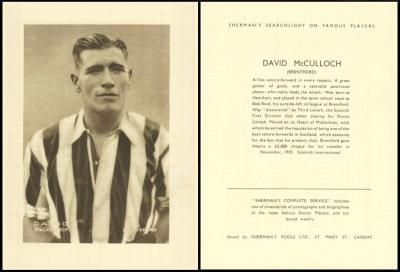
Unusually, we are not celebrating the player on this card, but the team, Brentford, which was born in October, 1889, spurred on by the opening of a new recreation ground in the town, and helped along too by the efforts of the local rowing and cricketing clubs. But it was not until the 16th of October, at a meeting at the Oxford & Cambridge public house, that the name of Brentford Football Club was decided upon, and its club colours set - though these were actually identical to those of the rowing club (salmon, claret, and light blue). They made rapid progress though, as by 1896 they were part of the London League, and two years later part of the Southern League.
However, here we have a player to celebrate, and that is David McCullouch, who was not a local lad, being born in Hamilton, South Lanarkshire, Scotland, on the 5th of October, 1912.
His first team was a junior side, Shotts United. From there he was signed for Third Lanark, in 1932. Then, a couple of years later, him and a team mate, John MacKenzie, were both picked up by Hearts of Midlothian. That is where he was playing when he appeared on his "Rookie" card, Carreras` "Popular Footballers" - which is a very unusual card as it has an addenda, in different text, saying "Since the front of this card was printed, McCullouch has been transferred to Brentford".
He moved to Brentford in 1935, for a fee of £5,000, or so it says on Godfrey Phillips` "Famous Footballers" (1936). The picture on this card is exactly the same as appears on Godfrey Phillips` "International Caps" and "Soccer Stars", though the backs are different. stayed there three years before returning in a slightly northerly direction and Derby County. After playing resumed in 1946, he was signed by Leicester City, for one year, ending his playing career in Ireland, with Waterford United, in 1951, though he did briefly manage Alloa Athletic, pretty much immediately after. He also played for his Country, Scotland, between 1934 and 1938; it appears that this would have continued for longer but was halted by the approaching of the Second World War.
However he did play quite a lot of football during that war, as a guest, a strange time during which professional footballers turned out for the nearest neighbouring club to wherever they were currently posted. This seems to suggest that Mr. McCullouch was based in the British Isles for his War Service - but I have not been able to find out which regiment he was with.
He died on the 21st of June 1979, aged just sixty-six.
This set was issued by Sherman`s Pools, which was just one of the companies trying to suggest that if you predicted the result of a certain number of football matches, you could become a millionaire. To some extent this has been replaced by the National Lottery now, but it was huge in the 1950s and 1960s.
Sherman`s issued two sets like this, "Searchlight on Famous Players" and also "Searchlight on Famous Teams". Both are extra large size and neither are numbered. And I have no idea how they were issued. Maybe someone can tell us more?
This set is described in our original British Trade Index as :
- SHERMAN`S SEARCHLIGHT ON FAMOUS PLAYERS. Ex. Lg. 140 x 101. Association Footballers. Brown gravures. Unnd. (38) ... SHZ-2
- John Arnold, Fulham
- John Barker, Derby County
- Clifford Bastin, Arsenal
- Ralph Birkett, Middlesborough
- John Bowers, Leicester City
- George Camsell, Middlesborough
- Horatio Carter, Sunderland
- Sam Crooks, Derby County
- Stanley Cullis, Wolves
- W. R. Dean, Everton
- Peter Doherty, Manchester City
- Edward Drake, Arsenal
- Willis Edwards, Leeds United
- Ernest Glover, Grimsby Town
- Leonard Goulden, West Ham
- Robert Gurney, Sunderland
- Edris A. Hapgood, Arsenal
- Harry Hibbs, Birmingham
- Harold Hobbs, Charlton Athletic
- Bryn Jones , Wolves
- David McCullouch, Brentford
- Geo. C. Male, Arsenal
- George Mills, Chelsea
- Stanley Matthews, Stoke City
- George Mills, Chelsea
- Frank O`Donnell, Preston North End
- Joseph Payne, Luton Town
- Ellis Rimmer, Sheffield Wednesday
- Herbert Roberts, Arsenal
- Arthur Rowe, Tottenham Hotspur
- Edward Sagar, Everton
- Ronald Starling, Aston Villa
- Frederick Steele, Stoke City
- Frank Swift, Manchester City
- Tommy Walker, Hearts
- Raymond Westwood, Bolton Wanderers
- Victor Woodley, Chelsea
- Alfred Young, Huddersfield Town.
In our updated British Trade Index, the list is removed to the handbook, and the description in the actual index reads :
- SHERMAN`S SEARCHLIGHT ON FAMOUS PLAYERS. 140 x 101. Footballers. Brown gravures. Unnd. (38) See HS-40 ... SHE-210
Sunday, 21st September 2025

When I originally wrote this card up I said that this set fell in a very fallow period, for I have a large gap between Wills "New Zealand Footballers" - export issue (October 1927) and Wills "Old Pottery & Porcelain" - home issue (large size), issued in October 1934. I now know that this was not so barren a land as I presumed, for we have been able to add several sets by Carreras - these being "British Prime Ministers" and "Malayan Scenes" from October 1928, and "Malayan Industries", along with all three sizes of "School Emblems", from October 1929, as well as their "Believe it or Not", by Ripley, from October 1934.
Sadly I cannot find any link with this painting, or the painter, and October, but we know this set was issued in October 1931. It was painted, by the Dutch artist Frans Hals, in 1624, and it was first exhibited at the Bethnal Green Museum from 1872 until 1875. But we know nothing of its story before 1770, when it was sold at the Hague. And it was only ever called "The Laughing Cavalier" in 1888, when it was exhibited at the Royal Academy, after which it passed into the hands of the Wallace Collection where it remains to this day. And it was only in 2024 that it ever left this country, for an exhibition at the Rijksmuseum, close to where it was born.
As for the set , that appears first in our original Wills reference book part four, where all the "A Famous Picture" sets are discussed. Briefly, these asked the smoker to collect a complete set of the cards and send them in to the address on the back of each card, and Wills would send back a picture of this image, which you would have framed and hung somewhere in your house.
You can see the full listing with our Card of the Day for the 17th of July, 2023.
Our set appears as :
A FAMOUS PICTURE .... Fronts printed by letterpress in colour. Complete sections form reproductions of celebrated pictures, and were exchangeable cor full size coloured prints, in accordance with a scheme detailed on the backs of the cards. Home issues
- 211. 48. "The Laughing Cavalier". Backs in blue. Issued 1931
A. Home Series No.5 :
(i) without full stop after "5".
(ii) with full stop after "5" and "Section No"
B. Irish Series No.2 - wording on back altered, Dublin Address
Series similar to items 210-212 were issued by Guernsey Tobacco Co.
The Guernsey version is a slightly different back, for one thing there is no "Series No" to the left hand side, only the section number to the right hand side. And though the text is the same until after the name and artist of the picture, below it all is new, and reads "In exchange for the complete set you will receive a print in full colours suitable for framing on application personally, or by writing to: "GIFTS", WATERLOO HOUSE, HIGH STREET. GUERNSEY TOBACCO COMPANY, LIMITED."
And as far as the entry in RB.21, that only concerns the Guernsey issues, with the section on our set reading :
200-210. A FAMOUS PICTURE. The six Wills home issues and two Irish issues are recorded in W/207 to W/212. The B.A.T. printings are summarised below :
- 211-C . Guernsey Tobacco Co. Issue - "The Laughing Cavalier"
By the time of our original World Tobacco Issues Index, the entry for our set has been truncated to :
A FAMOUS PICTURE IN .... SECTIONS. Sm. Nd. See RB.21/200.210-212. ... W62-134
- 5. "The Laughing Cavalier". (48)
A. Home Issue - "Series No.5. Back (a) without (b) with stop after numeral
B. Irish issue - Series No.2.
There is a slight catch up, regarding the Irish version, in our updated World Tobacco Issues Index, where the entry reads :
A FAMOUS PICTURE IN .... SECTIONS. Sm. Nd. See RB.21/200.210-212. ... W675-172
- 5. "The Laughing Cavalier". (48)
A. Home Issue - "Series No.5. Back (a) without (b) with stop after numeral
B. Irish issue - Series No.2. (Dublin Address)
Monday, 22nd September 2025
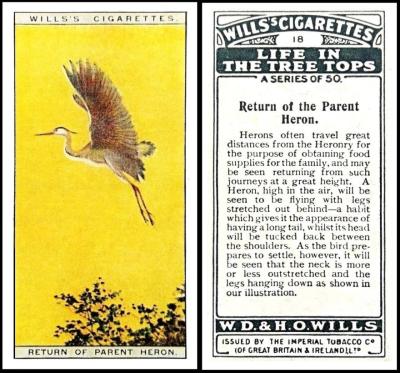
This set is included because it was actually issued in October 1925, one hundred years ago to the month. And though it was the only home issue, that month was quite a hectic one for W.D. & H.O. Wills, who also issued several other issues overseas, namely "Pirates & Highwaymen", "Railway Engines", and "Ships Badges". The home issue of "Ships Badges", by the way, was the set which this replaced; it had been circulated first in June 1925. And today`s set was ousted by the third series of "Do You Know", in February 1926.
Coincidentally though, October is one of the months when you are most likely to see a heron in flight. And I actually saw one only this week with my own eyes, in West Park in Pinner.
Actually it is a much more interesting set than the name suggests, and, like here, really brightly coloured. It is not given much of a description in our original Wills reference book part four though, only :
- 254. LIFE IN THE TREE TOPS. Fronts printed by letter press in colour. Backs in grey, with descriptive text. Issued 1925.
A. Home issue. Wills` name and I.T.C. Clause at foot
B. General Overseas Issue. Anonymous backs.
By the time of our original World Tobacco Issues Index, in 1955, the description had shrunk, a bit, to just :
- LIFE IN THE TREE TOPS. Sm. Nd. (50). See W/254.A ... W62-155
The General Overseas Issue is removed to the back of the book, under anonymous issues (1) with letterpress on back - and sub section 2.B, which contains overseas issues through British American Tobacco, where it is given the card code of ZB6-42.
And that remains identical in our updated version, save new card codes, of W675-194 for the home issue, and ZB07-450 for the General Overseas Issue.
Tuesday, 23rd September 2025

As far as the cyclist scout, the text on all the cards make much of the fact that this is a boy who stood a very good chance of becoming involved in war, if he was not already there when this version of the set was issued, in 1916. It even starts by saying that "A cyclist scout must sign a certificate to show he has a bicycle in good condition, which he is willing to use in the service of the Government, in case of emergency, such as national defence. He must know how to repair a puncture, read a map, and repeat correctly a verbal message."
Many, especially older, scouts, did go out to the front, or serve at sea (most notably John Travers Cornwell, a scout who was killed in action aged just sixteen and a half). Most of the time they were used to deliver messages to and from the trenches and HQ. However many of them, especially those of younger ages, served in the British Isles. Chief amongst these was being assigned to their local coastguard station, waiting for signs of invasion. They were trained to spot anything unusual, and then either send a message by signal or by semaphore, or cycle back to the station and deliver it in person.
It is believed that approximately eight thousand boy scouts lost their lives during the First World War whilst serving in the armed forces. These were mostly older boys, but we know that younger boy scouts were also killed on the home front, including George Harland Taylor, hit by shrapnel during the German Naval Bombardment of Scarborough, on December the 16th, 1914. We just do not have an accurate record of how many. And there seems to be no record at all of how many were killed during the Second World War, which seems to be a great scandal.
This is a set with a huge story, which all begins with our Card of the Day for the 27th of July, 2022 - which shows one of the cards from this set, but issued by, and branded for Ogden`s, and not only that, issued as the Ogden`s first series.
Reprinting this in a new format was not so different, the back being more or less identical apart from the "Churchman" and "Ogden" wording, and it was also aided by the fact that this third series had actually been the first set issued by Ogden - who would start the first set with card one, but then run them continuously, one after the other, from number one to number two hundred and fifty. Churchman actually chose to stick to one format, and each of their sets begins at card one and ends at card fifty
Though, oddly, Churchman chose to issue their third series twice, once with a brown back and once with a blue back.
The Churchman cards were issued later than the original sets by Ogden, which started in January 1911 and went through to September 1914.
They are recorded first in our original Churchman reference book RB.10, issued in 1948, with a very lengthy and detailed description that you can read at the home page for this group. that being with the Card of the Day for the 31st of December 2025. The write up for our third series, brown back printing, as showing here, is as follows
- 23. Oct. 1916. 50. BOY SCOUTS. Inscribed "3rd series of 50". Other detail as (21) -
which reads : "50. BOY SCOUTS (titled series). Size 2 11/16" x 1 7/16" or 67 x 36 m/m. Numbered 1-50. Fronts lithographed in colour. Backs in brown, with descriptions. Printed by Mardon, Son & Hall)
- but different subjects. Also issued by Ogden (Boy Scouts, 1st Series). Note : Cards 39/40 have backs transposed.
We know that the London Cigarette Card Company retailed the two versions as follows in their 1950 catalogue -
- series 3, brown back, odds from 3/6 to 10/-, but no complete sets
- series 3, blue back, odds from 12/6 to 35/-, but no complete sets
From our original Churchman reference book, they are moved to our original World Tobacco Issues Index, where the listing, much shortened, for the group is :
- BOY SCOUTS. Sm. See H.62 ... C82-14
3. "3rd Series of 50". Nd. (50). Back in (A) brown (B) blue
This is repeated, exactly, in our updated World Tobacco Issues Index, save a new card code, of C504-210
Wednesday, 24th September 2025

So far this is the earliest set that we have been able to tie to actually having been issued in October - way back in 1899 - which is one hundred and twenty six years before its appearance here.
But let us start with the characters on our card. Phyllis McKee Rankin was born in 1874, the daughter of a theatrical family of some repute, her father being McKee Rankin and her mother Kitty Blanchard. She had two sisters, also actresses, one of whom, Doris, was the first wife of Lionel Barrymore; they had met when her father, McKee Rankin, was acting at the Arch Street Theater, co-operated by two women, Lionel Barrymore's grandmother and Sidney Drew`s mother. This theatre therefore was the result of two marriages, for Phyllis` other sister, Gladys, married Sidney Drew and was usually billed by his name, as Mrs. Sidney Drew. However she died in 1914, so later cards and postcards of her are actually of another actress, Lucille McVey, who seems to have just taken over the title of Mrs. Sidney Drew in real life as well as on stage.
There was also a son, Sidney Rankin Drew, who was killed in the First World War in May 1918; he was an aviator, one of the famed Lafayette Escadrille Memorial, and he is buried with his comrades at the Marnes-La-Coquette Memorial Cemetery, in France.
Phyllis Rankin`s first theatrical performance is said to have taken place in the summer of 1890, though it seems more likely that she merely stepped further to the front of the stage than she had done before. We know that she acted with her parents from the age of ten, and, almost certainly before. Her role in this 1890 play was also quite a grown up one, the abandoned wife of a French adventurer. She must have made an impression, though, as she gained a couple of other roles through it, one of which was as part of The Arabian Nights in New York.
In 1897 she was cast as Fifi Fricot in "The Belle of New York", on Broadway. That ran for only a week, but she was teamed with a fellow actor called Harry Davenport, and, as part of the show, they had to sing a romantic duet called "When We Are Married". And they were, in 1901. The press made much of her becoming his second wife, but actually she had also been married before, to a Henry Daniel Gibbs, since March, 1895. And they were still married when she was singing on stage to Mr. Davenport - they were not divorced until June, 1899. Not just that, but there were also two children from that marriage, one of whom was adopted as part of the new family.
Harold George Bryant Davenport was also of theatrical stock, his father being E.L. Davenport and Fanny Vining Davenport. He was also quite a bit older than Ms. Rankin, being born in January 1866, and he could also best her on his earliest appearance, as he was on stage first when he was only six. And he was at least divorced when they met, from an Alice Sheppard, who had been his wife from 1893 until 1896. They had a daughter, Dorothy Davenport, who appears on loads of cards. I am not sure how true it is, but reputedly Mr. Davenport was not that impressed by Phyllis Rankin; however he was completely awestruck by the thought that she was related, if only by marriage, to the great Barrymore Dynasty, and it does seem likely that this was his reason for courting her. The marriage does seem to have been very happy though, and they had three children of their own
She died in 1934, but Mr. Davenport kept working, moving to Los Angeles, and being known to be readily on call to play elderly character actors who had some gravitas. Today he is mainly known for playing the surgeon Dr. Meade in "Gone with the Wind" (1939) and Judy Garland`s "grandpa" in "Meet Me in St.Louis" (1944). And he worked almost until he died, of a heart attack, aged eighty-three.
This set is a curious one, more usually known as "Actresses (Belle of New York Series). There are also two variations of size, and two different qualities and colours of board which can only mean it was reprinted, at least once.
It first appears in our original Hill reference book, RB.2, published in 1942, in those two sections, namely ;
- 1899. Oct. 25. BELLE OF NEW YORK SERIES (untitled set) previously catalogued as "Actresses" and "Eminent Actresses". Fronts, printed by letterpress from screen blocks - black and white printing with a black border running off the edges. Titles in a small white panel below figure. Wide border at bottom with "Photo by W. & D. Downey expressly for Hill`s Cigarettes". Backs printed in black only. "The Seven Wonders of the World are Hills`s Imperial, Fine Art, British Gold Cigarettes and Hill`s Badminton, Sweet and Mild, Maycastle, Ranelagh Tobacco. Guaranteed pure by the manufacturers R. & J. Hill Ltd. (Establ. 1775), London, E." (This wording is displayed). Thin white art card - this shows plainest at the back, printing on back starts to read from left-hand side, and runs from bottom to top. Size 2 15/16" x 1 5/8".
- 25. BELLE OF NEW YORK SERIES (untitled set) as above, but printed on thick buff or brownish card - most noticeable from the backs, printing on back starts to read from right hand side, and runs from top to bottom. Size 2 15/16" x 1 1/2". The same photographs were used for both of he above issues but some fresh engravings were made; as the buff cards are narrower, parts of the background were omitted. The screen for the engravings will be found different for the two issues, also the formation of the words at the base varies. On the white card the panel for "Hills`s" measures almost 1 1/2", whereas on the buff card it is 1 1/16"; also the "S" in Hill`s is a different shape. Actually the whole of the wording for the base was redrawn. On card 10 (buff card) the title "Edna May" slopes; on the white card this is quite straight.
Unnumbered, but numbered here for convenience -
- Dora Card. Full length portrait
- Helen Dupont. Full length, in tights
- Helen Dupont. Profile, wearing hat with large feather at back of head, shoulders draped and flowers at breast
- Helen Dupont. Looking right but face turned towards camera. Turned up hat with flower trimmings on underbrim
- Helen Dupont. Half length portrait. Hat with lavish trimmings. Arm right across picture holding flowers (?)
- La Gitana. Deated, right hand under chin.
- Edna May. Head and shoulders. Wearing pearl collar, facing camera. Large "lover`s knot" worked on left hand side of gown.
- Edna May. Full length study. Standing sideways. Short gown with "lover`s knot" at bottom. Hands behind back
- Edna May. Same as 7 but eyes downcast - looking down
- Edna May. Head and shoulders, wearing large hat trimmed with flowers and plumes. Big bow under chin
- Edna May. Full length study, facing camera. Same hat as 10. Short gown; holding long baton in left hand
- Edna May. Head and shoulders, wearing Salvation Army bonnet
- Mabel Power. Seated at desk with an open book
- Phyllis Rankin. Full length portrait ; facing camera with skirt raised
- Phyllis Rankin. Head and shoulders, facing left. White in hair; spotted gown
- Phyllis Rankin. Full length study. Facing right and looking over her shoulder. Hands clasped behind.
- Phyllis Rankin. Head and shoulders. White spotted headdress; trail of foliage and flowers right across body, arm resting on a wall.
- Phyllis Rankin. Same headdress as 17, but without trail of flowers across body, Body turned towards right but face looking towards camera
- Phyllis Rankin and Harry Davenport (seated)
- Ella Snyder and Frank Lawton. Full length
- Ella Snyder. Head and shoulders study, Facing camera
- Ella Snyder. Full length portrait, short gown, holding chin in right hand
- Sylvia Thorne. Head and shoulders study, facing camera. Dark gown with white spots. Flowers (?) on left shoulder
- Sylvia Thorne. Head and shoulders study, body turned right but face towards camera, Light figured gown with bows on left shoulder
- Heloise Titcomb. Full length study. Facing towards camera. Frock raised to show petticoat
Most of the names above were actually in the production, namely Helen Dupont (as Cora Angelique, the Queen of Comic Opera), Frank Lawton (as Blinky Bill McGuire, a Mixed-ale Pugilist), Edna May (as Violet Gray, a Salvation Army Girl), Mabel Power (as Kitty Peach, a role I cannot track down more about), Phyllis Rankin (as Fifi Fricot, a little Parisienne), Ella Snyder (as Marjorie May, one of Cora Angelique`s bridesmaids), and Sylvia Thorne (as Myrtle Mince, another of Cora Angelique`s bridesmaids). However there are three exceptions, these being Dora Card (who was actually Edna May`s sister), La Gitana (actually a Spanish actress, often confused wrongly with Gertie Gitana, a British music hall star), and Heloise Titcomb (who is possibly the equestrian vaudeville artiste Heloise McCeney, stage name La Belle Titcomb - the Titcomb coming from her first husband, of three, a San Francisco dentist).
The set, (if you remember that, after my digression hunting through play bills?) next appears in the 1950 London Cigarette Card Company catalogue for 1950 as
- BW. 25. Actresses (Belle of New York Series) (1899) : - H.206
"The Seven Wonders..." back -
A. White back (41 x 75 m/m) ... odds 35/- to 100/-
B. Toned back, thick card (39 x 74 m/m) ... odds 35/- to 100/-
As far as the reference to H.206, that leads you to the handbook accompanying this volume, but all you find is a redirect, which reads "H.206. ACTRESSES - Belle of New York Series (Hill) - see Society Booklet No.2 , pages 2-3" and we have already added that listing above.
By the time of our original World Tobacco Issues Index, the listing is a bit different; any mention of those alternative identifying names being removed, and another new title being given. The entry now reads :
- ACTRESSES - Ha.206 (A) Known as "Belle of New York Series". Sm. Black and white. "The Seven Wonders..." back. Unnd. (25). See Ha.206. H46-4
A. Size 74 x 41. "Hill`s" oblong on front 31 m/m long
B. Size 74 x 39. "Hill`s" oblong on front 28 m/m long
This is slightly different in our updated version of that book, which adds a few details from earlier books, and reads :
- ACTRESSES - Ha.206 (A) Known as "Belle of New York Series". Sm. Black and white. "The Seven Wonders..." back. Unnd. (25). See Ha.206. H554-050
A. Size 74 x 41. "Hill`s" oblong on front 31 m/m long. Thinner card
B. Size 74 x 39. "Hill`s" oblong on front 28 m/m long. Thicker card, backs reversed from A.
Thursday, 25th September 2025
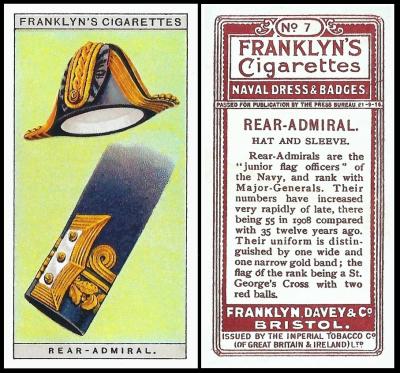
I am delighted to be able to bring you this, for we have featured this set before in our newsletter for the 18th of May 2024, albeit by another maker (W.D. & H.O. Wills). Even better, that card showed the other sort of image that is also included in this set, a half length figure of a man in uniform - as opposed to this, which only shows a cut off sleeve and empty hat.
As this is a Card of the Day, it inherits the mantle of being the home page for all the sets, which are :
- Franklyn Davey & Co. (October 1916) - https://csgb.co.uk/cardoftheday/2025-09-25
- F. & J. Smith (1911)
- W.D. & H.O. Wills (July 1909) - https://csgb.co.uk/publications/newsletter/2024-05-18 [in newsletter, scroll down to Monday 20th May]
Our Franklyn Davey version was actually issued quite a bit later than the others, seven years after it had first appeared in Wills` packets. That leads to the anomaly on the text of this card that states "Their numbers have increased very rapidly of late, there being 55 in 1908 compared with 35 twelve years ago." I cannot trace a figure for how many Rear Admirals there were in 1916. but I imagine it had risen quite considerably.
Sadly for cartophilists, only that Wills version had its details copiously examined as part of a separate reference book, though the information can be taken to be the same for the other two. And we do know that the Smith`s version is rather a challenge for the type-collector for it not only comes with and without a descriptive back, but you can get eleven different advertisement backs with descriptive text and six different advertisement backs without descriptive text, five of which are identical to the other version, and one, `Squaw Thick Black Tobacco` which is unique to this version of the set.
The first listing of our version, therefore, comes in our original World Tobacco Issues Index, where it is recorded as :
- NAVAL DRESS & BADGES. Sm. Nd. (50). See H.172 ... F52-14
This text is repeated in our updated version, save the card code, which has changed to F756-460.
Friday, 26th September 2025

James Moir was born, in Lambeth, London, on the 17th of April 1879, and he started to box, as many did, during his service in the British Army, which was out in India. Perhaps he was lucky, for his instructor was a wrestler, Sidney Grumley, from Shepherds Bush.
We know that he must have been in some kind of artillery regiment, because of his use of "Gunner" and "Ex-Gunner" Moir
In 1904, he turns up as the exhibition partner, and trainer, for none other than George Hackenschmidt, during both of his Australian tours. He did not apparently do any fighting on his own back, he just appeared in the ring with Mr. Hackenschmidt. . It was only in 1905, on his return to England, that he started thinking of competing seriously, and he won the British Heavyweight Title, which he retained until 1907, when it was taken from him by the Canadian Tommy Burns.
It was at about this time that he appeared in three films, which show him boxing. Two of these, made in 1907, he appears briefly with other boxers, kind of a newsreel - but in the third, Ian Hague v. Gunner Moir, it is an actual match, filmed by Gaumont British, to be shown in cinemas. "Ian" Hague was not easy to track down, but he turns out to be James William "Iron" Hague, born in 1885 in Mexborough, Yorkshire, who was the British heavyweight champion between 1909 and 1911. In fact this film shows the fight for the English Heavyweight title on 19 April 1909, against Gunner Jim Moir, which Mr. Hague won in the first round, with a knockout in 2 minutes and 47 seconds.
As for Gunner Moir, he returned to Australia with Hackenschmidt in 1910, then toyed with the idea of staying out there, but for some reason this never happened and he retired. His last fight before he retired was against Bombardier Billy Wells, at the Canterbury Music Hall in 1913, who beat him.
He never boxed again after that, though he did maintain an interest and wrote several books on the sport, including "The Complete Boxer", which he kept on revising and republishing. And a couple of years after that he somehow turns up running the same venue, at the Canterbury Music Hall, as manager, or perhaps just as assistant manager, reports vary.
We know that by 1924 he had a wife and six children, and a temper. He had also been in trouble with the police over a slander case that seems much more to do with the fact that one of his sons got a job at the company he slandered and decided not to return home. James Moir lost the case, but could not pay the court fees and the amount he was ordered to pay, so he was declared a bankrupt. His wife seems to have stuck with him - and defended him in court.
He also became an actor, in the 1930s. His first role appears to have been in a crime caper, "Third Time Lucky" in 1931, and all of the films seem to be the low budget thrillers or crime stories, some of which he just appeared in, parhaps for pin money. One of them, "Excuse My Glove" seems especially poignant - this was a boxing film, made in 1936, and he appeared as himself.
There is a rumour he appears on postcards, and maybe trade cards, for Phospherine, a medicinal tonic. He also sold boxing gloves. But he died, in June 1939, aged just sixty.
This is yet another complex set, ably described in our original Ogden`s reference book, RB.15, published in 1949, as :
75. PUGILISTS & WRESTLERS. Fronts lithographed in colour Backs in blue, with descriptive text. Home issues, 1908-9
- 140. A Series of 50. Numbered 1-50. Issued in two separate groups of 25 -
Nos. 1-25 - cream matt backs
Nos. 26-50 - (a) cream matt backs (b) white, semi-glossy backs
- 141. Second Series. Numbered 51-75. Cream matt backs.
However, by the time of our World Tobacco Issues Index, a lot of this has gone, and the listing now reads :
- PUGILISTS & WRESTLERS. Sm. Nd. See RB.15/140 ... O/2-111
- "A Series of 50".
- "Second Series", Nd. 51/75 (25)
And in our updated World Tobacco Issues Index, the entry is even shorter :
- PUGILISTS & WRESTLERS. Sm. Nd. See RB.115/140 ... O100-446
- "A Series of 50". 2. "Second Series", Nd. 51/75 (25)
Well there you go. We did finish, in time, all but the bit from the books for the Scottish Daily Express, but we did those the next morning, by which time we had also been sent the list of all the footballers on the cards and their teams, and the transcription of the wording which was rather hard to see because of the red on our card
Have a great weekend, and lets hope it is dry enough to take in a fair or market. Have fun, and we will return again next week.....