
Saturday has once again crept up and grasped me in its iron grip, and the last few hours were a bit of a panic, but we are reasonably ready, near enough to slide open the door and allow this into the public domain. And as always, anything that I need to correct will be added over the weekend, but also mentioned in the main body of that section. And anything that is supplied by you, my wonderful readers, and fellow researchers, and card lovers, will appear in our new section, which we call ...
website news :
Lets start with a few changes to report from the last edition of the 14th of February 2026.
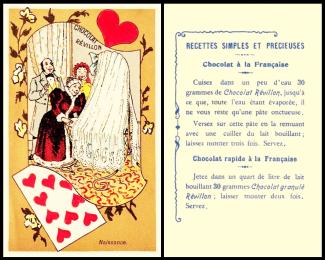
We have now found all the cards for this Chocolat Revillon playing card related set, which started us off on the 14th of February, as well as its proper title, but the recipe back version is proving very elusive. Something else turned up in the hunt though, and we have found another maker. That`s how we completed the list. We also noticed, just to make it more confusing, that there is another Chocolat Revillon set with the same wording "Recettes Simples et Precieuses" on the back, but the front shows food - we featured that as our Card of the Day for the 28th of January 2025.
------
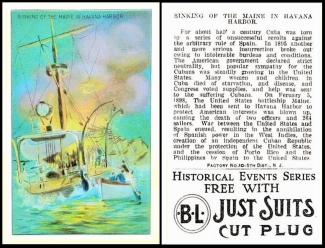
I did have help sorting out that this card, of the sinking of the USS Maine, stating `B.L. Just Suits Cut Plug` was actually issued through the American Tobacco Co., as a group issue. That seems odd, when you consider that Buchanan and Lyall (the B.L. in the circle) do appear as a separate issuer, of an untitled "Italian Series", in both our original and updated World Tobacco Issues Indexes, yet there is no cross reference to A.T.C. And it also seems strange that this version was shorter, only being twenty-four cards, and not having the "triple folder" - whatever that was - which was issued as part of the larger sized version issued with several A.T.C. brands.
As far as the Cards of the Day, they stayed more or less the same, though I did sort out, and add more cards to Chocolat Poulain "Divulgateurs de la Science" , though we still need the identities of the people on cards 32, 35, 36, 40, all from the fifth series, if anyone can oblige. In addition the card from Panini`s "The Smash Hits Collection 85" has now been changed to the English language version, because we already had the German version, to illustrate David Bowie`s time in Germany.
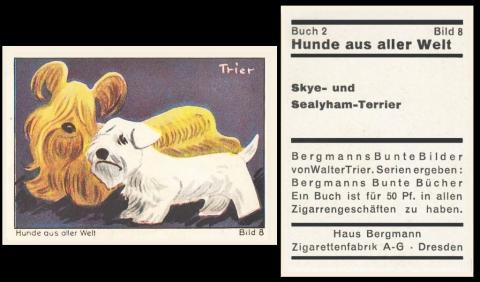
Haus BERGMANN Zigarettenfabrik A-G. [tobacco : O/S - Dresden, Germany] "Bergmann`s Bunte Bilder - Hunde aus aller Welt" / Bergmann`s coloured pictures - Dogs of the World (1930) Buch 2, Bild 8 - B317-100.2.5 : B60.2.2.5
Today we celebrate the Skye Terrier, for it is #InternationalSkyeTerrierDay.
This charming Scottish breed is long, and short legged, and, sadly, it is in danger of dying out within the next fifty years. As to why, it seems that it just fell from popularity. Or perhaps it is related to a concern that first came about a quarter of a century ago, when it was discovered that the breed suffered with a type of canine hepatitis. That was later changed, because it is not related to the human form, and is not actually hepatitis at all, it is just a kind of liver disease, but it is still very hard to diagnose, or to predict, for it does not appear to be genetic.
It would be a great shame if this did indeed lead to the disappearance of this breed, for they are very beautiful, in character and in form, with a thick, "double" coat, designed to keep them warm in the harsh Scottish winters, and a beard and fringe for protection when plunging into the undergrowth on a chase. And though it can be variously coloured in greys and light browns, sometimes even lighter, to cream, the muzzle, nose, and ears, are black.
Speaking of the ears, these lead to the suspicion that somewhere in the distant past there must have been two breeds, because you can get Skye Terriers with either ears that stand up to a point, or ears that fold half way down. However everything else about the confirmation of all the dogs is identical.
Its first cartophilic appearance seems to have been in 1888, in America, on one of the cards of H. Ellis & Co, of Baltimore`s "Breeds of Dogs". These were issued with various brands - including `Bengal Cheroots` and `Tiger Cigarettes` - and on the back of each card it states "...these cards showing a head of one of the following dogs, correct as to formation and colour". However there is a very scant description of the breed above this, in our case only "SKYE TERRIER. A Mouse Catching Dog & Pet"
Strangely, its first appearance on a British set was W.D. & H.O. Wills` "Dogs" (1914). This actually mentions the two types of ears, and says the dog "is much valued by gamekeepers and sportsmen in the North of Britain on account of his sporting proclivities. He is a game, hardy little dog, sagacious in hunting." And it goes on to say "...he is discreet and intelligent. As a watch-dog he is excellent, being vigilant and dependable; and as a pet he has few rivals, his long coat, when well groomed, and his dark thoughtful eyes making him a really beautiful little dog. The most approved colours for a Skye Terrier are dark or light blue or grey, or fawn with black points. He should not weigh over 20 lbs, or under 16 lbs."
In case you were wondering, the Skye Terrier is at the back of this card, behind the little Sealyham, another dog which was once all the rage, but has now fallen from favour.
These cards were designed to fit in albums called "Bergmann`s Bunte Bucher", and they are in groups, which are fully described at the current home page for all the sets, with our Card of the Day for the 16th of January 2022.
Our card comes from the second album, which appears in our original World Tobacco Issues Index as
- 2. Buch 2 (100). 9 sub-series numbered from Bild 1 upwards ... B60-2
1. Buhne und Film (10)
2. China - Japan (10)
3. Die Schnellsten Menschen (10)
4. Helden die Jugend (10)
5. Hunde aus aller Welt (10)
6. Lustige Trachtenbilder (20)
7. Rund um Tabak (10)
8. Sport Karikaturen (10)
9. Zwerg Nase (10)
This listing has not altered in our updated World Tobacco Issues Index, except for the card code, which is now B317-100, and for the fact that a third album of fourteen sets had been discovered. And again you can read about that with our Card of the Day for the 16th of January 2022.
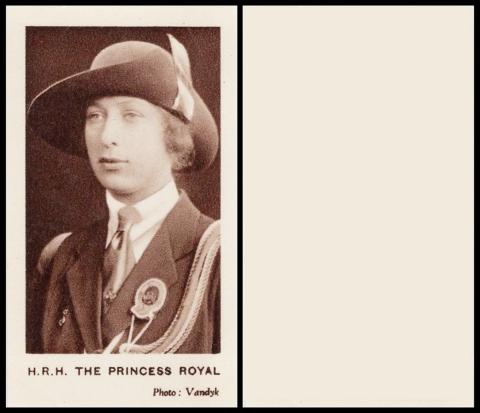
ANONYMOUS / "Schoolgirl`s Own" [trade : magazines : UK] "Royal Family" (1935) Un/12 - SCH-400 : ZJ5-35.2
[updated 21 February 2026 - actual issuer located and added, two more cards added to list of subjects]
Today I bring you a rather fascinating fact, as it is not just Lord Baden Powell`s date of birth, it was his wife`s. And her story has not yet been told on these pages.
It is also World Thinking Day in the scouts and guides, right across the world, when children remember the Baden-Powell`s and what they did.
Mrs., and eventually Lady, Baden-Powell, was born Olave St Clair Soames in Chesterfield, Derbyshire, the third child of the artist, and brewery owner, Harold Soames of Dorset, who was also related by descent to the Soames family of Sheffield Park in Sussex, now owned by the National Trust. By all reports little Olave was keen on sports and music, though we know that she was educated at home, which accounts for the fact that there are few records of her childhood.
In January 1912, when she was twenty-three, she went on a cruise to the Caribbean, but we known nothing of the how and why she was there, which is a great shame as it was here she met a fellow traveller, heading to New York to begin a round the world tour of lectures. It seems that they began to bond on learning they shared a birthday, and it was quite a whirlwind courtship, for when he came back to England, in September of that year, he went and found her and asked her to marry him. She agreed, despite the difference in their ages; she was twenty-three and he was fifty-five - and also the difference in their experiences, as he had been a general in the Boer War, and had founded the Boy Scout Movement in 1910, both of which brought him worldwide fame.
They were wed in October 1912, in a private ceremony in her Parish Church. Amongst their wedding presents was a car, which had been paid for by donation, every boy scout and girl guide handing over one penny.
By 1915 she had given birth to two children, the last of whom was only five months old. However she was slightly bored at home, and so she signed up to go out to France and work in one of the soldiers` rest and recuperation huts, supplied by the Mercers Company and staffed by scouts and people with scouting connections. She sent her children off to live with her mother, and left for France in October 1915. However at the end of January 1916 she was feeling unwell and so she came back home. She then offered to help with the Girl Guides movement, and in October she was asked if she would like to become Chief Commissioner, which she accepted, because by that time she was having her third child. And in 1918 she was given a new title, Chief Guide.
The Baden-Powells would eventually have six children, one son and two daughters of their own, and the three daughters of her sister, whom they took in after her death in 1919.
In 1938 they moved to South Africa, where Robert Baden-Powell died, in 1941. She decided to come back to England, which she did at great risk, by boat. However she was in for a shock as her home was being occupied by the Canadian Forces and she could not return. She was eventually allowed to stay at Hampton Court, where she stayed until 1976, when she moved to Surrey. However she died in only the next year. She left instructions that her ashes were to go to Kenya, and be buried in her husband`s grave, and this was carried out.
This is George V`s only daughter, Mary, and she became the honorary President of The Girl Guide Association in 1920, a position she held until her death in March 1967, twenty years after the death of her husband, Viscount Henry Lascelles, whom she had married in 1922, and she was given the title of Princess Royal ten years later in 1932, after the post was vacated by the death of her aunt, Princess Louise, the Duchess of Fife.
This set proved elusive, but Mr. Paterson, a regular reader, came up with all the gen, simply because he owns the album, and that has all the information that is sadly lacking from the cards. First up, the album cover, which shows Windsor Castle, with sun-ray bursts behind, is actually titled "Schoolgirl`s Own Photo Album of the Royal Family". And at the bottom in white on a black banner it says "Presented with "Schoolgirl`s Own". Inside the album the cards fit, one to a page, with text beside it - and the order of the cards in that album, though the cards themselves are unnumbered, is as follows :
- H.R.H. The Prince of Wales - Photo Foulsham and Banfield Ltd.
- H.R.H. The Duke of York - Photo Guttenberg Ltd
- H.R.H. The Duchess of York - Photo Bertram Park
- H.R.H. Princess Elizabeth : Photo Marcus Adams [this was one I missed off the original list]
- H.R.H. Princess Margaret Rose - Photo Marcus Adams
- H.M. King George V - Photo Vandyk
- H.M. Queen Mary - Photo Elliott & Fry
- Viscount Lascelles - Photo : Speaight, Ltd.
- Hon. Gerald Lascelles - Photo : Speaight, Ltd. [another one I missed off the original list]
- H.R.H. The Princess Royal - Photo : Vandyk
- H.R.H. The Duke of Gloucester - Photo : Vandyk
- H.R.H. Prince George - Photo Dorothy Wilding
The text accompanying our card reads as follows "H.R.H. THE PRINCESS ROYAL. Born in 1897, Princess Mary was just emerging from schooldays when the Great War began. In consequence, Her Royal Highness, when still more than a girl, was called upon to play an active part in the national struggle. She became a Commandant in the V.A.D. nursing organisation, after actively serving in the Hospital for Sick Children, Great Ormond Street, London. During the War she was an active member of the Girl Guide Association, and in 1927 became President of the movement. Her engagement to Viscount Lascelles was announced in 1921, and the wedding took place at Westminster Abbey in 1922. Princess Mary, who has two sons, has since been created Princess Royal. Her Royal Highness fulfils many public duties every year, and as their Majesties` only daughter, is immediately popular wherever she goes. She spends much of her time at Harewood, her Yorkshire home. "
On the back is a full cover advertisement for "The Schoolgirl`s Own" - which was published every Tuesday and cost two pence. As far as the date, we know that The Prince of Wales legally became King Edward VIII on the 20th of January, 1936, when King George V died, so this set must have been issued in late 1935.
Anyway once I had an issuer I was able to find it in the updated British Trade Index, then I went back and found it in the original one. In that original one it is recorded at the back of the book under a mixed section covering three "Schoolgirl`s Own" issues, "Film Stars", "Royal Family" and "Series of School Mistresses and Schoolgirls" - the heading of which, and our set`s entry reads :
- SET ZJ5-35. SCHOOLGILRL`S OWN SERIES. (A). Sm. 62 x 35. Front per Fig, ZJ5-35, in mauve brown, varnished. Unnd. Issued with "Schoolgirl`s Own". Special albums issued.
2. Royal Family - album titled "Photo Album of the Royal Family". (12). Listed in order of the album.
The list is in the same order that we use above, but with numbers added though the cards are not. I have to say I might have found this set all on my own if it were not for the fact that the figure is from the film star set, and it shows Ginger Rogers.
In or updated British Trade Index it has been shifted from the back and it is now recorded under "Schoolgirl`s Weekly" (simply because "The Schoolgirl", "Schoolgirl`s Own" and "Schoolgirl`s Weekly" were out of the same publishing stable and collaborated on the issue of a three part set we know as "Stars of the Silver Screen".
The entry for our set reads :
- ROYAL FAMILY (A). 62 x 35. Mauve-brown, varnished. Album entitled "Photo Album of the Royal Family". Unnd. (12). See HS-18. Anonymous ... SCH-400.
HS-18 is the code for the accompanying Handbook, and it lists the cards, albeit in a rather strange order, as :
- HS-18. ROYAL FAMILY (A). Unnd. (12). Issued by Schoolgirl`s Own. See SCH-400
- H.R.H. Princess Elizabeth
- H.M. King George V
- H.R.H. Prince George
- H.R.H. The Duke of Gloucester
- Hon. Gerald Lascelles
- Viscount Lascelles
- H.R.H. Princess Margaret Rose
- H.M. Queen Mary
- H.R.H. The Princess Royal
- H.R.H. The Prince of Wales
- H.R.H. The Duchess of York
- H.R.H. The Duke of York
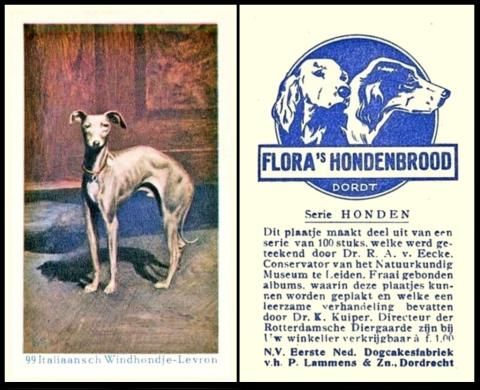
P. LAMMENS & Zn. [trade : dog food : O/S - Dordrecht, Holland] "Honden" / hounds (1930) 99/100
Today`s event may not thrill you, but it will almost certainly thrill your canine companion, as it is #InternationalDogBiscuitAppreciationDay.
Lots of makers produced dog biscuits, but the number one name was Spratts, possibly because they were never ashamed to shout their wares - in fact the first billboard to be erected in London was theirs. They also knew that if you got your clients early in life they would remain faithful, and so they made biscuits in every size, from puppy ones with cod-liver oil right up to what were known as dog cakes, packed with meat and fibre. However we featured one of their sets as our Card of the Day for the 28th of December, 2021. And as I hunted through the gallery and index for other makers I realised that despite the fact that the theme of the week for that newsletter (the 1st of January, 2022) was supposed to be "walk your dog month", and I had hinted with the first two clue cards that we were going to be doing breeds of dog, it all went pear and the rest of the week was spent chewing over dog biscuits.
However I also had the idea of still celebrating this biscuit-related date firmly held between my teeth, and so I found this card, which rather fits the theme all the better, for it is not only an international dog biscuit manufacturer, it is an international dog, which I have to say sounds much more romantic on the card, where it is called an "Italiaansch Windhondhe-Levron". The "windhondhe" bit does indeed mean wind, and refers to the speed of the dog - for though it was a lap dog, and as so, beloved of European Royalty, and of Queen Victoria, it was actually bred to chase hare and rabbits. As for the"levron", I have not been able to trace a root, but it is still connected, as another name they are known by, to this day, is "Piccolo Levriero Italiano".
Despite all this romance, we know them as Italian Greyhounds, which dates back to the nineteenth century, when dogs of this breed were first imported. Obviously the Italian part saluted from where they had come, but the greyhound part was used because they resembled the larger dogs of that name - though it was not actually incorrect, as the genes prove they share a common ancestor, now lost in the mists of time. They also travelled to America, and were first registered by the American Kennel Club in 1886. Great Britain took a little longer to recognise them, though a breed group was founded in 1900.
Both World Wars decimated their population, and they almost died out as a breed during the Second World War, but sterling efforts to bring in new bloodstock and encourage ownership in the early 1950s saw it begin to fight back, and in the late 1950s several clubs and breeding groups were formed. Thankfully their efforts saved the breed, and today it is again regaining its popularity as a pet and companion.
On the back of the card, there is no description of the dog, more`s the pity, it only tells you that the series title is "Honden" (or hounds) the set is complete in a hundred cards, and that the dogs were selected by Dr. R. A. von Ecke, the conservator of the Natural History Museum in Leiden. The issuer is also interesting because "Hondenbrood" means hound bread, or cakes, just like the dog cakes that Spratts used to sell. As for the issuer, Flora, that is said, at the bottom of the reverse, to be the first dog cake maker in the Netherlands. So it fits our subject even better than I had imagined
I have a very scant list, which follows, but will be delighted with any help to make it into a longer, or even a complete one. So watch this space. We also know that the set was issued at least twice, as some only have the Dutch wording which appears first, and some are in English language, at least on the fronts, though the backs are Dutch and identical. All this is noted below too. There has been a bit of a change, because at first I had a list with all the numbers, but it looked too empty in the completed newsletter so I did it this way and took out all the empties.
- 29 Skye Terrier [English?]
- 30. Yorkshire Terriers [English?]
- 31. Laika - Chien de Siberie
- 32. Skandinavische Elandhond - Chien de Norrland
- 34. Mastiff [English?]
- 37. Bulldog - Bouledogue
- 38. Boxer [English?]
- 39. Fransche Bulldoggen
- 41. Rottweiler (Chien de) - Bouvier Allemand
- 42. St. Bernard [English?]
- 51. Dalmatiner - Chien de Dalmatie
Variant : Dalmatiner - 55. Kortharige staande honden uit Auvergne
- 62. Griffon Korthals - Griffon a poil dur
- 65. Bloodhound - St, Hubertshound
- 73. Engelsche Setter - Setter Anglais
- 75. Blenheim Spaniel - Epagneul de Blenheim
- 82. Langharige Teckel - Dachshund a poil long
- 84. Blauwe Basset - Basset Bleu de Gascogne
- 85. Hollandsche Herder - Chien Berger Hollandaise
- 92. Kortharige Collie - Collie
- 94. Scotsche Windhond
- 95. Barsaja Psowaja - Barsoi
- 99. Italiaansch Windhondhe-Levron
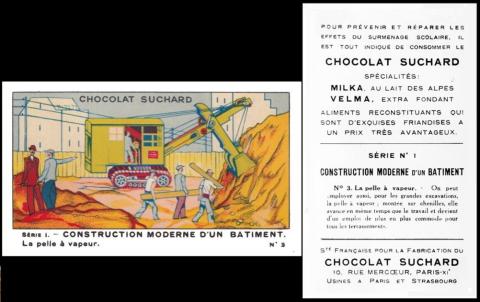
Chocolat SUCHARD [trade : chocolate : O/S - Paris, France] "Construction Moderne d`un Batiment" / modern construction of a building - series 1 (1920s) 2/12
[updated 21 February 2026 - replacement card of an actual steam shovel, from the same set as originally used]
I`m not sure why I got so excited to discover that today in 1839 a man called William Smith Otis invented the steam shovel, but maybe it has something to do with the fact that car boot sale season is almost here and I can again rummage through boxes of assorted tools...In fact he did not invent it today, nor did he lodge the patent, it was the date that the patent was granted.
William Smith Otis was born in 1813 in Pelham, Massachusetts, and he was indeed related to Elisha Otis, they were cousins. However whilst Elisha Otis was drawn to things that went up, specifically lifts and elevators, William Smith Otis went the other way, and had a passion for digging. When he was only twenty-two, his drawings and planning led to the invention of a steam powered digging machine, which was way ahead of its time, and actually quite unnecessary, for most digging was surface, and manpower was both adequate and cheap. His machine was a grandiose affair, mounted on a railway carriage, and able to scoop vast quantities of soil, and, more than that, able to deposit it straight into the open carriage, enabling it to be picked up, dropped, and taken away all at the same time.
One year later, he became a partner at a company in Philadelphia called Carmichael & Fairbanks, the Carmichael half of which was his brother in law. They were principally involved in the making of railways, and they used his machine in the work, to great acclaim, so much so that William Smith Otis was introduced to Joseph Harrison, who would go on to build most of the railways in Russia, and they worked together on the patent, together with the model which was required as demonstration. The patent was passed in 1836 but not issued until today in 1839.
Sadly, within a few months, WIlliam Smith Otis was dead, of typhoid fever, aged just twenty-six. Carmichael and Fairbanks continued to promote and use his machine, and they managed to get the patent extended in the name of his widow, something which would later prove very valuable when the railways spread across America.
You may not be surprised by something I ought to have considered, but did not, for there are very few steam shovels on cards. The earliest two are the same picture, they are card 27 of "Mining", issued by W.D. & H.O. Wills` in 1916, and Edwards, Ringer and Bigg in 1925.
This is more of an excavator, but it will suffice until tomorrow, when it will be replaced with a better, actual steam shovel, number three from this very same set, which I noticed only when I was typing out the list, supplied by the same reader who supplied the card we have now (number 2), and when I asked if he also had number 3, I am delighted to say he did, and will scan and send it tomorrow.
The full list of cards in the series are :
- L`Architecte [the architects]
- L`excavateur mecanique (fondations) [mechanical excavator, digging foundations
- La pelle a vapeur [steam shovel]
- Moulage des sous-sols [making the basement]
- Les Sapines [workmen]
- Betonniere [concrete mixer]
- Charpentes metalliques [metal frameworks]
- Boulonnage et coffrage de la charpente [bolting and forming the framework
- Coulee du ciment [pouring cement]
- Machine a injecter le cement [nechanical cement injector]
- La Couverture [laying roofing felt]
- Decoration [decorating for the new owner]
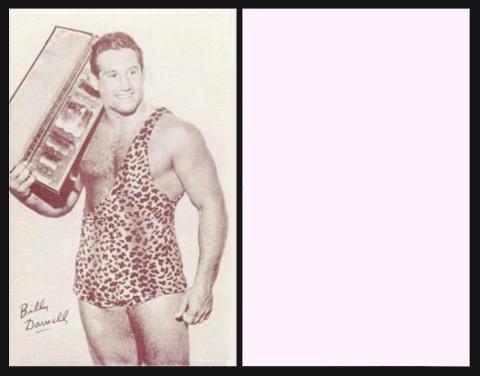
EXHIBIT Supply Company [trade/commercial : arcade cards : O/S - Chicago, USA] "Wrestlers" (??) Un/??
Today in 1926 saw the birth of William Lester "Billy" Darnell, in Camden, New Jersey, and his claim to fame came by complete chance, for in 1942, when he was working as a lifeguard, his physique was spotted by a wrestling promoter who offered him a job.
The reason for that was the date - for wrestling was going through rough times, most of the current crop being away fighting in the second World War. Wrestling was not quite the same as boxing, at least not at that time, it was, dare I say, more charisma than talent, and afforded the chance to dress up in some seriously odd costumes. For a young man, it was lots of fun.
His first time in the ring was with Herman Gustav Rohde Junior, also grew up in Camden, New Jersey. He would go on to become world wrestling champion fourteen times, and influence many of the later stars of the sport. The two men became great friends and would often work together in tag team matches. However our man`s time in the ring was cut short when he joined the U.S. Army in December 1944.
On his demob, he qualified for what was known as the G.I. Bill, a reward for military service aimed to help returnees readjust and also compensate for the higher prices which had come about whilst they were away; it allowed for lower cost mortgages, loans, and tuition fees to allow for retraining. Our man chose to learn to fly, and he found he was naturally talented, in fact he flew himself to many of his wrestling matches when they were a way away. He also returned to wrestling, and again partnered his old pal, who was just in the process of re-inventing himself as "Nature Boy" and "Buddy Rogers", possibly to avoid any hostilities about having a German sounding name. In fact for some time our man pretended to be his brother, in the ring, and the two were booked as "Billy" and "Buddy" Rogers. At this time television was looking for something flashy to catch the attention of prospective viewers and wrestling was given a go. This was when the costumes became more outlandish, and our man first sorted his leopard skin attire - whilst his partner flashed a cape covered in sequins.
In 1961 he was shocked when one of his opponents, a Portuguese wrestler who fought under the name of "Ali Pasha", had a heart attack ten minutes after the end of a match and died in his dressing room. Though an autopsy showed a pre-existing condition, our man never got over the event and retired the same year.
After that he retrained as a chiropractor, and ran a nightclub. He kept in touch with his partner, and regularly attended awards ceremonies. He died on September 7, 2007, at his home in New Jersey.
The Exhibit Supply Company was founded in 1901, and it manufactured all forms of mechanical devices for amusement arcades, including ones which dispensed sweets, and toys, as well as these cards, which they printed and shipped out all across America. Most are sports and film stars but there were also a range of humorous subjects, and scantily clad ladies. The card machines took one cent and dispensed a card, and according to their advertising, each machine was supplied, on delivery, with three thousand five hundred cards - from which you can tell that there are plenty of cards out there to collect. One downer is that most of them were either in black and white or a single monotone colour and white, though there were also cards in dark and light red, which certainly jazz up an album.
You can read much more about this company, and even see some of the cards, at the "Made in Chicago Museum" which is online every day and night of the week. And its well worth a visit.
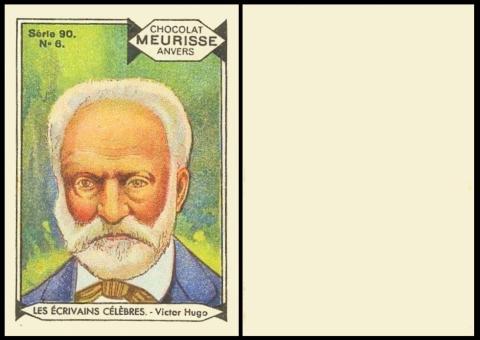
Chocolat MEURISSE [trade : chocolate : O/S - Antwerp, Belgium] "Les Ecrivains Celebres" / celebrated writers - serie 50 (????) 6/12
We move to the land of literature for our next celebration, for Victor Marie Hugo was born today, at Besancon in France, in 1802.
His father was a General in the Napoleonic army, who had enlisted at the age of fourteen and was a pro-republican in no uncertain terms, whilst his mother was totally on the opposite side. However she was devoted to her husband and would follow him on his campaigns, along with her children. Victor-Marie was the third son. Then in 1803 she seems to have had enough, and remained in Paris, possibly over her husband`s burgeoning friendship with an English woman. Somehow our man`s mother met up, and maybe had a little retaliatory dalliance with Victor-Marie`s godfather, also called Victor, and yes, our man was named after him. He had served alongside the father, but split off and changed sides, then got into trouble and gone into hiding on the Hugo estate, at a time when our Victor was small. But he was later captured, and executed in October 1812.
By then Victor-Marie`s father was now a Count, having been granted the honour in Spain, in 1810, by the then King of Spain, Joseph Bonaparte. The title was not legal in France, and probably not in Spain either, but Victor Hugo called himself "Vicomte" ever after and refused to let it go. His mother had decided to separate from her husband, and she took the boys to Spain and then came back to Paris without them. Later on it emerged that their mother had been forced to give them over as part of the separation deal, but they were sent to school in Madrid and hardly saw their father, which made it rather a harsh punishment for them too.
By 1815, one of the sons, Abel Joseph, had become part of the Joseph Bonaparte entourage, and the other two had been returned to Paris, but to a boarding school, not into their mother`s care. Victor-Marie next saw her at the age of eighteen, and moved in with her, but three years later she died. His father then married the English woman with whom he had been living quite openly, and Victor-Marie also married, a childhood friend. They would remain married until her death in 1868, and, after losing their first son in infancy, would go on to successfully rear five children; though both husband and wife had frequent affairs.
One year after his marriage he published his first book, "Han d`Islande", or Hans of Iceland, set in Norway, and revolving around the son of the Viceroy who was in love with the daughter of a man locked up in a fortress by the King. It is a very dark work, and very complex, but if you stick with it the two lovers eventually marry and the father is restored to being Count of Griffenfeld. It is possible that he was only able to write it because he had a pension, a grant given him for life by Louis XVIII, through his writing of a collection of poetry which the King liked very much.
It is said that Victor Hugo`s early works were just training, and that his first true novel, "Le Dernier Jour d`un Condamne" was written in 1829. This is indeed about a condemned man`s final day, and his thoughts as he nears the untimely end of his life, though it was not until 1832 that Victor-Marie claimed it and allowed it to carry his name, as Victor Hugo; before then it had been anonymous. The most interesting part of the tale is that at one point a man appears who is also condemned, not, as our man, for murder, but for stealing a loaf of bread, not for himself, nor his family, but for the family of his sister. Victor Hugo took a liking to this character and he would later revisit him, giving him a name, Jean Valjean, and making him the hero of another book, "Les Miserables", published in 1862, during a fifteen year exile to the Island of Guernsey, after his criticism of Napoleon III, which lasted from 1855 until 1870 - though in actual fact amnesty was granted him in 1859, providing he no longer openly criticised the government, he just refused to comply with that and preferred to stay.
By that time Victor Hugo was a prolific writer, almost always on themes of social injustice and inhumanity. In 1831 he published the ultimate novel of the tortured but romantic soul, "The Hunchback of Notre Dame".
After 1841 he became more embroiled in politics, and the abolition of both slavery and the death penalty. Sadly both still exist, worldwide.
His wife died in 1868, and he decided not to marry his long term mistress, she died in 1883, just two years before him. By then both his sons were dead, and his daughter struggling with her mental health.
He died on the 22nd of May 1885, at his home, from pneumonia, and his hand written last wishes, to be buried as a pauper, with no celebration, were completely ignored. Instead he had a state funeral attended by two million people, and a crypt in the Pantheon which, oddly, he shares with Alexandre Dumas and Emile Zola.
This is a lovely set with very characterful drawings. It comprises :
- Goethe
- Schiller
- H. Conscience
- Voltaire
- Honore de Balzac
- Victor Hugo
- Stendhal (Henry Beyle)
- Sainte-Beuve
- Ibsen
- Leon Tolstoy
- Emile Verhaeren
- Charles Dickens
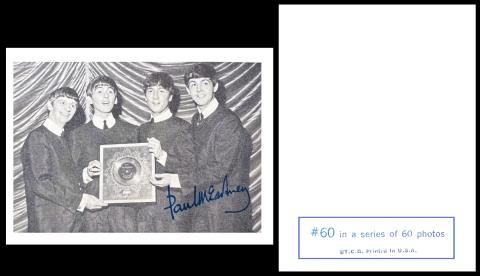
Topps [trade : chewing gum : O/S - USA] "The Beatles" (1964) 60/60
I picked his last event because it seemed easy and time was running out, and I still had not returned to tackle Lady Baden Powell who I was finding it hard to get along with.
So here we have a relatively new event, "Retro Day", only founded in 2018, and the beauty of that is that the word "Retro" simply means looking backwards, at either a time you remember well or a time you wish you were alive to experience.
In other words, lots of scope for a quick finale.
I would have liked to be alive in the 1920s, but then I would have been old enough to go to war, which I would have opposed. And if I had to pick a time in my life that I remember with great fondness, I would have to say I would struggle. There have been temporary happinesses, but most of them have either ended in great loss, and tears, or in indecision, when maybe I did have a chance to do what I so desired but let it slip away, then spent the rest of my life wishing I had taken the chance, and hoping I may get another, which, if I am honest, is getting ever more unlikely. Though like all big hopes, they never truly die unless you give up on them and let them wither.
As for why I have this card, music has been a great pleasure in my life, though even now I listen to it surreptitiously, with ear buds tucked beneath my hair. I freely admit to not being much of a Beatles fan, but the fact remains that when I was born they were number one in the British and American charts, with the same song, "I Wanna Hold Your Hand", and this picture reputedly shows the gold disc they were awarded for that song. So if history only begins when you take your first breath, this is the start of mine.
We have indeed had cards of The Beatles before, but this one is rather special as it was not issued by A. & B C. Gum, it is the original, American, Topps version, and the first of three series that they produced.
And whilst researching this we also discovered that this set was issued in Canada, by O-Pee-Chee. However, you have to be clever to know the difference, and that, I will reveal, is in the little blue square on the reverse - for the Topps version have the tiny bottom line saying "(c) T.C.G. Printed in U.S.A." whilst the O-Pee-Chee version says "(c) T.C.G. PRINTED IN CANADA."
This week's Cards of the Day...
got on "track" with our philatelic friends, and ran in con-"junction" with Royal Mail whose new commemorative issue of twelve stamps celebrates Hornby model railways.
Of course, we are not being so restrictive, mainly because actual cards of Hornby trains seem non-existent, we are just going to look at model trains - and I found it a really interesting week. So if you know a model train fan, why not send them a link to our newsletter this week and show that cards of model trains are not only plentiful, but could make an interesting side"line" to their collection...
Saturday, 14th February 2026
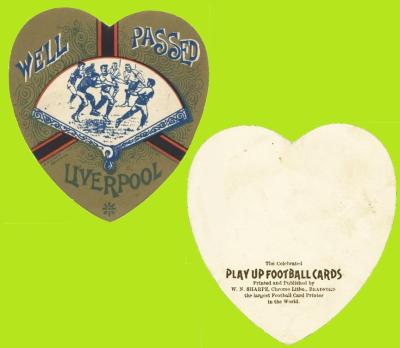
This card was not only supplied by CardhawkUK, but it is currently for sale, so if you like the look of it, it could be yours!
This card is primarily to represent Liverpool, which, in 1863, was the birthplace of Frank Hornby, the maker of the trains that the stamps celebrate, but also the maker of Meccano, the construction toy, and of Dinky, a brand of small diecast model cars, and other transportation vehicles.
But there was also a second clue, for these are PLAY-up cards, and the original idea of model trains were not for adults to accumulate, they were for children to play with, in the hope that they would turn into engineers, and train drivers.
According to the wording on the back of this shield shaped card "The Celebrated Play Up Football Cards [are] Printed and Published by W. N. Sharpe, Chromo Litho, Bradford the largest Football Card Printer in the World". Now we are not entirely sure that the final statement is true, as there were several printers of football cards, most notably John Baines of Manningham (also in Bradford), and James Briggs, of Leeds, and we also know that although Mr. Sharpe was in business before those companies, they both started producing sporting cards before him. In fact in his rather grand title "W.N. Sharpe, manufacturing commercial stationer, letterpress printer, lithographer (chromo and commercial) and account book maker" you will note that there is not a word of collectable sports cards.
We know that he started out in 1874 at a small shop at number 6, Piccadilly, then he moved to number 39, Kirkgate, Bradford, and that he also had works in Thornton Road. After his move he offered a range of family and business stationery, as well as notebooks and other leather goods. The works would eventually expand to cover numbers 151 - 157, so were of a considerable size, and here he did all the printing and book making.
In the mid 1930s, they expanded again and had a new headquarters and factory built in Bingley Road, mainly because they had become involved with the printing of greetings cards. This did not last too long though, as the Air Ministry took over the factory during the Second World War. After the war, cards again flew out of the factory - right until 1984, when they were bought out by Hallmark. But today the factory is converted, to housing, and the printing of cards, etc, will one day be a distant memory, despite the builders` attempts to immortalise them by calling it the Printworks development
Now you would expect this set to be listed in our original British Trade Index, especially as its actual name was the Index of "British Non-Tobacco Issues Up To 1945", but you would be wrong, as though W. N. Sharpe are listed, it is only with a set of postcards called the "Patent Fab Cards". That suggests two theories, either that they were not thought to be cartophilic, or they had not been discovered by card collectors yet, though they may have been known by football collectors. The first of these thoughts is ruled out quickly, though, as J. Baines, also of Bradford, is there; not just in the book, but described as "Cards sold in packets over period about 1880s to about 1919", which technically makes them commercial and not cartophilic, hence our cards would be no different.
However our cards are not in our second volume, either, now titled "British Trade Index part two". In fact they wait right until our British Trade Index part three, published in 1986, to make an appearance, and then it is shockingly scant, for it reads :
- Play Up Football Cards. Various shapes. Two known ... SHD-2
- Grimsby Town
- Milnbridge
What this entry does, though, is prove that these cards were indeed unknown until some time between 1969 and 1986. And all I know about Milnsbridge was that they were in the Huddersfield Area.
Anyway once they were listed other cards were obviously unearthed, and in our British Trade Index part four there is a very healthy list indeed, which reads :
- SHD-2 (Play Up Football Cards). Five groupings :
- Back headed "Puzzle No....." 6 known :
( 6) ""Well Played Mossley", portrait "G.H. Taylor"
( 13) "Kendal Hornets", portrait "J.H. Thompson
( 44) "Well Played Radcliffe", portrait "Alf Buxton"
(161) ""Play Up Cardiff", portrait "U. Barnes - Capt"
(174) "Play Up Morecambe", portrait "Codd. - J.D. Crock"
(192) "Play Up Cheetham Hill", portrait "R.A. Cowman - Capt"
- Back headed "Registered Designs - Copyright - The Celebrated Play Up Football Cards" - 3 known :
1. "Gloucester" - portrait "Albert Collins"
2. "Going for a Try - Stockport"
3 "Shield Winners - Bradford"
- Back headed "Sharpe`s - Copyright "Play Up" Regd. 11872". 1 known :
1. "Well Played - Grimsby Town", picture "A Throw Out"
- Back headed "The Celebrated - Play Up Football Cards". 4 known :
1. "Bravo Halifax - Good Old Cup Winners", portrait "Ripley"
2. "Play Up - Darwen", portrait "H.E. Briggs"
3. "Play Up - Kendal", portrait unnamed
4. "Play Up - Milnsbridge, no portrait
- Back headed "The `Floral` Football Card". 1 known :
1. "Play Up Stockport County", portrait "J. Birchenall"
None of these fit our card, and that was the final volume of the original set of the British Trade Indexes. Worse than that, when the updated version was issued in the year 2006 there was a bit of a surprise, for under W. N. Sharpe, all that appears are the "Patent FAB Cards" - and, sadly, the subtitle beneath the issuer`s name reads "Printers. Issued 1905-1907. Also issued "Play-Up" football cards, as those issued by Baines. These are classified as Commercial, and are not covered in this volume."
Sunday, 15th February 2026
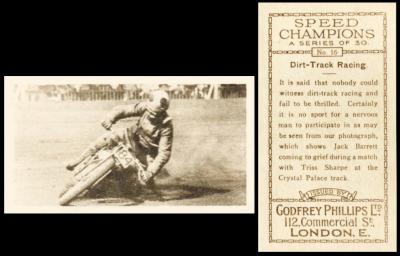
Our second clue, of "Dirt-Track Racing" ought to have given us TRACK, which is one of the most important parts of any train set, though when the earliest model trains were manufactured they ran by clockwork along the floor. These came to be known as floor trains, trackless trains, or even carpet trains. Most of them just ran in a straight line until they hit an obstacle but some included mechanisms to make them run in circles.Sadly, I have still drawn a blank on Jack Barrett, the subject of this card, which seems to be his only cartophilic appearance.
This card does also mention Triss Sharpe, who appears on card 20 of this set too, but it looks like his only card ever, though we do know a bit more about him. He first raced in the 1928 season, and was given the job of "skipper", or captain, of the Crystal Palace team in 1929, but he gave it over to Roger Frogley in 1930 in order to take part in the speedway league events. It appears that it was during one of these that he was injured in some way, bad enough to rule him out of the 1930 Star Riders final. He did return, though, and continued to ride with Crystal Palace right until he joined Coventry in 1933. That information led me to the fact he did not stay there long, and moved back down to south London to join New Cross in 1934, a track he never really took to, because it was rather hemmed in the area and kind of tight.
He also had two sons, also keen on motorbikes, and in the 1950s they started making a name for themselves in a slightly different branch of the sport, for they were off-roaders. Their names were Triss Jr. and Bryan, but it looks like they called themselves Sharp without the "e" on the end, so I am wondering if our card was a typo and if I went back to Triss Sharp Sr., I would find more. But its now eight a.m. on Wednesday morning so I must get up and get out (as well as check the weather).
This is a very interesting set, comprising record breakers, personalities, and sports, yet it seems not to be known of by many collectors of those subjects. Perhaps the publication of this list will aid that, for in this format it will show up in search engines, and more people will realise that the set includes :
- Warrant Officer Dal Molin [flying - Schneider Trophy 1929]
- Flying Officer R.L.R. Atcherley [flying - Schneider Trophy 1929]
- Arne Borg [swimming - Shelton Club, New York City]
- D.G.A. Lowe [running]
- Lieut. Giovanni Monti [flying - Schneider Trophy 1929]
- Flight Lieut. D'Arcy Greig [flying - Schneider Trophy 1929]
- Flying Officer H.R.D. Waghorn [flying - winner of Schneider Trophy 1929]
- Squadron Leader Orlebar [flying - Schneider Trophy 1929]
- Malcolm Campbell [land speed record breaker]
- Miss M.B. Carstairs [motor boat world speed record holder]
- The R.A.F. Display, Hendon, July 23rd, 1929 [39th Squadron - flying]
- The British Schneider Cup team, 1929 [Flying Officer Waghorn, Flying Officer Moon, Flight Lieut. D`Arcy Greig, Squadron Leader Orlebar, Flight Lieut. Stainforth and Flying Officer Atcherly - flying]
- The Italian Schneider Cup team, 1929 [flying]
- 30,000 Miles in 30,000 minutes [Miss Violette and Miss Evelyn Cordery : automobile endurance racing]
- Jack London [sprinting - Stamford Bridge]
- Dirt Track racing [Jack Barrett - speedway - Crystal Palace]
- Broadsiding [Nobby Keys - speedway]
- Sidecar Cornering [Bradford track at Greenfield]
- Neck and Neck [Roger Frogley and Ben Heiatt - speedway - Crystal Palace]
- "Cinder Shifting" [Triss Sharp - speedway - Crystal Palace]
- Forseti [racehorse - H. Beasley on top - winner of Cesarewich Stakes, 1925)
- British Super Marine S6 [flying - winner of Schneider Trophy 1929]
- Gloster Napier 6 [flying - Schneider Trophy 1929]
- The Golden Arrow [land speed record breaking car, driven by Major Sir Henry Segrave]
- The Shamrock [Sir Thomas Lipton`s yacht, challenger for the America`s Cup]
- Trigo [racehorse, winner of Derby, St. Leger, and Irish St. Leger in 1929)
- Gertrude Ederle [swimming - English Channel]
- Major Sir Henry Segrave [land speed record breaker / speed boat racer]
- Kaye Don [land speed record breaker]
- Lord Burghley [hurdling]
As for the cards, they are first recorded in our original Godfrey Phillips reference book, RB.13, as
- 128. SPEED CHAMPIONS. Small cards, size 67 x 37 m/m. Fronts printed by photogravure in sepia. Backs in brown with descriptive text. Issued 1930.
This is much reduced in our original World Tobacco Issues Index, where the entry reads only :
- SPEED CHAMPIONS. Sm. 67 x 36. Sepia gravures. Nd. (30) ... P50-82
And that remains identical in our updated World Tobacco Issues Index, save a new card code :
- SPEED CHAMPIONS. Sm. 67 x 36. Sepia gravures. Nd. (30) ... P521-370
Monday, 16th February 2026
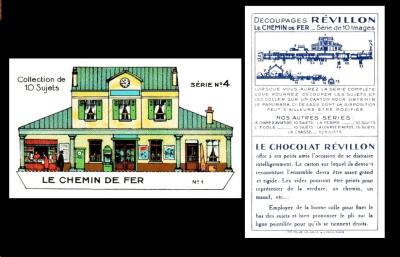
Today we brought you another one of these lovely Revillon cut out cards, the home page for which is with our Card of the Day for the 16th of March 2026, purely because that features what is believed to be the first series of all.
This set is of a station, and it is here to show that a model railway is not just a train, there are ancilliary buildings, and station staff, and passengers, plus other things, like weighing machines, and chocolate dispensers, which were all manufactured in metal or lead at one time. On which note I have to say I always got much more excited by getting hold of a box of peripherals like weighing machines and passengers than I ever was when I got a box of trains....
Before I steam on, do be aware that Revillon also used the title "Chemin de Fer" for a sectional series, slightly later, which was drawn by Jean Bernard-Aldebert, similar to the card of the travelling fair we featured as our Card of the Day for the 8th of May, 2025
On our card it says the title of the set, and "Collection de 10 Sujets" but this is not entirely correct as though there are ten cards, there are often more than one cut out figure on each card, and they are individually numbered, on the tab at the bottom, as on the list of twenty-five figures which follows, and this corresponds to the plan on the back of all the cards - though it is, of course, entirely up to the owner where they place their models. Then there is a large number on the front of our card, in our case "Serie No. 4", which is the series number, and this appears on all the cards in this series, which are :
- a station (on its own on the card)
- a signal box and two men sitting on a seat (with 10 - a card of two cut outs)
- a locomotive with coal cart (with 16 and 17 - a card of three cut outs)
- a goods carriage (with 25 - a card of two cut-outs)
- a blue topped passenger carriage with doors only at each end (with 18 and 19 - a card of three cut outs)
- a passenger carriage with six doors one open (with 13 and 14 - a card of three cut outs)
- a passenger carriage with six doors two open (with 15 - a card of two cut outs)
- a grey topped passenger carriage with doors only at each end (with 22, 23, and 24 - a card of four cut outs)
- the station master`s cottage (on its own on the card)
- a latticed railing with three people in front and one behind it (with 2 - a card of two cut outs)
- a stationary horse drawn cart with leader and a bicycle (with 12, 20 and 21 - a card of four cut-outs)
- the back of a motor car and a tandem motorbike (4 - with 11, 20, and 21 - a card of four cut-outs)
- a moving horse-drawn cart (with 6 and 14 - a card of three cut outs)
- two people dressed in rural costume (with 6 and 13 - a card of three cut outs)
- a signal arm with a red circular signal (with 7 - a card of two cut-outs)
- an overhead apparatus to fill the steam boiler with water (with 3, 16 and 17 - a card of three cut outs)
- two men and a porter with a flat bed trolley (with 3, and 16 - a card of three cut outs)
- two priests (with 5 and 19 - a card of three cut outs)
- two soldiers in blue with kepi caps (with 5 and 18 - a card of three cut outs)
- a porter with luggage and four passengers (with 11, 12, and 21 - a card of four cut-outs)
- a man, a family with a child, a man with a suitcase on his head (with 11, 12, and 20 - a card of four cut-outs)
- a man bending over suitcases and a standing man (with 8, 23, and 24 - a card of four cut outs)
- a woman with a man carrying a case on his shoulder (with 8, 22, and 24 - a card of four cut outs)
- two men talking (with 8, 22, and 23 - a card of four cut outs)
- an overhead signal gantry (with 4 - a card of two cut-outs)
Tuesday, 17th February 2026
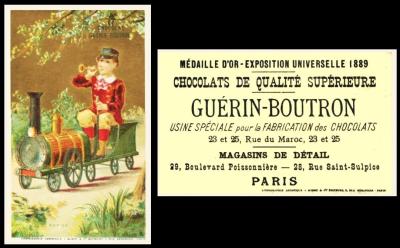
Here we have an extraordinarily grand model train, large enough for a child to ride, though it is possible it only existed in the mind of the artist, simply because this card carries a date of 1889, when Guerin-Boutron won a gold medal at the Universal Exposition in Paris - and it is recorded that the first toy trains were only retailed by Marklin, of Germany, in the early 1890s.
However it is known that toy trains had been scratch-built from wood or metal from the moment that real trains were invented, and that rich families could have conceivably had a carpenter made such a train as exists on our card. And this child is undoubtedly from a rich family, rich enough to ride to hounds and maybe even own a pack of their own, for he is attired in a miniature version of proper hunting "pinks", and blowing a tiny huntsman`s horn, an outfit that would have been costly, and very much a one off, made to measure.
We also know that from the 1840s, miniature railways for adults were built on large private estates, by and for the wealthy.
As for our card, we presume it is one of a set but have no idea of what that set comprises. Maybe you have a similar card though, which could complement ours and give us some idea ? If so, do let us know. There is no set title, though on the path at the bottom of the picture it does say "Le Rapide", which is French for "the fast [one]". And, curiously the words "Le Rapide" have come to mean the fast train, in transportation terminology.
There is another train-related link to "Le Rapide" too, as much later, starting in the mid 1920s, for it was the name of a French toy train manufacturing company founded by a Swiss man called Louis Roussy. And it turns out he has a cartophilic link too, for a member of his family actually owned our old friends Nestle, Peter, Cailler and Kohler.
Louis Roussy began with clockwork trains and then bought a factory in the early 1930s and diversified into lead soldiers, small cars, aeroplanes, and ships, even a construction system which used long strips and shapes, bolted together by the user into whichever model they fancy (just like Frank Hornby`s "Meccano").
There was, also, another thrilling link to our card, for his original logo was a diagonal shape in which a small boy was depicted riding on top of a model train, with the words "Le Rapide" below, in white, within a red bar. The name was to prove prophetic, for in 1934 they advertised that they were selling "le train marchant le plus vite dans le monde des jouets" (or the fastest moving train in the toy world). But this was electric , and it also gained most of its speed because although it was still die-cast, it was of much lighter construction, being pretty much a one piece body shell, the wheels and the internal workings, which, being electric, were substantially smaller than those needed for clockwork, key-wound models.
They were definitely innovators, and they took out several patents, on things that became industry standard, including continually simplifying the coupling method that linked the engine to the carriages, and, most importantly, discovering a means to reverse the mechanism so the toy would go backwards, eventually independently of touch, simply, as on a real train, by activating a lever by the side of the track - and, later still, by means of remote control, which they called "tele-inversion".
They thrived until the beginning of the Second World War, and then production halted - materials for making toys was needed for the war effort, and finding the money to buy necessities, like food, was more important than buying toys. British bombers also destroyed their factory at Trappes, along with many of the moulds, and lots of stock.
After the war, they had an offer from a Monsieur Chauvel, who agreed to keep the name, and maybe that was the clincher. But he sold it on in 1961, to a company called JEP which is sometimes recorded as having been founded in 1899 by Messrs. Roussel and Dufrien as "Le Jouets de Paris" (or The Toys of Paris), rather a forward thinking company who outsourced the production of its merchandise to home workers and small companies. In fact this is incorrect, because in 1909 that company filed for bankruptcy. The confusion is easy to understand though, as the JEP which bought our company was also founded in 1899, and ran on similar lines, outsourcing to local metal workers, under the company name of S.I.F., which stood for "La Société Industrielle de Ferblanterie" (and that last word means the making of tin-plate). They slowly changed their name through the decades, and also halted production, during the First World War, when their factory and their workers skill with casting had seen it become one of the centres for production of steel helmets. In 1928 they had hit on using the now long retired "JEP", and, under that name, after a Second World War, they had also successfully moved over to producing plastic models for a completely new generation of children. Sadly, though, this did not last, and only two years after buying out Le Rapide they stopped making 'O' gauge models and equipment, with the `HO` gauge ceasing two years after that, deciding to move into making small parts for full sized cars and lorries.
Wednesday, 18th February 2026
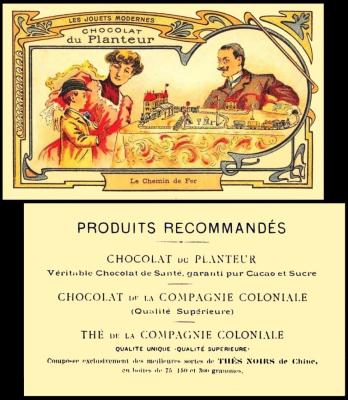
This is a typical railway layout, on a table top, the main benefit of which, at least to the model train-driver, is that it is always ready for action. However, you will often find them start out on the dining table and then be persuaded, in no mean terms, by the non model-train-drivers in the family, that it would be a much better idea to set it up in a spare bedroom, or the loft.
The idea of a train set was to encourage the skills of engineering the track into position and coupling the carriages together each time they were removed from the box. At first this was easy as the early tracks were all circular and the trains just went round and round. However in 1859 the Emperor Napoleon III built a railway in the grounds of Chateau de Sainte-Cloude, in Paris, for his three year old son. That used the same clockwork trains as other railways of the time but the track had an extra part which enabled one track to cross another, in a figure of eight, and that started the idea of making differently shaped railway layouts. It also meant that the user had to work out how to make the curves and straights but still fit them together at the end so that it was a continuous journey back to the start and round again, and that`s not as easy as it sounds.
Most model-train drivers start off with just the trains and the track, then they add. This is usually the result of going to a train fair or shop and seeing scenery (trees, hedges, mock grass), workings (signal arms, junctions, level crossings, bridges) or structures (a station, factories trackside, houses in the country, flats in the town).
Though you can run a very miniature layout in a box using the smallest scale of train, most model train-drivers soon outgrow it. Also that leaves little scope other than a continuous loop, which is really a backwards step, right backwards to when model train sets were first invented. Thinking "outside the box" brings in the main concepts of having more than one station, at which some trains stop and some pass by, branch lines, junctions, sidings, shunting yards and works.
If you find this all starting to what your appetite, then nip along to Hornby`s website, a page of which actually tells you everything you need to make a proper railway layout.
Returning to cards, the ones in this set are all very Art-Nouveau styled borders, but in differing colours, and the cards do have a tendency to browning. We have noticed that on most of them the set name is in a banner above the issuer`s name, but on some the set title are in diagonal boxes across the picture. We are not sure why but have noted this in the listing using (DB) However, they are still fascinating, and would be eagerly snapped up by a toy collector if they should come into contact with them.
So far we know of - a lot, so I will have to hold it here and come back later. The cards themselves are not numbered, but once I got over twenty I thought crikey, how many of these things are there. I now have sixty one, so it seems it may follow the normal practise of eighty four, but I now seem to be hitting all the same ones online and in catalogues and from European collector friends, so if you can add any, please do.
- L`Auto a Pedale et le Tricycle (pedal car and tricycle)
- L`Album d1Images (picture book)) - (DB)
- La Baignoire Enfants (doll`s bath) - (DB)
- Les Ballons Rouges (red balloons)
- Le Bateau a vapeur (steam yacht) - (DB)
- Le Bateau a Voiles [sailing yacht)
- Le Bebe Perfectionne (walking doll)
- La Bergerie (toy farmyard)
- La Boite a Musique (music box)
- La Boite de Couleurs {painting set)
- Le Canon de Bois (wooden cannon) - (DB)
- La Canon da Campagne (war cannon)
- La Charrette Anglaise (the English dog cart)
- La Chasse (toy huntsmen and hounds)
- Le Chemin de Fer (toy train) - (DB)
- Le Cheval (pull along horse)
- Cheval a Bascule et Cheval Mecanique (rocking horse and horse on wheels) - (DB)
- Le Cheval Jupon (horse costume with fake legs to side)
- Les Cheveaux de Courses (racehorse game) - (DB)
- La Chevre et la Mouton (goat and sheep) - (DB)
- Le Cirque (toy circus)
- Le Clairon et le cor de chasse (cornet and hunting horn) - (DB)
- La Construction et la Boite a Ouvrage (building bricks)
- La Crecelle (baby walker) - (DB)
- L`Epicerie (toy shop) - (DB)
- L`Escadre (ship models in a bowl)
- L`Etabli de Menuisier (carpenter`s workshop)
- La Ferme (toy farmyard)
- Le Fiacre et le Tramway Electrique (electric cab and tram) - (DB)
- La Folie, le Hochet (? and a baby`s rattle) - (DB)
- Le Fontaine et le Puits
- Le Fourneau (child`s cooking stove)
- Le Fort (toy fort and soldiers)
- Le Fusil et le Sabre d`Officier (guns and swords) - (DB)
- Les Jouets Parisiens (model figures) - (DB)
- La Lanterne Magique (magic lantern) - (DB)
- La Layette (doll`s clothes) - (DB)
- Le Menage (doll`s bedroom furniture)
- Le Metier a Tapisserie (tapestry on frame)
- La Panoplie (dressing up) - (DB)
- La Peche a la Ligne (indoor fishing, hook the [fake] fish) - (DB)
- Le Petit Piano (toy piano)
- La Polichinelle (puppet)
- Les Pompiers (toy Fire Brigade)
- Le Postillion (reins for one child to wear and one to drive) - (DB)
- Le Poupard (dolls) - (DB)
- La Poupee de Son (rag doll) - (DB)
- La Poupee Louis XV (a doll of the time of Louis XV)
- La Poupee Moyen Age (a doll of the Middle Ages)
- La Poupee Egyptienne (Ancient Egyptian doll) - (DB)
- Le Service de Table (tea set)
- Le Singe Grimpeur, Le Hanneton, le Canard, Le Toutou Sauteur (climbing monkey, cockchafer, duck, jumping dog) - (DB)
- Le Theatre (toy theatre) - (DB)
- Le Tir au Javelot (archery target) - (DB)
- Le Tir Eureka (shooting target) - (DB)
- Les Tombereaux (pull carts) - (DB)
- La Toupie a Musique et le Cab (musical spinning top, hansom cab)
- Le Toutou (dog on wheels)
- Le Tricycle a Petrole et Auto (ancient and modern model cars)
- Le Zootrope (zoetrope)
- La Voiture de la Poupee (doll`s pram) - (DB)
Now we also know there are other issuers of this set, because in the hunt we found :
- Au Paradis FLEURI
- Chocolat de L`UNION
- Chocolat LOUIT
Thursday, 19th February 2026
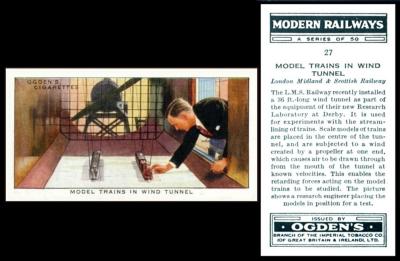
This card shows several things - that model trains were detailed and exact enough to serve as testing models for actual trains - that they were definitely not just children`s toys - and that their original, albeit "by product", purpose, to train engineers and railway staff, actually worked.
However, in the course of this week`s investigations, we learned that in the National Railway Museum, York, there is a model of a railway layout which was designed to train signalmen before they started actually working on the Lancashire and Yorkshire Railway. it was constructed in 1912, and the trains, (so presumably the track, signals and other equipment) were supplied by Bassett-Lowke.
Bassett-Lowke was founded in Northampton, in the 1890s, by Wenman Joseph Bassett-Lowke, selling trains, ship models, and construction sets by mail order. Unlike Hornby, it bought in most of its models, though it did design and produce a few. It offered trains in every size, from the most usual `O` Gauge, up to large live steam models, the first of which was used on the Blackpool Miniature Railway, that is now in private hands, but a much smaller size railway layout that they designed and built can still be seen at the Bekonscot Model Village.
The main thing about Bassett-Lowke was the excellence of their catalogues, yet sadly this was what led to their decline, for people would send off for a catalogue and go out hunting bargains in local shops and markets for less. In 1964 the company stopped selling by mail order and also sold their shops, to Beatties. That was the end, and Bassett-Lowke stopped trading in 1965. It was bought by a succession of private and company train enthusiasts, but in 1996 the name was bought by Corgi, who used it for a series of `O` Gauge trains, but did not really market it with gusto. Then in 2008, the unthinkable happened, and Corgi were taken over, by Hornby....
This set is first listed in our original Ogden`s reference book, RB.15, as
- 121. 50. MODERN RAILWAYS. fronts printed by letterpress in colour. Backs in grey, with descriptive text. Home issue, 1936. Similar series issued by Hignett.
The Ogden`s version next appears in our original World Tobacco Issues Index as :
- MODERN RAILWAYS. Sm. Nd. (50) See Ha.571-11 ... O2/159
And the listing in the same book, concerning the Hignett version, is identical save the card code.
The handbook reference, at that time, led to the one published by the London Cigarette Card Company , to accompany their catalogue for 1955, and the entries in that catalogue are quite telling, as they read :
- HIGNETT :
Modern Railways (October 1936) - odds 1/-, sets 50/-
- OGDEN :
Modern Railways (1936) - odds 6d,. sets 30/-
Sadly, months of issue were not recorded for the Ogden`s sets, but we presume, as the parent, that they preceded the Hignett ones. As for the difference in price, it is that more sets of Ogden`s cigarettes were sold, and over a wider area of the country, than the Hignett packets, so the Ogden`s sets were not just completed quicker by the consumer, but more duplicates were available for dealers to buy, or swap.
As for the handbook, that simply lists the eighteen series which were issued by both Hignett and Ogdens, which I am pretty certain are recorded elsewhere, but can`t seem to find.
By the time of our updated World Tobacco Issues Index, gone is any reference to that handbook, the entry simply reads :
- MODERN RAILWAYS. Sm. Nd. (50) ... O100-540
Friday, 20th February 2026
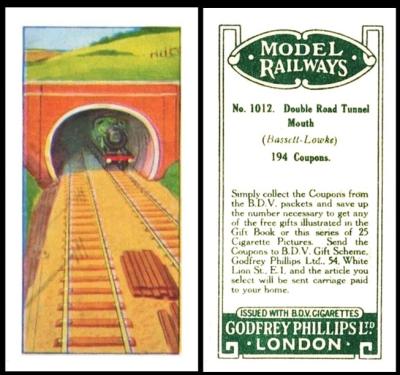
Here we have a feast for railway model collectors everywhere, a whole set which shows trains and sundry items from Bassett Lowke and Bing. Now we dealt with Bassett-Lowke yesterday, so today we will have a look at Bing.
Gebruder Bing, or the brothers Bing, was founded in Nuremberg in 1863 as a company to make metal kitchen ware and utensils, but they diversified to make toys, and by 1905 could rightly claim to be the largest toy sellers in the world. Their range included boats, cars, trams, optical toys, tinplate models, stationery engines, and trains.
Bing's first trains hit the market in the 1880's, and they were one of the first companies in the world to produce track, and also, slightly later, to offer railway buildings
In 1902 they introduced the first ever electric powered train.
In fact several of Bassett-Lowke`s trains were actually made by Bing - though Bing repainted them, on arrival, so they were in British liveries - and they also made trains for the toy store Gamages. Eventually Bassett-Lowke would save time by supplying Bing with the paintwork specs and also plans and drawings of the latest locomotives so they could be copied.
Somehow, things went very bad in the 1920s, and in 1927 the President and his son jumped ship. And in 1932 the company went under. Its assets were all sold off to other manufacturers, even the name was sold. However, when the president left, he bought another company making tinplate toys, and did a lot of work on improving the smaller sized `00` gauge trains. He also trademarked a new name, "Trix" which then joined up once more with Bassett-Lowke, who distributed the trains in the UK, and would go on to produce them under license. He managed to leave Germany just in time, and move to England, where he died in 1940.
In our original Godfrey Phillip Reference Book, RB.13, this set is lavishly described as :
- 101. 25. MODEL RAILWAYS. Small cards , size 67 x 35 m/m. Not numbered consecutively, but cards bear reference to numbers relating to B.D.V. gift scheme. Fronts printed by letterpress in colout. Backs in green, with recurring paragraph explaining how B.D.V. Coupons can be exchanged for items illustrated on the cards. Issued 1927.
Subjects (First line of BACKS) ;-
- No.84. Circular Water Tower
- No.60/624. Country Station
- No.10/513/0. Crane Truck
- No.1012. Double Road Tunnel Mouth (Bassett-Lowke) 194 Coupons
- No.1003. Engine Shed (Bassett-Lowke) 840 Coupons
- No.60/615. Gantry Signal
- No.1006. Goods Depot (Bassett-Lowke) 630 Coupons. No. 10/637. Crane (Bing) 170 Coupons
- No.62/230/0. Guard`s Van (Bing) 60 Coupons. No. 10/537/0. Barrel Waggon (Bing) 74 Coupons
- G.W.R. “Vulcan” Locomotive
- No.10/674. Level Crossing - Movable Gates (Bing) 170 Coupons. No. 10/616/1. Telegraph Pole (Bing) 50 Coupons.
- No.61. L.M.S. Bogey Brake 3rd. (Bassett-Lowke) 420 Coupons
- No.1346 LM.S. Open 10 Ton …
- No.95. L.M.S. Post Office
- L.M.S. Scale-model Locomotive
- No.134/33. Loco Coal Wagon
- No.10/664/0. Mechanical Turn-Table (Bing) 280 Coupons
- No.2. Model Hoarding
- No.62/520/0. Motor Spirit...
- No.9466/0. Parallel Points (Bing) 120 Coupons.
- No.10/529/0. Petrol Wagon (Bing) 87 Coupons. No.10/546/0. Timber Waggon (Bing) 114 Coupons.
- No.951. Pick-Up Apparatus
- No.10/.611/0/ Railway Bridge
- No.1002. Signal Box
- No.1020. Station Overbridge
- No.60/61. Wayside Station.(Bing) - 210 Coupons. No.10/641. Lamp Standard with Ladder (Bing). 80 Coupons.
Actually I am a bit disappointed by this, I would have liked to have known what they cost in points, so I might add them in myself, in brackets, but not tonight... or not all of them tonight, anyway ! I did add one or two, and hit on the plan of making the original wording to appear in standard text, whilst the additions are in bold text. Doing this also allowed me to add in the makers of the models, and the fact that there are sometimes two models on one card.
And once more it must be noted that the cards are not actually numbered, which leads to some of them causing confusion, most notably "No.2. Model Hoarding", which is not card 2, but model 2. And there are other double digit numbers too.
As you may imagine, that amount of information was never going to make it into the original World Tobacco Issues Index, and you are right, for all it says is :
- MODEL RAILWAYS. Sm. 67 x 35. Unnd. (25). See RB.13/101 ... P50-69
That is more or less repeated in our updated World Tobacco Issues Index, save a new card code and also a new reference book. relating to our updated Phillips reference book. That text therefore reads :
- MODEL RAILWAYS. Sm. 67 x 35. Unnd. (25). See RB.113/101 ... P521-342
So there you have it, another newsletter on the shelf ready for the reading.
Sadly I did not add any more of the cards in the back issues to the index over the week, we remain poised on the fence between November and October 2024 - but I may do some tomorrow. I will also try to do a few more Godfrey Phillips "Model Railways", as far as entering the full text on each card.
Almost forgot, we have opened a page of 2026 Convention News, so do keep checking there to see what will be going on in Kings Lynn - in not too many months to come.
And that is all I have to say. Apart from hope you enjoyed this edition, and now it is time to turn in