
So here we are again, Friday turning into Saturday, and a new newsletter sliding into its allotted slot. This may be the craziest newsletter ever as I just left my bag on a bus, and have no glasses, and I had not yet finished all the cards. There is also no way I can read the reference books - but normal service will continue as soon as it possibly can. I wrote the bit I had not finished yet last night with a magnifying glass..... but this morning, which is Saturday, I have borrowed a pair of someone else`s glasses, and so I may get the newsletter finished after all, in short bursts, as they are not entirely agreeable to my eyes.
I hope that you enjoyed the three-ish days of sunshine, got lots of washing done, and managed to stay out later because it stayed lighter longer. But there is still a month before we put the clocks back, or is it forward ... ? I enjoyed it most because it gave me a continuous and much awaited forty-eight hours of no rainy weather in which I could actually apply flea treatment to the back of nipper`s neck with no worries that it would be washed off before that forty-eight hours was up, because wetness renders it less efficient. And it ought to have gone on on the third of this month, which proves how jolly wet it has been.
This week I had a bit of a purge with the back issues of the newsletter and the cards from
28th of September 2024,, 5th of October 2024, 12th of October 2024, 19th of October 2024, and
24th of October 2024 have all been added into the index. Only one change, and it involved a Card of the Day from this week, the one I used on Monday to illustrate "Retirement Housing", which turned out to belong to a set I had used before. So our Card of the Day for the 26th of May 2023, which was from this set, of Sir Thomas Lipton, is now a lemon, which luckily fitted in with the theme of that week rather well.
Anyway, enough about the past - onwards, and into the future, starting with a very odd event indeed which some say will affect that future very much
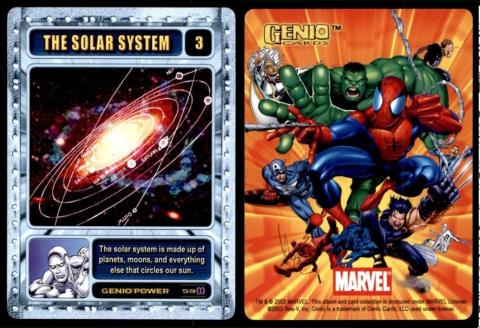
Genio Cards LLC [trade/commercial] "Genio Marvel Trading cards" (2003) 3/360
You see, tonight there will be a rare planetary event, when Mercury, Venus, Jupiter, Saturn, Uranus and Neptune will all form an arched line one after the other. And as you can see on this card, usually the planets are a disparate bunch, placed hither and yon, with not a thought of joining up. So it is pretty magical that every so often the varying schedules of their orbits bring them close at hand.
By the way, having six planets in alignment is not the highest ever, and it has been beaten, only last year, on the twenty-seventh of February 2025, when Mars joined in the parade. But do try to go out and see it, as it will not happen again until 2040.
Many centuries ago, such events were seen as portents of change, and some still believe they are prophets - with the degree of change dependent on just how many planets are so aligned. They certainly have form in this, and it is suggested that in 1496 an alignment of simply Jupiter and Saturn caused the Renaissance. Often though, other things joined in to make the astronomical message even stronger, a spate of really unseasonable weather accompanying the alignment of Mars and Saturn before the Fall of Constantinople in 1453 - and in 1066 there was not only an alliance of Jupiter and Saturn, but a solar eclipse, and also Halley`s Comet, which hung in the sky for an unheard of whole month, just before the Battle of Hastings.
Moving closer to modern times, Jupiter and Saturn were together, and visibly so, for an amazingly long time, a hundred and ten days, around the time of the Battle of Britain in 1940.
We do not know what will happen after this one, but people are expecting something, especially given the length of time that will pass before the next. We can just wait, I guess, and see.
These cards had a special launch, in 2003, at the toy shop, FAO Schwartz in New York. That tells you that they were actually designed for children, not collectors, with the age group specified as being from five to twelve. The idea of the cards was educational, but by osmosis, hoping that the children were inspired by their super heroes to learn. There was also a game, the Genio Power Challenge, where one player had to test the knowledge of another based on what they remembered from the cards.
The set actually has an album, a spiral bound one of sixty four pages, and it does say it was volume one, but have not yet tracked down any other volumes. Doing so may have meant that I did not have to alter the last time I used this set, ouch, but fear not all worked out okay as I have now actually been offered a proper card of the Channel Tunnel, which will go that other place some time today in that slot at which point I will add the linkage here. Though you can actually get these cards in the French language, which is something I will bear in mind for the future, and selected numbers are also available as Bonus Super Hero cards, in gold, silver, gold foil and silver foil. So this set may turn up again in the future.
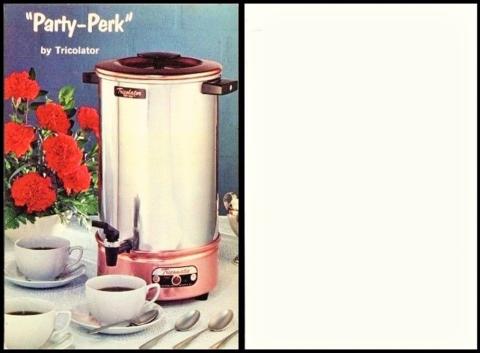
TRICOLATOR Co. Inc [trade : coffee machines and filters : O/S - New York City, USA] "Sales Advertising Cards" (1960s) Un/??
As rather a fan of a certain coffee caterer called Costa, mainly because they allow well behaved dogs to come into their shops - and they haven`t yet twigged that nipper does not exactly fit that description, I will almost certainly celebrate today`s event, #NationalBaristaDay, by calling in at a store in this locality. Or maybe further afield, who knows ?
So let us start by exploring that word "barista". It is of Italian origin, but simply means a bartender, someone who works behind a counter or bar making drinks. It does not specify whether these drinks are cold or hot, or alcoholic or not. So how it came to be associated so strongly with coffee who knows. And if we are being technical, if there are two men behind the counter, they are called "baristi", whilst two women are called "bariste" (which is actually Italian for "barmaids").
The main task of a barista today is to manhandle, or womanhandle, a large commercial coffee dispenser, but at one time they would have made the coffee from scratch, even grinding the beans. Nowhere in the description does it say that their job is to draw intricate designs on the coffee with cream, though it seems to be expected of them.
In fact that sort of thing has a name, "Latte Art", which you may brandish freely in order to impress or to show off, that is entirely up to you. You may also like to know that such is only made possible by a cunning blend of an emulsion of coffee oil, brewed coffee, and a foam of air in milk. It was invented, naturally, in Italy. However it is but ephemeral, and will never last the whole drink through..
Coffee machines are certainly not ephemeral, and the drip style of machine was developed by a female German entrepreneur called Melitta Bentz, way back in 1908. She was also the first to construct a filter, which was simply notebook paper, folded into shape. And another lady, Inez H. Pierce of Chicago, Illinois, patented the automatic vacuum coffee machine on the twenty-seventh of August, 1930.
Our machine looks rather like a Baby Burco, which I guess few readers remember, and I am pretty sure none of those remember it with fondness. This is a type of antiquated clothes spinner that might get the water out of wet washing by centrifugal force but seems to get more of it on the floor than in the bowl beneath the spout, and also all my dogs have found it funny to get the bowl between their teeth and pull it away. Mine was my mum`s wedding present, in 1959, and I still struggle with the wretched thing, though in the summer I just wash the clothes, wring them by hand, and hang them on the line soaking wet, which is way easier.
Tricolator was an American company, and in the 1960s they made a very futuristic design indeed using teak, that turns up on eBay from time to time. As the name of our machine implies, this was a percolator for parties, where lots of coffee could be continually served, but I imagine its original intention was to have it in the office, this was just a bit of diversification in the hope of getting extra sales. We know that the basic model was made of stainless steel, ours was a bit more grand and had a copper bottom. In fact we also know the model of our machine, it was TG-24, from which you could extract a maximum of twenty-four cups. The more futuristic one was model TRW-42, and yes, that did make a maximum of forty-two cups of coffee before needing a refill.
We have several addresses for the Tricolator Co. Inc, all within New York City or New York State, the earliest being in Water Street in 1920. They also seem to have diversified into other heating-up tools for kitchens, like plate warmers. But where they are now, I have no idea. It seems likely they were pushed out by cheap plastic flooding the market, as many companies were, unable to reduce their costs in order to combat falling sales. But we will keep looking and report back
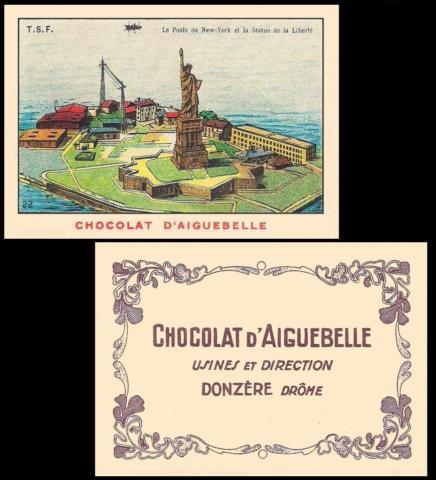
Chocolat d`Aiguebelle [trade : chocolate : O/S - Drome, France] "Telegraphie Sans Fil" / "T.S.F." / wireless telegraphy (1920s)
Ooh, a Centenary!
Today, three brothers, Benjamin, Oscar, and S. Ralph Lazarus, were very disappointed. You see they had believed themselves to be making a very generous offer, to design and to install a permanently illuminated clock on the wrist of the Statue of Liberty, and, more than that, to cover any and all costs.
However, on this day in 1926 they heard their idea had been rejected by the American Assistant Secretary of War, a man called Hanford MacNider. He was kind about his refusal, citing several reasons - that the clock would be too modern an addition to such a classical figure, and that the statue was a present from France, not to be tampered with. Also there were concerns that once she had a watch on her wrist, what next, and they did not want her shapely form to become a billboard.
Strangely, though, the main reason was the offer of the brothers supplying it for nothing, because it was seen as a favour, and giving favours to the government was prohibited by law.
You may be wondering why the War Department was involved, so let me tell you. Originally the statue was under the jurisdiction of the United States Lighthouse Board, and it served as a lighthouse from 1886 until 1902, guiding ships in and out of New York Harbour. In fact it was the first lighthouse to have electrical power, but it was not very effective, mainly due to its design, which meant the arm and head of the statue did not allow the torch to be visible from all angles. In addition the height, which ought to have been an advantage, meant the light had a long way to travel and the power was insufficient to give more than a dim light at sea level. So in 1902 the Lighthouse Board gave up, and handed it over to the War Department.
The War Department kept her, and kept people away from her, right through the First World War. During that time she was mainly used as a symbol of America, on posters and other propaganda. However it seems like their reason for wanting the statue was more a case of wanting to control the island on which she stood, not only because of its position, keeping guard on New York Harbour, but because before she was ever there it was actually Army land, and it included an star shaped fort with eleven arms known as Fort Wood which had been built in 1807 to protect New York from British invasion. They kept her right until 1933, as well, but then she was transferred to the National Park Service.
We chose this card because it actually shows the star shaped fort , thinking it was travel related, but it turns out to be a set about advances in wireless telegraphy, something that I think the Lazarus brothers would have been interested in. And it turns out that before they ever thought of using her to host a watch, there was a wireless station there, at Fort Wood, starting in 1905. That sent out signals to test how well wireless would work, and they worked well, so well that the Fort got its own call sign in 1908, but not long after that the American Army took it over and made it into a military wireless station. It was not just military though, and several public broadcasting stations used to bounce off its signal, simply because by that time the military had installed a long wave transmitter. And in the Second World War the Fort was actually planned to be the home of "The Voice of America", but this was turned down, by the Office of War Information, who seem to have still been keeping tight hold of the Island for military purposes despite it having technically been removed from them
The set is of quite small, and thin "cards", though "stamps" may be a more accurate description. They all have the letters "T.S.F." on them, but the titles are quite hard to read, being thin, grey, and on a coloured background, but we have now got all but number 5
- Le Telegraphe Optique des Romains
- Le Telegraph de Chappe
- Marconi a sa table de travail
- L`Institute Catholique ou eut lieu la premiere Experience de T.S.F.
- La Force employee pour la T.S.F. (Alternateurs)
- Le Poste d'Emission de la Tour Eiffel
- La Tour Eiffel et ses Antennes
- La salle des Groupes Electrogènes de Ste-Assise
- La Station Radiotelegraphique du Bouscat (pres Bordeaux)
- La station du Fort de l'Eau (Algerie)
- La Grande Station Intercontinentale de Ste-Assise
- Vue des Antennes de la Station "La Fayette"
- Sapeurs du Genie T.S.F. dans L`Armie
- Poste d`Emission dans un Transatlantique
- Le Montage d'une Antenne a la Campagne
- Les Montage d'une Antenne a Paris
- Le poste d'Emission de Ste-Assise.
- Un amateur de T.S.F. a ses Ecouteurs
- En famille Ecoutant le Haut-Parleur
- La Friture 11
- Le Poste de New-York et la Statue de la Liberte
- Le Semaphore du Havre et son Antenne
- L`Antenne a bord d`un Bateau vec son Poste
- Un poste de T.S.F dans un Avion de Transport
- L'Auditorium d`Emission de Radio-Toulouse
- La Diffusion en plein air par Haut Parleur
- L`Auditorium des P.T.T.
- La Derniere Merveille "L`Appareil Belin" pour transmission par T.S.F. des Images animees
- L`Enregistrement Phonographique sur Disques des Signaux de T.S.F..
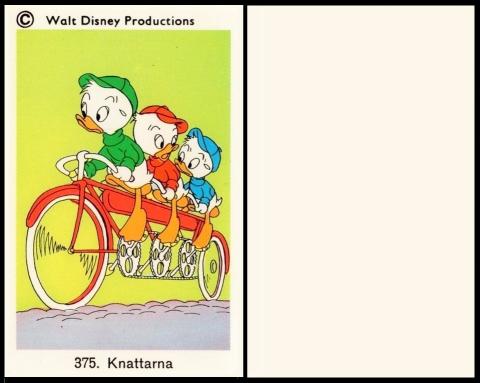
Anonymous [trade : gum : O/S - Sweden] "Disneybilder" - Disney pictures (1973) 375/624
This was the last day to fill in and it turned out more fun than I imagined. You see the clue is in the date, because it is the third day of the third month, and also #NationalTripletsDay.
Triplets in the human world are rarer than you may imagine, and if you are a betting person, it is probably not worth trying, for the odds are only one in eight thousand pregnancies. However triplets in the animal world, not so scarce as most small and medium sized mammals have multiple births, and three is at the lower end of the scale. If we look at just dogs, we find the record number in a litter was twenty-four puppies, delivered of a Neapolitan Mastiff in 2004. And that is beaten, considerably so, by a duck which is recorded as having seventy-six ducklings, in 2018.
With that in mind, Della Duck got off lucky, for she only gave birth to the three triplets above.
Della Duck was the sister of Donald, and the triplets were christened Huey, Dewey, and Louie. However in 2017, as part of the updated reboot of the cartoons, which were also rechristened "Duck Tales", it was revealed that they did have longer proper names, these being Hubert, Dewford Dingus, and Llewelyn.
They were created by the artists Theodore "Ted" Osborne and Charles Alfred "Al" Taliaferro, and first appeared in 1937 in a comic strip. Then, the following year, they appeared on screen, in a short subject called "Donald`s Nephews". This is where we get the back story of the triplets, starting with their uncle Donald getting a postcard from his sister, saying she is sending her children to visit. Oddly the card is signed "Dumbella", not Della, but it is supposed that Della is short for Dumbella. So anyway, these three boys turn up, and never go back; not just that, but their parents are never seen or heard of again, which seems to be rather a theme in the works of Mr. Walt Disney.
It appears that we can also credit Mr. Disney for realising that it is sometimes hard to tell triplets apart, and coming up with making their clothes in different colours, giving Huey red, Dewey blue, and Louie green outfits.
Cartophilically speaking it is said that they first appeared on a card in 1955, by Barratt, part of an untitled set which we know today as "Mickey's Walt Disney Characters", the first series. In fact the triplets appear rather oddly, for Huey is card three and Louie card four, but Dewey waits until card thirty-five. They then spend a couple of decades appearing together, but only on European gum cards, like ours, though ours is a bit different as it is Swedish, not Dutch. This dates from the 1970s and calls them "Knattarna", which is Swedish for "the boys". They probably have individual names in Swedish but I have not found it out yet.
In the mid 1970s they again turn up together on a British card, and that is Bassett`s "Disney Health and Safety" where they are misbehaving and causing all kinds of mayhem. More recently they have appeared on plenty of film and cartoon tie-in sets, and it is safe to say that we will be seeing them, and enjoying their escapades, for a very long time to come, though it does remain very curious that they have not aged into ducks by now and raised families of their own.
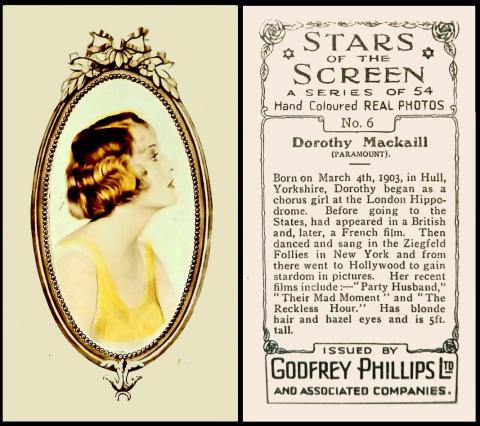
Godfrey PHILLIPS [tobacco : UK - London] "Stars of the Screen" (1934) 6/54 - P521-486.1 : P50-129.1 : Ph.136 [RB.13/136]
Today in 1903 saw the birth, in Kingston-upon-Hull, Yorkshire, of Dorothy Mackaill.
She was a dancer from a very early age, possibly because she enjoyed it, and possibly because her father was the owner of a dancing school. However, when she was ten or eleven her parents separated, and she, rather unusually, stayed with her father. He seems to have allowed her to teach at his school, and then she turns up in London, attending auditions and trying to get work on the stage, but we do not know if this was her idea or her father`s.
Her first big part was in a revue called "Joy Bells", which opened in March 1919 at the Hippodrome in Charing Cross Road, London. She was just sixteen, and presumably one of the chorus girls. It starred George Robey, and the title was a play on the ringing of the bells which had broken out on the announcement of the end of the First World War. After that she made a film, in 1920, called "The Face at the Window". From there she had an offer to dance in Paris, and also made films for the French studio Pathe, which made films as well as newsreels.
It also appears that when she was seventeen she fell in love, with a choreographer, who was moving to New York, and she went with him. Whomsoever he was, they never got married, but the move resulted in her getting spotted by Florenz Ziegfeld, who was always looking for new talent. Then again the story gets blurred, as she is said to have appeared in either the Ziegfeld Follies or the Midnight Frolic. Now the first Midnight Frolic was in 1915, so that is out, but it was revised in 1928, though that leaves quite a gap between her moving to America and appearing in that. She also made a few films in America with Johnny Hines, but they did not really capture the public`s attention as a hot couple and they were soon parted.
The part which really made her name was "The Man Who Came Back", released in 1924. This had been a Broadway play in 1916 and it would be remade in 1931 with Janet Gaynor and Charles Farrell. That led to several pretty good parts, and to her being named as a star of the future by the Western Association of Motion Picture Advertisers who, every year, picked thirteen starlets who they felt destined for fame, and called them the WAMPAS Babies. In 1924 the other babies were Elinor Fair, Carmelita Geraghty, Gloria Grey, Ruth Hiatt, Julanne Johnston, Hazel Keener, Blanche Mehaffey, Margaret Morris, Marian Nixon, Lucille Ricksen, Alberta Vaughn and Clara Bow - of whom only the last achieved true ever lasting fame.
The arrival of talking pictures put an end to Dorothy Mackaill`s career, but not because of her voice. What happened was that she was a First National Studios star, and they were bought out by Warner Brothers, who were intent on buying everything so there was less competition. Then, once the deal was done, the staff and the stars, including Miss Mackaill, were released from their contracts and thrown to the wolves. To be fair she did try to find another studio, but there were so many out of work actresses that she was not entirely successful.
In 1926 she had married, a German screenwriter and director called Lothar Mendes. He was older than her, by ten years, and they divorced two years later. She stayed alone for a few years and then, in 1931, she married again, a man about whom little is known, save his name was Neil Miller. They stayed together for three years and then she said goodbye not just to him but to Hollywood and moved to Hawaii, where she lived off the earnings she was making from some property that she had picked up cheaply in Los Angeles before the stars needed to live there to be close to work, and everyone else wanted to live there in the hope of becoming a star. In 1947 she married again, a man called Harold Patterson, but this also ended in divorce, within a year, and she never re-married.
What she did do was to find a new way of acting, and she began appearing on television, most notably on "Hawaii-Five-O" with Jack Lord. The rest of the time she seems to have just spent her money on having fun, until she died, in 1990, of kidney failure. Then, despite being born in England, and her time in Hollywood, she chose to be cremated, and her ashes scattered in Waikiki
This set is rather confusing as there are four Gddfrey Phillips issues by this name. However ours is the least confusing, as it is a set of fifty-four cards and has no other versions. It is described in our original Godfrey Phillips reference book as :
- STARS OF THE SCREEN. Small cards.
136. Series of 54. Size 66 x 35 m/m. Fronts hand coloured sepia photographs, medallion on plain background. Backs in black, with descriptive text. Issued 1934.
In our original World Tobacco Issues Index the sets are still grouped together and our set is recorded as :
- STARS OF THE SCREEN. Sm. Nd. ... P50-129
1. "A Series of 54". Hand coloured sepia photos.
And that entry remains the same in our updated World Tobacco Issues Index, save a new card code, of P521-486
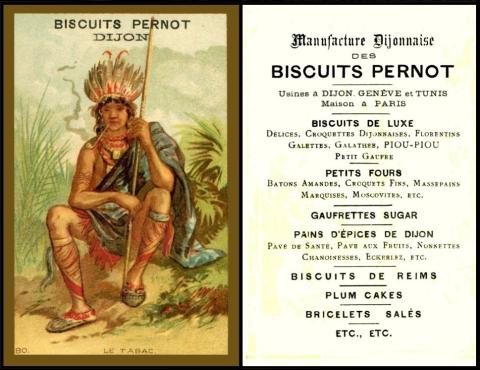
Biscuits PERNOT [trade : biscuits : O/S - France] "Advertising card" ? (1900) 80/??
So today started out as being King Henry VII authorising the expeditions of John Cabot and his sons, but we have chatted of John Cabot before, and used the very card i planned to use, which I only found out when I added the card and found it was already in the gallery
One quick segue later and we have not the Italian John Cabot but the Spanish Francisco Fernandez, who, on this day in 1558, introduced tobacco to Europe. He played hard to get for a very long time, much longer than I would have liked on just a few hours before this was shot out into the ether, but then I found that the source I had used had spelt his name wrong, it was actually Francisco Fernandes, and after that things became easier.
Francisco Fernandes, with an "s" as closure, was a physician, sent to Mexico by King Philip II of Spain to investigate the native plants and came back with tobacco plants and seeds. He called this herb, rather amusingly, "panecea", which is our word today for something that cures all ills, or at least disguises them temporarily.
The date is very interesting, because it is a long while after Christopher Columbus brought back what he called tobacco from the Americas just at the end of the fifteenth century. The word tabaco was used by the natives but Christopher Columbus mistakenly thought it meant the contents when it actually meant the smoking apparatus, a small hollow wooden y-shaped tube, one end plunged down into the smoke of the burning plants and the other end shoved up the nose of the person enjoying the inhaling. And this mistake was made fact by Girolamo Benzoni of Milan, in his book "History of the New World", published in 1565.
However all these dates are earlier than 1586, which is when Sir Francis Drake brought his tobacco over and gave it to Walter Raleigh.
As far as its other name, Nicotiana, that comes from Portugal, where a man called Jean Nicot sent some seeds for the delight of the Queen, Catherine de Medici. She liked them so much that she rewarded Jean Nicot by calling the seeds, and therefore the plant, after him - Nicot-iana.
It seems odd that despite the cards coming with the tobacco, so few of them show it. Even odder is the fact that the first card that does show it is not even a cigarette card, it is a trade one - from Liebig Meat Extract`s 1899 set of "Cuba", known as F588,and S585.
Our substitute card, above, may beat this, but we are not sure when it was issued. The scan of it was sent to me by a reader who wondered if it was connected to the set we featured as the Card of the Day for Tuesday the 24th February 2026 - which you will see if you just keep scrolling. However it does not say anything about "Firsts" in the title or on the reverse. They also have another card, number 81, La Poste, so I have added them into the list on that day in the hope that I will be able to confirm or deny when i come across another 80 or 81.
The first British cigarette card to show tobacco looks like it was part of John Player`s 1902 set of "Useful Plants and Fruits". But maybe you know of another?
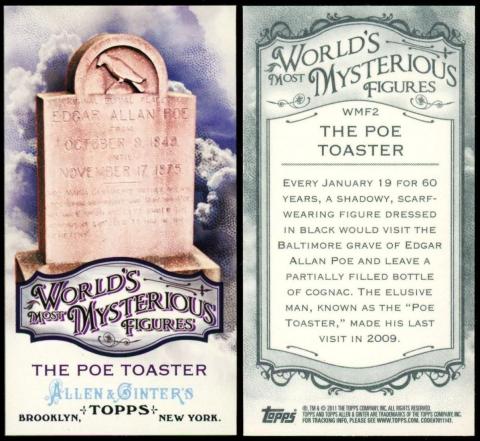
TOPPS/Allen&Ginter [trade/commercial : cards : O/S - USA] "World`s Most Mysterious Figures" (2011) WMF.2/10
Today in 1831 Edgar Allan Poe was dismissed from West Point military academy for gross neglect of duty and disobedience of orders - and he was also court-martialled. The truth is that he was only at West Point because he had amassed huge debts, through gambling, whilst at the University of Virginia, and his first book of poetry, published to repay those, did not sell.
Entering West Point was not our man`s idea, it was his stepfather`s, with whom he did not get along, so much so that he refused to drop his real father`s name, of Poe - though in truth he ought to have owed a great deal to John and Frances Allan, who were no relation to him nor his family, they just took him in after his father walked away and never came back in 1810, and his mother died, from tuberculosis, the following year.
Parts of West Point were okay, but he rebelled at the amount of work and the rigorous discipline, and determined himself to get expelled, by refusing to turn up to classes. And in less than a year he got his way.
Edgar Poe had been born on January 19th, 1809 in Boston, and only lived for forty years, but fitted in short story writing, poetry, literary criticism, and editing of the Broadway Journal, whilst some say it was he who invented the detective story, with his 1841 story, "Murders in the Rue Morgue". By that time, he was married, taking the hand of his thirteen year old cousin, Virginia Clemm in 1835. However, she also contracted tuberculosis, in January 1842 (and died of it, in 1847, aged just twenty four).
During this time he penned his most famous poem "The Raven" to tell another version of the story of Grip, the raven which appeared in Charles Dickens` "Barnaby Rudge". Edgar Allan Poe said he would have loved a raven for a pet, but made do with his fictional friend. This is not a long poem, and appears online in many anthologies. It seems that Cope Bros of Liverpool also had a soft spot for Grip, because he is the only non human given an entire card in the whole set of their "Dickens Gallery" though sadly the set is backlisted, for it would have been fun to read a larger text, though a small snippet of his words appear in the border at the front. In case you were wondering, this verse, often taught to parrots and parakeets, also appears in "Barnaby Rudge", though some of the words date from the 1790s, as a plainsong, and the tune to which it is sung dates from at least twenty years earlier.
Poe really suffered after his wife's death, and it is thought he intermingled it with memories of losing his mother, though he had really been too young to remember that. He did try to woo a fellow poet, but she turned him down, though it is thought she really loved him, her mother just thought him too risky a beau.
Then, on October the third, 1849, he was found in Baltimore, and taken to Washington Medical College, where he died four days later. To this day we do not know how he died, or why, and even more curious, his death certificate has disappeared
His first cartophilic appearance came in 1888, as part of Duke`s "Great Americans" 1888, issued in three formats, as a plain back card, as a backlisted card with a bottom border, and as a folder, with John Howard Payne and Francis Scott Key. And in the very same year he appeared as part of another Duke issue, the "Histories of Poor Boys Who Have Become Rich, and Other Famous People". In a rather nice tribute, Grip appears on the back cover of the booklet.
His next card is actually not of him. This was issued in 1911 by American Tobacco under the Helmar brand, and it shows the little white clapboard cottage on Fordham Hill, in New York where his wife died.
The first, and only British cigarette card of him that I have found is card 19 of the 1924 Millhoff set, "Men of Genius", and Grip is on that too - but it must be said that this card contains a very strange error as the final words of the text, which reads "Orphaned at three, he was adopted by John Adams, a rich but childless merchant"
His next appearance is on Topps Gum`s "Look n` See", issued in 1952, where he is card 79, billed as "Edgar Allan Poe, Writer". And after that we have to wait right until 1992, for Starline`s "Americana" card 140.
More recently he has been rediscovered by modern trading cards, particularly Topps and Panini. This card is from a set of mysteries, which I am always intrigued by - and the set comprises many I had not encountered before, namely
- Rasputin
- The Poe Toaster
- Kasper Hauser (an error, it ought to be Kaspar)
- Fulcanelli
- D. B. Cooper
- The Count of St. Germain
- The Man in the Iron Mask
- Nostradamus
- The Babushka Lady
- Captain Charles Johnson
The mystery on this card concerns an unknown man who visited Edgar Allan Poe`s grave on his birthday, every year, dressed in black. He would pour himself a glass of cognac and toast the departed, then leave three red roses and slide away into the darkness. This started in the 1930s, and continued until 1998, when it was made known that the original toaster had died and passed the mantle to his son.
This week's Cards of the Day...
celebrated #NationalHomeBuyingWeek, which runs from tomorrow, the 24th of February, until the 28th of February, an event which is mainly for first-time buyers and mainly to extol the virtues of new build homes. However the date seems to vary widely depending on which site you look at, some citing it at the start of February and others shunting it into the start of April.
Saturday, 21st February 2026
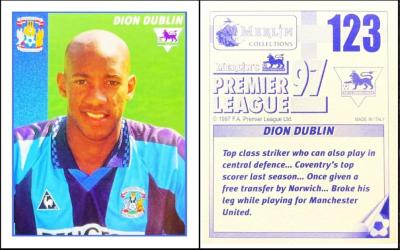
Our first card shows Dion Dublin in his football kit, but after leaving that field of play he joined another team entirely and became one of the presenters of the television show "Homes Under the Hammer", which aims to show that it is possible to pick up neglected properties at auction and turn them into renovated properties equal to any new build.
Mr. Dublin was born in Leicester on the 22nd of April, 1969, and started playing football with several local teams, one of whom was called Wigston Fields, which was founded in the 1950s but seems to have closed in the late 1980s, despite the fact that they competed in the F.A. Cup qualifiers right until 1987. Our man left them in 1985, and joined the youth squad of Norwich City, but strangely was not retained by them when he came of age to join the senior team in 1998 - instead he was traded to Cambridge United, and almost immediately loaned to Barnet (for one game) and then to Wycombe Wanderers (for two games). He then returned to Cambridge United, where he stayed for three years. He may have stayed longer, and he speaks openly of his regret at not staying, which was forced on the club when they failed to get through to the Premier League, they just did not have the cash to keep him.
In fact it appears his first ever cartophilic appearance came in a Cambridge United strip; that was on card 319 of Pro Set`s "1990/1991 Collector Cards".
He may have regretted it, but he soon found himself in demand by much bigger teams, and was the subject of quite a fight between Chelsea, Everton and Manchester United. He decided to go with the latter, for a transfer fee of a million pounds - though in hindsight it was not a great time, he was injured several times, and was out of the squad so much so that he did not even qualify for a league winner`s medal - though he was awarded one eventually, thanks to the generosity of the the Premier League. In fact his first appearance on a Merlin sticker shows him at Manchester United, the only set to do so - that being number 207 of their "Premier League 94" stickers" - for by the time the next edition rolled off the presses he was depicted in sky blue having been sold to Coventry City, for two million pounds; that was sticker number 100 in Merlin`s "Premier League 95" set
He remained with Coventry City until 1998, and this is where the bulk of his cartophilic appearances occur, until 1998, when British Petroleum show him in a new strip, for England. He played for them for the first time in 1998, against Chile, at Wembley Stadium, and he would play for his country three more times in that year. But he was not selected for the 1998 FIFA World Cup Squad, and in November 1998, the month of his last ever game for England, he moved to Aston Villa.
His first cartophilic appearance in an Aston Villa strip was another Merlin sticker, number U.24 of their "Premier League 99 Transfer Update" subset of sixty seven cards - and he is also on sticker U31. They have no descriptive text, they only say "These Transfer Update stickers feature all the latest players that have transferred into the Premier League, the stars that have changed clubs, and the breakthrough players that have forced their way into regular Premier League action. These stickers go in the special Merlin`s Premier League Transfer Update Album (red cover). If you`re having problems finding an Update Album call our customer services.....". The move to Aston Villa almost ended in disaster, because during a match in 1999 he broke his neck, and only survived by having extensive surgery, and a metal plate holding three of the bones together. It was predicted that it would end his career, but it did not, he returned to Aston Villa three months later, for another two years, during which he was again loaned out, to Millwall.
2004 saw him coming full circle and returning to Leicester, City. That only lasted two years, and then he was off to Celtic, which did not last either, not even a whole year, and by the end of 2006 he was sold to Norwich City, who had released him after his youth contract - and it was whilst with them that he retired in 2008. He was offered a new contact with Cambridge United, which he debated long and hard, but he was feeling the effects of his injuries and decided it was not worth the risk - though he did stay on good terms with them and was actually made a director of the club in 2021.
Also he had already started to investigate doing other things, including moving into the field of entertainment, which he did, both as a musician and a football commentator. In 2015 he joined the crew on "Homes Under the Hammer", becoming the first new regular presenter since the show began in 2003, and he much enjoyed this, developing a big interest in property developing, as well as renovating his own home. And in 2021 he took part in "Celebrity Masterchef", making the final.
As for our card, not much is known - though you can read the beginnings of a Merlin biography with our Card of the Day for the 14th of March, 2022.
Intriguingly there is also a subset, which does not fit in the album and has become known as the "Alphabet prefix" or the "Alphabet Set". It contains twenty six stickers with a large capital letter on the back, and the wording "This sticker does not have a space within Merlin`s Premier League 97 Album, but you can stick it on Merlin`s `Official` England Team Poster. See the insert in the centre of your album to learn how to claim your England Poster, FREE."
Sunday, 22nd February 2026
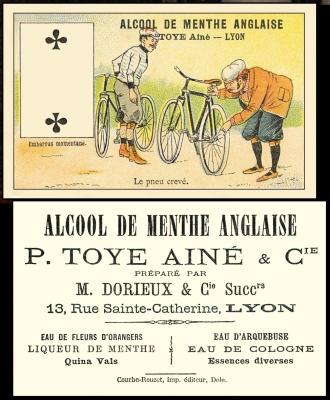
Our second card, of two men and bicycles, may have foxed a lot of you, but the clue was there, and it was the puncture, or FLAT.
A flat is where a lot of people start, and some never leave, finding these small but perfectly formed residences an ideal size for one.
Now this set is akin to the fortune telling and language of cards sets that we seem to have featured quite a few versions of, but there is a difference, for here we have the two of clubs and that suggests it seems to use the whole pack, not just the Sevens through Kings and Aces as is more usual in the science of divination with cards, at least in Europe.
When I tried to research P. Toye Aine I found that he took over the premises, and presumably the business, of Monsieur Dorieux et Cie, at 13, Rue Sainte-Catherine, in Lyon, France, in the mid 1890s. On further investigation though this is slightly incorrect. First of all his name was P. Toye, the Aine means "Senior", as in the eldest of the family. He may have been a distiller, but he had nothing to do with the peppermint alcohol, for that we can thank his nephew, also a Toye, who had premises elsewhere in Lyon, at 5 Rue Tête d'Or, who was a perfumer for liquor and confectionery. And it appears that when, in 1896, Mr. Toye Senior retired, the nephew took over the shop, and though keeping the same name, and using the distilling works, moved the business over to more romantic concoctions, such as peppermint alcohol, and orange flower water.
It may take me a time to get this list going, for today has seen many visits, the carer, the district nurse - and also phone calls, to and from hospitals who want to take a look at parts of mum`s anatomy, but not her stomach about which I am most stressed. But I can add a few and get it started, these being :
coeurs / hearts :
- Lahire/Jack - 100.000 livres se dot!! Je veux bien - Jeune homme a marier
crevets / diamonds :
- 2 - L`arrivee a la gare - Parents
- 5 - La Reine des blanchisseuses - Grandeurs ephemeres
piques / clubs :
- 2 - Le Pneu Creve - Embarras Momentane
combinations
- Lahire/Jack hearts and nine of diamonds - L`Incorporation - Changement d`etat
- eight and nine of spades - L`acces ge goutte - Les souffrances incomprises
Monday, 23rd February 2026
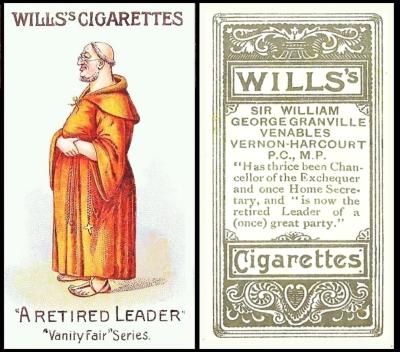
Our final clue card shows someone described as "retired", which brings us to the sort of home that is the most perfectly designed of all, with every feature designed for ease and to suit a range of challenges that come as we slide into older age
Sir William George Granville Venables Vernon-Harcourt P.C. M.P., better known today as simply Vernon Harcourt K.C. was born on the fourteenth of October 1827. He was a member of the Liberal Party, but also a lawyer and a journalist. who started his parliamentary career in 1868 as the M.P. for Oxford, then moved through Derby, and West Monmouthshire before becoming William Ewart Gladstone`s Home Secretary, and, in 1892, Chancellor of the Exchequer before becoming Leader of the Opposition four years later. For some reason, though he was talented, he did not appeal much to the general public. He stepped down in 1898, and died on the 1st of October 1904, aged seventy-six
So I thought I was doing really well with this card, but "Vanity Fair" is a curious set as is proved by our original Wills reference book part two, or, more correctly, "RB.11 – The Cigarette Card Issues of W.D. & H.O. Wills Part I (revised) and Part II", published in 1948, which includes all three versions, these being
- a first series,in which the cards are numbered on the front and of which we used the card of Lord Roberts as our Card of the Day for the 11th of May 2025 - where it was a "set born in May," and not just that but the earliest issue that we know of having been issued in May 1902, so it kind of wins
- a second series, entirely different cards from the first fifty
- a third, unnumbered set, made up of cards from the first and second series, but without numbers on the front, and some brand new subjects, also unnumbered on the front. This is the version that today`s card comes from, and that is recorded in our RB.11 as :
- 31. "VANITY FAIR" SERIES. The name of this series was taken from a popular Victorian Society periodical [called] "Vanity Fair" which published a great many cartoons of notabilities, and the cards are reproductions of a suitable selection. The caricatures were usually accompanied by racy biographical sketches, and from these most of the card texts were extracted. The cartoonist was "Spy", and his self portrait appears in Series 2, card No.42
Fronts lithographed in colour on stone coloured background. Backs in grey, with texts.
The records of Wills show the issue date as May 1902. Printed by Stewart & Wolf, Germany. There are three series, each of 50 cards.
C) "Vanity Fair" Series. Unnumbered. This series consists of 37 cards from the first, 6 cards from the 2nd, with 7 new titles, as listed below ; -
- "A Flannelled Fighter" (2nd, No.27)
- "An Admiral of the Fleet" (a new title)
- "A Retired Leader" (1st, No.23)
- "Aubrey Tanqueray" (2nd, No.26)
- "Australia" (a new title)
- "Birdseye" (1st, No.10)
- "Bobs" (1st, No.36)
- "Canada" (1st, No.20)
- "Canterbury" (a new title)
- "C.I.V." (1st, No.44)
- "Dick" (1st, No.40)
- "Dover and War" (1st, No.39)
- Dr. Jim" (2nd, No.16)
- "Dublin University" (2nd, No.22)
- "Easy Execution" (1st, No.29)
- "Fair, if not Beautiful" (1st, No.42)
- "Forbie" (1st, No.13)
- "Frank" (a new title)
- "From the Army to the Church" (1st, No.4)
- "From the Old Bailey" (1st, No.3)
- "Hard Head" (2nd, No.43)
- "High Commissioner" (1st, No.18)
- "Jacky" (new title)
- "Khartoum" (1st, No.22)
- "Ladysmith" (1st, No.35)
- "Little Bo Peep" (1st, No.46)
- "London" (1st, No.47)
- "Mafeking" (1st, No.37)
- "Mr. Speaker" (1st, No.15)
- "Our Soldier Prince" (1st, No.2)
- "Oxford Athletics" (1st, No.11)
- "Partnership" (1st, No.1)
- "Peking" (a new title)
- "P.R.A." (1st, No.17)
- "Ranji" (1st, No.21)
- "Redrag" (1st, No.30)
- "Sammy" (1st, No.6)
- "Self Reliant" (a new title)
- "Shamrock" (1st, No.50)
- "Smith`s Leading Cases" (1st, No.9)
- "Thanet" (1st, No.31)
- "The Colonies" (1st, No.45)
- "The Commercial Traveller" (1st, No.25)
- "The Croucher" (1st, No.49)
- "The New French President" (1st, No.24)
- "The Opposition" (1st, No.26)
- "United States Embassy" (1st, No.28)
- "U.S.A." (2nd, No.25)
- "Westminster" (1st, No.8)
- "Yorkshire Cricket" (1st, No.7)
The bad news was that today`s third series card had already been used in the first series, and I already had one of those in the gallery and index - it was our Card of the Day for the 26th of May 2023, of Sir Thomas Lipton. The good news for today`s card is that Sir Thomas Lipton was in a week when we were talking about iced tea, and it is the final card of the week, so I was able to replace that card with a lemon, something most people think of first when they are asked for something associated with iced tea - and this card gets to stay.
Returning to our reference books, this set next appears in our original World Tobacco Issues Index lists these cards under Wills section 1.E, for "Issues 1898 - 1902 inscribed "Wills`s Cigarettes". Cards without the full name of firm" :
- “VANITY FAIR” SERIES. Sm. 68 x 36. See W/31 ... W62-58
1. “1st Series”. Nd. 1/50.
2. “2nd Series”. Nd. 1/50.
3. Unnumbered. (50)
This means that without the original Wills reference book RB.11, which by then were in short supply, you would have no idea of the make-up of the unnumbered set. This is almost certainly one of the many reasons why the decision was made to reprint them all in one hard back volume.
In our updated version of the World Tobacco Issues Index, this has been partially restored, and the text there, still under Wills section 1.E, for "Issues 1898 - 1902 inscribed "Wills`s Cigarettes". Cards without the full name of firm", reads :
- “VANITY FAIR” SERIES. Sm. 68 x 36. See W/31 ... W675-083
1. “1st Series”. Nd. 1/50.
2. “2nd Series”. Nd. 1/50.
3. Unnumbered. (50). 43 subjects from the above two series, 7 new subjects.
Tuesday, 24th February 2026
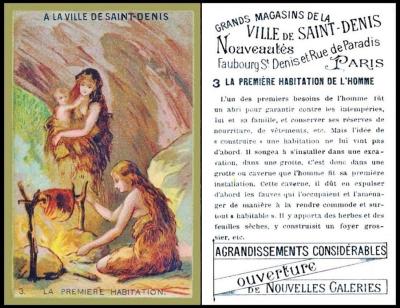
So here we have "La Premiere Habitation de l`Homme" - or the first home of man. And it rightly shows a cave, which was almost certainly discovered by accident and used for shelter from the wind and the rain. Then, little niceties started to creep in, a place to make fire, and, as shown here, to cook some poor defenceless animal. This unseen man also seems to have found himself a wife, or two, and one of them has a child. Then he probably needed a bigger cave, went scouting, and they all moved out and started to live in that. How simple it all was, once....
The wording on the back of this card tells us that it was issued by "Grands Magasins de la Ville de Saint-Denis Nouveautes Faubourg St, Denis et Rue de Paradis, Paris". That translates to Department Store, at the town of Saint-Denis, in the suburb of St, Denis and the street called Rue de Paradis, in Paris. The word I left out is "Nouveautes", which means novelties. In other words they sold a bit of everything, hoping to catch the eye and open the purse.
This seemed an elusive set, and I hunted through every permutation of house and building until I discovered the same card as ours with a different issuer, Chocolat Poulain. In fact we now know of several issuers of this lovely set,
- Chicoree ARLATTE (chicory coffee - Cambrai)
- Chocolat IBLED (chocolate - Paris)
- Chocolat MATTE Fils (chocolate - Montpellier)
- Chocolat POULAIN (chocolate)
- C. MONNIER (Carpet Maker - Paris)
and there are probably yet more to find
Then the list grew a lot quicker, because the subjects of their set are a bit easier to find online in twos and threes, and it was simple to see that the set is not the history of housing at all, it is a selection connected by the fact that they were all firsts, so from the single one, we now know of :
- La Premiere Habitation de l`Homme - the first home of mankind
- Le 1er Instrument de Musique - the first musical instrument
- Le Premier Vetement - the first clothes
- Le Premier Berceau - the first cradle
- Le Chien 1er Ami de l`Homme - the dog, first friend of man
- Le Premier Brancard - the first medical stretcher
- Le Premier Miroir - the first mirror
- Le Premier Architecte - the first architect
- La Premiere Table - the first table, as in furniture
- Le 1er Moulin a Moudre - the first grinding wheel
- Le Premier Vigneron - the first wine maker
- Le Premier Vannier - the first basket weaver
- Le 1er Metier a Tisser - the first loom
- La Premiere Charrue - the first plough
- La Premiere Ecriture - the first writing
- Le Premier Pecheur (La Ligne) - the first fisherman
- Le 1er Ingenieur Pont - the first bridge maker
- Le Premier Berger - the first farmer
- Le Premier Sculpteur - the first sculptor
- Le Premier Forgeron - the first iron worker
- Le Premier Macon - the first stone mason
- Le Premier Dessin - the first drawing
- Le 1er Geometre - the first geometry
- Le Premier Char - the first chariot
- La Premier Scie - the first carpenter`s saw
- Le 1er Botaniste - the first botanist
- Le 1er Papier Papyrus - the first paper, papyrus
- Le 1er Medecin - the first doctor
- Le 1er Astronome - the first astronomer
- Le Premier Puits - the first well
- La 1er Flute - the first flute, as in musical instrument
- La 1er Balance - the first scales
- Le 1er Sablier - the first egg timer
- Le 1er Eventail - the first fan
- Le Premier Bateau - the first boat
- La Peinture de Tableaux - the first painter of pictures
- Le 1er Marin - the first sailor
- Le 1er Vase a Boire - the first drinking glass
- La 1er Piece de Monnaie - the first coin
- La Clepsydre du 1er Horloge - the first clepsydra clock
- Le 1er Electricien - first electrician
- Le Tabac - tobacco - not sure this is the same set
- La Poste - postman - ditto
- Le 1er Calendrier - the first calendar
- Les 1ere Livres - the first books
Wednesday, 25th February 2026
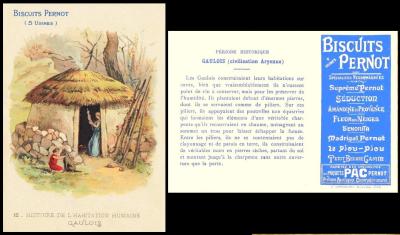
This card shows the development of the house from the cave, for what we have here are tall defensive walls and a straw roof, simply because engineering was not invented that could allow them to build a stone one.
Today`s house is marked up as being "Gaulois", which are classed as a branch of the Celtic tribe even though they lived far from Scotland or Ireland, starting out by inhabiting the region north and west of the Alps and ending up spreading over much of Europe, controlling huge lengths of four major rivers, ones which we know today as the Rhine, the Rhone, the Danube, and the Seine. Their control of these enabled them to travel and to trade. Their downfall was the rise of the Roman empire, which finally conquered the Gauls in 50 B.C., taking over their former lands and also changing their ways into a strange hybrid culture called Gallo-Roman. And in actual fact the next card in the series, number thirteen, shows a house belonging to the Gallo- Romains
The set is all about houses, and we know that it was issued more than once because you can find the cards with five different backs, namely
- no number to front - third of back advert in large blue solid (as our card today)
- numbered to front - third of back advert in large blue solid
- numbered to front - third of back advert in plain blue letters, no solid
- numbered to front - full back advert framed by dots and dashes
- numbered to front - full back advert for "Piou Piou" showing soldier (obviously a wartime version)
Trying to code them proved impossible for me, so when I started over, after ending in total confusion, I decided to just use the descriptions and drop the codes - but I have not had time to go back and do the ones I started with !
I also believe there to be two more cards, numbers 24 and 25, but only because 23 is a rather strange number to end at.
Anyway the houses featured are as follows :
- Dolmen, Age de la Pierre -
numbered to front - third of back advert in plain blue letters, no solid - Cite Lacustre
numbered to front - third of back advert in plain blue letters, no solid - Egypte Pharaonique -
numbered to front - full back advert framed by dots and dashes
numbered to front - third of back advert in plain blue letters, no solid
no number to front - third of back advert in large blue solid - Phenicians
numbered to front - third of back advert in plain blue letters, no solid
numbered to front - third of back advert in large blue solid
no number to front - third of back advert in large blue solid - Assyriens
numbered to front - third of back advert in plain blue letters, no solid - Hebreux
numbered to front - third of back advert in plain blue letters, no solid - Etrusques
numbered to front - third of back advert in plain blue letters, no solid
no number to front - third of back advert in large blue solid - Hindous
numbered to front - third of back advert in plain blue letters, no solid - Grecs
no number to front - third of back advert in plain blue letters, no solid - Romaines
numbered to front - third of back advert in plain blue letters, no solid
no number to front - third of back advert in large blue solid - Germains
numbered to front - third of back advert in plain blue letters, no solid - Gaulois
numbered to front - third of back advert in large blue solid - Gallo- Romains
numbered to front - third of back advert in plain blue letters, no solid
no number to front - third of back advert in large blue solid - Huns
numbered to front - full back advert framed by dots and dashes
no number to front - third of back advert plain blue letters, no solid - Maures
numbered to front - third of back advert in plain blue letters, no solid - Byzantins
numbered to front - full back advert framed by dots and dashes
numbered to front - third of back advert in plain blue letters, no solid - Style Roman
numbered to front - third of back advert in plain blue letters, no solid - Gothique-Moyen Age
numbered to front - third of back advert in plain blue letters, no solid - Style Renaissance
numbered to front - third of back advert in plain blue letters, no solid - Style Louis XIII
numbered to front - third of back advert in plain blue letters, no solid
numbered to front - full back advert for "Piou Piou" showing soldier - Style Louis XIV
numbered to front - third of back advert in plain blue letters, no solid - Une Rue de Paris sous Louis XV
numbered to front - full back advert framed by dots and dashes
numbered to front - full back advert for "Piou Piou" showing soldier
no number to front - third of back advert plain blue letters, no solid - Style Empire -
numbered to front - full back advert framed by dots and dashes
numbered to front - third of back advert in plain blue letters, no solid
no number to front - third of back advert in large blue solid
Thursday, 26th February 2026
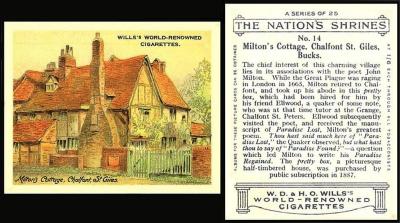
Picture started out a bit light, but as promised I have now zhush-ed it up a bit.
Here we have Milton`s Cottage, the former home of John Milton, at Chalfont St Giles, not so far off the Metropolitan Railway Line. It was built in the sixteenth century and is pretty typical of the construction of that time, being a timber frame, infilled with short, horizontal wooden blocks in order to make the frame stronger and also to allow plasterboard to be fixed in places where the frame was not there.
In fact, timber framed homes took over from stone as far back as the Neolithic period, though at that time they were but rough shelters cobbled together from branches and infilled with animal skins. It was the Chinese who developed the skills of butting planks of wood together and fixing them with elaborate joints to ensure they would not sway in winds.
In Medieval times it was still the way that everybody built their homes, especially in areas near forests - in areas with fewer trees you get more homes being built with plaster infill, and this idea spread out to the forested areas too because it was cheaper and quicker. And homes, including the one on our card today, were still built this way right into the mid seventeeth century, though visitors to that house today will not see the plasterboard that appears on this card, to them the building will be made of brick, and there is a good reason for that, which we will explore tomorrow
This picture also shows the cottage as being two storeys, which was a later addition to the original cottage, in the eighteenth century, a long time after Milton had left it. Shockingly, it was almost sold to America, on which it was due to be taken apart here and reassembled over there - but it was saved by public subscription in 1887, since when it has become a museum of Milton`s works plus some of his belongings and personal effects.
Now this set is often overlooked, and mistaken for the version which was issued by John Player. More than that, our set was not even issued in the United Kingdom, something that is hinted at by the top right hand corner of our card, which reads "WILLS`S WORLD-RENOWNED CIGARETTES". In fact it was issued way down in Australia, and, curiously, first, before the John Player home issue version, which was issued in 1929. In fact Player also changed the reverses, adding the decorative frame, and altering the bottom cartouche, whilst on the front they deleted all wording sans the caption of the shrine depicted.
The Wills version we show here appears in our original Wills reference book, part four, as :
- 271. 25. THE NATION`S SHRINES. Large cards, size 71 x 55 m/m. Fronts printed by letterpress in colour. Backs in grey, with descriptive text, inscribed "W.D.& H.O. WILLS`S WORLD-RENOWNED CIGARETTES". Issued in Australia, between 1925-1930. Similar series issued by Player.
It was, however, never listed amongst the list of dates that appeared in the Wills` "Works Magazine", which means it was printed over in Australia, and the date of that printing was not recorded - which explains the rather sketchy date of issue provided in our original Wills reference book, part four.
Its next appearance comes in our original World Tobacco Issues Index, recorded as :
- THE NATION`S SHRINES. Md. 70 x 55 m/m. Nd. (25) See W/271 ... W62-275
There is, as you will have noticed, no reference to the Player`s version, and likewise there is no mention of the Wills version with the Player`s listing. And this is still the case in our updated World Tobacco Issues Index, the only difference being a new card code, of W675-415
To close, I have to wonder at the title, which is, I feel, taking a bit of a liberty with the true meaning of "shrine", which is a holy place, through association with a saint, god, or divinity, or because a relic of that person is either contained within the building, or interred within its grounds. And many of these do not.
The cards included are :
- Anne Hathaway`s Cottage, Shottery
- Blarney Castle, Ireland
- Bootham Bar, York Minster
- Cashel, Ireland
- Clonmacnoise, Ireland
- Fountains Abbey
- Furness Abbey
- Glastonbury Abbey
- Haddon Hall
- Holyrood Palace, Edinburgh
- John Knox`s House, Edinburgh
- Kenilworth Castle
- Manorbier Castle, Wales
- Milton`s Cottage, Chalfont, St. Giles (note the errant comma between the Chalfont and the St.)
- The Cloisters, Newstead Abbey
- St. David`s Cathedral, Wales
- St. Paul`s Cathedral
- Shakespeare`s Birthplace, Stratford-on-Avon
- Stoke Poges Church
- Stonehenge
- Tintern Abbey
- The Tower of London
- Warwick Castle
- Henry VIII`s Chapel, Westminster Abbey
- Winchester Cathedral
Friday, 27th February 2026
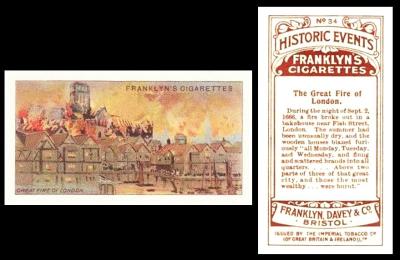
This card marks the real turning point of house-building, for it shows the Great Fire of London, which ripped through the timber and plaster buildings leaving but few survivors, not even St. Paul's Cathedral being spared .
When the flames had finally died down, there was the certain knowledge that there could no longer be such conflagration. And the solution was to build houses, and indeed all buildings, in brick. Not just that, but to widen the streets, because the flames easily leapt across the former narrow streets, where the top storeys of the houses often almost touched. In truth, to build a new Capital City from the literal ashes of the old one, using fire resistant materials like brick for the walls and tiles for the roof, and removing all traces of combustible ones like wood and straw.
Some thirteen thousand homes were completely rebuilt in under five years, and public buildings too, including a brand new St, Paul`s Cathedral;.
And it also led to something else, the first ever private home insurances, against fire, with the introduction of the "fire mark", indisputable proof that the house holder had paid up.
Now this is the much later version of the original set by W.D. & H.O. Wills, which was issued in 1912. That was our Card of the Day for the 1st of April, 2024, and on that page you will find the entry from our original Wills reference book.
This version of the set is only described in our original World Tobacco Issues Index, as :
- HISTORIC EVENTS. Sm. Nd. (50.) See H.464. ... F52-23
And that remains the entry in our updated version, save a new card code, of F756-550