
So here we are another Friday, most of the things I lost last week have been cancelled and replaced and the rest are on the way. That took a lot of time and effort though, and so this newsletter was a slight rush towards the end of the week rather than a slow progression, a couple of cards at a time. And I had to add the titles and the card descriptions as I added them to the index on the Saturday.
Website News :
I did manage a little bit of backwards progression with the index, and the cards from the newsletter of the 21st of September, 2024 are now added. However I am stymied with the one before that because one of the cards concerns the Tug of War, something I covered more recently, too. I can change the 2024 card, as the theme was the Pitlochry Highland Games, so I can write about the throwing of the hammer, another popular event there, but I just have not had time to hunt a hammer throwing card.
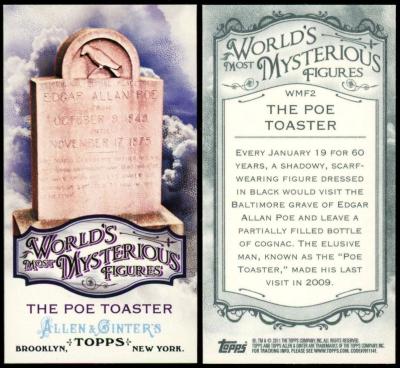
From last week`s newsletter I have altered the two final cards. We now have an entirely different card for tobacco, because the Cope "Household Hints" was too light to get anything out of at all. And we also replaced what started out as only the front of the card of Edgar Allan Poe from Millhoff`s "Men Of Genius", again due to a very light back which did not reproduce well.
In its place though we now have this card, and a story which would have intrigued Edgar Allen Poe himself, that of an unknown who visited Poe`s grave every year on his birthday, leaving three red roses and raising a toast with a glass of Martell cognac.

TOPPS [trade/commercial : gum/cards : O/S - USA] "The X Files Showcase" - promo card (1995) 1/1
I did try to find something else, honest, but here we are opening the X-Files again. And sometimes I do get the thought that these newsletters are like an Alfred Hitchcock movie, in that you are all waiting for the X-Files to appear, somewhere in the text - so at least this week we start with them and you can read the rest without the trepidation.....
As for why we mention them, again, well you see, today, in 1993 the first ever scene was filmed. Now if you watch the pilot episode, you might imagine that the first scenes would have been the ones in the forest. And you can watch it right now, as it was screened again on Channel 5 earlier this week, to mark the fact that it, and all eleven series, are now available to stream. That is not the case though, those scenes were shot later. And, much to my regret, the first scene was not the one where Agent Dana Scully is sent to the lower parts of the building to meet Agent Fox Mulder for the first time. In fact the first scene involved Agent Dana Scully, in Section Chief Scott Blevins` office, being told she had been assigned to the X-Files.
The titles of that scene identify the building as being at the F.B.I. H.Q., in Washington, D.C, but that is incorrect too, for that office, and Fox Mulder`s, were shot on location at CBC`s Broadcast Centre in Vancouver, and they were almost certainly shot at more or less the time. So here we have this card, which shows both those scenes, the front having the Cigarette Smoking Man leaning against a filing cabinet and showcasing Agent Dana Scully, a scene which comes from the part of the episode at Section Chief Scott Blevins` office, and the back having Agent Fox Mulder, a scene which comes from the scenes in the basement at his office.
Now you may think I have taken liberties, which I have a bit, and not just because I rejected an awful lot of cards from my collection before I saw both sides of this one. And you may also think I have broken my pledge never to use a card from a set I have featured before, thinking this is Topps` "The X Files Showcase", which was featured in our newsletter for the 16th of November 2024 as the diary date for Wednesday the 20th of November.
Actually though, the card we show here was not part of that set, and never appeared in the packets, for this was the Promo, numbered P1, and it presages the arrival of that set in the first few words on the back, which say "This January, Topps brings you an entirely new kind of X-FILES trading card series." This means, also, that this card was not sold in packets, it was a giveaway, at card fairs, and exhibitions, and so, whilst the set is commercial, this card is not, it is a true trade card. And it is the only promotional card for the set, though there was another giveaway, a curious white one giving details of the fan club, which is generally known as the "Investigate Membership Kit #2" card, simply because that is the wording on the top of the front of the card, above a space ship similar to that which is on a poster on the wall of Fox Mulder`s office.
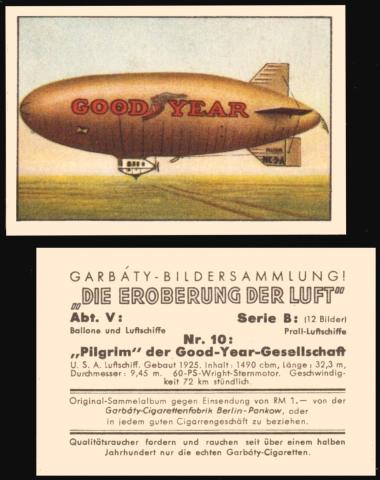
Garbaty Cigarettenfabrik [tobacco : O/S - Germany - Berlin] "Die Eroberung Der Luft" / Conquest of the Sky - series one (1932) 38/216 - G090-250.1 : G14-10.1
Speaking of strange goings on, if you look online at events on the 8th of March, you will see that the Goodyear Blimp`s first flight was on that day in 1972.
This is actually not true, because if you watch highlights of the Orange Bowl game in 1960 you will see her, clear as anything, in the sky. Cartophilists can date her to even earlier, as she is our card tonight, Abt V Serie B No.10, issued by Garbaty in 1932. Whilst only last year Goodyear had a whole host of events celebrating her one hundredth anniversary, which takes it back to 1925.
Now it turns out that the 1925 Goodyear Blimp was launched on June the third, in Akron Ohion, and it is the very craft, "Pilgrim" which appears on the Garbaty card. So again I have taken a bit of a liberty by using a different section from the same set as we featured in our newsletter of the 13th of July, 2024, (as the diary date for Monday 15 July) - though that card was an aeroplane, from section Abt.1 and ours is an airship, from section Abt.V.
As for "Pilgrim", she was revolutionary in every way, not least the fact that though her first flight was powered by the more usual hydrogen, her next trip out, on July the 17th, saw a change in that, and she was filled, instead, with helium, making her the first airship to ever use that gas. At that time she was not even called "Pilgrim", that name being bestowed one day later, by the wife of a Goodyear executive, Florence Litchfield. The executive, Paul Litchfield, was very big on blimps, and imagined a future where they would become the number one form of transportation, even replacing the automobile; though, it must be said, he was only thinking of the richer echelons of society.
"Pilgrim" retired, officially, on December the 30th, 1931, after almost five thousand flights and a total air time of almost three thousand hours. However the gondola which hung beneath her was attached to another airship, I have yet to find out which, though I am fairly certain it was a Goodyear blimp. And, wonderfully, that car still survives, at the Udvar Hazy Center of the National Air and Space Museum, in Chantilly, Virginia
Now by a massive stroke of luck, the card we used last time in our newsletter of the 13th of July, 2024 as the diary card for Monday the 15th of July, was actually from the second series, dealing with aircraft of other lands, whilst the one we show tonight is from the first series, showing German aircraft.
This first series is described in our original World Tobacco Issues Indexes as :
"DIE EROBERUNG DER LUFT" (The Conquest of the Air"). Sm. 61 x 41. ... G14-10
1. Back headed "Garbaty-Bildersammlung". (234). Nd. in sub-series
Abt. I ........................................................................... 24
Abt.II - Serie A (30). B (12). C (6). D (6). E (6) ....... 60
Abt.III - Serie A (6). B (36). C (18). D (6). E (6) ...... 72
Abt.IV - Serie A (6). B (12). C (6). D (12)........ ....... 36
Abt.V - Serie A (12). B (12). C (12). D (6)............... 42
This is almost identical in our updated World Tobacco Issues Index, save a new card code, of G090-250, and the fact that is made clearer that the number at the end of each line is the total of the cards in that section.
As to what these sections are, they are :
- I : "Geschictlichte Entwicklung" / the historical development of flight"
- II : "Verkehrsflugzeuge" / commercial aircraft -
A. Passagierflugzeuge
B. Frachtflugzeuge
C. Specialflugzeuge
D. Flug-Motoren
E. Im Gross-Flugzeug - III : "Sportflugzeuge" / sports aircraft" -
A. Sportflugzeuge
B. Sport- und Kurierflugzeuge uber 50 PS
C. Specialflugzeuge
D. Luftschrauben
E. Fallschirm und Flugzeug - IV : "Segelflugzeuge" / gliders"
A. Schulgleit- und Segelflugzeuge
B. Leistubgsflugzeuge
C. Sonderkonstruktionen
D. Flug-Modelle - V : "Ballone und Luftschiffe" / balloons and airships -
A. Ballone
B. Prall-Luftschiffe
C. Starr-Luftschiffe
D. Im Luftschiffe
And I will add the listing from the updated version tomorrow, because again I forgot.
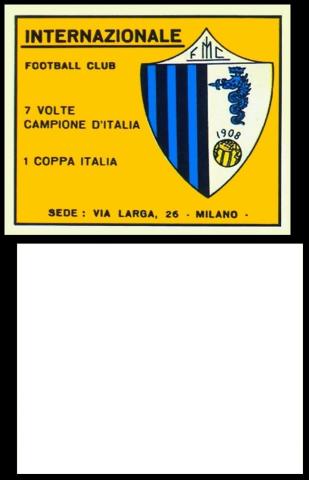
Edizione PANINI [trade/commercial : stickers : O/S - Modena, Italy] "Calciatori" - footballers (1961-62) Un/288
This day started out as the first appearance of Porky Pig, today in 1935, probably the most famous character from the cartoon universe to ever push his head through a drum head and say "That's all, folks!". However when I checked my research I found that was incorrect, because the short subject cartoon he appeared in, called "I Haven`t Got a Hat", was released on March the 2nd not March the 9th. Whether I remember this next year, who knows, but I have a card for it now already....
Instead of that I found that on this day, in 1908, saw the birth of Football Club Internazionale, in Milan. Today we know it as a very similar name, Football Club Internazionale Milano S.p.A - or Inter Milan.
The club was successful from the start, and since 1909 it has always been in the top division of Italian football, the only time they narrowly avoided relegation coming in 1922, from which two unbelievably skilful play off matches saved them. They are also the only club in the country which has won at least one major trophy in every decade of its existence.
Strangely our club was formed through a disagreement, as the players and management were once part of the Milan Football and Cricket Club. They are still going strong too, but are now known as A-C Milan.
The disagreement came about because several of the players and management wanted to be able to field more players from other countries, not just Italians, which is why the word "Internazionale" is part of the breakaway team`s name. Today we think nothing of a club which includes many nationalities, but at that time it was pretty revolutionary. And they started living up to their promise immediately, signing up the German Hermann Hofmann in 1908, and then two Swiss, Oscar Engler in 1909 and Ermanno Aebi in 1910.
Of these three men, I can find nothing of the first. Oscar Engler was born on January the 29th, 1889, and was bought from Torino F.C. in 1909. He would play for our club until 1915 and then no more is known of him, so it is entirely possible he did not survive the First World War. Ermanno Aebi was also born in January, but on the thirteenth, in 1892, in Milan. His father was Swiss and his mother Italian. And he was the first of the International players to play for Italy, five days after his twenty-eighth birthday. He retired in 1922, after a hundred and forty-two games for our club, and two for the Italian National Team. He also lived until 1976, long enough to see his son, Giorgio, become a footballer.
If you are lucky to find a packet for this set, you will understand why it is known as "Calciatori", for the full title on those packets, and on the album, was "Grande Raccolta Figurine Calciatori - Campionato Italiano de Calcio 1961-62". That translates to `a large collection of stickers of football [from the] Italian Football Championship 1961-62`, which I am sure you will agree is rather a mouthful. The word "Calciatore" is interesting though because it comes from the word "calcio", and that means to kick.
The set comprises 288 stickers, all unnumbered, and all with plain backs and no descriptions, because they were each to be stuck above a short description of the player. The exception to this is the badge and the team shot, which have no descriptive text below.
The set is split into teams, each of which starts with the badge, then a team photo, and then members of the team, shown as head and shoulders portraits. But good luck finding them loose, as they are pretty hard to come by in this country.
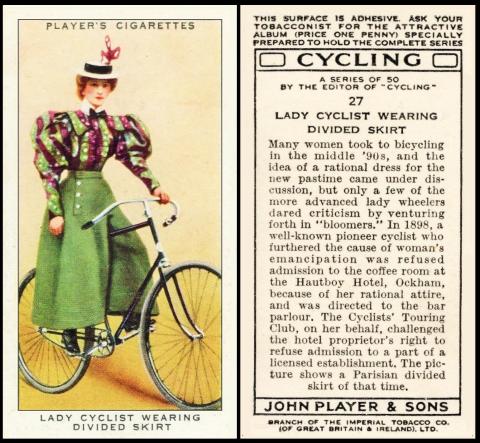
John PLAYER & Sons [tobacco : UK - Nottingham] "Cycling" (May 1939) 27/50 - P72-159.1 : P/67 [RB.17/67]
So on we go to #NationalSkirtDay, and I had visions of this card needing to be replaced, it did not come out well. But after a bit more of a tinker it is okay, except I have used John Player`s "Cycling" before, as a Card of the Day, for the 3rd of August, 2022 and at some time the versions will be swapped.
It is thought that prehistoric women wore skirts, simply by tying grass or skins around their waist. And there is an existing skirt, woven of straw, which was unearthed in Armenia and has been dated to some time between 3900 and 3800 B.C. We do not know, however, whether this was for a man or a woman. And we say that simply because the next proof we have of skirts comes from Ancient Egypt, where many paintings show men wearing a very similar costume, woven from flax, with no other clothes on top. This was called the Shendyt, and oddly, women would never have dreamed of wearing anything so short, they preferred long white dresses!
Strangely, after that, the skirt disappeared and the dresses remained. It only reappeared, as a garment for women, in the Middle Ages, for the upper classes, when a long skirt, made of luxurious fabrics, and trailing behind along the floor, was seen as the height of luxury. At that time, men sported tights, or rudimentary trousers.
Even in the times of the crinoline and bustle, nobody thought to make them attach to a skirt, they still had to go over the head and wiggle down the sides. That all changed in the late nineteenth century, because women were starting to become more active, both in their thoughts and their deeds, and they needed to be able to have a selection of bottom halves in order to allow them to cycle, walk out, and also take tea. That is why this card fits so well as it not only shows a divided skirt on a cyclist, the back speaks of pioneering cyclist Amelia Bloomer, after whom such scandalous outfits were named.
A skirt also made life easier, as the nineteenth century moved into the twentieth, for changing fashions, and hemlines. And in the 1950s Christian Dior took advantage of that to make a range of skirts rather than dresses, saving cloth, which was still in short supply, even though clothes rationing had officially ended on the 15th of March 1949.
Today we sport a skirt, primarily, to celebrate the fact that whilst a dress is usually one colour or pattern throughout, a skirt and jumper are not necessarily so. And whilst it may not be cost effective to have a selection of skirts in different shapes and colours, it pays for itself in the ability to allow for what is, in effect, a different outfit every day.
This set first appears in our original reference book to John Player, RB.17, issued in 1950, described as :
- 67. 50. CYCLING. Small cards. Produced with the co-operation of the Editor of "Cycling". Fronts in colour. Backs in grey, with descriptive text. Issued May, 1939, with special album. Variety : No.9 is found with a text variation.
A. Home issue, with I.T.C. and album clauses, adhesive
B. Channel Islands issue without I.T.C. and album clauses, adhesive
C. Irish issues, with I.T.C., but without album clause. Large green numerals overprinted.
1. Adhesive backs
2. Non-adhesive backs
Now when we move on to our original World Tobacco Issues Index, these sets are all over the shop. First up, as card code P72-86, is the non adhesive Irish issue, in section 2.B. You have to wait until section 2.C to find our home issue, and it is, curiously, combined with the other Irish issue, as :
- CYCLING. Sm. Nd. (50) See RB.17/67 ... P72-159
A. Home issue, with album offer
B. Irish issue. Back with large green numerals overprinted
As for the fourth version, that waits until section 3.C, a section for cards issued in the Channel Islands and Malta. And it is given the card code of P72-216.
This rather strange scheme of listing the cards is also continued in our updated World Tobacco Issues Index, where they are card coded, respectively, P644-180 for the non-adhesive Irish version, and P644-664 for the Channel Islands/Maltese one. Our version is again sharing space with the adhesive Irish version, as :
- CYCLING. Sm. Nd. (50) See RB.17/67 ... P644-320
A. Home issue, with album offer
B. Irish issue. Back with large green numerals overprinted
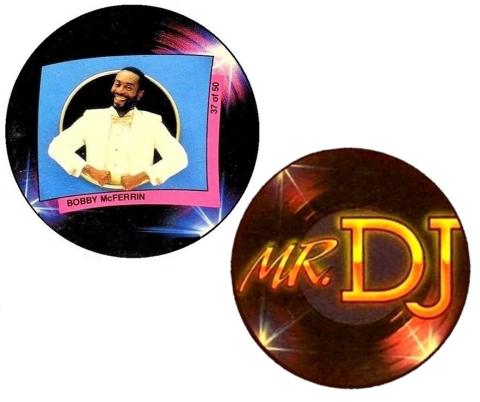
ANGLO Bellamy [trade : bubble gum: UK] "Mr. DJ" (1988) 37/50
I didn`t like this card last night either, or I did, but I couldn`t get the pair to line up to my liking from the two separate scans I was sent. Anyway, this morning, after another tinkering, its a whole lot better.
Today, in 1950, saw the birth of Robert Keith McFerrin Junior, in New York City. He may not be known to our younger readers, but seek him out, for he has a quite amazing vocal range, and ability, covering all styles of singing with ease. And though that makes him much in demand as a backing singer, he has also made many records on his own, as well as collaborations with other singers.
If younger readers know him at all, it will be because of his song "Don`t Worry, Be Happy", which was song, and record, of the year at the 1989 Grammy Awards, as well as being one of the favourite songs of Formula One driver Felipe Massa. It was, in addition, the only a capella song ever to be number one in America.
His unmistakable voice is almost certainly genetic, for his father, Robert McFerrin was the first African-American man to ever sing with the Metropolitan Opera, and his mother was a singer too. In fact if you ever get a chance to see the 1959 film of "Porgy and Bess", starring Sidney Poitier, do listen, as our man`s father, Robert Mc Ferrin, actually supplied the singing voice for Sidney Poitier.
Our man`s first record, however, the album "Bobby McFerrin", was not released until he was in his early thirties, simply, as he states, because he knew he had a voice of his own, and he wanted to use it, not to be confused with, or thought to be emulating, any other singers.
He has also appeared in an animated television movie, as the voice of Santa Bear, in both "Santa Bear`s First Christmas" and the sequel "Santa Bear`s High Flying Adventure". Those were before the runaway success of his song "Don`t Worry Be Happy", a song he came to virtually disown through its unauthorised use as the campaign song for George H.W. Bush in the same year. In fact it seems likely he will never sing it again as an act of permanent protest.
After that he concentrated on providing soundtracks and vocals for film and television, and he was appointed creative chair of the Saint Paul Chamber orchestra. In fact, in later life, he developed a great love for orchestral music, and frequently appears all over America as a guest conductor. He also toured, briefly, with a live version of "Porgy and Bess", to pay tribute to his father`s unseen role all those years ago.
More recently he has been awarded several Lifetime Achievement awards. Sadly though, in 2023, he revealed that he had been diagnosed with Parkinson`s disease, for which, currently, there is no cure, though there are an ever increasing range of treatments.
This set is sometimes said to have been issued with Dandy Gum, sometimes with Anglo, and sometimes with a company that does not exist called "Mr. DJ". The problem is that the cards do not have anything save "Mr. DJ", which is the name of the set, so the latter is an easy mistake to make. If you get to see a trade box though, it actually says "Made in Denmark for Anglo Bellamy Wilkinson Ltd., Pontefract".
Now this is a curious conglomeration of companies indeed. It started out in 1870 with Joseph Bellamy and Sons who was a confectioner of Leeds, then, in 1899, he moved to Castleford, where he started to add liquorice to his stock in trade.
Between those two dates, in 1884, a rival, W.R. Wilkinson & Co. of Pontefract, also started making liquorice. Wilkinson was bought out in 1894, but the name was kept, and converted to a limited company in 1924.
That was eleven years before Joseph Bellamy and Sons added the Ltd, to their name.
In 1961, W.R. Wilkinson merged with Bassett, a fellow liquorice maker. Three years later Bellamy & Sons was taken over by John Mackintosh Ltd, and in 1976 it was merged with Anglo, which was actually part of Barratt, and first produced in 1932. Once merged it was renamed Anglo Bellamy.
Then in the mid 1980s all three got lumped together under the name of Anglo Bellamy Wilkinson.
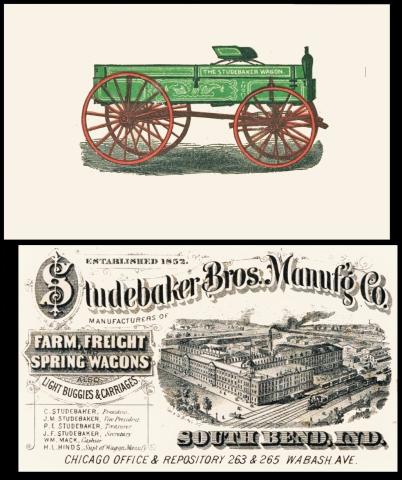
STUDEBAKER Bros. Manufacturing Co. [trade : horse drawn carriages : O/S - South Bend, Indiana, USA] "Advertising Card" (1900)
So let us return to today in 1831, when little Clement Studebaker was born. That was in Pennsylvania, but when he was four his family moved to Ohio. His father was a blacksmith and wagon maker, and maybe he felt that work would be better there, or maybe he just had big dreams for his sons.
However in 1850, young Clement, who had developed quite a talent for his father`s profession, suddenly upped and moved to Indiana, and started working as a school teacher in the little town of South Bend. He does not seem to have been too happy there as he soon found a sideline, helping out at a blacksmith and mechanical repair shop. He enjoyed that much better, and within the year he had left teaching. Two years later, he is recorded as married, to a lady called Charity Bratt, and as being the joint proprietor of `H. & C. Studebaker`, a blacksmith`s shop in the town. It turns out the "H" bit was his older brother, Henry, which begs the question did Henry go there first and Clement follow, or the other way around ? I don`t yet know that, but what I do know is that several of the other children all turned up there too. Sadly, by the end of 1897 only two were still alive, Jacob Franklin having died in 1887 aged forty three, Henry in 1895 aged almost seventy, and Peter Everst in 1897 aged sixty-one. That just left our man, and one brother, John Mohler, who remained alive until in 1917, and the age of eighty-four,
Unfortunately both the children from Clement Studebaker`s marriage died in infancy, and his wife also died, in 1863. However, he is next recorded as being wed, once more, and just the following year, to an Anna Milburn, the daughter of a carriage maker from a nearby town called Mishawaka. It seems like he met her either through doing business with her father, or whilst he was attending a local woollen company which he also had an interest, presumably over the material for the upholstery of those carriages. This marriage produced three children, all of whom, I am glad to say, proved much more healthy.
Another of his interests was politics, and frequent rumours flew that he was about to stand as the Governor of Indiana, but he never did, though he was on several local councils, and a strong supporter of the Methodist movement. In fact there are lots of links to him if you should get a chance to wander the South Bend area, including the Memorial Hospital, which was built on land that he and his second wife donated. And after his death, on November the 27th, 1901, he was also buried in the local cemetery.
Now you may have noticed that there is not a word, above, of cars, and the truth is that cars were not even dreamed of by our man. But if you have good contacts you might find, as we have here, an original card advertising the Studebaker carriages.
In fact it was John Mohler Studebaker`s son in law that was the driving force behind the move from horses to engines, and he was pretty much beaten down by the others, his chance only really coming after the death of Peter Everst Studebaker in 1897, at which point the son-in-law gained the chairmanship of the executive committee, though it appears that the son-in-law had been working on a motor vehicle for some time with one of the firm`s engineers. The first twenty Studebaker cars were made in 1902, and all of them were battery-powered. Their first petrol car came two years later, as a co-production with a couple of other companies. In 1910, the company was slowly closed and re-incorporated as the Studebaker Corporation, and they concentrated purely on gasoline powered cars.
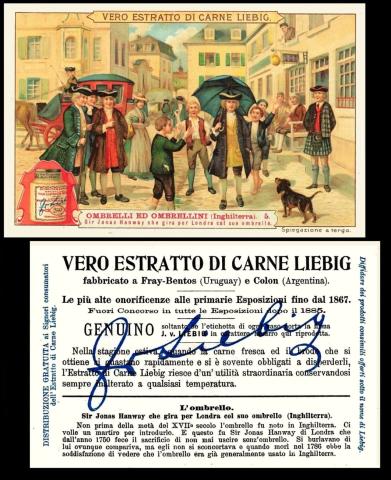
LIEBIG [trade : meat extract : O/S - South America] "Ombrelli ed Ombrellini" (1907) 5/6 - F.902 : S.0902
Friday the Thirteenth is rather a neat link to our final diary date of the week, for it is also "Open an Umbrella Inside Day". On which I have to say I would never be brave enough to risk opening an umbrella inside, and to do it on Friday the Thirteenth as well is a definite no-no.
A delve into the reasons behind the superstition seem to take it back to Ancient Egypt, where it was not really bad luck, it was more a case that to cover the sun could displease the sun god, Ra, and he may decide to leave. And Ra was a very important god, ruling the sky, the Earth, and the underworld, and he also kept an eye on the Pharoahs as well as the more lowly humans, whom he had created with his own tears and sweat. Now he was usually depicted as a man with a falcon`s head, and his headdress was a large red sun - but there are also stories that he existed, and was the first Pharoah of Egypt, until one day, when he decided he had grown too old and tired for staying on the Earth, and flew up to the sun. And you can make of that what you will.
At this time, though, the umbrella seems more of a parasol, used for protection from the sun and not against the rain, and although we know that the Nile flooded regularly you seldom see an umbrella in any of the accounts. People probably just stayed inside until the rain had gone.
It appears that the first true umbrella, against the rain, did not arrive until the seventeenth century, though as they were made of thin silk, they must have been pretty poor protectors. However it appears that though only the rich had them, there were cheaper imitations for people who wanted to make themselves look rich, (yes even then). These were made of stiffer fabrics, which actually did a much better job of repelling the rain and it is true to say that this is one of the few times in history when the rich copied the poor.
It is also true to say that as all these umbrellas flooded the streets, there became an awareness that they could be rather dangerous, poking fellow pedestrians in the eye, or knocking things over whilst out walking. And it is easy to see how this became connected with stories of people breaking priceless possessions by opening the unwieldy umbrella inside their home, the bad luck coming in the cost of replacing such items, whether they be yours or someone else`s. This reached a peak in the Victorian era, when homes were so cluttered with things that you could hardly walk between them anyway. And somehow the idea of bad luck stuck.
To close, all is not lost if you do accidentally manage to thumb the catch and open your umbrella indoors. For you can reverse that curse by turning round and going out of a door backwards, or by knocking on wood. And as long as the umbrella was not fully opened, you can close it down again without any harm at all.
Still not going to risk it though.....
Our set is the Italian version and covers umbrellas and parasols from :
- Egitto [Egypt]
- China [China]
- Italia [Italy]
- Francia [France]
- Inghilterra [England]
- Germania [Germany]
It is also available in German as "Der Schrim", and I will add those names tomorrow
This week's Cards of the Day...
...saw the return of our popular look at sets we know to have been issued in that specific month, throughout the decades, and this time our attention turned to March. And, yet again, I did my best to find cards that relate in some way to that month as well.
We also added a few more recent cards to the index, as we managed to do in February, so that makes a new total of seventy sets we can definitely tie to being issued within that month. However our earliest March set remains the same as before, being Edwards, Ringer & Bigg`s "Dogs Series" issued in March 1908.
Saturday, 28th February 2026
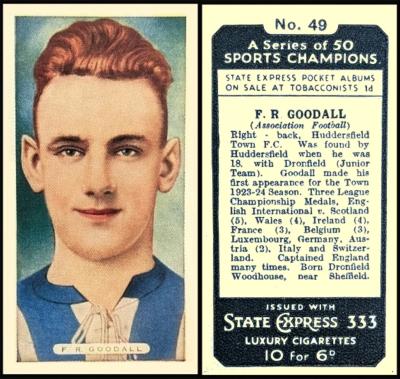
We started the week with this card of footballer F.R. Goodall, and the March links with him are both curious ones, his birth, which was on the 31st of December, 1902, but not registered until March 1903 - and his death, on the 19th of January, 1982, also not registered until March, 1982.
There is also a rather doom-laden fact from modern history, as it was on the second of March, 2010, that Huddersfield received their worst score, five goals to nil against, whilst playing Southampton.
This card holds a bit of a secret, for F.R Goodall is more usually known as Roy Goodall. and therefore collectors of cards of him may be seeing this one for the first time. His full name, however, was Frederick Roy Goodall, and he was born on the 31st of December, 1902, in Dronfield Woodhouse near Huddersfield, one of four children, born to a coal miner. His mother is a bit sketchy, as his father is recorded as being a widower at the time of our man`s birth; all we know about her is that she was called Florence, and they never appear to have married, but all four of these children seem to be hers, with him.
It took a lot of digging before I found that our man did actually play for a youth team, Dronfield Woodhouse F.C., most sites seeming to think that his first team was Huddersfield Town, which he joined in January 1921, when he was eighteen. He stayed with them throughout their glory days, when they became the first team to win three league titles in a row under legendary manager Herbert Chapman, in the years 1923-4, 1924-5 and 1925-6, and narrowly not win in the next two seasons. They also won the F.A. Cup in 1922, and were runners up in 1928, 1930, and 1938 In fact it is true to say that they were the dominant team of the 1920s and 30s.
In 1926 our man married a local girl Edith Clay - and he was also called up to play for his country. Rumour was that he was going to captain England in the 1930 World Cup, but they never took part. The reason for this is often cited as being because the journey, by ship, to South America was too long and too expensive. In fact no teams from Europe had agreed to enter by the deadline to receive those entries. This led to the hosts writing to the Football Association and asking/reminding England, Scotland, Wales and Northern Ireland, to take part. This was even more curious because at that time the Football Association were not members of F.I.F.A., they had resigned. Anyway they did reply, out of courtesy, with a firm rejection of said offer.
Despite a lucrative offer, from Arsenal in 1930, he stayed with Huddersfield Town until 1937, at which time he had played in over four hundred matches, and had also played for England until 1933, in twenty five games, twelve of which he captained. In the same year, 1937, he signed with Nottingham Forest, as a trainer, and stayed there until 1944. Now we know that during the second World War he was a Drill Instructor, and rose to the rank of Sergeant Major, so he must have been stationed in England, which allowed him time and opportunity for football.
After his demob, he was in the running for the manager of Newcastle United, but when that went elsewhere he took a job managing Mansfield Town, for four years, until 1949, though he came back as assistant trainer in 1964. After that we do not know what happened to him, until he died on the 19th of January, 1982
Now our original Ardath reference book, RB.6, issued in 1943, does not number the sets within, it only lists them in alphabetical order. However the description is detailed, and reveals there were two versions - one issued at home in the United Kingdom, which is today`s card, and one an export issue, which was our Card of the Day for the 8th of October, 2023. Another difference between the two sets is that ours is the only one with an album offer, though it is printed in a rather odd place compared to most cards, who choose to print it in the vacant space in the side border(s) - here it is located in a box between the top box with the set title, and the text, starting with the name of the subject depicted.
The full text in our original Ardath reference book reads :
- March 1935. 50. SPORTS CHAMPIONS (titled series). Size 1 7/16" x 2 11/16". Numbered 1-50. Fronts printed by offset in 4 colours, titled, white margins, varnished. Backs printed in dark grey, titled "A Series of 50 Sports Champions" with descriptions, adhesive. Issued with State Express `333` Cigarettes. Pocket album issued, price 1d.
- June 1935. 50. SPORTS CHAMPIONS (titled series). Size 1 7/16" x 2 11/16". Numbered 1-50. Fronts printed by offset in 4 colours, titled, white margins, varnished. Backs printed in dark grey, titled "Sports Champions. A Series of 50 " with descriptions, adhesive. Issued in New Zealand with Ardath Cork Tipped Cigarettes. Subjects the same as above set. (This series has no album offer.)
This is much reduced for our original World Tobacco Issues Index, to simply :
- SPORTS CHAMPIONS. Sm. Nd, (50) Special album issued. ... A72-39
A. Home issue. Brand issue, "Issued with State Express" at base,
B. Export issue, "Issued with Ardath Cork Cigarettes" at base.
And that remains the entry in our updated World Tobacco Issues Index, save the new card code of A745-510
Sunday, 1st March 2026
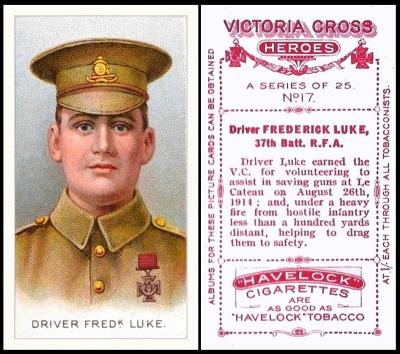
Our second clue card showed this man, and his March link also related to his death, aged eighty-seven, on the 12th of March, 1983 - until which time he was the oldest surviving winner of the Victoria Cross.
That honour is currently held by Flight Lieutenant John Cruikshank, V.C., who died on the ninth of August, 2025, aged a hundred and five. He won his V.C. in July 1944 for continuing to attack a U-Boat despite his own appalling injuries, which were such that he was never able to fly again.
Frederick John Luke was born on the 29th of September, 1895, at Lockerley, a small village in Hampshire. er 1895, being registered as Frederick John Luke at birth. His father, William Luke, drove a van for a grain miller, and there were thirteen children in the small cottage.
When our man left school he went to work at another farm, as a labourer, and he may have always remained so, but, in January 1913, he joined the army. That made him one of the first to leave for France, on the 19th of August, 1914.
In France, he was a driver, not of cars, but the man who drove the teams of horses down to the front line with the guns. Just one week after he landed, one of his Captains, a man called Douglas Reynolds, was trying to bring back a couple of field guns which had been taken by the Germans, but left behind in the melee. Two drivers, our man, and a Job Henry Charles Drain, went to help, perhaps even with their horses, and they managed to get one of the guns back, under heavy fire, because the enemy were, at that time, still quite close.
All three of these men received the Victoria Cross, on the 25th of November, 1914. Douglas Reynolds, 37th Battery of the Royal Field Artillery, and billed as a Major, not a Captain, is card 21 of this very series. Whilst Driver J.H.C. Drain is card 7.
Frederick Luke was wounded on the 2nd May 1915, at the Second Battle of Ypres, and it was a "Blighty Wound", which meant he was sent home for treatment, though it also means his wounds were too serious to be treated in the field. He went to Yorkshire, but was then sent to Glasgow. And he did go back to France, in January 1918, still in the Field Artillery.
After the war, he got married, to a girl he had met at the Glasgow hospital. And he was one of the men to stand honour guard for the burial of the Unknown Warrior, on the eleventh day of the eleventh month, 1920.
In peace, he became a clerk, and raised three children. He must have decided to stay in Glasgow, for he re-enlisted there in 1941, this time in the R.A.F. but he never seems to have flown, he was an instructor, and then went on the boats that would attempt to bring in downed pilots. His two sons were also in that war. And after the war he got a job at Weirs, in Glasgow, possibly a mechanic.
In 1962 he was surprised to learn he had been given the Freedom of the Town of Le Cateau, and this seems to have inspired in him a great fondness for attending military reunions and celebrations. one of which even took him to Buckingham Palace. He died, in Glasgow, on the 12th of March 1983, aged eighty-seven.
This set is a variant of a set that was issued several times, and you can see the `Scissors` branded version, issued in January 1915, as our Card of the Day for the 28th of December, 2025. You can also investigate the "Havelock" one, which is part of our newsletter for the 8th of November, 2025, where it was our Armistice Day card, on Tuesday, the 11th November.
This set was only ever issued overseas, and you will find it first described in one of our original Wills booklets, part three, where the text reads ;
- 109. 25. VICTORIA CROSS HEROES. Size 64 x 37 m/m. Fronts lithographed in colour ; backs with descriptive text.
AUSTRALIAN ISSUES :-
A. Red backs, with "Havelock" advertisement
B. Red-brown backs, with "Wills`s Specialities" advertisement
"SCISSORS" ISSUES :-
C. Red backs, with upright "Scissors" packet"
Varieties :- card No.21 is found (a) with front "Captain", back "Major" Reynolds (b) with front and back "Major" Reynolds.
"GENERAL OVERSEAS ISSUE :-
D. Blue backs, anonymous
I am struck by how our set, and the `Scissors` version both have small Victoria Crosses at the end of the chain beneath the title, whilst the `Havelock` and the anonymous one are totally different, managing to fit a huge Victoria Cross in between the words saying "Victoria Cross" and the line saying "Heroes". In fact we now know that the anonymous version was issued by Imperial Tobacco of Canada.
By the time of our original World Tobacco Issues Index, these sets have been dispersed, the `Scissors` branded Indian version , and the anonymous one being relocated. The two Australian ones do remain together, and are entered as :
- VICTORIA CROSS HEROES. Sm. 64 x 37. Nd. (25) See W/109 ... W62-247
A. `Havelock` back. Brand issue.
B. `Wills`s Specialities` back
In our updated World Tobacco Issues Index, the Australian versions are listed as
- 25. VICTORIA CROSS HEROES. Sm. 64 x 37. Nd. (25) See W/109 ... W675-379
A. `Havelock` back. Brand issue. B. `Wills`s Specialities` back
Monday, 2nd March 2026
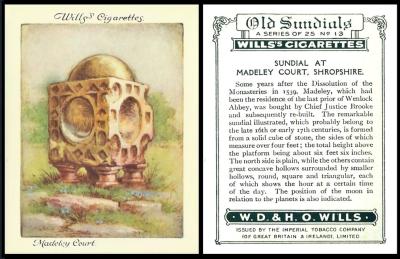
And thirdly, for our last clue card, we had this. The March connection here is simply that this is the month when it is true to say that sundials first start to be useful, because before March the sun is not about that much, and when it is it is seldom strong enough to cast a shadow, let alone one with which you can tell the time.
I have to say this is a most excellent sundial ! It can still be seen, too, at Madeley Court, a sixteenth century house in Madeley, Shropshire, with sections of thirteenth century structure, linking to the fact that it was originally a grange, for the medieval Wenlock Priory. It was bought by Sir Rupert Brooke in 1553, who almost certainly updated it. For some time the house was actually derelict, and in danger of being pulled down, but it is now a hotel, and this sundial still remains.
As for its curious shape and purpose, we are still baffled. There seems to have been no early record of who made it, when, and why. It is a cube of solid stone, approximately four feet tall and also wide on each side, and there is half a circle on top which is three feet in diameter The dome is stuck on with cement, but to all intents and purposes of the same age as the cube, so the thought is that somehow it became dislodged and was repaired. It is also an integral part of the sundial as it holds the vertical pin which the sun strikes to tell the time. On three of the sides are depressions, which have holes that would also have taken pins, presumably to show the altitude, and the azimuth of the sun. These hollows have also been seen on early sundials in Scotland, but this is the only one in England that either was, or that remains.
The pillars shown on this card are not thought to be original, and we know that at some time there was major damage to the sundial, the underside being quite badly cracked, bad enough that it was braced with metal to hold it together.
As to its maker, we also know not, but we do know that the German astronomer and mathematician Nicolaus Kratzer specialised in making sundials in cubes, using multiple hollows. And we know that he was associated with another, similar sundial, at Iron Acton, which carries the carved initials "N.K. 1520"
Our set is first catalogued in our "Cartophilic Reference Book - No.16 : The Cigarette Card Issues of W.D. & H.O. Wills Parts I, II, and III (revised) and Part IV", or RB.16, published in 1950, as :
- 285. 25. OLD SUNDIALS. Large cards, size 79 x 62 m/m. Fronts printed by letterpress in colour. Backs in grey, with descriptive text. Home issue, 1928.
The month of issue was later provided by Wills themselves, courtesy of their Works magazine.
By the time of our original World Tobacco Issues Index, the entry is much reduced, to just :
- OLD SUNDIALS. Lg. Nd. (25) ... W62-166
And that text remains identical in our updated World Tobacco Issues Index, save a new card code of W675-207
Tuesday, 3rd March 2026
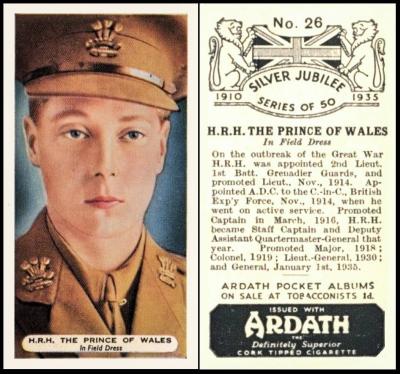
The original March connection here was that Edward VIII gave his first radio broadcast as King on March the 1st 1936. He had technically become King on the 20th January 1936, on the death of his father, but he was never crowned, for though his Coronation was scheduled to be on May the 12th, 1937, he decided to give up any idea of being King on December the 10th, 1936, in order to marry the woman he loved, the American divorcee Wallis Simpson.
However if you look at the card there is another March Mention, for it says "On the outbreak of the Great War H.R.H. was appointed 2nd Lieut. 1st Batt. Grenadier Guards..... Promoted Captain in March 1916." This card shows him in uniform, but the badge is curious, because it is not of the Grenadier Guards. Many collectors, seeing the Prince of Wales feathers, think it to be of the Royal Welsh Regiment, which would fit in with his title, but the badge is wrong, for the first part of the motto, the wording "Ich Dien", or I Serve, drops away from the crown, whilst this badge has that wording, or something, moving upwards.
A bit of detective work proves that it is the badge of the Welsh/Welch Regiment. In this badge the Prince of Wales feathers extend below the crown, and the "Ich Dien" is split between a pair of upwards curving banners, one word on each. Originally, on the banner below these said "The Welsh", but that only dates from 1881, when The Welsh Regiment was formed from two Regiments of Foot, the 41st (Welch) and the 69th (South Lincolnshire).
The first of these was originally formed, in a total coincidence to our theme, on the 11th of March, 1719, by Edmund Fielding (the father of the novelist Henry Fielding). It was a regiment for invalids, which sounds odd, until you discover that "invalids" at that time meant veterans of earlier wars or of earlier, now defunct regiments, who could be relied upon as extra men in time of need. In 1741, Edmund Fielding died, and his regiment was renamed The Royal Invalids. Ten years after that, it was renamed to the 41st Regiment of Foot, and in 1787 it was decided to change that, slightly, to add "(Invalids)", in brackets, behind the word Foot. However that only lasted for three years, and then it was quietly dropped. The next renaming came in 1831, when it was named The 41st (Welch) Regiment of Foot.
This all changed with the Cardwell Reforms of the 1870s, named after Edward Cardwell, Secretary of State for War, who pretty much updated the entire military system, including dividing the British Isles into sixty six districts based on counties and populations, in which all line infantry regiments were paired, sharing one home base and recruiting coverage area. One of the pair would serve overseas, whilst the other trained, and then they would swop over. If there was a local paramilitary, or private army, in that area, it would join forces with whichever needed them at any given time.
In July 1881, as part of the Childers Reforms, all these regiments were numbered, and our force was linked, as we said above, with the 69th (South Lincolnshire) Regiment, to form the Welsh Regiment.
However it was not until 1921 that the spelling of the Welch Regiment was again used, possibly to distinguish itself from any other. So when the Prince of Wales joined the army, on the outbreak of war, this badge would have said "Welsh", not "Welch"
As for our set, it first appears in our original Ardath reference book, RB.6, issued in 1943, as :
- March 1935. 50. SILVER JUBILEE 1910 - 1935. (titled series). Size 1 7/16" x 2 11/16". Numbered 1-50. Fronts printed in four colours from half-tone blocks, varnished. Backs printed in grey, with descriptions, adhesive. Pocket album issued, price 1d. Issued with Ardath Cork Tipped Cigarettes. Also issued April, 1935, in New Zealand. Printed by Bemrose and Sons, Derby.
Now often there is a different brand on the New Zealand issues, as we found out earlier in the week, but it is not listed here, and there only being one version seems to be backed up by our original World Tobacco Issues Index, which does not mention a second version at all. However it is less effusive, only recording it as :
- SILVER JUBILEE. Sm. Nd. (50). Special album issued ... A72-36
And that is the same wording that goes on to appear in our updated World Tobacco Issues Index, save a new card code, of A745-480
Wednesday, 4th March 2026
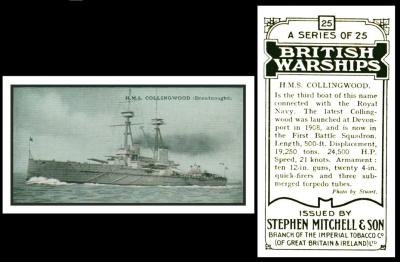
This H.M.S. Collingwood has two ancestors, or maybe three, if you count the Admiral, Cuthbert Collingwood, whom she was named for. He was a long serving Naval Officer, born in 1748, who joined the Royal Navy at the age of thirteen and left it just one day before he died, in 1810, aged sixty-one - and he took part in the American Revolutionary War, the French Revolutionary Wars, and the Napoleonic Wars, where he became very good friends with a certain Horatio Nelson. In fact on the death of Admiral Nelson, he took over command of the Mediterranean Fleet.
The first ship to bear his name was built in 1841, with sails, and converted to more modern screw propulsion twenty years later. However she only lasted six more years and then she was sold. After that there seems no record of who bought her or where she went.
The name was reused in 1882, for another fairly short-lived ship, but very different from her predecessor as she was an ironclad battleship. However she had a lengthy build and rebuild, and was only completed in July 1887. She was involved in a collision with H.M.S. Curacao in 1899, and though reports were that it was just a minor incident, just four years later she was decommissioned, just five years after that, in 1909, was sold for scrap.
Our ship was actually built before that, being ordered in October 1907 and laid down in the February of the following year at the Royal Naval Dockyard at Devonport. However she was not completed until April 1910, by which time her predecessor namesake was no more. At first she was used as part of the Home Fleet, and performed very well, apart from a rather embarrassing moment when she struck a rock off Spain (though to be fair the rock was not on any charts), and the damage was minor, just four months later she took part in the Coronation Review for King George V at Spithead. She remained with the Home Fleet until May 1912, when she became the flagship of the 1st Battle Squadron. However, after that she seemed to play host to several members of the Royal family, and in June 1914 was actually, briefly, used for pleasure alone. This all came to an end just one month later, when she was mobliised for war, whilst a month after that she found herself at Scapa Flow, and a month more saw her as part of the Grand Fleet, supporting Vice Admiral Beatty`s squadron. That led her to Jutland, on the 31st of May, 1916, where she saw much action. However with the end of the war she was transferred back to Devonport and became the flagship of the Third Fleet, before she was used for training purposes. Then, on the 12th of December, 1922, she was sold, for scrap.
As for a March connection, we could only find that on the 25th of March, 1915, Rear Admiral Hugh Evan-Thomas flew his flag aboard her for a couple of weeks, until the 14th of April of that year.
That was not the end of the name though, as to this day there remains an H.M.S. Collingwood. That was built in 1940, at Fareham, near Portsmouth, and it is an on-shore training establishment for new Naval recruits, as well as the Royal Naval Volunteer Cadet Corps.
This set is from the second period of Stephen Mitchell`s card issuing story, after they joined the Imperial Tobacco Company in 1902. It is a complex set, listed in our original World Tobacco Issues Index as :
- BRITISH WARSHIPS. Sm. 63 x 35. Black and white, bluish-green background. .. M122-13
1. "A Series of 25". 27 subjects known - Nos. 1/25, two subjects for No.3, ("H.M.S Fearless" and "Torpedo Boat 110") and No.10, ("H.M.S. Harpy" and "H.M.S. Liberty")
2. "Second Series, Nos. 26-50.
This is reduced somewhat in our updated World Tobacco Issues Index, to
- BRITISH WARSHIPS. Sm. 63 x 35. Black and white, bluish-green background. .. M757-250
1. "A Series of 25". Nos. 1/25, two subjects for No.3 and No.10
2. "Second Series, Nos. 26-50. (25)
I tend to find that the first series cards are a bit greener to the fronts than the seconds.
The ships in the first set are as follows :
- H.M.S. Iron Duke
- H.M.S. King George V
- H.M.S. Fearless / Torpedo Boat No.110
- H.M.S. Prince of Wales
- H.M.S. Birmingham
- H.M.S. Naiad (Mine Layer)
- Past and Present (H.M.S. Victory and Australia)
- H.M.S. Lord Nelson
- H.M.S. St Vincent
- H.M.S. Harpy / H.M.S Liberty
- H.M.S. Inflexible
- Submarine E.6
- H.M.S. Superb
- H.M.S. Audacious
- H.M.S. Orion
- H.M.S. Hercules
- H.M.S. Princess Royal
- H.M.S. Antrim
- H.M.S. Edward VII
- H.M.S. Dreadnought
- H.M.S. Queen Mary
- H.M.S. Centurion
- H.M.S. Shannon
- H.M.S. Forward
- H.M.S. Collingwood
Looking into the substitutions, I imagine that they could have been done to update the flotilla, for "H.M.S. Fearless" was built in June 1912, but "Torpedo Boat 110" ten years earlier. As far as the other pair, "H.M.. Harpy" was built in 1902 as well, and though "H.M.S. Liberty" was but a rename of an earlier boat (H.M.S Rosalind) her rename came just fifteen days after her launch on the 15th of September, under orders by the Admiralty, adding her to what would become the "Alphabetical Classes", each being a number of destroyers with a single initial letter. And in her class, the "L" Class, were Laertes, Laforey, Lance, Landrail, Lark, Lassoo, Laurel, Laverock, Lawford, Legion, Lennox, Leonidas, Liberty, Linnet, Llewellyn, Lochinvar, Lookout, Louis, Loyal, Lucifer, Lydiard, and Lysander. All of these ships had earlier names, and most of them were laid down in 1912, the two exceptions being Lassoo and Lochinvar, which were laid down in 1915.
Thursday, 5th March 2026

We actually featured one of the insert sets, "The Cage, Uncut", before, in our newsletter of the 6th of September, 2025, as the diary date for Monday the 8th of September, and I have to say that despite that being a special issue, it is a much more normal looking card than this. For here we have a card with cut corners, half diamond cuts to the sides, and even the picture is quartered into images.
The episode on this card, "The Immunity Syndrome", was the eighteenth episode of the second series, and it was first shown on the 19th of January, 1968. It starts out by telling us that the crew are headed for leave when they receive a garbled message. Whilst a better connection is sought, Spock tells them that the Intrepid, a Vulcan starship, has just lost all connection, and presumably been destroyed. He knows this because he too is a Vulcan, and they are able to connect by a form of telepathy. So instead of getting time off the crew investigate, only to find that a nearby star system has also disappeared. The cause is discovered to be a huge energy-sapping amoeba, which also traps the U.S.S. Enterprise, but does allow a shuttle out, with Spock aboard, and he discovers a way to kill it. Unfortunately his message is not delivered entirely, and Captain Kirk has no choice but to destroy the amoeba with an anti-matter bomb. However he also has time, just, to drag Spock`s shuttle out of where it is being captured and he returns safely to the ship.
I have not been able to find out if this episode was featured on any other set of cards. Maybe you know. I did find out that the first set of "Star Trek" trading cards was circulated with Leaf gum in 1967. The images were in black and white and had large black banners at the bottom with the titles in white lettering, but it was not a great success. It is rare today though, as it was only issued in Illinois and Ohio, and there were licensing issues which led to its withdrawal.
Friday, 6th March 2026
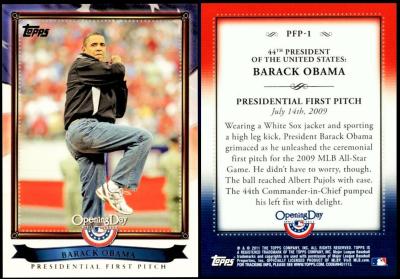
We are not entirely sure when the idea of a "Presidential First Pitch" began, but we know that William McKinley, whilst still the Governor of Ohio, threw a ball on to the field before an Ohio vs Columbus game in 1890. He would later become President, but not for another seven years. However he probably does still count as the first President ever to have thrown a First Pitch.
The idea of having some local celebrity or politician starting a baseball game almost certainly goes back way longer, in the same way that the Mayor or Mayoress opens a local fete.
The first actual President in office to throw a Presidential First Pitch was William Taft, in 1910. Whilst the President to have thrown the most, during his time in Office, was Franklin Delano Roosevelt, who threw eleven. This is beaten only if we include both Presidents Bush, who have each thrown fourteen, but before and after they were President.
Our man, Barack Obama, actually threw the first ball of the 2005 American League Championship Series, but he was not yet President, he was only a Senator from Illinois. That is not the game shown on this card though, our picture coming from the Major League All Star Game at Busch Stadium in St. Louis, Missouri, on July 14th, 2009, an annual event in which players from various teams throughout the American and National Leagues get together. And Barack Obama also threw the first pitch the following year, which is depicted on card PFP-10 of this series, and which was also the hundredth anniversary of that date we mentioned earlier, when William Taft did the honours.
The idea of having an "Opening Day" set of cards began in 1998, with a set of just 165 cards, released in April 1998, and it all sprang from a thought, by Major League Baseball themselves, as to why there was no cheap set for children to collect, in order to foster the collecting bug from an early age. Most of the cards were similar to the standard 1988 base set, except for the fact that the borders were silver, and that there was a silver foiled "Opening Day" logo on the front of each card. Also the cards were not numbered in the same order, and some were different. But the most different thing of all is that there were only 165 cards, no inserts or promos, and nothing to discourage the children from the prospect of getting a full set relatively quickly. They were also cheaper than the standard cards, just 99 cents a pack of seven cards, rather than the $1.99 for sixteen cards that the standard version cost.
The following year the cards were very similar, but an extra card was added to each of the packs, making seven. Again there were just 165 cards in the base set, but there were, for the first time, other cards available - one of these had a shadow of a baseball player and a date, and if any player hit a grand slam on that date you could send the card back and be entered into a sweepstakes in which the grand prize was a trip for two people to the 1999 All Star Game. There was also an autograph card, of Hank Aaron from the Atlanta Braves. And if you bought something known as a blaster box, a complete box of cards, inside it you would find a larger card, measuring 3 1/4" x 4 1/2". There were three of these cards available to collect - Sammy Sosa from the Chicago Cubs, Mark McGwire from the St. Louis Cardinals, and Ken Griffey Jr from the Seattle Mariners.
The cards continued to be produced every year until 2007, when there was a change, because for the first time there was a Hobby edition, with parallel cards.
In 2009 there was no "Opening Day" set at all, and no word as to why. It returned the following year though, and has continued ever since.
Our set was issued on March the 5th, 2011, which was a month before the actual opening day. The cards are still based on the standard set, but now there are 220 cards, plus a parallel set with blue borders and special numbers, and four printing plate cards (in black, cyan, magenta and yellow) for each of the base set cards. Then there are Autograph cards, and seven different insert sets - "Mascots", "Opening Day Stars", "Spot the Error", "Stadium Lights", "Superstar Celebrations". "Topps Attax" cards, "Topps Town", "Toys R`Us", "Under the Lights", and our set "Presidential First Pitches", a set which comprises :
- PFP-1 - Barack Obama, 2009
- PFP-2 - Harry Truman, 1951
- PFP-3 - Calvin Coolidge, 1924
- PFP-4 - Ronald Reagan, 1988
- PFP-5 - Richard Nixon, 1969
- PFP-6 - Woodrow Wilson, 1916
- PFP-7 - George W. Bush, 2005
- PFP-8 - George W. Bush, 2001
- PFP-9 - John F. Kennedy, 1962
- PFP-10 - Barack Obama, 2010
Well there we go, I did more or less finish after all. I suppose I would have completely finished if I had not spent the morning at the beach, or Ruislip Lido, which is just as good and quicker to get to than anywhere else, with nipper, whose birthday is today, he is now two - the terrible twos, as opposed to the `orrible ones. The weather was not great, it was grey and a bit drizzly, but he enjoyed it, and had a dig in the sand, and met lots of other dogs, so all in all it was a pretty fun time for him.
And I will start the next one earlier - promise.....
Enjoy your weekend, and I hope you find some cards. But remember to save some money as our grand convention is fast approaching......