
I was a bit slow this week so it looked like this may be a two part newsletter, but in the end only the final day was missing and that has been added, Saturday afternoon. I have now also added the details from the reference books about Thursday`s card, the large sized version of Wills "Arms of the British Empire" - second series.
This week included lots of phone calls, and visits to doctors and vets, because nipper managed to get a bit of wood in his paw. Glad to say he is fine now, but has to have pain meds with his food, and stand with his foot in a bowl of medicated shampoo for ten minutes which may not sound long to non-dog owners, but is an eternity for a dog, so when his version of ten minutes is up, which is long before mine, off he goes.
Website News :
None of the above was predicted when I meandered over adding the back issues of the newsletter to the card index and sauntered through the editions of the 3rd of June 2023, the 10th of June 2023, the 17th of June 2023, the 23rd of June 2023, and the 30th of June 2023.
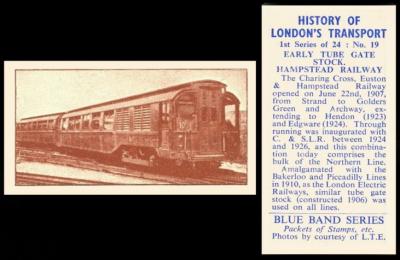
Not much was changed on most of these, which is why I rattled along so well, but there was a brief panic on Thursday the 22nd of June when this red fronted Blue Band “History of London`s Transport” first series (1954) was already in the index, but what had happened was that when I had featured the black version I had hunted through for the other two and put them all in the index at the same time.
What`s On This Week :
Our regular round up of branch and club meetings :
- Saturday the 20th of June - East Anglia : from 8.30 a.m. to 3.30 p.m. - with auction at 11 p.m, at Roydon Village Hall, High Road, Roydon, Diss, Norfolk IP22 5RB. Admission : EACC members free with annual subscription, Visitors £3 admission each time.
- Saturday the 4th of July - LINCOLNSHIRE : from 10.30 a.m, .at Kirton Leisure, 31a Willington Road, Kirton, Boston PE21 1EP.
And now for this week`s newsletter, where our cast of characters include - a court challenge, a spiritual stretch, a confectionery confusion, a saint`s story, a delayed decision, a luscious lick and, a bit delayed, some cosmetic creativity....
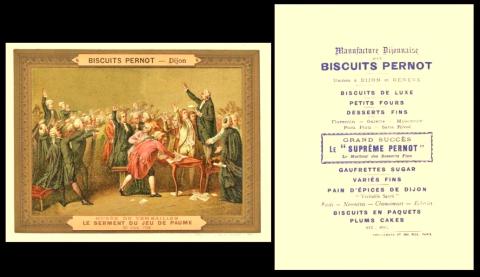
Biscuits PERNOT [trade : biscuits : O/S - Paris, France] "L`Histoire du France"? / the history of France (1900s?) Un/??
Another week of what I thought to be simple, fun, subjects actually starts in a different vein to what I imagined with our court challenge.
The court part has a double meaning, firstly it relates to #InternationalTennisDay, which I took to be people playing tennis for the love of the game, however bad at it they were; but it turns out not to be that, and not even tennis at all, at least not what I know of as tennis. But it also relates to the matter of the law and either its upholding or its breaking.
Confused yet?
Well lets start with the tennis bit, but something called court tennis (if you are American), royal tennis / real tennis (if you are English or Australian) or courte-paume (if you are French), is a game played indoors in a court, not the sort we today call lawn tennis, which is played outdoors on grass. The balls are cork inside, which is covered with fabric, and then covered again with cloth, not felt, which would not be strong enough for this game. Originally, and sometimes today, the balls were white, not yellow, though in later years yellow has crept in to make the balls easier to see. And to this day most of them are hand made. They are also heavier, and bounce less, which means the racquets are also different, stronger, with tighter, closer stringing. As far as the game, the court is split into two sections, one on each side of the net, and they differ, one side being twelve long thin strips across the court and the other being six strips the same and a larger strip which is split into sections of one third and two thirds horizontally. To play it involves striking the ball over the net aiming to strike the walls and jutting structures called roofs, or even to leave the court via an opening in the walls. The ball must always hit one of the sloping structures on the receiving side before it hits the floor, and it must also hit the floor in a specific place to be valid.
The other reason for the day is stranger still, for it was founded to mark the two hundred and twenty-fifth anniversary of the Tennis Court Oath, which took place during the French Revolution, today, in 1789, on a tennis court. This was a vow by the so-called commoners who were excluded from meeting in any form of royal meeting hall, and so they met on the tennis court inside Versailles. They then took an oath, declaring themselves the true National Assembly, and vowing to hold regular meetings and never to be parted until a written constitution was part of the legislature of France. This oath is important because it marks the date where the power was taken away from the monarchy (at least by the five hundred and seventy seven members of the Third Estate) and given over to the people instead. Because on June the 27th, 1789, the King, Louis XVI, relented, and agreed that clergy and nobility could join the new National Assembly, thus sowing the seeds for the French Revolution.
This painting is by Jacques-Louis David, and it was painted, in oils, in 1790-1791, being exhibited at the Salon, at the Louvre, of 1791, but it was then intended to be hung in the room where the National Assembly met. It is called "Le Serment du Jeu de Paume", or the tennis court oath.
Now the artist was reasonably famous already, he had won the Prix de Rome in 1774, and had tasted success with a painting called "The Oath of the Horatii", which depicted the three brothers Horatii vowing to fight the Curiatii, who were their cousins, and another set of triplet brothers. This was commissioned by Louis XVI. It may seem to have nothing to do with our painting, but it was representing a powerful theme of the French Revolution, namely the sacrifice of the individual for the good of the state.
Our painting is but a study, for the final work was intended to measure seven metres high by ten metres wide. We know that it was not finished when it was exhibited, and that the artist was not too happy with it, indeed his intention was to rework it, because he left many sketches and drawings of this image, subtly, and majorly, altered, but somehow he never actually completed that work, not even to the point of beginning a second painting. And yet he did not die until 1825, so we know not what stayed his hand so long.
He would, however, have been delighted that this image became so prevalent on European chromos that almost everyone you have ever heard of feature it on a card, and some more than once - the only exception being Liebig, who seem to only feature the game itself, strangely being played out of doors, in their set of "Jeux Populaires" (S.1399), issued in 1936
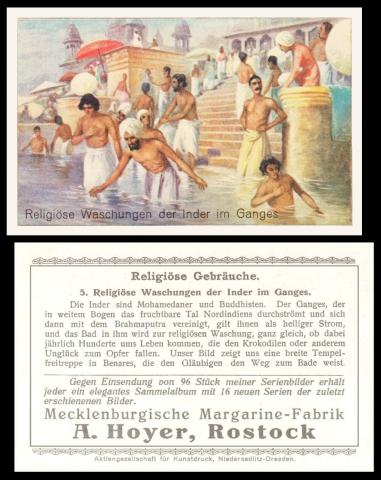
A. HOYER [trade : margarine : O/S - Rostock, Germany] "Religiose Gebrauche" /religious practises (1930s?) 5/12
Our spiritual stretch is a little pause for the gentle art of yoga, for it is #InternationalYogaDay.
Now I am going to be honest, I have tried to do yoga in the morning via you tube but never had a dog who would leave me alone whilst I was on the floor rolling and stretching, until it all dissolved into chaos and laughter.
Now yoga comes in several forms, as therapy, as relaxation, as exercise, and as a philosophy. It`s actually a Sanskrit word meaning connection and union but in the way of connecting and uniting your soul, spirit, and body rather than a connection to another person.
You may be wondering why we have the River Ganges, so let me explain. This waterway is also connected with yoga, being its birthplace and a metaphor for the practise in spiritual terms. People have worshipped, and performed yoga, beside it for many centuries, using the flow to do breathwork and looking into its deepness to ponder on the complexity of their souls. Indeed, in Hindu tradition, the river represents a source of vitality and of freedom.
To this day if you look along a modern map of the river, you will find many ashrams and yoga centres are very close beside the river banks. One of these, Rishikesh, is the "Yoga Capital of the World", with hundreds of retreats and tutors some of whom supply daily, drop-in classes for backpackers.
Now I don`t know much about Hoyer and I cannot find any other cards from this set. But maybe a reader can help me out in both cases.....
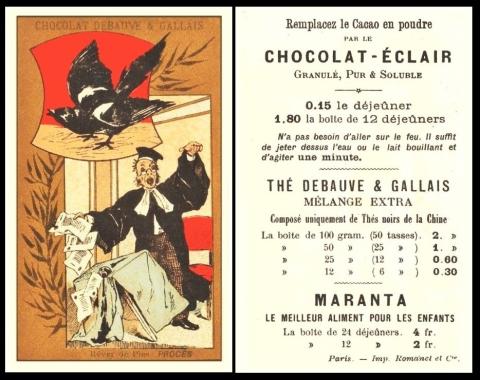
DEBAUVE et Gallais [trade : chocolate : O/S - Paris, France] "Reves et leur meanings" / dreams and their meanings (1900) Un/??
Our confectionery confusion leas us off on another tangent, which led to an interesting story, for today is #NationalChocolateEclairDay, and my request for cards showing chocolate eclairs brought up this one instead.
We know that this card dates from after 1878 because in that year Debauve and Gallais were awarded a gold medal at the Universal Exposition of Antwerp for his "chocolat eclair" - but not the sort we all know, the pastry tube filled with cream that has chocolate on the top. Instead his was a product that was made out of chocolate granules that was added to water and made an instant hot chocolate drink. For in this case the "eclair" was being used in another sense, relating to the fact that the drink was ready quickly, like a flash of lightning.
As for our card it is yet another dreams and their meanings - in this case dreaming of a magpie, which means communication, sometimes professional or legal. Most of the cards in the set are heavily gilded with red sections, but on some the red is absent. The object that you have dreamed of is in an inset, somewhere, and the large picture acts as the illustration of that; as you can see from our image, the man is in a long gown, with a white, untied, cravat, the emblems of law or teaching, and he has letters and documents issuing forth from a sack.
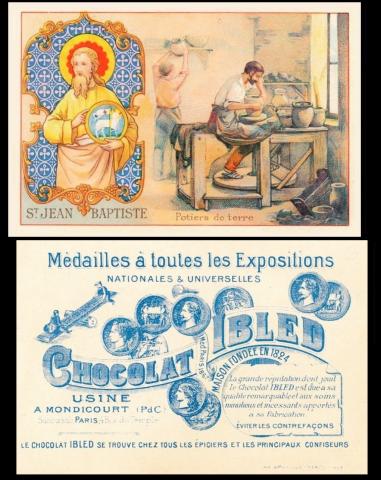
Chocolate IBLED [trade : chocolate : O/S - Paris, France] "Les Saintes" (????)
Let us move on to a saint`s story, for tonight, at sunset, it is St. John`s Eve, the eve of the feast day set aside for St. John the Baptist, to mark his birth.
Now the unusual thing about that is that there are only two feast days devoted to the birth of a saint, most marking the date that they died or were killed. The other, as I am sure you are wondering, being the birth of the Virgin Mary, on the 8th of September.
We do not really know when John the Baptist was born, all we know is that the bible tells us he was born six months before Jesus Christ, and so it was fixed into the calendar as June the 24th, six months before Christmas Eve.
We celebrate his birth in several ways, with a feast naturally, and with burnings or bonfires, as well as processions and church services, especially in churches that are named after him. In country areas it seems to be tradition to gather wildflowers and make them into a posy to leave at the church altar. These always include St John`s Wort, which is generally in bloom on this day, hence its name, but can also include corn marigolds, and wormwood (because it was from that plant that he constructed his coverings, or clothes).
He is a saint that seems universally revered, appearing in many religions, even as Yahya ibn Zakariya in the Islamic faith. But I did not know why this card records him as the patron saint of earthenware potters, and yet it is the truth. There are several reasons why, but the most telling is that after his killing his head was given to a potter for safe keeping and he stored it in an earthenware jar. However in the Eastern Orthodox tradition, where he is known as St. John the Forerunner, the role of patron saint of eartheware potters is given to St. Spirydon.
This set is another version of the set we featured as a Card of the Day for the 6th of June, 2025, which was issued by Wibault. And most of the details that we know so far are there.
As far as Chocolat Ibled, that was founded in 1824 in Mondicourt, France, by a young graduate chemist called Christophe Ibled, who opened his workshop on the banks of the Kilienne river. That workshop was soon outgrown.
In 1905 a Pierre Ibled took over the reins and during the First World War he moved it to Lisieux where he presumably lived. Thirty years later we know that it was being run by a Henry Ibled, who, strangely, decided to change the name, to Chocoreve
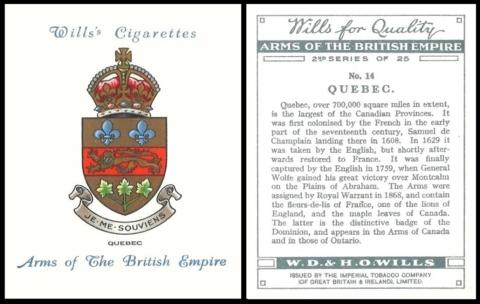
W.D. & H.O. Wills [tobacco : UK] "Arms of the British Empire"- second series (April1932) 14/50 - W675-150.2 : W62-112.2 : W/128
Our delayed decision brings us to the strange fact that the song "O Canada!" was first performed today in 1880, but did not become the national anthem of Canada for just over a hundred years - on July the 1st, 1980
It was written by a Canadian man called Calixa Lavallee, in 1880, and the words were provided by a Frenchman, Adolphe-Basile Routhier. The song was commissioned by the Lt. Governor of Quebec, Theodore Robitaille, curiously for a day we have just been celebrating, St. Jean Baptiste Day, on which there was to be a grand ceremony and banquet at the Pavillon des Patineurs (or the skating rink). And why we have Quebec is that this skating rink was in Quebec City.
It was met with rapturous applause, and there were suggestions that it be made the national anthem, but it was not, even though there was no official national anthem at that time - what was generally used, at least by the French, was another song, also by Adolphe-Basile Routhier, called "La Chant Nationale", whilst the English stuck religiously to "God Save The Queen", and both occasionally used "The Maple Leaf Forever". However, the anthemless state remained, and for many years, and nobody seemed to care - though there was once more a call to immortalise "O Canada" as the national anthem in 1939 after King George the Fifth seems to have mistaken it for such at the dedication of the National War Memorial in Ottawa, and remained standing to attention until it had ended.
It was not until 1964 that the Prime Minister, Lester B. Pearson, stepped in and decreed that Canada must have a national anthem. He narrowed it down to two, but failed to decide, or, most probably, wanted to retain the support of both the English and the French, and kind of fudged it by saying "O Canada" would forthwith become the national anthem of Canada, whilst "God Save The Queen" would be played as the royal anthem of Canada,
Yet our song still did not become the official national anthem until 1980. There was also a bit of controversy because some of the words in the English version were altered, and to this day traditionalists refuse to sing the new ones. It has also come under fire for being nationalist, sexist, and too religious !
Now when i originally wrote about the small sized, home issue, of this set, as our Card of the Day for the 19th of December, 2021, I did not mention the larger version that is showing here today. And it turns out that there is good reason for that, because that small sized set was issued in October 1910, and has the original card code of W/40.A, whilst our set was issued in April 1932, and the first and second series have the original card codes, respectively, of W/127 and W/128 - and they also appear in a different volume, the small cards being in our Wills reference book part three, and ours in part four. But the large sized versions are not even mentioned in the handbook to the World Index, under X21/200-126 - so it is understandable how I missed them.
The opinion of several Wills collectors is that because the original small sized version had a very short run, being replaced after just two months, in December 1910 with the calendar for 1911, the artwork was reused and the sets reissued, in a larger size.
Anyway, we have now added the two large sets to our table on the home page for this group, which is with our Card of the Day for the 19th of December, 2021. And eventually, when we use a large sized card from series one of the large format, that will be the home page for the two large sized sets.
They are first described in our original Wills reference book, part four, as :
- ARMS OF THE BRITISH EMPIRE. Large cards, size 79 x 62 m/m. Fronts printed by letterpress in colour. Backs in grey, with descriptive text. Home issues.
127. 25. 1st Series of 25. Issued 1931
128. 25 2nd Series of 25. Issued 1932
The actual months of issue were revealed in the Wills Works Magazine, and they are November 1931 for the first series and April 1932 for our second series.
The large sets are also in a different section of our original World Tobacco Issues Index, catalogued as :
- ARMS OF THE BRITISH EMPIRE. Lg. Nd. ... W62-112
1. "1st Series of 25"
2. "2nd Series of 25"
And this is repeated in our updated World Tobacco Issues Index, with a new card code only, of W675-150.1 and W675-150.2 respectively

UNSTOPPABLE Cards [trade/commercial : cards : UK - Kent] "Fireball XL-5" (2017) 41/54
And now to our luscious lick. which is a curious one, for it is #NationalBombPopDay - referring to the ice lollies with the bands of different colours, thrustingly shaped into what we do call it, which is a rocket.
Now actually there is a lot more to the story than that, because the actual lolly was called a Zoom Fireball XL5, and it was produced by Lyons Maid in 1963. The flavours were strawberry, lime, and orange, so that the rocket stages stood out. And you are right, the name is indeed in direct reference to the 1962 Gerry Anderson series which inspired our card above, and which was also called "Fireball XL5"
This was purely a case of claiming a name to get more business, as the actual "Fireball XL5" rocket was never that brightly coloured to the fuselage, only to the wings, which were red and yellow stripes, and the nascelles round the nose (or, technically, the landing capsule) which were red, for the most part it was silver. Nor was it a sloping pyramidal shape, it was simply a straight, five stage, cylinder, with the addition of those coloured parts.
There were only thirty nine episodes of "Fireball XL-5" and they were each half an hour long. It was also shown in America, who, oddly, bought it, for all the other Supermarionation series that were shown in America were syndicated .
This card comes from the base set of fifty four cards, but there were also promos and chase cards running parallel, six with silver foli insets, and a range of autograph cards, sketch cards, printing plate cards. For some reason the checklist card was split into a checklist of the first forty-one cards and another of the last twelve cards which had the foil inset.
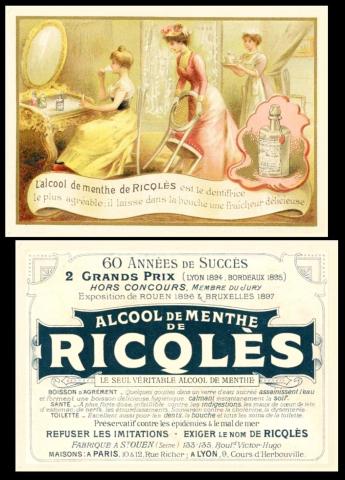
RICQLES [trade ; medicinal drink : O/S - Lyon France] "Advertising Card - The Beauty Parlour" (1897/98) Un/??
And we close our week, a little later than planned, with our cosmetic creativity, or #NationalBeauticiansDay.
There are many forms of beauty, both male and female, but often it is artificially enhanced by these clever cosmetologists, heavenly hairdressers, marvels of make up. magnificent manicurists, perfect pedicurists, and supreme stylists.
We can go it alone, and even go without, but so long as you are not trying to be someone you are not, there is nothing wrong with seeking advice as to how to show our true selves off for the better, and to protect the health of our skin, nails, and hair.
As far as the story of beauty, we have to go right back to Ancient Egypt, where the earliest cosmetics were made. Amazingly these included kohl, not just to highlight the natural beauty of the eyes, but to protect them from the glare of the sun. They were not so sensible in other ways though, and a sun tan was just as highly prized as it grew to be in the 1920s and 30s. This was swept away by the Greeks and Romans, who believed that having sun tans was a sign that you laboured all day in the fields, and tried to have the palest skin of all. This continued through the Middle Ages, and reached its peak in the Elizabethan era, where people, including Queen Elizabeth I, would paint their faces with white lead and mercury to get themselves, dare I say, beyond the pale.
Up to the twentieth century, and before women joined the work force, most people were either rich enough to have a lady`s maid to attend to their beauty needs, or they cut their own hair and didn`t bother with any other forms of beauty. But when women went to work, they learned the art of comparison, and enhancement, and the beauty salon, for all, was born. Some employers even had salons at the factories. Another change came with the beginning of motion pictures, leading to a rush of women demanding to have their hair cut like their favourite leading lady.
One man bridged the gap between the movies and the woman in the street, and that was Max Factor. He was born in Russia in 1877 and moved to America in 1914, at just the right time to become involved with the film industry. He realised that there was a call for home made glamour, and so along with developing his own products to enhance the glamour of the stars he started selling the same products to the general public. His first lines were eye shadow and eyebrow pencils, both launched in 1916. Then in 1920 he added several other products, and sold them as "make-up", a phrase he invented himself. And though he won an honorary Academy Award in 1929 h was adamant that his best work was making everyday people look more beautiful.
This card has two clues as to its date. The first is at the top of the reverse, where it reads "60 Annees de Succes" - or sixty years of success. Now we know that Heyman de Ricqles founded his company, in Lyon, in 1838, which makes sixty years after that 1898. Then the wording on the reverse goes on to speak of its successes - "2 Grands Prix (Lyon 1894, Bordeaux 1895. Hors Concours, Membre du Jury Exposition de Rouen 1896 & Bruxelles 1897". No other dates appear, but we know that the Brussels International Exposition was held from the tenth of May to the 8th of November 1897, so it seems likely that towards the end of that run these cards were issued, and perhaps even in time to give some away at the event.
This week's Cards of the Day...
led me to ponder on just how many of our readers already have reason to celebrate Learning Disability Week, which takes place from today, Monday the 15th of June until Sunday the 21st of June. You see, collecting, and researching, are often tasks at which our oddly compartmentalised minds excel. Though, personally, I think that is because there is no set way to do it, we can form our own method, and adjust it to work with the skills we have.
The problem with learning difficulties is that, unlike physical disabilities, they are not immediately apparent, though today many individuals wear lanyards and badges. This year`s theme asks that we take time to learn more about the conditions that we encounter. And if there is an event advertised near you, do go along with an open mind and an open heart.
Saturday, 13th June 2026
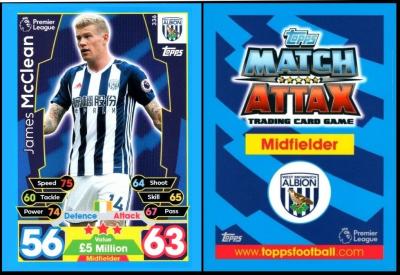
So our first clue for this week was of James McClean, who was one of the first footballers to admit openly that he is autistic - but he only decided to get himself tested after finding out his daughter was autistic, and realising many of his behaviours mirrored hers. recognizing many similarities between his own traits and those of his young daughter, who is also autistic. In fact he mainly admitted it to show her that everything was possible, despite the diagnosis, but he has gone on to use his social media to support many people, and call for greater awareness of the condition.
James Joseph McClean was born in Derry, Northern Ireland, on the 22nd of April, 1989, and started his footballing career with the local amateur side of Trojans Youth and Community Group. He then stepped up to the Semi-Professional side of Institute F.C., which again play in Derry, and whilst he was there became of age to join the adult team rather than the youth one, though at the same time he was still playing for the Northern Ireland under 21s.
However after just a year he moved to Derry City, where he stayed until 2011, when he was snapped up by Sunderland. This was when he seems to have made his cartophilic debut, part of Topps "Match Attax Premier League Extra" for the 2011-12 season. Now the important word there is "Extra" for it is an additional set with new signings and squad updates, and on the card he is shown in his new Sunderland strip
He openly admitted he missed Derry City, which is probably why he moved on so frequently, spending but two years in Sunderland and then the same with Wigan Athletic. And his homesickness was almost certainly not helped by his frequent appearances for the Republic of Ireland, which started in 2012. In fact the bulk of his cards show him in his international strip
He left Wigan Athletic in 2015 to join West Bromwich Albion. There seem to be no cards of him at Wigan, but he does appear in a West Bromwich Albion strip as card 336 of the 2016-17 "Match Attax Premier League" cards, presumably for the first time.
He moved across to Stoke City in 2018. This is where he played what is considered the bulk of his games, a hundred and two, but it is only in a single sitting, for in 2021 he moved back to Wigan Athletic (which if we add both terns together gives him 152 games for them in total).
In 2023 he went to Wrexham, staying there until 2026, and then in 2026 he returned to Derry City, which means that his match total there is also set to rise.
Our Topps Match Attax Premier League card for the season 2017-18, which shows him still at West Bromwich Albion, is another of those sets which has a base set and then lots of inserts, just to make it ever more difficult to complete a set without spending a footballer`s salary on them, but also to blur the lines as to what is a complete set anyway. So there are eight different insert sets connected to this, which are
- sixteen "International Stars"
- twenty "Kit Cards" showing current team strips only, not players
- eight "Limited Editions" cards, in bronze, gold and silver, of the following players only - Sergio Aguero, Christian Eriksen, Roberto Firmino, Javier Hernandez, Laurent Koscielny, David Luiz, Paul Pogba, and Wayne Rooney
- two "Limited Editions" cards in Platinum, both of Kevin de Bruyne
- forty "Live Code Cards", which allowed you to access digital cards and content with a code on each card.
- six "Tactics", cards on facets of the game
Then there is another set of sixty cards, which were only inserted in what were known as a "Mega Tin" of cards. This has another complication, because there were more than one "Mega Tin", you could get "Defensive Heroes", "Game Changers", "Goal Machines" and "Midfield Masters".
And if that were not enough, there is also a strange promotional set of eight cards which was to do with the Premier League Asia Trophy Tournament, first held in 2003 and last held in 2019.
Sunday, 14th June 2026

Our second card showed Albert Einstein, who comes from a time before learning difficulties were fully understood, but who is thought by many modern researchers to have been dyslexic. Most of this theory revolves around the fact that he was late to discover the power of speech, and, in fact, today, this condition, which is common to many dyslexics, is known as "Einstein Sydrome`.
But we also know that he struggled with words, being unable to remember or pronounce them, and it is well known that he performed badly at tasks involving reading and spelling. What saved him was being sent to a school in Switzerland, which used unconventional methods. There he was not taught by rote, and expected to learn great swathes of text, but by visualisation, and by handling physical items to learn mathematics.
Most of all though, is the fact that he often shut himself off from the outside world in order to work on elaborate codes and formulae,which was a language he could understand, and a system he himself developed to fit his strengths.
This is a scarce set, and mainly noted for some of the people in it - Muhammad Ali. Pele, Frankenstein`s Monster. Though all appear to be art drawn.
It seems to have been circulated not in packets but in sheets of cards, which were hand-cut by the buyer. There is also a theory that the sheets came with the album. We are not even sure on the title, because the strip in the middle says "415 supercromos a todo color" but that means simply 415 pictures in full colour.
Monday, 15th June 2026
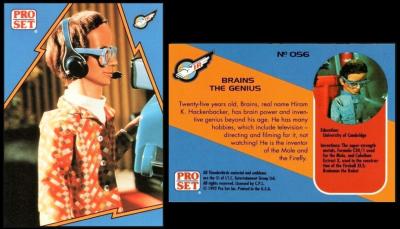
Today`s card shows Brains, from "Thunderbirds", for two reasons. Firstly that all learning difficulties are a result of how our brains process language, numbers, and abilities - but secondly if we look at the character Brains, he is described as a scientist, an engineer and the designer of all the machinery and computerisation of International Rescue, which, like Einstein, involved many hours alone, working on codes and formulas, and tinkering with machines.
We also know that he stuttered when he spoke - and that form of speech disorder, with frequent repetitions and silent sections in which the speaker is struggling to find the right word, is also characteristic of learning difficulties. It is not that they don`t know the word, but they are hunting for it, almost looking through the filing cabinets inside their brain.
Gerry Anderson described Brains as being pre-occupied with his work and experiments, but socially unsure of himself, and we know he would have liked to explore him more, but the network thought that Brains` stammering slowed the action, so in the first series he was not used as much as the rest of the cast. Sadly, during the second series, his stammer became less pronounced, so though this meant he was used more, I think it was a missed opportunity for all the children watching, not just because it would have made the condition part of their everyday experience, but also have encouraged childhood stammerers to imagine that they could find their tribe in science.
In fact on his first appearance on a card, in 1966, was card 8 of Barratt`s "Thunderbirds", he is described as "the vital member of the International Rescue Team . A young genius, he is the mastermind behind all the Thunderbird machines. He is very serious - often absent minded - and is never satisfied with the inventions he produces".
Later on, courtesy of Cards Inc`s "Thunderbirds", issued in 2001, we are told that he was "Born on 14 November 2040, Brains was orphaned when a hurricane struck his Michigan home and was adopted at the age of twelve by a Cambridge University professor. During a worldwide search for a brilliant scientist Jeff Tracy discovered Brains, lecturing in Paris. The inventor of all International Rescue`s dazzling machines the twenty-five year old is a perfectionist who is often to be found endlessly modifying and tinkering with his creations. To protect his identity in the outside world, Brains goes by the name of Hiram H. Hackenbacker; his real name is unknown."
This set was released in the UK in 1993, and came in packets of six. The wording on the front of the packets is not well defined, and has led to the set being popularly known as just "Thunderbirds", the remaining "Are Go" of the title being rather lost in a busy design and a very light print/colour. The packets contained six cards and cost 25p. The checklist was never included in the packets, it had to be sent away for. And there was also a card binder, which didn`t cost anything, only a stamped, self addressed envelope.
However if you bought the cards from Toys R Us you could get a starter pack with a plastic swap box, which is today quite sought after, all the more so because whilst this set was being circulated, Pro Set went into receivership.
Tuesday, 16th June 2026
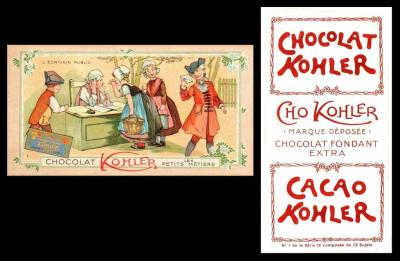
Today we have a lesser known learning difficulty, which is Dysgraphia. That follows along from Dyslexia and Dyscalculia and it involves the ability to write.
It shows itself in unreadable script, for a number of reasons, too small, too messy, incorrect punctuation, poor grammar and frequent spelling mistakes as well as many crossings out of words and sometimes whole sentences. Like Dyslexia, it is an inability to organise the words in your head, but instead of speaking or reading them wrongly, the difficulty is in writing them down on the paper.
Strangely, in times of yore, this would have been more awkward than now, when we do most of our day to day communication on a keyboard, emails, texts, whats apps, etc, and the number of actual letters that we hand write to people is much less.
Our card shows a man at a desk outside in a courtyard, and he is called "L`Ecrivain Public" - or the public writer. At one time he was a valued member of village life, and sometimes court life too, for he wrote letters and documents for those who did not know how to write or wanted to make a good impression on to whom they were sending the letters. And he would travel around and perform this service, often free of charge. The job was not too hard, but needed tact and sympathy and also trust, that what you told him would be accurately conveyed and not used against you.
The earliest mention of public scribes comes from Ancient Egypt, but we know that most civilisations had them. In Europe and England they were often the link between the church or government and the people in the street, broadcasting religion to the masses and proclamations and new rules to those who needed to obey them. However many of these could well have had learning difficulties, we will never know.
For some reason there were more public scribes in France than anywhere else, which is why our card is especially apt, and many of them remain well known today. Several even grew wealthy, or found employment with a family rather than having to tour the streets. However the French Revolution seems to have swept many of them away, when learning was seen as a mark of the rich, for the man of the street lived by his wits alone. We can thank Napoleon for realising that his words would go further if everyone had the power to understand them.
What saw another demise was the rise of schooling in basic subjects, reading, writing and arithmetic. For whilst there were many farm labourers etc who never went to school, they likewise only mixed with their own people, few of whom could read. But in towns it was soon the case that most people could read, at least the basics, and pass things on by way of mouth. The exception to this was women, for in many cases they were not taught other than just enough skills to cope with being a servant or a wife. And indeed there are two women on this card.
The strange inclusion is the man with his letter, for he looks well dressed and old enough to have been able to read well enough to write. And one of the women is definitely making cow eyes at him, thinking he may be quite a catch. So why does he need the service of a public writer? Well maybe he is applying for a job above his station? Perhaps he wanted the sort of letter which would win a young girl`s heart? However it is the way he looks at the letter which makes it unusual, as if he does not really know what it says even as far as the address. So was he, instead, a farmer, drafted into the military for no more than brute strength and cannon fodder, but given a fine uniform and a ruffle at his neck....?
Again, we will never know. But oh the stories we could weave, on a dark and rainy night, with nothing better to do........
This is a different sort of card for Kohler than the thin paper ones they are usually associated with, and it is marked as series nine.
We know that the company was founded by Charles Amedee-Kohler and Frederic Kohler, who were general food traders, like their father, in Lausanne, Switzerland. The foray into chocolate seems to have been a bit of a whim, when they bought an old sawmill at Sauvebelin. which was powered by the waters of the Flon river, and realised that they could use the same power to make chocolate.
Their claim to fame is producing the first chocolate bar to have another flavouring or content - namely hazelnut - in 1830.
In 1865, Charles-Amedee Kohler gave the company to his sons Charles-Amedee II and Adolphe Kohler - and in turn they gave it to their sons, Amedee-Louis and Jean-Jacques Kohler. You can see from that how easy it is to get confused!
These two grandsons were good at business, and under them the company prospered, building a brand new factory in Echandens. In 1904 they agreed to go into business as a partnership with Chocolat Peter, and the company was renamed Peter, Kohler. Then in 1911 they merged with another chocolate maker, Alexandre Cailler. Now this is interesting because the new company was called Peter, Cailler, Kohler, and that suggests that perhaps Peter did buy out Kohler, because Cailler is put in front of their name, and if Peter and Kohler had been running the combined company Cailler would have gone last.
Anyway in 1929 Nestle came along and bought the company.
The cards in this set show a number of professions, but it is rather intriguimgly called "Les Petits Metiers", which means little jobs. It is not known whether that refers to the jobs being seen as less worthy, or whether they are being done by children, but some of the "children" are rather grown up - though translating the titles seems to suggest these are lower class jobs, so maybe it is the first after all. And the inclusion of the "pickpockets" seems very odd indeed.
They show :
- L`Ecrivain Public (publiuc writer)
- Le Marchand de Mort aux Rats (rat killer)
- Le Marchand d`Eau (water seller)
- Carreleur de Souliers (shoe mender)
- Marchand de Mouron (chickweed seller)
- Colleur d`Affiches (poster putter-upper)
- Le Remouleur (grinder)
- Le Vitrier (glazier)
- Les Pickpockets (pickpockets)
- Le Rebouteaux (dentist)
- Marchande de Plaisirs (seller of wafers, I think)
- Marchand de Volailles (poultry seller)
Wednesday, 17th June 2026
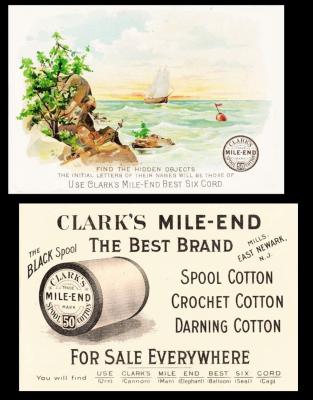
This card highlights a little known learning difficulty that is actually borderline physical disability, for it is Visual or Form Agnosia. The eyes are fine when tested, but the brain is affected in as much as it cannot recognise objects, faces, or shapes - and to fathom out this puzzle is quite beyond them.
The fault with their brains seem to mean that they can either see parts of the whole but not join them together to form a recognisable object - or that they can see the object entrely and well but cannot describe it in words. And whilst it is believed that most cases come from a physical cause like a stroke or disease there are cases which appear without those things happening, or even from the child begins to attempt to speak - and it is thought that eventually these will come to form a category all their own, classified under learning difficulties.
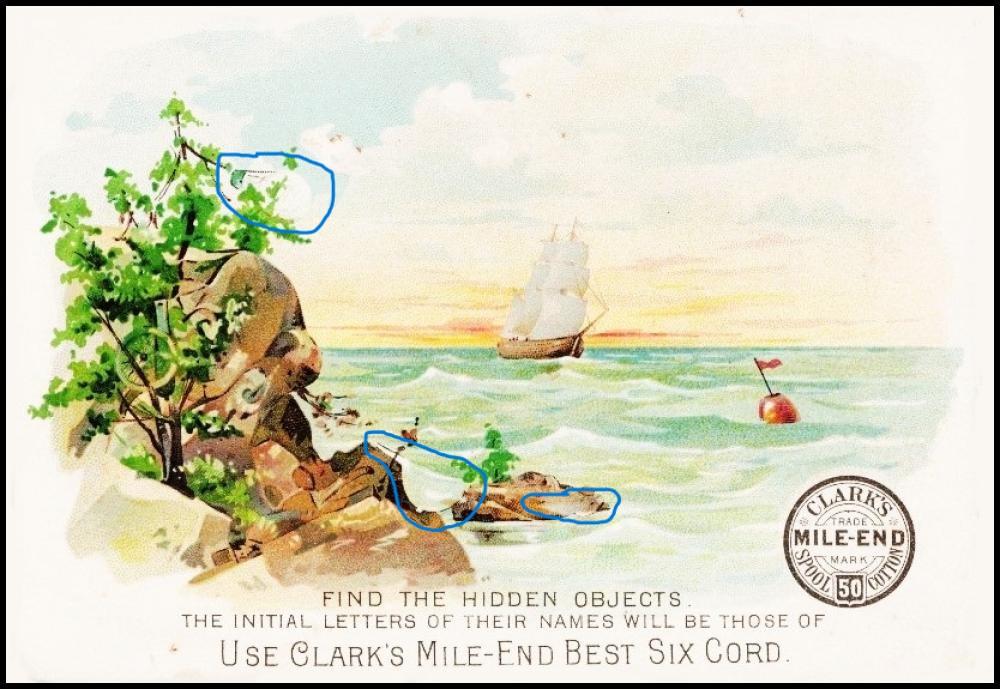
I threw this puzzle out as a teaser on our news feed, just as the picture and the fact that we were looking for words that began with the letters U, C, M, E, B, S C, (which made up the capital letters of the slogan "Use Clark`s Mile End Best Six Cord"). Because that was all it said on the front. Its kind of a teaser for top puzzlers. If you want to have a go at that, here is an enlargement of the front.
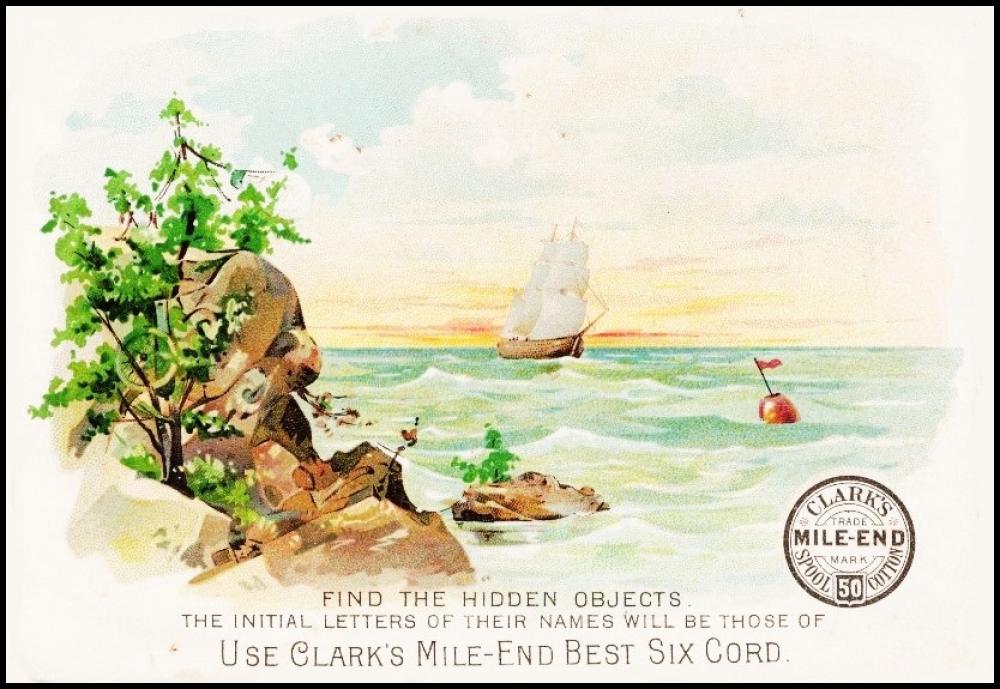
Stumped? Well now move on, for now I shall reveal that the actual items you need to search for are, as listed on the back of the card, are
- an urn
- a cannon
- a man
- an elephant
- a balloon
- a seal
- a cap
Now we have had quite a few guesses, and what follows are the results, to be read only after you are pulling your hair out.
- an urn - this flummoxed most of you but we think it is either upside down on top of the nearest rock between the tree and the rock edge - or it is the orange buoy floating with the flag (which therefore has the flagpole stuck down the top of the urn).
- a cannon - which is up the middle trunk of the tree, look for a round circle which is the wheel and the barrel is in white going upwards above it, with the carriage being formed by the junction of the two tree trunks
- a man - he is sitting on the nearest rock, his knees being at the top right edge, with his lower legs going down the edge of the rock and his upper legs along the top of it, his body being formed by the shadow of the rock coming above that, and his head the circular rock above the shade
- an elephant - is presumed to be facing backwards as the top rock, with its head in the same place as the man`s and with the branch forming its trunk, though someone else thinks it is in the same place but coming towards us, because between the rock and the head is a flapped ear.
the three that took the longest time to find, and have now been supplied, by reader Andrew Walters, (for which many thanks) were :
- a balloon - by which they mean a hot air balloon - this is at the top of the tree, on its side. If you follow the tree down from the top, the first branch off ends in the basket, then the balloon is a separate circular cloud.
- a seal - this is on the separate rock in the water, most of which is brown, but some of which is grey, and the grey bit is the seal.
- a cap - this is a jockey`s cap, with a button top, and it is upside down with the brim along the dark brown flat rock and the curving front of the cap being the space at the front of the same rick. Then the back of the cap balances between the back of the "seal" rock, and the inside of the cap is a darker section in the waves, starting at the base of the trees on "seal" rock and going up to join the top of the dark rock again
Mr. Walters also included a very helpful drawing of the last three, which is :
Thursday, 18th June 2026
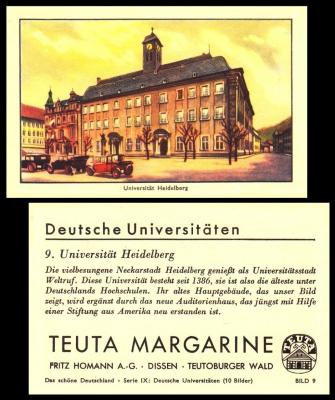
Now you may be wondering who first diagnosed "learning difficulties", and for that we must go to the place on our card, Heidelberg, in Germany to meet a physician, called Carl Phillip Adolf Konrad Kussmaul, who first coined the term "wortblindheit" or, translated to English, "word blindness".
Adolph Kussmaul was born on the 22nd of February, 1822, the son of a German Army Surgeon. He was educated at Heidelberg University, studying medicine, and was subsequently Professor of Medicine not only there but at Erlangen, Freiburg im Greisgau, and Strasbourg, where, in 1877, he made the discovery that although after strokes or other brain injuries, people could be rendered unable to understand written words or speak them, the condition also existed in people who had not had such life changing events.
He also discovered and named a curious condition called Selective Mutism, where, in a severe case of shock or trauma, the person seems to forget the power of speech, a phenomenon that sometimes returns when they are forced to revisit the incident or re-see the person who caused the trauma in the first place.
In 1843 he was given a posting with Maximilian Joseph von Chedus, at the Heidelberg eye clinic, a renowned specialist just entering his fiftieth year of age. Two years later our man received a gold medal for his dissertation, called "Die Farbenerscheinungen im Grunde des menschlichen Auges" - or the color phenomena in the fundus of the human eye. In 1850 he would make the predecessor of the modern opthalmoscope, using similar principles to Galileo`s telescope, but rather than looking outwards into space he reversed the lenses and used it for looking inwards and magnifying the further end. However he never made it work, and we now know that is because he simply had the light source in the wrong place, it needed to be in the middle of the tube, between the observer and the eye of the observed.
In 1848 he became a military surgeon and at the time of the war against Denmark was chief physician, something which enabled him to set up a private practise in the Black Forest after the war. However his fame preceded him and he was offered several jobs as MDs or Professor of Medicine, one after the other, until he retired in 1886, and was granted the title of Professor Emeritus at Strasbourg. He was also made an honorary citizen of Heidelberg, where he died, on May the 28th, 1902
As for our cards, they are often listed in dealer catalogues as "Deutsche Universitat Serie IX" but that`s not actually true, for it is not a ninth series of German Universities, if you read the whole text it says these are Serie IX of a set called "Das Schone Deutschland", which was complete in two hundred cards, or twenty sub series like ours, each of ten cards.
The ten cards in serie IX show the following universities -
- Universitat Konigsberg
- Universitat Berlin
- Universitat Leipzig
- Universitat Jena
- Universitat Marburg
- Universitat Bonn
- Universitat Frankfurt am Main
- Universitat Erlangen
- Universitat Heidelberg
- Universitat Munchen
We also know all the other sub sets, namely
| I | - Deutsche Landschaften [;andscapes] |
| II | - Deutsche Flusse [rivers] |
| III | - Deutsche Bergen [mountains] |
| IV | - Deutsche Seen [seas] |
| V | - Deutsche Inseln [islands] |
| VI | - Deutsche Hafen [harbours] |
| VII | - Deutsche Rathauser [town halls] |
| VIII | - Deutsche Burgerbauten [mines] |
| IX | - Deutsche Universitan [universities] |
| X | - Deutsche Burgen [castles in towns] |
| XI | - Deutsche Wasserburgen [castles on rivers] |
| XII | - Deutsche Schlosser [more castles] |
| XIII | - Deutsche Kirchen [churches] |
| XIV | - Deutsche Kloster [,pmonasteries] |
| XV | - Deutsche Bader [baths/spas] |
| XVI | - Deutsche Jugendherbergen [youth hostels] |
| XVII | - Deutsche Stadttore [city gates] |
| XVIII | - Deutsche Denkmaler [monuments] |
| XIX | - Deutsche Brunnen [fountains] |
| XX | - Deutsche Brucken [bridges] |
I`m not so sure about the three castles, because there are river castles in the first set, and not all the second are in the mountains, whilst the third is a complete mixture. But maybe someone can please enlighten me as to the true definitions of the words Burgen, Wasserburgen, and Schlosser....
Friday, 19th June 2026
We close this week with the staggering fact that the term "learning disabilities" was first spoken in 1963, by Dr. Samuel Alexander Kirk, to a small group of parents and educators at a conference taking place at the Palmer House in Chicago. At the time he was almost sixty years old, and he had lived a full life, starting with being a farmer`s son, which is where he first learned the power of teaching people, in this case the farm hands, to read. From there he went to the military, where he was able to create a programme for recruits who fulfilled all the basic needs except being able to read the manuals and instructions. After that he went back to college, and got a Bachelors and a Masters degree in psychology, and then did a PhD in the same subject. That led him to a school, where he was given the job of working with children written off and lumped together as delinquents. He proved this was not the case, and that if they were allowed to learn in their own ways they were every bit as capable as the rest of the school, and in many cases more so.
He would go on to pass laws that compelled schools to teach all children and give special help to those who needed it. And he also managed to convince the government to set up a scheme to train teachers to help students who needed extra coaching, right across America. He called his children exceptional, not disabled, but that was too groundbreaking a term for those times, and so today we remember him as The Father of Learning Disabilities, rather than the Father of Exceptional Children.
He died on July the 21st, 1996, aged ninety-one.
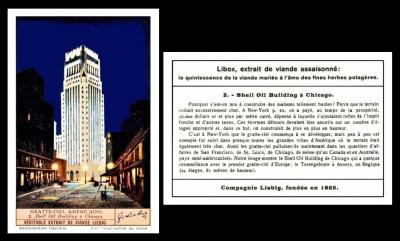
Now this is not the Palmer House, which never appeared on cards. It was a hotel, and, since 1945, has been a member of the Hilton Chain. However it is in Chicago, and looking online at the Palmer House and the Shell Oil Building brings up the fact that the Palmer House and the Aon Centre, formerly Standard Oil, is only an eighth of a mile. And I presumed that the Standard Oil Building had formerly been the Shell Oil Building, picked up in some kind of merger.. But then more research proved that the Standard Oil Building was not built until 1973. And looking at Shell Chicago brought up the fact that Shell had never had a building by that name.
A search of Shell buildings, however, brings up an almost identical tower, the only problem is that it is in San Francisco. So did Liebig get it wrong ? Looking at the reverse of the card they got something else wrong, as the penultimate line leaves the "L" out of Belgium, making it Begique not Belgique. In fact it is an odd text all round , mostly concerned with New York, and only at the end comparing our building with Le Torengebouw a Anvers, for some reason, because the two are pretty different to my eyes, even with my new glasses.
The cards in this French set are
- Lincoln Building a New York
- Shell Oil Building a Chicago
- Hopital presbyterien a New York
- Universite de Pittsburg
- City Hall de Buffalo
- Le Rockefeller Center a New York
well I did a lot better than I thought, and only one day, Friday, remains incomplete. That is for the simple reason that when I read this back, congratulating myself for getting it all done and ready to upload I suddenly realised that the week had apparently been altered and now ended on a Thursday. Where Friday got to I have no idea, it doesn`t even look like I made a note of it to hunt for a diary date subject!
But I will add that over the weekend, along with the card codes, etc, of the Wills set.
I thank you for tuning in, and hope you enjoyed the reading? And now off to bed, like me, perchance to dream. Of Fridays, no doubt, and disappearing acts....