
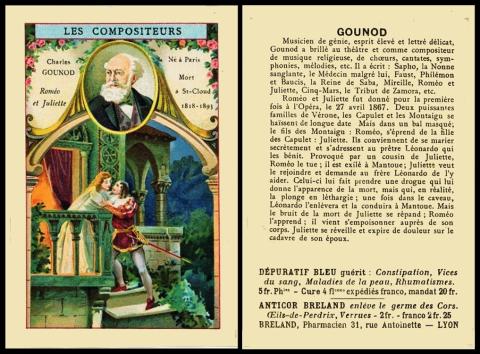
Our third clue here was “Romeo and Juliet”, one of Shakespeare`s most popular plays, written in 1595-6.
However Shakespeare did not come up with the story all on his own, as the basic premise had been first written down in the 1470s as Romeo and Giuletta, and had actually come from older tales passed on in person.
This story was then further embroidered by Luigi da Porta, using details of his own thwarted love affair, and in that version are many of the details in the Shakespeare version, the feuding Capellettis and Montecchis, the secret love, the faithful Nurse, Romeo committing murder but going unpunished, the deadly potion, the failure of the written message, and their deaths, though in the original it is a slower acting poison which allows them a short poignant time of togetherness.
Shakespeare simply fleshed all this out, added a larger cast of characters, made it less Italian, and made Romeo die first, though it is believed he had even got that angle from a translation in French.
Our card shows the opera based on the play, first performed at the Theatre Lyrique, Paris on the 27th of April 1867, and Charles-Francoise Gounod, its composer. He was born on the 17th of June, 1818, in Paris, into a family who loved art and music. His father was even the official artist to a minor Royal, and the family lived for a time at the Palace of Versailles. However, the father of the family died in 1823, and his wife lost the Royal patronage, having to eke out a living as a piano teacher, and sending the two children off to school.
There was no doubt in our man`s mind, even as a child, that he wanted to be a musician and he managed to mix in all the right circles. In 1836 he was admitted to the Conservatoire de Paris, and in 1839 he won the highest musical prize in France, beating his father, who had only come second. However it was the prize, not the honour, that was wanted by our man, for that was schooling, in Italy, Austria and Germany.
He did not return to France until 1843, to take up a post his mother had arranged, as a chapel master. However the truth was that the chapel, and its equipment, was well past its best, and any attempts to upgrade it was met with hostility. He much enjoyed the church atmosphere though, and dabbled with the idea of becoming a priest.
This was not to be, because he had an offer, thanks to a female friend, to write an opera. He chose to tell the story of Sappho, the Greek poetess, and though there were issues with some of his material, most of it was passed as fit to perform at the Paris Opera on the 16th of April 1851.
The opera he is most remembered for is Faust, which opened at the Theatre Lyrique in March 1859. Our opera, Romeo et Juliette, was first performed at that theatre too, but on the 27th of April, 1867, and it is relatively faithful to the Shakespeare version, just shortened - starting with the masked ball, moving on to the garden and young lovers, then a few scene changes squeezing in the visit to Father Laurent`s cell, the death of Tybalt, and Juliet in her bedroom being given the mock poison by a friar. After that the scene shifts to the tomb, where Romeo finds Juliet asleep, and thinking her dead, takes poison, only for her to wake and find him dying, and taking her own life so as not to be parted.
Sadly we don`t know much about the issuer of this card, only that he was a pharmacist, whose leading products were Anticor Breland (a corn remedy), Creme Breland (a cream for calming rashes and skin disorders) and Dentifrices Breland (toothpaste). He does seem to have been the maker not the retailer, as some of the cards he issues instruct the reader that his products are sold in hairdressers, pharmacies, and, in the case of the corn cure, shoe shops.