
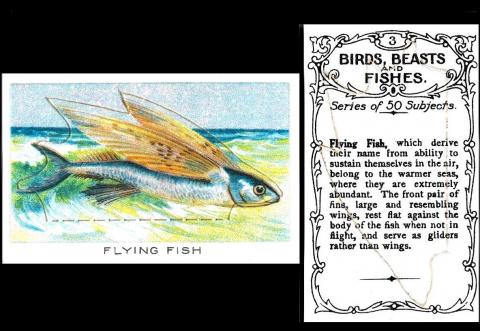
Ah the flying fish - but the truth is that, despite their name, they don't really fly, they are just so streamlined and such a perfect shape that when they leap up out of the water their motion, and their long wing shaped fins, carry them forward for a short distance. Of course it is probably the fact that the fins look like wings that make them appear to be flying, because we don't expect a fish to have wings at all.
The reason why they fly is rather a sad one, for they leap upwards to escape predators attacking them from below - and when they are above the water they get spotted by birds looking for their dinner. Their wondrous gift therefore is not, for makes them doubly vulnerable.
By the way they are also known as "Flying Cod" - but that doesn't have quite the same appeal, does it!
The first representation of this curious creature comes courtesy of Duke, whose "Fishers and Fish" concentrates more on the fisher, a lady in a red outfit and a jaunty red jockey cap, perched on top of a head which is so much larger than her body that she would always be tipping forwards and landing on the floor. The fish is tiny in comparison, but its fins are outstretched as it dangles at the end of a hook on her fishing line. That was issued in 1888, and the same year Duke, making the most of its payment for the artwork, uses the identical picture as part of another set, "Fishes and Fishing", combining our lady and fish with a card of a Pompano fish and filling in the rest of the card with a sailing ship, a buoy, and what looks like a spar from a shipwreck washed ashore.
For the first Flying Fish to not dangle from a hook we have to wait another year, 1889, when Allen & Ginter issued "Fish from American Waters".