
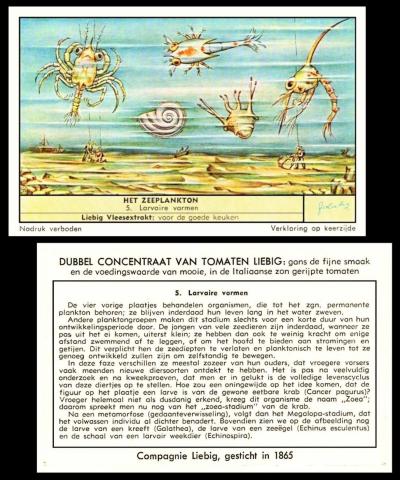
This card is included because people think marine life is only the huge mammals that roam the open seas, but it goes right down to these little guys here, who are generally known by the single name of plankton.
The name plankton was given to them by Victor Hensen, a marine biologist, in 1887, and it is a corruption of a Greek word, "halyplankton" and it means a drifter or wanderer, not in the sense of someone who comes to town and breaks several hearts and then one morning there`s just a space in the field and not a camper. In the sense of these creatures it means that they have no active means of propulsion, they are driven hither and yon by the wind and by the currents in the water. And they are everywhere in healthy water, from the wideness of the ocean to the mouth of the estuary of any size of river, saltwater or freshwater, rivers that go to the sea, or inland lakes. And they also live in different parts of that water, some float along the top and others are right down amongst the soil in the bottom strata.
Strangely we also know that they are also found in the air, and not just because the sea spray sends them up there in inclement weather - they come from dust, and sand, and are also often seeds of land based plants, though they can be bacterial and cause viruses and diseases. And we also know that the air plankton can fall in the sea and be swept along to other countries, many miles away.
As for their size, most are less than a millimetre across, and they can only be seen through a microscope. Their main purpose was once thought to be eaten by slightly bigger fish than them who hope to get bigger, but today we know that they have a far more important role than that, for they produce oxygen through photosynthesis, they store carbon, and they recycle nutrients.
This Dutch version of the set is quite unusual, you usually see the French and German ones. The cards show sea plankton, hence the title "Het Zeeplankton" and they are :
- Diatomeeen
- Peridieeen
- Copepoden
- Globiginia en Radiolaria
- Larvaire vormen
- Weekdieren en Wormen