
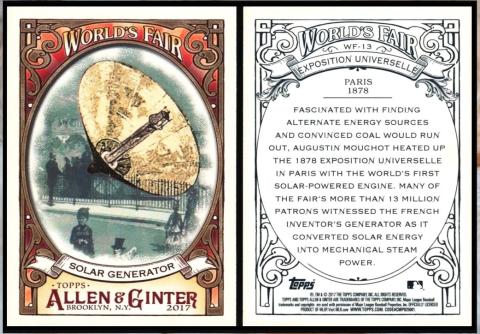
Here we have solar power, which, as this card tells us, was shown at the World`s Fair in 1878.
But the story begins in 1861, when a French mathematics teacher called Augustin Mouchot realised that there was not enough coal in the world to support humanity indefinitely. So how, he thought, could life continue? He did all sorts of experiments with all sorts of natural and man made fuel and then, one day, he realised that there was nothing on Earth that would support us, but there was a large, glowing, hot, planet in the sky. That turned his attention to solar power.
His first invention used the rays of the sun to heat the water in a bath, and then to cook with, in an oven. In 1866 he had a giant breakthrough and made a lidless container of brightly polished metal, which focused the sun`s energy on a tube of water, which turned the water to steam, and, with that, he could drive an engine.
Monsieur Mouchot showed his largest ever engine at the World’s Fair in Paris in 1878, which is the one on this card. Instead of a lidless container it used a metal cone that focused on a boiler, and that was attached to a kind of fridge that actually made ice, for the visitors to see, and taste. It even won a Gold Medal. But his downfall was that the same World`s Fair was a showcase for the internal combustion engine, taking advantage of a sudden drop in the price of the fossil fuels he wanted us to stop using. Sadly, this led to him losing the funding he had received from the French Goverment, and so he went back to teaching. And he died, in 1912, in Paris.
Commercial concentrated solar power plants were not developed until over a hundred years later, in the 1980s, though there were other pioneers. Charles Fritts made the first solar cell, in the 1880s. And in 1931 Bruno Lange discovered that silver selenide was a better material than copper oxide for a photovoltaic cell. The next decade saw Russell Shoemaker Ohl make a "light sensitive device" which was used as the basis for Gerald Pearson, Calvin Fuller and Daryl Chaplin`s silicon solar cell a decade later still, in 1954.
This set contains the following cards, all numbers of which are preceded by "WF" : -
- Life Savers Parachute Jump - New York World`s Fair - New York 1939
- X-Ray Machine - Pan-American Exposition - Buffalo 1901
- The Atomium - Expo `58 - Brussels 1958
- The Great Wharf - World`s Columbian Exposition - Chicago 1893
- Westinghouse Tower - New York World`s Fair - New York 1939
- Eiffel Tower - Exposition Universelle - Paris 1900
- Diesel Engine - Exposition Universelle - Paris 1900
- Facsimile Machine - The Great Exhibition - London 1851
- Sunsphere - 1982 World`s Fair - Knoxville 1982
- Conical Pendulum Clock - Exposition Universelle - Paris 1867
- Space Needle - Century 21 Exposition - Seattle 1962
- Unisphere - 1964/65 World`s Fair - New York 1965
- Solar Generator - Exposition Universelle - Paris 1878
- Monorail - Centennial Exposition - Philadelphia 1876
- Ferris Wheel - World`s Columbian Exposition - Chicago 1893
- Biosphere - Expo 67 - Montreal 1967
- Statue of Liberty - Exposition Universelle - Paris 1878
- Statue of the Republic - World`s Columbian Exposition - Chicago 1893
- Habitat 67 - Expo 67 - Montreal 1967
- Telephone - Centennial Exposition - Philadelphia 1876
They were issued alongside Topps "Baseball 2017", as an insert set, in the same vein as "What a Day!", "Sport Fish & Fishing Lures", and "Revolutionary Battles", in as much as if you bought two packets you ought to get one card from one of these sub-sets. However they were inserted randomly, and there was no guarantee on the ratios.