
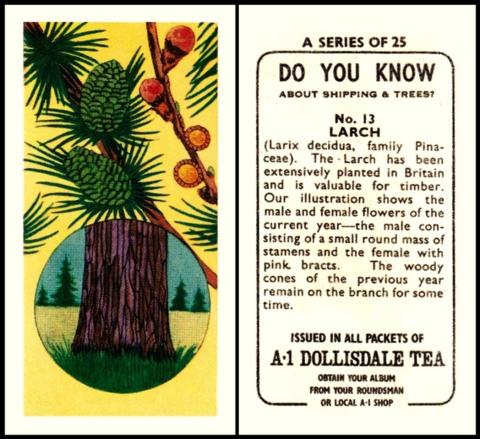
This clue brought you the larch, and that, along with the Scots Pine, is the tree of choice for making cabers, as seen in the Heavy Events category of the Pitlochry Highland Games. And the full list of these are :
- pitching (or putting) the stone - a local river stone, today either 16lbs or 22lbs in weight -
- throwing the hammer - a weight, again 16lbs or 22lbs, on a shaft - thrown the longest distance
- throwing the weight - a 28 lb ball on a chain - thrown the longest distance
- throwing the weight - a 56 lb block with a ring - thrown for height, over a bar.
- tossing the caber ...
Now a caber is a long pole, tapered either naturally or by careful trimming. The word comes from Gaelic, both the Irish form (cabar) and the Scottish form (chabair), and both mean a wooden beam. However it is a pretty massive one, usually sixteen to twenty feet, at least, and weighing up to a hundred and fifty pounds.
The idea is that the contestant runs with the caber upright into the air in order to gain momentum, and then throws it so that the ends change places. After that the caber has to land on the ground and lie as straight as possible, rather than what most people tend to think, which is that you just have to throw it for the longest distance.
The earliest recorded instances of the event shows it as more of a military trial of strength, and the first ever was in 1574, during what was called a wappinschaw. It is not hard to work out that this translated easily to weapon show, or show of strength. Strangely, at that event it was called the tossing of the "barr", but we know that the word caber, in a variety of spellings, was known much earlier, as early as 1505, though it was not used in a sporting context, it was only called the caber, etc, to refer to its use in building.
This is an unusual set, a real mix up. It might have been better as a set of twenty-four with one half as all ships and the other as all trees, or even all the odd numbers as trees and the evens as shipping, as they have done between numbers ten and fifteen - but instead of that we have the trees and the ships dotted about hither and yon. All very odd ..
The full make up is :
- Loading Heavy Cargo
- A Liner's Wheelhouse
- Devices for Ship Aground by Day
- Lowering Lifeboat from Ship
- Drifters Showing Basket Devices
- Lights Showing Ship Aground by Night
- Lights for Ship at Anchor by Night
- Series of Beacons
- Whaling Factory Ship
- Lifting Buoy Onto Buoyage Vessel
- Beech
- Light Buoys
- Larch
- Lights for Trawling at Night
- Stone Pine
- Elder
- Seres of Buoys
- Acacia
- Liner in Dry Dock
- Riding Lights by Night
- White Beam
- Sweet Chestnut
- Silver Birch
- Oak
- Wayfaring Tree
It is also the only set that this manufacturer ever issued....
It is catalogued in our original British Trade Index part two, with a bit of a revelation, as :
A-1 DOLLISDALE Tea
Cards issued 1966-67. Album issued.
- DO YOU KNOW ABOUT SHIPPING AND TREES ? Sm. 68 x 37. Nd. (25). See D.261. ... AAF-1
That "D" code tells us that this may be the only set that this manufacturer ever issued, but it was also duplicated by another, and, even more thrillingly, there turns out to be two other versions, recorded as :
D.261. DO YOU KNOW ABOUT SHIPPING AND TREES ? (25)
- A-1 Dollisdale Tea - Set AAF-1. Nd.
- Horsley`s Stores - Set HOM-3.2. Unnd, no captions. *
- The Stamp Corner, Doncaster - Set SRM-2.2. Unnd, no captions. *
* 10 issued, equivalent to Nos. 1/10
Before we steam ahead, numbers 1 - 10, issued by the two others, were only shipping, which makes the title a bit odd on those printings. However both the other issuers distributed their cards in the same unusual way....
- Horsley`s Stores were in Gainsborough, Lincolnshire, and they were a department store, founded in 1902. None of their sets were unique to them. We don`t appear to have featured any of their sets yet but they actually issued two sets as complete sets of twenty-five, these being "British Uniforms of the 19th Century" and "Castles of Britain", and sections, between eight and ten cards of another twelve sets, these being: "Cacti" (x 8 cards), "Do You Know About Shipping and Trees" (x 10 cards), "Dogs" (x 10 cards), "Football Clubs and Badges" (x 8 cards), "Freshwater Fish" (x 10 cards), "Fruit and Berries" (x 9 cards), "Historical Buildings" (x 10 cards),, "Into Space" (x 9 cards), "Naval Battles" (x 10 cards), "Parliament Buildngs" (x 8 cards), Products of the World" (x 8 cards), and "Sports and Games" (x 10 cards). But, rather cryptically, their listing of these sectional series says "Backs headed "When in Gainsborough.", which I don`t really understand.
- The Stamp Corner was in Doncaster, South Yorkshire, and it was a collector`s shop. In fact it still remains. None of their sets were unique to them either. We don`t appear to have featured any of their sets yet but we did mention them before with our Card of the Day for the 21st of July 2023. Now curiously they issued their cards in much the same way as Horsley`s Stores, which cannot have been a coincidence. However they only issued one set as a complete set of twenty-five, this being "American Indian Tribes", and, once more, sections, between eight and ten cards, of the same twelve sets as above, and in the same quantities. We do know something interesting though, because the backs of their sectional sets were plain, and overprinted with advertising, which is presumably what is meant by the cryptic reference in the Horsley`s Stores listing. But whilst in our original British Trade Index part two it only states that the Stamp Corner cards had the "address 23 Bowers Fold", we know that some of their sets were issued with two different backs, and this points to the sets being issued in the early 1970s, for one printing reads "Wanted to Purchase collections of coins, stamps, cards and medals. Good prices paid. If you return 25 of these cards to Stamp Corner, 23 Bowers Fold, Doncaster (Phone 3623) you may choose a 1/- set free." whilst the other printing says exactly the same but decimalises the "1/-" to "5p"
By the time of our updated British Trade Index the listing for our set is :
A-1 DOLLISDALE
Tea. Issued 1963. Album issued.
- DO YOU KNOW ABOUT SHIPPING AND TREES ? 68 x 37. Nd. (25). See HX-4. ... AAA-130
Later in that volume there is also a date given for the Horsley`s Stores sets, which suggests they were all issued in 1968. No more cards have turned up from the sectionalised sets, they remain in the quantities originally given, but it does explain a bit more about the backs, because these cards are now in a section re-titled from "General Issues" to "WHEN IN GAINSBOROUGH", which goes on to say "grey backs headed "When in Gainsborough visit Horsley`s Stores".
And under the "Stamp Corner" sets, which remain "Issued in the 1960s", it does now confirm that all their sets were available with pre-decimal and decimal prices, though, oddly, it puts the sets with the "5p" decimal version as (a), and the ones with the "1/-" pre-decimal version as (b), which is definitely the wrong way around as far as the issuing date goes.