
Our week, and our journey, started in Mexico, and with several good reasons.
Firstly, after the 1923 International Conference, that saw the Pan-American Highway gain a lot more acceptance, and the next one, in 1928, that saw the scheme approved, the route started in Mexico and ended in Buenos Aires.
Secondly, the first construction to begin on the road began in Mexico.
Thirdly, though our long and winding road technically starts at Prudhoe Bay, within the North American state of Alaska, it is not officially designated as part of the Pan-American Highway, it is titled as the Alaska Highway. It also changes name several times as it passes through the Yukon and into into British Columbia. When the road hits the border into North America this strange state of affairs continues, as though it was way back in 1966 that the Federal Highway Administration openly stated that the interstate highway system was part of the Pan-American Highway, they never bothered to change the signs, or anything else, and to this day you will find no written proof on any maps or plans. However if a driver, or anyone, come to that, was to look at the roadway system from Alaska downwards, it is pretty obvious to see that this long and fairly straight highway route is there for the taking.
And so, officially, our road only becomes the Pan-American Highway after it has waved goodbye to the entire continent of North America, at a place called Laredo, on the Texas border, and entered Mexico, at a place called Nuevo Laredo. Strangely, this section of the Pan-American Highway is very similar to that long and winding road from Prudhoe Bay, and it also changes name several times as it passes through Mexico, but it is still known as the Pan-American Highway, which makes it even odder that North America and Canada does not. Though we must say that Mexico does not always call it that, preferring the more honest term of the Inter-American Highway, simply because it is the road that takes them up into America.
It extends right down to Guatemala, crossing the border at Cuidad Cuauhtemoc - which was the finishing line of the first ever Carrera Panamerica race in 1950, a race which began at Ciuadad Juarez, just below the border with America, some 2096 miles away. This was a race designed to celebrate the delight at the completion of this section of the roadway, and it was a huge event, even though it took six days to complete, entered by world-wide racers from every form of motor sport, a bit like a giant gumball rally, but it also allowed for members of the public to take part, including women, nine of whom drove in it
The race would go on every year until 1954, though the start and finish line differed. In 1951 it was run the other way ending at the American border, to suit the American drivers and fans. It was eventually cancelled due to the fact it was a very dangerous race, and twenty-seven fatalities, of drivers, crew, and spectators, had occurred over those few years, giving it the unwelcome statistic of having the highest death rate per event of any form of motor sport past or present.
It did leave us one lasting legacy, and that was the reason why there is a Porsche called a Carrera. You see though the first Porsche cars to drive in the race, in 1952, had been privately owned, this suggested to Porsche that it would be a good idea if the factory entered a team in 1953. This was duly done, using a pair of the latest Spyders, but they failed to finish, the only two which did again being privateers. But in 1954 the works team not only came home third and fourth in the main race, they were first and second in their class.
However that may have been the final race, but it was not the end for the Carrera Panamericana, and it was revived in 1998, as a week long event on only certain parts of the former course, splitting the entrants into ten classes in order to compensate for the speed and power differences which caused many of the accidents in the original version. And most of the entries nowadays are from drivers of 1950s and 1960s cars, making it more of a tribute than a no holds barred speed fest.
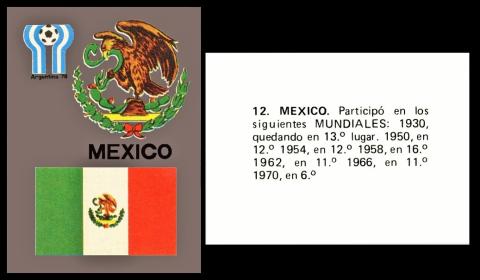
Our sticker today comes from a set that covered the Spanish League Championships and the World Cup in Argentina. However that World Cup was not a good one for Mexico, and it is chiefly remembered for its biggest ever defeat, being beaten by six goals to nil by West Germany, though they beat the other teams in their group, Tunisia and Poland, with a score of three goals to one in each match.
The first sixteen cards in this set are like ours, relating to the World Cup, all being silver backgrounds with the blue and white World Cup logo for that year, which, in itself was controversial, being based on a popular gesture by Juan Peron, who had been deposed two years before the tournament actually took place. The two other things on each sticker differed, for they were the emblem of the country, and its flag. The countries were :
- Argentina
- Alemania Federal (West Germany)
- Austria
- Brasil (Brazil)
- Espana (Spain)
- Escocia (Scotland)
- Francia (France)
- Holanda (Holland)
- Hungria (Hungary)
- Italia (Italy)
- Iran
- Mexico
- Peru
- Polonia (Poland)
- Suecia (Sweden)
- Túnez (Tunisia)
All of those cards had a text back about the country, and ours tells us that Mexico has taken part in the World Cup right since 1930, which was held in Uruguay. Unfortunately they went out in group one, after losing against Argentina, Chile, and France. However one of those teams, Argentina, made it all the way to the final, where they were beaten four goals to two by Uruguay, the host country.
Now if you came across that part of the set and looked for more, you would be unlucky, and you would probably think it a set of just sixteen cards. That is not the case though, it was simply the fact that the set changed the back after these cards to a pink design of circles with flowers inside (and we will use one of those some time so you can tell them apart more easily). These pink backed stickers showed players from the following Spanish League clubs, and in this order :
- Real Madrid
- F.C. Barcelona
- R.C.D. Espanyol de Barcelona
- Atletico Madrid
- Valencia C.F.
- Athletica Bilbao
- Sevilla C.F.
- Racing de Santander
- Seleccion Espanola
- Rayo Vallecano
- Burgos C.F.
- Real Sociedad
- U.D. Las Palmas
- C.R. Huelva
- R.C. Celta de Vigo
- Hercules C.F.
- Sporting de Gijon
- U.D. Salamanca
- Real Zaragoza
So let us now have a chat about the issuer, MAGA. This was founded in 1951, by Manuel Gago, and it takes its name from the first two letters of its founders forename and surname.
Senor Gago had previously worked for another, similar company, called Editorial Valencia, which had been founded in 1932, and its output was a mix of Spanish language melodramatic novelas, and what is called theatre scripts, but seems more to have been novelisations of those plots. It stopped all its printing when the Spanish Civil War started, and we are not entirely sure if the founder, Juan Bautista Puerto Belda survived that, because in 1940 it reopened, under the control of another person, Juan Manuel Puerto.
Now he is a very important person because he produced a book of stickers, "Deporte e Instruccion" (Sports and how to play them). However, he seems not to have made any more, moving instead into children`s comic books.
In 1950, Manuel Gago, whilst working for Editorial Valencia, decided to test the waters as to going it alone, so he founded a sideline business, Editorial Garga, with his father and his two brothers, Gago and Pablo. It seemed to be working so in 1951 he started another business, called MAGA. They specialised in adventure stories, mostly tales of yore, and it went so well that he left Editorial Valencia in 1954. For a while they continued to thrive, but the 1960s saw a world where entertainment was primarily supplied by television, not print, and in 1966 they stopped publishing the comics entirely.
All was not lost, as in 1965 they had decided to move into stickers and albums, which they did, very successfully, for another twenty years.
But in 1986 they closed, forever.