
Christmas now is over, and we must look ahead.... and finish all the things we didn`t get done whilst we feasted, and met with friends. Or just sat and watched television alone, which is as big a time waster, but maybe more solitary than a Christmas ought to be
This newsletter takes us into a new year, 2026, and not so many months are left before our annual card convention. Our branch meetings are also now starting to show of their new dates, so do write them in your diary, and vow, this year, to go along, at least to your nearest, and maybe, on a warm sunny day, to explore some others, at distance.
Anyway, without any further waffling, let us read on. And do note that the centenaries, when they arise, will now be coming from 1926....
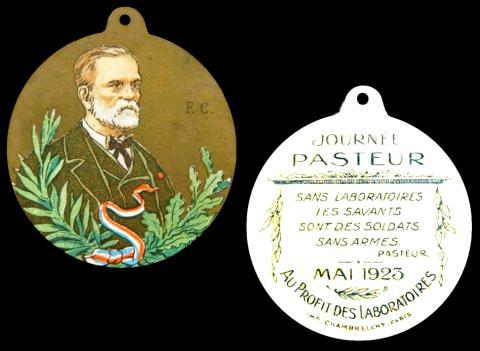
Anonymous [? - O/S - France] "Louis Pasteur Centenary Medal" (May 1923) 1/1
Today in 1822 Louis Pasteur was born in Dole, a place with a long and surprising story, for it had been the capital of the Franche-Comte region, home of the university and the court right until Louis XIV took the region over and moved both of the latter to Besancon.
Louis Pasteur was born into a very poor family, his father was a tanner and leather worker, there were already two children when Louis came along, and two more would follow.
When he went to school, aged nine, he was a poor student. Modern scholars believe he may have actually had learning difficulties, because he struggled so with examinations, but at that time such were not even heard of. However he refused to give up, and would eventually pass his master’s degree in 1845 and his doctorate in 1847.
Whilst he was working out what to do next, he worked as a laboratory assistant, where he spent his spare time experimenting and researching. His dissertation had been on using crystals to show and twist the light. This would lead him into further investigations with molecules, but his work was halted when he found a position in Strasbourg. He then moved to their Lille campus.
Whilst there he started working on fermentation, which he believed was caused by living microorganisms, contrary to current opinion, which believed fermentation was random and caused by chemical reaction. This led him to invent and patent a system of heating the substance to a temperature high enough to kill the living organisms. This worked, and was eventually named "pasteurization" after him. But he also wondered if diseases of the human body were not caused in the same way. And he used that theory successfully in the 1860s to discover that the silkworm crisis was also caused by microorganisms. However further research was halted when he had a stroke in 1868, paralysing his left hand side. He believed that had been caused by overwork, and managed to coerce the government to build him a laboratory and lessen his teaching work. He was also awarded a pension, which meant he did not have to work so hard.
The new facility allowed him to devote most of his time to his passion, the study of human disease. In fact there was a sad reason for this, as three of his five children died from infectious diseases. The government actually wanted him to start by investigating anthrax, which was first described in a clinical fashion by Maret in 1752 and Fournier in 1769, though the disease had been known for centuries. He was more interested in a fatal bird disease called fowl cholera, thinking it may be related to the human version, and it was whilst researchng this that he discovered vaccination, injecting a light dose of a same disease into a healthy body in an attempt to build immunity. To prove this he did a mass experiment on various animals, injecting half with a weakened anthrax compound, then returning and injecting all with anthrax. This resulted in undeniable proof that the system worked.
He then turned his attention to rabies. His vaccine also worked in animals, but no human was brave enough to be injected, until a nine year old boy, Joseph Meister, badly infected, agreed. That led to the opening of the Pasteur Institute in 1888.
Sadly he did not live for much longer, had several, ever increasing strokes, starting in the late 1880s, and he died, aged seventy-two, on September 28, 1895, in Marnes-la-Coquette, near Paris. He was then buried, in a vault, beneath the Pasteur Institute.
Since uploading this, when I stated that this card does not belong to me, but the owner would very much like to know more about it, I have actually found something quite interesting, and that is the fact that the Government of the French Republic announced that to mark the centenary of his birth there would be a joint celebration of Louis Pasteur and Strasbourg, where he began his career. Unfortunately they did this in 1923, and he was born in December 1822. Anyway, they also held an exhibition "L'Exposition Internationale du Centenaire de Pasteur", which showed updates and discoveries in the areas that he chose to research, primarily medicine. Many of the exhibits would then be moved to a new museum, of Hygiene. This seems never to have come about, unless it was removed to Dresden later, for the one there is the only one I can find.
However there are still problems with this, as the exhibition was not opened until the first of June, with, on the same day a monument in the Place de l'Universite being unveiled. And also Louis Pasteur was not in Strasbourg until 1848, when he started teaching Chemistry at the University
I have had time to research the words on it though, which are "sans laboratoires les savants sont des soldats sans armes". These must have been his own, because they translate to "Without laboratories, scientists are soldiers without weapons".
According to the Trading Card Database, Louis Pasteur`s "rookie" card was number 62 of Ogden`s "General Interest Series A, issued about 1901. That may well be true. However it is
certain that he does not wait until 1937, and card 27 of Ardath`s "Your Birthday Tells Your Fortune" to reappear.

MOORE & Calvi [tobacco : O/S - USA - New York] "Playing Cards" (1890) King of Spades /53 - M854-600.3.B: M138-4.3.B : X2/457-8.3.B : USA/457-3.B
For our next trick, we celebrate the art of having good hands and a steady nerve. For it is #NationalCardPlayingDay.
As you probably know by now I am rather fond of these small pasteboard wonders, and even more so when they were issued as true cartophilic items. And I have to say that this group of sets is one of my favourites, with its curvaceous beauties and elaborate, often theatrical costumes.
There is a theory that the Kings represent real people - Alexander the Great (King of Clubs), Julius Caesar (King of Diamonds), Charlemagne (King of Hearts), and King David (King of Spades). These Kings cross the boundaries of area and religion, being Macedonian, Frankish, Roman, and Jewish respectively, however it must be stated that these identities were only assigned them in the fifteenth century, and did not last longer than the eighteenth.
However I mention it here because the theory is actually backed up in our case, because this lady is carrying a sword. of fairly large proportion. In fact, if you look, most of it is hidden, but you can see that it continues inside of her clothing and pushes it out of shape. And although we remember David for killing Goliath with a simple slingshot, in fact, as we are told in the first book of Samuel - "Then David ran over and pulled Goliath’s sword out from its sheath. David used it to kill him and cut off his head.”
Our lady comes from the third group of these playing cards, and you can read more about the various sets in our newsletter for the 4th of October 2025 - by scrolling down to Wednesday, the 8th October. Now we have another group on display, we will start excising the pieces, so the third group, which this card comes from, is described as follows -
The whole group appears in our original World Tobacco Index as follows :
MOORE & CALVI, New York, U.S.A.
Associated with Maclin-Zimmer Tobacco Co. and Thompson, Moore & Co. Cards issued about 1885-95. Includes brand issues inscribed "Hard A Port Cut Plug" and "Trumps Long Cut".
- PLAYING CARDS (ACTRESSES). (A). Lg. 109 x 60. (53). Subjects unnamed. See X2/457-8. ... M138-4
Third Pack. Engraved back in blue.
A. "Trumps Long Cut" brand issue. Ref. USA/457-3.
B. "Hard A Port" brand issue. 35 m/m circle in centre of back. Ref. USA/458-3.
C. Back with Moore & Calvi name in centre circle. Ref. USA/458-4. Back overprinted at top in red as follows :-
(a.) "J.N. Cullingworth, Inc.- Factory No.34 - Richmond, 2d. Dist. of Va."
(b.) Inscription in (a) cancelled by mauve or grey rubber stamp, with new name "John H. Maclin & Son, (Inc.) - Factory No.10 - Richmond, 2d. Dist. of Va."
(c.) Inscription in (a) corrected in red with Cullingworth name blocked out, reading "J. H. Maclin & Son, (Inc.) - Factory No.10 ..."
(d.) "The Maclin-Zimmer Tobacco Co., Inc - Factory No.10 - Richmond, 2d. Dist. of Va."
That "X" reference leads to the accompanying handbook, where there are pictures of the backs, which I will try to track down the originals of, as these are hard to see, and this entry
- X2/457-8. PLAYING CARDS (Actresses). (A). Large size. Fronts pictures of girls with playing card value in corner or embodied on dress design. Three series, each of 53 (pack and joker). Issued by Moore & Calvi.
All series are brand issues except set 3.C. For details of minor printing varieties see Set M138-4 in the World Index. Set 3 was also issued by Maclin-Zimmer, see Set M20-3 in the World Index.
3. Third Pack. Engraved back in blue. Three styles.
A. Back per Fig X2/457-3 - "Trumps Long Cut" brand issue. Ref. USA/457-3.
B. Back per Fig X2/458-3 - "Hard A Port" brand issue. 35 m/m circle in centre
C. Back per Fig X2/458-4 with Moore & Calvi or Maclin-Zimmer names in centre. Various overprintings.
By the time of our updated World Tobacco Issues Index,about a half a century on, the entry had not changed vide the header, but some new information had come to light. That entry reads :
MOORE & CALVI, New York, U.S.A.
Associated with Maclin-Zimmer Tobacco Co. and Thompson, Moore & Co. Cards issued about 1885-95. Includes brand issues inscribed "Hard A Port Cut Plug" and "Trumps Long Cut".
- PLAYING CARDS (ACTRESSES). (A). Lg. 99 x 60. (53). Subjects unnamed. Ref.USA/457/8 ... M854-600
3. Third Pack. Engraved back in blue.
A. "Trumps Long Cut" brand issue. Ref. USA/457-3.
B. "Hard A Port" brand issue. 35 m/m circle in centre of back. Ref. USA/458
C. Back with Moore & Calvi name in centre circle. Ref. USA/458-4. Back overprinted at top in red as follows :-
(a.) "J.N. Cullingworth, Inc.- Factory No.34 - Richmond, 2d. Dist. of Va."
(b.) Inscription in (a) cancelled by mauve or grey rubber stamp, with new name "John H. Maclin & Son, (Inc.) - Factory No.10 - Richmond, 2d. Dist. of Va."
(c.) Inscription in (a) corrected in red with Cullingworth name blocked out, reading "J. H. Maclin & Son, (Inc.) - Factory No.10 ..."
(d.) "The Maclin-Zimmer Tobacco Co., Inc - Factory No.10 - Richmond, 2d. Dist. of Va."
(e) Back without overprint.
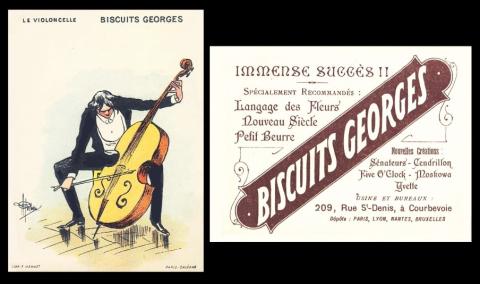
Biscuits GEORGES [trade : biscuits : O/S - Courbevoie, France] "Musique" (1900) Un/?
This day has two, closely linked, anniversaries, for it is #InternationalCelloDay and also the birth date of Pablo Casals. The first celebration of this day was held in 2015, which seems to have nothing to do with Pablo Casals, but maybe I will find something as I investigate.
Pablo Casals was actually Pau Casals, and he was Spanish, or more correctly, Catalonian. He was born today in 1876. His mother was Puerto Rican and his father Catalan; and his father, who was the parish organist and choirmaster, encouraged his son`s musical ability from a very young age. By the age of four, Casals was skilled in piano and flute, by the ago of six he played the violin, and liked it much better. Then, one day, not so long after, some travelling musicians came to town, and one of them produced a cello.Our man was enraptured, by the sound and by the size, so much so that he pestered his father to build him one, which he did, out of a hollowed gourd.
When he was twelve, his mother took him to Barcelona, and signed him up to the Escola Municipal de Música. He believed that he could dedicate himself to the cello, but he had to learn other instruments, and also work hard on music theory. The time at school was much enlivened by a local shop, which sold second hand sheet music - and one day he stumbled on an old, almost unreadable copy of Bach`s "Cello Suites". When he played them, his life was changed forever, for he would not only go on to make them part of his repertoire, but he would rework them, and make them known across the globe. To this day they are the one things that most people know him for.
In 1899 he even played for Queen Victoria, at Crystal Palace, and went on to play for President Roosevelt five years later, at the White House. In 1919 he started his own orchestra, which was extremely successful, but which he closed down at the outbreak of the Spanish Civil War.
He died on October 22, 1973, aged ninety-six, in a hospital in Puerto Rica after suffering a heart attack three weeks before. Six years later, his body was returned to Spain and buried.
The cards were printed by F. Hermet, the F. standing for Felix. The illustrator is "Guillaume"
And the eight cards known so far are :
- La Flute
- La Guitare
- La Harpe
- Le Biniou - a type of bagpipe from Brittany
- Le Tambour
- Le Trombone
- Le Violoncelle
- L`Orgue de Barbarie
Now in our newsletter of the 28th of March, 2026, as the diary card for the Wednesday the 1st of April 2026, we featured another version of this set, by High Life Tailor, a costumier of Paris, and in that printing there are four cards not listed above, namely
- La Clarinette
- La Grosse Caisse - or the bass drum
- La Piano
- Le Violon
I have yet to see any of those in the Biscuits Georges printing. But it does take the total to twelve, which is a more plausible number for a complete set.
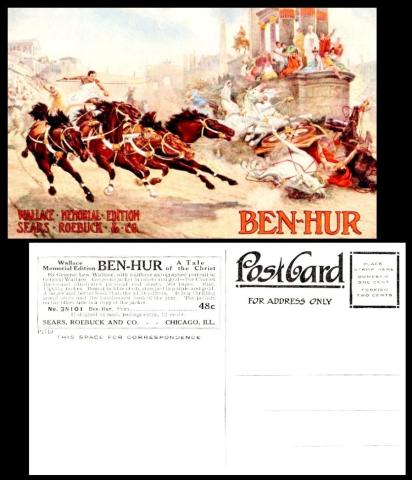
Sears Roebuck [trade : department store : O/S - Chicago, Illinois, USA] "Ben Hur Wallace Memorial Edition postcard" (1908) 1/1
In our last centenary of 2026, we have selected the theatrical release of Ben Hur : A Tale of the Christ".
Today we never use and seldom even remember that second part of the title, but it was indeed an attempt to tell a biblical story, starting with Mary and Joseph in Jerusalem. Today we mainly only remember it, if at all, for the chariot racing, and most people are thinking of the coloured version. released in 1959, with Charlton Heston. Our 1926 version was black and white, and was directed by Fred Niblo, from June Mathis` adaptation of the 1880 novel by Lew Wallace, and it had actually been filmed before, in 1907. However that was rather a disaster as it saw the film studio getting successfully sued by the author`s estate for not asking before they made it, a case which actually paved the way for the idea of authors rights.
The story is a simple one, padded out with action scenes. A wealthy Jewish man, called Judah, meets up with a boyhood friend, a Roman called Messala. It is a grudging friendship now though, as both feel their religions are the only one. As the new Roman governor passes by the house where the two men stand on the terrace a roof tile tumbles to the ground and Messala blames Judah, which gets him arrested and enslaved, then pressed into servitude, rowing a galley. During this period he meets Jesus, a carpenter`s son, who gives Judah water. Judah`s skill at rowing sees him sent to a warship, and the Roman in command of that vessel seems to have admired him, so much so that Judah was not chained to the oars as all the other slaves were. This means that when the vessel is attacked by pirates Judah is able to save the Roman from death by drowning, a feat which is repaid by Judah being adopted almost as the Roman`s son. During this time he shows that he is also an excellent horseman, and charioteer, which leads him to competing in a no holds barred race in Antioch. One of his fellow competitors turns out to be Messala, and the old rivalry flares up again. leading to a frantic chariot race that is more like war, in which Messala`s chariot is wrecked. Judah wins and decides to give all his money to Jesus, to help him overthrow the Romans, but before that can happen Jesus is arrested, and meets his death. Then, for some reason there is an earthquake, and the film ends with Judah vowing that Jesus will live forever.
Strangely, Ramon Novarro was not the first choice for the lead part of Judah/Ben Hur. June Mathis wanted it to go to Rudolph Valentino, on whom she was very keen. In fact when he died and had nowhere for his body to go she put him in her mausoleum and there he remains to this day, along with her. However when he did not meet with anyone else`s approval, George Walsh was cast. Then for some reason George Walsh was fired, after quite a lot of filming had taken place, and Ramon Novarro was hired. Apparently there are still some scenes where you can see George Walsh, either in the background or in crowd scenes. You can also see several other future stars watching the chariot race, including John and Lionel Barrymore, Douglas Fairbanks and Mary Pickford, Dorothy and Lillian Gish, and even Harold Lloyd.
The film was popular, though rather a niche market. The set piece, of the chariot race, involved over forty different cameramen so that views could be interspliced. Many of the accidents were real, caused by the use of tripwires, something that is luckily outlawed today, many horses, and reputedly some extras were killed. May McAvoy, one of the stars, playing Esther, was also injured, in an other, unrelated, chariot scene.
The film was neither nominated for, or won any Academy Awards - for they did not begin until 1929. However the 1959 remake with Charlton Heston won eleven.
This postcard was sent out by Sears Roebuck in 1908 in order to advertise their forthcoming issue of a memorial edition of General Lew Wallace`s book "Ben Hur - A Tale of the Christ". That book was published in 1908. On the left hand side of the reverse is a box which tells more of the book, "Gorgeous jacket in colours and gold - The Chariot Race - and illustrated pictorial end sheets.560 pages. Size 7 3/4 x 5 1/2 inches. Bound in blue cloth, stamped in purple and gold. A larger and better book than the $1.50 edition. It is a thrilling grand story and the handsomest book of the year. The picture on the other side is a copy of the jacket. No.3N101. Ben-Hur. Price 48c.
And this is true, for if you are lucky enough to find an original copy of that book, complete with dust jacket, this is indeed the picture on that dust jacket, running from front to back across the spine, though there is a decorative border added on the book. It does not look like that decorative border was ever reproduced on the postcards, which are way more easily available, for by now one would have turned up.
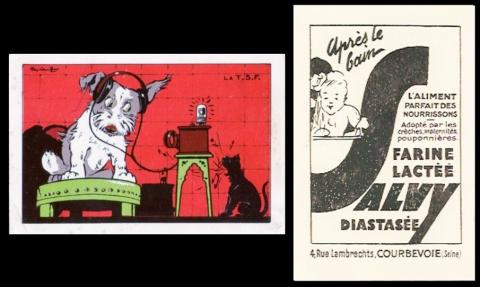
Farine SALVY [trade : baby food : O/S - Courbevoie, France] "Animaux Humoreux" (1920s)
When the year ends, it seems natural to want to reach out and make connections, and so we close our 2025 with the following tale, of London trying to send a message to New York, via Belfast.
Strange then that it starts with the U.S. Navy pretty much seizing Marconi`s ship to shore radio transmission facilities and setting them up as the Radio Corporation of America. This also resulted in the British military, who ran radio, for military purposes only at that time, pretty much banning present and former employees of Marconi from experimenting with any form of commercial radio broadcasting.
However, in 1922, the General Post Office agreed to license a non-military radio station, called the British Broadcasting Company; which was allowed to sell radio equipment to listeners and also charge license fees to use it. They were not, however, allowed to sell air time to commercial advertisers.
There had been experiments in non-military radio for a short while, even a radio station, call-signed 2MT, which had begun on the 14th of February, 1922, in a former army hut next to the Marconi facility at Writtle in Essex. This was run by an ex Royal Flying Corps wireless officer, called Captain Peter Pendleton Eckersley, (who was a relative of Aldous Huxley). He had joined Marconi as the head of the experimental section of the Aircraft Department, after proving his value at the wireless station at Biggin Hill. The station ]sent out its messages, for testing purposes, on Tuesday evenings between eight and eight thirty, hoping that people would tune in, though they had no way to know. Now because voice messages were often interrupted, or faint, and had to break for breathing, and, after all, because the station only operated on two hundred watts, it was realised that to play music would give a better chance at the broadcasts being picked up by the outside world. Therefore 2MT holds the honour of being the first radio station to provide entertainment, rather than just a stream of vocal testing messages.
Captain Eckersley`s skill was also picked up by his next employer, who wanted him as their chief engineer. His new job, at Marconi House, on the Strand, in London, included presenting and producing a similar regular broadcast for a new station, set up on the 11th of May 1922, and called 2LO. Again that only aired for one hour a day, and curiously operated on only a hundred watts, half of what was available at the little army hut in Writtle.
On the 14th of November, 1922, this station officially became part of the British Broadcasting Company, and relocated to premises at Savoy Hill. Later that year they first aired the chimes of Big Ben, live, to mark the coming of New Year`s Day, 1923. And today in 1925, the reason for all our preamble, they transmitted music, live from the Savoy Hotel, to Belfast, who sent it on to New York and Washington, the first attempt at the BBC going international.
However, earlier in 1923 the company had begun to question their non-selling of airtime, something which had led to the G.P.O. stopping their radio license, and eventually to the closure of the British Broadcasting Company in November 1927. After that they re-opened, as the British Broadcasting Corporation, though curiously their self imposed ban on commercial advertising remains to this day. Then, on the 9th of March, 1930, 2LO was no more, it was split into two, the BBC National and Regional programmes, which at first operated from the same studios, but slowly found local premises and presenters across the land.
Sadly Captain Eckersley flirted rather with scandal for the rest of his life, starting with the cause of it all, an affair with a fellow employee`s ex wife, who brought him into contact with such as William Joyce, Oswald Mosley and even Adolf Hitler. He was never actually stripped of his Life Vice-Presidency of the Radio Society of Great Britain, but it was questioned severely, especially after he attempted to set up a rival radio station in Europe using cable, and definitely after these were "captured".by the enemy. It is even more curious though, because from 1937 our man worked for M16, in the propaganda department, despite his attendance at at least two Nuremberg Rallies, one that very year, and one the next - and the fact that his wife and her son by her previous marriage both worked for German radio. In fact she recruited William Joyce and seems to have started his "Germany Calling" broadcasts. And in 1945 both the Eckersleys were tried for supporting the enemy - our man was bound over for two years but she went to jail, for a year.
This card is way more humorous than all that, but it does show two different species attempting to communicate through radio. I am not sure if is a one off, or not. Maybe you will let me know of others.
Farine means flour, and Farine Lactee was one of Salvy`s best selling products; the words translate to milk flour, and it was designed for babies. Another word on this card is equally important, and that is "diastasee", which is an enzyme called alpha amylase. Today it is still an important health product, called Diastase and it is used to break up complex carbohydrates like starch into smaller, more easily digested sugars.

C. REMONTEY [trade : shoes : O/S - Paris, France] "Cloches" / bells
Two days in one today, for it is #RingABellDay and the beginning of the National Bell Festival, at least in America. So if you listen out, wherever you are in the world, you will hopefully hear your local church joining in, though maybe not as many as in 2023, when the United Kingdom was chosen as the host country. And poignantly, this year the host nation is Ukraine, proving that the sound of bells can unite and inspire a nation, and give strength to one besieged.
Through the centuries, as long as bells have been around, they have acted as calling signs, much like a radio - they call the remote and isolated to gather, sound over life changing and lijfe ending events, even mark the changes in the calendar and the hours in the day. And they also warn of enemy attack, or the cessation of hostilities, so that they can once more resume their peace-time lives
Now we have featured this set before but in a much different format, and there is absolutely no question that the card we illustrated as our Card of the Day for the 9th of May, 2025 ever had these huge white borders, though there is speculation as to which version came first.

PETER, Cailler, Kohler, & Nestlé [trade : chocolate : O/S : Europe] "Animaux Humoristiques" - Serie XXXII (1930s) 9/12
Today in 1926 saw the first edition of "Melody Maker" magazine, and they did issue cards, showing musical performers, and, rather oddly, Alan Partridge. However I have none of those, and nor does anyone I know. So we have hopped away from that in leaps and bounds, and are going to chat about kangaroos.
The reason for that is that today, in 1913, Australia introduced a range of postage stamps which showed a kangaroo and a map of Australia. They were, rather prosaically, known as the Kangaroo and Map series, but they were very important, and timely, for the Commonwealth of Australia had been established some twelve years ago (on the 1st of January 1901), and these were the first stamps that were valid across the land. And they were enormously popular with the general public.
However, behind the scenes there had been many shauries. The stamp was to be chosen from all entrants of a design competition which began in January 1911, and ended in June, the winning artist of which would also receive £100, with the runner up getting £50, but the Postmaster-General, Josiah Thomas, did not like any of the entries. He had still not announced a winner by October, when he was replaced as Postmaster-General by Charlie Frazer. Mr. Frazer did not like any of them either, though he did like the idea of having a stamp with a kangaroo, and another design, with a map, was also pleasing, but both lacked something, though he did not know what.
He then reached out to the Victorian Artists’ Society (Victorian referring to the state, not the century), to see if there was anyone there who could design a stamp instead. They put him in touch with Blamire Young, an English artist living in Australia, and, after a few discussions, it was decided that the new artwork would feature a kangaroo and a map.
This was harder that it sounded, as Mr. Blamire soon realised that a map showing even just the largest towns would be too cluttered, and fitting the kangaroo in almost impossible, so what he did was to just draw the outline of the map of Australia, and have the kangaroo inside. That looked a bit odd, so he added vegetation for the kangaroo to stand on, and a plant called kangaroo grass just to its left.
The cabinet was happy with the finished artwork, but the media made fun of the tuft of kangaroo grass, comparing it to the head of a turnip, or the ears of a rabbit - so much so that this little tuft was painted out. There was also a lot of grumbling that the stamp did not have the King`s head on it, but strangely this was never inserted.
The stamp went on sale, in Sydney, New South Wales, on the 2nd of January 1913, then was released to the other states. We have said "the stamp" but it was sold in fifteen denominations, all in different colours for easy identification - these being ½d, 1d, 2d, 2½d, 3d, 4d, 5d, 6d, 9d, 1/-, 2/-, 5/-, 10/-, £1, and £2.
Now you may think our card flippant but look closer and you will see the kangaroo is actually a postman, delivering a letter from out of his pouch, and it does seem likely that our stamp was on the artist`s mind when he thought of something for the kangaroo to do.
The animals are :
- Cat mending a roof
- Dogs in running race
- Mother pig washing baby
- Doctor? fox with gladstone bag
- Wild boar chopping wood
- Wolf with shotgun
- Lynx barber with goat client
- Two beavers building a brick wall
- Kangaroo delivering post
- Crocodile selling handbag to fox
- Monkey dentist with a hippopotamus
- Hyena washing clothes ? by miners lamp
Now we featured card 1 in our newsletter for the 15th of June, 2024, but in the B version, and also with the top line of names in a different order, for there they say "Nestle, Peter, Cailler, Kohler" (to save you looking our card says Peter, Cailler, Kohler, and has Nestle last). However the list of cards with that entry is nothing like the above, so I will investigate.
This set, as usual, was issued in several variations -
- Nestle, Peter, Cailler, Kohler - Serie 32 and Serie 32 B
- Peter, Cailler, Kohler, Nestle - Serie XXXII
We also know that there were three sets of "Animaux Humoristiques", Serie 30, Serie 31 and Serie 32, so we will investigate.
This week's Cards of the Day...
told the tale of another animal who is featured in the nativity. This week we had the camel. who was a late comer, joining the ox and donkey only when the three wise men turned up. However, once more there are no camels specifically mentioned in the bible at that point, and even the men are only named in the eighth century, with a rather sketchy back story about them being found in a long lost and newly discovered Greek manuscript. Other sources speak of them coming on horseback, or even on elephants, reflecting another common theory, that each wise man came from a different area - Melchior from Persia, Caspar from Afghanistan, and Balthazar from Ethiopia in Africa, and it was he who rode the elephant.
The first mention of camels in any historical account is in the Old Testament, in Genesis, where Pharaoh gives them to Abraham. If he did that, then they would have been the first camels in Egypt.
Saturday, 20th December 2025

To start our week we have Paul Labile Pogba, who was born on the fifteenth of March 1993 at Lagny sur Marne in France, the youngest of three sons. All three are talented footballers, but the oldest two were born before the family moved to France, and so they play intenationally for Guinea.
As for why he is here, well he is an investor, shareholder, and ambassador for a Saudi Arabian camel racing team. The team. Al Haboob, is the world`s first professional camel racing team, and apparently Mr. Pogba is a huge fan of the sport.
Returning to football, he was almost certainly coached by his siblings, which gave him a good start to becoming a talented youngster and he joined the Le Havre youth side in 2007. They sold him on, two years later,to Manchester United, after repeated attempts at gaining his services and a lot of legal wrangling. However then they seem not to have needed him after all, and even gave him to Juventus on a free transfer.
Whilst at Juventus he became a star, guided and supported by the team, and won awards for being the most promising young player. Then Manchester United came along and wanted him back, paying the then World Record fee of a hundred and five million euros in 2016.
In June 2025 he signed for Association Sportive de Monaco Football Club
This is an odd set, which was sold in packets, containing eight cards, but which was also sold as boxes, containing ten of the packets and one autograph card. However the boxes then cost £90.
The set is also rather a mish-mash, with homages to the past and more unusual three dimensional cards which could best be viewed with a pair of 3-D glasses, also included in each box - or, should I say, apparently "only" included in each box. So it appears if you only bought the packets you could not get the glasses. There were also parallel cards, with different colour backgrounds.
Sunday, 21st December 2025
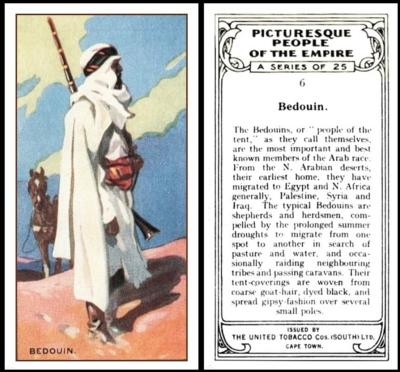
Though this Bedouin is shown with a horse, they are renowned as being camel people, breeding and refining them for strength and speed. Indeed the word camel comes from Arabic, and appears in much of their literature and poetry, right from the eleventh century B.C., This Arabic name is Ata Allah, which translates to "Gift of God", and that was an apt name for their value, for the camel provided transportation, milk, and were used as currency. Indeed the Bedouin revered the camel so highly that they would only eat them when they were unable to find any other food and in risk of starvation themselves.
This is the third and final set in this triumvirate which you can read more about with the Ogden`s version, which we featured as a Card of the Day on the 20th of May 2025.
The first time our South African version appears in any reference books, it is a round up, as part of RB.17, covering the issues of the British American Tobacco Company, which was published in 1952. That reads :
- 200-288 PICTURESQUE PEOPLE OF THE EMPIRE. The recordings in W/288, RB.15/131 and RB.17/147 are summarised below.
A. Wills` Overseas issue
B. Player Overseas issue, with `Drumhead` cigarettes.
C. U.T.C. issue
D. Ogden Home issue.
By the time of our original World Tobacco Issues Index , in 1956, it appears with the UTC listings,
under section 2, for "Issues 1918-43" and sub-section 2.A, for "Cards in English only" - as opposed to "Cards in English and Afrikaans" - as :
- PICTURESQUE PEOPLE OF THE EMPIRE. Sm.67 x 36. Nd. (25). See RB.21/200-288.C ... U14-26
This data is identical in our updated World Tobacco Issues Index, only the card code being changed, to U560-510
Monday, 22nd December 2025
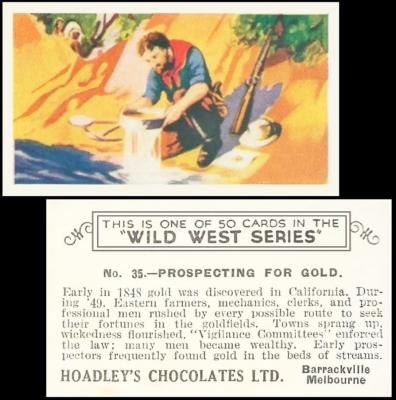
Here we have an Australian card showing goldfields, albeit in America - however this clue links to the fact that in 1892 camels were first brought to the Western Australian goldfields from South Australia, with others following direct from India.
The camel had made its name on the Burke and Wills' expedition in 1860, where it could sustain itself with almost no water for days, and eat all forms of local plant life.
,As far as "Hoadley's Chocolates", they were named after a man, Abel Hoadley who was actually English. He started a company in Melbourne in 1889, to make and bottle jam, then expanded into preserved fruits, candies, and crystallised peel. We are not sure whether he owned the orchards at Burwood, and then used the products, or diversified into buying orchards. Whichever, the fruit side of the business was booming almost immediately, and by 1901 he was running four preserving factories in the area.
The problem was that fruit is seasonal. That issue was solved when he heard of a factory up for sale. This had been owned by Dillon Burrows & Co., which but ten years before had been one of the, if not the largest confectionery firm in Australia. It is not clear whether the factory came with the equipment still inside, but something made our man decide to have a go at making chocolate to fill the seasons when the fruit was still swelling, and not ready to pick.
In 1910, Abel Hoadley sold his jam business, and just three years later he started anew as Hoadley`s Chocolates. However Abel Hoadley retired that same year, stepping aside for his four sons. Oddly all of them were given, or chose to assume, admin roles, employing managers and staff to make the actual chocolates.
Their first product was "Violet Milk Chocolates", named after their mother`s favourite flower, and in the same year they introduced "Violet Crumble". The latter was the first Hoadley product to be sold interstate. However there was lots of competition in the confectionery industry at that time, and Hoadley`s started to be left behind.
Now it is often said that the thing that saved them, rather thrillingly for us, was cards - but that is incorrect, for Hoadleys had a long backstory of issuing cards, starting before the First World War, with two untitled sets. One of these uses images borrowed from Sniders and Abrahams set of "Jokes Illustrated", whilst the other actually used Sniders and Abraham`s cards of "Melbourne Buildings", covering up the name with a label. They then issued another set of "Great War Leaders", combining cards from two Sniders and Abrahams sets. And finally they produced a set all of their own, known as "Loyalty Series" though it too is untitled; this comes in two styles, Flags of the Allies and a card of King George V.
It is more likely that what saved them was the decision to re-issue cards in the early 1920s, especially the sporting ones, which showed cricket and football, as well as a set which traced the history of the Australian Nation.
We do know that by the late 1940s / early 1950s the raise in their business allowed them to introduce more ranges, including something called a Polly Waffle, a tube made of waffle wafer, filled with marshmallow and then covered in chocolate. However in 1972 Hoadley`s was bought out by Rowntree`s. It seems to have been an amicable buy, and the names were merged, with the company becoming Rowntree Hoadley Ltd. The product range was altered though, and new sweets introduced, not all of which were chocolate. Then, for some reason, they sold out to Nestle, who abandoned the Rowntree and the Hoadley, and sold off the rights to some of their best loved products, including Violet Crumble and Polly Waffle. These two were bought by Menz, a fellow confectioner, whose desire it was to bring them back into production. And that did happen in 2018/19.
This is an unusual set, which deals with the Wild West of America - and looking at our card, of a gold panner, makes me wonder why they did not feature the Australian goldfields and their stories. It is also curious because it has the appearance of a much later trade set, and yet it was issued even before the Second World War had started.
As for the rather unusual card code, that is because this set is only listed in our original Australian and New Zealand Index, published in 1983 as RB.30.
There is a checklist of this set online, at Jeff Allender`s House of Checklists/ HWW
Tuesday, 23rd December 2025

Now you may not realise this but not all camels are the same.
The one on our card today is a dromedary, also known as an Arabian camel, or, simply, a one-humped camel. They are the tallest of all camels, reaching two metres at the shoulder for the males and slightly shorter for the females. And, treated well, they can live for forty years.
This is the oldest type of camel, known to the Assyrians as "gammalu". In fact a very similar word to this "gamal", appears in the bible, just not in connection with the three wise men. These words are the root of the word "camel".
As for the word "dromedary", that refers to its speed, and it comes from the Greek word "dromas", which means fast running.
Lastly, the name of "Arabian" camel is not just because of where it lives - it actually celebrates the fact that the Arabs were the first to manage to domesticate the camel, in the third century B.C.
The earliest cards to feature an Arabian camel was issued with Abdul Cigarettes in 1881 - but the first set to use the title of "Dromedary" is Allen and Ginter`s 1888 set of "Wild Animals of the World".
Today`s card simply chooses "the camel". Now at first I thought we had already had this set, and we have, but this is the German version, which translates to Hand Shadows. (You can see the French version, which, for some reason, translates to Chinese Shadows, as our Card of the Day for the 1st of December 2025.
The cards in this German version are :
The other cards, and equally attractive they are, though I am not so keen on the hare one, are as follows :
- Die Ziege- the goat
- Das Kameel - the camel
- Der Hase- the hare
- Der Bauer - the farmer
- Der Indianer - the Native Amerian
- Die Gans - the goose
And there is indeed a second set, "Handschatten II", issued in 1893. which are catalogued as F.0388 and S.0387. The cards there are :
- Der Stier - the ox
- Die Ente - the duck
- Der Kutscher - the coach driver
- Der Hund - the dog
- Der Elephant - the elephant
- Die Schnecke - the snail
This is also available in the same three languages, French, German, and Italian
Wednesday, 24th December 2025
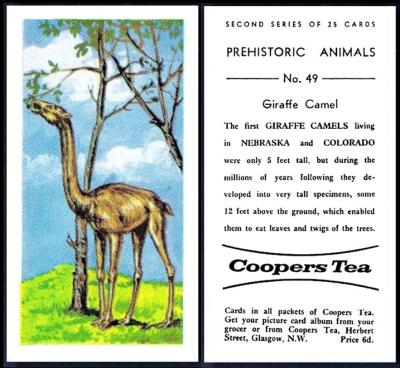
This is a really unusual card, showing an animal described as a "Giraffe Camel". And they are not making that up, there really was such a beast. It was huge, too, thirteen feet at the shoulder and an extra six feet for the elongated neck. The size seems to have been evolutionary, enabling the browsing of ever taller trees.
It was indeed related to both the giraffe and the camel., and about nine million years ago it roamed the area which we know today as the state of Florida in North America. There is also evidence to suggest it was also to be found in California, and Nebraska, as our card confirms, but those branches seem to have died out a fair while before the ones in Florida. And I have not been able to trace a link to Colorado, also as mentioned on our card.
It seems to have been rediscovered, from fossils, in the 1880s, by a man called Joseph Leidy, an American biologist, most likely whilst he was studying mastodons.
As for this set, it first appears in our original British Trade Index part II. The header tells us that the cards were issued with "Cooper`s Teas", which we know from the cards, and that the "Cards [were] issued 1958-66. Small size 68 - 69 x 36 m/m. Albums issued". As for our set(s) they are described as :
- PREHISTORIC ANIMALS. Sm. Nd. See D.356. ... CPD-5
1. "First Series" (25)
2. "Second Series". Nd. 26/50 (25)
This is duplicated exactly in our updated British Trade Index, save new codes, COO-190 replacing the card code, and HX-151 replacing the handbook reference.
Those "D" and "HX" codes tell us that this set was a duplicate of one issued by another company. In fact Coopers only issued one original set, called "Mysteries and Wonders of the World", again as a first and second series. Personally I think someone else did issue that too, perhaps by another name, and we just haven`t found it yet.
Anyway. if we go to the back of the book, we find all the "D" codes, and the one we are after reads :
- D.356. PREHISTORIC ANIMALS. 1st (Nd. 1/25) and 2nd eries (Nd. 26/50)
Charter Tea [ & Coffee Co. Liverpool ]- Set CFX-1
Cooper & Co. - Set CPD-5
Sunblest Tea - Set SUQ-2 [ issued in 1966 ]
It seems likely, but not proven, that all these companies were allied. This is partially proven by the fact that this set was issued by all three, and more than suggested by the list of sets issued by Cooper, which were
- "THE ISLAND OF CEYLON" - 1955 - also issued by Badshah Tea, E.H. Booth, Browne Bros, Ceylon Tea Centre, Empson, Esslemont, India & Ceylon Tea, Nicholls Johnson & Bingham, Pitt Robinson & Masters, Poyser Sons & Crouchley, Rowats Tea, Seymour Mead, Swettenham, Warnock, Wheeler Son & Killpack, Whytes Tea, Wilcocks & Wilcocks, Wood & Co and in an anonymous form.
- "MYSTERIES & WONDERS OF THE WORLD" 1st & 2nd - 1960
- "STRANGE BUT TRUE" 1st & 2nd - 1960 - also issued by Charter Tea
- "TRANSPORT THROUGH THE AGES" 1st & 2nd - 1961 - also issued by Charter Tea, and in an anonymous form.
- "INVENTORS & DISCOVERIES" 1st & 2nd - 1962 - also issued by Fine Fare Tea, Sunblest Tea, and in an anonymous form.
- "PREHISTORIC ANIMALS" 1st & 2nd - 1962 - also issued by Charter Tea, and Sunblest Tea
- "DO YOU KNOW" - 1966 - also issued by Elkes Biscuits
Thursday, 25th December 2025

Here we have the two-humped, Bactrian, or Mongolian camel, which comes from Central Asia.
It gets its name from the ancient land of Bactria, an Iranian civilisation long disappeared, which used to inhabit parts of modern day Afghanistan, Republic of Tajikistan, and Uzbekistan, protected by mountains on three of its flanks.
Like the dromedary, Bactrian camels were domesticated for carrying loads and people, but through the cold steppes of inner Asia rather than the desert heat. But although both are from the camel family they have long been known as two different species - as far back as Aristotle, who described them both in his "History of Animals" in the fourth century B.C., calling them the Arabian and Bactrian. And that is from where, in 1775, Carl Linnaeus derived his name of Camelus Bactrianus.
The two Aristotlean names are used on the earliest cards to feature camels - issued with Abdul Cigarettes in 1881 - though both the "Bactrian Camel" and the "Camel, Arabian" are shown on desert soil. Strangely, when these same cards are used in 1890, for the Allen & Ginter set of "Quadrupeds" the titles have changed, to "Camel" for the Bactrian and "Dromedary" instead of Arabian Camel.
This is a lengthy set, issued in two parts. The first batch, cards 1 to 361, were issued in 1976. and the next batch, cards 362 to 724 followed on later in the same year.
The advertising shows that they were designed to be kept in a binder, but this took only 60 cards. If you tried, you could fit the cards in back to back, and get 120 cards in, but you had to be very careful not to damage the cards as you squeezed them in, and once they were there you could not read the backs. In addition, this over-filling made the binders bulge out of shape. There was also another slight problem, as 724 is not divisible by 60, there are four cards left over, which would look slightly odd in a sixty card album. Looking at this another way, if you did manage to get 120 cards in, it would take 6 binders to get all but those four cards in - or if you went for the allotted 60 cards, you would need 12 binders, and again have four cards over.
Perhaps this was why the company offered alternative storage, a metal, lidded box, like a lunch box with a handle. I do not know how the cards fitted in here, but maybe they just stacked up one atop the other.
Friday, 26th December 2025

Chocolat Lombart is an unfamiliar name to a lot of collectors, but it is actually the oldest chocolate maker in France. However it is unclear why this card says "1720 - 1760" as it was not founded until the later of those dates. And we know that their Royal patents were only granted in 1814. In addition, their factory was not opened until 1860.
Equally curiously the first words below that are "Au Fidele Berger", which translates to "At the faithful shepherd". Maybe this was a trademark, for not all clients could read at that time, and a pictorial logo was the main way that they knew which shop to patronise.
Anyway next the card advertises their wares - "Chocolats, Bonbons, Confiserie Fine, Dragees, Baptemes" . A dragee is usually a nut covered in hard sugary chocolate, which you really need good teeth to enjoy. And actually baptemes are closely related to this as they are the little net bags which are given to the guests at christenings or baptisms, often containing dragees.
The card then gives two addresses, both in Paris - the "Usine & Bureaux : 75 Avenue de Choisy, Paris" and the "Magazines de Vente : 9 Boulevard de la Madeleine, Paris" - the first of which is actually the factory and offices, and the second the retail store.
Sadly, in the late 1930s the brand started to lose its popularity, almost certainly to it keeping with tradition, whilst others produced of more showy wares. In the late 1950s it was bought out by Chocolat Menier.
This is a very pretty set but for some reason suffers with a great deal of browning problems. And the advert on the reverse is in brown print. But eventually we got a back which was passable...
Each card looks the same on the back, but the section of text which is sideways on to the left hand side is pertinent to that animal.
Our text reads "Le dromedaire vit dans le pays chauds. Il sert du mouture et de bete de somme. Sa grande sobrietie lui permet de traverser des vastes desertes en absorbent tres peu de nourriture". That translates to : "The dromedary lives in hot countries. It serves as both a grind and a beast of burden. Its great frugality of need allows it to cross vast deserts while consuming very little food". The word "grind" actually represents the fact that if you harness the camel to a mill, you can grind corn or other kinds of food, whereas a beast of burden really means an animal which will carry goods or people.
The title, "Animaux Utiles" means useful animals, but not, as is usual, useful only to eat. And all three of our Christmas animals appear within it.
We are fairly sure it is a set of twelve cards, as I have also been unable to track down any more from any of my sources, and they are
- Chiens de chasse - hunting dogs
- L`Ane - the donkey
- L`Elephant - the elephant
- Le Chameau - the camel
- Le Cheval - the horse
- Le Chien de berger - the farmer`s dog
- Le Mulet - the mule
- Le Renne - the reindeer
- Les Boeufs - the oxen
- Les Chevres - the goats
- Les Poules - the chickens
- Les Vaches - the cows