
The first newsletter to be written. pretty much in its entirety, in 2026, turned out to be a desperate rush, and rather chaotic but we made it, more or less, and not just that but we closed the book before midnight struck and turned me into a pumpkin with egg on my face.
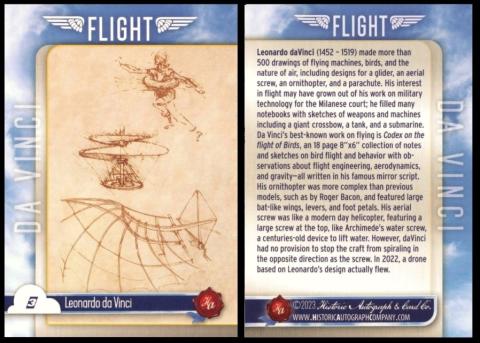
HISTORIC Autographs & Card Co. [trade/commercial : cards : O/S - Pottstown, Pennsylvania, USA] "Flight" (July 19th, 2023) 3/70
Today, in 1496, in a field near Florence in Italy, a man attempted to fly.
That man was Leonardo di ser Piero da da Vinci, and the attempt, though unsuccessful as far as actual flight, was just the beginning.
Sadly most of what follows is just conjecture, for there were no newsreel photographers, no daily papers, and no social media.
We do know, from his amazingly detailed notebooks, extracts of which appear on this card, that he was obsessed with flight, and spent hours observing birds, as well as bats, but we do not know why he was so determined to emulate them. His earliest designs show wings that attempt to mimic their flapping and even their feathers, through all manner of contrivances.
And we also know, looking at those drawings with today`s eyes, that many of the things he discovered would have only needed a tweak. In the case of the machine he tested today, all those centuries ago, using an incredibly technical rotor system, that the failing was only caused by an oversight, that there was nothing to prevent the body of the machine spinning in the opposite direction to the screw.
And our card actually tells us that in 2022, a drone based on the original design actually flew. I have failed to find anything else about that though.
I do know that this set is noted for its extras. Each card in the base set can also be found in foil, and deluxe foil, and as a printing plate in the usual colours (black, cyan, magenta, yellow). Then there are autograph cards. But where it really stands out are with the relic cards, not just the usual clothing, but such magical marvels as a piece of fabric from the Hindenburg - part of a flag flown by Howard Hughes at the 1939 World`s Fair - a piece of gauze from the medical kit aboard one of Charles Lindbergh`s flights (though not necessarily that of the Spirit of St Louis). The only problem is that these are scarce - the promotional material telling you that you would have to open almost three hundred and fifty packs to get these marvels, and even that there is no guaranteed certainty
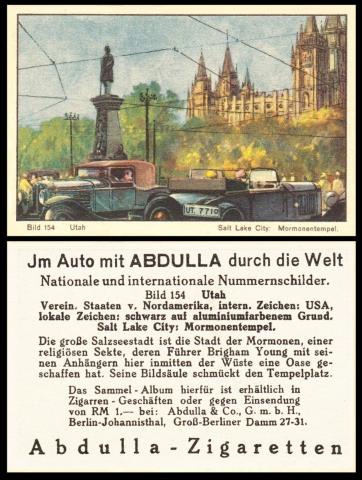
ABDULLA [tobacco : UK - London and O/S - Berlin] "Jm Auto mit ABDULLA durch die Welt" (1932) 154/160 - A065-030 : A5-2
Here is a fascinating fact for you, for today in 1896, one hundred and thirty years ago, Utah was admitted as the forty-fifth State of America - but only after it agreed to outlaw slavery and polygamy....
Utah seems to have been one of the first regions of the American land mass to have been colonised, almost certainly due to a very strange natural feature, a huge area of water which we know as The Great Basin, which seems to have no way of access to any ocean, and no means of support, yet is visible not only in Utah, but in California, Idaho, Nevada, Oregon, and Wyoming. This was soon realised to be a good place to live, for it not only provided water for human consumption, it attracted animals, who made for relatively easy prey.
Then, all of a sudden, the water rose, and the people left. Today it is pretty much dry, at least on the outside surface, though water is still there, buried.
We are not sure who these people were, but we know that they left nothing behind when they left - all the artefacts found in that area coming from the second group of inhabitants. We think, but are not entirely sure, that they were related to the Puebloans, who lived close by, and maybe died out in peace, by the two tribes joining together.
Native Americans came along in the thirteenth century, and we think they were originally from California. They split the land, quite amicably, between several tribes, but peace was not to last, and in the sixteenth century the Spaniards turned up, looking for a way to reach the California coast, but not to surf. They liked the land, and claimed it as their own, calling it New Spain, though they seem not to have had any proper relationship with the area, save mapping it in a very rudimentary way
Their ownership lasted until 1821, when it was taken over as part of Mexico.
In the 1840s, those maps were discovered by a man called Brigham Young. He had been born in 1801, in Vermont, after which his family had moved to New York. He started out as a painter and carpenter, but in 1835 found religion and joined the Church of Latter Day Saints. That took him to Missouri, in 1838, at what may have been seen as a rather unfortunate time, for the state was intent on outlawing the religion and its followers. Instead of that, our man stepped up, and managed to lead a trek of the faithful right the way to Illinois. This seems to have brought him to the attention of Joseph Smith, the President of the Church of Latter Day Saints, who had also been born in Vermont - and he named our man as his eventual successor. However neither man realised that in 1844, Joseph Smith would be shot and killed in a jailhouse riot. This left our man as President, with overall control and it was he who built not just a succession of temples but founded Salt Lake City, in Utah.
He seems to have been a curious man, quite accepting of slavery, in fact Utah was the only place in the western United States to openly use slaves, which were African and Native American. He was also keen on continuing Joseph Smith`s practise of polygamy. In fact when Brigham Young died he had fifty six wives, nine of whom had also been married to Joseph Smith, and who had been transferred over with the Presidency. Brigham Young`s youngest wife had been sixteen on her wedding day, and his oldest sixty-five. And he fathered over fifty children - though records differ, because he not only had relationships and children with women who were not his wife, but some women claimed that he was the father of their child when he was not.
Now you may think that with all that going on he did not have much spare time, but Salt Lake City was amazingly well planned, and thriving. In 1849 he applied to the American government so that the area could become a state, called Deseret. This was turned down, mainly because he had drawn the map to include land that actually belonged to eight of his neighbouring states, (making an area twice the size of the area eventually agreed to) - and they, quite rightly, objected.
However, the following year, Utah Territory was created, its capital city being named Fillmore (after President Millard Fillmore). Then, in 1856, Salt Lake City became the official capital, opening the door again for pleas of statehood. And that was eventually granted in 1896 - but only after those two conditions had been met, the ending of slavery which happened in 1862, but not by Utah`s choice, simply by the fact that on June 19, 1862, slavery was prohibited in all the American territories, and the ending of polygamy, which was grudgingly agreed to in 1890.
Sadly though our Cartophilic reference book No.5, issued in 1943, covers the issues of Abdulla, (along with Adkin and Anstie) it only covers the English language issues. That is a real shame, as we are denied the pleasure of a more detailed description.
Therefore this set`s first appearance comes in our original World Tobacco Issues Index, with the other German Language Issues as section one of the Abdulla listings. The entry for this set reads :
- IM AUTO MIT ABDULLA DURCH DE WELT (Motoring Round the World with Abdulla). Md. 75 x 50. Nd. (160) ... A5-2
However if you look at the card, the first word of the title is actually "Jm" not "Im", and that brings us back to a card we featured a short while ago, issued by Cibils. That was our Card of the Day for the 18th of December 2025, which says "Jndian Bullock Cart" instead of Indian. At that time I speculated that this could have been a typesetting error, but perhaps it was that the photo originated in Germany, and they copied it without changing the lettering.
The above entry is repeated word for word in our updated World Tobacco Issues Index, save a new card code, of A065-030
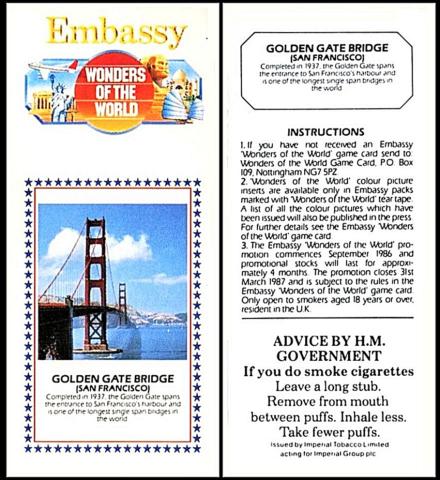
W.D. & H.O. WILLS `Embassy` brand [tobacco : UK - Bristol] "Wonders of the World" (1986) Un/56 - W675-292.A
Hard to believe, maybe, but at one time the only way across San Francisco Bay was by ferry.
This service began in the 1820s, using sailing boats, and continued as the only option until the opening of the Golden Gate Bridge on the 27th of May, 1937.
This seems staggering, but wait, for when the idea of a bridge was first mooted, the objections were many, citing the width of 6,700 feet, the depth of 372 feet, the extra strong tides, and gusty winds and white out fogs which appeared almost out of nowhere.
And yet the ferry endured.....
In fact the bridge may not ever have been built, were it not for a dreamer and poet, who saw an article in a local paper kind of sending out feelers to anyone who thought they could build a bridge for less than a hundred million dollars. This man was Joseph Strauss, and he had designed a railway bridge, on paper, as part of his thesis at college. This was never built, but he had used the same principles successfully, on hundreds of small bridges across rivers and streams in private estates across America. And so he applied.
That was in 1916, and Mr. Strauss` estimate said that he could build a bridge for about seventeen million dollars. This was accepted, but then the problems really began, with opposition from not just the ferries, but the Department of War, and the Navy, who were worried that the bridge could be used in case of enemy invasion, or blown up, blocking the harbour and preventing access. It was not until 1924 that the bridge was allowed, and most of the reason for that was the car industry, who rightly believed their customers would much prefer the idea of driving straight over a bridge than queuing for a ferry.
Construction began today, January the 5th, 1933. Mr. Strauss was the chief engineer, though he still knew little about bridge building and nothing about rigging the suspension cables which were part of the design. He did, however, save the lives of nineteen men by insisting that nets were slung below the construction as it moved out across the water. His plans had been changed by more qualified bridge builders though; the suspension design had been taken over by Leon Moisseiff, the architect of New York`s Manhattan Bridge, and the towers and visual design by Irving Morrow. There was also a new senior engineer, who oversaw the structural design.
The bridge was opened with a week of celebrations that started on May the 27th, 1937. First across was foot traffic, and there is a theory that this was in order to test the bridge before cars were allowed. The first cars were a slow parade, and included the Mayor and Joseph Strauss. And the next day, at noon, President Roosevelt, many miles away, pretty much the other side of America, sitting in the White House, pressed a button and the bridge was officially open.
This set only appears in our updated World Tobacco Issues Index, under Wills section 3.B, for "Embassy and other issues in the 1980s". In actual fact, the promotion started in September 1986 and ended on the 31st of March 1987
It is catalogued as :
- WONDERS OF THE WORLD A. Sm. 80 x 35. B. Md. 80 x 47. C. Md. 90 x 47. Unnd. (56) ... W675-292
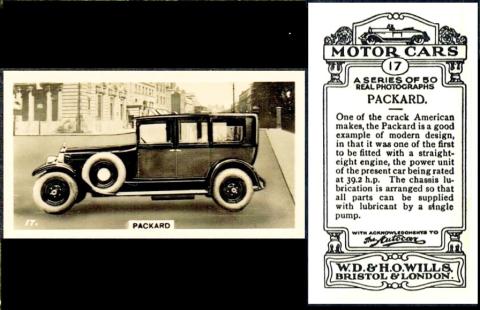
W.D. & H.O. WILLS [tobacco : UK - Bristol] "Motor Cars" - export issue (July 1927) 17/50 - W675-653 : W62-453 : W/266
Today in 1930 a vehicle with a diesel engine set out on a road trip of almost eight hundred miles. It was a spur of the moment decision, by the Cummins Engine Company, facing closure and also the dissolution of the parnership. The problem was that they made diesel motors, and the public were not only more used to petrol, but that they only made the motor, not the car, the two had to be bought separately and combined.
The Cummins Engine Company had been founded in 1919, in Indiana, by two men, Clessie Lyle Cummins and William G. Irwin.
Mr. Cummins had been born in Indiana, on a farm, and had little schooling, but he was fascinated by machinery and build his first engine, powered by steam, at the age of eleven. William Irwin entered his life just before the First World War, when he employed our man as a chauffeur. And that all came about because Mr. Cummins had given up everything to get a spot on a race car team that would win the first ever Indianapolis 500 race in 1911.
Both Mr. Cummins and Mr. Irwin were inspired by the work of Rudolf Diesel, and knew that his process had many benefits that petrol did not. So, following in his footsteps, or maybe his tyre tracks, they adapted his engine to make their own, the first of which was a simple six h.p., with which tools and small devices could be powered. The things they learned whilst doing that led to a larger engine, called the Model F, which went on sale in 1921. They then updated this with the model U, which was released in 1928.
The engines were good, and efficient, and cheap to run, but you had to bother to investigate that, to come out to a showroom and have a look, and the majority of drivers were just going to a showroom and selecting a petrol car. So these sales were poor. There was also another problem as their farm engines department was suffering from a bit of a scam, where farmers would buy an engine to help with planting or harvesting, and at the end of the season claim it did not work and return it. So Mr. Irwin, who, remember, was a banker, wanted out.
Mr. Cummins knew that this would be the end of the company. Then he had a brainwave. They did not have to wait for people to find them, they could take a car on tour. So he acquired a 1926 Packard, fitted it with one of their engines, and motored out, with an assistant. They left their Indiana factory and drove all the way to New York City, where there was a car show. They found when they got there that they could not take part, but rented some space opposite and gained quite a lot of attention from the public by publishing the fact that they had come all that way and the fuel had only cost a dollar and thirty-nine cents.
This was the first of many such stunts, including several long distance road trips, and demonstrating that diesel engines performed very well in racing cars. Their whole fascinating story can be read at CapitalRemanEchange/CEH
Best of all, the company is still in business today.
Now I am going to be honest, I think I may have told this tale before, but cannot find it - it may have been in the newsletters which wait to be restored from our former site. However the fact that I was a bit "meh" about the card I used has been solved by Mr. Preece of New Zealand, who sent us this card instead, which is very much better.
This set was first listed in our original "Cartophilic Reference Book - No.16 : The Cigarette Card Issues of W.D. & H.O. Wills Parts I, II, and III (revised) and Part IV", published in 1950, as :
- 266. MOTOR CARS. Fronts : Glossy photoprints in black and white. Backs in black, with descriptive text. Issued in New Zealand, about 1928
This date was later corrected, using the information published in the Wills Works Magazine, where it states the set was issued in July 1927.
It was next listed in our original World Tobacco Issues Index under Wills section 5.B., which was for "ENGLISH LANGUAGE ISSUES 1923-30/ Issued cheifly in New Zealand, some series in Malaya, Malta, and elsewhere." The entry reads :
- MOTOR CARS. Sm. Black and white photos. Nd. (50). See W/266 ... W62-453
And in our updated World Tobacco Issues Index this text remains the same, except for the new card code of W675-653
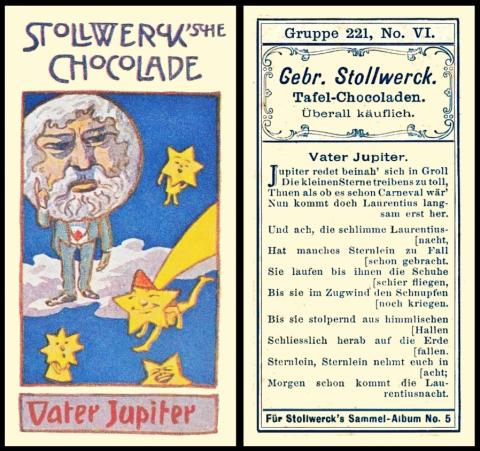
Gebruder STOLLWERK [trade : chocolate : Germany] "Im Reich der Sterne" / in the realm of the stars (1902) Album 5, Group 221, card VI
Today in 1610 Galileo Galilei first looked through his telescope at Jupiter and saw four moons. And it is in his honour we still sometimes call these four the Galilean moons or Galilean satellites, though today we know that there are more such orbs, these are but the four largest. And, in fact, the rest are not really orbs at all, they are just clusters of matter, for they are too small to contain the sort of gravitational inner pull which would round their edges into spheres.
The biggest of all is Ganymede, the largest moon in the Solar System, even bigger than the planet Mercury.
Callisto is only slightly smaller than Ganymede, but smaller than Mercury.
The other two, Io and Europa, are about the size of the Moon.
At this point we must state that these names were not chosen by Galileo, he called them the Cosmica Sidera, or the Medicean Stars, both being tributes to Cosimo II de' Medici, the newly incumbent Grand Duke of Tuscany.
For the mythological names we know them by today we must thank Simon Marius, who decided that it was only fitting that the Roman god Jupiter would have liked them to have been named after characters that he abducted or seduced, a rather interesting play on words for both the characters and the moons were forever held captive.
In fact Simon Marius, a German astronomer, discovered the moons at nearly the same time as Galileo, on the 8th of January 1610. In 1611 he spoke about them, in a local almanac, printed for his home town of Gunsenhausen. That went without incident. It was only in 1614 that he wrote about them again, from the viewpoint of the excited discoverer, in a book which translates to "The World of Jupiter". This had a wider circulation and was picked up by Galileo. This led to a lot of disagreement as to who was first, and it is about this time that scholars believe Galileo inserted a note in his journal to say that he had seen them earlier, in December 1609, and this was but a return visit to make better notes. This resulted in an argument of massive proportions, even a book, called "The Assayer", written by Galileo as far distant as 1623, in which he directly calls Marius a plagiarist.
At the time this was pretty much the view of the scientific community, which held him in great esteem. However, in 1903, a scientific committee in the Netherlands pored over old documentation and discovered that Marius has discovered the moons on the 29th of December, 1609, but that he used the Julian calendar, not the Gregorian one used by Galileo and the scientific community; and when adjusted, it is quite amazing that it comes to the 8th of January, 1610, just one day later than Galileo.
And, by the way, the fifth moon of Jupiter, known as Amalthea, was not discovered for almost three centuries, in 1892 by an American astronomer called Edward Emerson Barnard.
This is a lovely little set, giving human characteristics to the solar system. The cards are :
- Konigin Sonne - Dr. Michaelis Eichel-Cacao
- Jungfer Erde - Stollwerck`s Adler-Cacao
- Saturn und Merkur - Stollwerk`s extra zart
- Vater Jupiter - Gebr. Stollwerck Tafel-Chocoladen
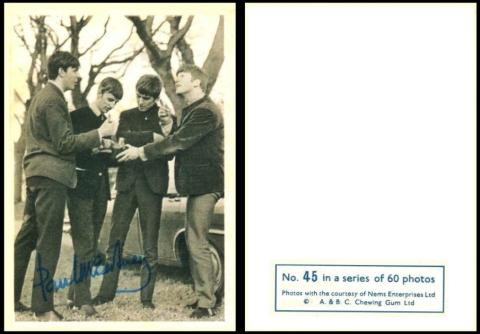
A. & B.C. Chewing Gum Ltd [trade : gum : UK] "The Beatles" - first series (1964) 45/60 - AAB-080.1.a.a : ABF-22.1.1
Today in 1966, which is, alarmingly, sixty years ago, The Beatles album "Rubber Soul" went to number one, and would stay there for six weeks. This was despite the fact that they had released another album, "Help!", not that long before, almost as soon as they returned from their tour of North America which began in August 1965.
It was their sixth studio album, released on the third of December, 1965. There were actually two versions, because the American released only contains ten of the songs, plus two addtional tracks intended to be used for the album "Help!" but not.
The "soul", was not simply a flippant parody on rubber soled shoes, it was inspired by, and in tribute to the many soul music acts that they had come info contact with in America, either in person or on the radio, and they were also much inspired by their meeting with Elvis Presley, who openly admitted he had been heavily influenced by the African-American soul singers whose music, in many states, was just as openly suppressed.
The record also gave a nod to folk music, and included Indian influences, such as the sitar. This has often been discussed in connection with the band beginning to experiment with recreational drugs. but it also reflects their new experience of the wider world, which would change their lives forever. It is true to say that henceforth they would be global stars, in every way, rather than just a group of young men from Liverpool.
As well as the album, there was a single, a double "A" side (which for younger readers just means that both sides were great tunes, and would probably go on to become hits, rather than the standard hit with a lesser catchy tune on the "B" side).These two songs, "Day Tripper" and "We Can Work It Out", were recorded at the same time as the album. And, quite unusually for the time, each were accompanied by short films, which could be shown on television rather than the band having to make a personal appearance. This was first shown on "Top of The Pops" on the 2nd of December, 1965 - and the record was number one for three weeks.
This set is the first series of Beatles cards to be issued by A. & B. C. Gum, and its first appearance in our reference book is rather oddly hidden away in our British Trade Index part II, in what is rather a mish mash of assorted and unrelated sets that reads :
- Pop Star Grouping (A) 81 x 57. Back with blue rectangular panel at centre base, inscribed "No...., in a series of ..... photos". "A. & B.C. name below.
1. The Beatles. Back "Photos with the courtesy of Nems Enterprises Ltd."
1. "....series of 60 photos". Black with blue facsimile signature
2. "2nd series of 45 photos." Back with blue facsimile signature, Nd 61/105
3. " ...series of 40 photos." Coloured, no captions.
2. The Rolling Stones. (40) Coloured. All Rolling Stones caption.
3. Top Stars (various groups). Coloured
1. "....series of 40 photos"
2. "....series of 50 photos"
These are all sorted out for our updated British Trade Index, and listed separately. Our group, only consisting of the Beatles cards, reads as follows :
- The Beatles. (A). 1964-65. 81 x 56. Nd. Three series ... AAB-080
1. B&W. (60). Autographed a) light blue, b) dark blue. Fronts a) matt, b) varnished
2. 2nd series. B&W. Nd. (61/105) (45) Fronts autographed.
3. Coloured. Backs "No. ... in a series of 40. Photos ... courtesy of Nems Enterprises Ltd."
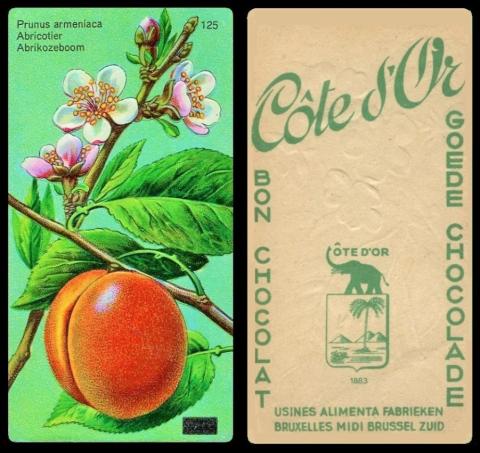
Cote d`Or [trade ; chocolate : O/S - Brussels, Belgium] "Arbres" (1930s) 125/?
For our last diary date of this week, we have #NationalApricotDay, which is celebrated every year on January 9th.
As to why, nobody seems to know - and you would be very hard pressed to find an apricot to eat on that day, unless it comes from a tin, or your freezer - for their season runs from May to August.
Apricots originally came from Asia, especially China. They were cultivated for their fruit and their flowers, and, like all fruits in the Prunus genus, they have a softish outer peel, beneath which is juicy flesh, with a hard shell in the middle, inside which is the seed. Most of the seeds of this genus are not just inedible, but, as in the case of several, including apricots, are poisonous. They even include cyanide, albeit in small doses.
Though the fruit needs dry warmth to ripen, it is a popular garden plant, mainly for its delicate pink flowers, but it soon grows too large, as it can reach eight metres, at which time the flowers are out of sight. Additional problems, especially in the United Kingdom, is that they start to bud just as the spring frosts arrive, and that rain can kill the flowers and the smaller branches, leaving them open to fungal disease.
It looks like the first apricot on a cigarette card was as part of that lovely Allen & Ginter set of Fruits, issued in 1891, which you can see courtesy of the Metropolitan Museum of Art. That site tells us the printer was George S. Harris & Sons, who was a very prolific printer of cigarette and tobacco cards for all the big American issuers, especially for Duke.
Our card is much later and was issued by Cote d`Or. It is part of an attractive set which shows the flowers as well as the fruit/nut of many different plants. It is also embossed into the thick card, but that may not show up on this image.
I will say that the three sections of words below are the Latin name, genus and species then the name in French and Dutch, however those two translate not to the fruit but to the tree. And I found a lot more when I searched for tree, so I have changed the name above from "fruites to "arbres".
Anyway here is the beginnings of a list, and do please send along any other names you have.
- 90 - Quercus pedunculata - Chene pedoncule - Eikeboom (oak)
- 91 - Evonymous europaea - Fusain d`Europe - Papenmuts (European spindle)
- 94 - Ulmus campestris - Orme des champs - Veid olm (field elm)
- 95 - Sorbus aucuparis - Sorbiers des oiseleurs - Ljisterbesseboom (rowan)
- 123 - Pinus malus - Pommier - Appelboom (apple tree)
- 125 - Prunus armeniaca Abricotier Abrikoseboom - (apricot tree)
- 136 - Phoenix dacytlifera - Dattier - Dadelboom - (date palm)
This week's Cards of the Day...
This week we are going to start another round of illustrating cards we know to have been issued in a specific month, starting, as the year does, with January.
At the time of typing this, we know of sixty nine sets that were issued in January, starting with the 1905 second series of Ogden`s "British Birds". Then there is a gap, of three years, before our second January set, Ogden`s "Famous Footballers", issued in 1908. And the following year saw the arrival of our first card, which is ....
Saturday, 27th December 2025
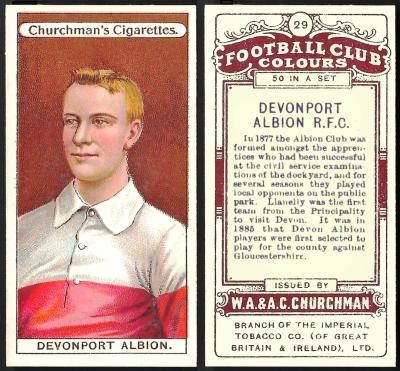
To start our week we have this card, which, along with its sibling, the same set but issued by Franklyn Davey and branded for `Loadstone Cgarettes` was issued in January 1909` - becoming the third oldest card in our January listing.
There is also a January connection to Devonport Albion, in that they signed the contract on their rental of Home Park in January 1893.
However, yet again this "Football Club Colour" is a rugby team - founded in 1876 by a group of dockyard apprentices. Mind you our card gives a different date, of 1877. It does add something that is usually absent from the history books though, and that is that it was only "the apprentices who had been successful at the civil service examinations of the dockyard" who were on the team.
Our card tells us that "for several seasons they played local opponents on the public park." That was Devonport Park, and they stayed there until 1887, when they moved to Beacon Park in Bladderley Lane. By this time they were becoming quite a renowned team, and, as our card tells us, "It was in 1885 that Devon Albion players were first selected to play for the country against Gloucestershire". This could have been the spur that saw them moving to that new ground, but also, in 1886, they had taken over another local team, Keyham.
Then, in 1893, they moved from Bladderley Lane and moved to a new, purpose built football ground, called Home Park, which they shared with local football team Home Park A.F.C.. Their first match, against Aberavon, was on the 1st of April 1893, which was, coincidentally, Easter Monday, and Devonport Albion won, in front of five thousand spectators. Their new home was a vast improvement, but they balked at the amount of rent which was being charged, £350 a season, and when re-negotiations broke down they decided to return to Bladderley Lane. And not so long after that the ground they had left was re-rented, to Plymouth R.F.C. It is not known whether they paid the same rent or not.
The Bladderly Lane site seems to have been vacated not long after that, and Devonport moved to Rectory Field. They were still there when the First World War broke out, on which a lot of the Devonport Albion players were sent off to war, many joining the Navy. After the war was over, the team was a shadow of its former self, for there had been many deaths and casualties, and so in 1920 it was decided to merge with Plymouth R.F.C. However, in rather a happy twist, the name of the team was changed, to Plymouth Albion R.F.C., and the club colours were also amalgamated, the green and white of Plymouth being joined by the red and white of Devonport Albion
The one thing we do not know is the identity of this player. So if anyone would like to have a go at that, please do!
This set is first recorded in our Cartophilic Reference Book No.10, devoted to The Cigarette Card Issues of W.A. & A.C. Churchman, published in 1948, as :
- 81. Jan. 1909. 50. FOOTBALL CLUB COLOURS. (titled series). Size 2 11/16" x 1 7/16" or 67 x 36 m/m. Numbered 1-50. Fronts lithographed in colour. Backs in brown, with descriptions. Printed by Mardon, Son & Hall. Also issued by Franklyn Davey and Ogdens.
Its next appearance comes in our World Tobacco Issues Index of 1956, which lists it as :
- FOOTBALL CLUB COLOURS. Sm. Nd. (50). See H.68. ... C82-20
And that is the same text as appears in our updated World Tobacco Issues Index , save a new card code, of C504-270.
By the way this Churchman version was also the first to be illustrated - in Cameric Notes and News, Vol.1, issue 6. Which I will scan asap.
As for a 1950s price comparison, in the London Cigarette Card Catalogue of 1950 the Churchman set was retailed at between 4/- and 12/- a card or £30 a set. The Ogden`s set, which was issued first, in May 1906, was much cheaper, being retailed at between 1/9d and 5/- a card or £12 a set, plus card fifty-one, only issued in the Ogden version, at 10/-. And the Franklyn Davey version was the most expensive of all, retailed at between 4/6d and 15/- a card or £37 a set.
Sunday, 28th December 2025
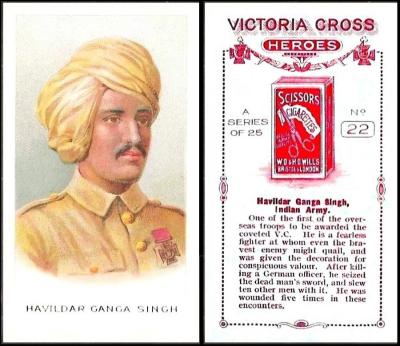
I have not found a January link to this subject, yet, but the card was from the first version of this set ever to have been issued, in India, and that was in January 1915.
Here we have Havildar Ganga Singh, who, it tells us on his card, was "One of the first of the overseas troops to be awarded the coveted V.C.". Research into that proves that though the award was introduced on 29 January 1856, by Queen Victoria, in order to honour acts of bravery during the Crimean War, it was not issued to colonial troops until 1867, when a petition was made for Major Charles Heaphy, a New Zealander, regarding an event in 1864 in which he rescued British soldiers under fire, and almost lost his own life in the process. In actual fact he probably only got the award because he was operating under British command and rescuing British troops. After that several such acts of bravery by colonials were either ignored, or rewarded in another way, however, in 1881. a South African Surgeon called John McCrea was nominated for the award over an event during the Basuto Gun War, which saw him attending to the wounded at great risk to his own person. After consideration Queen Victoria agreed to change the rules so that any military operation, whether it involved British forces or not, would be eligible to be considered for the Victoria Cross after acts of valour.
As for Indian troops, it was deemed that they ought to receive the Indian Order of Merit instead. There was a bit of an anomaly here though, for men employed by the East India Company were ineligible for this and often got nothing. With that in mind, in 1857, after the indian Mutiny, it had been decided that they, and they alone, were to be considered for the Victoria Cross. And that was extended to all Indian troops in 1911.
However the first two Indian men to receive the Victoria Cross were Darwan Singh Negi (of “B” Company,1/39th Garhwal Punjab, for clearing the enemy out of British trenches under fire, though injured in the head and arms) and Khudadad Khan (of the 129th Duke of Connaught’s own Baluchis, for manning his machine gun for almost an entire day, preventing the enemy over-running the position). Their medals were decreed, and awarded ,in December 1914.
The story of our man, Havildar Ganga Singh, must start with the fact that Havildar was a military title, not part of his name, in the Indian Army it is the equivalent to the British rank of Sergeant. He was serving in France, with 57th Wilde`s Rifles, as part of the British Expeditionary Force, and he, plus fifteen other Sikh soldiers, were charged with guarding a trench during an enemy attack. This led to hand to hand combat, almost certainly the worst thing to do. Ganga Singh must have been in front of the force, as he personally killed five German soldiers with his bayonet, and then, when that broke, killed another ten with a sword. After that he was shot in the leg, the chest, the hands and the head, and left for dead, along with fifteen of his fellows and sixty Germans.
The fact that he was actually still alive was only discovered when the trench was recaptured by the British forces.
After that, we do not know what happened, but it seems that he died in 1919, perhaps even of wounds. And he is the only Indian soldier in this set of twenty-five cards, which seems rather strange for a set sent out to India for issue; even stranger when you learn that during that conflict eleven Indian soldiers were awarded the Victoria Cross. And from 1857 until 1947 there were a hundred and fifty three Victoria Crosses awarded to soldiers and civilians of Indian descent.
This set first appears in our "Cartophilic Reference Book - No.14 :The Cigarette Card Issues of W.D. & H.O. Wills Parts I and II (revised) and Part III", which was published in 1949. There it is described as part of a group, namely :
- 109. 25. VICTORIA CROSS HEROES. Size 64 x 37 m/m. Fronts lithographed in colour; backs with descriptive text.
AUSTRALIAN ISSUES ;-
A. Red backs, with "Havelock" advertisement
B. Red-brown backs, with "Wills Specialities" advertisement
"SCISSORS" ISSUE :-
C. Red backs, with upright "Scissors" packet
Varieties - Card No.21 is found (a) with front, "Captain", back "Major" Reynolds (b) front and back "Major" Reynolds.
GENERAL OVERSEAS ISSUE :-
D. Blue backs, anonymous.
This is updated in our "Cartophilic Reference Book - No.16 : The Cigarette Card Issues of W.D. & H.O. Wills Parts I, II, and III (revised) and Part IV", which was published in 1950. That entry does not affect our version, for it reads : "109. VICTORIA CROSS HEROES. - see page 119. The anonymous series under "D" was issued in Canada - see page 41, item C.67, of Mr. Burdick`s American Catalogue"
We also know that the Australian versions were both issued in March 1915, two months after our Indian one. And that all three were printed in England and shipped abroad for issue, which is how we know the month.
The above description is very much altered in our original World Tobacco Issues Index, and not just because the Australian and anonymous versions have been excised, the former moved to the Australian section of the Wills listing, and the latter to the back of the book. Even the text of our version, listed amongst the other Indian `Scissors` issues, is truncated, to just :
- VICTORIA CROSS HEROES. Sm. 63 x 36. Nd. (25) See W/109.C ... W62-372
And this text is identical in our updated World Tobacco Issues Index, save a new card code, of W675-521
Monday, 29th December 2025
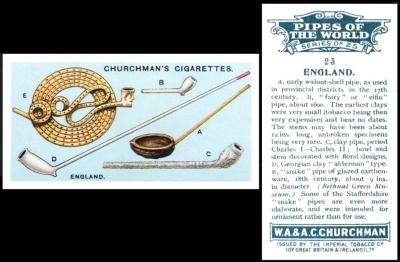
The January link to this card is that it has always been tradition for a smoker to either use an as yet unsmoked or a special or favourite pipe, or even try out a special blend, in order to mark the end of an old year and the beginning of a new. And with that in mind, several tobacco manufacturers have special festive and New Year blends.
But of course this set was also issued in January, 1927.
There are, you may think, few sets which are devoted to smoking paraphernalia, and even less for the allied habit of pipe smoking.
However, research proves there are quite a few, starting with Allen & Ginter`s 1888 set of "World`s Smokers", a set which was reproduced in 1905, by the Dominion Tobacco Co. of Canada, based in Montreal, and later still, with blank backs.,in 1926, by Teofani. And lots of collectors believe that the set was used for inspiration by Franklyn Davey for its "Types of Smokers" issued in 1898.
These are quite different from another triumvirate of smokers, namely Hudden`s "Types of Smokers", issued in 1903, Lea`s "More Lea`s Smokers" (1906) and Gallaher`s "Votaries of the Weed" (1916). Sadly we do not know who drew the artwork for the Hudden set. However, the Lea set not just credits the artist as Will Owen, but includes a self-portrait as card number three. Whilst the Gallaher set was drawn by prolific cigarette card artist "Kyd" (J. Clayton Clarke).
Another interesting group of smoking-related sets show manufacturing and retailing.
The earliest of these is A. Baker`s "Tobacconist Shops", issued in 1901, which shows black and white portraits of the exteriors of their various retail branches. If, as we presume, each card was only issued at the shop it shows, then collecting them must have been very hard, and explains why they are so scarce today, so scarce that we do not even know for sure how many were issued.
As far as manufacturing, there are two sets which spring to mind - the first, and easiest to acquire, is John Player`s "From Plantation to Smoker", issued in 1926, which starts with the home of a Virginia planter, across the ocean in America, and traces the journey through twenty-five cards, starting with its cultivation, harvesting, and curing. then on to being auctioned, and travelling across that ocean to the home of John Player, where it is cut, formed into cigarettes, and packed for retail. However there is a home-grown tobacco set, issued by Brigham & Co., of Reading, who in 1912, issued three cards showing how they grew and cultivated tobacco on their lands in Hampshire.
That leaves two sets which actually show pipes.
The earliest of these, by one year, was B.B.B. who issued a set of twenty-five cards called "Pipe History". I find this rather uninspiring, as it shows the pipes in brown on a yellow background. But I am also intrigued as to why it does not appear in our World Indexes, either under B.B.B., or the actual name of the company, A. Frankau.
The second set is much more pleasing, and colourful, and that set is the one we show today. It is first recorded in our Cartophilic Reference Book No.10, devoted to The Cigarette Card Issues of W.A. & A.C. Churchman, published in 1948, as :
- 109. Jan. 1927. 25. PIPES OF THE WORLD. (titled series). Size 2 11/16" x 1 7/16" or 67 x 36 m/m. Numbered 1-25. Fronts lithographed in colour. Backs in dark green, with descriptions. Printed by Mardon, Son & Hall.
By the time of our original World Tobacco Issues Index, in 1956, the set is recorded as :
- PIPES OF THE WORLD. Sm. Nd. (25) ... C82-71
And this identical text appears in our updated version of that work, save a new card code of C504-610
Tuesday, 30th December 2025
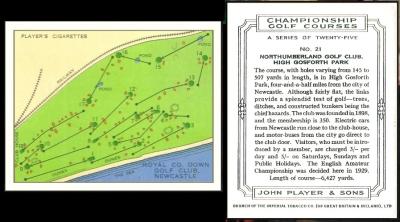
You may think this an odd write up, because it is in reverse, starting with the card chat. But bear with me, for there is good reason.
When I looked at the list of dates that I have been collecting, this set was recorded as January. However, when I came to write it up, I found there is a difference of opinion date wise - our Cartophilic Reference Book - No.17 : The Cigarette Card Issues of John Player - An Official Checklist Compiled by A Committee of the Cartophilic Society of Great Britain Limited" , published in 1950, saying :
- 46. CHAMPIONSHIP GOLF COURSES. Large cards. Fronts in colour. Backs in grey with descriptive text. Home issue June 1936.
and the London Cigarette Card Company`s 1955 catalogue listing the set as :
- 25 Championship Golf Courses (Jan. 1936).
The quandary is not solved by our World Tobacco Issues Index, either, which simply records the set as :
- CHAMPIONSHIP GOLF COURSES. Lg. Nd. (25) ... P72-76
Nor by our updated World Tobacco Issues Index, which uses the same wording as the original, save a new card code of P644-160.
The matter is only solved by looking at the entire set of cards, for on card number two, of the Royal Liverpool Golf Club, Hoylake, the text includes the following statement : "Length of course prior to the Open Championship in June, 1936, was 6,853 yards, but alterations were made increasing length to 7,100 yards."
I was actually going to alter this card, quietly, alone, some time in the future. But I think it makes an interesting point, that research is only as good as its sources, and that you cannot believe anyone or anything blindly, you have to check in more than one place in order to come up with the truth, or the best we can, ninety years after the issue.
And that is not all, as more research also seems to cast the June issue date into doubt, as the 1936 Open Championship was held on the 26th and 27th of June, 1936, surely too late in the month for the issuing of the cards to follow within it. The only way that a June issue may have been possible is if the author of the text wrote it in advance, knowing that the golf club would be altering the course length for that event. And this could well be the case as the new length quoted on the card is 7,100 yards - but the actual length differs, it is 7,341 yards. So if that was changed during the building, for some reason not foreseen, then it would mean the card was at least written before the actual tournament took place.
So do we have any golf fans who can verify any of my conjectures? If so, do get in touch, at webmaster@card-world.co.uk
As for our card, that too could create a quandary, for it is billed as being the "Royal Co. Down Golf Club, Newcastle", which at first could suggest Newcastle upon Tyne. But that too is incorrect - and only solved by reading the text on the reverse, part of which says "The course lies along the Dundrum Bay, with the Mourne Mountains, of which Slieve Donard is the monarch, towering above. Instituted in 1889, the club is one of the most important in Ireland."
Wednesday, 31st December 2025
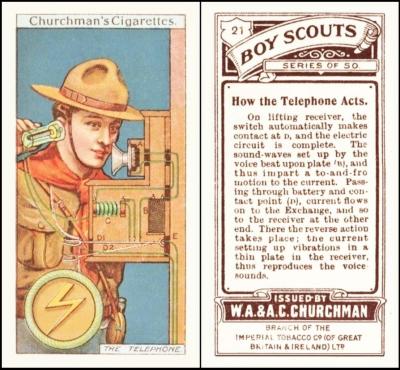
The January connection to this card is that at this time of year, or at least at one time, we would have been phoning our friends relentlessly and wishing them a Happy New Year. Today we tend to do this online, and often without actually speaking. I am not sure if that is an improvement or not...
This is a set with a huge story, which all begins with our Card of the Day for the 27th of July, 2022 - which shows one of the cards from this set, but issued by, and branded for Ogden`s, and not only that, which had been issued as Ogden`s first series, five years earlier, in October 1912.
In fact all the Churchman cards were issued later than the original sets by Ogden, which started in January 1911 and went through to September 1914.
Reprinting this Ogden set that we feature today for Churchman in a new format was not so different, the back being more or less identical apart from the "Churchman" and "Ogden" wording, and it was also aided by the fact that this had been the first set issued by Ogden - who would start the first set with card one, but then run them continuously, one after the other, through five sets, starting from number one and ending with number two hundred and fifty. Churchman actually chose to stick to one format, and each of their three sets begins at card one and ends at card fifty. That is almost certainly because the printer used the same artwork for this set and all the subsequent ones, only needing to change the number of the series in the small banner.
Curiously, Churchman chose to issue their third series twice, once with a brown back and once with a blue back. Ogden also did this, but for all their "Boy Scouts" sets, in blue and green
The Churchman group is recorded first in our original reference book RB.10, which was devoted to Churchman issues, and issued in 1948. This is quite a detailed description that reads :
- 21. Jan. 1916. 50. BOY SCOUTS (titled series). Size 2 11/16" x 1 7/16" or 67 x 36 m/m. Numbered 1-50. Fronts lithographed in colour. Backs in brown, with descriptions. Printed by Mardon, Son & Hall. Also issued by Ogden (Boy Scouts, 3rd Series)
- 22. Aug. 1916. 50. BOY SCOUTS. Inscribed "2nd series". Other detail as (21) but different subjects. Also issued by Ogden (Boy Scouts, 2nd Series).
- 23. Oct. 1916. 50. BOY SCOUTS. Inscribed "3rd series of 50". Other detail as (21) but different subjects. Also issued by Ogden (Boy Scouts, 1st Series). Note : Cards 39/40 have backs transposed.
- 24. 50. BOY SCOUTS. Inscribed "3rd series of 50". Identical to (23) but backs in blue..
We know that the London Cigarette Card Company retailed them as follows in their 1950 catalogue -
- series 1, odds from 3/- to 8/-, complete sets at £17
- series 2, odds from 3/6 to 10/-, complete sets at £20
- series 3, brown back, odds from 3/6 to 10/-, but no complete sets
- series 3, blue back, odds from 12/6 to 35/-, but no complete sets
From our original Churchman reference book, they are moved to our original World Tobacco Issues Index, where the listing, much shortened, for the group is :
- BOY SCOUTS. Sm. See H.62 ... C82-14
1. "Series of 50". Back in brown. Nd. (50)
2. "2nd Series of 50". Back in brown. Nd. (50)
3. "3rd Series of 50". Nd. (50). Back in (A) brown (B) blue
This is repeated, exactly, in our updated World Tobacco Issues Index, save a new card code, of C504-210
Thursday, 1st January 2026
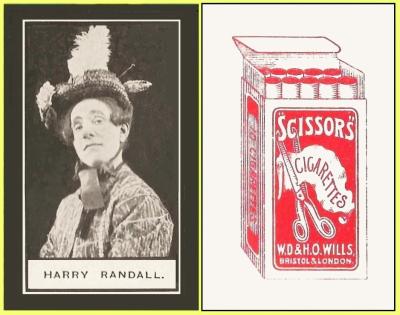
January sees the closure of many a fine pantomime, so if there is one you would really like to see why not sort out that booking today.... Or it will be behind you, and gone forever....
Our lady, in true pantomime tradition is a man - Thomas William Randall, and he was born, in Holborn, London, on the 22nd of March, 1857. And though this set is billed as "Music Hall Celebrities", he was a stalwart of the pantomime scene.
I have not found that he came from theatrical stock, in fact his father was a cobbler and boot maker - but he started young, at the age of eleven, which often points to familial involvement. And yet it is recorded that he made his first professional appearance quite late, at the age of twenty-six, at Deacon`s Music Hall in Islington. This led to him being picked up by a touring company. and to his first appearance in pantomime, in 1886, as a man, a mutineer against Daniel Defoe's Robinson Crusoe, who makes good, becoming a valued member of Crusoe`s community, even marrying a native woman and settling down.
In less than ten years, though, he was one of the most renowned pantomime dames, and, during the 1890s, was well known enough in the industry to start a company managing several theatres - in conjunction with his friends, Dan Leno, and Herbert Campbell. Sadly this did not last, but not through any fault of their own, purely through opposition from other theatre managers, who did their best to malign and hinder the company, eventually killing it completely. However the three men stayed firm friends, and appeared together at Drury Lane in 1903, the year the business folded.
Sadly both Dan Leno and Herbert Campbell died during the following year'. Mr Leno was already ailing during that performance, and Mr. Randall was his understudy, in case Mr. Leno could not go on stage at short notice. He would actually die at his home in London on the 31st October 1904, aged just forty-three and, curiously, we still have no idea of his cause of death. As for Mr. Campbell, he caused his own death, in a very strange way, for his shouting instructions to his coachman caused the horse to startle, and knock him to the ground. At first just a bruise, it turned into an ulcer, and led to a fatal haemorrage of the brain, from which he died, on the 19th of July, 1904, aged just fifty-nine.
Our man retired in 1913, shortly after his wife died. This was a very great blow to him, and he never remarried. He was cajoled into writing an autobiography in 1930, with mixed success, as it was a bit late; few modern theatregoers remembering him, twenty years after he last trod the boards. He was either already in a nursing home by then, in Hendon, or he moved there shortly afterwards, and he died there, on the 18th of May, 1932.
This is another set with conflicting dates. Our original entry for the set, in our "Cartophilic Reference Book - No.16 : The Cigarette Card Issues of W.D. & H.O. Wills Parts I, II, and III (revised) and Part IV", published in 1950, reads :
- 269. 50 MUSIC HALL CELEBRITIES,, (adopted title). Size 60 x 38 m/m. Unnumbered, Fronts printed by letterpress. Export issue, about 1906.
A. "SCISSORS" ISSUE. Fronts in black and white. Backs in red, with illustration of open "Scissors" packet, no other letterpress.
GENERAL OVERSEAS ISSUES. Portraits in black and white, plain backs
B. Blue borders to fronts. Anonymous issue.
C. Gilt borders to fronts. Anonymous issue.
There is a further series with gilt borders, numbered, embodying Nos. 1-16 below and 34 new subjects. Of these two gilt-bordered series, known to have been issued in Canada, the numbered series is recorded in Mr. Burdick`s American Catalogue under C.241 on page 43.
Similar series issued by Lambert & Butler (see Fig.22 of Reference Book No.9) and Ogden (see Fig.61 of Reference Book No.15).
- Wilkie Bard
- Billie Barlow
- Chevalier
- Chirgwin
- Alexandra Dagmar
- Marie Dainton
- Daisy Dormer - vertical card
- Daisy Dormer - horizontal card
- T. E . Dunville
- May Moore Duprez
- Gus Elen
- Will Evans
- Happy Fanny Fields
- Harry Ford
- Florrie Forde
- George Formby
- Tom Foy
- Fragson
- Marie George
- George Gilbey
- Lil Hawthorne
- Alice Holander
- Daisy Jerome
- Neil Kenyon
- Geo. Lashwood
- Harry Lauder
- Queenie Leighton
- Lottie Lennox
- Mdlle. Leonora
- Alice Lloyd
- Marie Lloyd
- Voilet Lloyd
- Cissy Loftus
- Marie Loftus
- Rachel Lowe
- Clarice Mayne
- Sam Mayo
- La Milo
- Victoria Monks
- George Mozart
- Harry Randall
- Ada Reeve
- Mark Sheridan
- Eugene Stratton
- Ellaline Terris
- Little Tich
- Vesta Tilley
- Zona Vevey
- Max Waldon
- Daisy Wood
Now I know that usually in such cases I eschew using these sort of artificial numbers when the cards are actually unnumbered, but in this case there is good reason, because in our "Cartophilic Reference Book - No.19 : The Cigarette Card Issues of W.D. & H.O. Wills Parts I to IV (revised) and Part V", published in 1951, an update appears, which reads :
- 269. MUSIC HALL CELEBRITIES - see page 152
Correct typographical error : No.22 - Alice Hollander
Series A was issued first as a series of 30 female artists only (Nos. 2, 5-8, 10, 13, 15, 19, 21-23, 27-36, 38, 39, 42, 45, and 47-50 in the listing on page 152), in January 1911; subsequently the whole 50 subjects were issued in February 1911. The Ogden ("Tabs") issue consists of 50 subjects, but the Ogden ("Polo") and the Lambert & Butler ("Scout"") issues both consist of the 30 female studies only.
Now before you think I have used the wrong set again, hang on - for this set has several dates. In the first of the entries above it was listed as an "export issue, about 1906", which was totally wrong. Then above, the two versions were split, and said to have been issued a month apart, which is in itself rather unusual, few sets being only issued for just one calendar month. The truth seems to come from a series of lists which were published in the Wills "Works" magazine, in the 1930s, giving publishing dates of all the sets which had been printed in the British Isles and shipped overseas for issue - and in this list both the Wills versions of this set were recorded as having been issued in January, 1911.
The next time this set appears is in our original Cartophilic Reference Book No.21. There it is listed as :
- 200-269. MUSIC HALL CELEBRITIES. The recordings in W/209, RB.9/77 and RB.15/125 were all made on the assumption that every printing consisted of 50 subjects. This is no known to be incorrect, and all of the printings are detailed below.
I - SERIES OF 30 FEMALE STUDIES. (Nos. 2, 5-8, 10, 13, 15, 19, 21-23, 27-36, 38, 39, 42, 45, and 47-50 in the listing in W/269).
A. Lambert & Butler Overseas issue, with "Scout" back.
B. Ogden`s Polo issue
II - SERIES OF 50 MALE AND FEMALE STUDIES (as listed in W/269).
C. Anonymous issue, with plain back.
1. Blue borders to front
2. Gilt borders to the front. This is the unnumbered printing with gilt borders - the numbered printing appears under F.
D. Wills` Scissors issue
E. Ogden`s Tabs issue
III - SERIES OF 50 FEMALE STUDIES. (including 16 of the subjects in II, with 34 new subjects.
F. Anonymous issue, with plain back. Gilt borders to front, Burdick C.241. Numbered.
Our original World Tobacco Issues Index splits all these up into individual issuers, and removes the anonymous versions to the back of the book. And it also lists our set as one set, of fifty, rather than isolating the males and females. That entry reads :
- MUSIC HALL CELEBRITIES (A). Sm. 60 x 35. Black and white. Unnd. (50) See W/269 and RB.21/200-269.D ... W62-365
And it remains as a single set in our updated World Tobacco Issues Index, with the following entry, in which the reference to RB.21 is removed - simply because that was now long out of print :
- MUSIC HALL CELEBRITIES (A). Sm. 60 x 35. Black and white. Unnd. (50) See W/269 ... W675-513
Friday, 2nd January 2026
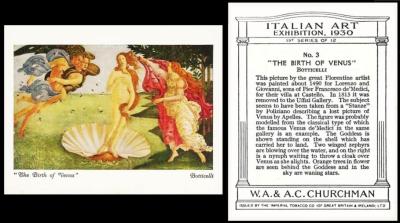
I am so delighted to be able to use this painting to celebrate the birth of a New Year, by alluding to the birth of Venus - because a while ago I showed you a card of the same image but recast with Jim Henson`s Muppets, and showcasing the charms of Miss Piggy as Venus. That was our Card of the Day for the 31st of October, 2025.
The Italian Art Exhibition was also born in January, being held from Wednesday January the 1st to Saturday March the 8th, 1930, at The Royal Academy of Arts, Burlington House, Piccadilly; though the correct title was the "Exhibition of Italian Art 1200-1900". That does make it rather odd though as regards the issue of this set, a whole year after that opening date, and even more strange for the second series of cards, which did not appear until August 1931.
The exhibition had joint patrons, the Kings and Queens of the United Kingdom and Italy. And the Honorary Presidents are almost incredible, being Il Capo del Governo d`Italia, S.E. Cav. Benito Mussolini, The Prime Minister, The Rt. Hon. J. Ramsay MacDonald M.P., The Secretary of State for Foreign Affairs, the Rt. Hon. Arthur Henderson M.P., The Rt. Hon. Stanley Baldwin M.P., and the Rt. Hon. Sir Austen Chamberlain K.G. M.P.
Admission was a shilling and sixpence on Monday to Saturday, but, for some reason not Friday, which cost a rather swingeing five shillings. Or you could get a season ticket for one pound one shilling, which included every day of the week, even those more expensive Fridays.
And if you want to read more of the exhibition, it can be viewed online, because the official catalogue has been digitised by the Royal Academy and uploaded to the web. Sadly it is not the illustrated version which was sold in the Galleries as either a paper-back for 5/- or a stiff cover for 7/6d.
The cards in this first series are :
| ITALIAN ART EXHIBITION, 1930 | ||
| 1 | "The Virgin and Child" | - A. Baldovinetti |
| 2 | "Fortuna Inconstans" | - Giovanni Bellini |
| 3 | "The Birth of Venus" | - Botticelli |
| 4 | "The Calumny of Appelles" | - Botticelli |
| 5 | "Madonna and Child" | - Botticelli |
| 6 | "The Lovers" | - Paris Bordone |
| 7 | "The Grand Canal and House of the English Consul, Venice" | - Canaletto |
| 8 | "The Duke of Urbino" | - Piero Della Francesca |
| 9 | "The Duchess of Urbino" | - Piero Della Francesca |
| 10 | "La Bella" | - Titian |
| 11 | "Portrait of a Lady" | - Raphael |
| 12 | "Angelo Doni" | - Raphael |
The sets first appear in our original Churchman reference book RB.10, with a rather lengthy description, of :
- 81. Jan. 1931. 12. ITALIAN ART EXHIBITION, 1930. (titled series). Size 3 5/16" x 1 9/20" or 80 x 62 m/m. Numbered 1-12. Fronts printed by letterpress, 4-colour half tone process. Backs in dark green, with descriptions. Printed by Mardon, Son & Hall.
- 82. Aug. 1931. 12. ITALIAN ART EXHIBITION, 1930. Described "2nd Series of 12". Other detail as item (81), but different subjects.
They next feature in our original World Tobacco Issues Index as :
- ITALIAN ART EXHIBITION, 1930. Lg. Nd. ... C82-59
1. "1st Series of 12"
2. "2nd Series of 12"
And it is further shortened in our updated World Tobacco Issues Index, to a single line, reading :
- ITALIAN ART EXHIBITION, 1930. Lg. Nd. 1. "1st Series of 12" 2. "2nd Series of 12" ... C504-545