
I am never sure whether to go full emoji and say hey wow its Saturday, or bemoan the fact it comes round really fast.... But anyway here it is, along with another newsletter.
This week I tried a different tack, as the cards take longer to do - so instead of labouring over them first, I tracked down the diary dates, then wrote them up, hoping I could find suitable cards. And actually I did, all but one, but thanks to the reader who supplied that at the last minute - and I have to say the rest were very much more by luck than judgement.
As to whether I will ever do that again, I am not too sure, but it was fun, I guess....
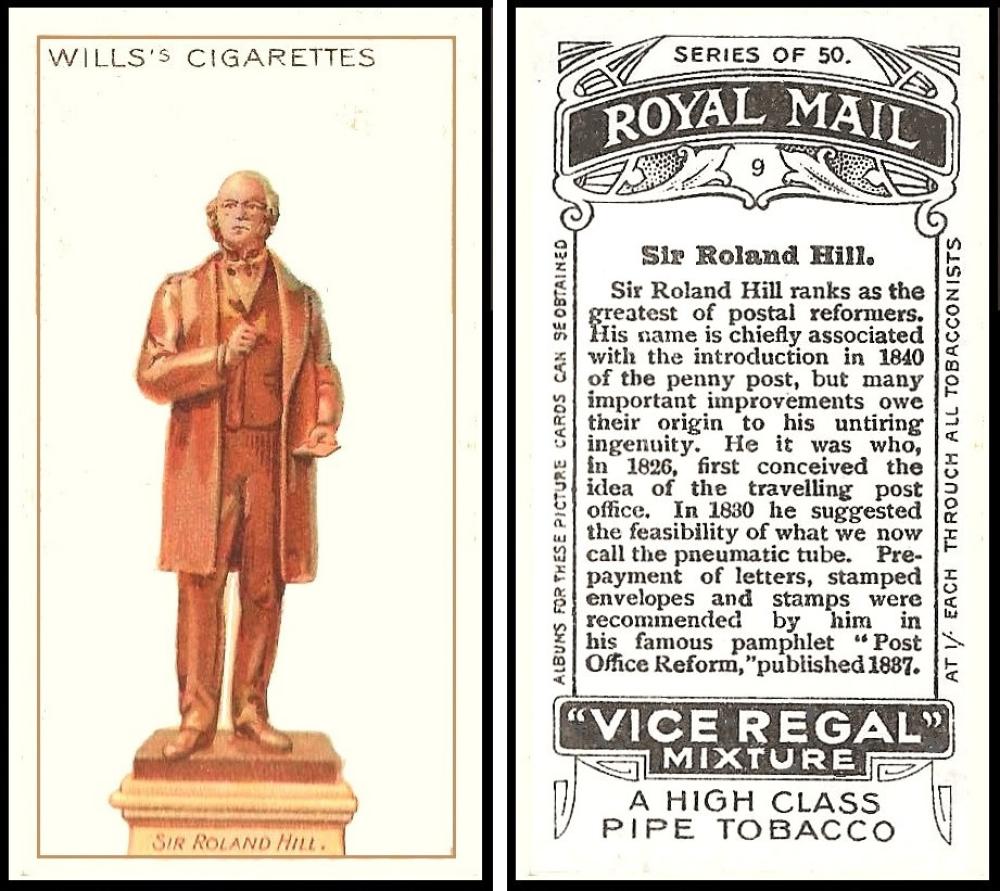
W.D. & H.O. WILLS [tobacco : UK - Bristol] "Royal Mail" - `Vice Regal` brand (1913) 38/50 - W675-368.C : W62-235.C : W/95.C
Today in 1840 saw the birth of a Uniform Penny Post, allowing for letters weighing under half an ounce to be sent anywhere in the United Kingdom for a penny.
Originally championed by Rowland Hill, so that anyone could afford to send news to their family and friends, it was mainly agreed to be the postal authorities because they knew it would result in more mail being sent, and more money coming in. And within a year, the amount of stamps being bought, in advance of sending (which was also a new idea, for the letters had formerly had to be paid for by the recipient), double the amount of stamps were being sold,
Sir Rowland Hill, KCB, FRS was born on the third of December, 1795, in Kidderminster, and at the time he suggested the idea of the Uniform Penny Post he was not a postal official, he would only become one later. He had actually had several jobs, he had worked at the Assay Office in Birmingham, been a teacher and educational reformer, not just in matters of schooling, but of school design, and had been secretary of an organisation which attempted, unsuccessfully, to establish a settlement in Australia, which, quite coincidentally would have been on the site of present day Adelaide. In fact it was, reputedly, though no proof exists, whilst he was working on that project that he saw a young woman crying in the streets because she was too poor to pay for the letter sent to her by her fiance.
Whether this is true or not, he gave much of his time to developing a postal system which would allow anyone to access it. He used many of the things which were already commonplace; the idea of adhesive stamps coming from the tax office, and the idea of the pre-printed letter sheets, on to which those stamps would be stuck, almost certainly came from Australia, where they had been in use for several years.
The design of the stamp was the head of Queen Victoria, who celebrated her twenty-first birthday in the same month that the first stamp was issued, May 1840.
Despite the acclaim, Rowland Hill lost his post at the Treasury in July 1842, not through fault of his own, but because the newly elected Conservative Party had been long term opponents of the Penny Post. He soon found employment, with the London and Brighton Railway. However when the Conservative party lost the election in 1846, Rowland Hill was given the post of Secretary to the Postmaster-General, and then, in 1854, of Secretary to the Post Office, a job he held for ten year before his retirement in 1864.
He died in 1879, and is buried in Westminster Abbey.
Now the popular opinion is that he only appears on one cigarette card, number one of Ardath`s "Stamps Rare and Interesting", issued in 1939, which shows him and a "Penny Black" stamp. He actually appears on several others, includiing :
- Ogden`s "Royal Mail" (1905) card no.4
- Sarony "Celebrities and Their Autographs" (1923) card no.87
- Weeties "Famous People and Places" (1949) card no.64
...but the card we show today is the only one that spells his name wrong, calling him Roland, not Rowland, and not just once, twice on the back and once on the front on the plinth. This seems a most uncharacteristic error for such a large company as Wills.
This set was issued several times, as explained in our original Wills reference book part three, the full text of which reads :
- 95. 50. ROYAL MAIL. Fronts lithographed in colour; backs in black (see Fig.54), with descriptive text (except E and G below). Australian issues, 1913 :-
With "Wills`s Cigarettes" on fronts -
A. Backs with "Capstan" advertisement.
B. Backs with "Havelock" advertisement
C. Backs with "Vice Regal" advertisement
D. With anonymous backs
E. With plain backs
Without "Wills`s Cigarettes" on fronts (anonymous issues) -
F. With anonymous backs
G. With plain backs
This set is entirely different from the similarly titled series by Ogden and Clarke
In our original World Tobacco Issues Index under the entry for the Wills version, where this set appears as :
- ROYAL MAIL. Sm. (50). See W/95 ...W62-235
A. "Capstan" back. Numbered.
B. "Havelock" back. Numbered.
C. "Vice Regal" back. Numbered.
D. Anonymous backs, "Wills`s Cigarettes" on front. Numbered.
E. Plain backs. "Wills`s Cigarettes" on front. Unnumbered.
The first thing you will notice is that sets F and G, the sets "Without "Wills`s Cigarettes" on fronts" are not there. However, if you go to the back of the book, you will find "F", as :
- ZA3-5. ROYAL MAIL. Sm. Nd. (50) see W/95.F
However, I have not yet tracked down set G, not even in the section for plain backed cards. It is possible that it was an error of reporting, or an error of printing, cut down from a proof sheet, a one off, as it were, not worth recording.
In our updated World Tobacco Issues Index, the listing is identical to above, and reads :
- ROYAL MAIL. Sm. (50). See W/95 ...W675-368
A. "Capstan" back. Nd.
B. "Havelock" back. Nd. (a) with (b) without "Wills`s Cigarettes" on front.
C. "Vice Regal" back. Nd.
D. Anonymous backs, "Wills`s Cigarettes" on front. Nd.
E. Plain backs. "Wills`s Cigarettes" on front. Unnd.
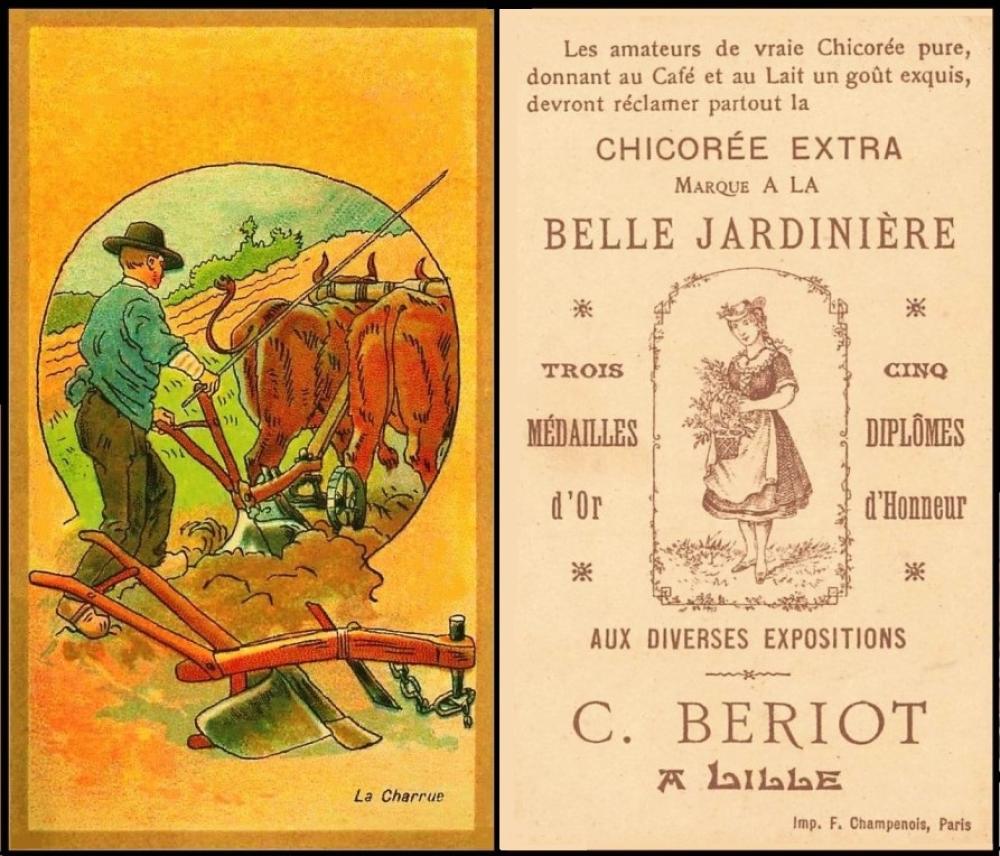
C. BERIOT [trade : chicory coffee : O/S - Lille, France] "Instruments de Travail" / tools of work (1900?) Un/84?
Now you may think it is very early in the year for anything agricultural to be going on, but today, in 1378, in Durham, saw the first ever celebration of an event that we now call "Plough Monday" - though it did not have that name until the sixteenth century.
We do not really know what happened on either of these days, but the event still goes on, annually, on the first Monday after Epiphany, so this year, on Monday the 12th of January, will be the start of the agricultural season, and farmers must go back to work.
There is also an allied day, Plough Sunday, which only seems to have originated in the fifteenth century, and that sees the cutting blade of a plough brought to Church so that it may be blessed., ensuring swift and safe passage through the earth as it does its work. Sometimes you will find that other tools can also be blessed, and we know that some rural areas held ceremonies to bless the soil before it is planted.
This seems to have caused the demise of the original celebrations, which got rather out of hand, with parades and dancing, or races and contests revolving around agricultural skills - even to local people dragging a plough round the area asking for money. But also, farming was much affected by the Industrial Revolution, which saw many farm workers relocating to towns and giving up the land.
It was not until the 1960s that people started to get more interested in the customs of the past, especially those of the land, and think about reviving them. And we know that they were re-started first on the Eastern side of this country, where the celebrations of the event had always been more prevalent, in places such as Cambridgeshire and East Anglia. Back too came the plough parade through the streets, and the demands for money, but this time the proceeds were to be given to farming charities in the area.
We actually featured this set before, but by Guerin-Boutron, and I have to say that their version is not even half as colourful as this one. Maybe that was because this one does not have a company name on the front which could be obscured by too bright a yellow.
You can see the Guerin Boutron in our newsletter for the 24th of May 2024, but you will need to scroll down to Friday 30th May. As that version gives us the title of the set and also the fact that it contained eighty-four subjects, it is only fitting that it will one day hold the list of all the tools. But I have not got that far yet.
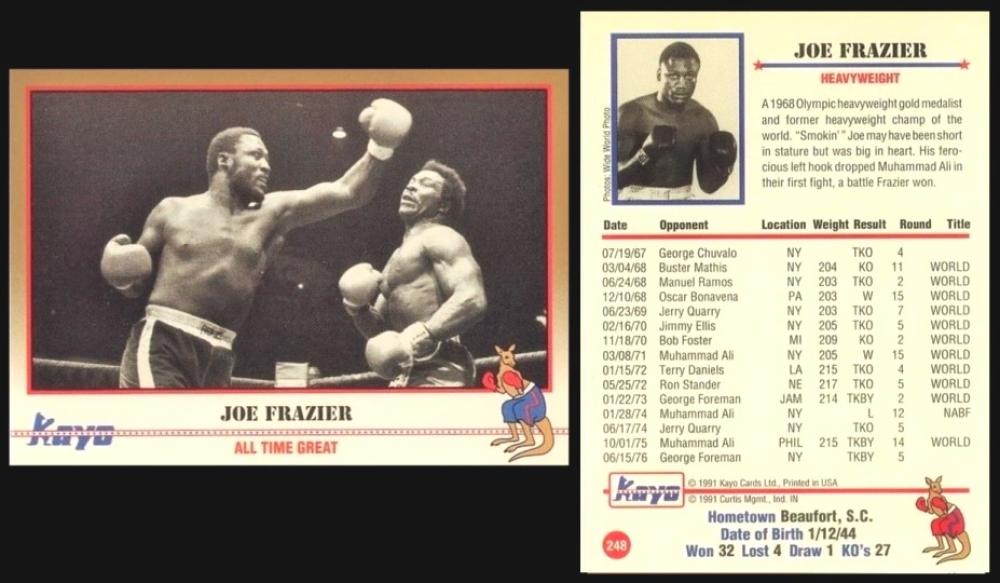
KAYO Cards Ltd. [trade/commercial : cards : O/S - East Rutherford, New Jersey USA] "Round One" (1991) 248/250
Today in 1944 saw the birth of Joseph William "Joe" Frazier, whose place in history was sealed in 1971 when he became the first boxer to defeat Muhammad Ali.
He was one of twelve children born to a farming family in South Carolina. They did not have a television until the 1950s, but the father was soon addicted to watching boxing. This was rather fortunate, as one of his relatives put the idea in the father`s head that young Joseph could become a boxer, which is how it all began, training with a home made punchbag in the back yard, running, and lifting weights, which did wonders for the young man`s physique. Unfortunately there was an accident on the farm and his arm was damaged, and as the family could not afford a doctor it had to mend on its own - which it did not, leaving him unable to fully straighten his left arm.
He left home aged fifteen determined to be a boxer. He took any jobs he could, and sparred for money, including taking on fights which were barely legal, and sometimes not. However they were all good training, honing his ring-craft for a time when the fights would all count for titles. He won the Golden Gloves heavyweight championship in 1962, 1963 and 1964, but only took part in the 1964 Olympics because the original entry was injured. He was not expected to do well, but made it right through to the final, where, despite a broken thumb, he won. Not just that but this was the only boxing gold won by an American fighter.
He turned professional the next year, and steadily rose up the ranks. On March the 8th, 1971, he met Muhammad Ali for the first time at Madison Square Garden, and won. However success is always fleeting, and in January 1973 he lost his world championship to George Foreman, being knocked down several times in the process. It was one of the hardest fights of his career. Perhaps because of that he was invited to rematch against Muhammad Ali, and again at Madison Square Garden, in January 1974. This time Ali won.
That led to what was billed as a grudge match, in the Philippines, in October 1975. That fight was ended after fourteen rounds, and awarded to Muhammad Ali on technicalities.
In 1976 Joe Frazier announced his retirement and started up as a trainer. He also appeared in "Rocky", the movie, as himself - in the crowd, watching the Rocky v Apollo Creed match.
In the 1980s he attempted a comeback in the ring, but that was not entirely successful, and he sensibly agreed to retire for good. He went back to training, including his sons and his daughter (who would fight Muhammad Ali`s daughter in 2001), and he also made a lot of special appearances on television, including guest roles in many popular programmes.
He wrote his autobiography in 1996, and also a training manual for aspiring boxers. But in September 2011 he was diagnosed with liver cancer, and he died less than two months later.
There is a difference of opinion as to the title of this set. Most collectors call it simply boxing, but the packets are titled "Premiere Edition Round One Boxing Cards". That may have been because the intention was to have more than one set, calling the next one "Round Two", but as far as I can establish this set was the only one.
We know that it was distributed in packs, and that each pack contained fourteen cards. There was also a chance that one of those cards could have been a hologram or an autograph, which the company preferred to call signature cards.
They also had a great promotional campaign, giving specially marked cards away at the National Sports Collectors Convention in Anaheim, and two special yellow-backed cards of Virgil Hill and Hector Camacho at several other venues.
We also know that they circulated prototypes and samples at other places, because some of these have come on to the market, though it is believed these either escaped the pulping machine, or maybe were just not handed back by the client as they ought to have been.

TOPPS [trade/commercial : cards : O/S - USA] "Wacky Packages go to the Movies - Animated Films" (2018) 18/20
This is the tale of a Bond and a Bear, and, thrillingly, a centenary - as they seem a bit thin on the ground this year.
Lets start with Thomas Michael Bond, an English author, who was born today in 1926, in Newbury, Berkshire. The bear came quite a bit later, in 1958, though Mr. Bond had been considering himself a writer for almost fifteen years, after finding out that conjuring stories out of thin air relieved the monotony of being in the Army, in Cairo. Actually the bear was just a bit of fun, by that time Mr. Bond was working at the BBC, as a cameraman, and it is not really known how the story got into the hands of a publishing company, but they read it, and liked it, and made him an offer.
That is how most of us know the bear is called Paddington - though that is not his real name, it is but the name which was given to him after he came to be adopted by the Brown family, for no other reason than that was where he was found - at Paddington Station, with a label tied to his coat, saying "Please Look After This Bear". I do find that rather troubling, mainly because it was written in English, for though it is said that he comes from Darkest Peru, he must have had some other interaction with the English, in order for the label to be written. As for who that was we are never told, yet it is a whole part of his life that is missing, and will never be known.
This was actually the point where I realised that the idea of writing the text first was doomed to failure, because Paddington is too young to have appeared on a cigarette card, and seemed never to have featured on a trade one. Which is very surprising to me. However thanks to one of my contacts, this card was supplied me. It comes from a much larger set, but one which is split into segments according to film genre.
The animated films parodied, in sometimes qute an offensive manner, are :
- Minions
- Shrek
- Angry Birds
- Popeye
- Ninjago (#1)
- Paddington (#1)
- Smurfs
- Hotel Transylvania
- Peter Rabbit
- Despicable Me
- Boss Baby
- The Squirrel ?
- Captain Underpants
- Ninjago (#2)
- Nose job ?
- The e-Coli Movie
- My Little Pony
- Paddington (#2)
- Mr. Peanut
- Red Dragon
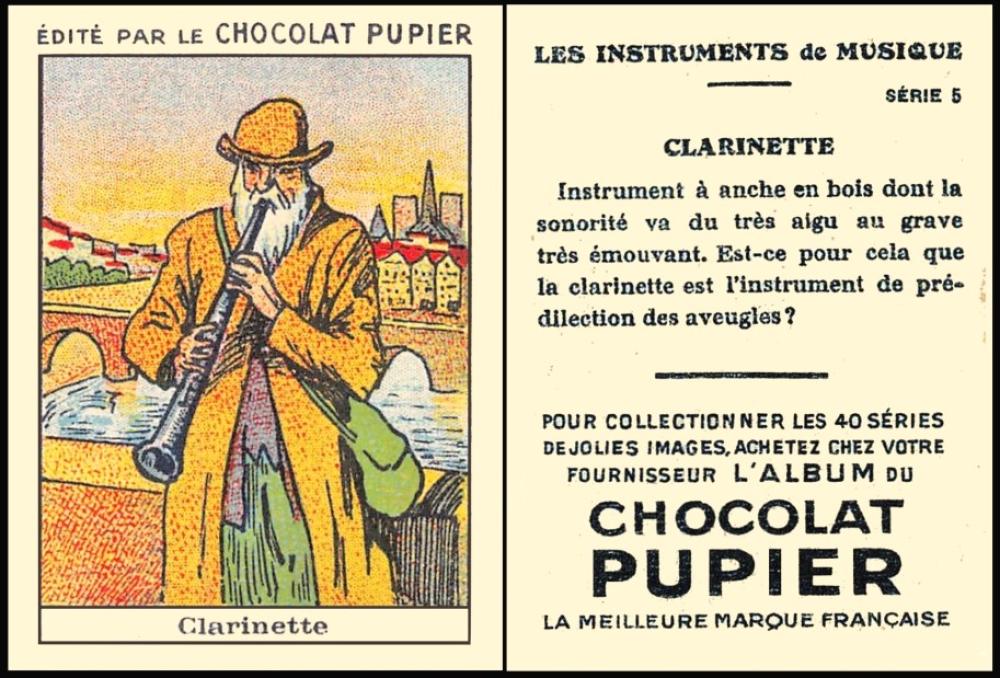
Chocolat PUPIER [trade : chocolate : O/S - Saint Etienne, France] "Les Instruments de Musique" (1931) Un/?
Now for a musical interlude because today in 1690 the clarinet was invented by a thirty-five year old German called Johann Christoph Denner.
At which point we have to say that primarily it was but a development of another instrument, the chalumeau, popular in the Baroque and Classical eras, which had a simple cylindrical bore with eight finger holes.
The Denner family were all into music and his father was renowned locally as the manufacturer of whistles and hunting horns. Our man, his son, was born on the 13th of August 1655, in Leipzig, and the family moved to Nuremberg when he was only eleven.
In 1678 we know that our man started a business as an instrument maker, being joined later by his sons. There is a suspicion that his father may have died about this time, and the business took over his father`s trade and place of employment. Our man certainly seems to have specialised in instruments which you blew, and was famed for oboes, horns (like his father) and a rather strange predecessor of the recorder.
He was also well known for acquiring old instruments which had fallen from favour and trying to turn them into something else, which is almost certainly how the clarinet came to be.
However not much is known about Herr Denner after that, only that he died on the 26th of April, 1707, aged just fifty-one.
This is yet another new Pupier set, and it seems to be of twelve cards, which are ;
- Accordeon
- Bag-Pipe
- Clairon
- Clarinette
- Clavecin
- Cor de Chasse
- Guitare
- Harpe Chromatique
- Mandoline
- Orgue Barbarie
- Tambourinaire
- Violon
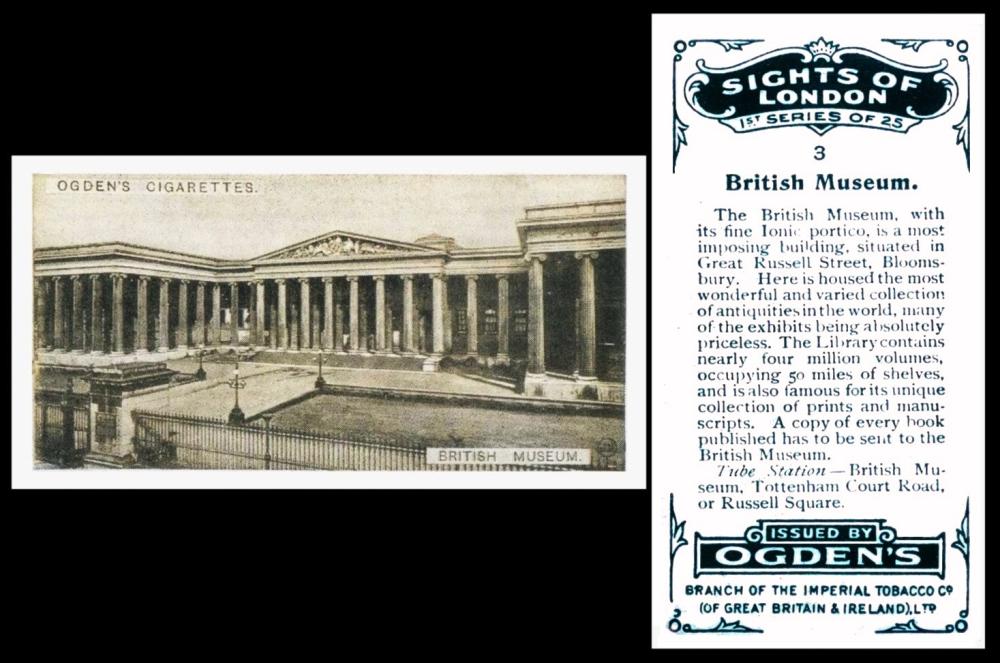
Ogden`s Ltd [tobacco ; UK - Liverpool] "Sights of London - first series" (1923) 3/25 - O100-570 : O/2-174 : O/154
Today, in 1759, saw the Trustees of the British Museum buy Montagu House, an elaborate seventeenth century mansion in Great Russell Street, owned by the Second Duke of Montagu who was relocating to a different part of London.
Their idea, which remains the same today, was to tell the tale of humanity throughout the ages, up to a today which moves continually further forward. And the Museum was already in business, for it had been founded in 1753, by an Act of Parliament which called for a national public collection of artefacts which could be viewed by the general public for free.
The problem was that there was not yet a permanent building. That was solved by the purchase of the Montagu one. However one of the grounds of the Act was not immediately complied with, as anyone wishing to see the items inside had to apply for a ticket, which seems to have ruled out anyone but the wealthy and well connected. And this did not change until the 1830s.
The first exhibits were the overflow possessions of Sir Hans Sloane, whose tiny home/museum was bulging at the seams. Most of these were books, which are today housed in the British Library, now a separate entity but at that time part of the British Museum. Then they started buying new items; whilst also receiving, gladly, items that had been acquired from other countries as they were explored and colonised.
With all this going on they soon started to run out of room, and, in the 1840s, the collections all had to move out so that the building could be demolished and rebuilt, larger.
This was when the building we know today appeared, with the body of a Greek Temple, as fashioned and imagined by Sir Robert Smirke. However it was an extraordinarily long build, and was not completed until 1852. First to be completed was the room for King George III`s library, almost seventy thousand books, which had been donated by his son, George IV in 1823.
Our card is recorded in our original Ogden`s reference book, RB.15, published in 1949, as follows :
- 154. 25. SIGHTS OF LONDON. Fronts printed by letterpress in brown. Backs in green, with descriptive text. Home Issue, 1923
However, just in case you have not noticed, the back of our card definitely says "1st Series of 25", and this entry makes no notice of a second, it is followed by O/155, which is "Smugglers and Smuggling".
And there is no second series in our original World Tobacco Issues Index either, the text there reading simply :
- SIGHTS OF LONDON. Sm. Brown. Nd. (25) ... O/2-174
... a text which is repeated exactly, save a new card code of O100-570, in our updated version of that work
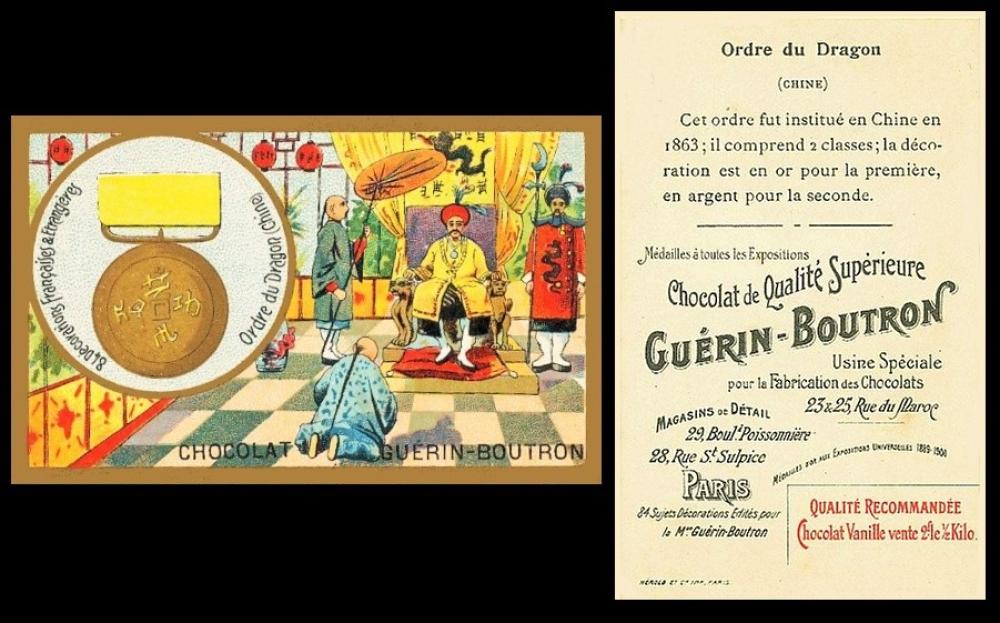
GUERIN-Boutron [trade : chocolate : O/S - Paris, France] "Decorations Francaises & Etrangeres" / Medals - French and Foreign" (1900) Un/84
Appreciate a Dragon Day is celebrated annually on January 16.
Now we have gone off on a bit of a tangent because the Inn Sign I had here turned out to be from a Whitbread set I had already used, but then this one was sent in after I asked around.
This is a medal, called on the card "Ordre du Dragon", and the text says it was instituted in China in 1863, in first and second class. Now that has taken quite a bit of tracking down and I am not there yet. At first I thought it might have been the Medal of the Order of the Dragon for the Tai-Ping Rebellion, 1863. The year is right, and it does indeed have a yellow ribbon, with a suspender of this exact shape, but there is a problem, because that medal has a square hole in the middle.
Anyway whilst I was hunting for that I did have the time to draw up a rough list of these cards - though it was still a couple short. However they have now been supplied, and, just to stop you wondering they both fell in the pit caused by a medal with the same name being issued in different countries, so we have an extra Ordre de la Toison d`Or (adding the Austrian version) and an extra Ordre de St. Georges (adding the Bavarian version)
So that makes the entire list as follows
- Aigle d`Or (Wurtemberg)
- Couronne (Saxe)
- Couronne de Chene (Hollande)
- Couronne des Indes (Angleterre)
- Couronne du Croix de Fer (Autriche)
- Couronne Royale de Prusse (Allemagne)
- Croix de Fer (Allemagne)
- Croix d`Honneur (Autriche)
- Croix du Sud (Bresil)
- Croix Militaire (Belgique)
- Dragon (Annam)
- Legion d`Honneur (France)
- Medaille de Madagascar (France)
- Medaille de Sauvetage (France)
- Medaille d`honneur Militaire (Allemagne)
- Medaille du Dahomey (France)
- Medaille du Tonkin (France)
- Medaille Militaire (France)
- Merite Agricole (France)
- Officier de l`Instruction Publique (France)
- Ordre Civil de Savoie (Italie)
- Ordre d`Albert le Valeureux (Saxe)
- Ordre d`Alcantara (Espagne)
- Ordre d`Aviz (Portugal)
- Ordre d`Isabelle la Catholique (Espagne)
- Ordre d`Osmanin (Turquie)
- Ordre de Constantin (Italie)
- Ordre de Charles III (Espagne)
- Ordre de Charles XIII (Suede & Norwege)
- Ordre de Charles-Friedric (Bade)
- Ordre de Galatera (Espagne)
- Ordre de Guillaume (Hollande)
- Ordre de l`Aigle Blanc (Russie)
- Ordre de l`Aigle Noir (Allemagne)
- Ordre de l`Aigle Royal (Allemagne)
- Ordre de l`Annonciade (Italie)
- Ordre de l`Elephant blanc (Danemark)
- Ordre de l`Elephant blanc (Siam)
- Ordre de l`tpee (Suede & Norwege)
- Ordre de la Couronne (Siam)
- Ordre de la Couronne (Wurtemberg)
- Ordre de la Croix Etoile (Autriche)
- Ordre de la Gloire (Turquie)
- Ordre de la Jarretiere (Angleterre)
- Ordre de la Toison d`Or (Autriche)
- Ordre de la Toison d`Or (Espagne)
- Ordre de Leopold (Autriche)
- Ordre de Leopold (Belgique)
- Ordre de Marie-Therese (Autriche)
- Ordre de Medjidie (Turquie)
- Ordre de St. Alexandre-Newski (Russie)
- Ordre de St. Andre (Russie)
- Ordre de St.Anne (Russie)
- Ordre de St. Catherine (Russie)
- Ordre de St. Elisabeth (Baviere)
- Ordre de St. Etienne (Autriche)
- Ordre de St. Ferdinand (Espagne)
- *Ordre de St. Georges (Baviere)
- Ordre de St. Georges (Russie)
- Ordre de St. Hubert (Baviere)
- Ordre de St. Michel & St George (Angleterre)
- Ordre de St. Stanislas (Russie)
- Ordre des Seraphins (Suede)
- Ordre des St. Maurice et Lazare (Italie)
- Ordre du Bain (Angleterre)
- Ordre du Chardon (Angleterre)
- Ordre du Chefakat (Turquie)
- Ordre du Christ (Bresil)
- Ordre du Christ (Portugal)
- Ordre du Croissant (Turquie)
- Ordre du Cygne (Allemagne)
- Ordre du Danebrog (Danemark)
- Ordre du Double Dragon (Chine)
- Ordre du Dragon (Chine)
- Ordre du Lion & du Soleil (Perse)
- Ordre du Nicham Ihikhar (Tunis)
- Ordre du Sauveur (Grece)
- Ordre Militaire de St. Louis (Italie)
- Ordre Militaire de Savoie (Italie)
- Ordre Royal de Victoria (Angleterre)
- Ordre Royal du Cambodge
- Palmes Academique (France)
- Soleil Levant (Japon)
- Tresor Sacre (Japon)
This week's Cards of the Day...
...have slightly moved on from sets issued in January, and moved on to calendars, as we put our new ones on the wall.
This was an idea by one of our readers, who also supplied the cards, which this time have all been issued by cigarette manufacturers. Some of them are very scarce, so we hope that you enjoyed the chance to get to see them, perhaps for the first time.
However as usual we started the theme on a sideways tangent, with three cards which referenced months, but somewhat indirectly.
So lets start with :
Saturday, 3rd January 2026
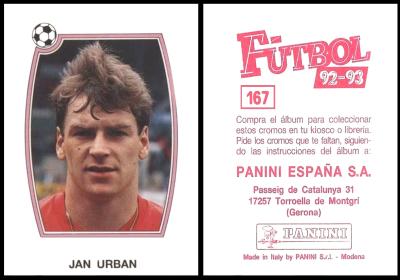
Here we have "Jan" Urban of Poland - who is, rather thrillingly the current manager of the Polish International Football team. As for the calendar connection, it is simply that "Jan" is the most usual shortening of January when the full name of the month will not fit into a given space.
Jan Urban was born on the 14th of May, 1962, in Jaworzno, Poland. He was one of six children, born into a mining community, and he first played for the local team of Victoria Jaworzno, which is actually the oldest miner`s football club in the country, not withstanding the fact that it closed in 2011 - and that the new incarnation was only re-founded in 2014.
There is great confusion over Mr. Urban`s "rookie" card. Many collectors will tell you that it was Panini`s very hard to come by set of "Calciatori 1970-71", where he is shown with Riccardo Innocenti. This cannot be true though; firstly, because in 1971 our man was only nine years old - secondly, that he did not start with any team until the mining one, in 1980 - and thirdly, because though he did spend part of the 1990s as part of European teams, none were from Italy.
That seems to make our set his true "rookie" card, and it shows him at the 1986 World Cup, at which time he was playing for Gornik Zabrze S.A., and still in Poland. That was his second adult team, for he had previously been with Zaglebie Sosnowiec, between 1981 and 1985. In fact he had been on the Polish National team since 1985, and would stay with them until 1991.
In 1989 he moved to Spain, to join Club Atlético Osasuna, which is based in Pamplona. During this time he appeared on card 188 of Panini`s "Futbol Estrellas de la Liga", and card 198 of Mundicromo`s "Sport Futbol", though by the time this latter set hit the stores, in 1995, he had gone, though he was still in Spain, just playing with Real Valladolid Club de Futbol S.A.D., since 1994 This does not seem to have worked out though, and by the end of 1995 he was at yet another Spanish team, Club Deportivo Toledo S.A.D.
From there he went to Germany, to play for Verein fur Bewegungspiele e.V. Oldenburg. Yet again it was not long before he was moving on, but this time it seems to have been because he was offered a chance to play once more at Gornik Zabrze. And it was there that he ended his playing career, retiring in 1998.
Strangely, after his retirement, he went back to Spain, and rejoined Osasuna, but as the head coach at their youth training facility. He left in 2007, but only because his stint at Osasuna had led to an even better offer, to become head coach of a Polish team, Legia Warszawa. With him at the helm, the team won two major tournaments, the 2007-2008 Polish Cup and the 2008 Super Cup. He even became trainer and assistant to the Polish National team, then there was some kind of falling out, and he was sacked by Legia Warszawa in 2010.
Rather than this stopping his career, though, he had several offers from other Polish teams, which he accepted, and just a couple of years later he was welcomed back into the fold at Legia Warszawa. Then, in 2014, he returned to Osasuna but this did not end well; the team continued to lose and he seems to have been the scapegoat.
In fact he went back to Poland, and worked, on and off, for several teams, until 2025, when he got the call up to be manager of the Polish National team. And he is still their manager to this day. In fact you can find him as a manager on cards.
This set is a set of two halves because from card 184 it shifts into a sub-set, called "Las Estrellas de la Eurocopa `92", or stars of the European Cup. Some of those are stars we know well, so here is a list of this section just so you can see if your favourite is there and you can add it to your check list :
- 184. Sergeij Alejnikov (Russia)
- 185. Dennis Bergkamp (Holland)
- 186. Laurent Blanc (France)
- 187. Basile Boli (France)
- 188. Tomas Brolin (Sweden)
- 189. Eric Cantona (France)
- 190. Bent Christensen (Denmark)
- 191. Thomas Doll (Germany)
- 192. Ruud Gullit (Holland)
- 193. Thomas Hassler (Germany)
- 194. Klas Ingesson (Sweden)
- 195. Andreij Kanchelskis (Russia)
- 196. Jürgen Klinsmann (Germany)
- 197. Ronald Koeman (Holland)
- 198. Jürgen Kohler (Germany)
- 199. Brian Laudrup (Denmark)
- 200. Anders Limpar (Sweden)
- 201. Gary Lineker (England)
- 202. Maurice Malpas (Scotland)
- 203. Ally McCoist (Scotland)
- 204. Dave McPherson (Scotland)
- 205. Paul McStay (Scotland)
- 206. Jean-Pierre Papin (France)
- 207. Stuart Pearce (England)
- 208. David Platt (England)
- 209. Flemming Povlsen (Denmark)
- 210. Thomas Ravelli (Sweden)
- 211. Frank Rijkaard (Holland)
- 212. Franck Sauzee (France)
- 213. Peter Schmeichel (Denmark)
- 214. Igor Shalimov (Russia)
- 215. Jonas Thern (Sweden)
- 216. Marco van Basten (Holland)
- 217. Des Walker (England)
- 218. Chris Woods (England)
- 219. Rudi Voller (Germany)
- 220. Akhrik Zvejba (Russia)
Sunday, 4th January 2026
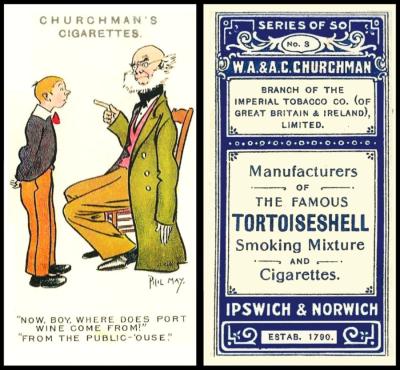
This was a rather fiendish clue as the name of the set was nowhere on the card, it was purely derived from the artist`s signature, which, on our card at least, is inscribed beneath the coat of the seated man. And that is Phil MAY.
In our original reference book RB.10, devoted to the issues of the Churchman company, it is revealed that they also issued two versions, described as :
- 107. Feb.1912. 50. PHIL MAY SKETCHES. (untitled series). Size 2 11/16" x 1 7./16" or 67 x 36 m/m. Numbered 1-50. Fronts lithographed in colour with words "Churchman`s Gold Flake Cigarettes" at top in blue. Backs in blue, no descriptions. Printed by Mardon, Son & Hall. Also issued by Fry and Smith
- 108. 50. PHIL MAY SKETCHES. Identical to (107) but words "Churchman Cigarettes" at top of fronts.
This is why I have a question mark on the date of our title, for I am not sure whether the omission of the date in the reference book against the second set means it was issued at exactly the same time, just in a different brand, or that the date of issue was simply not recorded.
As far as the two other versions mentioned in the text, the F. & J. Smith one was actually issued almost four years before ours, in May 1908, and you can see that in the newsletter for the 29th of September 2023, just scroll down to Thursday, 5th October. As for the one by Fry`s Chocolates, which is a trade set, that was issued first of all, in 1905, and you will find that in our newsletter for the 4th of April, 2026, by scrolling down to Tuesday the 7th of April. .
By the time of our original World Tobacco Issues Index, the Churchman sets were recorded as ;
- PHIL MAY SKETCHES (A). Sm. Nd. (50). See H.72 ... C82-25
A. Front inscribed "Churchman`s Gold Flake Cigarettes"
B. Front inscribed "Churchman`s Cigarettes"
This is only very slightly different in our updated World Tobacco Issues Index, and now reads :
- PHIL MAY SKETCHES (A). Sm. Nd. (50). See H.72. Front inscribed ... C504-330
A. "Churchman`s Gold Flake Cigarettes"
B. "Churchman`s Cigarettes"
All the cards are the same in all the versions, namely :
- Sol Jacobs
- A real grievance
- Now, Boy, where does Port wine come from ?
- Ardent Politician (evidently playing his trump card)
- Drunken Tramp
- Thought Reading
- Weary Willie (seating himself beside nervous Miss Jones)
- Moses (generously)
- Affable Country Doctor (to former patient)
- I want you to take me to St. John`s Wood, Cabbie
- Shure, if I was as big as ye'self…
- Sarcastic
- Do you want an errand boy ?
- Bailiff (who has been very well treated and settled with)
- Stout Party
- Josser
- Overheard near the Zoo
- Farmer Brown
- What sort of bait are yer usin` Billie
- Jones to new servant
- Sy, Bill, wots `is pedigree?
- Little Girl
- Excuse me, but is your name Pole Carew ?
- Say, Brown
- Minister
- Spare a copper, Sir
- English as she is spik
- Jocular Briton
- Does your poetry pay ?
- Fat Capitalist
- Why don't we have open air cafes ?
- Scene; Outside Popular Theatre
- Hullo, old chap
- Benevolent Lady
- Mr. and Mrs. Binks
- My Father 'e once caught a fish
- Thirsty Pedestrian
- Conversation Overheard by sympathetic old Lady
- I must congratulate you
- Visiting Day on a Gunboat
- The Vicar
- Obliging
- Did you go to Smith's Buryin ?
- A fact
- Bill Snooks
- Brown
- How did your Billie get runned over ?
- Overheard on a Cab Rank
- Youngster
- Overheard in Sydney
Monday, 5th January 2026
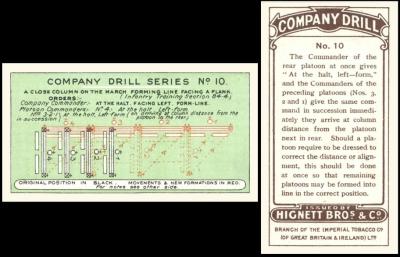
This card gave us MARCH, but rather than a month, again, as a military term for a column of men all moving in unison in one direction.
This is a very curious theme for a set, and would be most uninteresting for anyone but a soldier, for it simply deals with marching and the formation of drills. In fact it would probably be of little interest to the rank and file, who would only need to follow the instructions.
So what we are looking at is a set purely to instruct drill sergeants on how to train their men.
You may think this a boring even useless task, but it does have a purpose, making a disparate group of men from all areas and backgrounds into a team, who will eventually, albeit grudgingly, rely on, and depend on each other, once they are on the field of combat. And it also teaches them that if a command is given, it is to be responded to instantly, and correctly, whatever else they are doing at that moment in time, something which has saved many lives.
Our original World Tobacco Issues Index mentions none of the details as to what this set is about, it simply says :
- COMPANY DRILL. Sm. Nd. (25). ... H44-22
And that text remains identical in our updated version of the World Tobacco Issues Index, save a new card code of H536-130
Tuesday, 6th January 2026
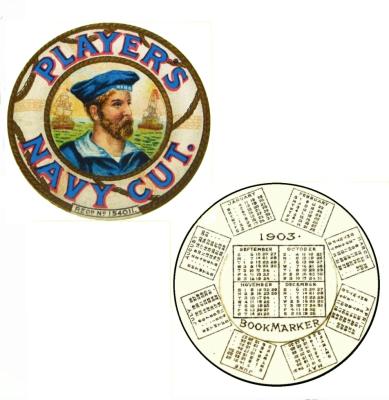
This is a strange little item. and it was only issued this one year, 1903, though it is almost certain that the date of issue ought to have been recorded as 1902, giving time for the full calendar to be usable. We do not know why it was only issued that one year, either - nor whether there was a link with the "Authors" set of photographic bookmarks, which were issued in 1902.
The very idea of this card was that it was used and, when broken, discarded. If you look at an original, you will see a pre-cut, almost circle, enclosing the four central months, and that was designed to open up enough to fit around the page of the book where you had been forced to stop reading, marking your place until such time you could return and pick the story up anew.
Our original Cartophilic Reference Book - No.17 : The Cigarette Card Issues of John Player, published in 1950, describes it as :
- 26 BOOK MARKER. Circular card 42 m/m diam. Front per Fig. 6 in colour, centre portion cut for use as book marker, inscribed "Regd. No. 154011." Back in black, inscribed "Book Marker" with complete monthly calendar for 1903, no I.T.C. Clause. Single card, miscellaneous issue, 1903.
Despite this being in the body of the text in that work, by the time of our original World Tobacco Issues Index, it is removed right to the back of the Player listings, sharing a space with the "Sundry Issues" under section 4.C. It is described as :
- BOOK MARKER. Circular, 42 m/m diam. See RB.17/26 ... : :
And it is even further back in our updated World Tobacco Issues Index, under section 5.D, for "Sundry Cards", where it is described as :
- BOOK MARKER. Circular, 42 m/m diam. 1902 calendar back. Single card issue. ... P644-920
There are several interesting things about this card.
The first thing is that it quotes "Regd. No. 154011". You may think that was the registration number of this style of bookmark, but no, it is the registration number of the logo, the Sailor`s head in the lifebelt, and everywhere that this sign appears you will see the same registered number, from the packaging to the large enamel signs, and even when it is used in magazines and newspapers as advertising.
This number marks the change over from, or, rather, the combination of two trademarks - the life belt, which originated in 1888, and the bearded seaman.
However the seaman was not a Player original artwork, it was from a painting, "Head of a Sailor", by Arthur David McCormick, which was painted from life in 1880, and modelled for by a sailor from H.M.S. Edinburgh, by the name of Thomas Huntley Wood.
Even stranger is the fact that the picture had already been used in advertising, and not just by someone else, but for tobacco, namely the "Jack Glory" brand, manufactured by William Parkins & Co. of Chester. However it was all above board, shall we say, as John Player did buy the logo and the rights to use it, in 1885 - though there seems to have been some conditions to this, as John Player added the lifebuoy, which they originally owned the rights to, and the ships, one each side of the sailor. These ships were never identified but it is thought that they were H.M.S. Britannia and either H.M.S. Invincible or H.M.S. Hero - if we go along with the idea that it is H.M.S. Invincible, that would mean that all three ships of the line were featured on this one card, H.M.S Hero being represented by the name on the cap tally which is sported by the sailor. Though there is even discord there, as the H.M.S. seems to have been omitted from that tally.
And historians also point out another rather glaring error, for the Royal Navy has three stripes on the collar, but this image has only two.
Maybe because of this, in 1905, just two years after this bookmark was produced, the name on the tally changed, to H.M.S. Invincible. And you can see that on their 1929 advertising card, which we featured as our Card of the Day for the 19th of June, 2022
Wednesday, 7th January 2026
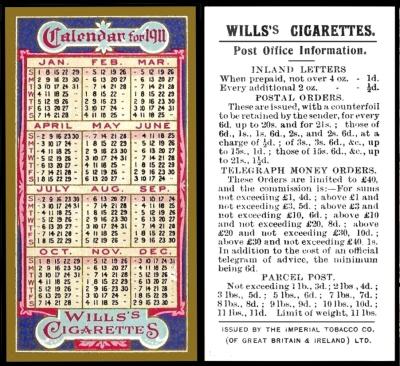
This is not just a calendar, for the back is a useful compendium of Postal rates, from letter to parcel post, stationery, and postal orders. And it may have been issued at this early date, but it did not make the Wills reference books until part III, where it is listed with its pair, as :
55. 2 CALENDARS. Unnumbered. Fronts printed from relief blocks in colour; backs in blue, headed “Post Office Information”. Home issues : -
A. Calendar for 1911, issued 1910
B. Calendar for 1912, issued 1911
And you can see the Calendar for 1912 as our Card of the Day for the 4th of February, 2024.
There is no month of issue recorded for either of these but it seems safe to imagine they were in the final parts of the year before. However I have to wonder why this useful item was only issued in these two years? Any ideas?
This information is only slightly altered in our original World Tobacco Issues Indexes, to
CALENDARS (A). Sm. Backs inscribed “Post Office Information” ... W62-72
1. “Calendar for 1911” (1)
2. “Calendar - 1912” (1)
And this remains the same in our updated version of that work, apart from a new card code, of W675-105
Thursday, 8th January 2026
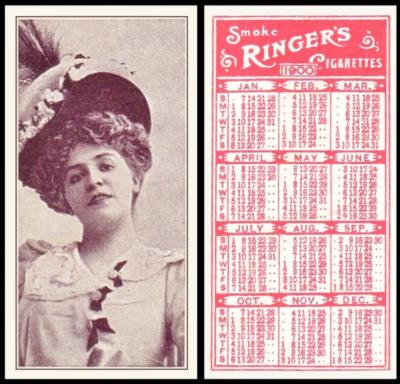
Here we have a very unusual calendar indeed. It is branded for "Ringer`s Cigarettes", but if you look in our original World Tobacco Issues Index under that name it re-directs you to Edwards, Ringer and Bigg. And once there, your initial delight at seeing "Calendars" listed under section 2.D, soon fades, as there is no calendar for our year, 1900, the listing there simply reads :
- CALENDARS. (A). Sm. Calendar in red. See X1/Ha.492-6. Single card issues : ... E14-51
1. Calendar for 1905. Back in brown,, "Exmoor Hunt" wording
2. Calendar for 1910. Back (a) in blue. "Empire" wording (b) in red, "New York" wording.
Even looking at X1/Ha.492-6 does not turn up what may be a later version of our card, for the backs shown are completely different.
There seems to be a glimmer of hope in our updated World Tobacco Issues Index, for there you will find three calendars, namely :
- CALENDAR FOR 1899 (A) Sm. 67 x 39. Red and black. Back with lighting-up table, etc. Unnd. (1) "Ringer`s Cigarettes" Brand issue ... E265-910
- CALENDARS (A). Sm. Calendar in red. See H.492-6. Single card issues : ... E265-920
1. Calendar for 1905. Back in brown,, "Exmoor Hunt" wording
2. Calendar for 1910. Back (a) in blue. "Empire" wording (b) in red, "New York" wording.
Yet, sadly, once more, none of these are ours, which is but a simple date calendar, not a Lighting-up times one.
We have, however, identified the set which includes the beauty on the front, for she also appears in a set which has come to be known as "Beauties FECKSA". That is an acronym made of some of the issuers, namely Faulkner, Edwards Ringer & Bigg, Churchman, Kennedy, Shepherd, and in an Anonymous form. Today we know that these cards were also issued by Glass, the Planter`s Stores in Calcutta, and The B.C. Co. - and that there are actually fifty cards in one of the anonymous printings. plus a coloured version (issued anonymously), and a titled one, The B.C. Co. version, which is also printed up as "Wonderful Series of Well Known British and Foreign Actresses and Beauties". And from that set we even know the name of this lady; she is Lise Requier. Tracking her down seems impossible, though I will persevere.
Now if you return to the original World Tobacco Issues Index, and look at the listing for that set under Edwards Ringer & Bigg, the truth is revealed, for our cards are there, listed as ;
- BEAUTIES "FECKSA" (A). Sm. 67 x 36. Deep plum. Unnd. (25). 1900 Calendar back - "Ringer`s Cigarettes" brand issue. See H.58 ... E14-1.
And this wording is repeated in our updated World Tobacco Issues Index, apart from a new card code, of E265-010
Friday, 9th January 2026
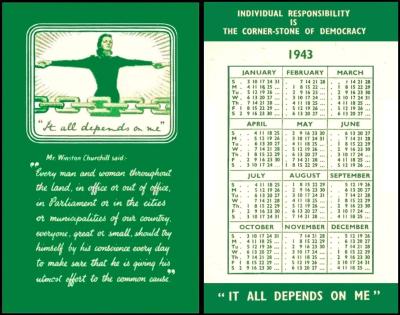
This is a very scarce calendar card indeed, and though we know it was issued by Ardath, their name does not actually appear.
There is also some confusion as to its listing in our original Cartophilic Reference Book - No.10 : The Cigarette Card Issues of W.A. & A.C. Churchman", published in 1948, which reads :
- 1941. 1. CALENDAR - "IT ALL DEPENDS ON ME". Size 2 3/8" x 3 7/8". Picture of a girl as link in a chain at top with quotation from Mr. Winston Churchill. Printed in dark green. Back a calendar for 1942. No maker`s name. Packed in flat 50 packings. Issued under the auspices of the M.o.I.
However, our calendar is for 1943, not 1941.
The "M.o.I", by the way, was the Ministry of Information. That is said to have been founded on the 4th of September, 1939, one day after the Second World War was declared, and its first minister, Lord Macmillan, took office on the 5th of September. It was announced in this way to show diligence and speed - but actually planning for it had begun years earlier, in October 1935. It was to be a ministry devoted on one hand to issuing propaganda in order to bolster the national morale, whilst on the other hand acting to censor news which would work against the national morale. And it had also functioned, briefly, for one week in late September 1938, after Germany occupied part of Czechoslovakia, partially because it was believed that this would see escalation towards war, and partially as a dry run of the way it would work when that war came. In actual fact that week was not a huge success, and the whole idea was almost abandoned, but most of that was due to a bit of a row over who controlled the news, which the Foreign Office was adamant was their responsibility, and they did not believe it should be censored. This was slightly resolved in January by the removal of the Director General of the M.o.I, and the group becoming part of the Home Office.
The whole Ministry of Information was an unwieldy one, often being divided into separate sections for "Home" and "Foreign" news, but not allowing the two to get together, which often resulted in one deciding to censor and the other not. This led to confusion amongst the public, and to anti-censorship campaigns in the daily papers.
In January 1940 Lord Macmillan was ousted and replaced by Sir John Reith, who had been the first Director General of the BBC. He did not last very long either, but mainly because Winston Churchill became Prime Minister when Chamberlain resigned, and put one of his comrades, Alfred Duff Cooper, in the job. Under his tenure, and also because the war in Europe was not going too well, it was decided that news from Europe would appear less, and more time and effort would be given to schemes concerning the home front, things that encouraged the general public to join together, and appear to be assisting the war by simple tasks like growing their own food, and donating paper and metal for the war effort.
Alfred Duff Cooper was also replaced, in 1941, by Brendan Bracken, another close ally of Winston Churchill, and his Parliamentary Private Secretary, who had pulled several strings to ensure Winston Churchill became Prime Minister in the first place. He stayed in the post until the end of the Second World War - and his tenure proved popular with the press as well because was one of them, having been a newspaper proprietor, publisher, and editor. After the War he would buy the Financial Times
In 1946, the Ministry of Information was closed down, and its staff and effects were moved to a new Central Office of Information, which handled peacetime information and ran campaigns on health and welfare.
These cards do not seem to appear at all under Ardath in our original World Tobacco Issues Index, not in our updated version. Maybe they are removed to the back. But I have not time to look there now.
I will tell you that the quotation, which is small, light, in mock handwriting, and also in italics, all of which make it hard to show up here, reads :"Every man and woman throughout the land, in office or out of office, in Parliament or in the cities or municipalities of our country, everyone, great or small, should try himself by his conscience every day to make sure that he is giving his utmost effect to the common cause".
But I have not yet tracked down when and where that was delivered, nor what it referred to
And there we must close. I have a busy day tomorrow, which will start early, as early as I can wake up. Places to go, people to see, as they say, and with the promise of change on the horizon, in many ways for the better, but in some ways adding more complications.
Thanks for tuning in, as we start to edge our way into another year. Hope you were entertained, amused, and educated?
And, remember, there will be a whole new newsletter for you this time next week