
Welcome to another Saturday, and also another newsletter. I have slowed down, but hopefully you will not notice, for I am constantly changing how these are produced, and now work on the system that I do two diary dates a day and then the reference book gen on the final day, though this still needs improvement for often things intervene and though I can type the wording at night by using the chromebook folded in on itself as a tablet, which gives me a virtual keyboard on the screen, it is then too late to do the reference books. Hence they, too often, are added over the weekend.
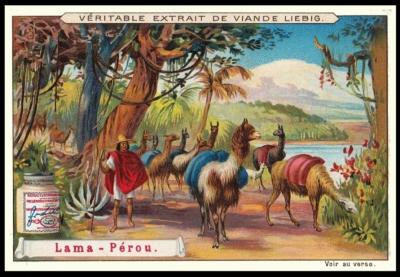
This week I managed to add another back issue of the newsletter into the card index - namely that of the 14th of December 2024 - but then I had to stop for I do not know the identity of this set - so if anyone does, please let me know either the title, or the Fada or Sanguinetti catalogue numbers. I can state that it is not any of the sets I looked at, or any that I found for looking up "Liebig Llama", or "Liebig Perou" in a vast selection of search engines and internet auctions. You can see the back in the newsletter dated for the 7th of December 2024 - by scrolling down to Monday, 9th December 2024. And thank you in advance.
And so to this week`s diary dates, which are a mixed bag but lots of fun..... and lets start with a really odd one....

NESTLE, Peter, Cailler, Kohler [trade : chocolate : O/S - Switzerland] "Sciences, decouvertes, explorations, aventures" - Vol.2, Serie 79 (1956) 1/?
Today in 1871 the skies of Western San Francisco were darkened, not by night, but by millions of birds. If you live in certain parts of England you will immediately say, ah yes, a murmuration, and point to the starling, who is known to enjoy such pursuits as flying em masse, and whirling about so that the cloud ebbs and flows. And they could, very easily block out the light.
Then the story gets intriguing, for it is said that the starling was not introduced to San Francisco until the 1890s, by Eugene Schieffelin. However, research proves that this is incorrect, for Mr. Schieffelin actually only introduced European starlings to Central Park, in New York, in 1890, and they did nest, successfully. Mind you there were, reportedly, at least a hundred released. However, as far as we know he never went to San Francisco.
That leaves many people to suspect the sighting was of bats, which do fly in large groups, called clouds, emerging from their roosts at sunset to hunt. Today there are sixteen species of bats within the San Francisco area, but I have been unable to find when they arrived or if they have always been there. The two most common are California myotis and Yuma myotis, both of which are from the family of vesper bats, or Vespertilionidae, which is the most widespread family of all, and you will find them on every single continent save Antarctica.
But it still does not answer the question why on this one night the skies blackened, and at no other time, for surely if it was bats or birds returning to roost they would have used the route forever, not just once.
I failed to find a vesper bat on a card though I am sure there is one. Instead I went for this, because it showed the most bats, but it also dealt with how they not only find their way, but communicate with each other to stay together in formation, and that is echo-location, a form of sonar, where they make a noise, and listen for its echo. We mainly associate it with bats, but it is also used by whales, birds, dormice, and shrews.
This is from volume two of three, which were issued in 1954, 1956, and 1957 respectively, and the cards were designed to be stuck in albums, though they are rather lavish, hard back, ones. In fact unless you knew that they were cards, you may just take them for books.
If you look at the card, you will also note that they are multi-lingual, in French, German, and Italian - and the main title of each translates to "science, discoveries, explorations, adventures". However I am not sure whether you could get albums with all the text in each of these languages, or not.
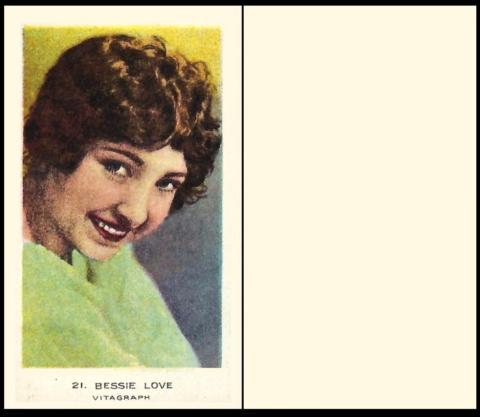
ANONYMOUS/ British American Tobacco [tobacco : O/S] "Cinema Stars" - set 1 (1928) 21/50 - ZJ04-190 : ZJ4-8 : RB.21/259.1
Today in 1929 the film "Broadway Melody" was released. It was a musical, the first musical ever released by Metro Goldwyn Mayer. And in fact it narrowly beat another Metro Goldwyn Mayer musical, "The Hollywood Revue of 1929". However the clincher was almost certainly the fact that "Broadway Melody" had a section in technicolour, which was one of the catalysts that led to colour films, especially musicals, becoming more popular. Sadly, and amazingly, the technicolour scene is lost, and we only have the footage in black and white.
In fact it ought to be more famous for the fact that it was the first sound film to ever win an Academy Award for "Outstanding Picture" - which was later renamed as "Best Picture".
The story revolves around two sisters, Queenie and Harriet Mahoney, who attempt to strike it big on Broadway after leaving the vaudeville circuit, but love complicates everything. It was written by Edmund Goulding, a British screenwriter and film director, born in Feltham, Middlesex, and adapted for the screen by Norman Houston and James Gleason, who was also an actor, and actually appears in the film as a music publisher. He would, much later, in 1941, be nominated for an Academy Award for Best Supporting Actor for the film "Here Comes Mr, Jordan". That award was won by Donald Crisp for "How Green Was My Valley".
The "sisters" were Bessie Love (as Harriet "Hank" Mahoney) - who was nominated for the Best Actress Award for this movie, but lost out to Mary Pickford for "Coquette" - and Anita Page (as Queenie Mahoney), with Charles King as the leading man, Eddie Kearns.
:Later on there would be more "Broadway Melody" `s - of 1936, 1938, and 1940. There was going to be a 1943 film, starring Gene Kelly, but that never came about as Gene Kelly made "Cover Girl" instead. And the 1944 film distanced itself by being titled "Broadway Rhythm" instead.
This is a very pleasing set, apart from the plain back. It first appears in our reference book to the assorted issues of the British American Tobacco Company, RB.21, published in 1952, with the following description :
- 259. CINEMA STARS - Anonymous, Plain Back (adopted title). Two series of small cards. Front in colour, illustrates at Fig. 259. Anonymous issues, with plain back. See also Sets 260-2, 260-3 and 260-4.
259-1. Set 1. Size 64 x 37 m/m. Front per Fig. 259.1. Numbered series of 50. Fronts matt or varnished.
259.2. Set 2. Size 60 x 36 m/m. Front per Fig. 259.2. Front matt. Unnunbered, 9 subjects seen -
1. Renee Adoree
2. Vilma Banky
3. Clara Bow
4. Bernice Claire
5. Maria Corda
6. Lilian Harvey
7. Lois Moran
8. Jenny Jugo
9. Miriam Seegar
The front index of this book tells us that set 2 (or the nine cards, anyway) was issued in Malaya, but it has no issuing area for our set, which probably means it was a general issue.
In our original World Tobacco Issues Index the set is shunted to the back of the book. Now it is a bit confusing, because the film star listings starts with a "Set1" but it is not ours. Our pair, I now realise, is listed as :
- SET 8. (A) See RB.21/259-1. CINEMA STARS. Sm. 64 x 37. Coloured, matt or varnished. Nd. (50). Issued abroad through B.A.T. ... ZJ4-8
- SET 9. (A) See RB.21/259-2. CINEMA STARS. Sm. 60 x 36. Coloured. Unnd. (9 known). Issued abroad through B.A.T. ... ZJ4-9
However, once you have got used to calling our cards Set 8, along comes the updated World Tobacco Issues Index and changes everything, with a listing which reads, simply :
- CINEMA STARS. Sm. 64 x 37. Coloured, matt or varnished. Nd. (50). See RB.21/259.1. Issued abroad through B.A.T. ... ZJ04-190
- CINEMA STARS. Sm. 60 x 36. Coloured. Unnd. (9 known).See RB.21/259-2. Issued abroad through B.A.T. ... ZJ04-195
Nowhere, until now, are the cards that comprise our set listed, so let us change that, right now :
- Ivy Close
- William Russell - Fox Film
- Tom Moore - Goldwyn
- Jean Paige - Vitagraph
- Milton Sills - Goldwyn
- Mabel Normand - Goldwyn
- Mae Marsh - Goldwyn
- Guy Newell - G. Clark Film Star
- Peggy Hyland - Fox Film
- Madge Kennedy - Goldwyn
- Buck Jones - Fox Film
- Violet Hobson - Butcher's Film Star
- Winifred McCarthy - Walturdaw
- Marion Davies - Walturdaw
- May Allison - Walturdaw
- Anne Luther - Pathe
- Alice Joyce - Vitagraph
- Norma Talmadge - Walturdaw
- Madlaine Traverse - Fox Film
- Ivy Duke - G. Clark Film Star
- Bessie Love - Vitagraph
- Doris May - Paramount
- Jackie Coogan - Pathe
- Joan Maclean - Walturdaw
- Sydney H. Folker - Walturdaw
- Shale Gardner - Walturdaw
- Charles Ray - Walturdaw
- George Walsh - Fox Film
- Tom Mix - Fox Film
- Stewart Rome - Broadwest
- Larry Seman - Vitagraph
- Dustin Farnum - Fox Film
- Jack Pickford - Goldwyn
- Pauline Frederick - Goldwyn
- Charlie Chaplin - Keystone Photo Co.
- Constance Talmadge - Walturdaw
- Bryant Washburn - Goldwyn
- Lawson Butt - Goldwyn
- Katherine MacDonald - First National
- Richard Barthelmess - First National
- June Caprice - Paramount
- W. S. Hart - Paramount
- Isobel Elsom
- Billie Burke - Paramount
- Constance Worth
- Shirley Mason - Fox Film
- Pearl White - Fox Film
- Louise Lovely - Fox Film
- Carol Halloway - Vitagraph
- Corinne Griffith - Vitagraph
This is how it appears on the cards but we know that there are two mis-spelt names, Card 26 ought to read "Shayle Gardner" and card 49 "Carol Holloway". It is not known if these were ever corrected but that seems unlikely.
In addition, several of the cards do not list studios, only having one line with the name of the actor or actress.
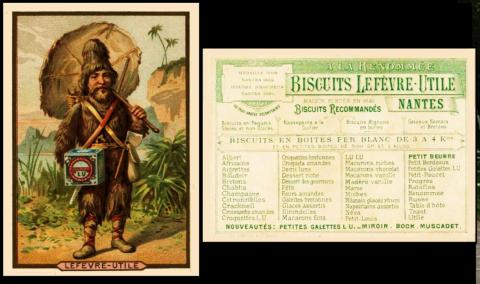
Biscuits LEFEVRE Utile [trade : biscuits : O/S - Nantes, France] "Characteres du Literature"
Today in 1709 the British sailor Alexander Selkirk was rescued from an island - fifty-two months after he arrived. And the story inspired Daniel Defoe to write Robinson Crusoe.
As far as sailor Selkirk, he was born in Lower Largo, Fife, Scotland, in 1676. He was a wayward child, and frequently in trouble, in fact he was summonsed by the local Presbyterian Church board in 1693, but did not appear, for he had run away to sea. This running away to sea eventually led to his becoming more or less a pirate, but on the authority of the British Navy, who encouraged piracy, once given the more acceptable name of privateering, as a form of warfare, under which merchant shipping was a legitimate target, in order to break down the morale of the opposing forces.
In fact, how Alexander Selkirk got to be on the island at all is an even stranger story, for he had a premonition that the ship he was on, the Cinque Ports, was doomed, and when it stopped off at Mas a Tierra, part of the Juan Fernandez islands, off South America, he asked to be left there. His commander, Captain Stradling, seems to have readily agreed to this, possibly because it appears that Mr. Selkirk was still a bit of a handful, prone to fighting and not great at submitting to authority. And not so long after he waved goodbye to the Cinque Ports, thoughts turned into reality, as the vessel did actually sink, off the coast of Colombia, and we know that most of the crewmen died, with the rest (Captain Stradling and a handful of men, less than ten) being captured by the Spanish, and remaining imprisoned for four years.
Alexander Selkirk was rescued by a ship called "Duke", which was another privateer, and by complete coincidence, as they pulled into the Juan Fernandez Islands to get some limes, much needed to fight off the scurvy which had already killed seven of his men, and as they neared the shore they saw a campfire, which they investigated, cautiously, the following morning. What they found was a wild looking man wearing only the skin of a goat, and his person just as hairy. It appears he took aim at the welcoming party, but then the leader, Thomas Dover, spoke in English and Alexander Selkirk laid down his arms.
When he came aboard, he found William Dampier, who had formerly commanded the expedition which included the Cinque Ports, and he allowed Alexander Selkirk to join the crew, and eventually to take over command of one of the enemy ships they wold later capture.And he stayed aboard for quite some time, only returning to England on the 1st of October 1711.
At first he liked living in London but he got bored. In 1713 he was charged with assault, and escaped prison only by running away to Scotland, where he met a local girl from his home town and, in 1717, was married. But he was soon off to sea, having re-enlisted in the Royal Navy. In 1720 he took a second wife, the widow of a Plymouth inn-keeper, and then returned to sea aboard HMS Weymouth. In 1721 the ship was damaged by bad weather, and pulled in to make repairs by the river Gambia, where local men took some of the crew hostage, though they were released in exchange for money and food. The ship then left and sailed down the coast, stopping off to cut wood, a rash action which brought aboard yellow fever, from which several men died, including Alexander Selkirk, who was buried at sea on the 13th of December, 1721.
"The Life and Surprising Adventures of Robinson Crusoe" had been published in 1719. The story is mostly fiction but many elements seem to have been suggested by the plight and recovery of Alexander Selkirk, who dresses in goatskins and has a wild appearance. However he invents companions, which were never there, perhaps because sustaining the interest in a man alone would have been harder.
Later on, in 1782, William Cowper directly names our man in his poem "The Solitude of Alexander Selkirk", and ponders on his isolation, but that is easier to do in a shorter verse. However, and curiously, he called the poem "Verses supposed to be written by Alexander Selkirk, during his solitary abode in the Island of Juan Fernandez".
So now it is Saturday, I have sorted out the picture coming out too small, but may change it again as someone sent me a much darker back. And I now know that the set (or sets, as there are twelve cards) is of literary characters, which are sadly not identified, but I think they are :
- Baron Munchausen
- Boy in red striped socks and clogs
- Cinderella losing her slipper
- Gargantua?
- Juliet on the balcony
- Lady rolling pastry
- Little Red Riding Hood
- Puss in Boots
- Queen of Hearts?
- Robinson Crusoe
- Sleeping Beauty
- Tom Thumb?
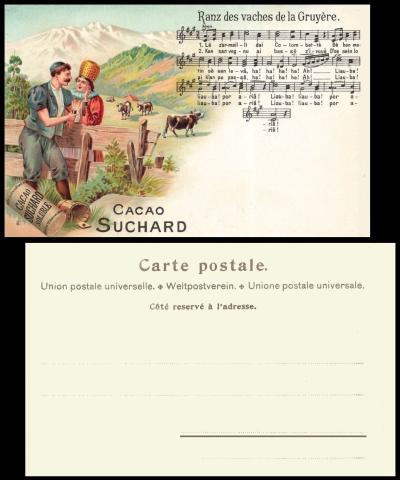
Cacao SUCHARD [trade : chocolate] "National Songs?" (??)
Today, in 1815, Switzerland opened the world’s first commercial cheese factory. That is fair enough, but I have been unable to find which cheese it made.
Therefore lets start off with a quick cheese chat.
For many centuries, cheese meant something akin to what we today call cottage cheese, and, as now, it was made to be eaten quickly before it went off. The first hard cheese was not made in Switzerland at all, the Romans brought it with them. And the first connection with Swiss cheese was made by Pliny the Elder, who wrote about Caseus Helveticus in the first century A.D. Whilst the first cheese to have its manufacturing process documented, in 1115, was from Pays d`Enhaut, in Gruyere. It took until the fifteenth century before it was discovered how to harden cheese, by using a particularly beastly product called rennet. However, the ability to make hard cheese also made the product transportable, and led to Swiss cheese becoming so popular worldwide
The one thing everyone associates with Swiss Cheese is holes, though it does not apply to all makes. For a long time nobody knew why the cheese came out with holes in it. then they thought it to be bacterial, but not harmful. Only in the twenty-first century was it discovered that it was actually bacteria, but from the strangest of sources, for if any airborne dust from the hay got into the bucket during milking the cow it would attract bacteria and produce gas during the manufacture which would blow a hole in the cheese, the size of which would vary depending on the size of the particle of dust. It also has a benefit, as it allows the cheese some growing room whilst it hardens, and therefore prevents large cracks. If you are a cheese connoisseur, you may notice that the holes are much smaller, even non-existent in summer, and that is because in the warmer months the cows live, and are often milked, on the hillside, eating grass, which is more succulent and less prone to dust than winter hay.
Now I chose this card because it showed the cheese and Switzerland, whereas many of the cards I thought were Swiss turned out to be from America. I still have no idea what this set is called, but, with many thanks to reader Mr. Franks, we do have a list, of all but one of the cards, which are -
- "Schweizerpsalm"
- "Dem Vaterland"
- "Sempacherlied"
- "Roulez, tambours!"
- "Das Grutli"
- "Ranz des Vaches de la Gruyere"
- "Emmenthalerlied"
- "Der Lustige Schweizerbue"
- "Min Vater ischt en Appezeller"
- "Die zwei Leibi Im Aargau"
- "Guggisbergerlied"
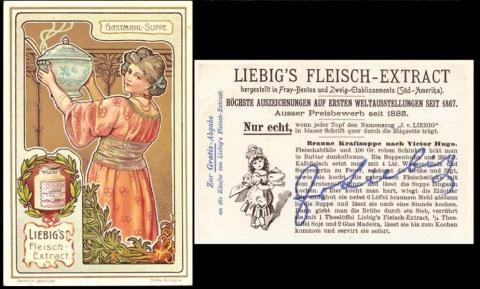
LIEBIG [trade : meat extract : O/S - South America] "Gastmahl" / types of food (1904) F.764 : S.764
Come on, get the saucepan, for today is #NationalHomemadeSoupDay.
I could complain that it is not chocolate cake day, as it is my birthday, but actually soup is rather pleasing and less fattening, and made right it can contribute very amply to your tally of daily vegetables.
It's also pretty simple, you just need a frying pan, a saucepan and a stove or camp cooker. The internet abounds with recipes, just put in your vegetables of choice and the word "soup" and you will be amazed.
You may not think that soup would be featured on many cards, but it is, along with peripherals, like the large bulbous tureens, and ladles. In addition many soup companies issued cards. In fact from my research I imagine it would be a very fascinating collection, much more so than just a lot of bowls with different coloured contents.
This set has very much the style of Alphonse Mucha, but we have not been able to prove that he was the actual artist, it is more likely that his work was used as inspiration. The cards, in the German version, the first word of each of which translates to "a meal for our guests" are :
- Gastmahl Braten
- Gastmahl Fisch
- Gastmahl Geflugel
- Gastmahl Gemuse
- Gastmahl Suppe
- Gastmahl Wild

C. BERIOT [trade : chicory coffee : O/S - Ivry, France] "Les Sportes" (1928?) A18/64
Today, in 1931, Malcolm Campbell set the world land speed record speed of 246.08 mph driving his famous Campbell-Napier-Railton Blue Bird at Daytona Beach in Florida.
But before that, in March 1929, another British driver, Henry Segrave, had driven his car, Golden Arrow, and wrested the land speed record away from the American Charles Raymond Keech.
Sir Malcolm Campbell, as he would later be, was a voracious record hunter, and he set nine speed records between 1924 and 1935, some of them, including his first, on the beach at Pendine in Wales and others, including his last, at the beach at Daytona, in Florida, Sands and five at Daytona Beach.
Malcolm Campbell was born on the 11th of March, 1885, in Chislehurst, Kent, the son of a diamond dealer who operated out of Hatton Garden, and it was presumed he would follow his father`s trade. He was actually in Germany studying the story of diamonds and the way to cut them to best advantage, when he became addicted to motorbikes and speed. That led to him returning to Britain and taking part in a series of motorcycle trials that started at London and ended at Lands End. Doing that was not actually racing, it was more being able to encourage endurance and speed out of a machine without breaking it, and if you did break it knowing how to make it work, or coax its frailties the rest of the way.
He moved into racing cars soon after, starting with a Darracq which he called "Flapper I". In 1906, whilst he was racing "Flapper III" he went to see a play called "Blue Bird" by Maurice Maeterlinck, and decided, on the spot, to rename "Flapper III" to "Blue Bird" - so much so that he reportedly saw a paint shop on the way back from the theatre and banged on the door until the proprietor woke up and allowed him to buy some paint. By the next day the paint was dry, or almost, and "Blue Bird" was hurtling round the track at Brooklands.
In 1913 he married, but it ended in divorce, after two years. This is probably due to the fact that for most of the marriage he was overseas, at war, where he enlisted straight away, reputedly on seeing an advert or poster saying that motorcycle despatch riders were needed at the Front. He ended up with the Royal Flying Corps. And he was awarded the O.B.E. for War Services on the third of June 1919. This raises another query, for we are not entirely sure what these services were, though there is a suspicion that because of them he went on to serve the country in other ways, including being put in charge of the military police branch charged with removing the Royal family from London, should the Germans invade. And in 1945, when he was sixty and had to retire, he was allowed the honorary rank of Major.
In 1920 he married again and they had two children, Donald Malcolm (who would also become involved in land and water speed records) and Jean. During the early years of this marriage he began to consider becoming the fastest man on Earth, and in 1924 went off to Pendine, near Carmarthen. where he managed to reach a speed of 146.16 mph. That was not in a Blue Bird, it was in a Sunbeam; which you can actually see on the 1926 set of D.C. Thomson`s "This Season`s Latest Motor Cars", card 24, though card is incorrect as these are on metal.
His first record with Blue Bird came on the 4th of February 1927. And Blue Bird is shown, with an inset picture of Malcolm Campbell, on card 29 of Pattrieouex`s "Celebrities in Sport" issued in 1930, by which time the text tells us his record had been beaten by Major Seagrave, in March 1927.
In 1927 and 1928 he competed in Grand Prix as a private entry, not as part of a team. His first race was the British Grand Prix at Brooklands, but he retired, with a stuck valve. However he did win the Junior Car Club 200 Mile Race, on the 22nd of October 1921, which was nothing to do with his age or that of his vehicle, it was simply for cars with lower engine capacity. And he would also win the same event a year later, though I cannot find him listed at any of the other Grands Prix.
Malcolm Campbell became a Sir in 1931, on his return from the event we celebrate today, where, on the 5th of February 1931 he reached 246 mph at Daytona Beach. In the same year he featured on card 37 of Churchman`s "Sporting Celebrities", a card which tells of his 245.37 mph speed record, set at Daytona Beach the year before. That card also tells that "In August `31, Sir Malcolm Campbell nearly lost his life after saving two men from drowning in a raging sea off West Wittering, Sussex, where he was cruising." This incident seems not to be recorded anywhere else, but I will keep after it.
In September 1935 reached 301.337 mph at Bonneville Flats in Utah. He also set the water speed record four times during the 1930s, the highest speed being 141.74 mph in Blue Bird K4, at Coniston Water in Lancashire, in August 1939.
He was divorced in 1940. And in 1948 he died, after a series of strokes, growing ever more serious. However in this he became one of the few land speed record holders not to die during yet another attempt at becoming fastest. Sadly this included his son, killed at Coniston Water trying to break the water speed record.
I do not know this set, but it is quite amazing, for it is an actual photograph of our man, with Blue Bird. I did wonder, originally, when I only knew this card, if it was a set of record breakers, or of sportsmen, and asked for assistance, which brought out all these cards, and the certain knowledge that it must be sports...
- A1 - Boxe - Kid Francis
- A3 - Boxe - Primo Carnera
- A4 - Boxe - Marcel Thil
- A7 - Patinage - Sonja Henie
- A18 - Automobile - Campbell
- A20 - Automobile - Wimille
- A21 - Automobile - Nuvolari
- A22 - Automobile - Etancelin
- A32 - Cyclisme - Scherens
- A42 - Aviron - R. Marne contre B. Seine
- A43 - Aviron - Hausotte & Frisch
- A44 - Tennis - Perry & Cochet
- A45 - Tennis - Merlin & Perry
- A49 - Tennis - Brugnon, Perry, Hughes
- A52 - Athletisme - Rigoulot
- A53 - Course a pied - Lecuron devant Leclerc
- A56 - Course a pied - Robert Paul
- A57 - Football - Thepot
- A58 - Football - Finot
- A59 - Rugby - Bailette
- A60 - Rugby - Ribeire
- A64 - Natation - Un beau plongeon
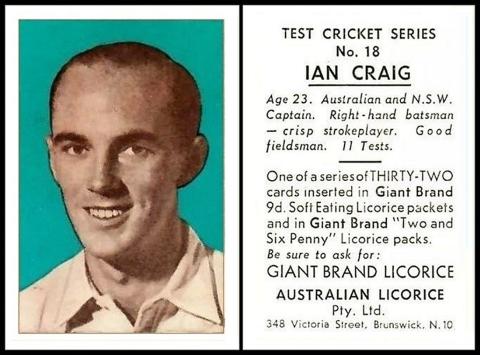
AUSTRALIAN Licorice Pty. Ltd. [trade : confectionery : O/S - Brunswick, Australia] "Test Cricket Series" (1958) 18/32 - AU2-30
And lastly, we end with a teenager called Ian David Craig, who today, in 1953, made his debut on the Australian National cricket team, aged just seventeen years and two hundred and thirty nine days - the youngest ever.
He would go on to appear in eleven Tests, and to also hold the honours of being the youngest Australian to make a first-class double century, the youngest to tour England, and the youngest to captain his country in a Test match in 1957. But he was affected badly by being lauded as the replacement for Donald Bradman, and by the mid 1950s was losing form and suffering with illnesses and stress, so much so that he left the team, and when he did briefly return he felt his only option was to retire from first class cricket, aged only twenty-six.
Today we hope that better management and more access to help may have seen him through this, but we also know that sport is, more than ever, a cruel mistress, with the public able to reach out to their fans on social media and say whatever they feel at any given moment. This may indeed be true of stars of other fields, but sport seems to evoke the most reactions of all.
Ian David Craig was born on the twelfth of June 1935, at Yaas in New South Wales. His father was the first to suggest that he would become Australia`s second Don Bradman, soon after he was born, but at school young Ian preferred baseball and rugby. It seems that it was only after taking a tumble in rugby and breaking his jaw that he decided cricket was a bit safer, and joined the Sydney Cricket Club.
He made his first class debut for New South Wales at the age of sixteen years and two hundred and forty-nine days. Less than a year later, he was the youngest to score his double century. He was, at this time, training as a pharmacist, something he much enjoyed, and he would go on to become the managing director of the Australian subsidiary of Boots, the British chemist, after his retirement from cricket.
The rather odd card code is because this set is only recorded in our original Australian and New Zealand Index, RB.30, published in 1983. The listing appears as :
- Test Cricket Series. Nd. (32). Issued 1958. ... AU2-30
This week's Cards of the Day...
A new week, and almost a new month, so we thought we would try and add a few more cards to our gallery that we know to have been issued within the month of February.
And I must add my thanks to several readers who supplied post 1970 dates, so that we now have a total of ninety-three sets known to have been issued within this month, the latest of which is Topps "F.C. Barcelona 125th Anniversary", issued only last year.
At the other end of the dateline, the earliest set so far identified as a February one remains the 1903 issue of John Player "Fishes of the World". Unless you know an earlier one...
As far as decades go, only twelve sets were issued between the years of 1903 and 1908, and twenty between 1912 and 1917, Then there is a break, before our next confirmed February issue which is Churchman`s "The Inns of Court", from 1922. In fact only eighteen sets were issued in the Februaries of the 1920s, despite this being classed as one of the heyday decades, and the last one, issued in 1929, was the large sized set of Wills "Rigs of Ships". The nineteen thirties, however, puts all the rest to shame, with a grand total of thirty-seven sets, starting with Churchman "Life in a Liner" (1930) and ending with Wills "Racehorses and Jockeys, 1938", in 1939. As for the entire list, and those new date-discoveries, you will have to nip along to the full calendar, in our ever growing section of blogs.
Saturday, 24th January 2026
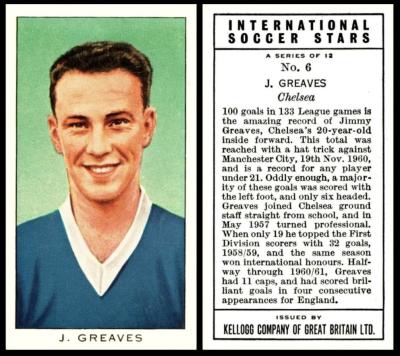
Now our first clue card was a man born in that month - and not actually a set issued in February, simply because the only three football sets I know to have been issued in that month are already shown, these being
- Amalgamated Press "English League (Div.1) Footer Internationals" (1926),
- Daily Sketch "World Cup Souvenir Cards" (1970)
- Topps "F.C. Barcelona 125th Anniversary" (2025)
but if you know others, especially from boy`s magazines, which are usually dated, just tell us.
So here we have James "Jimmy" Peter Greaves was born on the 20th of February 1940 at Manor Park in Essex, and grew up in the same county, but relocated to Hainault. Nowhere seems to mention where he played football as a child, or a youth, but we know that somewhere he was spotted by Jimmy Thompson, who was working as a talent scout for Chelsea, and in 1955 he was signed by that team, as an apprentice. Unlike many new recruits, he seems to have spent very little time on the bench, and managed to score fifty one goals in his first season.
He turned professional in the summer of 1957, and not long after that made his first appearance on a card, number 17 of Barratt`s "Famous Footballers" (A6), issued in 1958. Already he is known as Jimmy Greaves, and the text on this card describes him as "Chelsea`s young inside-forward". It then says he "was born in London" which we know is incorrect. However it does tell us that he made "...his first League appearance at the beginning of the 1957-58 season, he was immediately chosen for the Young England team v. Bulgaria, September, 1957, and later against Roumania and Scotland. Also played for London v. Lausanne, October 1957, in the Inter-Cities Fairs Cup match."
We get a bit more information from his next appearance, on card 36 of Cadet Sweets` 1958 set of "Footballers", and a foretaste of the future, for that tells us "If any player ever seemed certain of many International Caps it is young Jimmy Greaves of Chelsea. He was considered too young last season to play for England, but his play certainly merited the highest honours."
His third cartophilic appearance came later that year, and fills in several blanks - it was card number 10 of D.C. Thompson`s "World Cup Footballers", issued with "The Wizard" comic, which he shares with Peter Brabrook, for there are two portraits on each card. In fact the portrait is the same one that is used for the Cadet Sweets set, only trimmed down to a square (and Cadet uses it again, full size, for their next sets of footballer cards, issued in 1959 and 1960.) His section of the text on the Wizard card, which is also split, describes him as : "Inside forward from Manor Park. Turned senior with Chelsea. Before that played for Lakeside Manor Boys Club and Dagenham, Essex, and London Schools. Honours include London F.A. Youth International and England Under 23".
Jimmy Greaves remained with Chelsea until April 1961, when AC Milan of Italy bought him. He appears as being at "Milan" for the first time on Barratt`s "Famous Footballers" (A.9), where it reveals that "The Italian club paid £100,000 to sign goal-grabber Greaves from Chelsea." However he did not enjoy living in Italy, and almost immediately started approaching British clubs with an eye to coming back.
This led to an offer from Tottenham Hotspur, and he returned home, to them, in December 1961. The first set where he is identified as being with them is card 34 of Barratt`s "Famous Footballers" (A.10), the text of which reads "Spurs were happy to pay Milan nearly £100,000 for goal-snatching Jimmy in November, 1961, after he had spent only a few, unhappy months in Italy after his transfer from Chelsea..."
Strangely, these transfer figures are disputed by A. & B. C. Gum, on card 28 of their 1969-70 "Footballers", where they state that he was "...transferred to the Italian club Milan for £80,000 in April 1961 [and] Tottenham paid £99,999 for him in November of the same year."
In 1970 he was traded to West Ham United, and retired the following year. But retirement did not suit him, he was frequently bored, and so he went back to football with the non-league teams of Brentwood, Chelmsford, Barnet, and Woodford, but then decided enough was enough and left the pitch forever, at least as a player, for he had an intriguing offer to commentate in games, which led to several appearances on television, including in his own show, "Saint and Greavsie", with fellow ex-footballer Ian St, John, which ran for six years on ITV.
In our original British Trade Index part two, where it appears as :
KELLOGG Company of Great Britain Ltd.
Cereals. Cards issued 1952-67.
- INTERNATIONAL SOCCER STARS. Sm. Nd. (12) ... KEO-3
This is slightly altered in our updated version, which reads :
KELLOGG Co. of Great Britain Ltd.
Cereals. Cards issued 1949-71- INTERNATIONAL SOCCER STARS. 1961. 67 x 37. Sm. Nd. (12). Free folder issued ... KEL-290
The twelve men in the set are :
- J. Armfield Blackpool
- J. Baker Hibernian
- R. Charlton Manchester United
- B. Douglas Blackburn Rovers
- R. Flowers Wolverhampton Wanderers
- J. Greaves Chelsea
- J. Haynes Fulham
- M. McNeil Middlesbrough
- R. Robson West Bromwich Albion
- R. Smith Tottenham Hotspur
- R. Springett Sheffield Wednesday
- P. Swan Sheffield Wednesday
Sunday, 25th January 2026
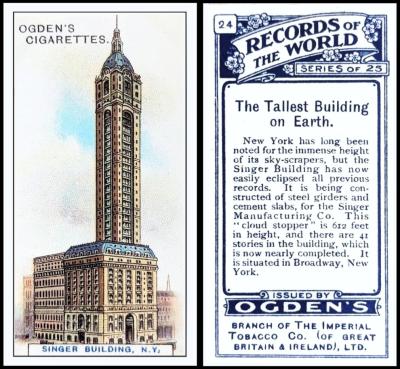
Our second clue card, was indeed a February set, and it seems to be a very little known one indeed, though the subjects are really interesting - and not all buildings, for there are trains, cars, and ships. The set is a short one though, just twenty-five cards, which seems odd, as there were surely at least twenty-five more to make it a fifty.
As to why we chose this card, it is because this is the Singer building, and, although not mentioned on the card, this was the Singer who made the sewing machines, and issued those lovely large format cards that many of us collect. It was built in New York in 1896 by architect Ernest Flagg, as the headquarters of that Singer Sewing Machine Corporation, and, thanks to an extension, a decade later, once the tallest building in America - at 630 feet - with only the Eiffel Tower being higher on a worldwide scale (984 feet). And it remained America`s tallest building from 1908 to 1909, when the Metropolitan Life Insurance Company Tower was topped out at 699 feet.
In fact our structure was two buildings in one, as you can see on our card - a bottom section, called the Singer Building, and the Singer Tower, with a lantern and flagpole on top, mainly to add to the height .
The tower was opened to the public on May the 1st, 1908. However, in 1921, the entire building was put up for sale. It was sold, in 1926, to a shadowy figure, said to be acting for the Utilities Power and Light Corporation, but this sale seems to never have gone through, and in 1961, when it was sold, to Webb and Knapp, a real estate firm, it was sold by Singer.
These new owners started people worrying, that the building would be radically altered, changing the skyline for ever, and petitions and campaigns began. These got it classified as an important building, but for some reason it was never registered on the list of New York City landmarks. In any event, Webb and Knapp, despite their business, made no attempt at developing the site, only stating that they hoped to interest the New York Stock Exchange to move there. But when this did not work out, by 1964 they sold the building, to United States Steel, which, quite wrongly, stopped the protests - for, in 1967, United Steel had it demolished, along with the City Investing Building, and replaced with an office block, known today as One Liberty Plaza.
This set first appears in our original reference book to the issues of Ogden`s Ltd, RB.15, published in 1949, as :
- 145, 25. RECORDS OF THE WORLD. Fronts lithographed in colour. Backs in blue with descriptive text. Home issue, 1908.
Its next entry is in our original World Tobacco Issues Index, where the description is altered, and slightly shortened, to :
- RECORDS OF THE WORLD. Sm. Nd. (25) ... O/2-112
And this is identically listed in our updated World Tobacco Issues Index, as :
- RECORDS OF THE WORLD. Sm. Nd. (25) ... O100-450
Monday, 26th January 2026
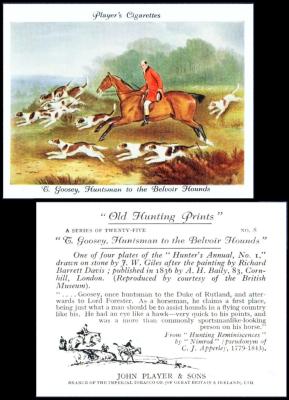
This is one of the sets that I am not fond of, but this scene of the huntsman with his hounds could be innocent enough, and I will just hope that every fox they hurtled after that day managed to get away and laugh from the safety of their lair. And I was also able to write it up to tell the story of the painting, which I found very interesting, and I hope you will too.
But I still say this is a very dated set to have been issued as late as 1938, unless it was as a lament for the country ways in general, which were already dying out, and were set to disappear entirely with the coming of yet another war.
There is something very unusual about this card, for the image is much lightened up from the original, which you can see as part of the government`s art collection. Actually, as it tells us on the back of the card, it was "One of four plates of the "Hunter`s Annual, No.1", drawn on stone by J. W. Giles after the painting by Richard Barrett Davis : published in 1836 by A. H. Baily, 83, Cornhill, London (Reproduced by courtesy of the British Museum)".
John West Giles specialised in painting sporting and animal subjects, but very often, as in this case, they were copies of contemporary works. We think he was related to, perhaps even the brother of, James William Giles; both lived together in Aberdeen, in the late 1820s, early 1830s and the similarity of the initials is also often a clue. However our man was in London by the end of the 1830s, and though we know he did return, he never again used an Aberdeen address. We also know that he knew Richard Barrett Davies, the artist of the original work, quite well, as the two collaborated on "The Hunter`s Annual, No.1".
Richard Barrett Davis was born in Watford, which was, at that time, very rural. His father was a huntsman with George III`s pack of hunting harriers, and that is probably how George III saw some of our man`s art and placed him with a succession of art tutors, ending up at the Royal Academy, where he first had a painting exhibited in 1802. Then, in 1831, he was appointed Animal painter to the Royal Household, originally for King William IV, and later for Queen Victoria. Our painting was drawn for, and perhaps commissioned by Lord Forester, and more about him later.
The other name mentioned above is "A. H. Baily, 83, Cornhill, London". They were printers and publishers, and are best known today for their publication of "Baily`s Monthly Magazine - Sports and Pastimes" which began in 1860.
The only person who is rather sketchy is the subject T. "Thomas" Goosey. All it says on this card comes from a book called "Hunting Reminiscences" by `Nimrod` (pseudonym of C.J. Apperley, who was born in 1779 and died in 1843). The quotation is "...Goosey, once huntsman to the Duke of Rutland, and afterwards to Lord Forester. As a horseman, he claims a first place, being just what a man should be to assist hounds in a flying country like his. He had an eye like a hawk - very quick to his points, and was a more than commonly sportsmanlike-looking person on his horse."
From the front we know he was attached to the Belvoir Hunt. This was in Leicestershire, and was run under the control of the Dukes of Rutland. Thomas Goosey joined the Belvoir in 1817, and stayed until 1841, and he was succeeded by Will Goodall, who took over in the following year, staying until 1859. The only time, right up until 1896, that a Duke of Rutland was not in direct control was between 1829 and 1859, when a nephew, Lord Forester, was appointed - and it is for that Lord Forester that this painting was done.
This set, or rather this pair of sets, first appears in our original John Player reference book, RB.17, as :
- 140. 25 "OLD HUNTING PRINTS" . Large cards. Fronts in colour. Backs in grey, with details of print and quotations in view. Issued February 1938.
A. Home issue, with I.T.C. Clause
B. Channel Islands issue, without I.T.C. Clause
By the time of our original World Tobacco Issues Index, in 1955, these two were no longer together.
The home issue is recorded under section 2 of the Player listings, for "Issues with I.T.C. Clause" and sub section B, for "Issues 1922-29, excluding cards with adhesive backs". And its entry reads :
- "OLD HUNTING PRINTS" . Lg. Nd. (25). See RB.17/140 ... P72-117
The Channel Islands issue is recorded under section 3 of the Player listings, for "Export Issues without I.T.C. Clause" and sub section C, for "Issues 1935-39. Chiefly in Channel Islands and Malta. Small size 67-68 x 35-36, large 79 x 82 m/m". And its entry reads :
- "OLD HUNTING PRINTS" . Lg. Nd. (25). See RB.17/140 ... P72-225
The above remains the same in our updated World Tobacco Issues Index, with the two issues remaining apart, but the reference to RB.17 being omitted in both cases, and the card codes having changed, to P644-242 on our home issued set and P644-682 on the Channel Islands version. There is also one more alteration, as after 1965 John Player again began to issue cards, and they were listed before the export issues, hence the Channel Islands version is now listed under section 4, and sub-section C
Tuesday, 27th January 2026
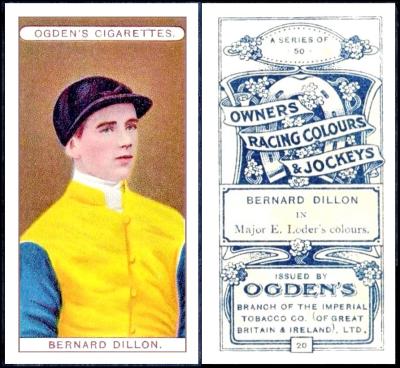
I am delighted to be able to feature this card of someone we mentioned before, and give him a face instead of just a name. For this is Bernard DIllon, the third husband of Marie Lloyd, the music hall star. However he was also a very famous jockey in his own right, having won the Derby in 1910, on a horse called Lemberg.
He was born on the 7th of September 1888, on a farm in Tralee, County Kerry, in the south west of Ireland, and started his racing career in 1901 when he joined his older brother Joe as an apprentice jockey at Druids Lodge, near Amesbury, in Wiltshire, England, run by Lord Cunliffe. His first major win came in 1904, on top of Uninsured, for Druids Lodge; and at that time he had the advantage of being very light weight, just over five stone. However we know that by 1905 he had filled out, as Taddy`s "Famous Jockeys", issued in that year, tells us that he weighed eight stone nine pounds, and was riding for Gilpin`s and Lewes stables. He was shown in the pink and black silks of Mr. Forester.
The following year, Cohen Weenen`s "Owners Jockeys Footballers Cricketers" series two, gives a bit more back story, and describes him as "B. DILLON, winner of many big Handicaps, including the Lincoln with "Uninsured" and the Kempton Park Jubilee Stakes, two years in succession, with "Ypsilant". He is first jockey to Major Loder." And the silks he is wearing on this card are indeed those of Major Loder.
Our set appeared the same year and he is in it four times - our card, number 20, which describes him as "Bernard Dillon in Major E. Loder`s colours" - card 25 as "Bernard Dillon in Mr C. Hibbert`s colours" - number 33 as "Bernard Dillon in Mr. W. B. Purefoy`s colours" - and card 38 as "Bernard Dillon in Mr. E. A. Wigan`s colours"
He met Marie Lloyd in 1910, apparently at a racecourse, whilst her current husband, Alec Hurley, was off placing bets. She was eighteen years his senior, and seems to have moved herself in with him not long after.
In 1913 it was discovered that he was entangled with gambling, placing bets using inside information, and, so rumours go, on himself to lose. The Jockey Club want as far as taking him to court, so we know it was not innocent gaming. His punishment was to have his racing licence revoked, on which he resigned from the Jockey Club. By this time he was openly living with Marie Lloyd, and she took him to America where she had bookings for work. This caused more trouble, for they went there using the (false) names of Mr. & Mrs. Dillon. In fact when the truth broke they were charged with crime of moral turpitude, and briefly detained at Ellis Island, until they could pay for their release.
They were not actually married until 1914, two months after Alec Hurley`s death, of pneumonia, just two months before, at a public house, Jack Straw`s Castle, in Hampstead, London, though it is not as quite as bad as that sounds, for he was also living there. The marriage, his first, her third, took place in Oregon, America, but it was doomed from the start; Bernard Dillon already being abusive, depressed, and jealous of his wife`s success.
Around this time, also in 1914, Bernard Dillon appears on the anonymous and untitled set known as "Jockeys & Owners Colours" with a playing card inset on each one. It was actually issued overseas through British American Tobacco. The horse is unidentified, but he is shown in white silks with orange sleeves, and the caption top right is "Jockey : Bernard Dillon / Colours : Mr. Fairie" Mr. Fairie was a pseudonym for Alfred William Cox, a racehorse owner and breeder of Scottish descent, who was born in Liverpool, and one of his horses was that Derby winner Lemberg.
He also went off to war, but apparently most of his service was in England, at the Machine Gun Corps training depot at Belton Park. His service was marred by his often getting into trouble, going absent, and not helped at all by his wife frequently turning up, which generally ended in rows. However when he returned to her home things got much worse, and she was forced to take him to court for continued abuse. In June 1917 he was sent to prison for assaulting her whilst under the influence of alcohol, blackening her eye. When he was released, she took him straight back, and they remained together, until 1920, when they separated, briefly, but she fell into a great depression and took him back. They were still in a state of back and forth when she died on the 7th of October, 1922,, three days after collapsing on stage at the alhambra Theatre in London.
In 1923 he appears as card 16 of Godfrey Phillips "Derby Winners and Jockeys", in a bit of a retrospective, for the text reads : "Has retired from the saddle for some years. Was first jockey for Clarehaven Lodge stable, succeeding Willie Lane, was associated with the peerless Pretty Polly in several of the victories scored by the late Major Loder`s wonderful filly. Won the One Thousand Guineas on Flair, owned by the late Sir Daniel Cooper, in 1906, the Derby on Lemberg, in 1910, for Mr. Fairie. Bernard Dillon rode the winner of many of the biggest handicaps, one of his most powerful finishes being on Hammerkop in the Cesarewitch of 1905."
In fact card 15 of this set shows Lemberg, who is immortalised as : "Lemberg, owned by the late Mr. Fairie, made his first appearance as a two-year-old when winning the New Stakes as Ascot in 1909. His great rival as a three-year-old was Neil Gow, owned by Lord Rosebery. Few will forget the great finish for the Two Thousand Guineas at Newmarket in 1910, when Lemberg lost to Neil Gow by a head. His revenge came in the Derby which he won easily with B. Dillon up. Neil Gow (D. Maher) being unplaced. Lemberg failed in the St. Leger, being beaten by Lord Derby`s Swynford. Has been a great success at stud."
Bernard Dillon faded from the headlines and the high life. He died on the 6th of May, 1941, whilst at work, as a night porter at South Africa House in London, aged just fifty-two.
He was buried at West Norwood cemetery, far away from home.
Bernard Dillon is on the following cards
- Taddy "Famous Jockeys" Blue Letterpress - unnumbered (1905)
- Cohen Weenen "Owners Jockeys Footballers Cricketers" series 2 - unnumbered (1906)
- Ogden "Owners, Racing Colours & Jockeys" - number 30 in yellow and blue silks (February 1906)
- Ogden "Owners, Racing Colours & Jockeys" - number 38 in white silks (February 1906)
- Smiith "Derby Winners" - number 48 (1913)
- Anonymous / British American Tobacco "Jockeys & Owners Colours" - untitled - the nine of clubs (1914)
- Godfrey Phillips "Derby Winners and Jockeys" - number 16 (1923)
- John Player "Derby and "Grand National Winners" cards - number three (1933)
- John Player "Derby and "Grand National Winners" transfers - number three (1933)
His brother also appears, as part of Cohen Weenen`s "Owners Jockeys Footballers Cricketers" series 3 -issued in 1907, where he is described as "J. Dillon (brother of the well known flat race jockey Bernard Dillon) is one of the many able Jockeys that Ireland have given us. He is as clever over the sticks as his brother is on the flat"
As to our card, there turns out to be two sets with this same name, and both are described together in our original reference book to the issues of Ogden`s Ltd, RB.15, published in 1949, as :
75. OWNERS, RACING COLOURS & JOCKEYS. Fronts lithographed in colour. Backs without descriptive text. Home issues.
- 129. "A Series of 50". Jockeys in colours on fronts, blue backs with Jockey and Owner`s names. Issued 1906
- 130. "A Series of 25". Jockeys in colour and Owners on fronts. Green backs. Issued 1914.
By the time of our original World Tobacco Issues Index, in 1955, the two are still together, but entered as :
- OWNERS RACING COLOURS & JOCKEYS. Sm. Nd. (50). Back in blue ... O/2-108
- OWNERS, RACING COLOURS & JOCKEYS. Sm. Nd. (25). Back in green ... O/2-109
And these two listings remain both identical, and together, in our updated World Tobacco Issues Index, save for having new card codes - our blue back issue now being O100-440, and the green back version being O100-442
Wednesday, 28th January 2026
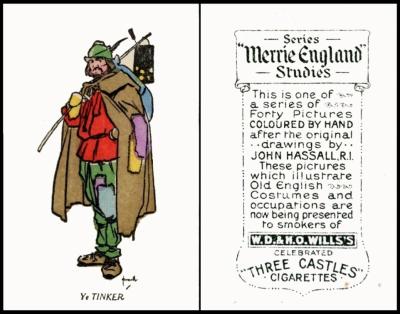
Out of all these cards, I went for the tinker. But what, you may ask, is a tinker? Well, originally it was someone who travelled around mending household utensils, using tin, primarily, but also other metals, and it seems to have been associated with travelling folk, as a way to make some pin money. We do not know when the name "tinker" was associated with mischievous children, but the trade would never have been something done by children, the working of the metal, and the ferocity of the heat, to say nothing of the skill involved to mend the items and know which metal to use.
This set was first described in our original Cartophilic Reference Book No.3, devoted to the issues of W.D. & H.O. Wills (or RB.3), published in 1942, as :
- 78. "MERRIE ENGLAND" STUDIES .Size 69 x 42 m/m. Unnumbered. Fronts printed from line blocks, in colour, after original drawings by John Hassall, R.I. There are TWO series, both General Overseas issues, between 1905-15.
A. MALE studies (titled "Merrie England" Studies). Series of 40. Fronts per Fig. 49. Backs in green, no descriptive text. Similar series issued by Westminster.
- Ye Angler
- Ye Armourer
- Ye Ballad Singer
- Ye Blacksmith
- Ye Carter
- Ye Cellarman
- Ye Cleric
- Ye Clerke-at-Law
- Ye Colporteur
- Ye Falconer
- Ye Friar
- Ye Gaoler
- Ye Haberdasher
- Ye Headsman
- Ye Highwayman
- Ye Innkeeper
- Ye Jester
- Ye Landlord
- Ye Leech
- Ye Lord of Ye Manor
- Ye Mendicant Pilgrim
- Ye Night Watchman
- Ye Page
- Ye Parish Clerke
- Ye Pedlar
- Ye Piper
- Ye Pirate
- Ye School Master
- Ye Sea Captain
- Ye Spicer
- Ye Squire`s Son
- Ye Steward
- Ye Tailor
- Ye Tinker
- Ye Town Crier
- Ye Traveller
- Ye Troubadour
- Ye Turnkey
- Ye Verderer
- Ye Weaver
B.FEMALE Studies (untitled). Fronts per Fig.50. Plain backs (anonymous issue). 30 subjects have been seen ;-
1. "Birch Brooms"
2. "Burgundies"
3. "Cockles & Mussels"
4. "Feather Whisks"
5. "Fresh Pastry"
6. "Gingerbread"
7. "Green Walnuts"
8. "Hot Chestnuts"
9. "Live Carp"
10. "Milko"
11. "Muffins"
12. "My Lady`s Maid"
13. New Laid Eggs"
14. "Posies"
15. "Prime Ducklings"
16. "Shrimps"
17.Spills and Dips"
18. "Spring Water"
19. "Sweet Lavender"
20. "Sweet Oranges"
21. "Sweet Violets"
22. "Toys"
23. "Wi` Rabbit"
24. "Ye Housewife"
25. "Ye Novice"
26. "Ye Nurse"
27. "Ye Pedlar"
28. "Ye Seamstress"
29. "Ye Sick Nurse"
30. " Ye Spinster"
However we know that the male part of the Wills version of this set was printed in England and issued in Australia in February 1915. As for the females, we know nothing, which means it was printed in Australia and the date of issue was not recorded.
In our original World Tobacco Issues Index, the following is listed under section 3 of the Wills entry, for "Australian Issues" -
- "MERRIE ENGLAND" STUDIES .Sm. 69 x 41. Unnd. (40). Wills` "Three Castles" back, See W/79.A ... W62-231
This is repeated in our updated World Tobacco Issues Index, save a new card code of W675-360
However both versions of the World Tobacco Issues Index only show a set of forty cards, and that is only the male studies. And if you look at the entry for the Westminster version, under W42-32, that is also only the males, for it reads : "MERRIE ENGLAND" STUDIES .Sm. 70 x 41. Unnd. (40). See W/79.A".
There is something else curious too, for the Westminster version of our set of male studies was issued first, in 1914 - and the backs of those cards are very similar to the Wills ones, with one exception, for the closing statement reads "The pictures illustrate Old English Costumes and occupations and have been copyrighted by Westminster Tobacco Co, Ltd. Cape Town & London" - whilst our cards say "The pictures illustrate Old English Costumes and occupations and are now being presented to smokers of W.D. & H.O. Wills`s celebrated "Three Castles" Cigarettes"
As for the cards showing the females, we have to adjourn right to the back of the original World Tobacco Issues Index to find those, listed under section three of the Anonymous issues, because of their plain backs. Their entry reads : "MERRIE ENGLAND" STUDIES .(A). Sm. 68 x 41. Female studies, inscribed Hassall. Unnd. (30). See W/79.B. Issued in S. Africa, through B.A.T. ... ZJ3-51." This entry is again repeated in our updated World Tobacco Issues Index, but with the new card code of ZJ03-495.
Moreover, with that South African connection, it definitely seems that they were follow ups to the Westminster issue, not to the Wills.
As for our artist, John Hassall, he was born in Walmer, Kent on the 21st of May, 1868. His father had been a Naval man, and had served in the Crimea, but was paralysed in an accident and died aged just thirty eight. John Hassall`s first published drawing was in the Graphic newspaper in 1890, and only then, aged twenty-two, did he study art, in Europe. In 1895 he started working for David Allen & Sons, the publisher, and it was during this time that he painted what is probably his most famous work, "The Jolly Fisherman", used as a railway poster, and better known with the title of that, which was "Skegness is So Bracing.." It can be found as card 20 of F. & J. Smith`s "Holiday Resorts". The "R.I." which follows his name is for The Royal Institute of Painters in Water Colours, who admitted him to their ranks in 1901 - but he was also a member of the Royal Society of Miniature Painters, and the London Sketch Club, which elected him President in 1903. He was married twice, and had two children, and he died on the 8th of March, 1948, aged seventy-nine.
Thursday, 29th January 2026
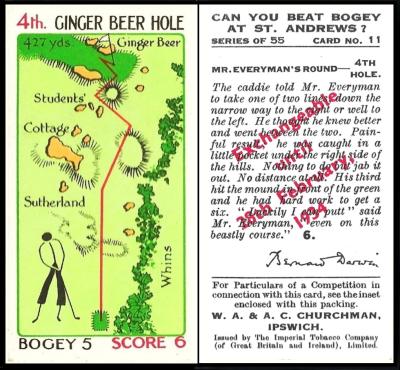
The first thing that any non-golfing readers is wondering is what, in golf, is a bogey. Simply put, it is a score of one stroke over par on any individual hole on a course - in other words if the hole is a par 4, that means you ought to get the ball in the hole within four strokes, but if you take five you have played a bogey.
As to how you play with these cards, I have absolutely no idea. But I am sure that one of you will not only know, but be able to tell us, in simple terms.
There is a question about this date of issue. We know that the set was originally issued in March 1933., without the overprint in red. This version arrived some time later, and was the exact same set, just with overprint across the top of the text, telling the smoker that they did not have long to complete their set. The debate is whether the overprint arrived in late January or early February, but I tend to feel February more likely.
The two sets are catalogued in our original Churchman reference book (RB.10) issued in 1948, as :
- 26. Mar.1933. 55. CAN YOU BEAT BOGEY AT ST ANDREWS ? (titled series). Size 2 11/16" x 1 7/16", or 67 x 36 m/m. Numbered 1-55. Fronts lithographed in colour. Backs in black, with descriptions. Printed by Mardon, Son & Hall. Note : FOUR joker cards can be collected, "Golfer with Halo" and "Bottle of Whiskey", each with (a) "Available at Bogey 3 Holes", and (b) "Only available...."
- 27. 1933. 55. CAN YOU BEAT BOGEY AT ST ANDREWS ? (titled series). Identical to item (26) but bearing inscription on back reading "Exchangeable until 28th February 1934"
This is slightly different in our original World Tobacco Issues Index, where the entry reads :
- CAN YOU BEAT BOGEY AT ST ANDREWS ? Sm. Nd. (55) ... C82-36
A. Set of 55 - alternatives at No.55, see RB.10/26
B. Overprinted in red "Exchangeable until 28th February 1934"
And in our updated World Tobacco Issues Index it has reduced still more, to just :
- CAN YOU BEAT BOGEY AT ST ANDREWS ? Sm. Nd. (55) .Alternative subjects at No.55 ... C504-430
A. Sm. (55) B. Overprinted in red "Exchangeable until 28th February 1934"
Friday, 30th January 2026
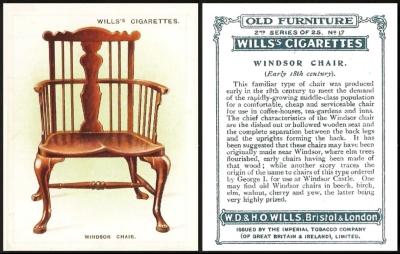
Here we have a chair which at one time was very familiar, but these days seems to have faded from fashion, like most chairs with hard wooden seats, for today comfort is the watchword, and even with a cushion, it is hardly a place to lounge long-term, when you could sink into a sofa. However they do regularly turn up at auctions and in antique shops, the first of which being, naturally, the cheaper option, should you be looking to purchase one for your home.
There are several theories as to why these are called "Windsor" chairs. Two of them are even mentioned on our card.
The first theory is that the "Windsor" part of the name refers to them having been "made near Windsor, where elm trees flourished". This may be true, but not where the style originated, for we know that this style of chair, with a solid wooden seat into which the back and legs are plunged, were made as far back as ancient times, primarily, at first, in the Land of the Pharoahs, Egypt.
As for the second theory, that they were "ordered by George I, for use at Windsor Castle", this fact is undoubtedly true, but the chairs were made in England long before George I was even born, and that they were also known as Windsor chairs.
However, they were not made in Windsor, but in Buckinghamshire. At first, in the 1700s, it was a rural craft, made by one or two men in a certain area for their village, and often these could mend the chairs as well. A century later, it seems that the chairs were High Wycombe`s major industry, and, by the 1840s, its largest employer, for it was very much piece work, one man turning the spindles, another making the seats, and another collecting and constructing the parts to make the chairs. Once assembled, they would go off to market, especially in Windsor, and hence that geographical name became attached to them.
As to why High Wycombe became the centre, it was purely through geography. The Chiltern Hills were primarily beech, ash and elm. And that brings us neatly back to the card, where it states that they were "made near Windsor, where elm trees flourished".
By 1860 there were hundreds of chair workshops across the town of High Wycombe, and within twenty years almost five thousand chairs a day could be assembled. This was mainly due to the employment of former farm hands and rural workers, who were enticed in by higher wages and made the town`s population almost double by the turn of the twentieth century.
To our card, and there seemed something odd about this chair, because I was not, at first, sure it was a "Windsor" chair at all. You see traditionally the back spindles of the "Windsor" chair start at the base and slant to the head bar, like a fan, and none at all are straight, whereas our chair only has straight spindles. Not just that, but the wide centre bar is also not a feature commonly seen on a "Windsor chair". But after research I found that in the time of George I and George II that central spline was indeed part of the design, and the spindles did also rise straight to the top bar. I also now know that there are over 1500 different types of "Windsor" chair. So I have learned much tonight !
This set, and its younger sibling, were first catalogued in our Wills reference book part IV, as
OLD FURNITURE. Large cards, size 79 x 62 m/m. Fronts printed by letterpress in colour. Backs in grey. With descriptive text. Home issues.
- 278. “1st Series of 25”. Issued 1923
- 279. “2nd Series of 25”. Issued 1924
Series one had rather a short run, being issued in October, with Series 2 arriving in February, just four months later.
Our original World Tobacco Issues Index describes the pair as :
- OLD FURNITURE. Lg. Nd. … W62-161
1. “1st Series of 25”.
2. “2nd Series of 25”.
It is further shortened in our updated version, which combines the two series on to a single line. And the code is changed, to W675-202
So here I am, on Saturday afternoon, just finishing off the reference book data and adding the two lists of cards.
I`m now off to have a well earned coffee, the third of the day; the first being out of a jar at breakfast, the second being free at Waitrose and drunk after a particularly more-ish smoked salmon sandwich, and this one about to be extracted from my amazing coffee machine, but sadly its the last of the Bailey`s flavour pods that I bought myself for Christmas.
See you all next week, same time, same spot on the dial - and I really must look up who said that first....