
Welcome, dear readers, to what started out as a slightly truncated newsletter, without the last two days, but as a promised they were added on Saturday. This week has been quite a difficult one, with many medical goings on with mum, not just the usual carers, and district nurses, but several trips to hospitals, and these look set to continue for some time, until such time as it is deemed that things have reached a point where something drastic will have to happen by way of relocation, for her, and then for me. So there is a lot going on, and a lot in the planning stage, which must be tackled, even though there is no firm date of when, or even if, they will happen
The newsletter itself was not so bad. The first day started out as Lita Roza and I could not find a card, but then I found something else. Days two and three stayed as they were when I noted them down. However day four was a last minute change, though I was surprised how quickly I found a card for that once I had given up on the date I had started with. Day five did not change. However day six and seven were really hard to find anything for, though I think I have something pencilled in for them both now, but there is neither time to write them up or ask around for cards, though I will sort them out over the weekend. At least the major parts are here, and I hope you will forgive me for not actually finishing it all.
Website News
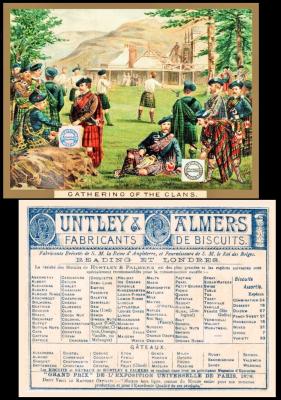
I have not had a lot of time to do much on the website, though I did persist in my attempts to find a different card for the Pitlochry Highland Games, this being for the Card of the Day for Wednesday the 11th of September, in the newsletter of the 14th of September 2024, which was the next in line to be indexed. The problem was that the card I used showed the Tug of War and I covered that elsewhere. My alternative thought was hammer or weight throwing, maybe even tossing the caber, for we only clued that with a tree, and I thought I had struck lucky with Wills "Sports of Nations" but each card has only two different brands, and not only are both the brands used for the caber are on this website already, neither of them was issued with a different second brand. Anyway this morning I was sent a scan of this, which I have hurriedly, and thankfully, put in place, so that newsletter is now, just as hurriedly, indexed.
As far as last week`s newsletter, not much was added after publication. There is now a breakdown of the actual series included in Garbaty`s "Die Eroberung der Luft", and the pictures for John Player`s Cycling and Anglo-Bellamy-Wilkinson`s "Mr. D.J." are much more to my liking.

Going back even further in time, and much aided by a reader, Alex Núñez, there is now a complete list of the cards for this German set, which first appeared in our newsletter of the 9th of August, 2025. The title has also been changed as I called it "Cathedrales", but on the cards it is actually "Kultstatten der christlichen Religion". I also used to call the issuer Erdal, or Erdal-Kwak, but I have become enlightened and now call them by their correct name, of Werner & Mertz, for "Erdal" is just the name of a shoe polish which is but one of their products.
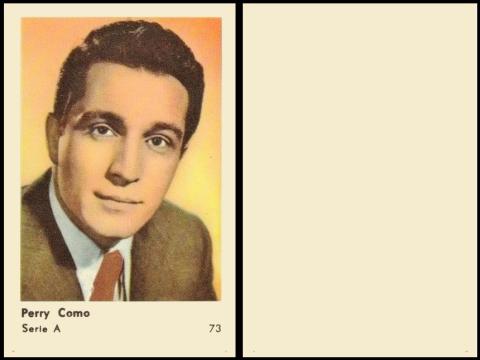
Anonymous [trade : gum : O/S - Holland] "Serie A" (1958) 73/198
Now I was contacted by a reader, who is rather a musicologist, about the piece I wrote about Glenn Miller as the diary date for the eleventh of February, in our newsletter of the 7th of February, 2026.
That segment celebrated the fact that on that day in 1942 the first ever "Gold Record" was presented by RCA Victor to mark the sale of over a million records of any one song, namely "Chattanooga Choo Choo", by Glen Miller and his Orchestra. You see that was given to Mr. Miller by his record company, so technically although it was a gold record, it was more of an "in house award", more for promotion - and there were several of these awarded by other record companies, who, it is said, were rather cavalier about the count up.
Then, in 1958, a group called the Recording Industry Association of America decided that things had to change. They published their plans in "Billboard" magazine, in the edition dated February 24, 1958, and said that they had developed a system for accurately auditing and certifying a millon or more American sales of any one American produced "single" (albums were not eligible), and that they intended to start to issue an official certificate. Now there was a down side to this, as the record company had to ask whether their record had reached the numbers required for the certificate, and the asking had to be accompanied by a payment, of $350, which was not refundable in the event that the record had not yet reached those sales.
Yet, for some reason, the idea took off, possibly because of the fact that today, in 1958, the announcer Frank Gallop suddenly appeared on the Perry Como Show, and presented a gold record to the singer, for his recent release "Catch A Falling Star", though never is it mentioned that it is from the Recording Industry Association of America. And you can see that very show, which lasts for just under an hour, on YouTube.
Perry Como was born Pierino Ronald Como on May the 18th, 1912, one of whom would eventually be a family of thirteen children born to a couple who had emigrated from Palena, Italy, in 1910. It sounds like their life was not easy, for the father worked at a mill, and then opened a barber`s shop; but the children, all of them, were happy and encouraged, though not pampered, and Perry Como frequently spoke of how when he wanted extra music lessons he had to get a job, in addition to helping at the barber`s shop. When he was just fourteen, his father fell ill, it would later be diagnosed as a problem with his heart, and was very serious, so much so that he relinquished the barber shop to his son.
Then, in 1932, for some reason, I presumed because his father had died, but that is not the case, Perry Como moved out and went to live with an uncle, who was also a barber. He seems to have been the life and soul of the party, and frequented lots of local bars and clubs, and at one of these he almost forced his charge to get up on the stage. Despite his initial fears, he sang well, so well that the singer offered him a gig, which he discussed with his father, and, equally surprisingly, his father gave him his blessing. His fiancee was less keen, but she agreed to go with, and so they were married, on July the 31st, 1933. However, she does not appear to have gone with him, so maybe it was more a case of making sure he was hers before he went on the road.
The tour led to lots of opportunity, and he sang with many bands. He did not return home until 1935, and then he was in and out pretty much continuously, though he did have a child, a son, in 1940. For a short time both his wife and child travelled with him, but again she decided it was better to go home, and he followed her, albeit two years later. Eventually they would have three children, a daughter and two sons.
Once home, he was offered a radio show with CBS, which he took. His first gig was in March 1943, but before the month was out he had signed with R.C.A. Victor, where he would stay for forty-four years, almost worth a gold disc on its own. He seems to have been as friendly and affable in real life as he appeared, and his television shows, where he introduced other new and seasoned acts, and had little chats, were amazingly popular. And he is one of the few people to have three different stars on the Hollywood Walk of Fame, one for music, one for radio, and one for television. He did, however, also appear in films, for Twentieth Century Fox, four of them, mostly musicals, plus one for Metro-Goldwyn-Mayer, again a musical, but he did not enjoy them, believing, and probably rightly, that he was only there to bring the teenagers in, for he was quite an idol at that time. He liked television a lot better, for it was, primarily, an extension of him, being himself, and chatting with guests.
His later years were marred by the death of his beloved wife in 1998, after they had been married for sixty-five years, and by his own treatment for bladder cancer and diagnosis of Alzheimers disease. Yet he died, peacefully in his sleep, aged eighty eight, on May the 12th, 2001, and was buried with his wife in Florida
The general belief, and probably rightly, is that his first card was issued by the Peerless Weighing and Vending Machine Corporation, in America, as part of a set called "Engrav-o-tints Portraits of Movie Stars". In fact there were two sets, one being decidedly redder in hue. Both cite "RCA Victor Star" though, so though the cards began to be issued in 1940, we know his must have been added to the list after or during 1943.
Most of his cards were issued anonymously, with gum, in Holland and Europe, the exception being the 1960 black and white, plain backed, set of "Red Letter Pop Artistes & Film Stars" issued, anonymously, by D.C. Thomson. He seemed to fall out of favour with cards in the mid 1960s, and only reappeared after the millennium when modern issuers rediscovered singers of the 1950s and 60s and included him to their repertoire.
Our set seems to also have been issued a year earlier, with a printed back, by Hellas. In that version it is exactly the same pose, and number 73, as well as being cited as "Serie A". Hellas is a very elusive manufacturer but it turns out they were from Turku, in Finland, and they issued chewing gum. "Jenkki" was actually first sold in 1951, and was an immediate success. As for the name, it is Finnish for Yankee, and refers to all the Americans who introduced the habit to the locals. The picture, but slightly darker, is also used on another anonymous Dutch set, known as "Set 9" or "Set X"
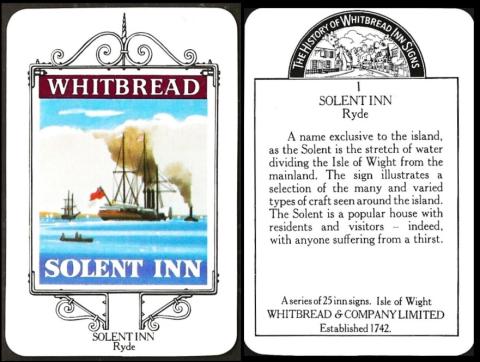
Whitbread & Co. Ltd [trade : breweries : UK] "The History of Whitbread Inn Signs - Isle of Wight" - medium size (1974) 1/25 - WHI-120.3 - WHI-2
Today marks the centenary of the first car ferry to travel from Portmouth on the UK mainland, sail across the Solent, and disembark her passengers at Fishbourne - and it is the location of that disembarkation point which gives us that centenary.
It seems that as long as people have stood in Portsmouth they have been gazing across at the land beyond the sea. And so we do not know who the first person was to set sail across the water, nor even the name of the person who made it all the way. The first record comes centuries later, when the Lord of the Manor in Ashey, pretty much part of Ryde, was said to be responsible for any boats making the crossing between Portsmouth and Ryde, However right until the end of the eighteenth century the ferry relied on local fishermen, who could be summonsed at any time to make the crossing, and if they did not, they would be fined.
The first actual, purpose built, Isle of Wight ferry boat, was built in 1796. This was called "The Packet", and within fifteen years it was making two return trips every day, though it subjected its passengers to the considerable indignity of being carried across the sands to the town, because the boat could not get near enough to shore. This problem was solved in 1814, by the opening of the Ryde Pier, which met the ferry in the water - and which we waxed lyrical of in our newsletter of the 26th of July 2025 as our diary date for Saturday, the 26th of July.
Three years later sail gave way to steam, with a new ferry "Britannia" but she did not last too long, and I am not sure why, as all that is listed is "unsuccessful experiment". By the 1820s, there were also rivals, operating from and to other areas, and it was to combat this that the Portmouth and Ryde Steam Packet Company was founded in 1827, though it had stiff competition, including from other companies running ferries along the same route.
Then, today, in 1926, the service moved from Ryde to Fishbourne, starting with a tug boat, the `Adur II` which pulled three wooden boats in its wake. It could carry sixteen cars and a hundred passengers. This is often quoted to have been the first ever purpose built car ferry in the world, but that is wrong, because in 1871 a steamship called `Suhulet` started a regular service taking cars across the Bosphorus in Istanbul.
Now I have cheated here a bit, because if you hunt fast you will find this card elsewhere, but it was a bit of a tangent at that place, for the diary date was for the Battle of the Isle of Wight, in 1545, and I managed to find a card of that actual event, though I have not locked it in to that place yet, thinking it is more important to get this newsletter to bed than to tinker with an old one.
As far as this set, it is kind of a re-issue of the original ones on aluminium and on card, which were first issued in 1949. These ones are, if you look closely, titled as "A History of Whitbread Inn Signs" and we speak of them in greater detail with our current home page for those later sets, which also holds the full listing of all the sets in that date range.
This set, of twenty-five cards, includes the following inns :
- Solent Inn, Ryde
- White Lion, Arreton
- Sloop Inn, Wootton Bridge
- The Griffin, Godshill
- Bugle Hotel, Newport
- Boniface Arms, Ventnor
- Fighting Cocks, Arreton
- White Hart Inn, Havenstreet
- Wheatsheaf, Yarmouth
- Rose Inn, Ventnor
- The White Horse, Whitwell
- Shoulder of Mutton, Newport
- King Lud, Ryde
- Duke of York, Cowes
- Horse & Groom, Ningwood
- Royal Standard, Sandown
- Plough & Barleycorn, Shanklin
- The Vine, Newport
- Crab Inn, Shanklin
- The Red Lion, Newport
- Roadside Inn, Nettlestone
- King`s Head, Yarmouth
- Buddle Inn, Niton
- Castle Inn, Newport
- The Railway, Ryde
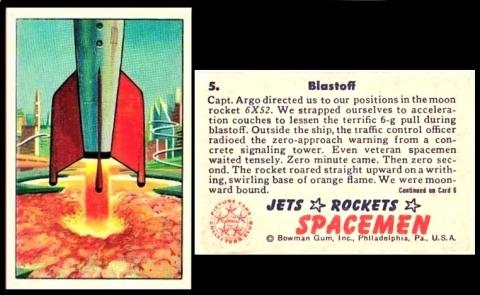
BOWMAN Gum Inc [trade : gum : O/S - Philadelphia, USA] "Jets, Rockets, Spacemen" (1951) 5/108 - R701-13
In another centenary, today, in 1926, saw the launch of the first liquid fuelled rocket. For that we can celebrate, or blame, Robert Hutchings Goddard, born in Worcester, Massachusetts, USA, on October the 5th, 1882. He started out by building standard solid fuelled rockets, with which he hit previously unimaginable heights, and speeds, and though he never lived to see it, because he died in 1945, without his work space travel may never have become possible, for as well as the liquid fuel, he invented the multi-stage rocket, gyroscopes, and steerable thrust propulsion.
His story begins in 1898, when he was sixteen, and when he suddenly discovered science fiction, and became obsessed with going to Mars. At first he confined his thoughts inside his head, but then began to write them down, and fairly quickly he was making rudimentary rockets, one of which exploded at his college.
He was still allowed to go on and teach, at the same place, and just after the First World War he published a paper about his ideas, which the general public found faintly ridiculous.
However, like everyone with a dream ought to, he kept that dream alive, and today, in 1926, he tested a proper liquid propellant rocket at his Aunt Effie’s farm. To everyone`s surprise, and probably his to, it raced into the sky, forty-one feet up, flew almost two hundred feet from the launching tower.
This brought him to the attention of Charles Lindbergh, who seems to have supported him morally and financially, and he also guided him to move, to Roswell, New Mexico, where he set up a laboratory and a testing field. And, once there, he was able to accomplish ever better performance, with many flights reaching an altitude above a thousand feet into the skies.
This kind of adds a whole new dimension to the Roswell "alien" story, and I have to wonder if maybe they were just innocently looking for him, so he could help them to mend their spaceship, before they were ruthlessly shot out of the sky.
But sadly he had died, and not too long before, on August the 10th, 1945.
This set was issued in 1951, and it is fascinating. You got six cards, and gum for five cents, and though the packet, it must be said, was rather uninspiring, the cards are bright and colourful, and seem to suggest that co-operation with the inhabitants of other galaxies will result in friendship, and bring us many benefits - though I am not so sure about those giant steam frogs. They also predict many things that came to pass - including space stations, and how drinking in space would be adversely affected by gravity. They are much different, in that, to the "Mars Attacks" and other cards that would come later, and treat other races as something to be feared and destroyed before the predictions on the cards could come true.
It appears that this was intended to be a much longer set, but some of the artwork went missing before the cards on it could be produced. Some of it did turn up, and much later, but not all of it, only that for the last thirty-five cards, numbered 145 to 180, and these were produced by WTW Productions. They did a very good job, and at the same time also reprinted the original one hundred and eight cards uniform with the ones that were lost - and the cards are clearly marked with "Reprinted 1985 WTW Productions", so close to the title that it could not be cut off and the reprints sold as originals. All in all it was an excellent production, and it meant that a while new generation got to see, and own, a set of cards that they may otherwise never have done.
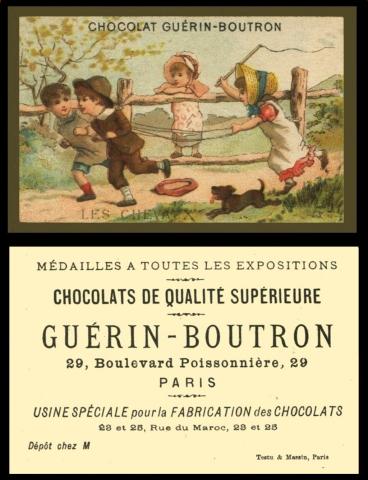
GUERIN-Boutron [trade : chocolate : O/S - Paris, France] "Jeux de Plein Air" / outdoor children`s games (1900?) Un/?
Catherine, or Kate, Greenaway was born today in 1846, in Hoxton, London, making it her one hundred and eightieth birthday. And I am sure she would doubtless be delighted to find, and maybe even to receive a card showing her charming, yet old fashioned children, for they are still just as popular today.
Her artistic talent almost certainly came from her engraver father, it just went off at a tangent. In fact her father was quite famous, and did the illustrations to a reprint of Charles Dickens` "Pickwick Papers". Unfortunately, despite his hard work, the publisher went bankrupt, and the work was neither seen, nor paid for. In order to save the family, Mrs. Greenaway opened a dress shop, and relocated the whole family to the flat above. Here she would make, mend, and retail primarily children`s clothes, and slowly the family got back on its feet, and Mr. Greenaway also recovered enough from his loss to go out and find other engraving work to do.
Catherine may have become a dressmaker too but for a chance discovery, that the South Kensington School of Art were giving evening classes to women, at Finsbury School. She took her first class at the age of thirteen, and though she found it rather boring, for it was mainly set up to train women to act as home workers, and copy patterns slavishly on to products, like a human conveyor belt, in 1864 she was said to be talented enough to rise above this, and enrol at the Royal Female School of Art, newly moved to Queen Square in Kensington.
Despite the innocence of her painted characters, she seems to have been quite forthright at the School of Art, even complaining as to why only men were allowed to draw actual nude models. In fact that was what led her to enrol at evening classes at the Heatherley School in Newman Street.
Her fellow students there were very much of the aesthetic, and included Walter Crane, who specialised in illustrating and writing books for children. She took to him straight away, and it seems that she originally only started to draw children to catch his eye, but sadly he already had an intended, who he would marry in 1871. It is said that this is why she never married, preferring to wait for him, but the truth is that she may have married eventually if she had lived longer; perhaps to John Ruskin, if he had been as interested in her as she was him, or even to Frederick Locker, a poet, with whom she frequently stayed, at both his home in Sussex and his summer residence in Norfolk, though he was also married, twice.
However, somehow her drawings of children were seen by someone else and she was commissioned to make a frontispiece for a book on children`s games. This was so successful that she was allowed to exhibit more, and that led her to the attention of publishers including Frederick Warne and Marcus Ward. Now Marcus Ward were a publisher, but not of books, of greetings cards.
That is really how most of her fame arose, though she did write and illustrate her own books too, starting with a book of verse, called "Under the Window - Pictures and Rhymes for Children" in 1879.
This set her off, and she wrote several books of verse and little stories, which were amazingly popular. She was admitted to the Royal Institute of Painters in Water Colours in 1889, and travelled to America, where her books had developed quite a following, to exhibit some of her drawings at the 1893 World`s Fair in Chicago, Illinois. And she bought a house, which she had specially rebuilt in Arts and Crafts style by Richard Norman Shaw, near Hampstead in London. Then, suddenly, in 1901, she died, from cancer, aged just fifty-five, which came as a great surprise to all her friends, as she had not told them of the diagnosis.
Our set is untitled but it has come to be known as children`s games, though that is a bit confusing as at the time of writing this we already have three children`s games sets by Guerin Boutron in our index. One of those is titled "Les Jeux d`Enfants" and has decorative borders to the front, and you can see that in our newsletter of the 7th of June 2025, as the diary date for Friday the 13th of June. The other has white borders and shows toys, though it is untitled, and you can see that as our Card of the Day for the 17th of February 2026. The card we show here is also untitled, but they are in a very Kate Greenaway style, and the name of the game, or pastime, is in large letters on the front of the card. They also have large gold borders, right to the edge of the card. And actually I have just found a couple online listed as "Jeux de Plein Air", or outdoor games, which does seem to fit, so far, anyway.
So far we know of
- En Promenade [boy and girl pulling cart with two boys and girl inside]
- Le furet du bois joli [six children sitting in a ring around a wicker basket]
- Le Gouter [a standing girl trying to feed one of three seated children]
- Les Chevaux [girl pretending to drive a carriage pulled by two boys]
- Les Petits Cadeaux [two seated children, one standing with toy lamb]
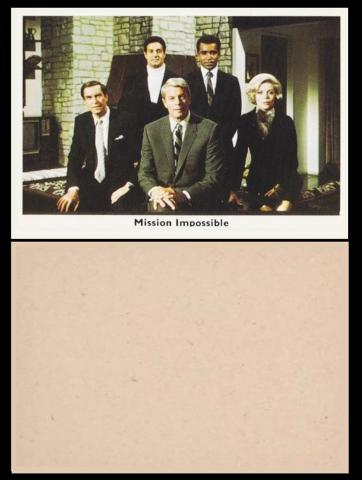
MONTY Gum "TV Shows" - series 4 (1968) Un/55
In yet another centenary, today in 1926 saw the birth of Peter Duesler Aurness, in Minneapolis, a brother to the three year old James King Aurness, who would find fame on television as Marshall Matt Dillon in the western series "Gunsmoke", using the pseudonym James Arness.
Our man graduated from high school in 1944 and then joined the Air Force. I am not sure what he did or where he was based but we know he appeared, uncredited, in a short subject, almost a recruiting film for the U.S. Army Air Force, where he is part of the bomber crew, so perhaps that was his job. We also know he was awarded the American Campaign Medal, which was given for service across the American mainland and territories, and frequently to people who had assisted in breaking up spy rings and saboteurs, who may otherwise have caused an invasion of America. He also got the Victory Medal, but all active members of the forces got that, just like the British version, it simply denoted that you served your country at some time between the start and end dates of the war. However, it did mean that he was eligible to go back to college and retrain for peace, in any subject you chose, and our man went to the University of Minnesota.
I am not sure what he was retraining to do, but somehow his paths crossed with motion pictures, and he decided to become an extra, in several movies between 1950 and 1952. Then he was given a part in "Stalag 17", quite a big one, as Sergeant Frank Price, who is finally accused of being the spy, and is shot almost as the closing scene.
He made a few more movies, but then decided to move into television, which he much enjoyed. His first big break there was as "Fury" and he appeared in a hundred and sixteen episodes, until the series had run its course, but he soon got another job in "Whiplash". After that he settled down to guest appearances, in such as "Route 66", and "The Invaders", until he was asked to play James "Jim" Phelps in "Mission : Impossible". That took him through from 1967 until 1973, and it was his favourite role, as well as the one he is most remembered for today. He was actually asked to reprise it in the 1996 tribute/remake starring Tom Cruise, and was interested to do so until he read in the script that at the end of the film he was revealed to be a traitor and murderer, and is killed in a helicopter crash. He felt that this was not in keeping with his character, and so he turned the part down. He also, reportedly, asked that the character was omitted, or at least renamed, but neither were done, and the part of Jim Phelps was played by Jon Voight.
The experience did not sour him from making films, and he continued to do so. Then, in 1980 he suddenly found fame with a part he thought was just a throwaway, the pilot, Captain Clarence Oveur, in "Airplane". This brought him to the attention of a whole new group of younger fans, and led to his appearance in the 1982 sequel as well. And he continued to appear on film and television until he died, on March the 14th, 2010, outside his home in Los Angeles, from a sudden, and massive heart attack, on the way back from a meal with his family.
Series 4, our set, was issued in 1968, contains unnumbered cards
- one card from "Big Top" (named as "Grand Chapiteau")
- six cards from "Forsyte Saga"
- three cards from "Gunsmoke"
- ten cards from "High Chaparall" (spelt wrongly, it ought to have been Chaparral)
- eight cards from "Huck Finn"
- one card from "Ironside"
- four cards from"Julia"
- two cards from "Mannix"
- ten cards from "Mission Impossible"
- four cards from "Rawhide"
The most important programme here is probably not the one you are thinking, it is "Julia". That aired from 1968 to 1971, and the "Julia" of the title was a nurse, played by Diahann Carroll, in what was the first television show to ever give a starring role to an African-American actress.
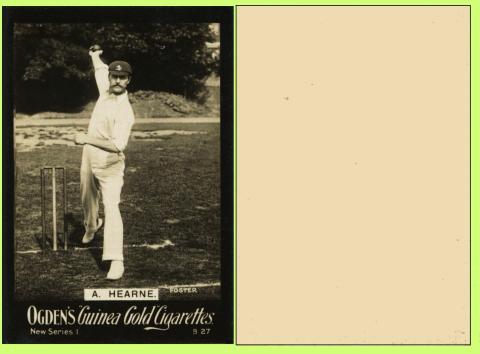
OGDEN`s Ltd [tobacco : UK - Liverpool] "Guinea Gold New series B" (1900) B.27/200
Today, in 1892, was rather a momentous day for cricket and for fraternity, for three brothers played cricket together, albeit not on the same side.
These were the Hearne brothers - George Gibbon, born on the 7th of July, 1856 - Frank, born on the 23rd of November 1858 - and Alec, who had been born on the 22nd of July, 1863. And even stranger, Frank Hearne took the field for South Africa, where he had relocated to on advice from a doctor, as he was unwell However the illness did not stop him playing cricket and he lived to be ninety years old. He was also the only one of the brothers who appeared in more than one Test Match. And in fact, before he emigrated, he played over a hundred matches for the England National Team.
In fact thirteen Hearnes played first class cricket, starting with Tom and George who were born in the 1820s. Then there was Tom`s son, George Francis, and George`s sons, George Gibbons, Frank, and Alec - plus, eventually George Francis` son Thomas John, and Frank`s son George Alfred Lawrence.
Another branch of the family included William, Herbert, Jack (who was born John Thomas), and Walter. And then there was a cousin of John Thomas` called John William, though he preferred to be known as Young Jack.
They all appear on cards, apart from George Gibbon, and sadly Frank only appears on more modern ones, the 1984 set of John Brindley "Cricketers" series 2, as card no.30, and the 1990 County Print Services "South African Cricket Team 1894", as card no.15.
That leaves us with Alec, whose first cartophilic appearance was in Wills` "Cricketers 1896". He then appears on several cards issued with Ogden`s `Guinea Gold` brand, and finally on Godfrey Phillips` "B.D.V. Cricketers", issued in 1932, some thirty years after the last of the Ogden`s ones. However he did appear on a curious little modern set, by Keech, of Spalding, which has a rather similar back to the 1901 series of Faulkner`s "Cricketers", a set also issued by A. Baker & Co. Ltd, Charlesworth & Austin Ltd, J. Gabriel, W. G. Glass & Co. Ltd, E. J. Newbegin, and I. Rutter & Co., as well as in two anonymous forms. But our card is what I wanted, something issued whilst the person on it was still alive.
As for our match, well that was played at Newlands Cricket Ground, in Cape Town, as part of an unofficial tour of South Africa, organised by Walter William Read, of his own team, in December 1891 until March 1892. He was also a cricketer and a good one, enough to play as Captain in two Test matches, to take part in the original "Ashes" series of 1882, and be named a Wisden "Cricketer of the Year" in 1893. The tour took place a couple of months after the British Isles had sent an official team to South Africa, which is now considered to be the first ever British Lions tour, and at the same time as another, official British team, captained by W.G. Grace, was out touring Australia and Ceylon.
For many years, Mr. Read`s team was thought not to count as an official Test, but more recently it was decided that it technically was, or at least the matches against the South African National Team were, the ones against Transvaal and Western Province still being debated.
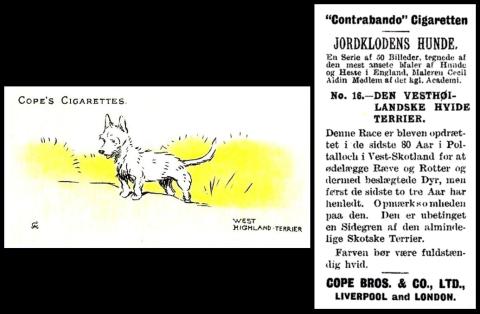
COPE Bros & Co. Ltd [tobacco : UK - Liverpool and London] "Jordklodens Hunde" / dogs of the world (1910?) 16/50 - C132-41
And so to finish off the newsletter for another week, we have a day I never knew existed until I found it, today, but which I really ought to have known, because the 20th of March, every year, is #NationalWestieDay, in honour of the West Highland White Terrier.
Oddly the date is in memory of Colonel Edward Donald Malcolm, the 16th Laird of the MacCullum-Malcom, who died on that day in 1930. Anyway Colonel Malcolm was the 16th Laird of Poltalloch, and so his dogs were called Poltalloch Terriers.
He was kind of a rival to George John Douglas Campbell, the 8th Duke of Argyll, who bred similar dogs by the name of Roseneath Terriers, after his castle at Roseneath - though it seems they got on quite well and even collaborated from time to time for the improvement of both breeds. Now we featured a Roseneath Terrier in our newsletter of the 2nd of December 2023, on Thursday the 7th of December.
There was a third breed in the mix, which originated with a friend of Col. Malcolm`s, a Dr. Flaxman from Fifeshire, and his dogs were known as Pittenweem Terriers. For some reason Colonel Malcolm, though he was Dr Flaxman`s friend, would not allow interbreeding between their dogs.
Anyway in 1903, Colonel Malcolm seems to decided to rename his dogs, and he called them West Highland White Terriers. The breed club was founded the following year, and George John Douglas Campbell, the 8th Duke of Argyll was its first president. In 1906 a second club was formed and the Countess of Aberdeen was elected in as the chairwoman. When she retired, Edward Malcolm took her place.
Then the two clubs seem to have become closer together, for the sake of the breed, and through their efforts The Kennel Club recognised the breed in 1907, allowing one to appear at Crufts Dog Show for the very first time. We know it did not win Best in Show as that honour went to a Pomeranian, "The Sable Mite", who had also won in 1905, the first year of the show.
We also know that the first champion West Highland White Terrier was called Morven; he was born in 1905 and owned by Colin Young, however he was registered as a Scottish Terrier, and as so he took part in the Scottish Terrier Kennel Club Show, but after he had won his owner was informed that his championship win would not stand.
The following year the West Highland Terrier was recognised by the American Kennel Club, though it took another year to get it into the Canadian one.
As for the first West Highland White Terrier to win Best in Show at Crufts, that was not until 1976, and a dog called Dianthus "Bobby" Buttons.
Our set is not the one you may have thought it was, and it is listed in our original World Tobacco Issues Index with the following header :
2.B. THE `CONTRABANDO" ISSUES. Danish language issues. Except for set C132-42, the series have the same fronts as the equivalent English Set in 2.A above, with backs reprinted in Danish.
- JORDKLODENS HUNDE (Dogs of the World). Sm. 69 x 36. Nd. (50) ... C132.41
In case you were wondering, set C132-42 is a set of Scandinavian actors and actresses, black and white, with plain backs.
That entry is exactly the same in our updated World Tobacco Issues Index, save a new card code, of C798-330
Sadly, nowhere in these books does it tell you that the dogs were drawn by renowned illustrator Cecil Charles Windsor Aldin.
This week's Cards of the Day...
This week we are going to look at two events to cheer us up.
The first is the publication of the World Happiness Report, on Thursday the 19th of March and the next is the International Day of Happiness on the 20th of March.
The World Happiness Report may sound flippant, but it is drawn up by the Wellbeing Research Centre, sited within the University of Oxford, and it is also authored in conjunction with the United Nations. There are events throughout the year, which are available through YouTube, and the calendar is also online.
Whilst the International Day of Happiness is also a United Nations Initiative; indeed they recognise that happiness is one of the fundamental human goals in order to achieve true well being.
Saturday, 7th March 2026

Our first clue card brought us footballer Kurt Zouma, but not just because he is smiling. The real reason he is here is that has a middle name, and it is "Happy", not because he was always a happy child, but because in Africa, where his parents are from, there is a rather wonderful tradition of giving children a middle name with a positive message.
This set is generally sold and catalogued as being by Merlin, but it was actually produced by Topps, which is clear from the reverse of the sticker, where it cites the website www.toppsfootball.com and also has the Topps logo in the bottom right hand corner. The packaging also has the Topps logo at the very bottom in the pink semi circle, as well as the back, which says, top right "Published by Topps Europe Ltd." and gives an address in Milton Keynes.
That packet also tells us that there were five stickers in each packet, so you can work out from there that it is quite a task to collect all three hundred and twenty-five cards, without a box load of duplication. When I saw the packets, I believed there to be an additional complication, for, though not mentioned anywhere on the actual stickers, the packet tells you that "Foil stickers are inserted 1 in every 2 packets". However these are not a separate, parallel set, they are the first two stickers in the set, which show a crowned lion`s head and the title of the set, and an outline drawing of the Premier League trophy - as well as the club badges for each page.
Sunday, 8th March 2026
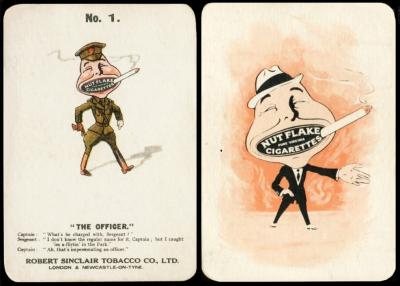
Our second clue is here simply because it is called "The Smiler Series", though I am not entirely sure that it is a smile, its more of a grimace, but perhaps that is because it must be hard to hold a cigarette in the corner of your mouth and smile at the same time !
This set was issued in two formats, and this is the larger version. If you want to compare it to the standard sized set, well we used that as our Card of the Day for the 4th of April, 2024. That smaller size is much more readily available than the larger ones and, curiously, it has the same image on the front, but only the wording "What`s The Joke? SEE OVER", whilst on the back is the a little wittiscism about the profession depicted. However on our larger card they have crammed the wording on the front beneath the picture, and then added a large image of a smiling man with the words "NUT FLAKE CIGARETTES" in his open mouth. I have no idea why they did this, for it is rather a strange use of the space - surely it would have been better to just make the picture larger on the front and the wording larger on the back ?
Our original World Tobacco Issues Index lists them as :
- THE "SMILER" SERIES. Caricatures, mouths inscribed "Nut Flake Cigarettes". ... S72-22
A. Small, 67-68 x 37. Back with series title, inscribed "This Series Consists of 24 cards." Nos. 1/12 only issued.
B. Large, 82 x 56, rounded corners. Backs with caricature of "Nut Flake" smoker only, no series title. Nd. (12)
The first thing I pick up from that entry is the fact that the back says it is inscribed "This Series Consists of 24 cards." Nos. 1/12 only issued". Indeed I have only found these twelve, in both sets, which are :
- The Officer
- The Diner
- The Angler
- The Cricketer
- The Irishman
- The Skipper
- The Lawyer
- The Scot
- The Temperance Orator
- The Old Gent
- The Witness
- The Street Urchin
As far as the other twelve, all I can think of is that there are two of each size, and that makes the twenty-four ? But if so you would have thought that fact would have been better explained - unless it was a deliberate deception to keep the collector hunting for those other twelve long after he had actually acquired a set.....?
Monday, 9th March 2026
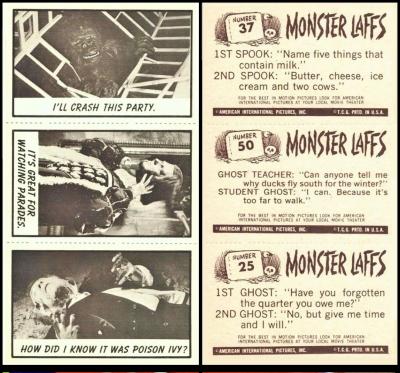
And thirdly, we had this card, simply for the title, of "Monster Laffs", though that is just the title on the reverse of the cards.
The back story turned out to be much more curious than I had imagined, and not only involved a larger version of these same cards, as singles, in black and white, but a link to the cult film maker Roger Corman !
However it seems that both versions are seldom seen - and that our version, in strips, is quite rare. So many thanks to the reader who sent this, uncut, strip, in for us to enjoy.
This smaller version, was the first to be issued, in 1963, and it was issued in strips of three really tiny cards. I have enlarged this one to show it off better. However if you look for them online it is harder to tell if it is a card cut from a strip or a larger card, so just bear in mind that the cards in this set are much browner than the later, larger, ones.
Those larger ones came along in 1966, and it looks like all the cards were re-issued as single cards, each one of which was the size of an entire strip. Like ours, the backs have a gravestone which is incised with "Monster Laffs", but the packaging bills them as "Monster Midgee Cards". And you got twelve cards for 5 cents, plus a piece of bubble gum, so they are true trade.
Both are from images supplied by American International Pictures, Inc., which was founded on April the 2nd, 1954, under another name, of The America Releasing Corporation. Their first film was "Operation Malaya", or "Terror in the Jungle", and though it was actually a documentary about the fight against Communism in Malaya, the poster makes it look more of a shock-horror-alien movie, which presaged their later output, for that was primarily low budget shock-horror-alien movies for the new "teenage" audience. Roger Corman started out with them and it is probable that some of his footage appears on these cards, and later on he would film many of the stories penned by Edgar Allan Poe.
Now I have not yet had time to check whether the two sets use the same pictures and numbering system, but I do know that there is a list of the large individual ones at Jeff Allender`s House of Checklists/MLS. He seems to think these were produced for Hallowe`en, as a bit of a cheap gimmick, and perhaps that is true, but once the artwork had been done Topps thought they could get double the value out of it.
Tuesday, 10th March 2026
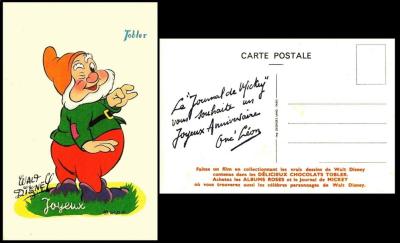
This is a very unusual set, as it turns out to have three issuers, and to be a twisted tale indeed.
You see the cards were originally issued by Tobler, with just the red wording at the bottom of the reverse. The wording reads : "Faites un film en collectionnant les vrais dessins de Walt Disney contenus dans les DELICIEUX CHOCOLATS TOBLER. Achetez les ALBUMS ROSES et le Journal de MICKEY ou vous trouverez aussi les celebres personnages de Walt Disney". That translates to "make your own movie by collecting the real Walt Disney drawings contained inside TOBLER DELICIOUS CHOCOLATES. Buy the PINK ALBUMS and the MICKEY Mouse Journal, where you'll also find the famous Walt Disney characters".
Both these other names are publications.
"Les Albums Roses" were books, published by an offshoot of Hachette, most notably of short, illustrated children`s tales, including Walt Disney characters, and they got their name because they had roses on the back covers and, originally, pink spines and endpapers - however that soon changed as they were prone to getting grubby. But they only began in 1950, with Snow White first being published in 1951, then her "return" in 1954 and her "Coronation" in 1955.
As for "Le Journal de Mickey" that was the first American styled comic to be released in France, under authorisation from Walt Disney himself, and the first edition was issued on October the 21st, 1934, however it was not until May 1938 that Snow White appeared, introduced by Onc` Leon. There was also a special issue, in colour, forty pages entirely devoted to to Snow White.
That might make you think that the wording on the card "where you'll also find the famous Walt Disney characters" refers simply to seeing them on the printed pages, but on some of these cards, like ours, the correspondence side of the reverse has been used, with a rubber stamped message saying "Le "Journal de Mickey" vous souhaite un Joyeux Anniversaire Onc` Leon". That, translated, actually means "Mickey`s newspaper wishes you a Happy Birthday [from] Uncle Leon". At first I thought that this meant "Le Journal de Mickey" just got hold of a lot of these cards and used them to send birthday greetings to subscribers, but maybe it means that the cards were given away with them too, and maybe, also, with "Les Albums Roses", and then, possibly, Le Journal de Mickey took the remainders and used them to send birthday greetings. And we also know that some of these birthday ones are also rubber stamped on the front, in black/grey with Mickey Mouse`s head and the word "MICKEY". At first it was thought that this was done in the mailing office, as the cards with it are usually postally used, but it turns out that some cards without an address and stamp also have this on them, so the plot kind of thickens....
We also do not know how many cards were issued, but we have so far found the following, which appear in several versions, as listed, including with and without a character name
- Atchoum, Dwarf [Sneezy] - playing an accordion
- Bruno - sitting on yellow mat with green border
- Capitaine Crochet [Captain Hook] - with large feather in hat
- Cleo - a rather flirty goldfish
- Daisy [Duck]- in blue and pink dress
- Dingo [Goofy] - playing baseball
- Donald [Duck] - in red sombrero playing guitar
- Donald [Duck] - in yellow sombrero
- Dormer, Dwarf [Sleepy]- on brown circular base
- Grand Chef - Native American in yellow coat
- Grincheux, Dwarf [Grumpy] - with mushrooms
- - unnamed, Dwarf, [Grumpy] - standing with arms folded
- Jiminy Cricket - with large shadow
- Joyeux, Dwarf [Happy] - facing to right, looking over shoulder
- Joyeux, Dwarf [Happy] - facing camera, hands on hips
- Le Lievre de Mars [The March Hare] - with birthday cake
- Lulubelle - with flower in hair
- Minnie [Mouse] - in blue spotted dress
- Mouche, Dwarf - in red striped t-shirt
- Mr. Toad - right arm raised
- Naf-Naf [Three Little Pigs] - building a brick wall
- Nif Nif et Nouf Nouf [Three Little Pigs] - as sailors dancing the hornpipe
- Pecos Bill - with gun on horse
- Peter Pan - in green flying through the air
- Prof, Dwarf [Doc] - yellow hat, with trumpet
- Prof, Dwarf [Doc] - green hat, arms outstretched
- - unnamed, Dwarf [Doc] - green hat, arms outstretched
- Simplet. Dwarf [Dopey] - in green with droopy candle
- - unnamed, Dwarf [Dopey] - in green with droopy candle
- Timide, Dwarf [Bashful] - in green with musical instrument
- - unnamed, Dwarf [Bashful] - in green with musical instrument
- - unnamed, Dwarf [Bashful] - in yellow on grass
- Timothy, [mouse] - as circus ringmaster
And if you know any more names, or variations, do please let us know
Wednesday, 11th March 2026
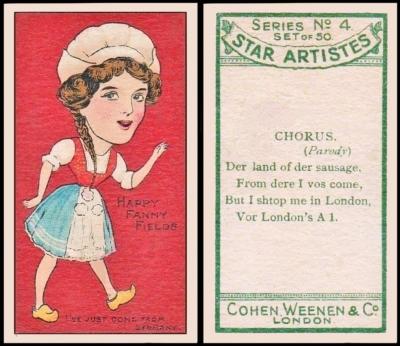
Our lady of today, billed as "Happy Fanny Fields" was born Fanny Furman, on September the 15th, 1880, in New York. Her parents were Jewish, of both Polish and German extraction, and there was theatrical blood too, with her brother becoming an actor, and her sister`s husband, Joseph Fields, being part of Gallagher and Fields, and yes, that is from where she took her stage name.
We know that she started on the stage very young, she says she was thirteen, but there is some evidence that it was earlier. She did it simply to help her parents, whose business, importing fruit, took a tumble. However she soon found she enjoyed it, and went off touring with a succession of companies. Then she came back and got a permanent gig as a Dutch girl in a play called "A Hired Girl".
In 1901, her mother died, and she decided to move to England, where she soon became a favourite. And she toured around the country, picking up new fans. She was billed as "The girl who is always laughing", and that led her, in 1905, to her first pantomime, "Mother Goose" at the Prince`s Theatre, Bristol. She played Mother Goose`s servant, Gretchen - and Mother Goose was played by another character from this set, Wilkie Bard.
This pantomime was important not just because it was her first, but because it gave her the grounds for her solo act, and new stage persona, Gretchen, a very naive young lady, with a most indecisive sweetheart called Schultz. Gretchen was, once more, Dutch, but Schultz was German, hence a lot of her verse, including the one on this card, seems to poke fun at the Germans, but it is in no way a war reference.
It seems that this card also shows Gretchen, but by the time the set was issued she had developed her act to include other characters, and she was a talented musician, and clog dancer, too. in 1906 she gained considerable notoriety (from her male audience) and praise (from the ladies) with a song called "The Suffragette", exhorting women to "stand up for your rights"
She continued to perform the length and breadth of Britain, and even appeared in a short silent movie, called "Happy Fanny Fields and the Four Little Dutchmen", in 1913. However in October 1913, she made her last stage appearance at the London Coliseum, then retired. In fact, it was not so much a retirement as a new life, as she got married, in New York, to gynaecologist Dr Abraham J. Roginsky, two years her senior, who, as Dr. Rongy, specialised in maternity and called for the legalisation of abortion. She became deeply involved in medical fundraising, even after her husband`s death in 1949. And she stayed in New York, dying, aged eighty, in 1961.
As for the personalities, this set has rather a unique claim to fame, because it contains both Marie Lloyd and her then husband Alec Hurley, in what appears to be his only cartophilic appearance. She met him in 1894, married him in 1906, and deserted him for Bernard Dillon in 1910, though she remained legally married to him right until his death in December 1913, and only after that decided she may as well marry Bernard Dillon. It also contains many other notable music hall and vaudeville stars, including Chirgwin, Harry Lauder, Little Tich, George Robey, Eugene Stratton, Vesta Tilley and Vesta Victoria.
This set is actually from a curious little group, just six sets, issued between 1904 and 1909, and all prefixed by "Series 1" to "Series 6" - but "Series 1" was not their first ever issue, because the company had been issuing cards since 1897 - and they would issue other sets, after "Series 6", without the "Series" or the number, continuing right up to 1926. It also leads to a spot of confusion because the top of every card says "Series No....", and a lot of people think this is the number of the card.
The group appears in our original World Tobacco Issues Index together. At the moment the only other one we have featured is Series No.5, so today`s card, being issued earlier, inherits the mantle of being the home page for the entire group. However once we feature series 1 this information will relocate there, and this and the other pages will only record the details specific to that set. By the way, they are not dated individually in the World Tobacco Issues Index list, we have added that. We will also include links in this list to the various sets, as we feature them, clicking which will whirl you to their page.
The group is therefore recorded as :
4. SERIES 1 TO 6. Issued 1904-09. Small size 63 x 35 m/m., unless stated.
- SERIES No.1 - NAVAL AND MILITARY PHRASES. Sm. 63 x 37. Unnd, (40). See H.14 ... C102-31 [1904] ... C102-31
- SERIES No.2 - OWNERS, JOCKEYS, FOOTBALLERS, CRICKETERS. Sm. Unnd. (50). See H.98 [1906] ... C102-32
- SERIES No.3 - OWNERS, JOCKEYS, FOOTBALLERS, CRICKETERS. Sm. Unnd. Inscribed "Set of 50", 20 only issued. See H.99 [1907] ... C102-33
- SERIES No.4 - STAR ARTISTES. Sm. Unnd. (50). See H.102 and Ha.102 [1907] ... C102-34
- SERIES No.5 - FOOTBALL CAPTAINS, 1907-8. Sm. Unnd. (60). See H.94 [1907] ... C102-35
- SERIES No.6 - WONDERS OF THE WORLD. Sm. Unnd. (30). See H.104 [1908] ... C102-36
This is slightly altered in our updated World Tobacco Issues Index, and now reads :
4. SERIES 1 TO 6. Issued 1904-09. Small size 63 x 35 m/m., unless stated.
- SERIES No.1 - NAVAL AND MILITARY PHRASES. Sm. 63 x 37. Unnd, (40). See H.14 [1904] ... C633-320
- SERIES No.2 - OWNERS, JOCKEYS, FOOTBALLERS, CRICKETERS. Sm. Unnd. (50). See H.98 [1906] ... C633-340
- SERIES No.3 - OWNERS, JOCKEYS, FOOTBALLERS, CRICKETERS. Sm. Unnd. Inscribed "Set of 50", 20 only issued. See H.99 [1907] ... C633-350
- SERIES No.4 - STAR ARTISTES. Sm. Unnd. (50). See H.102 and Ha.102 [1907] ... C633-360
- SERIES No.5 - FOOTBALL CAPTAINS, 1907-8. Sm. Unnd. (60). See H.94 [1907] ... C633-370
- SERIES No.6 - WONDERS OF THE WORLD. Sm. White border. Unnd. (30). See H.104 [1908] ... C633-380
If we look at the "H" codes, the first H.104 sends us to the handbook, which at the time of the original World Tobacco Issues Index was produced by the London Cigarette Card Company, and the entry for our set reads :
- H.102. STAR ARTISTES. (titled series). Fronts in colour ; front and back illustrated in "Notes and News", Volume 1, No.2. Issued by Cohen Weenen, inscribed "Series No.4". Unnumbered series of 50.
20 - with Stage backgrounds
1. Charles Bignell
2. Chirgwin
3. Whit Cunllffe
4. T. E. Dunville
5. Fred Earle
6. Daisy James
7. Neil Kenyon
8. Harry Lauder
9. Queenie Leighton
10. Marie Lloyd
11. Annie Purcell
12. Harry Randall
13. Phil May
14. Ada Reeve
15. Arthur Roberts
16. George Robey
17. Ernest Shand
18. Mark Sheridan
19. Little Tich
20. Vesta Tilley
30 - Plain backgrounds
21. Ben Albert
22. Wilkie Bard
23. George Bastow
24. George Brooks
25. Harry Champion
26. Dan Crawley
27. Leo Dryden
28. Gus Elen
29. George Elliot
30. Will Evans
31. Happy Fanny Fields
32. Harry Ford
33. George French
34. Hector Grant
35. Alec Hurley
36. R. G. Knowles
37. Geo. Lashwood
38. Sam Mayo
39. Victoria Monks
40. George Mozart
41. Michael Nolan
42. Pat Rafferty
43. Arthur Reece
44. Arthur Rigby
45. Austin Rudd
46. Ryder Sloan
47. Eugene Stratton
48. Nat Travers
49. Vesta Victoria
50. Charles Whittle
Their 1950 catalogue, uniform with the handbook, also tells us that they valued the two types, above, differently too, and sold them as separate sets, the catalogue entry actually reading :
- 50 Star Artistes - Series No.4 - Handbook Ref. H.102
20 With stage background, odds from 5/- to 15/- each, complete sets £15
30 No stage, plain background, odds from 2/6 to 7/- each, complete sets £12
The curious thing about this is that though our updated World Tobacco Issues Index still carries a Handbook reference of H.104, that number does not appear in our own updated handbook, it skips from H.103 "British Admirals, British Warships and Admirals" straight to "H.105 Boer War Celebrities - STEW"
Thursday, 12th March 2026
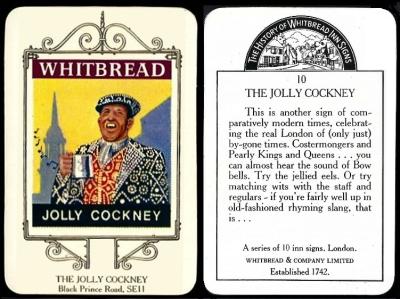
Here we have the "Jolly Cockney", at 49 Black Prince Road, London SE11. Oddly, for most of its life this public house was named the "Jolly Gardeners"; it was only renamed, briefly, to "Jolly Cockney" in 1968, and since then has gone back to its original title. As for the building itself, it was rebuilt in 1895, but there had been an inn here since the 1750s. And it has two claims to fame - one being that Charlie Chaplin`s father used to play the piano there - the other that Guy Ritchie used it to film part of "Snatch". I guess you show your age by whichever of these makes you the most excited.....
Our set first appears in the British Trade Index part III, along with three groups of 1950-1958 signs which had been discovered and/or produced after our second volume. Our group is described as
- The History of Whitbread Inn Signs. 76 x 50. Rounded corners, on board. Special albums issued, 1973-74. Eleven numbered series.
5. London (10)
However the "5" refers simply to the number in that list, it is not marked on the cards as series 5. And the "(10)" is the number in the set.
This varies very slightly in our updated British Trade Index, though the listing of the set numbers, after, is the same :
- The History of Whitbread Inn Signs. 1973-74. 76 x 50. Rounded corners. Special albums issued, 1973-74. Eleven series, all numbered.
5. London (10)
As for the ten cards in the set, they are :
- The King`s Head and Eight Bells, Cheyne Walk SW3
- The Tournament, Old Brompton Road, SW5
- The Sherlock Holmes, Northumberland St., WC2
- The Crown Tavern, Albert Embankment, SE1
- The Duchy Arms, Sancroft Street, Lambeth
- The George Inn, Borough High Street, Southwark
- The Nag`s Head, James St., WC2
- The Printer`s Devil, Fetter Lane, EC4
- The Gilbert & Sullivan, John Adam Street, WC2
- The Jolly Cockney, Black Prince Road, SE11
There is a bit of confusion though, as there is also another set of London Inn Signs on that list, item 6, and that contains fifteen cards. Until I did the list below, I was none the wiser why the London sets were split up, for I imagined that they were all different, but now they are listed here I can see it is, for the most part, the same cards, renumbered, with five few new ones, And they are :
- The King`s Head and Eight Bells, Cheyne Walk SW3
- The Tournament, Old Brompton Road, SW5
- The Sherlock Holmes, Northumberland St., WC2
- The Crown Tavern, Albert Embankment, SE1
- NEW CARD - The Escape, Mabledon Place, WC1
- NEW CARD - The Pig & Whistle, Bramley Road, W10
- RENUMBERED - The Duchy Arms, Sancroft Street, Lambeth
- RENUMBERED - The George Inn, Borough High Street, Southwark
- NEW CARD - The Lord Morrison of Lambeth, Wandsworth Road, SW8
- RENUMBERED - The Nag`s Head, James St., WC2
- RENUMBERED - The Printer`s Devil, Fetter Lane, EC4
- NEW CARD - The Finborough Arms, Finborough Road, SW10
- RENUMBERED - The Gilbert & Sullivan, John Adam Street, WC2
- RENUMBERED - The Jolly Cockney, Black Prince Road, SE11
- NEW CARD - The Pillar Box, Mount Pleasant, WC1
Friday, 13th March 2026
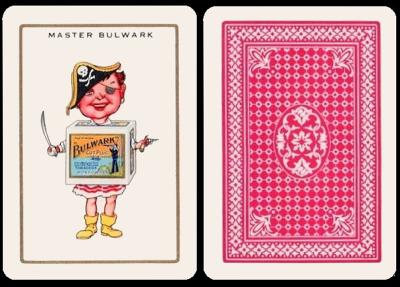
These cards would seldom have been seen by the general smoker of the 1930s, for they were only given to tobacconists and other retailers. And it is probably for that reason that they did not make an appearance until almost the end of the final volume of our original Wills reference book part-work, as number 374 of 383. buried amongst the export issues between the set of `Purple Mountain` "Roses" and the Australian set of "Islands of the Pacific". Perhaps it was even believed that because they were so scarce, they had been issued only overseas but we know now that they were indeed issued in the British Isles.
The description of them, in that volume, reads as follows
- 374. 32. HAPPY FAMILIES (adopted title). Large cards, size 91 x 63 m/m, rounded corners. Pack of 32 playing cards, fronts printed by letterpress in colour, each member of "family" with Wills` packing over body. Backs usual playing-card design in red. Packed in special cover headed "Wills` Happy Families Cards", inscribed at foot "I.T.C.10952" with I.T.C. Clause. Presumably given away as advertisements, about 1930.
8 Families, each consisting of four cards "Mr." , "Mrs.", "Master", and "Miss" : -
Surname Package advertisement
1. Bulwark "Bulwark" Cut Plug Tobacco.
2. Capstan "Capstan" Navy Cut Cigarettes
3. Cut Golden Bar Wills` Cut Golden Bar Tobacco
4. Goldfllake "Gold Flake" Cigarettes
5. Legation Wills Legation Navy Cut
6. Star Star Cigarettes
7. Viceroy Wills Viceroy Tobacco
8. Woodbine "Wild Woodbine" Cigarettes
Some of these families are, in addition, themed, the "Star" family being theatrical, and the "Bulwark" and "Capstan" families being connected with the Navy and the sea. And it is telling that on the "Woodbine" family, Mr. Woodbine is wearing a cloth cap, for those cigarettes were inexpensive, and primarily aimed at working class people - though we know that they were also the cigarette of choice of Prince Philip`s mother, Princess Alice of Battenberg.
In addition, today, some of the cards are more sought after than others, purely because they have a sporting theme, Master Cut Golden Bar being in hunting attire, Miss Cut Golden Bar playing tennis, and, especially, Master Woodbine, who is kicking a football.
In our original World Tobacco Issues Index, you will have to hunt still harder, for it is right at the very end of the Wills listings, in section 6.F, devoted to "Presentation Issues 1928 - 31", a slot it shares with three other sets, the curious, and very attractive, triumvirate of large sized issues titled "The British Empire", "Cities of Britain" and "Industries of Britain".
Our set is entered as :
- HAPPY FAMILIES. (A). Lg. 91 x 63. Unnd (32). See W/374 ... W62-553
This is the same in our updated World Tobacco Issues Index, save a new card code of W675-806, but they are now located in section 7.F, because of the issues that were circulated after the original World Tobacco Issues Index had been published. And there is a new section, after them, of three printed albums.
As for Thursday and Friday`s diary dates, they will appear tomorrow. As will any missing titling and reference book details - including the World Tobacco Issues Index data for Friday`s Card of the Day, which I just remembered I forgot.
Thank you, in advance, for your patience. And have a great weekend.