
Welcome to a new newsletter, which, for some reason, has a rather revolutionary theme!
Website News :
I did manage to crack on with indexing a few more back issues of the newsletter, though time was short. These were for the 2nd of December 2023, the 9th of December 2023, the 16th of December 2023, the 23rd of December 2023 and the 30th of December 2023. And that means next time we will be into November. But other than that little has changed.
What`s On This Week :
our regular round up reminder of our club and branch events...
Sunday the 10th of May - two meetings :
- Cheshire - at Larkhill Community Centre in Thorley Lane, Timperley WA15 7AZ from 9am until 1 pm. Admission £2
- Hants & Surrey - at Normandy Village Hall, Manor Fruit Farm, Glaziers Lane, Normandy, GU3 2DD from 1.30 to 4.30 pm. Free Admission.
Saturday the 16th of May
- East Anglia - at Roydon Village Hall, High Road, Roydon, Diss, Norfolk IP22 5RB from 8.30 am to 3.30 pm - with auction at 11 am. East Anglia club members free admission with annual subscription, visitors £3
And so on with our regular newsletter, starting with :
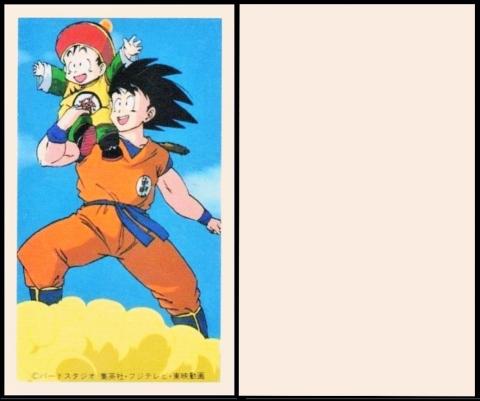
Just as I thought I would have to have a blank date, I was saved by a reader, a superhero that I had no idea existed, and a card that neither its owner or I know anything about. Maybe you can help with that one?
You see today in Japan it is Goku Day, and Goku is a character in Dragon Ball Z. Now for the uninitiated, Dragon Ball Z is a manga, a kind of adult comic, which sprang from the imagination of Akira Toriyama, and it was first serialised in 1984, in a magazine called Weekly Shonen Jump - a magazine which started in 1968.
Dragon Ball Z is heavily inspired by lots of things, starting with a sixteenth century adventure novel called "Journey to the West", (which was also used as the inspiration for a book and cult television series called "Monkey") and mixing in martial arts and the two best known protagonists of those martial arts, Bruce Lee and Jackie Chan.
As for Goku, or more correctly Son Goku, he starts out as a child, with a monkey`s tail, and slowly grows up. Now this is where it gets very strange, because in Manga characters generally do not age, at all. Along the way he meets a teenage girl called Bulma, who talks him into going on a quest to find seven orbs, known as the Dragon Balls, which, if brought together, summon a dragon. And off they go, finding other companions along the way, and getting into lots of martial arts mayhem. He also finds out that he is not of this Earth, he is really a Saivan called Kakarot from Planet Vegeta, who was, like Superman, etc, sent to this planet as a small child, to be saved, but also to be hidden from those who destroyed his planet. He is found, in his spaceship, by a man called Son Gohan, who takes him on almost as a grandfather, and calls him Son Goku.
This card shows Son Goku, as a child, complete with his monkey tail, but I have to say that if this is his grandfather he looks very young and not at all how I imagined him when the person who supplied this card was trying to explain the story!
As to why Goku Day is today, it is a bit of a play on words, because the fifth month of the year gives us the number 5, which in Japanese is "Go", and the day date gives us the number nine, which is Japanese is "Ku". If you put the two together, you get Goku.
The first set of cards to be devoted to the franchise was the Dragon Ball Z Trading Card Game, issued by Score Entertainment in the year 2000. However it was later sold to Panini. Then, in 2008, a different set was issued by Bandai, but it was rather shortlived and the cards ceased to be issued in 2009. In 2014 Panini suddenly re-issued the original game, as issued by Score, but updated, with input from a man called Aik Tongtharadol, who was the current Dragon Ball Z Card Collecting Game champion. His ideas led to a better game, and one on several levels, the rules were made much clearer so that it could be played quite easily by beginners, but new elements were added for professional game players. Then in 2017 Bandai returned with another set, the Dragon Ball Super Card Collecting Game.
None of those are the slightest bit like our card, which may be a packet issue as it is on quite thick board, but surely that board would be grey not pinkish. Anyway, over to you for the solution, please!
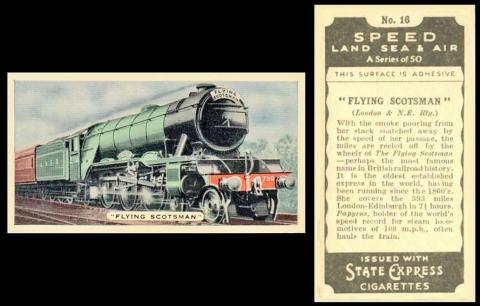
ARDATH [tobacco : UK ] "Speed - Land Sea & Air" - `State Express` brand (July 1935) 16/50 - A745-490.A : A72-37.A
I know I have mentioned The Flying Scotsman before, but this was too interesting a centenary to let pass by.
For today, one hundred years ago, today, whilst travelling on its usual route between Edinburgh and Kings Cross, it was derailed, by a group of miners, who pulled up the track just outside Cramlington in Northumberland. Of the almost three hundred passengers, only one was injured, mainly due to the quick thinking of a volunteer engineer who saw the missing rail out of the front of the cab, and quickly got the driver to slow the train. However, two of the carriages did leave the track, and overturned in the process.
At this point the stories differ. Some say that the miners were not intending to derail such a big prize, they were only hoping to stop a coal train, heading for the mine which had locked them out. Others say that tension had been growing for some time and they wanted to make a big statement. But maybe it would have been better for them if they had only hit a coal train, as eight men were sent to jail as a result, three of them for eight years, and the rest for lesser periods, miles away, in Kent, purely based on the fact they derailed the Flying Scotsman, whether they intended to or not.
This card took some finding, because there are actually two Flying Scotsman trains. Our more traditional one also features as card 20/25 of Churchman`s "Famous Railway Trains", the first series, in the large size, issued in 1928, as card 19 of Godfrey Phillips` "This Mechanised Age", first series, issued in 1936, and as card 44/48 of Gallaher`s 1937 set of "Trains of the World". Then there is a streamlined version, which arrived on July the 4th 1938, and which you can see on card 26/48 of Pattrieoux`s "Senior Service" set of "British Railways" issued in 1938.
Our set is one of an unequal trio, which I have not used before, and I now know that`s because its almost impossible to get the back to show up, its not only light grey, but the varnish was not a great idea as it has turned to yellow, and the combination is not at all to the liking of my scanner.
Anyway the three versions are described in our original Ardath booket, RB.6, as
- July 1935. 50. SPEED, LAND, SEA & AIR (titled series). Size 1 7/16" x 2 11/16". Numbered 1-50. Fronts printed in 4 colours from half-tone blocks, titled, white margins, varnished. Backs printed in grey, with descriptions, adhesive. Issued with State Express Cigarettes. Album of pocket book type issued. Also issued abroad.
variety :
No. 46. "Endeavour", flying a red pennant and flying a red and white pennant
- Nov. 1935. 50. SPEED, LAND, SEA & AIR (titled series). Size 1 7/16" x 2 11/16". Numbered 1-50. Fronts printed in 4 colours from half-tone blocks, titled, with margins, varnished. Backs printed in grey, with descriptions, adhesive. Issued with "Ardath Cork Tipped Cigarettes" in New Zealand. Same subjects as above set but design of back different.
- April 1938. 25. SPEED, LAND, SEA & AIR (titled series). Size 3 3/4" x 2 5/8". Numbered 1-50. Fronts printed in two colours from half-tone blocks, titled, with white margins. Backs printed in grey, with descriptions, adhesive. Issued with State Express and Ardath Cigarettes. Subjects differ from the above set, except three cards, viz. R.M.S. "Queen Mary", Cheltenham Flyer, and Flying Hamburger.
I feel I must explain the last two words. They refer to Germany`s first high speed train which went from Berlin to Hamburg and began service in 1932.
By the time of our original World Tobacco Issues Index, this group is listed as :
- SPEED - LAND, SEA & AIR. Sm. Nd. (50) Special album issued. ... A72-37
A. Home issue. Brand issue, "Issued with State Express" at base.
B. Export issue. Ardath name at base
- SPEED - LAND, SEA & AIR. Lg. Nd. (25) Special album issued. ... A72-38
And that is actually the first time I noticed that the card above did not actually say "Ardath".
In our updated World Tobacco Issues Index, the entry above remains the same, save the card codes, which have altered to A745-490 A and B for the standard sized pair, and A745-500 for the larger sized version.

GARBATY Cigarettenfabrik [tobacco : O/S - Berlin-Pankow, Germany] "Schienen-Wunder" / railway wonders (1934) 215/300 - G090-630 : G14-17
In rather a similar vein, today saw the escalation of another strike, by the American Railway Union against the Pullman Company. It had all began some weeks earlier, locally, in Chicago, but when that failed, it spread to boycotting all trains that carried Pullman passenger cars and sleepers. That national boycott started today, May the 11th, 1894, and would last right until July the 20th, 1894.
It all began with Mr. Pullman, and his idea of housing his workers together in a private town. This allowed him to take part of their wages in order to keep the rents low, but in 1893 there was a major problem, right across America, which affected railroads most of all, though it also led to many banks going under, and mass inflation. In fact, it was caused by the railroads, who, once the American Civil War had ended, decided that the time was right to carve railways all over the United States without taking into account how much that cost, and sometimes without caring. The first thing that happened was that people who had bought shares in those expanding railroads wanted to cash them in, and the railroads had no money with which to allow that.
So we could say that Mr. Pullman caused it, and we could also say that he was guilty of raising his workers rents without raising their wages, and also that he failed to keep the prices in the town shops at an affordable rate. But he had also reduced the wages because the trains were running at a loss, and he no longer needed all the workers he was supporting.
Then the workers got together and filed a formal complaint. Maybe if he had considered even listening to their pleas, it would have ended there, but instead of that he sacked the workers who had complained. And so the strike began.
The American Railway Union seems to have courted the Pullman factory workers, and many of them joined the Union. In support the American Railway Union decided to put a halt to running any train that included Pullman carriages, which spread to other workers downing tools and walking off any train that had them on it. The railroads, seeing their trains abandoned all over the country, hired replacement workers, which escalated the hostilities.
Eventually, federal troops were brought in. This did not go well and thirty strikers were killed, with almost double that wounded. And there was much burning and looting of railway property. The leader of the American Railway Union was arrested, mainly on the grounds that he had obstructed the delivery of the mail, which was a Federal offence. He was found guilty, and given six months in prison, and the American Railway Union was disbanded.
This set may be known, and titled on the cards, as "Schienen-Wunder" but its full title was "Schienen-Wunder – Ein wahres Märchen aus der Wunderwelt des Schienenstranges, von Luxuszügen, Schienenzepp’s und Torpedobussen", which translates to "A true fairytale from the wonderful world of railways, of luxury trains, rail zeppelins, and torpedo buses".
The Pullman carriage on this card is definitely a luxury train, and it is easy to see how the railroads ran out of money.
It is described in our original World Tobacco Issues Index as :
- SCHIENEN-WUNDER (Ralway Wonders). Md. 62 x 52. Nd. (300). Inscribed "Bilderdienst, Berlin -Pankow ... G.14-17
And once again this remains identical in our updated World Tobacco Issues Index, save a new card code of G090-630
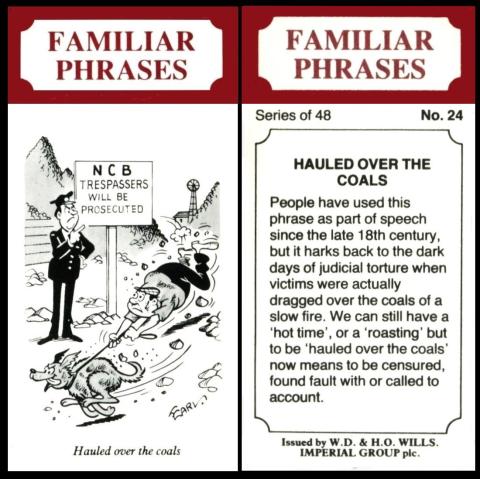
W.D. & H.O. WILLS [tobacco : UK - Bristol] "Familiar Phrases" (1986) 24/48 - W675-274
Well as I failed to mention the beginning of the General Strike last week, (on May the fourth, when, for some reason, I chose to wax lyrical on orange juice instead), I will mark its ending, which was today, one hundred years ago.
This card shows a policeman guarding a National Coal Board site, and in 1986, when this set was issued, a year long miners` strike in the United Kingdom had just taken place, running from March 1984 until March 1985, at which time the National Union of Mineworkers voted to return to work. However, the National Coal Board continued to close pits, which was what the strike was against, and tensions remained high.
Sixty years before that, the General Strike had also begun over coal, on the third of May, 1926. The mine owners had started to reduce the pay of their workers, which had already halved in the years since the end of the First World War, but also to raise their working hours, and the Unions resisted, strongly. This led to the Trades Union Congress asking workers in other jobs to stand up and stop their own work in support of the miners.
It seems that they never imagined how many would answer the call, right across the country, from all sorts of jobs, which led to paralysis of many industries, especially transport, engineering, and printing.
Again the government called for temporary workers to step into the striker`s jobs, and this caused lots of ill feeling, especially in small towns. In London many volunteers were seen driving buses, with a police escort ; it seems to have been seen, by the upper classes, as a fun thing to do, though many admitted they did not understand the reason for the strike.
After nine days the Trades Union Congress called off the strike. The miners tried to continue it, but without the support of the other workers they had to admit defeat, and many were punished with wage cuts and increased working hours. And by the end of the 1930s though the output of coal was at an all time high, the number of miners had drastically reduced.
It did not dim the enthusiasm of the Trades Unions though and they fought on, eventually, over the intervening hundred years, gaining workers many of the rights we take for granted today.
This set was issued long after our original World Tobacco Issues Index had been printed and delivered. And so its only entry is in our updated World Tobacco Issues Index, which reads :
- FAMILIAR PHRASES. Md. 90 x 44. Nd. (48). No brand mentioned ... W675-274
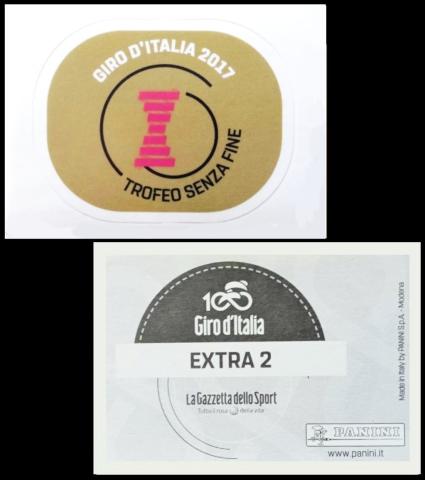
Figurine PANINI [trade/commercial : stickers : O/S - Modena, Italy] "Giro d`Italia 2017" (2017)
Today in 1909 saw the start of a bicycle race which would grow far beyond its humble beginnings. The idea was to do for Italy what the Tour de France did for France; namely increase tourism and gain publicity worldwide.
Now it is said that this all began with a telegram, from the main editor of a newspaper called La Gazetta dello Sport, to its owner and to its cycling editor; a simple one, asking why they could not hold a bicycle race. Then the plot gets rather confused. Some people say that this plan was merely to steal the thunder of a rival paper who was also planning a bicycle race. But if we look at that, we find that our same main editor had already successfully hosted two bicycle races; what is known today as the Giro de Lombardi, first run in 1905, and first organised by La Gazetta dello Sport since 1907, and the Milan-San Remo Race, first run in 1907 and organised by La Gazetta dello Sport the next year. And if you look at our card you will see that La Gazetta dello Sport is still involved, with their name in the central section of the reverse.
Anyway, on the 7th of August 1908, La Gazetta dello Sport announced the race was to be held in May 1909. This was to be a much bigger race, and they needed more funds, so a friend came up with what was a really great idea, that he would ask local people to donate, from the towns that the race passed through. This also had a side effect of ensuring that people would turn out to watch, and to see that they money was well spent. And there cannot have been any ill feeling from the supposed "rival" paper, as it donated three thousand lira.
On the 13th of May, 1909, a hundred and twenty men and machines lined up at Loreto Place in Milan. Only forty-nine would pass the finish line, even though the route, of 1,521 miles, was split into eight stages, with a break in between each. The winner, on points, was a man called Luigi Ganna, who had won three of the individual stages. His purse was almost five and a half thousand lire, which was a very good prize indeed - to put that into perspective, the race director took home only 150 lire a month as his wages.
As to why this "hundredth birthday" set was issued in 2017 and not 2009, it is because the race was not held during the First or Second World War, though it was held in 1914. It resumed in 1919, and was also held in 1939 and 1940, but then it was cancelled again and the next race was not until 1946.
The base set contains 380 stickers, but ours is not one of them, it comes from the "Figurine Extra" insert set, which consists of eight specials, which when removed from the backing paper are completely transparent. Our image would therefore be clear apart from the golden oval, and the same goes for the other stickers. Now for some reason, all of the base cards which show the team shirts are also transparent, so don`t get confused with one of them being sold as part of this set to compensate for a missing one. The stickers in this extra set are all logos and all a large oval, like ours, except where noted, and they are :
- EX1 - Velocita
- EX2 - Trofeo Senza Fine
- EX3 - Maglia Rosa
- EX4 - Il Vincitore
- EX5 - Montagna Pantani - Tappa Bartali (two small roundels)
- EX6 - Cima Coppi - 100 Giro d'Italia (two small roundels)
- EX7 - Lupo Wolfie (a circle with his head and shoulders only)
- EX8 - Lupo Wolfie (an oval but coloured, of him on a bike)
Lupo Wolfie was a cartoon wolf, the mascot of the race, at least since 2014, because before him was Ghirbecco, the mountain goat (2008-2013), and Ghiro, the dormouse (2002-2007)
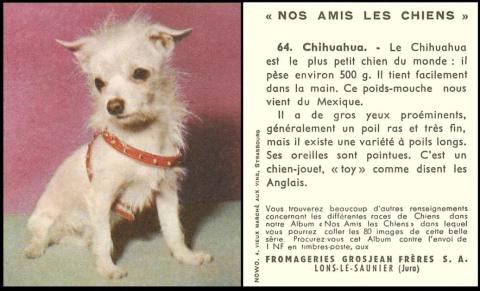
Fromageries GROSJEAN Freres [trade : cheese : O/S - Lons-le-Saunier, France] "Nos Amis les Chiens" / our friends the dogs (???) 64/80
Now let us shake a paw for #InternationalChihuahuaAppreciationDay, because these tiny dogs have a big attitude, and are just as devoted to their owners as any Great Dane.
Originally they come from Mexico, and a long while ago, way back before Columbus landed. And though you may think this would make them insular, there are many natural variants, both in their colour and in the length of their coat.
They were first registered by the American Kennel Club in 1904, but they were exhibited in England before the turn of the twentieth century, and records of small dogs like them can be found from the beginning of the nineteenth century. However they did not have a British Breed Club until 1952, and were not formally registered by the British Kennel Club until the year after.
Sadly their tiny size makes them prone to many health complaints, especially with their bones and muscles, and there has been a recent development in trying to breed them even smaller. They also have a slightly lower than average life expectancy.
Our card is French but you can also find chihuahuas on several English cards, notably :
- 1957 - Priory Tea "Dogs" - No.20
- 1961 - Doctor Teas "National Pets" - No.30
- 1961 - Hornimans Tea "Dogs" - No.42
As far as the company, it was founded in 1901 by a woman, called Octave Grosjean, and she was a cheesemaker, specialising in Gruyere. She called her business "La Vache Serieuse" (or the serious cow), but she was taken to court in the late 1950s over the name by Fromageries Bel, who owned the brand called "La Vache Qui Rit" (or the laughing cow), and she lost, in 1959. However she kept going, and rebranded as "Grosjean Rama", then shifted over to "La Vache Grosjean" in the 1960s. In 1969 the company was bought out by Nestle, and in the mid 1980s sold again to Lactalis, who decided not to continue with the "La Vache" branding. At first I thought this may have been to spare them further lawsuits, but it turns out that Lactalia actually owned almost of a quarter of "La Vache Qui Rit", and they felt two brands of almost the same name may confuse consumers.
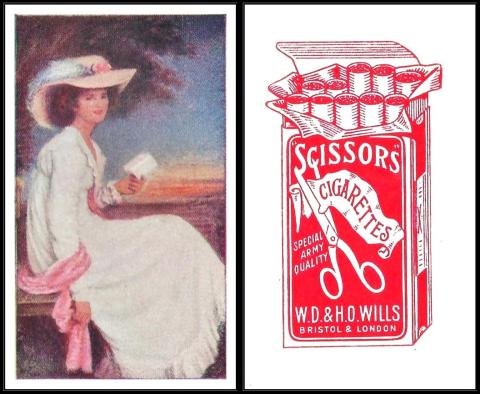
W.D. & H.O. WILLS [tobacco : UK - Bristol] "Beauties and Children" - `Scissors` brand (1910-1915) Un/30 - W675-485 : W/147.A
And we close this week`s newsletter with a former closing of the season, for May 15th is #StrawHatDay, when, in times of yore, your felt hat would be left on its peg, and your straw one donned, in order to welcome in the summer. And on September the 15th you would reverse the process, and don the felt again.
Our card might not be the proper one, as it shows a lady, and the hat switching used to be confined to men. However, the straw hat is, strangely, a worldwide wear both for men and women, and it has a proper purpose, to shade the head and face from direct sunlight. You can see them across Europe, Russia. South America, and Asia, especially China. In more modern times they have been adapted to allow their manufacture to include paper and an artificial straw called Visca, which is made from spun viscose.
Reportedly the first straw hat on the silver screen was sported by Joan Crawford, in "Possessed", released in 1931, a tale of a factory girl who thinks she is going to end up with a lawyer, played by Clark Gable. But I am pretty certain that generations of silent cinema farmers had already strolled through their fields in one.
Sticking with the glamour, though, here we have a card from a fairly scarce set, perhaps because it was never issued in the United Kingdom. It is described in our original Wills reference book part four as :
- 147. BEAUTIES AND CHILDREN (adopted title). Size 63 x 38 m/m. Unnumbered. Fronts printed by letterpress in colour. Thirty subjects illustrated in Fig.79. Export issues, between 1910-15.
A. "Scissors" issue. Backs in red, with illustration of open "Scissors" packet, no other letterpress.
B. General Overseas issue. Plain backs, anonymous issue.
There then follows Fig.79, which I cannot get anything out of. probably because it was taken off a copy in an original magazine. And hopefully I will find that original block as I go through the original magazines and it will scan better.
In our original World Tobacco Issues Index these two are parted. Our "Scissors" issue being recorded in the W.D. & H.O. Wills section as :
- BEAUTIES AND CHILDREN (A). Sm. 63 x 38.. Unnd. (30). See W/147.A ... W62-346.
and the General Overseas version being at the back of the book under "Anonymous Issues (3) - With Plain Back" as :
- BEAUTIES AND CHILDREN (A). Sm. 63 x 38.. Unnd. (30). See W/147.B. Issued abroad through B.A.T ... ZH2-20
These remain the same in our updated World Tobacco Issues Index, except for new card codes, which are W675-485 for our "Scissors" branded version, and ZH02-145 for the anonymous plain backed one.
This week's Cards of the Day...
followed a theme which actually lasts all month, and its "No Mow May". This is a fairly recent initiative, run by Plantlife, and all they ask is that you keep your lawnmower in the shed or garage for this one month and allow the lawn its freedom. Technically that gives you your freedom as well, from mowing. However they also realise that this may be too much for some people, and so there is another way you can take part, simply by leaving a patch of lawn unmown, somewhere out of sight, behind a tree or hedge. This allows for wild flowers and weeds to spring up and nourish bees, butterflies and other insects, as well as birds. - and it also allows a habitat for birds and small mammals.
Not mowing your garden for one month will never replace all the meadows that have been lost to development of all kinds since the 1930s (some 97% of what we used to have in the British Isles) - but by joining forces, and making a long chain of gardens, with the help of your neighbours, we can do more than we imagine, especially if we decide that we will leave our new flower-filled grassland into June, or maybe even longer....
So why don`t more people agree to do this? Well it seems that they worry about the look of the garden, because they imagine that it will just turn into a green wilderness. In actual fact, it will not; it will release long hidden seeds all of its own accord, remnants from former gardens on that spot, plants blown in by the wind and brought in by them clinging to the scaly legs of little birds. And in less than a week some form of flowering plant will start to show its face amongst your newly un-mown lawn, starting with :
Saturday, 2nd May 2026
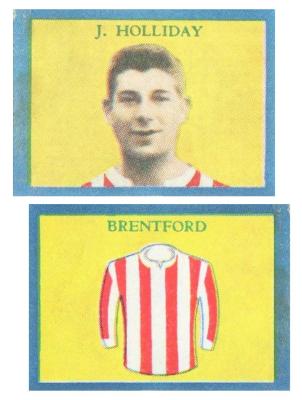
The Buttercup, which is one of the first plants to appear on an un-mown lawn, but be warned as its roots will spread right across your garden. It also has another problem for it grows along the surface, and can be hidden by other plants as they grow tall. But it is loved by butterflies, beetles and birds,
So we started with this card, not just with a buttercup coloured background, but of Brentford Football Club, who marked their first season in the Premier League (2021-22) with a new away strip which was named to be in "buttercup yellow" - shirts, shorts, and socks - in the hope that the team would seldom, if ever, turn up to an away game and have to change to a third strip. In fact there are a few teams with a yellow strip, including Norwich and Watford, and only this year Southampton played in one in the FA Cup semi final against Manchester City - celebrating and commemorating the F.A. Cup final of 1976, fifty years ago, when they beat another Manchester side, United.
As for our featured player, John William (Jack) Holliday, who was born in Cockfield, County Durham, on the 19th of December 1908. His first club, however, was Middlesborough, in 1930.
Football was in his blood, for his father had been very keen on the game, but sadly he was killed, during the First World War, on the 1st of October, 1918, whilst serving with the 6th Battalion of the Durham Light Infantry, when little John William was only nine years old, and been buried at the British Cemetery in Warlencourt, near Calais, along with three thousand, five hundred, and eleven other men.
Our man stayed at Middlesborough for two years,and then, with two teammates, William Reed "Billy" Scott and Herbert Leonard "Bert" Watson, he joined the Southern side of Brentford. Here all three flourished, and the team became the champions of the southern part of the Third Division in 1932-33. Our man also hit the record books, for scoring the most league goals in a single season, thirty-eight, and the most hat tricks in a single season too. And though the former has been beaten, the latter still has not at time of typing. But he should also be remembered for another astounding feat, the fact that he scored all five goals that held Luton Town to what must have been a thrilling 5 - 5 Score Draw on the first of February 1933.
His first cartophilic appearance, perhaps because of those feats, was issued in August 1934, card 38 of Ardath "Famous Footballers". The reverse tells us that he was a Centre Forward, and that he "Joined Middlesborough 1930. Chances were limited and Brentford secured his transfer in the summer of 1932. His goals - 36 in 33 games - did much to gain the club promotion to Division II. Born Cockfield."
Another candidate for his "rookie" card is number 45 of Carreras` "Famous Footballers", also issued in 1934, but we have no idea of the month, it may have been before, or after the Ardath. It has much the same text, "Joined Brentford from Middlesborough in 1932, and in his first season scored 36 goals in 33 games contributing greatly to their promotion to the Second Division. Has since played regularly as centre-forward, and in the 1933-34 season was second on the list of Division II`s goal scorers with 27." But it does tell us something else, and that is that he "Is, in addition, a keen cricketer and tennis player".
Another similar text comes on number 45 of Carreras` "Famous Footballers", the version issued in 1935, which reads "Born at Cockfield, J. Holliday, scoring 36 goals in 33 matches was the big factor in Brentford`a promotion to the Second Division last season. Before being transferred to Brentford he was with Middlesborough, but found little scope for his capabilities there and Brentford secured his signature in 1932. Scored 25 goals last season. A brilliant centre-forward. "
The same year we get quite a lot more information, courtesy of number 21 of W.D. and H.O. Wills` "Association Footballers", which tells us he was "Trained in the famous north-east coast nursery, Holliday was playing with Cockfield, a Durham amateur club, when he received his first professional appointment with Middlesborough. He acted as understudy to Camsell for some time, occasionally appearing in First Division matches, but it was not until he was transferred to Brentford in May 1932, with other members of the Middlesborough side, that he really came into prominence. In each of his three seasons with the London club he has been a marked success as the centre-forward, leading the attack well and scoring freely. He played a big part in helping to win the Second Division Championship in April 1935."
He seems to have kept playing for Brentford during the Second World War, but retired in 1944, albeit temporarily, as he turned up at Chelmsford City in 1945. This was short lived though, as he played two games only and then left as abruptly as he had come. He did stay connected with football though, as he became trainer at Brentford, and only left that job in 1961. By that time he had developed another sporting passion, bowling, and he was a valuable member of the West Ealing club; in fact he represented Middlesex County several times.
Sadly his death seems very sketchy, all I have is 1987, no month nor day, and I have found no site that adds either,
Despite the age of this set it does not appear in our original British Trade Index covering issues up to 1945, it waits until part two. The reason for that may have been that only after that date (part two being published in 1969) was it realised that the flags were issued loose, or rather in a sheet, until then it may have been thought that they were printed in the album, and then, suddenly, an empty album turned up. And maybe at that point they had not even seen a flag, loose. This is certainly suggested by the wording in British Trade Index part two, which reads :
- THE WINNER FOOTBALL FLAG BOOK. 36 page album, with spaces for pinning 62 flags. ... THO-108
This is expanded upon in our updated British Trade Index, issued in the year 2000, to :
- THE WINNER FOOTBALL FLAG BOOK. (S). 36-page album, spaces for pinning 62 flags, 30 x 22. Double sided, club one side, player representing the club other side. Cut from gummed sheets. The 62 represent all the clubs from the English First & 2nd Divisions, and the Scottish 1st Division . Unnd. ... THO-765
In fact the flags were very curious indeed. There were three sheets, each of 21 flags, with either red or blue borders, and they were issued with "The Skipper" boy`s magazine, starting with the edition of the 24th of February 1934 - one sheet a week. Then the fun began. Firstly the flags had to be cut out, folded exactly in half, have a long pin placed in the middle of the central border, and somehow manage for the two halves to be licked and pressed together so that both flags lined up without odd white bits showing on each side. If all that was accomplished, then you could get the album, gently pierce two holes on each page in the places which were indicated by small black dots, and stick the pin through.
Now I had a lot of help with that, and with the next bit, from Mr. Reeder, who actually has an album - and it`s one of his flags that we show here. The album has a coloured front cover showing a footballer kicking a ball high into the sky, and then the rest of the pages, when opened out, had an article printed on the left hand side, and space for your flags on the right hand side, each with a little box about that team.
The first page was only for two teams, but after that the pages on the right hand side had four boxes and took four flags - starting with
First Division :
- Arsenal (J. Dunne : S1) and Aston Villa (A. Cunliffe : S3)
- Birmingham (H. Hibbs : S1), Blackburn Rovers (J. McLean : S3), Chelsea (P. O`Dowd : S3), Derby County (D. Duncan : S3)
- Everton (W. Dean : S1), Huddersfield (R. Goodall : S2), Leeds United H. Duggan : S1), Leicester City (H. Adcock : S2)
- Liverpool (G. Hodgson : S2), Manchester City (M. Busby : S3), Middlesborough (G. Camsell : S1), Newcastle United (S. Weaver : S3)
- Portsmouth (J. Weddle : S2), Sheffield Wednesday (E. Blenkinsop : S1), Sheffield United (R. Barclay : S3), Stoke City (T. Sale : S1)
- Sunderland (R. Gurney: S1), Tottenham Hotspur (G. Hunt : S2), West Bromwich Albion (T. Glidden : S2), Wolverhampton Wanderers (A. Hetherington : S2)
Second Division :
- Blackpool (P. Watson : S3), Bolton Wanderers (J. Milson : S2), Bradford (J. Parris : S2), Bradford City (R. Bauld : S1)
- Brentford (J. Holliday : S3), Burnley (T. Douglas : S1), Bury (J. Vernon : S2), Fulham (A. Tootill : S2)
- Grimsby Town (J. Bestall : S1), Hull City (W. McNaughton : S2), Lincoln City (A. Horne : S2), Manchester United (E. Hine : S1)
- Millwall (J. Poxton : S3), Notts County (G. Walker : S1), Nottingham Forest (J. Graham : S3), Oldham Athletic (J. Pears : S3)
- Plymouth Argyle, (S. Black : S3), Port Vale (T. Rhodes : S3), Preston North End (E. Harper : S2), Southampton (E. Drake: S1)
- Swansea (H. Hanford : S2), and West Ham (V. Watson : S1) -
because though the four teams to a page continues, the bottom two are from the
Scottish League, First Division :
- Aberdeen (W. Mills : S2), and Airdrieonians (J. Shaw : S3)
- Celtic (J. McGrory), Clyde (J. Mayes : S1), Cowdenbeath (A. Robertson : S3), Dundee (L. Morgan : S1)
- Falkirk (J. Bartram : S3), Hamilton Academicals (D. Wilson : S1), Hearts (A. Massie : S1), Hibernian (D. Urquhart : S2)
- Kilmarnock (J. Maxwell : S3), Motherwell (J. McMenemy : S2), Partick Thistle (E. McLeod : S2), Queen`s Park (J. Crawford : S3)
- Rangers (R. McPhail : S1), St. Johnstone (J. Calder : S2), St. Mirren (J. Latimer : S1), Third Lanark (J. Warden : S2).
The last page in the book on that side is a bit more unusual, as it is for a flag of your own invention , for a team you made up, and whose logo you drew, and for this purpose there was a blank flag as the final flag of sheet three.
Sunday, 3rd May 2026
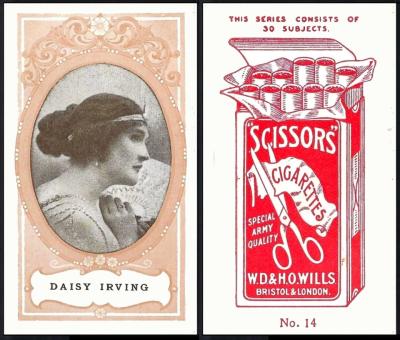
The Daisy will come along pretty soon, but you won`t get flowers in the first year, only leaves, which you will start to see within ten days after pressing the seeds into the soil. We call it the simple daisy, but it is anything but, for what you think of as a single yellow flower in the centre are hundreds of small pollen carriers, each a magnet for bees, butterflies, and beetles. And when they go to seed the birds will feast on them.
So for our second card we had Daisy Irving, shown here with a long feathered headdress that seems to come from her most famous role, as Angele Didier in the operetta "The Count of Luxembourg" - in in which she appears on many postcards. There is a problem though, because when the original London production opened, at Daly`s Theatre, in 1911, it starred Lily Elsie. And I have failed quite spectacularly at finding anything biographical about Daisy Irving, though I will keep looking. I know she appears on two other sets of cards, neither of which have a descriptive back, these being the 1908 Lorillard "Actresses", and the 1908 Ogden`s "Actresses" - both of which use the same picture as each other with her hands to her chin.
This set is also non biographically texted. It first described in our Wills reference book, part four, or RB.16, which was published in 1950, and it appears as :
- 118. 30. ACTRESSES - Orange/mauve surround (adopted title). Size 64 x 37 m/m. Fronts per Fig.68, printed by letterpress, portraits in black and white. surround in orange or mauve. Backs in red, with illustration of open "Scissors" packet, inscribed at head "This seres consists of 30 subjects", numbered at foot. "Scissors" issues in the East, between 1910-15 : -
A. Surround in orange ; normal background is black, but there is a distinct printing with olive background.
B. Surround in mauve
By the time of our original World Tobacco Issues Index this has been shortened, to :
- ACTRESSES - W/118. Sm. 63 x 36. Portrait in black and white, coloured surround. Nd. (30). See W/118 ... W62/337
A. Surround in orange
B. Surround in mauve
And in our updated World Tobacco Issues Index it appears as :
- ACTRESSES - W/118. (A). Sm. 63 x 36. Portrait in black and white, coloured surround. Nd. (30). See W/118 ... W675/476
A. Surround in orange
B. Surround in mauve
In none of these books is it mentioned that only the colour changes, the actresses in both sets remain the same in picture and in number, as follows :
- Iris Hoey
- Iris Hoey
- Sybil de Bray
- Gertie Millar
- Cissie Moore
- Avice Kelham
- Madeline Seymour
- Isobel Elsom
- Ellaline Terriss
- Gwladys Gaynor
- Gladys Mason
- Miss Le Gros
- Jean Aylwin
- Daisy Irving
- Madge Saunders
- Gladys Mason
- Zoe Gordon
- Peggy Kurton
- Gabrielle Ray
- Phyllis Terry
- Miss Greenough
- Winnie Collins
- Constance Worth
- Emmy Wehlen
- Agnes Glynne
- Fay Compton
- Lilian Fay
- Gracie Cooper
- Violet Blythe
- Avice Kelham
Monday, 4th May 2026
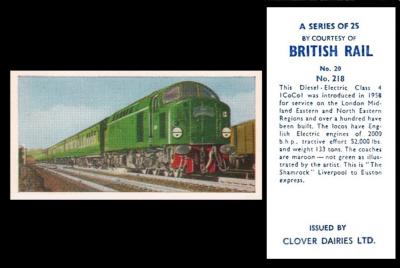
Clovers give you lovely ground cover, not to speak of all the hours of "pleasure" you will spend in trying to find one with four leaves. They also have white or pink flowers, which are most attractive.
Our third card is actually the first appearance of any picture of a Clover Dairies issue on our site - though I may add some more as I work back through the newsletters. Now there is something about the clover that I only just realised, and that is that in a set of playing cards, we have a suit called clubs, but in France they call that suit trefles, or trefoils/three leaved clovers. And to be honest it looks much more like a clover than a club, so does anyone know how we came to call them clubs and not clovers?
Clover Dairies started in Grimsby, in the 1920s, and their head office was in Victoria Street. They were bought by Northern Dairies in the mid 1970s.
Their cards first appear in our original British Trade Index part two, but not this set. That has to wait until our original British Trade Index part three, where it is listed, with another new set, "People and Places". Our entry reads :
CLOVER DAIRIES Ltd. - CMM in II. Add series issued 1972-3
- BRITISH RAIL. 68 x 36. Nd. (25). See Db.238 ... CMM-7
Now I`m going to change track for a minute, as the "D" codes first appear in our British Trade Index part two, and sure enough this set is there, listed as :
- D238. BRITISH RAIL or BRITISH RAILWAYS. Nd (25)
Hitchman`s Dairies - Set HIT-4 (British Railways)
George Payne - Set PCH-12 (British Railways)
Phillips Tea - Set PHI-1 (British Rail)
This information is not repeated in our original British Trade Index part three, but it is cross referenced back, presumably because it was expected you also had the other volume. So all that is printed in our original British Trade Index part three is as follows :
- Db.238. BRITISH RAIL or BRITISH RAILWAYS. Add CLOVER DAIRIES Set CMM-7 ("British Rail")
Now if we move forward to our updated British Trade Index, the one issued in the year 2000, that lists our set as :
CLOVER DAIRIES Ltd
Issued 1964-73. Size 68 x 37
- BRITISH RAIL. 1973. Nd. (25). See HX-99 ... CLO-060
Tuesday, 5th May 2026
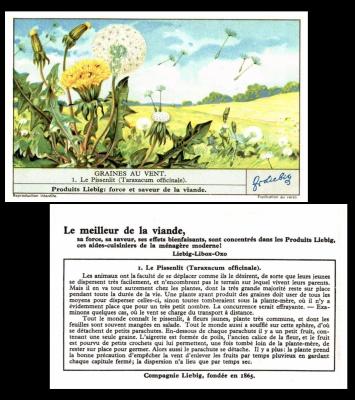
This is an excellent depiction of the dandelion flinging its seeds in all directions, though a lot of time they have help, from a passing dog, which I always thought would make a fun computer game.
The dandelion is like marmite, loved and loathed in equal measure. It is loved for its cheery yellow heads, but not for its far flinging seeds, nor for its tap roots, which wriggle themselves down into the soil for a very long way and have the ability to self generate another plant even if the most minute bit is left in the soil.
We chose a French card because the name dandelion comes from French, dent de lion, or the tooth of the lion, referring to its leaves. It has many names, and it is rather amusing how closely the French one on our card is so close to one of the English ones, namely "wet the bed". This is because it is nature`s equivalent to a water tablet, and if you go to a herbalist for such a thing you will end up with a powder which is heavily dandelion based - though doctors are on the fence, as it were.
The cards in this set, which I think may have only been issued in French, are :
- Le Pissenlit (Taraxacum officianale) - the dandelion
- La Linaigrette (Eriphorum vaginatum) - cotton grass
- L`Erable plane (Acer platanoides) - the Norway maple
- Le Frene (Frazinus excelsior) - the Ash tree
- L`Oseille sanguine (Rumex sanguineus) - wood dock
- Zanonia Macrocarpa - Javan cucumber
Actually the most interesting plant here is on card 6, and not only because it now goes under another name, of Alsomitra macrocarpa. Though its still commonly known as the Javan cucumber. The now extinct "Zanonia" name was given it in 1825 by its discoverer, Carl Ludwig Blume, who found it in Java. Then, in 1843 this name was revised by Max Joseph Roemer, who called it Alsomitra, and lumped it in with several other plants of what would turn out to be no relation to each other. And today, despite this, it is known as Roemer`s Alsomitra macrocarpa - even though in 1881 a man called Alfred Cogniaux refuted all those attributions and moved it over to the Macrozanonia family, which was a much better fit. Macro, of course, refers to size, and large at that, for the fruits are the size of a football, which springs open like a struck pinata and allows the seeds to fly away.
Wednesday, 6th May 2026
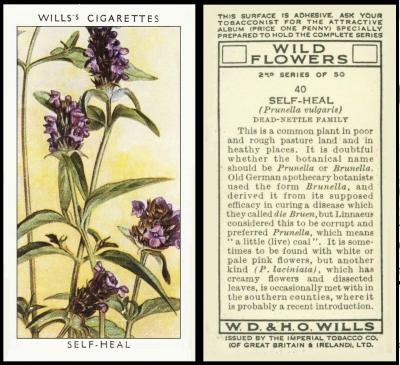
Our plant today is Self Heal, or Heal All, and it is actually in the nettle family. It is much beloved by bees and wasps, who plunder it ruthlessly for its nectar, and it pops up quite easily in an un-mown lawn, unless you have been using chemical treatments on it by way of weedkillers or growing assistance. In addition the lovely bluey-violet flowers appear from June to October, so you may be lucky to get some just at the end of your no-mow May, especially if you decide to leave it for another month and see what happens. And best of all, because it is a perennial, it will pop back up again next year too, especially if you take a couple of the purple seed heads and sprinkle them elsewhere.
The name Self Heal is a reference to the fact that this is a medicinal plant with many centuries of usage, especially in China, but it was also known to the Native Americans. Its major uses were for staunching bleeding, and helping the body to heal itself after it has been wounded, but it was also used as a drink to ease sore throats and mouth ulcers. Today it is being investigated as a treatment for heart disease, and studies have found it lowers cholesterol and high blood pressure.
As for its Latin name there is much debate, so much so that it even tells us on the back of the card that "It is doubtful whether the botanical name should be Prunella or Brunella [vulgaris]". The confusion comes from the fact that the Germans used it to cure a disease called "die Bruen" (but all my attempts at tracing this have failed), but when Linneaus came along he changed it to Prunella, which meant the colour of a coal just as it was smouldering to an ash.
More confusion now, as this is the later series of "Wild Flowers", not the grey backed version issued in 1923, and it is the second of two 1930s issues. Both of these 1930s series are described as a group in part four of our original reference book to Wills issues as :
WILD FLOWERS (1936-7). Fronts printed by letterpress in colour. Backs in grey, with descriptive text. Issued 1936-7.
- 346. 50. "Series of 50"
A. Home issue, adhesive backs. Special Album and I.T.C. Clauses.
B. Irish issue, non-adhesive backs. General Album and I.T.C. Clauses.
C. Channel Islands issue, adhesive backs. No Album or I.T.C. Clauses.
- 347. 50. "2nd Series of 50"
A. Home issue, adhesive backs. Special Album and I.T.C. Clauses.
B. Irish issue, non-adhesive backs. General Album and I.T.C. Clauses.
C. Channel Islands issue, adhesive backs. No Album or I.T.C. Clauses.
The 1923 issue leads to a bit of a problem, because it turns up first in our original World Tobacco Issues Index, and it has a second series, but only issued in Ireland, in 1937. That makes this entry appear to be ours, but it is not, if you keep reading past it you will find our set appears opposite under Section 2.C, for adhesive backed cards with I.T.C. Clauses. And it is recorded as :
- WILD FLOWERS. Sm. Nd. See W/346-A ... W62-202
1. "A Series of 50".
A. Home issue - back "This Surface ...."
B. Irish issue - back "Note : - This Surface ..."
2. "2nd Series of 50". Home issue
As far as the Channel Islands issue, you have to keep going still further forward to find that, all the way to Section 5.D. for "English language issues, 1935-39. Issued chiefly in Channel Islands and Malta." And there it is recorded as :
- WILD FLOWERS. Sm. Nd. Adhesive back. ... W62-504
1. "A Series of 50". See W/346.C
2. "2nd Series of 50". See W/347.C
The only change to this in our updated World Tobacco Issues Index is the card codes, W675-245 for the Home and Irish issues, and W675-719 for the Channel Islands pair
Thursday, 7th May 2026
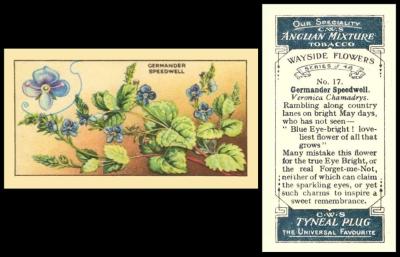
Here we have a plant that is already in lots of lawns and we don`t know it, for is sidles along the ground sinking its roots deep into the soil as it goes, and very often several clumps are actually just one plant, spreading out from a middle as yet undiscovered.
For such a hidden plant, it has several names. Our card only mentions three, Germander Speedwell on the front, and Veronica chamaedrys and Blue-Eye-Bright on the back, but it also known as Birds-Eye Speedwell, Cats-Eyes, and Gypsy Weed.
It is used medicinally to combat many different disorders. In Britain it gained a reputation for being able to ease gout, by making it into a kind of tea. That almost led to its extinction, which only goes to prove how prevalent gout once was.
To our card, it may have surprised you that the Co-Operative Wholesale Society sold tobacco. In fact they had a tobacco factory, all their own.
This set has a sibling, and both are described in our original World Tobacco Issues Index as :
CO-OPERATIVE WHOLESALE SOCIETY, Manchester, England
Known as "C.W.S." and many cards only identifiable through these initials. Some cards inscribed "C.W.S. Tobacco Factory". Trading, 1956. Series listed are inscribed with tobacco advertisements; the firm also issued cards advertising non-tobacco products All small size, 66-68 x 35-37 m/m unless stated.
- WAYSIDE FLOWERS. Sm. Nd. ... C130-15
1. Back in brown. (48)
2. Back in grey. (48)
I have to say it is a very greenish grey, sometimes almost blue.
They next appear in our updated World Tobacco Issues Index, with an identical listing and a new card code, of C792-360.
Strangely, in neither of these books is it mentioned that the two sets are not only different as to the colour of their backs, they are different sets as well, even though number 37 is a Cranesbill in both versions, blue meadow in the brown back and blood red in the grey-green.
| brown back | grey-green back | |
| 1. | - Campion | - Daisy |
| 2. | - Scarlet Poppy | - Dandelion |
| 3. | - Wild Pansy | - Clover |
| 4. | - Grass of Paruassus | - Primrose |
| 5. | - Field Knautia | - Comfrey |
| 6. | - Thrift | - Sweet Violet |
| 7. | - Carline Thistle | - Sootted Palmate Orchis |
| 8. | - Toadflax | - Tufted Vetch |
| 9. | - Yellow Balsam | - Snake-Weed |
| 10. | - Dropwort | - Wood Betony |
| 11. | - Meadow Sweet | - Sneezewort |
| 12. | - Woody Nightshade | - Hemp Agrimony |
| 13. | - Foxglove | - Broad Leaved Hawkweed |
| 14. | - Common Mallow | - Great Hairy Willow Herb |
| 15. | - Rose Bay | - White Dead Nettle |
| 16. | - Valerian | - Black Knapweed |
| 17. | - Giant Bell Flower | - Germander Speedwell |
| 18. | - Corn Cockle | - The Dog Rose |
| 19. | - Knapweed | - Scarlet Pimpernel |
| 20. | - Herb Robert | - Deadly Nightshade |
| 21. | - Golden Rod | - Creeping Cinquefoil |
| 22. | - Yarrow | - Buttercups |
| 23. | - Soapwort | - Wood Strawberry |
| 24. | - Water Mint | - Field Gentian |
| 25. | - Garlic | - Stitchwort |
| 26. | - Flag | - Chicory |
| 27. | - Cuckoo Pint | - Orache |
| 28. | - Water Lily | - Traveller`s Joy |
| 29. | - Blue Bell | - Rock Rose |
| 30. | - Marsh Marigold | - Bindweed |
| 31. | - Wood Anemone | - Great Mullein |
| 32. | - Bindweed | - Field Rose |
| 33. | - Lady`s Smock | - Rest Harrow |
| 34. | - Spear Plume Thistle | - Monkshood |
| 35. | - May Weed | - Loosestrife |
| 36. | - Cowslip | - Cornflower |
| 37. | - Cranesbill | - Cranesbill |
| 38. | - Welsh Poppy | - Perennial Flax |
| 39. | - Purple Orchis | - Oxytropis |
| 40. | - Centaury | - Ragged Robin |
| 41. | - Common Ragwort | - Lesser Celandine |
| 42. | - Corn Marigold | - Pasque Flower |
| 43. | - Great Burnet | - Cloudberry |
| 44. | - Ox Eye Daisy | - St. John`s Wort |
| 45. | - Hare Bell | - Water Crowfoot |
| 46. | - Marsh Woundwort | - Lesser Periwinkle |
| 47. | - Meadow Vetchling | - Groundsel |
| 48. | - Rose of Sharon | - Mountain Pansy |
Did anyone spot the mistake there? Its on card 4 of the brown backed version, where it says "Grass of ParUassas" not Grass of ParNassas - and it repeats it in the text, as "This chaste and lovely flower that loves the chill winds of upland heaths, whose blooms appear but tarnished pearls when Winter decks her earliest shroud of snow, became associated, in the poetic mind of ancient Greeks,with the grass of that snow-clad Mount Paruassas"
Friday, 8th May 2026
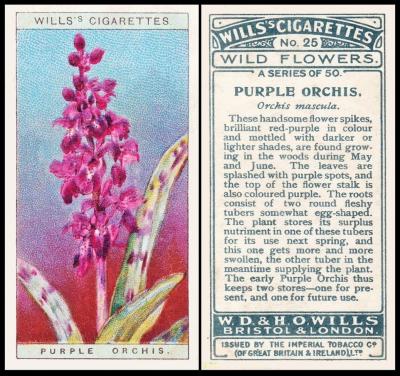
You may not believe it, but if you leave your lawn un-mown long enough you may indeed be able to grow an orchid, and here it is. The card calls it a "Purple Orchis", but today we call it the Early-Purple Orchid, and we continue to use the same Latin name as on the card, of Orchis mascula. And it is a native wildflower, to both the United Kingdom and across the Ireland. The flower is actually a flower head, with up to fifty separate purpley-pink flowers.
The first people to discover the alternative use of the Orchid were the Turks, in the eighth century, when they converted to Islam and were not allowed to drink alcohol. For some reason, they hit on the idea of digging up the orchids, and making their root into powder, adding milk and heated water to make it a drink. What they did not realise was that the root contained a substance called glucomannan, which has the side effect of opening the pathways to the lungs, and easing respiratory problems. And it was also believed that the tubers were an aphrodisiac.
That drink was called Salep, and it is not only still sold, it is still made from flour made from wild orchid tubers. The only problem with that is that to get just one kilo of flour, you have to dig up a thousand orchids, and that is leading to their extinction.
This set first appears in our original Wills reference book part four, as :
- 345. 50. WILD FLOWERS (1923). Fronts printed by letterpress in colour. Backs in grey, with descriptive text. Home issues, 1923. -
A. With dot in each of the two panels immediately above "W" and final "s" of "Wills`s Cigarettes" on back (popularly known as "secret mark".
B. Without the above dots.
I have no idea what the purpose of these dots were, but I am certain someone else does, and can enlighten us all.
Our original World Tobacco Issues Index complicates things rather, by making it into a group, and apparently including a card which does belong to this series but which was issued much later on, and only in Ireland. This turns out to be the set without the dots, but the confusion comes because the dots are not mentioned, only a link to W/347.B, and if you don`t have the original Wills partworks you are unable to find that out. It also means that if you are not paying attention you could easily believe that this entire listing refers to the 1936 version of this set.
Anyway, the entry reads :
- WILD FLOWERS. Sm. Nd. ... W62-185
1. "A Series of 50". See W/345. Back (a) with (b) without dot in each of two panels above "W" and final "s" of "Wills`s Cigarettes". Home issue, 1923
2. "2nd Series of 50". See W/347.B. Irish issue, 1937.
And the entry in our updated World Tobacco Issues Index is exactly the same, but with a new card code, of W675-226
So there you go, I have struggled with time this week but its more or less all finished bar a few card references and I will get those done in what was going to be my spare time tomorrow.
Thanks for tuning in, hope you enjoyed the read, and also hope you were inspired. If so, then I have done my job, to the best of my ability, in what are very strange days indeed.