
Welcome to the end of another week, and to a brand new newsletter.
This week has rocketed past thanks to a cruise on a canal boat, and two trips to the doctors. But the newsletter came together better than I hoped and so we made it on time with the exception of a couple of reference book gleanings which I will do tomorrow.
Website News
There are a couple of new blog posts, neither of which are more than stubs. Yet. One is about our latest reference book, the British Trade Index covering post 1970 cards which was launched at our latest convention in King`s Lynn. The other is going to be the home for all the information about reference books that appeared in the magazine but never actually made it into print as separate books. I call that The Ones That Got Away, but the information was actually used, to form our original World Tobacco Issues Index
I rocketed on with the indexing of the back issues this week as well, and am delighted to say that all the cards are now in from the editions of the 8th of July 2023, the 15th of July 2023, the 22nd of July 2023, the 29th of July 2023, the 5th of August 2023 and the 12th of August 2023.
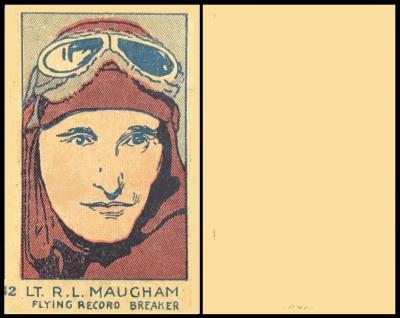
Most of these went swimmingly, but there were a few substitutions, most excitingly the donation, for the edition of the 8th of July 2023, of a scan of the W/512 strip card of Lieutenant Russell Lowell Maughan (which actually spells his last name wrong, as MaughaM).
The only other newsletters that were changed midstream were
- the newsletter of the 22nd of July 2023, which now has Ardath`s "Stamps - Rare and Interesting" and J. J. Schuh`s "Cinema Stars - Tobacco House back" - because both the cards that originally filled those places were already in the index when I came to type these in
- the newsletter of the 5th of August 2023 which now has a Glengettie Tea Purple Heart instead of a Tommy Gunn one - because the Tommy Gunn set contained both the British and American versions of the Distinguished Flying Cross that I needed for last week`s newsletter!
What`s on This Week :
- Sunday the 14th of June : Hants & Surrey - Afternoon Meeting from 1.30 to 4.30 pm - at Normandy Village Hall, Manor Fruit Farm, Glaziers Lane, Normandy, GU3 2DD. Free admission to all.
- Thursday the 18th of June : London - Evening Meeting from 5 p.m, with an auction, of approximately 100 lots, starting at 6 p.m, - upstairs at The Carpenters Arms” 12, Seymour Place, Marble Arch, Central London W1E 7NE. Free admission to all.
- Saturday the 20th of June : East Anglia - from 8.30 a.m. to 3.30 p.m., with auction at 11 p.m - at Roydon Village Hall, High Road, Roydon, Diss, Norfolk IP22 5RB. EACC club members free with annual subscription, visitors pay £3.
And now, moving swiftly on, to our diary dates of things to celebrate this week, which comprise a winged warrior, a Continental City, a canine celebrity, a perfect poireaux, a masked mascot, a grumpy grimalkin and Tansy the terrier....
Lets start with that winged warrior, and its not what you are thinking....
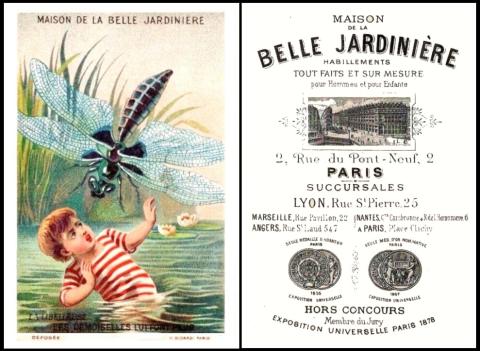
Maison de la Belle Jardiniere [trade ; department store : O/S - Paris, France] "Insectes" (1900)
You see our winged warrior may be only an insect, but it looks pretty warlike in this picture.
Anyway, this week we start with #NationalDragonflyDay, which is every second Saturday in June. This aims to raise awareness of these beautiful creatures and their close relation, the damselfly. Now it is easy to tell the two apart, if you remember that the "dragon" is larger and spreads its wings out when resting - whilst the "damsel" is dainty and keeps its wings tucked in along its body. Both rely on ponds to leave their eggs in, and this is where we come in, for the water does not need to be large or deep, it just needs to be clean, and be surrounded by reeds and plants to give it cover whilst its eggs are laid.
It is often said that the first cartophilic appearance of the dragonfly was in 1907, in the Liebig set F.896 or S.896, known in France as "Fleurs et Libellules" (or flowers and dragonflies). This is not true, though it is the first set which has a dragonfly on every card.
The first card of the dragonfly for which we have a reliable date is from the 1903 British American Tobacco set of "Marine Girls", where on the card entitled "dragonfly" it shows a beauty looking upwards to where the dragonfly is skimming past her hair. However we know that there are earlier European chromos than that, either where the dragonfly is part of a floral landscape, or being chased by a cherub flourishing a net, or, as in our case, getting its own back.
One to look out for it Ty-Phoo Tea`s "Common Objects Magnified" issued in 1925. The front reveals it to be a strange bull headed creature with pincer-like horns, and the back test tells us that "The dragonfly lives its larvae and pupa days in the water. During these stages it devours all the insects and other creatures that it can. It is furnished during the larvae stage with a very curious apparatus known as the mask which consists of a large pair of movable jaws ; when not in use they are folded over its head like a mask, ad may be shot out to seize prey." And this mask is also mentioned on card 16 of E, Robinson`s "Nature Series", issued in 1914.
Our card is part of a set showing insects and children, and we know of :
- Le Cousin - Touche !! Et Juste au Nez [mosquito]
- Le Frelon - Haute Ecole Aerienne [hornet]
- Le Hanneton - La Peine du Talion [cockchafer]
- La Sauterelle - Hop La ! [cricket]

WERNER & Mertz "Die Schone deutsche Heimat - Isar I"
As for our Continental City, you will often read that today, in 1158, saw the City of Munich founded on the banks of the River Isar by Henry the Lion.
This is not strictly true, because that river had been a trade route since prehistoric times, and by the dawning of the Bronze Age had grown to become one of the largest ports in what would become modern day Europe, even though at that time it was rafts, not ships, that weighed anchor there. They probably didn`t even have anchors, but you get my gist. The Romans used it too, you can tell that from the amount of roads that headed for the crossing, and we know that Romans lived in the north east of what became modern Bogenhausen.
The one thing that was missing was a bridge, and that arrived in the Middle Ages. It was later burned, along with the settlements located nearby, by Henry the Lion, the Duke of Saxony and Bavaria, who wanted to control the salt trade for his own ends, and it was also he who founded Munich, in about 1158, and ordered that it be fortified, with walls and gates. He also rebuilt the bridge, but as a toll, with a customs house. Not everyone was happy with this, and Bishop Otto of Freising went as far as putting in a formal protest to the Holy Roman Emperor Frederick Barbarossa, who was also his nephew. Despite that, at the court, held in Augsburg on the 14th of June 1158, the Emperor ruled in favour of the actions of Henry the Lion, and allowed the bridge to stay, though there was a condition, that Henry the Lion had to give a third of the income from the tolls and the taxes to the Bishop. The most important thing about the trial though was that the location was given as "forum apud Munichen", which may have translated to the market near the monks" but gave us the future town name, of Munich.And that is also considered the date that the settlement became the city of Munich, though in actual fact the official granting of City status only came in 1175 .
As for Henry the Lion, he did not prosper for long, for he was brought before the court again in 1180, and again by the Holy Roman Emperor Frederick Barbarossa, and as a net result Munich was given to the Bishopric. And they would retain control thereof right until the end of the first World War in 1918.
Munich has changed a lot since then, and not just because almost the whole of it was destroyed in two huge fires, of 1327, and of 1429, and it saw two outbreaks of plague, in 1349 and in 1634/5. Another change came in 1806, when it was made the capital of the new kingdom of Bavaria, also resulting in the arrival of the relocated State Parliament, and it was further altered under the reign of King Ludwig I, between 1825 and 1848, who turned it into a showcase of neoclassical architecture, replacing many of the former buildings with elaborate and magnificent structures. He did not clear the walls of the former city, though, as is often said - they remained until the mid nineteenth century, and were only demolished in order to allow the city to enlarge of its boundaries in a more seamless manner.
One of the earliest cards to feature Munich is Wills` "Arms of Foreign Cities", card number 50, issued in 1912. That tells us that "Munich (or Munchen, which means a little monk) is the capital of Bavaria and the third largest town in Germany, It is situated on the Isar a tributary of the Danube, and has a population of 595,053. It has a very valuable collection of art treasures."
Not long after this, Munich was at war, its people suffering from Allied blockades. Thirteen thousand men had their name inscribed on the war memorial in the Hofgarten, but they were erased by Allied bombing in the Second World War. And when the memorial was restored, a new plaque remembered an additional twenty-two thousand killed in action, eleven thousand marked as missing, and six thousand six hundred victims of the air war of the city of Munich between 1939 and 1945.
Now this card is overprinted in red and and it reads : "Probebild! Die bilder, die man beim Kauf von Erdal u Kwak erhalt, haben einlosungs. Abschnitte zur erlangung der pramien", and I thought it was telling the customer that the set was coming to a close - but it turns out to be much more interesting than that, for it translates to "Sample image! This picture, which you get when purchasing Erdal und Kwak, has sections for obtaining bonuses." That suggests that this was inserted not at the end of the run, but maybe first, as a taster for the set to follow. And it could still be stuck in the albums, for the number and the text was visible behind the overprint.
We also know that this was one of many sets devoted to "Die Schone Deutsche Heimat", which translates to `the beautiful German homeland`, and several of them, like ours, are devoted to rivers and the towns along them. So far we know of :
- Series 48 - Rhine (I?)
- Series 51 - Elbe I
- Series 60 - Rhein III

Our canine celebrity has a very famous owner - but first, our celebration for today, and that takes many forms, for it is #NaturePhotographyDay.
That leads me to ponder what nature truly is, and the truth is that it seems to comprise all forms of life, whether than be human, animal, bird, insect, or plant. But it turns out it is also the nature of the beast, the way it acts and operates, its humanity and kindness, or otherwise.
Lots of scope there, then.
But what I came up with was this, one of the first named animals on a cigarette card and one of the earliest photographic sets.
This is known as "Ogden`s General Interest - Similar Tabs C.301-350" and it was issued between 1900 and 1902. The "Similar Tabs C.301-350" refers to the fact that the cards are similar to the cards that have numbers, from between 301 and 350. There are actually double that amount, one hundred cards, in our series, made up of twenty-eight actresses, forty castles, twelve dogs, and twenty cards of general interest including sport and air transport, one of the most sought after cards being "Final Tie for English Cup, 1902" which, though it names not the teams on front nor back, was Sheffield United versus Southampton. on the 19th of April, 1902, and it ended in a one all draw.
The dogs form group C, and are entitled :
C. Dogs
- A Brace of Champions.
- A Little Champion
- Belper Snow
- Bogo
- B.P.`s Maltese Terrier
- Cannon Hill Beauty
- Golden Tina
- Impi
- Paddy
- Rococo and Sweet Nancy
- Royal Charlie
- Walkley Queenie
To take these in order,
Belper Snow was a white Pomeranian, owned by the Chell family, and he had won forty-three prizes by the time he was fourteen months old, including at Crystal Palace in 1902.
Our card is described on the back as "B.P.`s Maltese Terrier. Maj-Gen. Baden-Powell`s Champion Maltese Terrier which won the 2nd Prize at the Toy Dog Show, Crystal Palace, 1902."
We know that Robert Stephenson Smyth Baden-Powell spent three years in Malta as aide de camp to his uncle, Governor Henry Augustus Smyth, between 1890 and 1893, and before he went off to the Boer War in South Africa.
It is possible that he saw the dogs in Malta, and arranged to have one brought home, but the complexity arises in the fact that at that time such a dog, a "toy dog", was not a breed for a man, it was a breed for ladies. That leads to the theory that his dog might have been his wife`s, except that he was not married, to Olave St. Clair Soames, until 1912, ten years later.
Sadly I have been able to find very little on the dog or the show, I could not even find who, or which breed, won the first Prize at the Toy Dog Show, Crystal Palace, 1902, which would have led, perhaps to the discovery of more. We know that the first dog show at Crystal Palace was held in 1870, and it would go on to become managed and run by the Kennel Club, after its founding, on the fourth of April 1873.
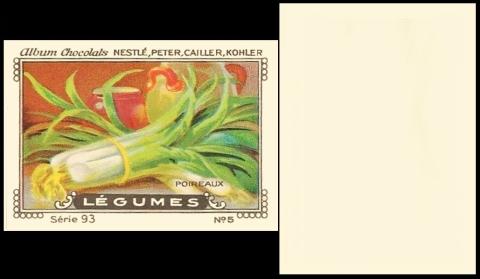
NESTLE, Peter, Cailler, Kohler [trade : chocolate : O/S - Switzerland] "Les Legumes" - Serie 93 (1920s) 5/12
Our perfect poireaux was only possible because there are two bunches of them on this card - if it has been a single French leek it would have been simply a poireau without the X on the end.
This is the fourth card of the week and I am over half way, catching up on the rails as it were. Maybe I need a bit more fuel though, which makes today`s subject rather apt, for it is #FreshVegetablesDay.
Vegetables are amazing, and there are over a thousand different ones, so there`s no use saying you can`t find thirty different plants a week to munch on to improve health. I`ve gone for this, which I thought was a spring onion, but it turns out to be a leek - though both vegetables are not too far along the family tree of Alliums.
It is said that the word Leek is old English, from "Leac", which means onion, but we know that word has close relations with German, Iceland, and Scandinavia, which suggests it was brought to us by Vikings, or other raiders, though we also know it was familiar to the Mesopotamians and Egyptians. Nero, reportedly, could not get enough of them, eating them raw.
As to why it is a Welsh emblem, opinions differ. some say that King Cadwaladr`s soldiers plucked them and fixed them to their helmets whilst fighting the Saxons, as a means of identifying friend from foe, whilst others say it is remembrance of Saint David, who, when fasting, in the sixth century, would only eat leeks and herbs.
This set is another of those paper cards, but one we have not featured before, its from the period when Nestle came first in the group of four names at the top and its series 93. However you can also find it headed as Peter, Cailler, Kohler Nestle, with a rather curious inscription in the left hand side of the bottom border, of "SERIE XVII NESTLE"
The set comprises the following vegetables :
- Petits Pois
- Haricots Blancs
- Carottes
- Scorsoneres
- Poireaux
- Asperges
- Chouxs de Bruxelles
- Choux de Milan
- Choux-Fleurs
- Choux-Raves
- Tomates
- Artichauts
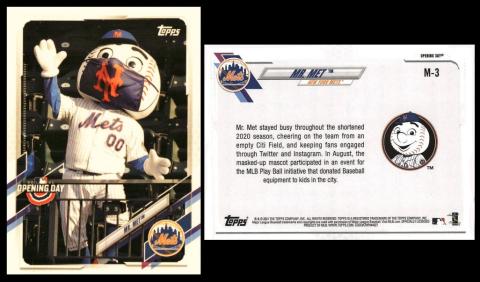
TOPPS [trade/commercial : cards : O/S - USA] "2021 Opening Day Mascots" (2021) M3/24
Our masked mascot brings us to the fact that today is #NationalMascotDay. This celebrates all the heroes who dress up in costume and bring extra excitement to many sporting events and advertise brands and companies.
Of course, I have gone for a baseball one, but for two reasons.
The first is that this is "Mr. Met", of the New York Mets, and he first appeared as a character in the club`s programmes, yearbooks, and scorecards, in 1963. He seems to have become a fan favourite very quickly, and in 1964 it was decided to bring him to life and have him attend a game. This made him the first costumed, human-worn, mascot in Major League Baseball. From 1975 to 1978 he was joined by a Mrs. Met, with three children, to enhance his family reputation, but as the 1980s approached he was phased out, and replaced by a mule, who would be led round the arena before the game, probably in a most grumpy and ornery manner, digging his heels in much like when I try to get nipper to come out of the park when he wants to walk round it all over again.
In 1992 a fan wrote to the team and asked if they could bring back Mr. Met. She seems to have even offered to don the costume, but for some reason the team denied this, which was a bit unfair, to my way of thinking. But they did at least say they would consider resurrecting the Mr. Met Mascot, and to their credit they did, bringing him back in 1994. In 2002, for some reason, he had a grand birthday party with mascots attending from right across Major League Baseball. And in 2007 he was inducted into the Baseball Hall of Fame.
Now the other reason we have this card relates to the mask that he is wearing. For this set was issued in 2021, the first year that baseball began to return to normal after covid. In fact Major League Baseball had suspended itself during spring training on the 12th of March, 2020, and the season did not begin until the 23rd of July, allowing for only sixty games. And whilst the 2021 season was the usual length of 162 games, none of those were played outside of America or parts of Canada.
Normality did not resume until the 2022 season, when, at last, television crews were allowed to travel out of state. However some players and officials were still testing as positive and several games were postponed or cancelled when a full team could not be fielded
At time of typing, Mr. Met appears on a hundred and thirty-one cards, but what most people call the earliest is not him, because it was issued in 1992, and though it is called Mr. Met, it is for the Pittsfield Mets, a minor league team based in Massachusetts. He is also most unlike our man, being rather sacklike and without a solid baseball head. However, it is a curiosity, in a parallel universe kind of way, and it is quite sought after by fans of the true Mr. Met. Our man saw his "rookie" card come in 1996, as part of a set of photocards with pictures by Marc S. Levine.
Some of the cards in our base set can be found in five formats, plain, as ours, with an autograph, with a cloth patch, and with a relic (a piece of his costume). However not all mascots are available in all the formats - there being twenty four mascots, ten patches, eight relics, three autographs (our Mr. Met, Raymond, the mascot of the Tampa Bay Rays, and Wally the Green Monster from the Boston Red Sox), plus a single autograph relic, of Raymond, the mascot of the Tampa Bay Rays
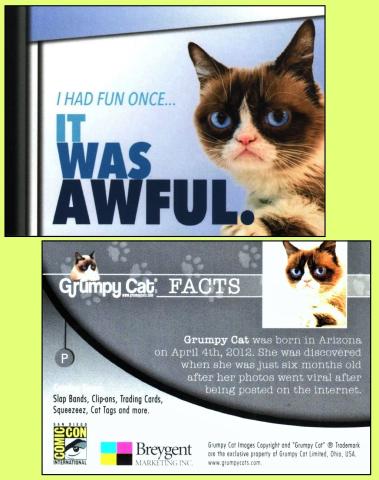
BREYGENT Marketing [trade/commercial : cards and promotional items : O/S - USA] "Grumpy Cat" - promo card (2016) 1/1
To speed me up I have found lots of curiosities this week and this is one of the most curious of all, our grumpy grimalkin. And if you hve not come across the word "grimalkin" before, it is an archaic term for a domestic cat, typically a female one which is old and bad-tempered
You see today is #NationalInternetCatDay.
Now at first I looked up some facts about cats online. It seems that cats are just as popular as dogs, and that the first cat content came on YouTube, courtesy of the co-founder who immortalised his cat Pyjamas to a backdrop soundtrack of Nick Drake music. After that, everyone started filming the funny things their pet cat did and putting it online.
Some were really only appreciated by the film-maker, but other cats gained a bit of a following, and one of these was a domestic short-hair called Grumpy Cat.
Now I know she was a domestic short-hair because that was the way I was going to slant this, with a card of one of her breed, so I asked my go to cat collector if they had any cards showing a domestic short-hair, and they said they did not have any named as a a domestic short-hair, but they did have a few cards of one by the name of Grumpy Cat, or more properly, Tardar Sauce, for that is her actual off screen name. So after I had got over my disbelief that there was an actual card of Grumpy Cat, he sent me a scan of back and front.
Now this is the promo card of an entire set of seven cards, sold at one time, not in packs to collect. They were issued by Breygent, and the promo was given away at Comic-Con in San Diego in 2016, but you also got a promo with every set you bought. Anyway the reverse of the promo tells us that Grumpy Cat was born in Arizona on April the 4th, 2012 and she was first put online at the age of six months. And it also advertises that Breygent were going to produce non card memorabilia, slap bands, clip-ons, squeezees, (all of which sound rather risky to search for definitions of online) plus cat tags and many more.
Now my cat collector tells me that there is a problem with this promo card, because it credits Grumpy Cat with the slogan "I Had Fun Once ... It Was Awful" - but that slogan was actually used by a rival feline favourite, called Colonel Meow.
And all I can say about that is that you learn something every day.
The cards in the set all show Grumpy Cat with a slogan, and they are :
- How about No
- I have An Idea ... Go Away
- Horrible !
- Good Morning - No Such Thing
- Bah, Humbug (with a Christmas theme)
- This Picture of Me Looks Great - You`re Not In It
- "No"

TOPPS [trade : bubble gum stickers : O/S - USA] "Return to Oz" (1985)
To close, then, and just in the nick of time, we have Tansy the Terrier, for #NationalPetsInFilmDay.
Now Tansy was a female border terrier, and a family pet, and she played Dorothy`s pet dog Toto in the 1985 movie adaptation of Return to Oz, as seen on this card. The film was a sequel to the 1939 version, and was based on two novels by L. Frank Baum. It was a Disney production, because they owned the film rights to the later Oz books - but was rather scary in parts, and maybe that was why it did not do so well at the box office.
The original Toto was drawn as a cartoon and there is no idea of his breed, he is just described as "a little black dog with long silky hair and small black eyes that twinkled merrily on either side of his funny, wee nose." From that description he could be a Cairn (as was used in the 1939 movie with Judy Garland) or a Yorkshire Terrier. This has made it easier for film makers to use all manner of dogs in the various adaptations of the story.
Now these cards were true trade cards, as the wax packs contained six stickers and a stick of bubble gum. There were also four different wax packs, one wih Tik Tok, a robot, one with The Scarecrow, one with Jack Pumpkinhead, and one with Dorothy and Billina the chicken. There are forty four stickers in all, which seems rather a short set.
This week's Cards of the Day...
this week, because I am getting more used to my glasses, I have returned to the reference books, so we are going to celebrate the month of June, either with sets issued in that month or with events, sometimes both...
Saturday, 6th June 2026
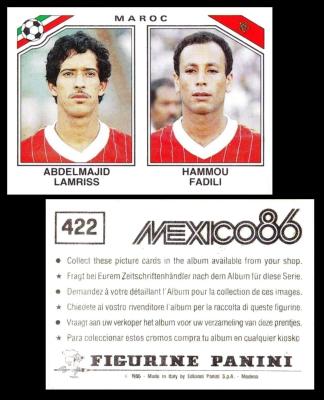
We start our celebration of June not with a card issued in that month, but with a country that has good reason to celebrate it. You see, Morocco made their World Cup debut with a match against West Germany on the 3rd of June 1970 - though they lost 2-1, and did not advance to the second round. But in 1986, even though their first match, on the second of June, was against Poland, and ended with a no score draw, they ended up at the top of Group F, with one more score draw than England, and in the process they became the first African team to reach the second round, and only the second nation from outside Europe and the Americas to do so. And, as I`m sure you are wondering who the first was, I looked it up and found out it was actually North Korea, in 1966. As far as Morocco, though, their luck ran out on the 17th of June, when they lost 1-0 to West Germany. And, just to tie a loose end, North Korea lost to Portugal in the quarter-finals.
As for our men, Abdelmajid Lamriss was born on the 12th of February, 1959 at either Marrakesh or Rabat, though his senior career started in 1975 with a team called Mouloudia de Marrakech which seems to point to the first birthplace. In 1980 he moved to FAR Rabat, which may be where the confusion set in, and also joined the Morocco International squad, with whom he took part in forty-eight games. He seems to have retired in 1990.
Hamou Fadili was bornon the 26th of October, 1957, at Mohammedia and his first senior side was also FAR Rabat, in 1981. He stayed with them until 1992 and then joined Union Tuarga Sport. From 1985 he too played for Morocco.
As for our set, it is also known as "FIFA World Cup", though the album and packets firmly calls it "Mexico 86", albeit with a "World Cup" at the very bottom. There is no idea of how many stickers you got in each, or of the cost, on the packet, but we do know that the packets were twelve pence each in the UK, and, according to the back cover of the album, different prices, depending on which country you were in - and what this means is that there was only album. it was sent to all the countries.
- Austria - five schillings
- Belgium 10 francs
- France - 3 francs
- Germany - 0.50 deutschmarks
- Greece - 20 drachmas
- Italy - 500 lira
- Morocco - 3 dirhams
- Netherlands - 75 cents
- Spain - 50 cents or 50 pesetas
- Sweden - 3.50 krone
- Turkey - 200 Turksh lira
- United Kingdom - 20p
There is also a box for Norway, but the price square section of that box is blank.
We also know that an album, and a packet of six stickers, was given away with every copy of "Shoot" magazine on the 24th of May, 1986. That must have been a lot of stickers, and technically those are cartophilic, but sadly it is impossible to tell which ones they were.
Sunday, 7th June 2026
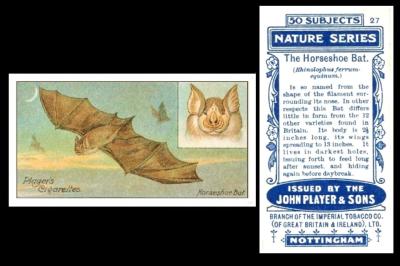
This set seems to have a difference of opinion as to when it was issued - the 1950 London Cigarette Card catalogue for 1950 having it as June 1908 and our original John Player Reference Book, RB.17, published in 1950, having it as March 1909.
In any event, we have selected it for today because in June the bat breeding season suddenly results in flocks of females coming in to roost in all manner of buildings, even under bridges and motorways, where their pups will be born, at the end of June or at the beginning of July. Once these pups are born, the females have to forage, so this becomes the most likely time of the year to see them flying.
This set is part of a group, including two larger sized sets, but their dates do not really help clear up the confusion. Anyway, the book lists the group as :
- 136. NATURE SERIES. Fronts in colour. Backs in blue, with descriptive text. Home issues.
A. 50 Small cards. Issued March 1909. Some colour varieties seen.
B. 12 Extra Large cards – Birds. Thick board. Issued October 1908.
C. 12 Extra Large cards – Animals. Thinner board. Issued October 1913.
We featured the extra large sized set of Birds as our Card of the Day for the 13th of March, 2025, where we display a list of all the cards included in both large sets, along with their numbers in the smaller version. And we also discuss a suggestion that a third large sized set was intended to be issued, but it was shelved by the First World War.
The description in our original World Tobacco Issues Index is shorter, and appears as :
- NATURE SERIES. Nd.... P72-41
A. Small (50)
B. Extra-large (20) –
(1) Animals Nd. 1/10
(2) Birds. Nd. 1/10
This actually is the right text, there are only ten extra large cards in each set, so the original John Player book was wrong by saying twelve.
And in our updated World Tobacco Issues Index the sets appear as :
- NATURE SERIES. Nd.... P644-092
A. Small (50)
B. Extra-large (20) – (1) Animals Nd. 1/10 (2) Birds. Nd. 1/10
Monday, 8th June 2026
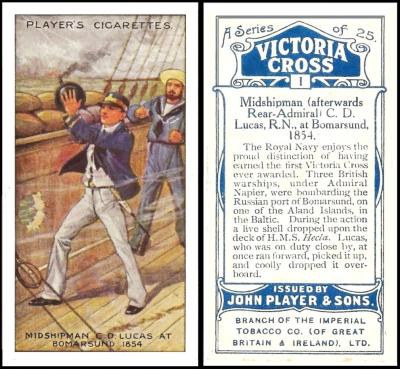
There is also conflict over the date that this set was issued - the 1950 London Cigarette Card catalogue for 1950 having it as June and our RB.17, published in 1950, as September - but there is no doubt that the first Victoria Cross was awarded on the 26 June 1857, to the man on our card, whose action was the first to be rewarded with that medal - which is why he is number one of the set. Though it must be noted that this first ceremony, in Hyde Park, London, saw Queen Victoria give out sixty-two of the medals, but that, for some reason, our man was not the first in line, but the fourth.
His name was Charles Davis Lucas, and he was Irish, having been born at Druminargal House, in County Armagh, on 19 February 1834. At the time of his bravery, he was a Midshipman, but he would end up as a Rear Admiral, and marry Frances Russell Hall, the daughter of Admiral William Hutcheon Hall, who had been the captain of the boat when, and where, his Victoria Cross was won.
Master Lucas enlisted with the Royal Navy in 1847, when he was just thirteen, and was placed on H.M.S. Vengeance. He did not see any wars at that time though, not until he was eighteen, when he went off to the Second Anglo-Burmese War with H.M.S. Fox and was on the field of battle during the captures of Rangoon (between the eleventh and the fourteenth of April 1852), Pegu (on the third of June, for which he received a medal, the India General Service Medal, with a clasp, saying "Pegu" to fit across its ribbon)
In 1854, on his twentieth birthday. he transferred to a new ship, the H.M.S. Hecla, though she was not a new ship in age. having been built in 1839. She was a four-gun, steam powered, wooden paddle sloop in the Hydra Class, who had two sisters, the Hydra herself and the Hecate. Two of these were the names of mythological beings, the hydra being a multi-headed water-monster slain by Hercules, and Hecate being a Greek witch. The odd man out was the Hecla, named after a volcano in Iceland, which was believed to be the gateway to Hell, and which had erupted in 1845, which suggests that a re-naming may well have taken place with our ship.
1854 would be a tumultuous year, and a marvellous one. The ship spent time in the Baltic, drawing up charts, and often met with Russian ships for a little sparring practice. Then she returned to Dover, only to receive orders to set to sea and join the Crimean War, one of the first vessels to do so. They soon met resistance, at the Aland Islands, and then went into action against the fortress of Bomarsund, and its vast arsenal of at least a hundred guns. The battle had no sooner commenced than a live shell landed on deck, and orders were immediately given to lie flat on deck; but our man ignored these, and picked up the shell, with its fuze still sparking, carried it towards the rail, and dropped it over the side, where it exploded, almost immediately, even before it hit the water, so close that two men were wounded by the retort. The Captain knew that in moments it could have killed all the men aboard and set fire to the ship, and so he immediately called for our man and made him Acting Lieutenant - as well as nominating him for a Royal Humane Society Medal, which he duly received, in gold.
The Victoria Cross, for the same action, was awarded three years later.
Our man stayed with the Royal Navy, progressing through the ranks and changing to bigger and better ships. He retired from the Navy on the first of October 1873, aged just thirty-nine, and moved in with his sister who was living in Scotland.
Then, five years later, when our man was forty-four, a really strange thing happened, for our man was contacted by Admiral Sir William Hutcheson Hall, from H.M.S. Hecla, to say that he was ailing, and he would like to give him the care of his wife and the hand of his only daughter. Lucas agreed to this, and the wedding not only took place the following year, but resulted in the birth of three daughters. They all moved down to Kent, but travelled between there and Scotland because our man was a Justice of the Peace for Kent and Argyllshire. On one of these trips to Scotland, he left his medals on the train, including his Victoria Cross; they were never handed in, but he was issued with replacements. These are now held by the National Maritime Museum at Greenwich, and though they are not on public display, the Royal Humane Society Medal can be seen online.
Charles Davis Lucas, V.C., died, at home, in Kent. aged eighty, on the seventh of August 1914, three days after Great Britain had declared war on Germany.
This set first appears in our original John Player reference book, RB.17, published in 1950, where it is catalogued as :
- 193. VICTORIA CROSS. Small cards. Fronts in colour. Backs in dark blue, with descriptive text. Home issue, September 1914. Variety : Card No, 22, 4th line of text (a) Pargai Heights (b) Dargai Heights (correct)
It is next catalogued in our original World Tobacco Issues Index, as :
- VICTORIA CROSS. Sm. Nd. (25) ... P72-54
It is slightly differently recorded in our updated World Tobacco Issues Index, as :
- VICTORIA CROSS. Sm. back in blue. Nd. (25) ... P644-118
Tuesday, 9th June 2026
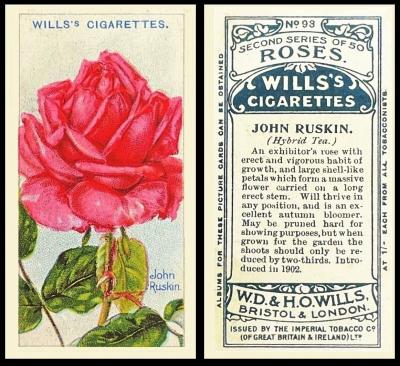
A gentle rose, but with a sting in its tale, for this is John Ruskin, named after the artist - and in June 1853 he and his current wife, Euphemia Gray, travelled to Scotland with fellow artist, and his protege, John Everett Millais. And before summer was out, Euphemia Gray and John Millais were together, so much so that she left her husband forever on April the 25th, 1854, and married John Millais on the third of July, 1855.
The rose is a dark red hybrid tea, and it is rather interesting that it is in our 1914 set as rose manuals say it was bred some time before 1922, in America, by a man called Dr. Walter Van Fleet. However it was not introduced in that country until 1928, when it was just called Ruskin. In fact it appears that it was nothing to do with the artist, it was named for the Ruskin Colony in Tennessee, a socialist experiment where all people worked together on all things, and seem not to have been repaid in money, just in work certificates. where Dr. van Fleet was the physician. But in 1899 it all ended, because it ran out of money. Curiously none of this is mentioned on our card, it just says the rose was introduced in 1902. So is it the same rose, or not? Maybe there is a rose specialist out there who can help us out?
I am surprised that I have not featured any of these sets before, only the overseas edition issued with "Purple Mountain" Cigarettes, which was our Card of the Day for the 11th of August, 2022. Anyway, now we have a new set to discover!
Now at first when I wrote this I said that the home issues were three in number, and they are first described in our original Wills reference book part three, as :
- 94. ROSES. Two series of 50 and re-issue. Fronts lithographed in colour; backs in grey with descriptive text. Home issues :-
A. Series of 50, numbered 1-50. With Album Clause. Issued 1912
B. Second series of 50, numbered 51-100, With Album Clause. Issued 1914
C. Series of 50, numbered 1-50. Without Album Clause.Issued 1926. This series repeats 9 subjects from A, and 7 from B (letterpress in some cases revised) with 34 new subjects.
That sounds like a list to me, but not tonight.
We also know the months of issue, which were April 1912 for the first series, June 1914 for the second series, and May 1926 for the re-issue. But this means that in our original World Index you will find the first two together in section 2.A, for sets issued between 1902 and 1917, and the third shelved away to section B, for sets issued between 1922 and 1939. The listing of our set is :
- ROSES. Sm. Nd. See W/94. ... W62-100
1. "A Series of 50"
2. "Second Series ....." Nd. 51-100
However, when I went to section B, I found the following :
- ROSES. Sm. Nd. (50). See W/94.C. ... W62-174
- ROSES. Lg. Nd. (40). ... W62-175
This large set was obviously not mentioned in the same breath as the later set in our Wills reference book, or I would have seen it, but when I looked at the London Cigarette Card Catalogue for 1950 it was there, so it must have been known of. Therefore I went back to the original Wills book part three and picked up the thread again. and it was not there. And it turns out that the large set does not appear until part four of the Wills books, where it is described as :
- 314. ROSES. Large cards, size 73 x 62 m/m. Fronts printed by letterpress in colour. Backs in grey, with descriptive text. Home issue, 1936.
In our later Wills combination volume, which contains all the original booklets reprinted under one hardback cover, we also find a month of issue, January 1936, which was almost ten years later than the third small sized set mentioned above. However that did make it easier to find when I came to the updated World Tobacco Issues Index, where the sets are listed as follows :
Section 2.A - Issues 1902 - 17.
- ROSES. Sm. Nd. Series title in curved panel. See W/94. ... W675-133
1. "A Series of 50" 2. "Second Series....."
and
Section 2.B - Issues 1922 - 39. Excluding cards with adhesive backs.
- ROSES. Sm. Nd. (50) Series title in straight panel. See W/94.C ... W675-215
- ROSES. Lg. Nd. (40). ... ....................................................................W675-216
Wednesday, 10th June 2026
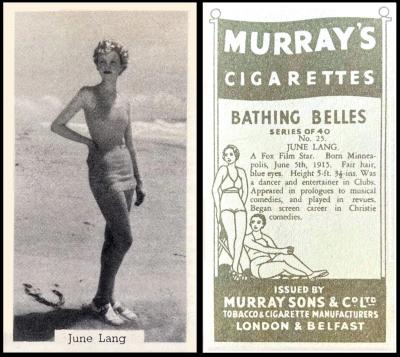
We welcome a real June to our website today, though actually that was her middle name, as she was born Winifred June Vlasek. Our card says that she was also born in June, June the 5th, 1915, but modern records state she was born on May the 5th, 1917. I think that may be her film star records, where starlets were well known to shave a few years off hither and yon as they aged. Both the card and her online records agree on her place of birth, Minneapolis, USA.
Who knows, if she had stayed in Minneapolis she may never have been a movie star, but chance took the family off to Los Angeles, and she discovered the delights of dance and theatre. Our card tells us that she "was a dancer and entertainer in Clubs. Appeared in prologues to musical comedies, and played in revues." Then it adds something very intriguing, and that is that she "began [her] screen career in Christie Comedies". If that is true, then it is unlikely, as modern records say, that she was only sixteen when Fox took her on, asking "only" that she straightened her teeth and changed her name, making her drop the Winifred and change the Vlasek to Lang. And we also know that she appears as June Vlasek on many cards, including Abdulla`s "Stage and Film Stars", and Godfrey Phillips` "Stage and Cinema Beauties", both almost identical cards, and both issued in 1935, where it states that her "first screen engagement was a comedy role at the Christie Studio" - though in the same year she appears in the German sets of "Bunte Filmbilder" as June Lang.
Everyone agrees that she made her film debut in 1931, in a film called "Young Sinners", made for Fox, which hardly lived up to its title, as it was about someone who regains the joy of living by meeting a man and woman who had experienced the ups and downs of life. Our girl was unbilled, and we don`t even know what she did, though we do know, thanks to our card, that she had "fair hair, blue eyes [and was] 5 ft 3 1.2 ins".
She remained in the background for three films, and maybe more, until she was cast as Betty Lou Regent in a film called "Chandhu the Magician", which was based on a radio show. Its chiefly remembered for the fact that Bela Lugosi was in it, as the mad kidnapper, desperate to get his hands on a death ray so he can control the world, or half of it anyway, as the death ray is billed as having beams that reach half way round the world, not sure why it falls short, maybe just the curvature of the earth.... In fact he was also in a later serialised version, but stepped up to play the leading role of Chandhu the Magician.
Probably the best role that our girl ever got was in "Bonnie Scotland", released in 1935, a Laurel and Hardy film, set in British India, where she played Stan Laurel`s wife. That was her last film for Fox, and yet she is recorded as being still with them on the reverse of our card, issued in 1939. Mind you, she is also recorded as June Vlasek on the 1937 series of Carreras "Film Stars" and on several British American Tobacco sets that were issued later still.
Her last film was in 1947, "Lighthouse", rather a pot boiler, where she falls in love with a lighthouse keeper who turns out to be married, so she marries the other lighthouse keeper and all three live together. Of course the original man then turns out to be in love with her, and schemes lots of ways to make her his, but by then she has realised she loves her now-husband more. The only thing is that they seem to forget the wife that led to the marriage, she is not anywhere to be seen in the lighthouse, and she`s not in the credits either, so maybe the now-husband was also a bit of a schemer and only invented her to turn our girl towards him. All too convoluted for me!
Between those two films she was married, in real life, to her agent, Victor Orsatti, but it was short lived, they married at the end of May 1937 and divorced at the beginning of August 1937. Then in 1939 she married an Italian union man, John Roselli, also known as Filippo Sacco, and "Handsome Johnny", who was a friend of Al Capone, and was also reputedly recruited by the C.I.A. to assassinate Fidel Castro, but she said she never knew anything about that until after they divorced in 1943, though in the same year he was sent to prison for extortion, involving several Hollywood stars and filmmakers, and later on he would be mixed up with the shooting of John F. Kennedy.
Three years after that she married again, to a man called John Morgan, and they had a daughter, but they divorced in 1952. She never remarried, and died in May 2005 at the age of eighty-eight.
This set first appears in our original World Tobacco Issues Index, as part of the penultimate cartophilic output of this firm, who were founded in 1810 and first issued cards in 1901. It is catalogued as :
ISSUES 1929 - 31
- BATHING BELLES. Sm. 68 x 38. Black and white halftones. Nd. (40). See Ha.592 ... M164-42
Curiously, there is another set directly above, namely "Bathing Beauties", slightly differently shaped cards at 62 x 40 m/m, and a set of twenty-two real photos. In fact all the sets in this section but one contain some form of female form, the one being "Types of Aeroplanes". Now you might think that to be the latest set, in preparing for war way, but actually it was issued in 1929, the same year as all the rest (save "Dancing Girls", which I don`t seem to have a date for), and ten years before our "Bathing Beauties" slithered suggestively from their wraps.
Then cards abruptly halted, until 1939, when they discovered the allure of the sea, and gave us "Steam Ships" (1939) and "The Story of Ships" (1940). And then they were gone forever.
As far as the "H" code, that takes us to the Handbook, which at that time was published by the London Cigarette Card Company, and it tells us the following :
- Ha.592. BATHING BELLES. (titled series). Front in black and white. Numbered.
Murray - Series of 40
United Services - Series of 50.
Now both of these were issued in the same year, 1939, but the retail prices in the accompanying catalogue tell a tale, for our version is priced at 1d. a card or 1/6 a set (and we are told that they are cheaper in the Abridged Catalogue), whereas the cards of the United Services Manufacturing Co., Ltd, London, retailed at 6d. a card and sets cost 30/-
In our updated World Tobacco Issues Index the text is pretty much the same but it does have a new card code, of
- BATHING BELLES. Sm. 68 x 38. Black and white halftones. Nd. (40). See H.592 ... M970-620
Now I do have a list of these cards, which is as follows :
- Dolores Casey
- Franciska Gaal
- Blanca Vischer
- Gladys Swarthout
- Jane Hamilton
- Marian Marsh
- Muriel Evans
- Ann Sheridan
- June Knight
- Maxine Jennings
- Toby Wing
- Frances Drake
- Jane Hamilton
- Irene Ware
- Ann Dvorak
- Sheila Darcy
- Jean Chatburn
- Kitty Carlisle
- Anne Shirley
- Maxine Reiner
- Judith Barrett
- Eleanor Whitney
- Grace Bradley
- Mary Carlisle
- June Lang
- Mildred Stone
- Jean Parker
- Maxine Reiner
- Iris Adrian
- Gwen Kenyon
- Mary Howard
- Eleanor Hansen and Frances Robinson
- Linda Parker
- Gwen Lee
- Rosalind Keith
- Ida Lupino
- Frances Gifford
- Cecilia Parker
- Gertrude Michael
- Arline Judge
But I`m not sure what the extra ten cards were that were issued by United Services. Not yet, anyway....
Thursday, 11th June 2026

Strangely, just like the bat we featured earlier in the week, June is armadillo breeding month too, and prime time for their babies, also called "pups" to be born. This is planned, because June is often a warm month, and that means there are plenty of insects to root out as food for the young - that`s why the armadillos are more prone to damaging gardens and lawns at this time.
In our original reference book to the issues of W.D. & H.O. Wills, part four, we find out that this curious set falls under games, for it is written up as :
- 124. 48, ANIMALLOYS. Fronts printed by letterpress in colour. Sixteen animals, each divided into three sections, sections interchangeable to form comic combinations. Backs in grey, with instructions for interchanging, Home issue, 1934. Similar series known with Chinese inscription, no makers name.
By the time of our original World Tobacco Issues Index the description is much shorter,
- "ANIMALLOYS". Sm. Nd. (48). See RB.21/200-124.A ... ... W62-110
And this remains identical in our updated World Tobacco Issues Index, save a new card code of W675-144.
Now before I race on, the pictures only work because the animals are skewed in size, so that all the necks and rear ends are the same size, making it possible to make a creature that fits exactly together with a head, a body, and back legs. This is no mean feat, for the animals are :
- ALL - IGA - TOR (cards 1.2.3.)
- ANT - ELO - PE (cards 4.5.6.)
- ARM - ADI - LLO (cards 7.8.9)
- BUF - FA - LO (cards 10.11.12.)
- HIPP - OPOTA - MUS (cards 13.14.15.)
- IG - UA - NA (cards 16.17.18.)
- LE - OPA - RD (cards 19.20.21.)
- OP - OSSU - M (cards 22.23.24.)
- PLAT - Y - PUS (cards 25.26.27.)
- PORC - UPI - NE (cards 28.29.30.)
- RAC - COO - N (cards 31.32.33.)
- RHIN - OCE - ROS (cards 34.35.36.)
- TORT - OI - SE (cards 37.38.39.)
- WAP - IT - I (cards 40.41.42.)
- WE - ASE - L (cards 43.44.45.)
- WOLV - ERI - NE (cards 46.47.48.)
In addition, the way that the names are split between the cards means that your creature creating also ends up with a strange name
Friday, 12th June 2026
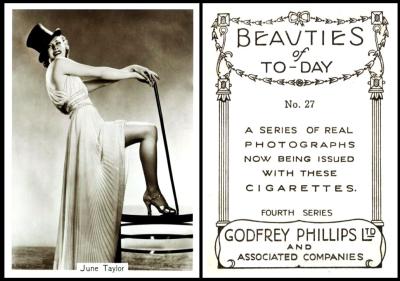
We close our week with another June, June Taylor, who ostensibly appeared on only three cards :
- Abdulla & Co`s "Beauties of To-Day" (1938) - 9/50
- Godfrey Phillips` "Beauties of To-Day" - small size - series 1 (1938) - 9/50
- Godfrey Phillips` "Beauties of To-Day" (1938) extra large - series 4 - 27/50
However all these cards have the same picture, albeit colourised on set one above, And two of them, sets one and two above, have the same biography, which reads : "JUNE TAYLOR - who appeared in Henry Sherek`s Supper Time Show "Laughter and Rhythm" at the Dorchester Hotel": Our card, which is set three above, has no biography, though it is a larger card with more space to expand one; it simply says "A series of Real Photographs now being issued with these Cigarettes".
Now there are lots of June Taylors online, but none seem to be our girl. So it seems likely that she was a pretty showgirl who never made the big time, and never had any scandalous relationships with more famous people than her, but was pleasing enough to be featured on these cards, so at least she left the proof that she existed. And many showgirls cannot even say that.
I will not have time to describe this set tonight, but according to the World Tobacco Issues Index there are a lot of cards with this title, four series of small sized cards variously in colour and black and white, two series of large black and white cards, and seven series of extra large black and white cards.
For now I will confine myself to our set, and only as described in the original World Tobacco Issues Index as :
- BEAUTIES OF TO-DAY. Extra-Lg. Black and white photos
4. “Fourth Series”. Nd. (36)
And tomorrow I will add the rest...
And so there we have it; a couple of reference books to glean tomorrow, the odd bit of titling, but not so bad. I`m happy with that, and I hope that you are too.....