
Well I think I may be getting on with my new glasses, I am wearing them for longer periods, and I am still splitting my day, going between the laptop, the chromebook, sitting in the garden without them, sorting cards, and reading the paper. That`s why the newsletter is a bit slow, and also why I am getting on better with the indexing, which is cut and paste, and takes less typing. But I have only had the glasses for just over a week, and I`m already doing better than I had hoped.
Website News.
This week I added the contents of four back issues of the newsletter to the index.They were for the 19th of August, 2023, the 25th of August, 2023, the 2nd of September, 2023 and the 9th of September 2023.
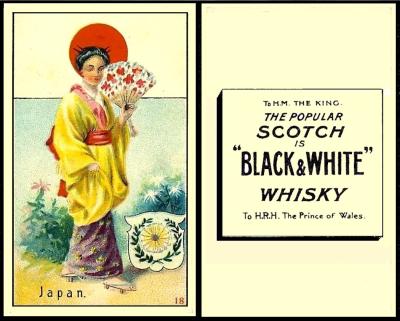
Within these there were only two alterations/replacement cards, both in the newsletter of the 19th of August - firstly Sanitarium`s "Australia Leaps Ahead" (instead of a duplicate Wills` "Crests and Colours of Australian Universities, Colleges and Schools"), and secondly, this Hill`s version of "Flags, Arms & Types of Nations" (instead of a duplicate of the Cope version). I remain unsure as to why this has never been included in the Hill`s section of our World Tobacco Issues Index, and languishes at the back, especially as Hill`s "Statuary" set three has exactly the same advert on the reverse of a card with Hill`s name on the front . Any ideas?
The fifth newsletter is partially done, but it contains a double of a set already used. I have a replacement but that means swapping something else as well. So its all been shelved until tomorrow!
Where to Go this Week
Saturday the 6th of June -
- Lincolnshire - from 10.30 a.m. at Kirton Leisure, 31a Willington Road, Kirton, Boston PE21 1EP.
Sunday the 7th of June -
- Winchester & Solent - from 1.30 p.m. until 4.00 p.m. at Botley Market Hall, High Street, Botley, near Southampton SO30 2EA
Thursday the 11th of June - two events
- Cotswolds - from 7 p.m. at Uckington Village Hall, The Green, Tewkesbury Road, Uckington, Cheltenham GL51 9SR
- Reading - at 7.30 pm (for 8 pm start) at Charvil Village Hall, Park Lane, Charvil, Twyford RG10 9TR.
And now lets see what else is new to celebrate this week, with a fresh cast of characters to meet and fun things to join in with. So allow me to introduce an Amazing Atlantic Adventure, a Canal City Christening, a Parisian Peugeot Purloining, a Chicago Cheese Creation, lots of Political Parrot Profanity, two Alternate Aviation Awards, and some Giant German Growlers.
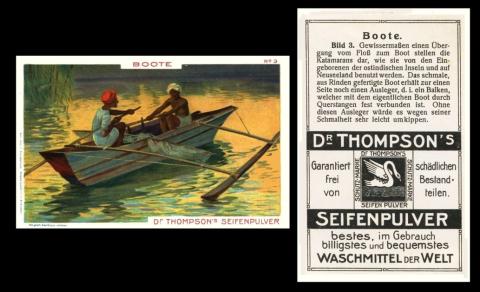
Dr. THOMPSON`S [trade : washing powder : O/S - Germany] "Boote" / boats (1930s?) 3/6
Let us start with our "Amazing Atlantic Adventure", for today, in 1896, a pair of Norwegian-Americans called Frank Samuelsen and George Harbo, rowed out of New York harbour and kept going, right the way across the Atlantic Ocean, in fifty five days. And their record was not broken for a hundred and fourteen years.
George was the older, he had been born in 1864, and Frank was six years younger. Both men had been born in Norway, but come to American and found work along the coast of New Jersey. They met quite by chance, and became good friends, and they would go out together in their little boat to do a spot of fishing, and make a little money on the side. It appears that it was George, one day, who wondered what would happen if they just kept rowing. The idea was just a throwaway, but it stuck, and they looked at maps, and planned a route which would end at the Scilly Isles. And it appears that they shared of their idea with other people, who thought them both brave and mad. It even got to the ears of the press, and the editor of the Police Gazette even said that if the two men made it all the way across he would give them a medal.
Support can sometimes egg you on, and in this case it definitely did, to the point that the men actually decided to make and rig out a new boat, called "The Fox". However it remained a rowing boat, with neither a sail nor a rudder. And on the 6th of June, 1896, one hundred and thirty years ago today, watched by thronging crowds, they hopped into their boat and began to row out of New York harbour.
The trip was not without incident; the weather was oft inclement, there was a fire aboard, caused by the kerosene stove, they were almost run over by a larger ship, and at one stage the boat overturned and most of their food and possessions were lost. Worst of all, they had to work in shifts, one man having to sleep whilst the other rowed, which had not been planned and left the one with nobody to talk to or gain encouragement from.
However, one day, they started to see birds in the sky, and they knew they were nearing some form of land, though they were not entirely sure where. But that night, they were suddenly picked up in the beam from a lighthouse, which turned out to be Bishop Rock, in the Scilly Isles. And the next day, August the 1st, 1896, they were able to row to the shore of the lighthouse and bump its nose against the rock. Then they tied up at the little pier and suddenly people appeared, to greet them.
After a rest, a wash, some food, and a change of clothes, the men waved goodbye to the Scillies, and rowed on to France. They put the boat on exhibition and then rowed on to Paris and did the same. However they seem to have found the French to be quite uninterested in their trip, so they rowed off again and went to Norway. Here they received a quite rapturous attention, and they even met the King, though there were some who believed they ought to have rowed beneath the Norwegian flag rather than the American one. But despite meeting the Norwegian King, they failed to gain much in the way of fame or fortune, and their only tangible reward seems to have come from the Police Gazette, which stood up to its honour and gave them each a gold medal. And it was rather an anticlimax that all they could do was return to fishing.
Twelve years later, in 1908, George died, from pneumonia, aged just forty-four. Frank decided that he wanted to go back to Norway, which he did, and he lived for almost another forty years, dying on his family farm in 1946 at the age of seventy-six.
Now if you look for cards of rowing, you invariably get one man, or a team of men, in a very long boat, but that is technically sculling. I`m not sure this card is any better, for one thing it is a catamaran, and from another continent entirely, but it does suggest lonely nights at sea, interspersed with frantic conversation between one man going to bed and one man taking the oars.
And its an issuer I have not mentioned before, Dr. Thompson`s Washing Powder, in Germany, about whom I can find absolutely nothing - but you can also find the same set by Hoyer Margarine of Rostock, and possibly others too.
The cards in both these sets show
- Baumstamme - man standing on log
- Urmensch Boote - boat of early man
- Indien Katamaran - Indian catamaran
- Afrikanischen Boote - African canoe
- Kajak der Eskimos - Eskimo kayak
- Ruderboote - rowing boat, but as in sculling
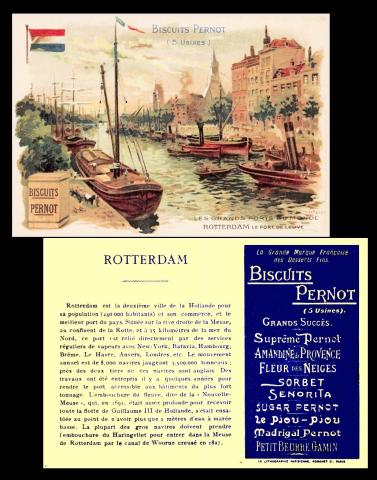
Biscuits PERNOT [trade ; biscuits : O/S] "Les Grandes Ports du Monde" / the largest ports of the world (1900s) Un/25?
Our "Canal City Christening" celebrates the founding of Rotterdam, today in 1270. However it was not the creation of a new settlement, for there had been people living along the river Rotta since at least the year 950, and long enough to name it so, for "rot" means muddy and "a" water. The "dam" bit indeed comes from a dam, a way to block the river, which was constructed between 1260 and 1270, almost certainly a result of devastating floods which swept through the area from 1150 onwards.
In 1340, the town had grown large enough for it to be granted City Rights by a man who was Count of Hainaut, Count of Holland, and Count of Zeeland. as well as being, somehow, Count Willem II and Count Willem IV. Ten years after that, with the completion of a proper shipping canal, the Rotterdamse Schie, things really took off, for it allowed trade to pass through from Germany and also the other way, from England. By 1550 it was the centre of the herring industry, and in 1618 of wine importation and exportation.
Today Rotterdam is a sprawling, bustling, metropolis, the second largest city in the Netherlands and the largest by total area - as well as the tenth largest city in Europe, and its largest seaport. However the centre and harbour was almost completely destroyed by German bombing in the Second World War, and, unusually, the council chose not to replace the buildings with like for like, but to embrace of modernity, one of the first major cities to do so.
I am not sure how many cards are in this set, perhaps twenty-five, but so far only know of :
- Alexandria
- Alger
- Antwerp
- Buenos Aires
- Constantinople
- Genoa
- Hamburg
- Hanoi
- Le Havre
- Lisbon
- London
- Marseille
- Melbourne
- Montevideo
- Montreal
- New York
- Rio de Janeiro
- Rotterdam
- Shanghai
- Singapore
- St. Petersburg
- Trieste
So if you know of any more please tell us....
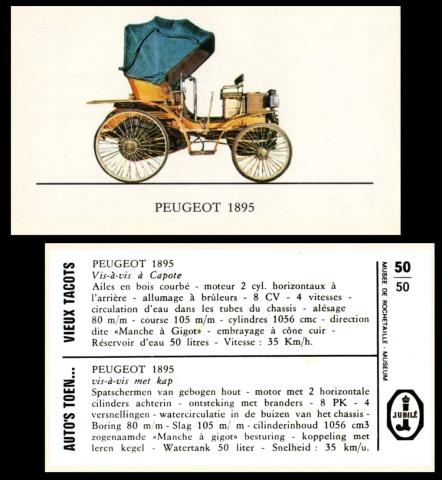
JUBILE [trade ] "Autos Toen" / "Vieux Tacots" / old timers (??) 50/50
Now for the "Parisian Peugeot Purloining", which took place in Paris, today in 1896, one year after the car on our card, and was the first recorded car theft.
The victim was Baron Etienne de Zuylen de Nyevelt, who had been born in 1860, in Holland, and who was an early enthusiast of motorcars. In fact in 1895 he was one of the founders of the Automobile-Club de France, the first car club in the world, and he would be its President from 1904 until he retired in 1931.He was also a founder member of the Royal Automobile Club, which today we know better as the RAC. One of the other important things he did was to develop, if not invent, the sport of motor racing, the first competition being The Gordon Bennett Cup, first held in the first year of his presidency
As for the theft, it is extraordinarily strange. The thief was Baron de Zuylen`s own mechanic, who drove off with the Baron`s Peugeot automobile, whilst it was at the manufacturer`s shop for repairs. The strangest thing is that both the mechanic and the car were found together in the nearby town of Asnieres, and not too long after. Today we would probably call it a joy ride, or just think the mechanic may have been testing it before taking it home.
Unfortunately I have not been able to find out a thing about what happened to the mechanic, though he was probably fined, or dismissed - maybe both....
I`m not sure who issued these, which are actually stickers, on card.
One theory is that it was the museum mentioned on it, the Musee de L`Automobile Henri Malartre. That was opened, in Rochetaillee Castle, in 1960, though the castle is much earlier, dating to the twelfth century. It was once the property of the Church, until the French Revolution, when it was seized, and sold. The museum was opened by Monsieur Malartre himself, and it is still in business today. However, fifty years from that is 2010 and I am fairly sure these are earlier, so perhaps its their silver jubilee, in 1985?
The other theory is Cigars, or Cigarillos Jubile, but I cannot find them at all.
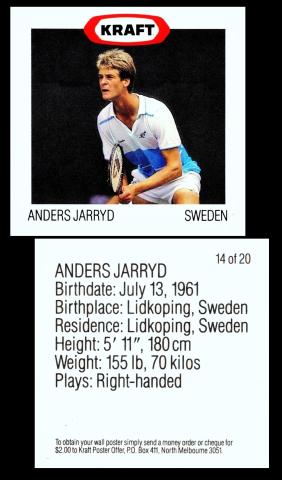
KRAFT Australia [trade : cheese : O/S - North Melbourne, Australia] "International Tennis Champions" (1983) 14/20
This was the hardest day to find anything for, but we somehow managed to turn up a "Chicago Cheese Creation" - for today, in 1953, a John H. Kraft was granted U.S. Patent number 2,641,545 - for the "manufacture of soft, surface cured cheese".
This was just one of the many patented and unpatented discoveries of the Kraft family, starting with James Kraft, born in 1874 on an Ontario farm, the second of what would become a family of eleven children. In 1903 he was in Chicago, having just lost his job and become a door to door cheese seller, bemoaning of the fact that to get a profit on the cheese he bought, he had to buy in bulk, which often meant that unsold cheese went mouldy, and had to be thrown away, lessening his profits. So he worked on making a new kind of cheese, using standard cheese, melting it, and adding all manner of things that he thought could lengthen its shelf life.
He knew he was on the right track, so he created the J.L. Kraft and Bros. Company in 1909 with four of his brothers - though it took him right until 1915 for him to realise that the secret was not just the cheese, it was the container, and how quickly you could reduce the cheese to liquid, pour it into a container, and seal it fast. The liquid would eventually cool and harden and return to cheese, but it could not go off until the container was open. And in 1916 he was given the patent for sterilizing cheese, and for making an improvement to that process.
These dates were fortuitous in other ways, for they meant that when America joined the First World War Kraft was able to get the contract for supplying long life cheese, which needed no refrigeration, to the forces.
By 1923 Kraft was the biggest cheese company in the world, and, from 1924 to 1930 it expanded still further by buying up cheese makers across America. But in 1930 it was itself bought out, by Thomas McInnerney, of the National Dairy Products Corporation, though he kept the Kraft name. And in 2012 it was bought again, by Mondelez, who again kept some of the names, and ran it under Mondelez International Kraft Foods Group.
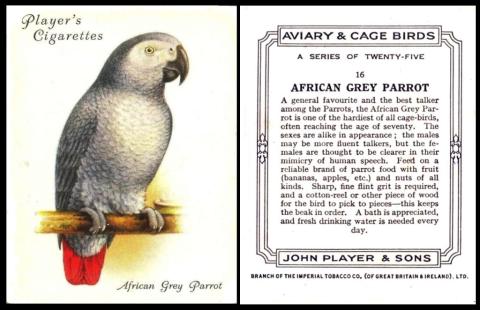
John PLAYER [tobacco : UK - Nottingham] "Aviary and Cage Birds" - large size (February 1935) 16/25 - P72-154 : P/18.C
And now for the probably much awaited "lots of Political Parrot Profanity".
This was such fun I had to include it, and I actually had to oust what I had already started to write when I stumbled on the fact that today, in 1845, a parrot was ejected from a funeral for swearing.
The parrot was called Poll, and she was a Congo, or African, Grey. She was bought in 1827 for a lady called Rachel Robards, who had left her husband in 1791 and run off with a man called Andrew Jackson, marrying him en route. However she was not divorced then, and the couple had to then get a divorce and remarry later, in 1794.
Now some of you may have already twigged this, but Andrew Jackson was the seventh President of the United States, but not until 1829 - and sadly, Rachel Robards/Jackson was never a First Lady, as she died in 1828, the First Lady to Andrew Jackson therefore being his niece.
After she died, Andrew Jackson took over the parrot, whether he wanted to or not, and it was at his funeral, of all places, that the parrot suddenly remembered every dirty word she had ever heard and delivered them all, in a colourful litany. Now for that we can only blame the president himself, who was well known for being bad tempered and using equally bad language. But when all else failed, the bird was picked up and carried out of earshot, and the funeral continued without her presence. Though undoubtedly there were several mourners who were sad to see her go...
After the funeral Poll seems to have stayed at The Hermitage, an estate and cotton farm owned by Andrew Jackson until his death, and where he was subsequently buried, with his late wife. We also know that Poll survived a house fire in 1834, and that she was mentioned in family correspondence until 1850, but then she seems to disappear. As for whether this was due to her death, from natural causes, it may indeed be the case. Congo, or African Grey Parrots African Grey parrots live for between forty and sixty years in captivity, and we know not her age when Poll was bought in 1827, only that she lived with the Jacksons, and then at the Hermitage for twenty three years.
This is a set with three permutations, small cards, transfers, and large cards, which are first described in our original reference book to the issues of John Player, RB.17, published in 1950. You can read that entry in full with the home page for this group which is with our Card of the Day for the 7th of March, 2022.
The section for our large sized version reads :
- 18. AVIARY AND CAGE BIRDS. Fronts in colour. Backs in grey. Home issues.
C. 25. Large cards, adhesive. Titled "Aviary & Cage Birds". Backs with descriptive text. Issued February 1935
However this is the last time you will find them all together, for just six years later, with the publication of our original World Tobacco Issues Index, whilst the cards and transfers remain together the large version has been removed. This is because the World Tobacco Issues Index is catalogued by date, not alphabetically, as the reference books had been. So whilst the two home issues find a slot within Section 2.B, for "Issues 1923-39. Excluding cards with adhesive back". the large set, with an adhesive back, has to wait until Section 2.C, for "Issues 1934-39. Cards with adhesive back". Now that does rather beg the question why Player delayed issuing the large version for quite so long, but anyway, there they are, recorded as :
- AVIARY AND CAGE BIRDS. Lg. Nd. (25) See RB.17/18.C. No album ... P72-154
As for the birds released from the aviary to make our large set of twenty-five, that will eventually appear on the home page for the full set, with our Card of the Day for the 7th of March, 2022.
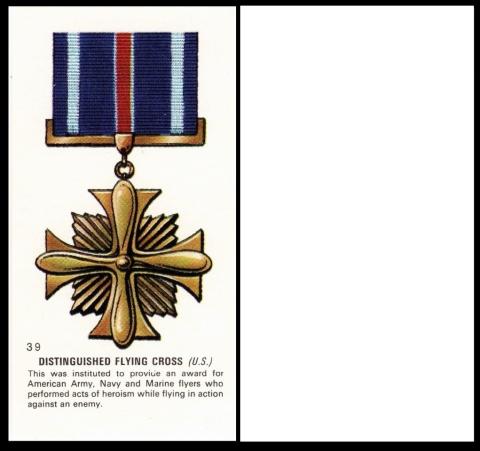
Tommy Gunn [trade : toy soldiers : UK] "Medals" (19) 39/50
Our "two Alternate Aviation Awards" will briefly touch on a man, and concentrate on a medal. For I have mentioned the Distinguished Flying Cross a few times, being awarded to Russell Lowell Maughan for flying coast-to-coast in a single day (in the newsletter of the 8th of July, 2023), and to the film star Sabu (in our newsletter of the 27th of January, 2024). And today, in 1927, the very first Distinguished Flying Cross ever was awarded to Charles Lindbergh, by President Calvin Coolidge, for his historic solo, nonstop transatlantic crossing in the "Spirit of St. Louis".
All these men were awarded the American medal, showing above, designed by Elizabeth Will and Arthur E. Dubois, and established on the 2nd of July 1926, though it covered actions from April the 6th, 1917, and in 1929 a medal was awarded to the Wright Brothers, or rather to Orville, who was still alive (and would remain so until January the 30th, 1948), for Wilbur had died of typhoid, in May 1912, aged just forty-five. The first "recipients" of this medal were ten of the aviators who had taken part in the Pan American Good-Will flight in 1926-27, and two of those medals were awarded posthumously - however the men were only given certificates, and received their medals later, once they had been made. That is why Charles Lindbergh is cited as the first man to actually receive the medal, a month later, when the medals were ready - though it seems odd that they did not bring the other men back and just line them up first.
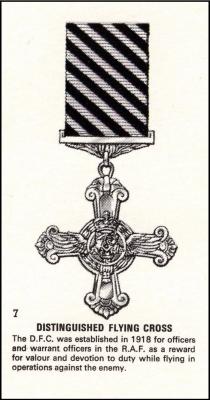
The other medal is British, and it was designed by Edward Carter Preston, being established on the third of June 1918. This was for RAF commissioned and warrant officers from all allied forces, including the Commonwealth. It was only extended to the Navy in March 1941, and to the Army in November 1942, but only to those who survived the action for which they were nominated. Posthumous awards were only started in 1979, and the first medal to carry the name of the recipient was only issued in 1984.
Now I have taken a bit of a liberty here as both these medals appear in a single set, which I had already featured.
All that really means is that our newsletter for the 5th of August 2023 still has a Purple Heart medal, but it is no longer from this set, it is from another, by Glengettie Tea, and there is a new issuer write up.
As for the write up for this set which was removed from there, it is now here, and is as follows...
This set is anonymous, untitled, and plain backed, though the story goes that it was planned to have the text which is below on the reverse, but somehow a misunderstanding, or an attempt to save money, saw the front and back combined.
Anyway we are certain who issued it, and that was “Tommy Gunn”, a British Action-Man style figure, produced by Pedigree Toys. In fact our updated British Trade Index says :
Issued 1969
MEDALS (A). 65 x 36. Nd. (50). Plain back, anonymous. Special folder issued, spaces for 20 cards which, when returned, obtained a full size “Tommy Gun” soldier in uniform, free.
That toy name is wrong however, for a Tommy Gun, with one N, is the general abbreviation for a sub-machine gun. That is probably why the figure has the extra N, to save on issues like copyright and trademark infringements.
You can read more about the toy, and it also mentions these cards, at Wikipedia / Tommy Gunn
Now you may be lucky enough to see another version of this set, which was given out at Timperley. You can read more about those on their site. And if anyone out there has one of those, and would like to scan the back, (unless there is a difference to the front) I will change this blank back for it, forthwith.
And, by the way, this set seems not to be in our original four volume British Trade Index. Unless my eyes deceive me…
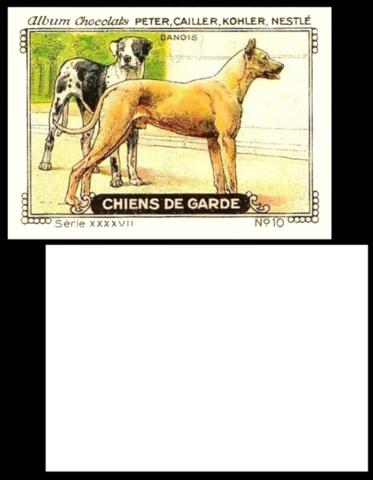
PETER, Cailler, Kohler, Nestle [trade : chocolate : O/S : Europe] "Chiens de Garde" / guard dogs - Series XXXXVII (1930s?) 10/12
We close our week with those "Giant German Growlers" for it is #NationalGreatDaneDay.
Great Danes live up to their name, at least the first part, for it is the tallest of all dogs, up to 32 inches tall. However they have nothing to do with Denmark, they come from Germany. And despite their height and imposing appearance they are also one of the gentlest dogs of all, though you have to start training them early, before they start to train you. As for their inclusion in this set, of guard dogs, yes they may be gentle, but they are also fiercely protective of those they love.
They come in a variety of colours, both as complete shade of light brown, blue, and black, plus striped brindle, black and white mantle, and an assortment of mixed colours that come under the name of harlequin.
If there is a downside to these striking dogs, it is that they need a fair bit of room, and that they only live for eight to ten years.
The other dogs in this set are :
- Bouvier des Flandres
- Terre Neuve
- Mastiff
- Colley
- Chien des Pyrenees
- Chien de Trait Belge
- Berger de Brie
- Berger de Beauce
- St, Bernard
- Danois
- Berger d`Alsace
- Dogue de Bordeaux
Now as usual this set was also issued by Nestle, Peter, Cailler and Kohler, as series 47 and as Series 47.B, and also by Kohler alone, in which case the title "Chiens de Garde" is at the top border and the name of Kohler is in the cartouche within the picture frame.
This week's Cards of the Day...
were chosen and written up whilst I adjusted to my new glasses, so I thought it would be fun to find out more about their story, and to celebrate a few of their wearers.
Saturday, 30th May 2026
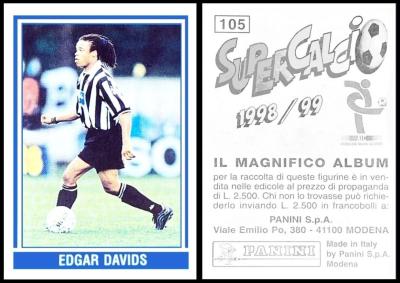
So our first clue was of Edgar Davids, who suffered a severe head injury in 1995 and was diagnosed with glaucoma four years later. The important link to our story is that after his surgery he was not told to stop playing football, but advised to wear protective sports goggles when he was on the pitch. The only problem was that this was not in the rule book, but, staggeringly, FIFA agreed. Now it is said that this made him the first player ever allowed to wear glasses during a game, but I`m not so sure about that. Maybe you know of some though, and can tell me!
Edgar Steven Davids was born on the 13th of March, 1973, in Paramaribo, Suriname, which is in South America. When he was small his family moved to the Netherlands. At which point we must say that there is a big link between there and Suriname, because it was a Dutch colony from almost three hundred years, beginning in 1667 and only gaining its independence on November the 25th, 1975. Now you might think that's a good thing, but it seems to have caused a lot of people to move to the Netherlands, almost certainly including the Davids family. And this move continues, making the Surinamese population of the Netherlands almost as large as it is back home.
Football entered Edgar Davids` life early, and we know he was twice turned down by AFC Ajax for being too young. The third time, in 1985, when he was twelve, they relented. It was a good move on their part, and they moved him straight into the senior team in 1991. It seems that his rookie card came not long after this, in 1992, part of the Shooting Stars issue of Dutch League players. He is card thirteen. And he also joined the Netherlands National team during that time, in 1994.
In 1995 he suffered eye injuries which led, four years later, to the diagnosis of glaucoma. However it seems that this was not an outcome that was predicted at the time, it was only discovered later.
In 1996 he was given a kind of free transfer to AC Milan, in Italy, due to a new ruling that banned the former quota restrictions on the number of foreign players in any one team, at least within the European Union. His time at AC Milan was not a happy one and it ended with him breaking his leg in February 1997. However though that lost his spot at AC Milan, it did get him an offer from Juventus FC, whom he joined in December of that year.
In 1999 the glaucoma was diagnosed and he had to wear the glasses. Juventus were happy to let him play on, but he was eventually loaned out to FC Barcelona, in Spain, in January 2004.
He did not last there long though, returning to Italy after an offer from Inter Milan, a three year contract. Sadly, this was fated not to run its course, and in August 2005 the club cancelled it. Once more, however, a rival club was waiting in the wings to snap him up, and that was a British one, Tottenham Hotspur.
He played in England until the end of January 2007, and then was offered a gig back at AFC Ajax. He loved that club, and happily accepted, but fate would again see him leaving the pitch with a broken leg, in a friendly match in 2007, which kept him out for three months. He also decided during that time to leave the club.
After that he seems to have been unsettled, though he did briefly return to England and join Crystal Palace, as a kind of freebooter. He left them in November 2010, but stayed in England, becoming manager of Brixton United and, from 2012, player-manager of Barnet FC. He resigned from this in 2014 and moved into coaching, presumably moving back to the Netherlands, as his last three coaching roles have been out there, including for the Netherlands National Team.
Our sticker was not his first appearance in a "SuperCalcio" set, that came in 1995. And it looks like his first appearance in glasses comes in the year 2000, as part of another Calcio, "Planeta Calcio", issued by DS, a company I cannot trace.
Our sticker comes between these two, and there is a kind of parallel set, as apart from the 377 football players and managers there are eighteen club name stickers, which were for the poster included in the centre of the album. These name stickers are very scarce.
Sunday, 31st May 2026
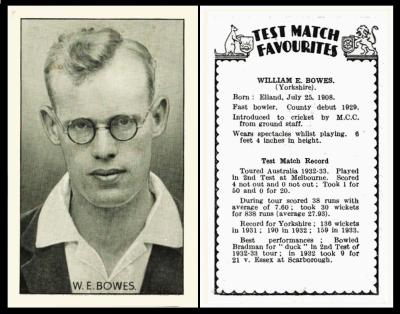
Our second card, actually showed a spectacled sportsman, whereas the card above was from a time before Edgar Davids was diagnosed with glaucoma, though you can get later cards which show him with glasses on.
However this card was chosen because it actually says in the reverse text that our man "wears spectacles whilst playing". It appears that this was simply because he was nearsighted, which, as it says, makes items that are further away seem out of focus, they only become visible as they come nearer. The main problem with this is that to compensate without special glasses the sufferer ends up squinting, straining their eyes, and getting headaches.
So today we will have a chat about William Eric Bowes, who was born on the 25th of July 1908, in Elland, Yorkshire, the son of a railwayman. This meant the family travelled about the country, until 1914, when they settled in Leeds. Our man fell into cricket almost by accident. Like most small boys, play invariably turned to football or cricket, and it was sheer luck that the cricket team was closer to where he lived. He was a good cricketer though, even as a youngster and he was on the team of both his schools. However he still did not consider it as a career, and became an estate agent after leaving school, only playing for a church team, for which he served as the secretary. This would probably have continued, if it were not for an offer, out of the blue, to join a cricket club in another part of Leeds. When he started to play with them, it was soon realised that he was rather good, and one of the club members seems to have taken him in hand and coached him up.
The intention of this man was to get our man a trial at Yorkshire, but that proved impossible. In the end he got him a trial at Warwickshire, but some time in the distance. By that time, fate had stepped in, and our man had taken a job on the ground staff at Lords Cricket Ground in London, for £5 a week. This seems to have also included the chance to play for Middlesex Cricket Club, which is why when Yorkshire did ask him for a trial he turned it down, only accepting when they said that the could fit his appearances for them around his groundwork and any appearances for the M.C.C.
In May 1928, when he first turned out for Middlesex, he was just nineteen years old. The following year saw his first match for Yorkshire. The terms of his contract often saw the curious situation that sometimes he would be playing for M.C.C. against Yorkshire, but never the other way around.
In 1932 he played for England against Australia and New Zealand in his first Test, his claim to immortality being the dismissal of Donald Bradman with his first ball.
We think his first cartophilic appearance came during this test, in a set of cricketers issued with packs of Allen`s "Steam Rollers" peppermints, but several sets (with very similar, if not identical pictures) were issued in that year, including Barratt`s "Famous Cricketers", Boy`s Magazine`s "Zat Cards", De Beukelaer Biscuits` "All Sports", Godfrey Phillips` "Test Cricketers". Only Hoadley`s Chocolates of Melbourne`s "Empire Games and Test Teams" varies from this, not only showing him in a full length playing pose, but in colour!
During the mid to late 1930s he was one of the top players, despite several injuries, and we do not know how high his average would have risen, because play was stopped by the Second World War. Our man was commissioned to the Army, and served as a gunnery officer in North Africa, until he was captured at Tobruk. He was then shunted around between Italy and Germany in a succession of prisoner of war camps, and was starved and dehydrated. When he was released he had lost four stone in weight. This affected his muscle tone, and his cricket, for he could no longer run up at speed, nor bowl with such ferocity. And in 1946, after a tour of India, another hot country, which affected him badly, he decided to retire from the Tests, though he continued to play at County level until 1947, and then moved into coaching. He also got a job as a cricket correspondent for the Yorkshire Post newspaper, back in Leeds, and was a regular contributor to many books and magazines, until he died, on the 4th of September, 1987, aged seventy-nine.
This is a set of forty cards, and it does appear in our original British Trade Index, but not under Amalgamated Press, only at the back of the book with the anonymous issues, where it is listed as :
- SET ZB7-21. TEST MATCH FAVOURITES. Lg. 89 x 56. Green tinted. Unnd. (40). Issued in strips ... ZB7-21
England Australia 1. L.E.C. Ames 21. B.J. Barnett (sic) 2. A.H. Bakewell 22. D.G. Bradman 3. W.E. Bowes 23. E. H. Bromley 4. E. Clark 24. W.A. Brown 5. C. Duckworth 25. A. Chipperfield 6. W.E. Hammond 26. L.S. Darling 7. D.R. Jardine 27. H. Ebeling 8. James Langridge 28. J.H. Fingleton 9. H. Larwood 29. L. O`B. Fleetwood-Smith 10. M. Leyland 30. C.V. Grimmett 11. A.Mitchell 31. P.M. Hornibrook 12. The Nawab of Pataudi 32. H, Ironmonger 13. E.Paynter 33. A.F. Kippax 14. H. Sutcliffe 34. S.J. McCabe 15. L.F. Townsend 35. W.A. Gidfield 16. B.N. Valentine 36. W.J. O`Reilly 17. H. Verity 37. W.H. Ponsford 18. W. Voce 38. V.V. Richardson 19. C.F. Walters 39. T.W. Wall 20. R.E.S. Wyatt 40. W.M. Woodfull
As far as the entry in our updated British Trade Index, the entry has still not been restored to Amalgamated Press, and remains at the back of the book, listed as :
- TEST MATCH FAVOURITES. 89 x 56. Green tinted. Issued in strips. Unnd. (40). See HZ-5 ... ZAT-020
Monday, 1st June 2026
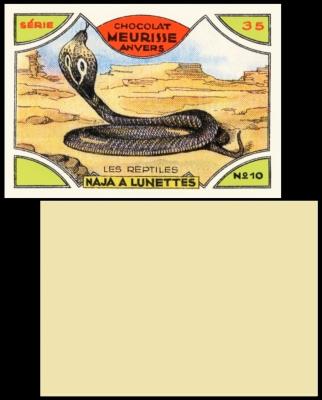
Our third card was this week`s red herring, for it is a snake which is known as the spectacled cobra. That refers to the white marking on the back of its hood, two circles connected by a curved line, which, if you look at it upside down, resembles a pair of glasses with just a nose clip, but without any arms. And that is how eyeglasses truly began, with what were technically a pair of magnifying glass style lenses, riveted together so that they held at the nose and balanced over it.
In France, and Belgium, where this card comes from, the Spectacled Cobra is known as Naja Lunettes, but not simply because lunettes are French for spectacles, more because a lunette is a special type of spectacles. You see, the word "lunette" actually comprises two parts, "lune", which means moon, and "-ette" which is a suffix meaning small, or in our case, half - and it harks back to a time when eye glasses were indeed small and semi circular. This sort of frame still exists today, as a basic level, though the fashion wavers between blending in with tiny glasses and standing out with giant colourful ones.
However the word "lunette" was already in existence when the eyeglass came along, as an architectural term, for a half circular window or painted panel above a door. And I was actually sent a scan of a card for Friday which gives "lunettes" a whole new meaning! But you will have to read on for that...
As for our snake, it has a deadly reputation, and in India and Sri Lanka it is one of the most venomous of all.
This is one of those thin little cards that I like a lot, and we are building up quite a gallery of them. This set is series 35, and there are twelve reptiles in the series, which are :
- Crocodile - crocodile
- Gavial - gharial
- Iguana Tubercule - tuberculated iguana
- Chlamydosaurus - frilled lizard
- Lezard Vert - green izard
- Moloch Herisse - thorny moloch
- Cameleon - chameleon
- Boa Constricteur - boa constrictor
- Python - python
- Naja a Lunettes - spectacled cobra
- Tortue Elephantine - giant tortoise
- Caret - sea turtle
Tuesday, 2nd June 2026
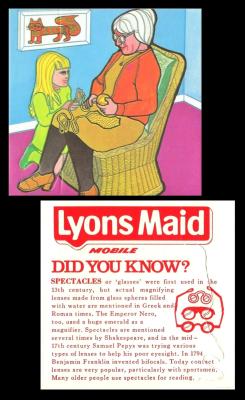
This is a great, and well researched card, telling us lots of fun truths about eye glasses, including the facts that :
- "magnifying lenses, made from glass spheres, were known to both the Greeks and Romans".
Roman philosopher Seneca the Younger is known to have favoured, and written of a glass sphere filled with water, held over text to make it larger. to magnify text and letters for easier reading. However it was simply to look through, it was not eyeglasses as such.
- "Nero used a giant emerald as a magnifier"
This only neglects to say that the emerald was polished. And we do not really know why he used it, because he was primarily seem with it at events in the Coliseum, so there is much debate as to whether he was making the action appear nearer, or just using the green to filter out the shine of the sun.
- "Shakespeare speaks of glasses in several of his plays"
These plays are "As You Like It", in which he mentions "spectacles on nose" ie without side-arms, in his famous "Seven Ages of Man" monologue - "Much Ado About Nothing" where Benedick speaks of still being young enough to "see without spectacles" - and "Coriolanus", when he speaks of a crowd looking at Coriolanus "with bleared sights, spectacled to see" . All of these are used to define old age, and they would simply have been magnifying glasses, to make things, and text, appear larger.
- "Samuel Pepys experimented with different lenses"
We still do not know much about Pepys` vision problems. They seem to stem from an incident when he was looking at a gun at close range, by which they probably mean a cannon, when it went off, and the flash injured his eye, or maybe even the gunpowder and spark. However, his sight was not aided by the fact that he wrote his diary in the evening, by candlelight, and we know his eyes were sensitive because one of his chief complaints is that they watered under strain. At first he resorted to the Roman and Greek method, a globe of glass, and he also tried using a pair of spectacles with tinted green lenses, which brings us back to Nero and his emerald. In 1668 he tried paper tubes, which concentrated the vision and eliminated the glare from outside, and this seems to have been his favoured method, though he was soon forced to abandon the writing of his diary. He did return to the tubes again, and added all manner of lenses inside them, colours and shapes, but nothing seemed to work, though even he noted that after times when he was forced to abandon all forms of trying to see, his eyes would slowly restore themselves.
- "Benjamin Franklin invented bifocals".
This is true, though many doubt it. He did it the hard way, getting hold of his glasses, removing the lenses and sawing them in half. This was to give him a top section for normal vision and a bottom section for a larger picture. He claimed that he did it so that he could lipread in French, and make sure they were not speaking ill of him or the rest of the government. The idea seems rather outlandish, and that is why it was probably discredited for so long. As for claims that they were already known of in Europe, and indeed in England, there is no evidence that any of those ever made their way to America, and it seems likely that all three were invented completely independently, though from the same desire, to fill a need.
It also has a picture of the development of the eyeglass, starting with the two magnifying glasses joined together, moving on to the ones with the clip to the nose, and finally to the invention of the arms, which at last kept the glasses on whilst you moved about.
This set does not appear in our original British Trade Index, or part two, it had to wait right until the third part, issued in the 1980s. And in there, it appears as :
- Did You Know ? 76 x 77. (12). See Db.455 ... LYO-62
The Db.455 takes us to the back of the book, where it is revealed that this is not the only version of this set. The entry actually reads :
- Db.455. DID YOU KNOW ?. Unnd. (12)
Lyons Set LYO-62, Mister Softee Set MJZ-13, Tonibell Set TNA-14
1. Belisha Beacons ...
2. Bicycles ...
3. Cameras ...
4. Clocks ...
5. Lighting ...
6. Money ...
7. Pens ...
8. Pillar Boxes ...
9. Spectacles ...
10. Telephones ...
11. Umbrellas ...
12. Zip Fasteners .
As for the Mister Softee version, we have already featured that, as a Card of the Day, on the 27th of March 2023.
The sticking point is the Tonibell version, for it is clearly shown as being this set of twelve cards in that original British Trade Index part two, yet all attempts to find it only seem to bring up another set entirely, which we speak of with the version by the Jersey Tobacco Company, as our Card of the Day for the 12th of May 2022, and that is entirely different to this square, cartoon format, set.
Wednesday, 3rd June 2026
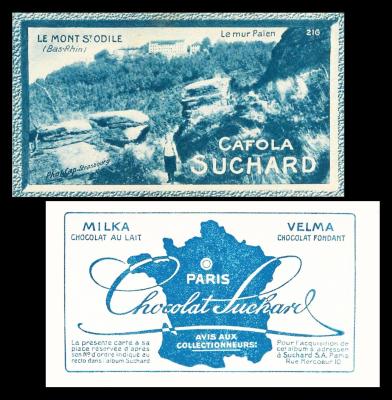
This card may have fooled you at first, but it is a link to an interesting tale about the patron saint of eyes and eyesight. She is Saint Odile, and she was born some time about 662 A.D., presumably about the 13th or 14th of December, as those are her feast days. She was born in Allitona, part of Alsace in France, an area which today is known as Mont Sainte-Odile, after her.
Unusually for a saint, she was the daughter of a nobleman, Etichon, the Duke of Alsace, and she was born blind. Her father did not want her once this was realised so her mother took her away and gave her over to be raised by what are referred to as peasants. They were obviously much more kindly, and gave her a happy upbringing, despite the lack of money and any support from her family, and when she was twelve years something magical happened, a visiting Bishop turned up, and said he had been sent by an angel to find her. He baptised her, and she looked up and was able to see, perfectly, all at once. Now someone must have told this to her family and her younger brother arranged that she come back to them - but as he was her younger brother that puts him only eleven and I am not sure how much arranging he could have done. Anyway when she turned up her father flew into a rage and killed his son, who he suspected of bringing her back - on which Odile laid her hands on her brother and he sprang back to life. Now nothing more is heard of the brother, all we know is that Odile turned and fled, crossing the Rhine and ending up living in a cave, either in Germany or Switzerland, maybe both. The cavern was also magical, because her father chased her and the cliff face suddenly opened up to let her run in but closed to keep him out, then sent down a hail of rocks from above that pushed him down the mountain. Despite this, later in her life, when he was old and ailing, she returned and nursed him. Because of that he founded an Abbey for her to live in, and when he died he was buried there. She would go on to become the abbess, and also found a convent at Neidermunster, including a hospital with a reputation for curing eye injuries and diseases. That is long gone, but a well nearby is still believed to have the power to cure eyes. She died at the convent, in about 720, but there was another miracle shortly after, as when the nuns were praying over her body, she sat up, and told them how wonderful it was in heaven. Then she took a final communion with them and fell back, dead.
She was regarded as a saint not too long after, definitely by the ninth century, but she was only officially canonised in 1807, by Pope Pius VII. Her devotional image varies but she is usually carrying eyes, either on top of a book laid flat, or, rather alarmingly, in a glass cup.
This is quite a hard issue to sort out, for there are several sets that look alike. We have featured one of them before, as our Card of the Day for the 29th of July, 2022, but as that is from the second series today`s card, from the first series, albeit with the third back, currently becomes the home page.
Set one, then, was the earliest, issued in 1909, and it only shows views of Switzerland, titling them "La Suisse", and there is also a Swiss address, in Neuchatel, on the cards. That is a set of 240 cards.
Set two and three, issued in the late 1920s, show views of France, and titles them as "La France Pittoresque" (Picturesque France). In addition they have an address in Paris. The way to tell these two series apart is through the numbering system, because the first series, issued in 1928, is of three hundred cards, starting at card 1 - whilst the second series, issued in 1929, carries on, and starts at 301.
Its not quite that simple though, because there are also different backs, back number one being text only and advertising a "Grand Concours des Vues de France". This relates to a competition, which you can read more about with our Card of the Day for the 29th of July, 2022,
The second back is very similar except that the "Grand Concours" (the competition) is not there, this just says "Collection des Vues de France", so I imagine that this was issued either before the competition had started or when it had been won.
Then there is a third back, ours, which shows a big map of France, though it is but a outline view of the country infilled in blue, with only one town, Paris, shown. I am not sure if this predates the competition or not.
Thursday, 4th June 2026
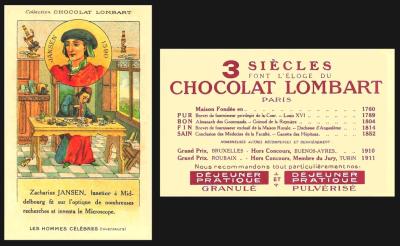
Our card today was supplied by a reader after I spoke of several reasons why glasses were called lunettes. However this card gives that word another facet as it shows Zacharias Jansen (or Zacharias Janssen), and he is described as being a "Lunetier". Now that word is still in existence in France and it means someone who makes and/or retails glasses, but at one time, as shown on this card, it meant something else. You see Zacharias Jansen is often claimed to be the inventor of both the first optical telescope and the first compound microscope, and what both these things have in common is that they use lenses. And from that it becomes clear that by calling eye glasses "lunettes" they were not referring to the glasses or the frame at all, simply to the lenses that the frame held in place.
It seems our man did also make eyeglasses, but only from 1616, the year after he was chosen to become the guardian of two children belonging to a man called Lowys Lowyssen, who must have died, because along with the children came a great deal of his effects, amongst which were tools that made the frames for spectacles. Now as our man knew all about lenses, it was not long before he had set himself up as a spectacle maker. However he seems to have got himself in all kinds of trouble after that, and died some time in the 1630s.
As far as Chocolat Lombart, that claims to have been founded in 1760, making it probably the first in France. However it was founded under a different name, for the trader himself, Antoine Meunier. His shop was in the centre of Paris and soon gained a reputation amongst the rich and famous, including royalty, who plied him with warrants. He sold chocolates, but also sweets and tea, which, oddly, considering how the story continues, was branded as "Lombart Tea". Then we lose track of them, for a hundred years, when they opened a huge factory on Avenue de Choisy.
In 1875 the company was bought out, by a man called Jules Lombart. Now I don`t know if this was a coincidence or he was related to the tea. He did not know much about chocolate, he had workers to know that, but he was a whizz at promotion, and attended almost every trade fair he could get to, and won lots of gold medals. He also realised that to be a successful seller you could not cater for the rich alone, you had to bring chocolate to everyone. That led to small bars of chocolate, right down to their popularly priced "One Penny Bar", and to novelties like chocolate cigarettes.
Jules Lombart, above all else, loved art and architecture, and he spent his money on not only a vast collection for himself, but in beautifying and up-keeping local buildings, including the Church of Sainte-Anne in the Butte-aux-Cailles. When he died, his collections were left to the town of Doullens, plus money to build a museum in a disused convent to hold them. Sadly this museum was badly bombed in the Second World War and many of its items stolen, but the building was restored in the 1950s.
In 1957, the Chocolat Lombart company was bought out, by Chocolat Menier
I`m not sure how many are in this set, it is suspected to be 25, hence the list below has numbers, to see when we get them all. So far we know of
- Ader - flying
- Bessemer - steel
- Branly - transatlantic telegraphy
- Edison - phonograph, electric light, etc
- Benjamin Franklin - lightning rod
- Robert Fulton - steamboat
- Gutenberg - printing
- Jacquard - silk weaving
- Jansen - optics
- Montgolfier - hot air balloon
- Isaac Newton - gravity
- Nobel - dynamite
- Bernard Palissy - ceramics
- Renaudot - newspapers
- Berthold Schwartz - gunpowder
- Senefelder - printing
- George Stephenson - locomotion
- Toricelli - physics
- Triptoleme - the plough
- Tubalcain - fire
- Watt - steam engine
Friday, 5th June 2026
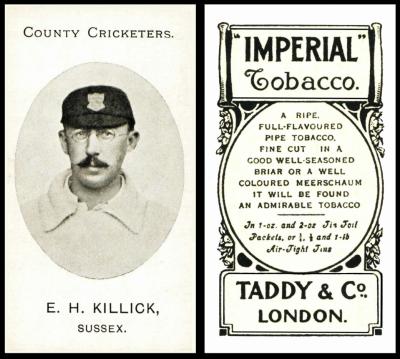
This card was sent in by a reader, because it shows that the use of eyeglasses in cricket was allowed much earlier than in football, and also much earlier in cricket than I spoke of in the week.
For here we have Ernest Harry "Tim" Killick, who was born in Horsham on the 17th of January, 1875 and who played for Sussex from 1893 to 1913. And he wore eyeglasses, continuously, including on the field of play, from 1897 onwards.
Now you may be thinking that for most of his time he was a reserve, or left on the bench, but no, because he took part in three hundred and ninety consecutive matches, scored 18,768 runs, and took 729 wickets.
To put that in perspective, the current record for the most consecutive first-class appearances is held by Ken Suttle, and it stands at four hundred and twenty-three matches, between 1954 and 1969. More intriguingly, Mr. Suttle broke the record of Joe Vine, with four hundred and twenty-one matches, between 1900 to 1922, thus breaking our man`s record.
Stranger still, all these men played for Sussex.
The first listing of these cards comes in our original Taddy reference book, RB.12, published in 1948, and that reads as follows :
- 11. ? 238. COUNTY CRICKETERS (titled). Size 2 5/8" x 1 7/16" or 67 x 37 m/m/. Unnumbered. Fronts printed by letterpress in black. Backs in black, as follows : -
(a) "Grapnel Mixture" advertisement
(b) "Imperial Tobacco" advertisement. The letterpress of the advertising matter at the base of the card is found in two slightly different types (a) upright (b) slanting.
No subjects are known with more than one advertisement.
W. G. Grace`s last full season was 1902, but he played occasionally in first-class cricket up to 1908; his card, issued without a stated County, may have been the introductory card to the series.
From the names of the players represented in this series, some conclusions can be drawn as regards the probable date of issue. All the players were well-known in first-class cricket in 1907 (with a few explainable exceptions); J.T. Tunnicliffe, a prominent Yorkshire player , retired at the end of that season and is not included in the series. Glover of Warwckshire and Daniell of Somersetshire (incorrectly recorded on the card as Daniel) took over the Captaincy of their Counties in 1908, but that year`s Captain of Northamptonshire, T.E. Manning, and a prominent Middlesex player in 1908, L.J. Moon are not included in the series. It appears likely, therefore, that the cards were prepared after the conclusion of the 1907 but before the end of the 1908 season, which points to issue during the summer of 1908.
To date, 15 players have been recorded for 13 of the Counties, but only 14 players for the other three, Leicestershire, Nottinghamshire and Worcestershire. All the prominent players of the latter three Counties in 1907 have already been recorded and it may well be that in these three caes only 14 cards were issued, making a total of 238 cards in all.
COUNTY CRICKETERS SUMMARY
1. Derbyshire ...................... 15
2. Essex ............................... 15
3. Gloucestershire ............ 15
4 Hampshire ...................... 15
5. Kent .................................. 15
6. Lancashire ...................... 15
7. Leicestershire ................ 14
8. Middlesex ........................ 15
9. Northamptonshire.......... 15
10. Nottinghamshire............. 14
11. Somersetshire................. 15
12. Surrey................................ 15
13. Sussex .............................. 15
14. Warwickshire .................. 15
15. Worcestershire ............... 14
16. Yorkshire........................... 15
17. Without County ............... 1
_______
238__
Now, if we just break that entry off for a moment, I am not sure why nobody else has noticed what I am about to throw into the ring and that is if we consider, as they did above, that W.G. Grace was a promo card, advertising the series, without him there are 237 cards - and with the three cards that are "missing" (from Leicestershire, Nottinghamshire and Worcestershire), it would actually make a set of 240 cards, a much rounder total. But as to why these three still remain unaccounted for, I have no explanation.
Anyway, to return to the entry, it continues, with
There are numerous cards with minor typesetting errors, i.e. omission of stop after initials or comma at end of team.
Individual cards by teams : -
(to be tapped in later as the scanning and pasting failed, dismally....)
There is a much shorter entry in our original World Tobacco Issues Index. That reads as follows :
- COUNTY CRICKETERS. Sm. Black and white. Unnd. (238). See RB.12/11
Vari-backed, two wordings.
1. Derbyshire (15)
2. Essex (15)
3. Gloucestershire (15)
4. Hampshire (15)
5. Kent (15)
6. Lancashire (15)
7. Leicestershire (14)
8. Middlesex (15)
9. Northamptonshire (15)
10. Nottinghamshire (14)
11. Somersetshire (15)
12. Surrey (15)
13. Sussex (15)
14. Warwickshire (15)
15. Worcestershire (14)
16. Yorkshire (15)
17. Without County - Dr W. G. Grace (1)
So I didn`t quite get everything done.
I thought that I could borrow the write up from the small set of John Player`s "Aviary and Cage Birds" only to find that wasn`t written up yet either, so I will do both of those tomorrow at the same time, and add links between them.
As for the Taddy "County Cricketers", I just didn`t realise how lengthy the description was, so that will be done tomorrow too.
Apart from that, all`s okay.