
Greetings at the end of another hot day, but I am reliably informed that tomorrow will be cooler. And I hope that is true....
This week we have been cracking on with indexing but things are definitely going to need altering as we go along, so it may get slower not faster.
Most of this week has been occupied with a single newsletter, that of the 26th of November 2022 - and those changes have also affected other newsletters. That edition has two new cards,
- MY Weekly`s "Soldiers of the King" (1916)
- Ch. Leborgne`s (presumably a chocolatier, from Brussels) "Vues de France", which may be the wrong title, and I have no idea of the date.
Whilst although the Ogden`s Guinea Gold "British Trees and Their Uses" stayed put, I have altered the other card, already, in the index, to A-1 Dollisdale`s "Shipping and Trees".
This week I remained on the outskirts of Harrow so we can finish off the tale I started last week about John Lyon and his schools, and move up the slopes to the proper ones on the top of Harrow Hill.
The idea of the original school was to give free education for thirty poor boys who had to come from the parish. An extension, of ten more, was written in later on But it was also changed to allow the current School Master to accept `foreigners`, a rather odd term for boys who lived outside the parish, from whom fees were collected. This also led to another change, as these boys could not go home to their families at night and so they were boarded at the school.
The problem was that the teaching grew ever more elaborate, and went above the heads of the local boys, so they started to stop coming. By 1875 there were under twenty local boys and over two hundred paying customers, which had already led to new buildings - the Chapel, and the Vaughan Library - and would lead to the founding of the Lower School the following year, in 1876, which was later, confusingly, renamed the John Lyon School, though he had no connection with it.
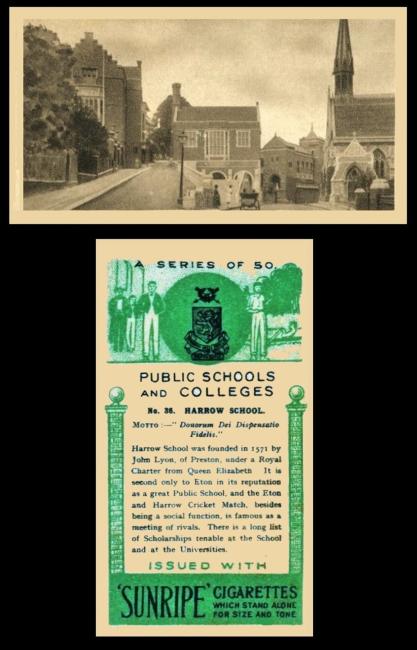
In 1926 another new building arrived, the War Memorial Building, in honour of the six hundred former students who had lost their lives in the First World War. It was designed by Herbert Baker to fill a vacant plot between Grove Hill and Church Hill, and you can see this right in the centre of the card we feature here, above the car - it is the building with the arches at the top of the bottom section. Strangely, this set, Hill`s "Public Schools and Colleges", was issued in 1923, but the building was not actually opened until the third of June 1926, by the current Prime Minister, and ex Harrow student, Stanley Baldwin. You will find more about this set elsewhere on our website, for it was used as the Card of the Day for the 24th of November 2025
Three hundred and fifty one names of former pupils were added to the memorial after the Second World War, but strangely five of them were not deceased, and I have failed to find out any more but that intriguing fact. We do know that the memorial to these was founded by an appeal to local residents and ex students which took place from December 1944, and that it was dedicated on the sixth of October 1949.
To this day the memorial remains private, gated, and only readily accessible by the pupils and masters. However at certain times of the year the School does run guided tours, during which the memorial is visited. Alternatively tours can be booked on a private basis by groups, especially educational based ones. A standard tour takes about an hour and a half and it also includes some of the other buildings; more recently the Fourth Form Room was added due to it being used as a location for movies.
This Week`s Events and Meetings :
Saturday the 15th of August
-
East Anglia - from 8.30 a.m. to 3.30 p.m., with auction at 11 p.m - at Roydon Village Hall, High Road, Roydon, Diss, Norfolk IP22 5RB. EACC members free admission as part of their annual subscription; visitors pay £3.
Thursday the 20th of August :
-
London - from 5 p.m, and there is an auction, of approximately 100 lots, starting at 6 p.m - at The Carpenters Arms” 12, Seymour Place, Marble Arch, Central London W1E 7NE. Free admission to all collectors
Friday the 21st of August :
-
North West - from 4 until 8 p.m - at Barton Village Hall, Garstang Road, Broughton, Preston, Lancashire PR3 5HE.