
welcome to another week, and can you believe a whole year has gone by since we re-jigged this site. That ought to spur me on to getting on with that index, and to preventing the same old cards coming round on the conveyor belt....
Well I have to say this is yet another short newsletter, for I now have neither computer nor tablet. My vintage voltage has decided that enough is enough, and I am currently looking out for a tablet online, missed one this afternoon for £15, needed a bit of tinkering, but sounded fun, though I dont really want a basic black, even though what are known as "skins" are available in a variety of rather interesting designs.
So lets close with many thanks to my phone, which I will repay by not groaning at the bill, and to the local library, which for now will, and must, suffice.
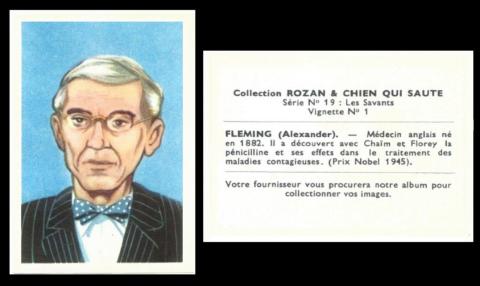
Collection ROZAN et Chien Qui Saute [trade : chocolate : O/S - Paris, France] "Les Savants" - Serie 19" (1950s) 1/?  Today in 1881 saw the birth of a little Scottish boy who would grow up to become Sir Alexander Fleming, discoverer of the wonderful healer, in conjunction with the Australian, Howard Florey, and the German, Ernst Chain. However there is another Brooke Bond, in "QEI - QEII" (1983) 39/50, which is an actual photo of him at work in his laboratory. And Brooke Bond issued another portrait of his as well, in conjunction with Liebig, in 1973, card four in a set dealing with the fight against microbial infection - that is called "Cacciatori di Microbi", and its code is F.1860 or S.1859, depending whether you lean towards the Fada or Sanguinetti system
In fact his "Rookie" card is usually supposed to have been issued in Ireland, by Barkers, with bubblegum, in 1961, and, the following year, issued with `Lyons Maid` ice cream. It`s the same card, save the issuer`s details. However, this card may be earlier, as many sites date it to the mid 1950s, and that could make it his true "Rookie" card. It all hinges on whether it was issued before , or after, the company was bought out by Lindt, in 1961.
Chocolat Rozan was named for Maurice Rozan de Mazilly. He was born in 1893, in Normandy, and went to sea at the age of fifteen. Then, when the First World War broke out, he jumped ship, literally and joined the army. It was not a good move and he sustained what today would be called life-altering injuries, to his face, which saw him spend two years in hospital having it virtually rebuilt in a series of ever more painful and invasive surgeries. However, he was made of tough stuff and survived, though he also realised that he wanted to find other employment, something that made people happy, not sad. What he came up with, quite by accident, was making chocolate, which he was reasonably successful at. His breakthrough came on a trip to Austria, where he was completely shocked by the range of pastries, and he suddenly wondered if he could make a chocolate in the same way. And he did, though it took him two long years, and countless failures. The chocolate was called "Les Pyreneens", named after his factory in Oloron-Sainte-Marie in the Pyrenees mountains, and it was not only amazing chocolate, it had a gimmick, because it had to be served straight from the fridge.
Now the other name on this card, Chien qui Saute - or leaping dog - is sometimes said to be another chocolate maker, who also issued the set. This is seems to be incorrect though, as both names appear on official documentation like bills and letterheads. It seems more likely that the leaping dog was their logo on their standard chocolates whilst the Pyrenees appeared on the special refrigerated brand that was only available as Christmas neared.
The cards in our set are
- Fleming (Alexander)
- Edison
- Einstein
- Branly
- Pasteur
- Jenner
There is a bit of confusion though because there are two distinct groups of these cards, and I`m not sure which version was issued first.
Our sets have a much fuller back, and it says at the bottom that your supplier will supply you with the special album in which to collect these images. The sets seen with this back are as follows :
- Les Sports
- Dans les airs
- Les Fondateurs de l`Empire Colonial
- Madagascar
- Indochine
- Antilles et Guyane (12 cards)
- Automobile
- Habitations
- Edifices Religieux
- Les savants
The other version has a fuller back, all text, and at the bottom mentions that in order to get an album you have to send three francs and a four franc stamp. The sets seen in that version are
- L`Automobile
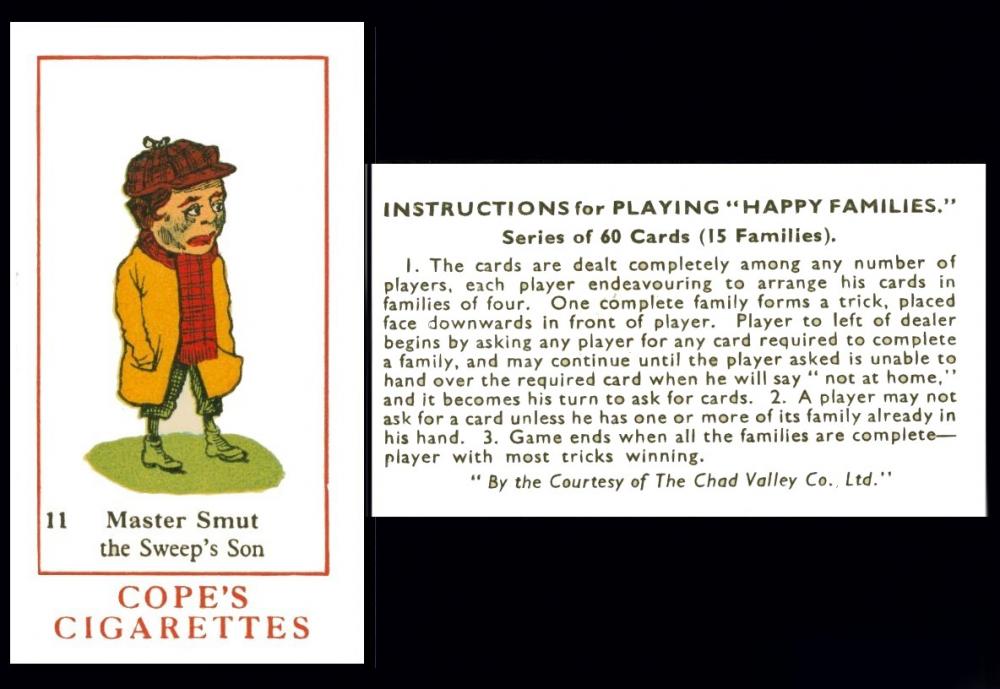
Cope [tobacco : UK] "Happy Families" (1937)
Today in 1840, almost a centenary after the issue of this card, Master Smut was probably smiling, for on that date the United Kingdom passed a regulation that child labour, of anyone aged under sixteen, should no longer be used by chimney sweeps.
The truth was that it would have been quite difficult to fit a teenager up a chimney, which were extraordinarily narrow in parts, so most of the children were what we call today pre-teenage, and some not even yet in double figures, and despite the fact that in 1788 another act had stated that the minimum age was eight, it also allowed a loophole as it said that minimum age was for "an apprentice" and not just a sweep`s boy.
In 1834 another act levied a minimum age of ten for "an apprentice", but also gave a minimum age for a chimney cleaner, of fourteen. That was updated to sixteen by the act passed today in 1840. However it was seldom obeyed, and that raised the hackles of one Charles Kingsley, who wrote a book about a small child, maltreated and eventually turned into a "water baby", by drowning It is a strange book, for all its good intentions, and today a lot of people would find it offensive in its language and treatment of other races. Anyway it was serialised in a magazine, and became a book in 1863, and the next year another act appeared. That was pretty useless, but people were at last taking notice and in 1875 The Chimney Sweepers Act did finally contain enough force to stop the cruelty, though it did not extend into Scotland.
Now if you look at this card, you will see "By the courtesy of the Chad Valley Co. Ltd." and that is because they had already published these images, on playing cards, seven years earlier, under the title of "Happy Families - Grotesque Cards - Beautifully Coloured - An Amusing Round Game for any number of Players". And you can see those at the World Of Playing Cards site
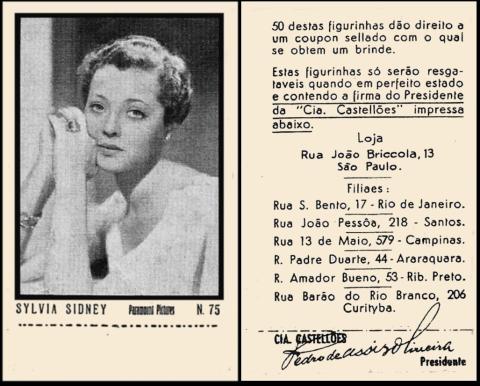
Cia. de Cigarros Castelloes [tobacco : O/S - Sao Paulo, Brazil] "Film Stars" (1930s) 75/?
Today in 1910 Sophia Kosow was born in New York. Five years later her parents divorced and she took the surname of her stepfather, Sigmund Sidney. John Sinclair`s "Film Stars" tells us that under that name she "entered the Theatre Guild School while still in her teens, made her stage debut at the age of twelve, and was famous on Broadway before turning to films"
Her first film was in the background of the D.W. Griffith "Sorrows of Satan" (1926). That was almost at the turn of silent pictures becaming talking ones, and luckily she had a good voice for it, but she became typecast as the girlfriend, or the gangster`s "moll".
The Second World War halted films, and after it ended she returned to the theatre, before turning to television, appearing in many popular series, which she much enjoyed. Towards the very end of her life she went back to the movies, and her final part was in "Mars Attacks", in 1996, a film based on the rather lurid trading cards of the same name. She died on July 1, 1999.
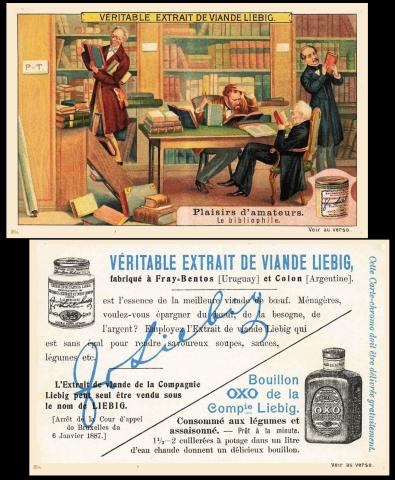
Liebig [trade : meat extract : O/S - South America] "Plaisirs d`amateurs" / hobbies (1909) Un/6 - F.0965 : S.968
Today is National Book Lovers Day, at which we must say that it might seem odd that though we are more and more coerced into spending all day online, the humble printed book in black and white still endures.
This card is part of a set devoted to hobbies, and the other ones are :
- Dilettantes musicaux (music)
- L`ami des fleurs (gardeners)
- L`ami des oiseaux (birds)
- Le bibliophile (books)
- Le collectionneur d`antiquites (antiques)
- L`entomologiste (insects)
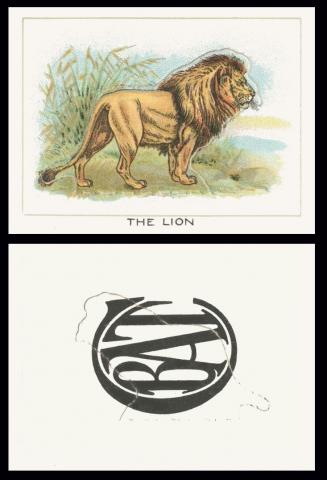
British American Tobacco [tobacco : O/S] "Birds, Beasts and Fishes" - BAT logo back (19) Un/50
World Lion Day is observed on the 10th of August every year, rather apt, as the star sign of the moment is Leo, the lion.
You may wonder why we need a day for lions, but though they are seen as strong and fearless, they are hunted by man, and their habitat dwindles every year through colonisation and through climate change.
Strangely, although they are called the Kings of the Jungle, they live, like this card suggests, in grasslands and mountainous areas.
This is an unusual version of the familiar cut out card and I have not been able to track down any other sets with this British American Tobacco logo, which even more oddly, is sideways on, when it would have fitted fine the right way up.
I presume that the C which surrounds it is for Company?
But happy to be corrected - also delighted to hear of you have any other sets which feature this logo reverse.
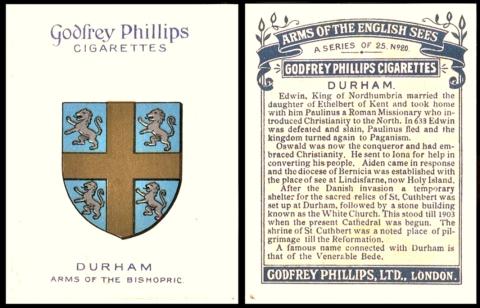
Godfrey Phillips [tobacco : UK - London] "Arms of the English Sees" (1924) 20/25
Today in 1093 the Foundation Stone for the new Durham cathedral was laid by Bishop Carileph.
The Cathedral was erected to house the remains of St. Cuthbert, the Bishop of Lindisfarne. However a quick spot of research tells us that Bishop Carileph, or St Carilephus, was the name given to Bishop William of St. Calais, and that his name was in honour of William the Conqueror, who was actually present at his consecration.
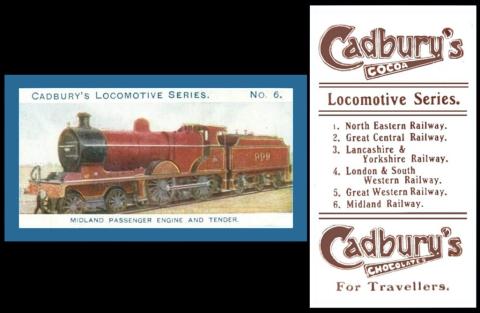
CADBURY`S Chocolate [trade : chocolate : UK] "Locomotive Series" (1924) 6/6
Today in 1801 John Cadbury was born in Birmingham, though his parents were from the West of England. His parents were Quakers, his father sold linens, and they made sure he attended a Quaker school in Warwickshire.
When he was seventeen, he was apprenticed to a tea dealer, John Cudworth, in Leeds. He was immediately inspired by the work in the shop, and moved on to Sanderson Fox, in London, a bonded warehouse. In 1824, helped by a monetary gift from his father, he opened his own shop, at 93, Bull Street, back in Birmingham, selling drinking chocolate, coffee and cocoa, plus tea and some other goods. Seven years after that he was so successful that he opened a warehouse and started making his own cocoa and chocolate. Fifteen years on, his brother, Benjamin, joined him as a partner, moving to a new, larger, factory the following year, 1847. That changed the name of the company, to Cadbury Brothers, but just three years later both brothers handed the reins to John`s son Richard, though they remained behind the scenes until 1856, when their partnership was finally dissolved, with mutual consent. John retired in 1861, prompted by the death of his second wife, the mother of his seven children, from tuberculosis.
As well as his shop, he had many other interests and supported many charities and humanitarian groups; he was heavily involved with animal welfare, Sunday Schools, environmental reform, and the temperance movement. Indeed his was one of the first signatures on the pledge to form a temperance society in Birmingham. His voice was also one of the loudest against the exploitation of child chimney sweeps, so it is curious that we featured that earlier in this edition.
He died on the 11th of May 1889, and was buried in Birmingham. In his will he left his home to his church and to the Religious Society of Friends.
His sons shared his beliefs, but also set about fulfilling his dreams. One of these was Bourneville, built in 1879, as a new town for his workers where they could breathe the country air and live in ideal circumstances, not crammed together in the middle of a smoky town. The only condition the workers had to fulfil was never to drink alcohol, and so although there were pubs and shops in the village, alcohol was never served or sold.
Our card was mainly chosen because the train is from the Midland Railway, which runs to and from Birmingham. It is one of a set of six, issued in 1906. However Cadbury actually owned fifteen trains that were used to transport milk and chocolate to and from its factories, warehouse, and Bournville, starting with the first, built in 1894, by Dick, Kerr (the company which had the famous ladies football team). However the track had begun to be constructed ten years before that, as one single siding, from which they eventually steamed over six miles of track running past and even through the warehouses and the factories, until they eventually even connected with the mainline. And it lasted right until the 1950s, seeing steam phased out first in favour of coke and coal, and then diesel taking over just before the decade closed. That lasted until the 1970s, when it was realised that it would be quicker, and cheaper, to transport the goods by road, not rail.
This week's Cards of the Day...
. . . celebrated "Cycle to Work Day" which was on August the 4th, and would you believe 2022 is its tenth birthday, almost a new generation of cyclists to work has come round full circle. Their website is fascinating, and encouraging.
In America they call this event "National Bike to Work Day," it takes place in May, and has been going since 1956, when it was started by The League of American Bicyclists.
Saturday, 30th July 2022
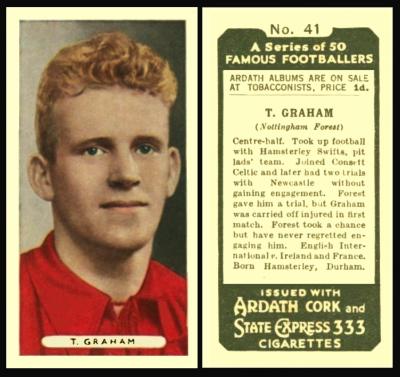
Here we have T Graham who played for Nottingham Forest - and Nottingham has also been the home of one of the most remembered British bicycles, the Raleigh, since 1887.
Strangely there was no Mr. Raleigh, nor did it celebrate the exploring of Sir Walter; its founder was Sir Frank Bowden, who was advised when he was almost forty that his poor health might be restored with more exercise and decided that biking might be fun, and, when it turned to to indeed be so, he started making bicycles.
Or so the story goes, for the truth is that he merely bought the shop which sold him the bike and enlarged it. He also became President of the British Cycle and Motor-Cycle Manufacturers Trade Union, and was created a baronet, passing that title to his oldest son.
And what of the owners of that original shop, Mr. Woodhead, (who held a patent for gear cases, and must have been reasonably well off as he is recorded as having "one servant" in the 1901 census) and Mr. Angois, (a Frenchman, who was naturalised in 1900)? Well they do seem to have been given directorships in Raleigh, but there is little word about what happened to them after that. Anyone knowing, or researching them, do tell us!
This set was first mentioned in the original "Notes on Current Series", written by Mr. C. L. Porter for the London Cigarette Card Company`s "Cigarette Card News", Volume II, No.14, dated November 1934. This reads as follows :
Ardath Tobacco Co. Ltd., Famous Footballers. 50 small cards. No sport has a greater following in the mass than Association football, and this series is certain of great popularity. The cards are exceptionally well produced (Ardath are setting a very high standard in this respect) in full colours from photographs of the players, and brief biographies are printed on the backs. The series has adhesive backs, and an album for the set may be obtained from tobacconists, price 1d. The biographies are reproduced in the album, in order that it may form a complete record.
This set was replaced by “Champion Dogs” (A745-280) in November 1934.
In our original reference book to Ardath (RB.6), published in 1943, this set is described as :
Aug.1934. 50. FAMOUS FILM STARS (titled series). Size 1 7/16" x 2 11/16". Numbered 1-50. Printed in two colours from half tone blocks, varnished, titled, with white margins. Backs, printed in grey, adhesive, with description. Issued with Ardath Cork and State Express 333 Cigarettes. A pocket-book album was issued, price 1d.
ERRORS :
No.32, printing on back reversed, description of Mc.Grory, front picture of Brook
No.39, Front photo of S. Matthews, back description of J.W. Smith (No.12)
I have to mention that having "white margins" is quite a scarcity these days, because the varnishing has aged and they tend to be cream, or even yellow. However in October this year it will be ninety years since they first slid into view from a packet., so some yellowing is to be expected and really ought to be forgiven.
By the time of the original World Tobacco Issues Index, this set is less effusively catalogued as :
FAMOUS FOOTBALLERS. Sm. Nd. (50). Special album issued. ... ... A72-24
And this text, exactly, appears in the updated version, though the code is altered to A745-350.
Sunday, 31st July 2022
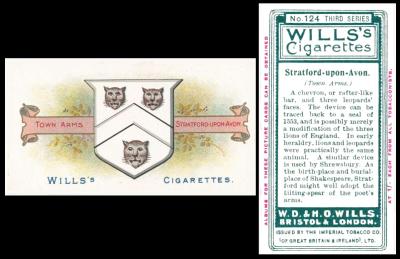
Our second card was for one of the best known bicycles of today, Pashley, but I wonder how many of you know that they were founded, in 1926, by a Mr. Pashley, who knew all about bikes from his wartime service as a despatch rider.
We may have misled you slightly with our card, as at that time the company was based in Birmingham. They made all kinds of bicycles then, including tandems for pleasure, and shop delivery bikes for work. They only moved to Stratford-on-Avon in the 1960s, when Mr. Pashley retired and gave the handlebars to his son.
In fact Pashley is one of the few makers which are wholly or even primarily based in England, for many who claim of this fact really only assemble parts that are produced elsewhere around the globe.
This card is just one of the variations of this fascinating set, which are dealt with more fully in our blog "B for Borough Arms". That tells the differences in all the sets, and one day will include a sample back and front of every one.
This particular card we feature today is from Group 5 - Numbered set of 50, 101-150, numbered on the backs, and entirely new subjects on the fronts. Fronts printed in full colour, no frame lines, with "Wills`s Cigarettes" across fronts of cards. Backs in grey, with descriptive texts, plus an I.T.C. clause and an album offer down the sides of the reverse, both being printed in red. Marked "3rd Series"
This is the only sub set of Borough Arms which has the red side inscriptions. I have to wonder why this was done, and also why it was not continued, though to add another colour would have been more expensive.
Monday, 1st August 2022
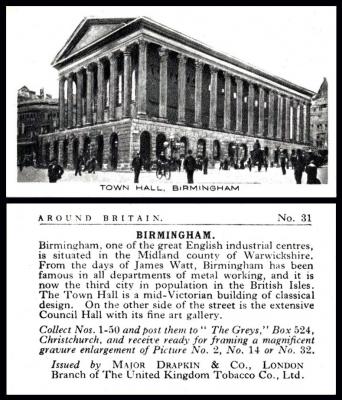
This card celebrated another bicycle maker in the Birmingham area, B.S.A. which made bikes and motorbikes, but actually started out in 1861 by making weapons, indeed B.S.A. stands for Birmingham Small Arms Company, which was an alliance of several gunsmiths who grouped together to share knowledge and production, and to standardise the production of certain parts in order to fulfil demands by the War Office.
They moved into bicycles in 1880, which were also in demand and used similarly shaped and standardised parts, there not being much difference between a gun barrel and a tube frame on the outside.
Bicycle production always had to take second place to their war work though, and there was a succession of wars from that time right through to the First World War, something that can be told from the fact that their first large scale production, under the name of BSA Cycles, dates from 1919.
In 1957 B.S.A. sold out to Raleigh.
P.S. if you didnt find the bicycle on this card, its above the gap between HALL and BIRMINGHAM
Tuesday, 2nd August 2022

Here we have what is starting to get quite a sought after set. This may be to do with the fact that when they were issued you could only get them at cycle dealers, and, in a very cunning ploy, not all of the cards were sent to all of the dealers, so getting a set involved an awful lot of pedal power.
It is not just bicycles that are shown as well, because there are cards of bicycle parts, and also, something else that made complete sets scarce, two tribute cards which showed the Raleigh "works riders" of the time, Reg Harris (the winner of two Olympic medals in 1948, for Tandem and Sprint) and Cyril Peacock (World and Commonwealth Games champion in 1954 and national sprint champion from 1952 - 1954)
They measure 67 x 53mm.
I have not been able to find out why the set was issued, though in this year Raleigh bought B.S.A. However it was the only set of trade cards they ever did, so it cannot have worked sufficiently well to continue.
There are a number of postcards showing Raleigh bicycles, a few were issued by the company in the 1900s, and others appear as part of sets that deal with "Celebrated Posters" etc. Today the advertising does often feature on what deltiologists call "moderns", which are museum and other reproductions. They may not be very valuable, but if they appeal, or bring back memories of your own time in the saddle, then why not look out for them - and they also make great covers for books and journals
Wednesday, 3rd August 2022
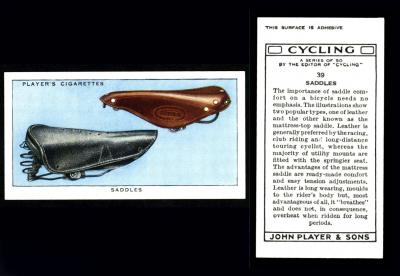
The sets first appear in our original reference book to John Player, RB.17, issued in 1950, described as :
- 67. 50. CYCLING. Small cards. Produced with the co-operation of the Editor of "Cycling". Fronts in colour. Backs in grey, with descriptive text. Issued May, 1939, with special album. Variety : No.9 is found with a text variation.
A. Home issue, with I.T.C. and album clauses, adhesive
B. Channel Islands issue without I.T.C. and album clauses, adhesive
C. Irish issues, with I.T.C., but without album clause. Large green numerals overprinted.
1. Adhesive backs
2. Non-adhesive backs
Now when we move on to our original World Tobacco Issues Index, these sets are all over the shop. First up, as card code P72-86, is the non adhesive Irish issue, in section 2.B. You have to wait until section 2.C to find our home issue, and it is, curiously, combined with the other Irish issue, as :
- CYCLING. Sm. Nd. (50) See RB.17/67 ... P72-159
A. Home issue, with album offer
B. Irish issue. Back with large green numerals overprinted
As for the fourth version, that waits until section 3.C, a section for cards issued in the Channel Islands and Malta. And it is given the card code of P72-216.
This rather strange scheme of listing the cards is also continued in our updated World Tobacco Issues Index, where they are card coded, respectively, P644-180 for the non-adhesive Irish version, and P644-664 for the Channel Islands/Maltese one. Our version is again sharing space with the adhesive Irish version, as :
- CYCLING. Sm. Nd. (50) See RB.17/67 ... P644-320
A. Home issue, with album offer
B. Irish issue. Back with large green numerals overprinted
Thursday, 4th August 2022
![ZJ9-71 [trade : UK ; Tea] Brooke Bond "Chimps" untitled (1986) Un/12](/sites/default/files/styles/content_aligned/public/2022-08/cyril%20the%20cyclist.jpg?itok=DX9zrSo5)
These were blank backed cards, and they are sometimes referred to as "Thirty Years of The Chimps".However there are actually three versions of this set, which are
- A plain backed thick card with a peel off back that reveals the sticky bit.
- A plain backed paper thin card with a peel off back that reveals the sticky bit
- A printed back that reads "Tak Tik" in blue with a peel off back that reveals the sticky bit
The last version is by far the rarest
Cyril the Cyclist might well have been in honour of Cyril Peacock, as seen in our last section, but he was very popular, appearing on many tie in products, including tea towels, though many of those items showed an actual chimpanzee, dressed up, whilst our cards, being drawn, are more in keeping with my more animal friendly beliefs.
The full list of chimps in the set is as follows :
- Ada
- Al B Blowed
- Cyril the Cyclist
- I Bodgit
- Mr Shifter
- S Bend
- Tania
- The Judge
- The Twins
- Brooke Bond
- Dolly (Housewife)
- Jean Pierre Berke
Friday, 5th August 2022
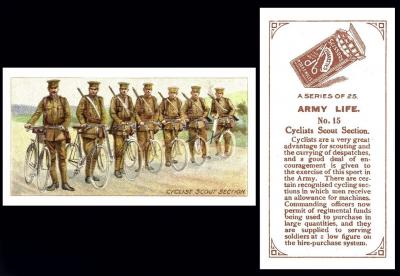
Now this set is a slightly different one to the Players "Army Life" of 1910 that we all know so well, for this was issued in India, with Scissors Cigarettes. If you look at the front it has no Players Cigarettes on the card. And the back is entirely different, with the slanting packet design. However every word of the main text is identical. And a look through our reference books tells us a bit more. W/133 says that the fronts were lithographed in colour and the backs in red with descriptive text, and it was issued "In the East, about 1910", though 1914 is most often quoted. And it must have been reprinted, possibly causing the confusion over the date, as it can be found printed on a} a white polished board or b) a cream matt board.
It also says that it was also issued by two other companies as well, both in 1915. These were Wm. Clarke of Liverpool and London, who was bought out by Ogden`s in 1924 and moved to Dublin - and W.T. Davies of Chester
well we made it to the end and its still Saturday morning. I`ll nip back tonight and finish completely and get the codes done over the weekend.
See you next week