
This is a rather short newsletter as I am waiting for new eyeglasses and have been told not to use my current ones so much. When they come, they will be varifocals, though, which may take some getting used to. I will attempt to keep going, though it does seem strange that this was not on the list of reasons why I predicted that I may have to take a back seat...
Website News:
I`m delighted to say that I found a card for the Giro d`Italia, and it even mentions La Gazetta de Sport. You can see that in our newsletter for the 9th of May 2026, just scroll down to Wednesday 13 May.
I didnt do so well with indexing the newsletters though, only managing to completely index the one for the 14th of October 2023. I`m partially through the one for the 7th of October 2023 but need a new card for Wednesday, which is the East India Company.
What`s On This Week :
Our regular review of Branch and Club events
Sunday May 24th : two events
- Hants & Dorset - from 12.30 til 4.30 pm at Fryers Field Pavilion, Bond Avenue, West Moors, Ferndown, Dorset BH22 OLJ - Free entry to all collectors
- Lea Valley - from 9 am til 2.00 pm, with an auction at 1 pm, at The Village Hall, North Weald High Street, CM16 6DH - admission £2 per person
Thursday May 28th :
- Nottingham & East Midlands - from 7.30 until 9.30 pm at West Bridgford Social Club, Rectory Road, West Bridgford NG2 6BG.
Friday May 29th :
- closing date for the latest Hants & Surrey Postal Auction
And now its time for our diary dates of a different kind, which this week comprise children`s cultivation, a curvaceous capra, a tapping tribute, a boxing Bob, a changing city, a decisive darkness, and a slimy specimen..... So let us start with :
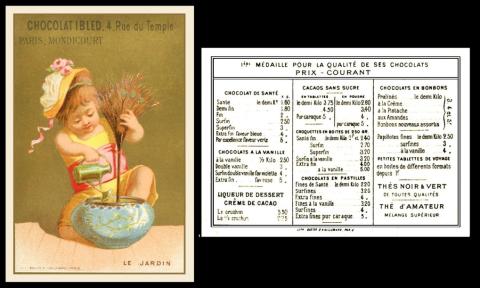
Chocolate IBLED [trade : O/S - France] "Price List" (1900) Un/?
I did debate having this for a theme of the week, but in the end I went for something else which I think I may regret. Anyway today is the first day of #NationalChildren`sGardeningWeek. Now this is designed to inspire children to spend time outdoors away from their phones and computers, and also raise awareness of where some of their food comes from. You don`t even have to have a garden, only a windowbox or even pots, and even reading garden themed stories can mark the week. In addition, it`s up to you whether you think the child in question would be more excited by the prospect of fruit and vegetables or by flowers.
There is a practical side too, for it is believed that children who are involved in any way with the garden when they are young grow up to be more environmentally aware, and that sounds plausible. And it is often part of the school curriculum, which is why it is this part of the year, for that enables seeds to germinate faster and for the children to see results, and maybe even taste some of the produce, before they break up for summer holidays.
Now I have looked, and gardeners on cigarette cards are either men, doing the actual work, or ladies smelling the roses. Its pretty much a child free zone. If there is a child, they are invariably holding a box of biscuits, or sitting watching - and the same goes for trade cards, at least in this country.
On the continent, the problem is that "Jardin" also means park, so you get cards of children playing in the park, but not actually gardening.
However I did come up with this one, which is a child watering a pot, even though there doesn`t look as if there is any dirt in the pot, and it does look like what they are watering are peacock feathers, in a metal trumpet, which could well be a hair ornament, something that will probably not delight their mother too greatly when she discovers their handiwork.
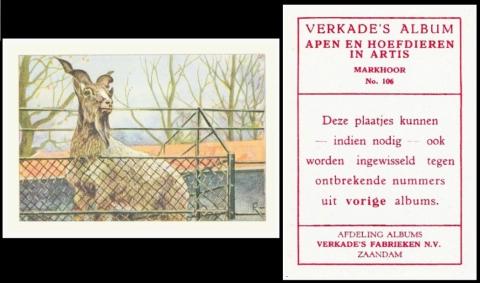
VERKADE`s Fabrieken N.V. [trade : cakes : O/S - Zaandam, Holland] "Apen en Hoefdieren in Artis" (1940)
Let us turn our attention to the plight of the Markhor, whose day it is today. This creature, with its long spiralling horns, may look like a character in science fiction, but it is actually science fact, though have probably neither seen or heard of it until today.
The Markhor, or Capra falconeri, is a goat, hence the "Capra", which is where we get Capricorn, the astrological symbol, from. That Latin name comes from a German zoologist, Christian Hermann Ehrenberg, way back in 1839.
Strangely, the word "Markhor" comes from the Persian, and it means `snake-eater`. Nobody seems to know how it got this name, or whether it does eat serpents, but if it does, then it is unique amongst the species, for two reasons - firstly, because goats are herbivores and only ever eat vegetation, their stomachs being quite unsuited to meat - and, secondly, because goats are allergic to snakebites, and if such a thing should happen the goat will swell up and could even die. So to have one species of goat that catches and eats snakes would be extraordinary indeed.
The Markhor lives in the mountains, across Central and Southern Asia, and it is, as we find out from the 2011 set of Topps/Allen and Ginter, an "Animal in Peril". In fact the text on that card tells us it is "A large goat species found mainly in Pakistan, India, and Afghanistan, the Markhor`s population has been slashed by about 80 percent in the span of just two generations, with about only 3,000 remaining (chiefly due to hunting), it is threatened with extinction"
In fact it was added to the International Union for Conservation of Nature`s "Red List" of threatened species in 1992 - and it has been listed as part of the CITES list, which aims to restrict international trade in items made from animals, or horns and other body parts, since 1975.
Despite this, hunting, sadly, still goes on, by which we mean not only poaching, illegally, but shooting for sport. The main attraction of the Markhor is its amazing anti-clockwise twisting horns, which make quite the trophy for the war-room.
There is hope for the Markhor though, as in 2001, Pakistan made it their national animal. They also led the fight to have an international day of raising global awareness, which turned out to be the day we celebrate today, and an annual event, the first International Day of the Markhor taking place on May the 24th, 2024.
For such an unusual animal, it seems odd that there are so few cards. The earliest seems to be the 1931 set of John Player`s "Wild Animals Heads", which I don`t like, it is just too reminiscent of a stuffed head, with glazed eyes, doomed to forever be poking very strangely out of a wall. Ours seems to come next nine years later, and is part of a Dutch language set which translates to "Monkeys and Hoofed Mammals at Artis", which is Amsterdam`s Royal Zoo. And its next cartophilic appearance is twenty years after that, being Brooke Bond`s "Asian Wildlife". This repeats the `snake eater` claim, though admits that "whether this is one of the habits of this is fine goat is not known". It also tells us that "There are several races inhabiting various mountainous countries and the horns are extremely varied, one race having the horns in the form of a tight screw, and another extreme having horns of a very open spiral. Between these extremes there is a variety of twisted horns.".
I am told that there were three albums devoted to the zoo at Artis, "Dierenleven in Artis" (animal life, issued in 1939), "Apen en Hoefdieren in Artis" (our set of monkeys and hoofed animals, issued in 1940), and "Vogels in Artis"(birds - which was intended to be published in 1941 but was not, until 1988). They were written by Anton Frederik Portielje, who worked for the zoo for almost fifty years, and the animals and birds were drawn by Cornelis and Henricus Rol, or Jan Voerman Jr.
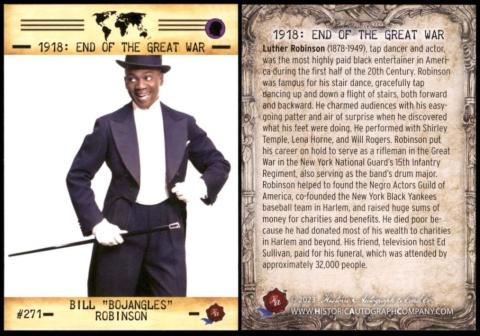
HISTORIC Autographs LLC [trade/commercial : cards : O/S - USA "1918 : End Of The Great War" (July 2023) 271/300
Let us turn our attention to two celebrations in one, for today is both #NationalTapDanceDay, and the birthday of one of the best tap dancers of all time, Bill "Bojangles" Robinson.
National Tap Dance Day is a celebration of the art of tap dancing, which uses metal plates, partially, or wholly affixed to the soles of a standard shoe, which make a loud tapping noise when they strike the floor, and beat out the rhythm of the song being danced to. It was first celebrated today in 1989.
Bill Robinson was actually Luther Robinson, he was born today in 1878, in Richmond, Virginia, and became an orphan in 1884, along with his younger brother. They were both taken in by his grandmother, and she took good care of them, but not long after he moved in with her our man was to be seen performing, as a kind of unauthorised busker, in taverns and outside theatres, where he was spotted by someone who ran a minstrel show. We don`t know much more than that, but in 1890, when he was twelve years old, he ran away to Washington, and got work at a race track, where he claimed he was also a jockey from time to time. That claim seems dubious as he was only twelve, and by 1891 he had left, going on the road with a travelling show. It is not known when he traded forenames with his brother, and became William instead of Luther, which makes fact finding hard.
When he was nineteen, he went back to Richmond and joined the Army. He claimed that this was his response to the start of the Spanish American War, but it did not last very long, as he was shot by a fellow rifleman, who was cleaning his gun. It seems this invalided him out of the Army, as in 1900 he was back on the stage, winning a tap dancing contest in New York. This led to lots of offers of work, often with a partner, sometimes dance, sometimes comedy. In 1902 he gained a permanent partner, George W. Cooper, and the two performed and travelled together, right until the end of 1916. As soon as America joined the First World War, our man offered himself as an entertainer, and was accepted; and more than that, reportedly, he charged not a penny for his services.
After the war he went back on the vaudeville circuit, as a solo act. In 1926 he even toured the United Kingdom. In 1930 he was featured in a film, "Dixiana", which was really just a reel of acts belonging to the Keith and Orpheum circuits, with whom he had been attached, and it was one of their first films as a film making studio, under the name of R.K.O. It is primarily known for the fact that it starred Bebe Daniels, and that the last twenty minutes were in colour, though they were subsequently lost, and only turned up in the late 1980s.
His next film was "Harlem is Heaven", in which his name appeared above the title, and in which he played himself. He made several films in the early 1930s and then moved to Twentieth Century Fox. They signed him up for a film called "The Little Colonel", in which he was to dance with Shirley Temple. Reportedly, and I am certain it is true, the two of them were great friends, right from the outset, and for their entire life, she called him Uncle Billy, and he adapted his complex dance routines so that she would be able to copy him, or so that what she did looked similar, just not as advanced. In total they appeared in four films, "The Little Colonel" and "The Littlest Rebel" (both 1935), and "Just Around the Corner" and "Rebecca of Sunnybrook Farm" (both 1938) , and she requested that he was her choreographer in "Dimples" (1936)
His last film was "Stormy Weather" in 1943, starring with Lena Horne. After that he moved into radio, and television, and he often tap danced. His last appearance was in 1949, on a talent show, where he just came on to congratulate a tap dancer.
He died on November 1949, of heart failure, penniless, but not because he had wasted his money, or spent it on things for himself, because he had supported many charities, in Harlem and elsewhere, and also because he frequently took no money for his performances and appearances, happy to donate his time for a worthy cause. His funeral was paid for by the television personality Ed Sullivan, and attended by crowds of people, many children. And his coffin was carried in by Irving Berlin,Joe di Maggio, Duke Ellington, Bob Hope, Joe Lewis, and Jackie Robinson.
He had no children, save all the children who he had helped through his work for schools, and local projects, but he was married three times, firstly to a Lena Chase, from whom he was divorced in 1922, then to a Fannie Clay, which again ended in divorce in 1943. Finally, he married an Elaine Plaines in 1944, and she was still his wife at the time he died.
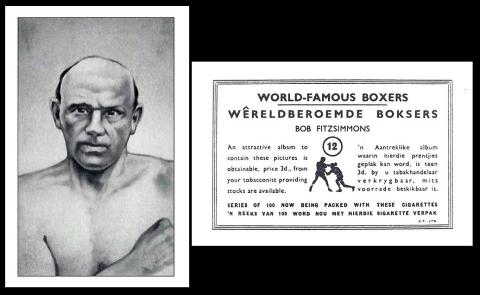
ANONYMOUS / UNITED TOBACCO COMPANIES (SOUTH) LTD. [Tobacco : O/S - South Africa] "World-Famous Boxers" (1935) 12/100 - ZC1-10
Now moving on from the gentle art of the garden, we have the not so gentle art of fisticuffs, at least not in the nineteenth century, when boxing was a real scrap. And so it was, today, in 1863, when Robert "Bob" James Fitzsimmons was born, in Helston, Cornwall.
His big claim to fame was beating James "Gentleman Jim" Corbett, but he is in the record books for another reason, for being the lightest ever heavyweight champion, at just 167 pounds. And, until 1994, he was the oldest heavyweight champion ever; that record is currently held by George Foreman.
His father was Irish, and married a Cornish girl. Our man was their youngest child, but they had eleven others, seven boys and five girls. All but him had been born in Ireland, and shortly after he was born they moved again, to New Zealand, settling in the town of Timaru, where his father became a farrier and blacksmith.
When our man left school, he wanted to go to sea, but was turned down. The ship he had designs on crewing was the Isabella Ridley, built in Greenock, Scotland, in 1858, for a Liverpool company, but sold on to Walter Guthrie of Dunedin in 1874, then to Gibbs and Clayton in the same town in 1877. However, perhaps it was well that he did not get the job, as in April of that year she was caught in a gale whilst at anchor, and wrecked on the rocks.
Our man then worked his way through a variety of jobs, and ended up at the family blacksmith, where he gained a bit of reputation for fighting. Maybe this was why, in 1880, he entered a boxing tournament set up by an English boxer, Jem Mace, newly arrived in Timaru on a promotional tour. In the first year of the contest, our man won the lightweight title, and in the second year he won the middleweight. That almost certainly decided him to make boxing his career, though to do that he moved to Australia, in 1883, where he married his first wife, Louisa Johns, a Sydney girl, in the October. They would have three children but lose two early in life.
In January 1891, he won his first World Title, knocking out Jack Dempsey, in New Orleans, but not the one we all know, for the later Jack Dempsey took this one`s name. By that time he had taken up with an Australian acrobat, Rose Julia, or Julian, Samwells, who it is said also became his manager, but some records say she was his manager`s sister. Its a bit cloudy. They would also have three children, one of whom would have a brief boxing career.
Our man stayed in America after that fight, and in 1893, when his first wife divorced him, he wed his girlfriend/manager. However life was not smooth; he was charged with manslaughter after the death of an opponent in 1894, for which he was acquitted. He would go on to fight such worthy opponents as Tom Sharkey, in 1896, and Gentleman Jim Corbett, in 1897, a fight which holds the honour of being the first time a complete boxing match was filmed, and shown in cinemas, as well as being the longest film to ever have been screened at that time, with a running time of just under two hours.
We are not sure why, but after that he toured round on the theatre circuit, taking on all comers, and even doing a spot of wrestling. It was not until 1899 that he got back to the ring, and he was out of shape, losing his World Heavyweight Title to James J. Jeffries, though he took it back in 1902.
In 1903 his wife/manager died, and in July he married an actress, Julia May Gifford, in San Francisco. He was forty-one and she was twenty-one, and they seem to have had no children. In the November of that year, he also became World Light Heavyweight, beating George Gardner. But despite his holding three titles, modern boxing historians discount them, because he won the Heavyweight before the Light Heavyweight class, and you are supposed to move up, not drop down in weight.
He retired in 1914, and returned to England, settling in London. In January 1915 he was divorced by his third wife, and in May of that year, he married again, an actress from Portland, Oregon, called Temo Ziller, who is another shadowy character, claiming to be a Russian Countess, but actually being born in Ukraine, in 1884, as Temo Ziller Slomonin.
But, suddenly, on the 22nd of October, 1917, he died, in Chicago, U.S.A., of pneumonia.
Our set is also a bit strange, for we know it was issued by United Tobacco, but it is not listed with their cards in our original World Tobacco Issues Index. However it is there, at the back of the book, under Anonymous Issues section 1.3, for "bi-lingual issues, issued in South Africa", which says the sets were issued through B.A.T. The listing for our set is as follows :
- WORLD-FAMOUS BOXERS. Sm. 67 x 43. Black and white. Nd. (100). Anonymous special album issued. ... ZC1-10
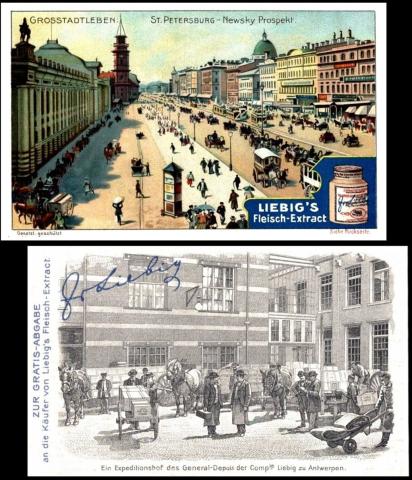
Liebig [trade : meat extract : South America] "Grossstadtleben" / life in a big city (1905) Un/6 - F.0807 : S.0806
Today in 1703 the city of St Petersburg was founded.
Originally, the land was Swedish, and it was captured in the Great Northern War. Tsar Peter the Great did not name it after himself, though, as is popularly thought, but after his patron saint, the apostle Saint Peter, the fisherman, hence the true meaning of the town name, which is Saint Peter`s Town.
The land was really not much loss to the Swedish, it was very damp, and not very well suited for building. Indeed the construction took the lives of so many men that more had to be conscripted, and many of those died on the journey to the site, of exhaustion, disease, exposure, and overheating.
The first building to be constructed was a fortress, and the city spread out from there. There was a grand seaport, and two palaces. But after the death of Peter the Great, Peter II decided he did not like the city, and moved the capital back to Moscow, where it stayed until 1732. Then, for several reasons, it moved back.
During the First World War it was renamed, to Petrograd, but it remained the capital until 1918, when Lenin was forced to move it because opposing forces were getting ever nearer.
In 1924 there was another name change, to Leningrad. And it was as Leningrad that it was besieged by the German forces between September 1941 and January 1944, causing the deaths of over a million civilians, through bombing and starvation. In 1945 it was honoured as the first ever Hero City, an honorary title given to Russian areas which stood against overwhelming odds.
The rebuilding started almost immediately the Second World War was over, starting with the infrastructure, and then the restoration of its buildings and effects which had been destroyed or stolen. Then the schools were re-opened, and the theatres, and the Metro, which had been begun before the outbreak of war, and used to shelter and hide so many civilians. It was completed in 1955. However many of the palaces took decades to restore, and many of the artworks were destroyed, or taken away into private collections, where they will never be found.
As for the name Saint Petersburg, that was only restored on the 6th of September, 1991.
This card is one of six, but oddly the panel with the jar of Liebig moves sides and changes background colour, which can lead to confusion when trying to make the set up. So the full list of cities are :
- Berlin - Brandenburg Gate (red - left)
- London - Fleet Street (red - left)
- Paris - Opera House (green - left)
- Rome - St. Peter`s (green - right)
- St. Petersburg - Newsky Prospekt (blue - right)
- Vienna - The Hofburg Palace (blue - left)
Strangely, the French version is titled "Vues des Capitales", or views of capital cities. which is probably more correct, but less romantic.
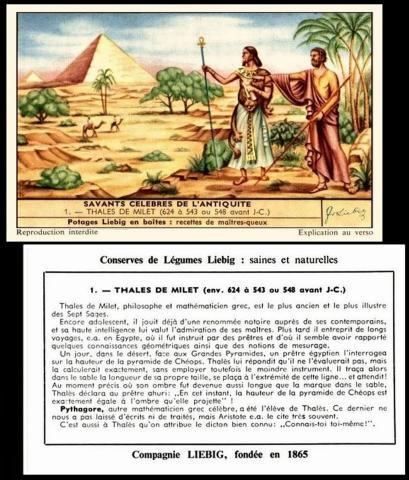
Liebig [trade : meat extract : South America] "Savants Celebres de L'antiquite" / wise men of antiquity (1958) 1/6 - F.1696 : S.1696
Today, in 585 B.C., saw the earliest event in history that can be precisely dated to a specific day, the first time that a battle has been proven to have taken place on a certain day, and the earliest known accurate prediction of a solar eclipse to have been recorded.
This was the eclipse of Thales, and it was recorded by Herotodus, the Greek historian, as being the reason for a halting in a battle between the Lydians and the Medes. This war had been raging for six years, and as the two armies were fighting by the River Halys, which is now in Turkey, the sky completely blackened. As it had been daytime, this was seen by both sides as a bad omen, and they downed their weapons, leading to a truce, and then to peace.
And the reason why it is the "Eclipse of Thales" is that the Greek philosopher, Thales, of Miletus, had correctly predicted the year in which the eclipse would occur, though he did not proffer a month or day.
The cards in this set are :
- Thales de Milet (624 to 543 B.C.)
- Hippocrates (460 to 377 B.C.)
- Aristotle (364 to 322 B.C.)
- Theophraste (372 to 287 B.C.)
- Ptolemy
- Galien
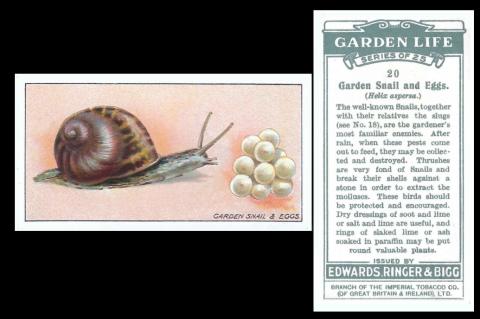
EDWARDS, Ringer & Bigg [tobacco : UK - Bristol] "Garden Life" (1934) 20/25 - E14-42
We close this week with the tale of a snail, because today, believe it or not, is #NationalSnailDay at least in America, where every May the 29th they celebrate the wonders of the snaildom, and it is a far reaching one, for it is estimated that over five hundred different species of land snail can be found in America.
Now you may not think there is anything to love about the snail, as you lay your fiendish beer traps, but the truth is that the snail was one of the first animals on Earth, right back to the Cambrian Age, five hundred million years ago. It is known that prehistoric man ate them, much as we do today, under the rather unappetising name of l`escargot, and that they were definitely a delicacy in Roman times, where Pliny the Elder writes of a man called Fluvius Hirpinius, a snail farmer, who fed his snails with wine and meat, making them more flavoursome.
Usually the diet of the snail is simple, just soft plant life, which they digest, until it passes through as a rather nice kind of compost. So if you encourage snails to your domain they will help your plants survive, though it does seem odd that they do this by eating others. But sadly they are themselves eaten, by frogs and especially by birds, who find them a good source of protein for their growing chicks. This is why you should hold off on the slug pellets, especially in the bird breeding season.
Snails are actually gastropods, which means `stomach foot`, and refers to the fact that the piece of the snail that travels along the ground is a big muscular foot. Slugs are also gastropods, the difference being that snails have shells and slugs do not. However we know that some species of snail are carnivorous, and will eat worms, insects, and slugs, as well as each other.
The snail family is diverse, and widespread, living in the sea, and in fresh water, as well as in pools and aquariums. All share the same characteristics, including a rough tongue that comprises up to twenty-thousand tooth-like structures. They also have the ability to shut down all their organs in times of drought or cold, sometimes for years. Perhaps this is the reason why they are one of the few creatures that live right around the globe, even in Antarctica.
Despite this they do not seem to appear on many cards, and the only other one I know of is card 17 of John Player`s 1987 "Grandee" set of "Britain`s Nocturnal Wildlife".
Our card was primarily chosen because it fills a gap, for we have used both the other versions of this set before, the Wills home issue, dating from October 1914, as our Card of the Day for the 29th of October, 2024 - and the Lambert & Butler`s, dating from April 1930, as our Card of the Day for the 8th of June, 2023.
Both those issuers have reference books devoted to their cards, but our version today only appears in our original World Tobacco Issues Index, as
- GARDEN LIFE. Sm. Nd. (25)" See H.449 ... E14-42
The H code is for the handbook, and this tells us tof the other issuers. However I do have something rather fabulous, and that is the contemporary new issues report on our set, from The London Cigarette Card Company`s "Cigarette Card News" Vol.2, No.13, October 1934, under "Notes on Current Series - by C. L. Porter" which reads :
Edwards, Ringer & Bigg. This branch of the Imperial Tobacco Company are now packing in their "Klondyke" Cigarettes "Garden Life", a series of 25 small cards, similar to the Lambert & Butler set of the same name."
Now this does not mention the Wills original set, but the reason could be something which is revealed in our Wills Reference Book, where it tells us their original set was a series of fifty cards, double the size of the other two. So how, I wonder, were the cards selected? And did both those sets use the same cards and numbering system? That will have to be revealed later on when I have time to list the cards that make up the three sets
This week's Cards of the Day...
... joined in with Royal Mail, whose current set of Commemorative stamps, issued on the 21st of May, featured castles. However, we started by going off on a tangent for the first three and looking for other things that bear the same name as the castle, and I did manage to continue that all week.
The stamps, as usual, these days, are all for First Class Postage. Of the standard ones, which use photographs for the stamps, we found alternative things to do with Pembroke, Urquhart, Stirling and Warwick Castle, but failed to locate any other connections to Bamburgh, Dunluce, Dundrum, or Raglan Castle, so if you know of any do let us know. However we did much better with the Miniature Sheet, which uses art drawn images, managing to find something for all four, which were Balmoral, Caernarfon, Dover, and WIndsor Castle.
So lets start with :
Saturday, 16th May 2026
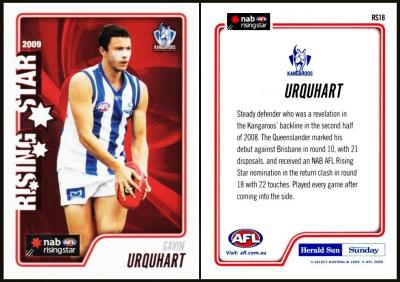
Our first clue, gave us another "Urquhart", and it also shows that football takes many forms, this being Australian Football. There is actually a Scottish connection though because a man called William Swan Urquhart went from there to Australia as a surveyor and planned the streets of Ballarat in 1852. He seems to have no connection with the castle - though the truth is that no one by the name of Urquhart ever lived there, the name is not a title, it is from the Irish, "aird", which means a promontory, and the Welsh, where "carrden" means a wooded area.
So here we have Gavin Urquhart, who was born on the 18th of May, 1988, in Mackay, Queensland, Australia. Now, although our card calls him a rising star, it is not his `Rookie` card - that honour goes to another Select issued one, the "AFL Pinnacle" series of 2009, which tells us that he made his debut in 2008 for a club called Morningside, which is actually in Brisbane, and then he joined the North Melbourne Kangaroos.
Now you may not have heard of them, but their first appearance on a card was in 1905, and it was issued by Sniders and Abrahams!
Further research has discovered that his first team was not Morningside, but the Glenmore Bulls. It appears that Morningside was simply his first adult team. He does seem to have been a good signing, and was frequently named Man of the Match, but in 2010 he suffered several injuries, and the Kangaroos let him go in 2012.
He then left the sport entirely, and moved over to American Football, but it does not seem to have worked out and in 2014 he went back to Australia and signed with Airport West, also of Melbourne. In 2015 he moved to Pascoe Vale, where he remained until 2018, after which he signed for Riddell. He joined the Essendon Doutta Stars in 2021, but then there was another brief time when he played no football at all, before joining the Springbank Tigers in 2024.
Our set seems to have been issued in conjunction with the newspapers "Herald Sun" and "Herald Sun Sunday", so maybe some cards, or packets were given away as promotion. I will try to find out.
Sunday, 17th May 2026
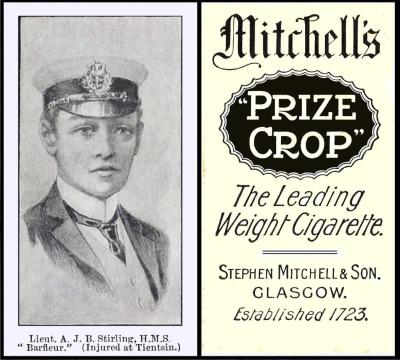
Our second card gave us another man, a military man called "Stirling", who, so the card tells us, was injured at Tientsin, during the Boxer Rebellion. Now we don`t think he has any connection to the castle either, and again it is not named for a family, but for the stone it sits upon, known as Stirling Sill, and which was once part of a glacier.
Our man today is Lieutenant Anselan John Buchanan Stirling, born on the 27th of June, 1875, and he was on a ship called H.M.S. Barfleur, during the third China War, otherwise known as the Boxer Rebellion.
On June 9th and 10th, 1900, he was involved in the relief of Peking, an action which proved very costly indeed, sixty-five men losing their lives, two of whom were officers, and two hundred and thirty men injured. Though he was injured during this series of battles, and severely enough that he was supposedly invalided out of the Navy with a regular monetary payment, he went on to have a distinguished Naval career, on several vessels, including service in the First World War, during which he was in charge of H.M.S. Faulknor, head of the 12th Destroyer Flotilla at the Battle of Jutland.
After that he was Captain of several more ships, ending with H.M.S. Argus and Columbine, and then he seems to have started to move away from the fighting, becoming Captain in Charge at Port Edgar, a military base in the Forth of Forth near Edinburgh in 1922; though his last ship, the H.M.S. Columbine, was actually part of this base. In 1924 he moved on, to Hong Kong, where he was the Commodore in Charge. Then, in 1927, he became an Aide-de-Camp to King George V, but at the end of the year he turns up as being the Admiral Superintendent of the Chatham Dockyard.
At the time of his retirement, in April, 1931, he was a Vice-Admiral, and Companion of the Order of the Bath, with the right to wear the French Legion d`Honneur medal and the Order of St. Anne of Russia.
But he died, just five years after he retired, at the relatively early age of sixty.
This set first appears in our original World Tobacco Issues Index as :
- BOXER REBELLION - SKETCHES (A). Sm. 70 x 37. Black and white. Unnd. (25 known). See H.46 ... M122-2
It is part of the first group of cards ever issued by Stephen Mitchell, the others being several groups of actors and actresses, and a set showing Regimental crests, nicknames, and collar badges. None of these cards are titled as to a set name, and they all date from approximately 1899 to 1902, a time before Stephen Mitchell joined the Imperial Tobacco Company, and we know that because the next sets, issued from 1903, carry wording to show they are part of Imperial Tobacco. We also know that the theatrical personalities are all part of sets called FROGA A, B, C, and D, which were issued by several other companies.
H.46 takes us to the handbook, which at that time was published by the London Cigarette Card Company, though the work was jointly done by their head, Colonel Charles Lane Bagnall, and our editor, Edward Wharton-Tigar. And it is rather a lengthy listing, so it may appear in stages, but lets see how we go. It reads :
- H.46. BOER WAR AND BOXER REBELLION - Sketches. (adopted title). Front per Fig.46. The series was issued in black and white by Cadle, Lambert & Butler, and Mitchell and the same basic designs were used for a coloured issue by Phillips and Anonymous. There are a few minor dfferences in letterpress as between the two groups. All cards are unnumbered
Pre 1919
A. Anonymous - Coloured, plain back. 25 cards, all Boxer Rebellion subjects.
C. Cadle - Black and white, "Cadle`s Cigarettes are the Best...." back. 12 mixed subjects seen.
L. Lambert & Butler - Black and white, descriptive back. 22 mixed subjects seen.
M. Mitchell - Black and white, "Prize Crop" back (Illustrated in C.W. page 679). 25 cards seen, all Boxer Rebellion subjects.
P. Phillips - Coloured, "Guinea Gold" back. 25 cards, all Boxer Rebellion subjects.
41 subjects seen: the 25 cards in the two coloured issues are listed first, with letters, as above, indicating cards seen.
BOXER REBELLION
(Coloured and/or Black and White)
.
1. AP - Admiral Alexieff, Russian in Command of Allied Forces - L - M - Rear Admiral Alexieff, Russian Admiral 2. AP - Adm. Sir Edward Seymour, British Admiral in China - L - M - Admiral Sir Edward Seymour, British Admiral in China 3. AP - L - M - Admiral Kempff, U.S.A. Commander in China 4. AP - M - British Legation, Pekin 5. AP - Captain E.H. Bayly, H.M.S. "Aurora" (at Tientsin) - C - M - Capt. E.H. Bayly, H.M.S. "Aurora" (at Tientsin) 6. AP - Com. David Beatty, D.S.O. H.M.S. "Barfleur". Wounded at Tientsin 7. AP - Czar of Russia 8. AP - Emperor of Germany 9. AP - M - Emperor of Japan 10. AP - M - Empress Dowager of China 11. AP - M - General Fukushima, Commanding Japanese Troops 12. AP - M - Kwang Hau, Present Emperor of China 13. AP - C - M - Lieut. A.J.B. Stirling, H.M.S. "Barfleur". Injured at Tientsin 14. AP - C - L - M - Li Hung Chang 15. AP - M - Major-General Stoessel, Commands Russian Forces at Tientsin 16. AP - M - M. Pichon. The French Minister at Pekin 17. AP - M - Prince Ching, Friendly to Europeans 18. AP - M - Prince Chun, Present Emperor`s Father 19. AP - M - Prince Tuan. Father of Heir Apparent 20. AP - M - Sir Chih-Chen Lo Feng-Luh. Chinese Ambassador to England 21. AP - Sir Claude MacDonald, British Minister at Pekin - C - L - M - Sir Claud MacDonald, British Minister at Pekin 22. AP - C - L - M - Sir Robert Hart, Bart. Director of Chinese Customs 23. AP - The Late Baron Von Kettler. German Minister at Pekin - L - M - Late Baron Von Kettler. German Minister at Pekin 24. AP - The Late Count Muravieff. Russian Minister for Foreign Affairs . - L - M - Late Count Muravieff. Russian Minister for Foreign Affairs - C - M - Capt. E.H. Bayly, H.M.S. "Aurora" (at Tientsin) 25 AP - M - Yuan Shis Kai. Governor of Shantung (Black and White only )
26. - M - Count Von Waldersee. Commander European Forces 27. - M Mr. Edwin Conger. U.S.A. Minister at Pekin BOER WAR
(Black and White only)
28 . - C - L - Captain Mansel-Jones, V.C. 29. - C - L - C.I.V. Pte. No. 968 30. - C - L - Commandant de Wet 31. - C - L - Ex-President Kruger 32. - C - L - Hon. W. D. Schreiner, Late Premier, Cape Colony 33. - L - Late Col. Dick -Cunyngham, Killed at Ladysmith 34. - L - Late Gen. Woodgate, Killed at Spion Kop 35. - L - Late Lieut. Roberts, V.C. 36. - L - Late Major Gen. Penn-Symons 37. - C - L - Lord Kitchener at the Heilbron, S.A. 38. - C - L - Lord Roberts at the Front 39. - L - Lt. Gen. Forestier Walker 40. - C - L - Private, C.I.V. Queen`s Westminster Contingent 41. - C - L - Volksraad, Pretoria
Now looking in the London Cigarette Card catalogue, issued uniform with that handbook, we find that only two sets are given a date of issue, and that the retail prices (for 1955) of the respective issues, but not the anonymous version, were as follows :
- C. - Cadle - odds, 12 cards only, from 50/- to 140/-. Complete sets unavailable.
- L. - Lambert & Butler - 1904 - odds, 22 cards only, from 30/- to 100/-. Complete sets unavailable.
- M. - Mitchell - odds, 25 cards, from 40/- to 120/-. Complete sets unavailable.
- P. - Phillips - 1904 - odds, 25 cards, from 30/- to 80/-. Complete sets unavailable.
By the time of our updated World Tobacco Issues Index the listing of our set appears as :
- BOXER REBELLION - SKETCHES (A). Sm. 70 x 37. B&W. Unnd. (25). See H.46 ... M757-120
The H.46 here takes us to our updated handbook, published by us in 2003. Most of the wording is the same as above, but it does explain the wording "There are a few minor differences in letterpress as between the two groups" as "the captions in black and white being the (a) choice" or, in other words, the reason for certain numbers having two titles in the listing. The only part that is really altered is the description of each issuer, which now reads :
Pre 1919
Anonymous - Coloured, plain back. Nos. 1/25, all Boxer Rebellion subjects. Cards have been seen in black and white with captions in blue
Cadle - Black and white, "Cadle`s Cigarettes are the Best...." back. 12 mixed subjects known - Nos. 5, 13, 14, 21, 22, 28/30, 37, 38, 40 and 41
[New Issuer] Edwards Ringer and Bigg - Black and white, descriptive back. Nos. 29 and 37 known.
Lambert & Butler - Black and white, descriptive back. Series of 25 - Nos. 1/3, 14, 20/24 and 26/41.
Mitchell - Black and white, "Prize Crop" back. All Boxer Rebellion subjects. Nos. 1/27, excluding 7 and 8 (25)
P. Phillips - Coloured, "Guinea Gold" back. 25 cards, all Boxer Rebellion subjects.
41 subjects known: the 25 cards in the two coloured issues are listed first, followed by the balance of the Boxer Rebellion subjects and then the Boer War.
The list in the original handbook is then repeated, without the coding initials. It seems to be the same, but I may have mistyped two -
- 12. Kwang Hsu, not Hau
- 23 a. Ketteler not Kettler (the other one is Kettler)
Monday, 18th May 2026
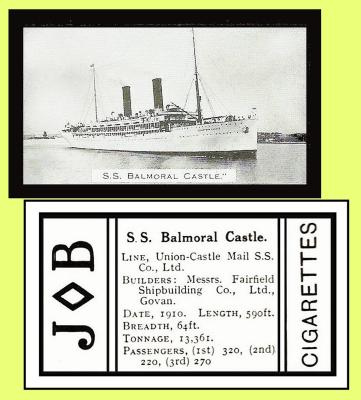
And lastly we brought you a ship. Now at the time I originally typed this, I said it was erroneously named as S.S. Balmoral Castle rather than her correct R.M.S. However research done this week has shown that a ship can only use R.M.S. if she is currently engaged in carrying Royal Mail, if she is not, then she becomes a simple S.S., for Steam Ship
It turns out that Balmoral Castle is again not named after a family, and I expect the Royal family would be rather shocked to learn that in a mixture of Gaelic and Pictish it means a hut in a clearing. However that does tie in rather well with Queen Victoria, who said openly that she much preferred it to any other palace, because it was private and ordinary. Continuing with the theme of finding alternate themes than actual castles, which is fun, and I might keep it going through the week, here we have a ship, the Balmoral Castle. She steamed under the Union-Castle Line and was launched in November 1909, with the intention of being used on the route to South Africa. At the time of her launch she was big news, in every way, for she was larger, and more powerful, and no expense had been spared in her interior fitting out. That was probably why she was chosen to carry Prince Arthur, Duke of Connaught and Strathearn, and his wife, when they went to open the Union Parliament in 1910, though it seems like she had been earmarked for that trip during her building.
In August 1914 she made a very different journey, with very different passengers; servicemen, recalled from South Africa to England so that they could join the war effort. She made a similar trip many times, and in between those times she served as part of a convoy, containing war essentials and food, all the way to South Africa and back.
After the war she was moved to another route, taking Australian soldiers home and bringing back Australian goods and foodstuffs. But she was scrapped, just before the Second World War, in June 1939, which does seem rather odd as she had been so useful throughout the first one.
This set is first described in our original World Tobacco Issues Index as :
- LINERS (A). Sm. 64 x 37. Black and White. Unnd. (25). See H.407 ... J18-2
H.407 leads us to the handbook. which, at that time was published by the London Cigarette Card Company. That does not, as, often, give us another issuer, only a list of the liners included, and it reads as follows :
- H.407. LINERS (adopted title). Fronts in black and white, illustrated in Review, Vol.2, page 47. Issued by Societe Job. Unnumbered series of 25.
- S.S. Antony
- R.M.S.P. Asturias
- S.S. Balmoral Castle
- R.M.S. Baltic
- S.S. Canada
- S.S. Carmania
- S.S. City of London
- S.S. Clan Sinclair
- S.S. Devonian
- S.S. Dover Castle
- R.S.S. Empress of Britain
- S.S. Falaba
- S.S. Franconia
- S.S. George Washington
- S.S. Imperator
- S.S. Malwa
- S.S. Mauretania
- R.M.S. Oceanic
- R.M.S. Olympic
- R.M.S. Orcoma
- S.S. Otranto
- S.S. Oswestry Castle
- S.S. St. Paul
- S.S. Tainvi
- S.S. Virginian
This list proves without a doubt, that the oft used title for this set, of "British Liners", is incorrect, for there are liners of other countries here.
The strangest thing, to me, is that the R.M.S Olympic, launched in 1910, is here, but not her sister, R.M.S. Titanic, launched in 1911. This has led to thoughts that the said date is wrong, and that it was either issued late in 1912, after the loss of the Titanic, or two years earlier, just after the launch of the Olympic.
Looking at the cards, we can immediately discount the earlier theory, as S.S. Franconia gives a launch date of 1911. In fact there is no such ship as S.S. Franconia, (much as our ship is actually an R.M.S. not an S.S.), for the Franconia was actually R.M.S. Franconia. Now she was actually launched on the 23rd of July 1910, though it seems she was only launched as far as being christened with champagne, then she went straight back to dry dock and was painted, only leaving it to be delivered to Liverpool on the 13th of January 1911. That leads to another theory, which is that the Titanic was originally included, but her sinking came before the set could be released, and that card was swopped out by another, perhaps even the Franconia, which is the latest liner in the set.
As far as their retail prices at that time, 1955, odd cards were listed at between 7/6 and 20/-, with complete sets also available, for £25.
The next appearance of this set comes in our updated World Tobacco Issues Index, and it is in an entirely different place, under B, for Joseph BARDOU et Fils, though much of the set listing is identical.
- LINERS (A). Sm. 64 x 37. Black and White. Unnd. (25). See H.407 ... B097-540
That H.407 takes us to a different place, our own handbook, published by us in 2003, and there have been some changes, including the substitution of the correct issuer, so it reads
- H.407. LINERS (adopted title). Fronts in black and white. Issued by J. Bardou (Societe Job). Unnumbered series of 25.
It then lists the cards, with two variations. One is just a correction of the alphabetical order, putting S. S. Oswestry Castle before S. S. Otranto, instead of after as originally listed, and the other is a spelling error, card 24 being renamed to S. S. Tain-U-i instead of S.S. Tain-V-i
Tuesday, 19th May 2026
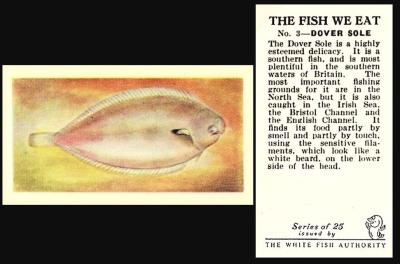
Our fish, of course, is the Dover Sole, for Dover Castle, one of the standard first class stamps in the new issue. In fact the Dover Sole refers only to the fact that this was the port at which most of them were landed in the nineteenth century - its actual name is the Common or the Black Sole, and it lives in the Northern Atlantic and the Mediterranean. It is a flatfish, which means it spends most of its life on the sea bed, where it burrows in waiting for something tasty to swim past. There is a really curious fact about all flatfishes, and that is that they are born looking like normal fish, with an eye on each side of their body, but when they get a bit older one of the eyes move across the head until both are on the same side and together.
The White Fish Authority was actually connected to the government, and was established as part of the Sea Fish Industry Act of 1951, which aimed to regulate and maintain the industry of catching, preparing, and selling white fish. Now a white fish means that its meat is white, or light in colour, and it has no strong taste nor aroma. The main benefit of white fish is that it is very low in fat, and there is a reason for that, because the fat in these fish is stored inside their liver, and does not form part of the muscular structure of the fish.
These cards show the sort of fish that the Authority was trying to make more appetising, and they were issued in 1954, just three years after the Sea Fish Industry Act. At that time they were based in Knaresborough, in North Yorkshire, where they stayed until 1955, and then they moved, to London so they could work more closely with the Ministry of Agriculture and Fisheries, which had just changed its name to the Ministry of Agriculture, Fisheries and Food, and undergone much change at the same time. The next change came in 1981, the White Fish Authority merged with the Herring Industry Board, founded in 1934, to form the Sea Fish Industry Authority. And now, since 2018, this is known simply as "Seafish"
This set is first listed in our original British Trade Index part two, as :
The WHITE FISH Authority
Cards issued 1954.
- THE FISH WE EAT Sm. 67 x 35. Nd. (25). ... WHIM-1
A. Back in black
B. Back overprinted at base with red illustration of fish marked "GOW".
It next appears in our updated British Trade Index, as :
The WHITE FISH Authority
Issued 1954.
- THE FISH WE EAT Sm. 67 x 35. Nd. (25) Backs a) normal in black, b) overprinted in red at base with red picture of fish, and name of retailer. ... WHI-230
The last bit is an interesting change, because it suggests "GOW", from the first book, was probably a fishmonger; however I have not been able to find anyone who has a card with any red overprints. So if you do, please get in touch, and we can find out what the overprints were all about
Wednesday, 20th May 2026

Here we have a Pembroke, or, correctly, a Pembroke Hunting-Percival, said, on the card, to be a general purpose military transport aircraft.
In fact, the "Pembroke" part is the name of the aircraft, and it was a development of the Percival Prince, which was first flown in 1948, and ours was basically just given longer wings to compensate for the extra cargo. Its first flight was on the 21st of November, 1952, and they technically retired them all in 1958, though the Royal Air Force continued to keep them going for another thirty years, which only proves how skilful the R.A.F. are. Because our card mentions communications, I hazard a guess that it shows the C.1, or first version, which was a communications and transport aircraft built for the R.A.F., of which only forty-four were built
The "Hunting-Percival" is the maker, and a lot more interesting, as Hunting started out in 1874 as a veterinary surgeon, with a sideline in shipping. That branched out into tankers, and in 1936 they started to offer aircraft maintenance, but they did not have an actual aircraft company until they bought out another company called Percival, in 1944, which had been founded as the Percival Aircraft Company in 1933, by Mr. Edgar Percival. However the combination of "Hunting-Percival" was only used between 1954 and 1957, after which it just became Hunting Aircraft and the Percival part slipped away, and after that, in 1960, it became part of the British Aircraft Corporation, and then part of British Aerospace, or B.A.E.
Now Halpin`s turned out to be much more interesting than I knew as well. They were founded in 1886, by a man called Bill Mulqueen, and they lasted for almost a hundred years, but sadly they closed down in 1984, just two short of the century.
As for cards, they are listed first in our original British Trade Index part two, as :
HALPIN`S Willow Tea
Cards issued 1958-59, as singles or doubles.
- AIRCRAFT OF THE WORLD. Sm. 68 x 36. Nd. (25). See D.202 ... HAO-1
- NATURE STUDIES. Sm. 68 x 36. Nd. (25). See D.210 ... HAO-2
Now those "D" codes tell us both these sets were issued by other companies. And, as this is going to be the home page for E. & M. Halpin, here they are, for both sets - though the dates are my addition, for reference and information, they are not in the original book.
D.202. AIRCRAFT OF THE WORLD or HISTORY OF THE AIR. Nd. (25)
- Amalgamated Tobacco Corp (Mills) - Set A46-21 (Aircraft of the World - Tobacco issue) [1958]
- Barratt - Set BAR-79.3 (History of the Air) [1960]
- Halpin - Set HAO-1 (Aircraft of the World) [1958]
- Swettenham - Set SWE-6 (Aircraft of the World) [1959]
and
D.210. ANIMALS OF THE COUNTRYSIDE or NATURE STUDIES. Nd. (25)
- Amalgamated Tobacco Corp (Mills) - Set A46-22 (Animals of the Countryside - Tobacco issue) [1958]
- Armitage Bros. - Set ARB-1 (Animals of the Countryside) [1965]
- Candy Novelty Co. - Set CAR-1 (Animals of the Countryside) [1957]
- Halpin - Set HAO-2 (Nature Studies) [1957]
- Sweetule - Set SWA-1 (Animals of the Countryside) [1959]
- Swettenham - Set SWE-7 (Animals of the Countryside) [1958]
Now in our updated British Trade Index, there are slight changes to the listing, and that reads :
HALPIN`S
Willow Tea. Issued 1957-59, as singles or in pairs
- AIRCRAFT OF THE WORLD. 68 x 36. Nd. (25). See HX-180. Also issued in pairs, with mixed numbers, some appearing twice with different numbers ... HAL-120
- NATURE STUDIES. 1957. 68 x 36. Nd. (25). See HX-9 ... HAL-130
The "HX" codes just take you to a separate handbook, but add no new information
Thursday, 21st May 2026
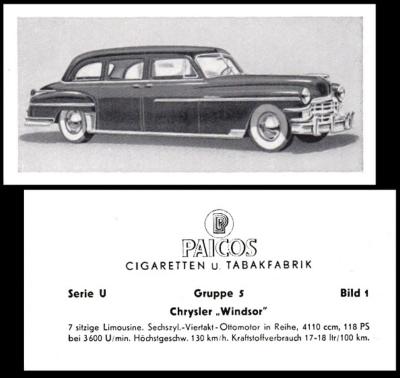
Here we have a set I have never come across before, a German set, showing the Chrysler Windsor, which in our tangential week stands for Windsor Castle.
Now it is easy to see why the Americans would call a limousine a Windsor, because it would reinforce the idea of luxury, and have a little frisson of excitement that it might have had something to do with the Royal Family. There was even one called the "Royal Windsor", from 1939 to 1941/42 which is when production of cars was given over the production of war materials. This ceased in 1946 and the Windsor came back, until 1961 in American and until 1966 in Canada.
In fact, however, there were not only limousines that bore the "Windsor" name, there was a whole range, from sporty coupes to more workmanlike sedans.
Paicos as a manufacturer is somewhat elusive, but they are listed in our original World Tobacco Issues Index, as :
PAICOS Cigaretten- und Tabakfabrik Berllin, Germany.
German Language Issues, 1950-52
- MOTOR CARS (A). Sm. 76 x 36 (174) and Md. 77 x 54 (94). Black and white. Numbered in sub-series (268) ... P3-1
- SCHONES DEUTSCHLAND (Beautiful Germany). Lg.98 x 78. Black and white. No.10 seen ... P3-2
The first thing I noticed here is that there is no German title for our set, but I imagine it was probably "Das Autos". It may have been on the album, if there was one, but its not on the car cards, whereas it is on the other set listed here. That also gives us an address, of sorts, "Berlin NW 87", which is a postal district, namely Nordwest 87, which was in West Berlin at the time these sets were issued, and which today is part of the borough of Mitte.
Now in the intervening years between our original World Tobacco Issues Index and the updated version, some fifty years, there had been some discoveries. Therefore the entry for our group in the updated version reads as follows :
PAICOS Cigaretten- und Tabakfabrik Berllin, Germany.
German Language Issues, 1950-52
- FLUGZEUGE DER GEGENWART (Modern Aircraft). Lg. 100x 80. Black. Nd. (200) Special album issued ... P062-300
- MOTOR CARS (A). Sm. 76 x 36 (174) and Md. 77 x 54 (94). Black and white. Nd in sub-series (268) ... P062-500
- SCHONES DEUTSCHLAND (Beautiful Germany). Lg.98 x 78. B & W. Nd. (200). Soecial album issued ... P062-800
This is not the end of the story, either, as in the updates to that book, which you will find elsewhere on this site, there is the following record :
PAICOS, Germany
SCHÖNES DEUTSCHLAND (Beautiful Germany). Lg. 98 x 78. B & W. Nd. Special albums issued. 1. No series number. (200). 2. Inscribed "2. Teil". (200). ... P062-800
And we also now know that the special album was titled as "Auto-mobile Aus Aller Welt" which is therefore what the title at the top of this page has been changed to.
Finally, since this was first written, we have also discovered that "Paicos" is not just a brand, it is the name of the founder, Giannis Paicos. He actully started out trading in just the natural tobacco, and moved into setting up contracts to supply this to many manufacturers, until he had the idea to start his own company, in 1880, and both make and retail his own cigarettes. That first company was based in Hamburg, which is where he was when he entered the 1900 Paris Exposition, and won a gold medal. In 1932 he moved to Berlin, which led to its downfall, as the area was heavily bombed.
Friday, 22nd May 2026
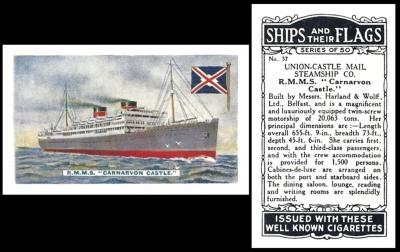
Now our final card is again a ship, and again the word "Castle" is in the title. However, the word in front is different to the Caernarfon which appears on the recent stamp, because the name of the town has changed, twice.
The first change came in 1926, just one year after our card was issued, and that saw the town name become slightly more Welsh, adding an "e" and making it Caernarvon, reflecting the fact that it was a fortress, which is what "Caer" actually means. This change was through petition, by the Borough Council, which is proof that if you get the right people involved most things are possible. However this means that you will only find the updated spelling in cards from 1926 onwards. Now this seems to have led to the strange situation that both names were used, and if you look at Cope`s Castles, which was issued in 1939, you will see that on card 23 the old name of "Carnarvon" is in the title box that juts into the frame, and "(Caernarvon)" is beneath it in the white border.
The second change came in 1975, again through the Borough Council , and that was to physically change the "v" to an "f", hence Caernarfon. Now this was an important change, because in the Welsh alphabet the letter `v` is not actually present, and so it was more a change for the English than it was for the Welsh, who had been calling it Caernarfon all along.
On to another strangeness. and you will see that this ship is called the R.M.M.S. Carnarvon Castle. Now this acronym differentiates between steam ships, which used R.M.S, and diesel ships, which used R.M.M.S., the additional "M" meaning "Motor-powered". The R.M. at the front, of course, denoted that this was a ship which carried the mail for Royal Mail, and technically it could only use it when it was carrying mail, at other times it had to change to S.S., for "Steam Ship".
Our ship belonged to the Union Castle Line, and she was launched on the 14th of January 1926. Like the Balmoral Castle, she was used on the Southampton to Cape Town run, and she served up until 1936, when she was deemed, by the revision of the contracts, to be too slow to carry mail. Then she went in for a refit which included allowing for more passengers, and removing the front funnel, which was actually a dummy, seemingly only for aesthetic purposes. On the 8th of September, 1939, whilst at Cape Town, she was requisitioned by the Royal Navy and re-equipped as an armed merchant cruiser. In this capacity, she saw much action, including a scrap on the 5th of December, 1940, with the German auxiliary cruiser "Thor" in which she came off badly, with the loss of four men and the wounding of over thirty, and she had to be strapped up at Montevideo, very quickly, for there was much grumbling from Germany, who objected to her being in a South American port, and also because of rumours that she was being mended with pieces removed, illegally, from the scuttled German ship Graf Spee.
In 1943, perhaps because of her war wounds, she was decommissioned, with the intention of converting her into an aircraft carrier, but this never happened. Instead of that she became a troop carrier, right until 1947, after which she returned to her South African routes. Despite all this, she was scrapped, in Japan, in September 1963.
Now whilst writing this, I discovered that she was not the first Carnarvon Castle. That vessel was built at Elderslie Dockyard, in Glasgow, in 1867, by Barclay, Curle & Co. and she was a three masted sailing ship, strangely intended to sail to the Cape and back. She was very highly thought of, and you can tell this because she was the first of their ships to be registered in London, as opposed to Liverpool. However, she was sold to Sinclair & Ellwood in 1889, and they sold her on in 1897, to a German company, Flugge, Johannsen & Libinus, of Hamburg, who renamed her the Nurnburg. They did not keep her long either though, and by 1906 she had been sold on to Sven O. Stray & Co. of Christiansand, in Norway. But then the story takes a dark twist, for she was abandoned at sea in January 1910. Now all I have been able to find out is that when this happened she was in the Atlantic Ocean, travelling back from the Peruvian island of Lobos de Tierra to Antwerp, laden with guano - and we have no idea what happened after that, whether she landed, or sank, and she was a big ship, almost seventy metres long.
This set is completely anonymous, but we know it to have been issued by Teofani, an issuer who seemed to enjoy hiding their light beneath a bushel, as many of their sets are not ascribed to them. In fact the entire ZA-7 section at the back of our original World Tobacco Issues Index, containing seven issues, starts with the header "overseas issues by Teofani". Our set is catalogued as :
- SHIPS AND THEIR FLAGS. Sm. 63 x 38. Back inscribed "Issued with these Well Known Cigarettes". Nd. (50). See Ha.602. ... ZA7-4
Now Ha.602 sends you off to the handbook, which at that time was published by the London Cigarette Card Company, though the work was a co-production between our Edward Wharton-Tigar and their Colonel Charles Lane Bagnall. And that tells you that there was another issuer of this set, namely :
- Ha.602 SHIPS AND THEIR FLAGS (titled series). Front in colour, numbered.
Phillips - Series of 25
Teofani - Series of 50. Anonymous cards, inscribed "Issued with these well known cigarettes"
Now I haven`t got time, at this late juncture of the night, to investigate that Phillips link, so that will be done over the weekend, along with more details of the twenty-five ships which were sadly scuttled from the Phillips set, or maybe excitedly launched to join the anonymous/Teofani version. Your guess, right now, being as good as mine, as to which came first.
What I do know, and very surprisingly, is that fifty years on, in our updated World Tobacco Issues Index, the set is still not restored to the Teofani section in the main book, it remains as an anonymous issue, and, in fact, another issue has come to join it, that being "Transport - Then and Now". Our set remains catalogued as :
- SHIPS AND THEIR FLAGS. Sm. 63 x 38. Back inscribed "Issued with these Well Known Cigarettes". Nd. (50). See H.602. ... ZA07-740
I`m not sure why it says H.602, because when you go to the modern handbook this code does not exist, it jumps from H.597 to H.604.
The most curious thing is that of these eight issues, only two use the same back inscription, as you can see from this quick list :
- "Cinema Celebrities" - "Presented with these well-known choice cigarettes"
- "Famous British Ships and Officers" - Issued with these High Grade Cigarettes"
- "Public Schools and Colleges" - "Issued with these fine Cigarettes" (as Zoological Studies)
- "Ships and their Flags" - Issued with these Well-known Cigarettes"
- "Sports and Pastimes" - "Smoke these cigarettes always"
- "Transport Then and Now" - Now being packed with these cigarettes"
- "Views of London" - "Issued with these World Famous Cigarettes"
- "Zoological Studies" - Issued with these fine cigarettes" (as Public Schools)
So there we are, we managed. I was not sure we would. There is still a bit of titling, and a few reference books to glean but I will sort that out over the weekend.
Thanks for tuning in, and thanks to everyone who helped.
And I`ll be back again next week, at the same time, hopefully a little calmer!