
this week went a little better, perhaps because I started earlier, though I needed to as I had rather a job to find both dates and cards. Only one of the first three diary dates stayed the course, and the rest were not much better. But we persevered, as always, and everything worked out in the end.
website news :
This week, or at least on Saturday, because I finished last week`s newsletter way earlier than I had imagined, I did a lot of indexing, and now all the cards from the newsletters dated 10th of August 2024, 17th of August 2024, 24th of August 2024, 31st of August 2024 and 7th of September 2024 are added
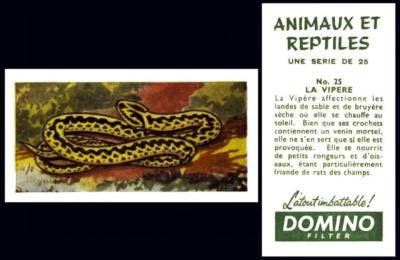
There is also a new home page for the issues, in Mauritius, of British American Tobacco`s `Domino Filters` brand, and you can find that in our newsletter of the 21st of October 2023, with the entry for "Animaux et Reptiles", which, in alphabetical order, is their first set. During the making of that we expanded some what on the little known fact, to tobacco card collectors, anyway, that several of the sets were also issued in the United Kingdom as trade cards. And this very set is one of them,.for you will find this very same venomous viper branded for Clover Dairies and Millers Tea, with the translated title of "Animals and Reptiles" - the Miller version dating from a year earlier than our issue, and the Clover Dairies one waiting until 1962.
this week`s diary dates :

BENSEL Workforce [trade : staffing solutions : UK - Wolverhampton] "Occupations" (1991) 12/20
Well we started out with Alan Freed in this spot, and the Moondog Coronation Ball, held on this day in 1952 and generally regarded to be the first Rock and Roll concert ever. However the moment I started looking at cards of him I knew I had used a certain set before and it turned out I had used him, too, on the 26th of January, 2024, in respect of him being one of the non-singers that were inducted into the Hall of Fame in the first wave, but also because he is considered to have invented the phrase "Rock and Roll". I even mentioned the Moondog Coronation Ball.
The replacement is interesting for two reasons, it is a day I had never heard of, and the card is from a set I had never heard of. The day is #GlobalSurveyorsDay, and it is every March the 21st, but it is also part of #NationalSurveyorsWeek, which begins annually on the third Sunday in March. The first one seems to have been held in 1984, but only in America, it took quite a while for the idea to take off in Europe, and the first official #GlobalSurveyorsDay was not until a decade later. Mind you the skill of surveying is much older that that suggests, we can trace it right back to Ancient Egypt, where despite only having basic tools like rope and pegs they were able to make magnificent structures like the geometrically perfect pyramids.
The first cigarette card celebrating the skill of the surveyor is said to be found in Duke's "Perilous Occupations", a set issued in 1888. The title of that card is "Surveying in the Mountains", but the description, like on most Duke cards, is basically a lot of words that never really make it to a satisfactory point, nor have that much to do with the picture. Take the words on the surveying card, which read "The Arabs believe that the mountains steady the earth and hold it together. To Eastern people generally mountains were sacred, and, as the Bible tells us, they offered their sacrifices upon them. The idea of sacrifice suggests itself when we look upon the poor fellow on the slippery mountain-side in the picture. His dress reminds us how cold, keen and razor-edged the air is, and we readily perceive how dangerous is his crumbling footing, where he stands with his instrument signalling instructions to his assistant. But history tells us that in every age science has demanded its martyrs." If anyone got "surveyor" from that clue I would be very surprised.
As far as trade cards, one of the best, surprisingly, is Dandy Gum`s "Our Modern Army", where the eight of Spades celebrates the Royal Engineers really well with a bereted soldier using a theodolite. However, when you think about it, having people to lay out bases, runways, and installations, is, and has always been, vital to the war effort.
Our card was issued as advertising for a company which offered a range of skilled staff for any sudden emergencies. I cannot find them online, so it is possible they are no longer in business. The cards are excellent though, very well drawn and designed, with the only fault, perhaps, being that all the backs are identical. And it appears to be the only set of cards they ever produced. The cards show some of the skilled workers that they can supply, which are :
- Coded Welders
- Machinists
- Fitters
- Electricians
- Plater Welders
- Riggers
- Erectors
- Supervisors
- Foremen
- Pipefitters
- Technicians
- Surveyors
- Inspectors
- Draughting Service
- QA - QC Inspectors
- NDT Technicians
- Designers
- Electrical Engineers
- Mechanical Engineers
- Managers
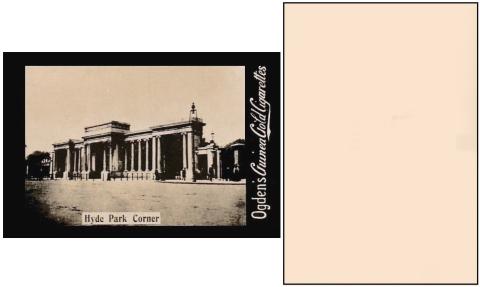
OGDEN`s Limited [tobacco : UK - Liverpool] "Guinea Gold" - series B (1900) Un/
Today we mark the centenary of traffic calming measures at Hyde Park Corner - which, until that date, was rather chaotic and growing ever more so as the number of mechanical vehicles on the road increased.
Hyde Park Corner first hit the headlines in the 1820s, when King George IV wanted to make the entrance to his Royal Parks grander and more imposing than the current, rather ramshackle, turnpike gate. He commissioned Decimus Burton, founding fellow and vice-president of the Royal Institute of British Architects, to come up with a more fitting approach to Buckingham Palace, and when each one was shown to the King, on paper, it was rejected, for not being grandiose enough. Unfortunately, whilst the final version was being built there were new laws that prevented most of the ornamentation, and the planned statue of a chariot, drawn by four horses, on the top. However it did end up with a statue on top, much to the architect`s distaste, of the Duke of Wellington, on horseback, which was paid for by public subscription, and erected in 1846.
In the 1870s, with traffic growing heavier it was decided that the Wellington Arch should be moved, to face down Constitution Hill. This allowed four major roads and the carriage drives at Hyde Park and Constitution Hill to merge more satisfactorily. The statue was removed, and sent to Aldershot, where it remains to this day. In its place, but not until 1912, came a similar statue to that which had been originally intended, a chariot, drawn by four horses. By that time the arch had been extended out to each side, with piers and gates, as shown on our card, to allow for better traffic access, but it was still not working.
The new traffic scheme closed off the Wellington Arch, so that traffic could no longer pass through it to get into the park. They did that by making it the centre of a large roundabout, which all traffic had to circle in the same direction, clockwise, another new idea, as before that the area was two way, which, as six routes converge at that point, seriously had to change. Of course, the first morning of the new system did not go smoothly, and there were several crashes, some caused by drivers who saw the arrows but presumed they did not apply to them. I have not yet found any instances of people trying to climb up on the roundabout and still go through the arch, but I am sure there may have been a few. And the difficulties and dramas must have continued as in the 1930s traffic lights were installed at the junctions of all the merging routes.
Now I am sure that there are many Londoners who are wondering about some of the above, and it confused me too, until I found out that plans to enlarge the roundabout were laid down in 1938, but that they were not anything other than plans until the 1960s, when Wellington Arch was altered again, removing the elaborate side sections, and just leaving the central arch.
This card belongs to a reader, and I have to admire the way it is just on a white background. I generally go for green, simply because I never imagined that it was this simple to show both a black edged card and a whitish back. But I will copy it in future!

AUSTRIA G.m.b.H. [tobacco : O/S - Munich, Germany] "Bunte Filmbilder" - II Folge / colourful film images - second series (1937) card 372 - A920-100.1 : A.92.2.2
This stunning card celebrates the birthday of Joan Crawford, born today, in San Antonio, Texas, and christened Lucille Fay LeSueur. We know the day of her birth, but strangely not the year, which was variously reported as being between 1904 and 1908.
Her father was a construction worker and we are not entirely sure that he was ever married to her mother, though he already had a son with her - and a daughter with someone else. When Lucille was less than a year old her father went out and never came back. Her mother married again in 1909, and they moved to Oklahoma, where the new husband ran a theatre/opera house. This seems to have been where Lucille fell in love with the idea of being on the stage, as a dancer. This was almost thwarted by a childhood accident but surgery saved her foot and allowed her to return to dancing.
In 1917 there was trouble at the theatre and the family moved to Missouri, but separated not long after. She went to college, but that did not work out, and she started haunting the theatres, so much so that she got a part in a revue. That took her to Broadway where she came to the attention of Metro Goldwyn Mayer. Once signed by them, she seriously expected they would make her a big star quickly; and when that failed to happen she took things into her own hands and became her own publicity unit, which worked, for within five years she was one of the top stars at the studio.
Her first film told a different story for she was what is now known as a body double. Today that means someone whose naked body is on screen if the star is more sensible and refuses, but at that time it sometimes meant taking the place of a more famous actor/actress if the scene called for any risk of harm, or if the actor/actress was suddenly unavailable for a scene of short duration. The film was called "Lady of the Night", which kind of suggests the first of those scenarios, but I have not watched the movie.
At that time she was still going by her real name of Lucille LeSueur, a name that the studio did not like. Then they had a brainwave, and ran a competition in "Movie Weekly" asking readers to find her a new name. The winning name was Joan Arden, but reputedly that name was already being used by another actress, at the same studio, who threatened a court action. Whomsoever this was, we don`t know, as it seems she never struck it lucky and became a star, at least no trace of her can be found today. The runner up name was Joan Crawford, and so, with much fanfare, the new name was announced.
With that, she redoubled her efforts to become famous, any way she could. Chief amongst these was using her dancing talent to win contests, every sort of dance, even marathons. That led her to being crowned as a WAMPAS Baby Star in 1926, a very good year indeed for finding stars of the future, for alongside her were Mary Astor, Mary Brian, Joyce Compton, Dolores Costello, Marceline Day, Dolores del Rio, Janet Gaynor, Sally Long, Edna Marion, Sally O`Neil, Vera Reynolds and Fay Wray,
During the 1920s she was very much made to be a girl of the night clubs, glamorous, fickle, and full of life. In the 1930s, this changed, and she became more serious, more grown up. She coped well with moving to talking pictures, but at the end of the 1930s seemed to suddenly fall from favour with the audiences, partially due to a rather strange article in the "Hollywood Reporter" newspaper, which said that she, along with Marlene Dietrich, Kay Francis, Greta Garbo, Katherine Hepburn, Mae West, and the actor Edward Arnold, were "box office poison". Apparently he thought that the salaries of these stars were artificially inflated, considering their films were not popular with the general public - and for some reason, the general public believed this to be the truth, so much so that in 1943 MGM agreed to release her from her contract.
She quickly moved to Warner Brothers, for a trial of three movies. She desperately wanted to play the lead in a film called "Mildred Pierce", written by James M. Cain, author of "The Postman Always Rings Twice", though the original story had no murder, that was written in to appease the censors, who demanded that bad deeds must be punished. The film was a huge success, and because she played the mother, it led to a host of other older women parts being offered her, many of which showed her acting skills to great effect. More than that though, she was suddenly a woman who could look after herself, and did not need a man, and that appealed to the women of the 1940s, left behind whilst their menfolk were at war. The film won Joan Crawford the Academy Award for Best Actress, though the film did not win Best Picture, that went to "The Lost Weekend".
Her status as a strong independent woman continued to grow throughout the 1940s and 1950s, and as the 1960s broke, she took a huge gamble, co-starring in "Whatever Happened to Baby Jane", in which she was a former star, living in fear of her sister, played by Bette Davis. That moved her into the thriller and horror genre, and brought her a whole new generation of fans.
Later on, she moved into writing, publishing two autobiographies, and appearing in person at launches and openings. But in the mid 1970s, she seemed to withdraw from public life, and she died, from a heart attack, on May the 10th 1977, her age given as just sixty-nine.
Now this card was shown to me with a problem, the owner did not know who issued it, and I have to say that I didn`t either, as though our original World Tobacco Issues Index lists eight issuers of this set (though not all of them issued the first section), none are listed with the brand of "Drama". Then I started working through each of the eight and under "Jasmatzi" in the main body of that book it says "Includes issues inscribed "Unsere Marine" and "Cigaretten-Bilderdienst Dresden" and that last wording is what appears on our cards. Though nowhere at all does it mention the brand of "Drama". And it turns out that was for good reason, as Mr. Stuart Arnold told me that this set was by a company called Austria. Therefore I have now found it in the original World Tobacco Issues Index, where it is listed as follows :
AUSTRIA G.m.b.H.,Munich, Germany
German language issues. Includes brand issues inscribed "Regie Sport"
- BUNTE FILMBILDER (Coloured Film Stars). Sm. 60 x 33 (150) and Lg. 72 x 58 (100). See X24/2A. .. A92-2
1. First Series (250).
2. “II Folge”, Nd. 251/500 (250).
The X24/2A, which is part of the original handbook, that was at first issued as a separate volume to the World Tobacco Issues Index, and then combined as a double volume, opens up a huge network of other issuers of this set. The set is also described again, as :
- X24/2 BUNTE FILMBILDER (Coloured Film Stars). Two numbered series, each small size 60 x 33 m/m (150 subjects) and large size 72 x 58 (100 subjects). Pictures in black and white, coloured framework, gold borders.
1. First Series. Numbered 1-250.
2. Inscribed “II Folge”. Numbered 251/500
A. Austria G.m.b.H. of Munich, Germany (1) and (2)
B. Martin Brinkmann A.G. of Bremen, Germany. (1) with firm`s name (2) brand issue. Inscribed “Lloyd Zigaretten”
C. Zigarettenfabrik Greiling A.G. of Dresden, Germany. (1) and (2)
D. Jasmatzi Cigarettenfabrik G.b.m.H., of Dresden, Germany. (1) not studied (2) brand issue, inscribed “Unsere Marine”
E. Massary Cigarettenfabrik of Berlin, Germany. (1) and (2) Brand issues, inscribed “Caid”
F. Orienta Cigarettenfabrik G.b.m.H., of Dresden, Germany (2) only known
G. “Polo” Brand issue, maker unknown, but they were based in Dresden, Germany (2) only known
H. G. Zuban A.G. of Munich, Germany. (1) and (2)
This raises another question, though, for the image on this cards is hardly black and white, it is decidedly brown.
As for the listing in our updated World Tobacco Issues Index, that is as follows :
AUSTRIA G.m.b.H.,Munich, Germany
German language issues. Includes brand issues inscribed "Regie Sport"
- BUNTE FILMBILDER (Coloured Film Stars). Sm. 60 x 33 (150) and Lg. 72 x 58 (100). See X24/2A. .. A920-100
1. First Series (250).
2. “II Folge”, Nd. 251/500 (250).
There is no cross reference to the other issuers, and it does not appear in the updated handbook.
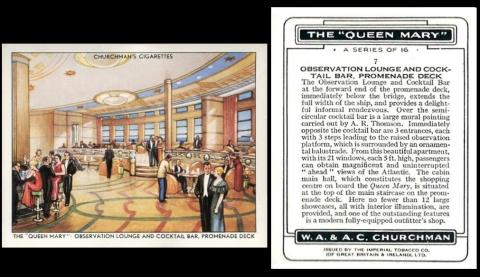
W.A. & A.C. CHURCHMAN [tobacco : UK - Ipswich] "The Queen Mary" large size (June 1936) 7/16 - C504-621.B : C/114 [RB.10/114]
This was the day that caused all the trouble, for I could only find events I had used before, or events that turned out to be listed with the wrong date.
Then a reader told me it was #NationalCocktailDay, which gladdened even my non-drinking heart, for I was sure there were tons of cards showing bright young things with an impossibly long cigarette holder in one hand and a cocktail in the other.
Then I admitted defeat and asked if anyone knew of such a thing.
What I got, Friday afternoon, was this, the Observation Lounge and Cocktail Bar on the Promenade Deck of the Queen Mary, but when I looked in the index we had already featured the small version I had been offered - as the Card of the Day for the 3rd of November, 2023 - however, rather wonderfully, the same person had both the sizes, so here we are, completing the circle and using the final one of the pair.
I am delighted to say that the Observation Lounge and Cocktail Bar are still on the Queen Mary today, after many restorations, which you can read about at an excellent website by Julian Hill, devoted to the glorious vessel - for I know I could not better what he wrote.
Now let us raise a glass to the cocktail, which is a curious thing indeed. All we can say for sure is that it is more than one drink, combined in a single glass, and it is usually alcoholic, but, especially today, not always. We know that mixed drinks like it date back to Ancient Greece where they were called kykeon - and in actual fact kykeon simply means to mix together. Homer even mentions one in the Iliad, which comprised wine, barley, and goats cheese; no wonder they were thought to have mind-altering powers to equal any hallucinogen today.
Then they seemed to disappear, until 1798, when the "Morning Post and Gazetteer" newspaper published a curious article about a man who ran a pub and won the lottery. Apparently he was so happy that he literally wiped out the debts of all his clientele, with a wet mop, for, at that time, the owing amounts were chalked up on an actual slate. Amongst these debts were for a Mr. Pitt. who owed a shilling for two small glasses of Venus oil [a French liqueur], seven pence for one small glass of that and a Parfait Amour [a purple curacao-based liqueur], and three farthings for yet another glass of Venus oil, and a "cock-tail" (vulgarly called ginger). Some writers suggest the mention of ginger means that the drink was non-alcoholic, others that it was simply a drink with warming capabilities on a cold dark night. However, as the "Morning Post and Gazetteer" was renowned for what we today call fake news, maybe the whole thing was made up - though you may be interested to know that despite such things, the paper survived from its first issue in 1772 right until 1937, when it was acquired by the Daily Telegraph.
I am not entirely sure whether the nineteen-twenties invented the cocktail, or the cocktail caused the nineteen- twenties, but that was the age when the drink did, as I had known, come into its own. It was seen as a drink for all occasions, and all people, even ladies, and indeed ladies were the main consumers, something which remains true to this day.
Returning to our card, and the fact that it is from a set of just sixteen, extracted from the small sized set of fifty, I have a list, of those sixteen cards. Whilst doing this, I discovered that cards 1, 2, and 3 are identically titled front and back, but on cards 4 to 16 the words "The Queen Mary" only appear on the front as part of the caption, they are missing on the reverse. However, with hindsight I realise, of course, that the words "The "Queen Mary" " are in the title box at the top of the reverse...!
- The "Queen Mary" (card 50 of the small sized set)
- The "Queen Mary" compared with the First Cunarder (card 47 of the small sized set)
- The "Queen Mary" compared with Trafalgar Square (card 49 of the small sized set)
- The "Queen Mary" Funnel compared with Nelson Column (card 18 of the small sized set)
- The "Queen Mary" : Switchboard in the Power Station (card 21 of the small sized set)
- The "Queen Mary" : Main Restaurant, "C" Deck (card 24 of the small sized set)
- The "Queen Mary" : Observation Lounge and Cocktail Bar, Promenade Deck (card 25 of the small sized set)
- The "Queen Mary" : Children`s Playroom, Promenade Deck (card 29 of the small sized set)
- The "Queen Mary" : Verandah Grill, Sun Deck (card 31 of the small sized set)
- The "Queen Mary" : Main Swimming Pool, "C" Deck (card 32 of the small sized set)
- The "Queen Mary" : Special Suite, "A" Deck (card 30 of the small sized set)
- The "Queen Mary" : Tourist Lounge (card 34 of the small sized set)
- The "Queen Mary" : Tourist Swimming Pool (card 35 of the small sized set)
- The "Queen Mary" : Third Class Garden Lounge (card 37 of the small sized set)
- The "Queen Mary" : Third Class Stateroom (card 38 of the small sized set)
- The "Queen Mary" : Sun Deck (card 39 of the small sized set)
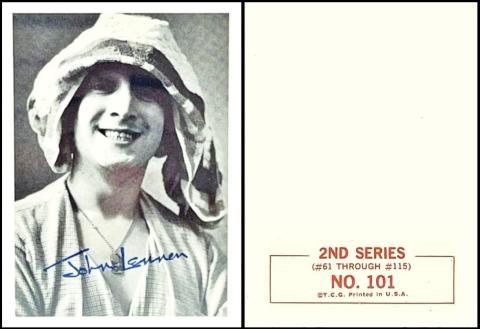
TOPPS [trade : gum : O/S - USA] "The Beatles" - second series (1964)
Today marks the start of John Lennon and Yoko Ono`s week long "bed-in" at room 702, or "The Presidential Suite, of the Hilton Hotel in Amsterdam; the ultimate peaceful protest against the Vietnam War, and all war in general.
This event was only five days after their marriage, which had taken place on March the 20th, 1969, and it was the first of two "bed-in"s.
The second was planned to take place in New York, but there was a problem, for John Lennon had been convicted in 1968 for possession of cannabis and was not allowed into America. They then changed their mind and thought of the Bahamas, but before the event could take place they decided it would be too uncomfortable to stay in bed for a week in such a hot climate, so they obtained a ten day visitor visa and flew off to Canada, where "bed-in" number two took place at the Queen Elizabeth Hotel in Montreal, between May the 26th and June the 1st. This "bed-in" seems to be chiefly famous for its guests, notably Allen Ginsberg and Timothy Leary, rather than the fact that the song "Give Peace a Chance" was recorded on the final day.
The idea of a "bed-in" is derived from a "sit-down" strike, or a "sit-in protest", where the protestors make it as difficult as possible to eject them from the place they are at. However, although those ideas are non-violent, they often result in arrest, and often after much violence from the police or opposing forces. The "bed-in" was a purely peaceful way of making a point, and newspapers and television crews were invited in whenever they liked between nine in the morning and nine at night.
Some of the footage is available on YouTube, because Yoko Ono wanted the idea to spread and so she aired it first on her website for anyone to view for free.
After the untimely death of John Lennon she continued to fight for peace, and even hold "bed-in"s, one of them being with fellow Beatle, Ringo Starr, in 2018.
However it seems that John Lennon was not at all sure the event had accomplished what he hoped, for he wanted it to make a serious point, and most of the press coverage had been rather of a humorous kind.
I picked this card not just because we now have both the Topps "Beatles" sets - the first series being in our newsletter of the 21st of February 2026, as the last card of the week, on Friday, the 27th of February - but because John Lennon does seem to be wearing a very strange outfit, rather akin to a pair of pyjamas. But sadly there is no text on the back of the cards, and so I am left to wonder what was actually going on, and why......
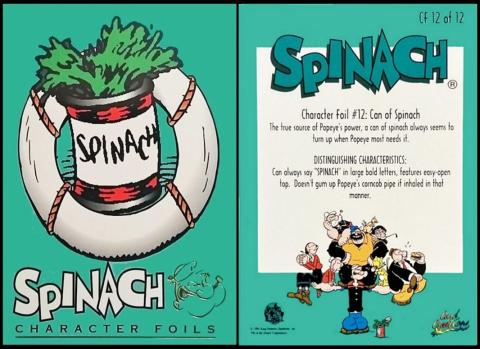
CARD Creations [trade/commercial : cards : O/S - USA] "Popeye 65th Anniversary" - character foils (1993) CF12/CF12
How can we have #NationalSpinachDay without a tribute to its number one fan, and probably number one consumer as well? That is Popeye the Sailor Man, who I was positive I had featured before, but maybe it is in one of the really early newsletters that may one day return to this site.
Today, therefore, we will content ourself with merely a tribute to the toothsome treat, Spinach oleracea - or common spinach.
This green good-guy, or maybe good-girl, is native to the continent of Asia, and it is a versatile vegetable indeed, as it can be eaten raw, cooked, or preserved for eating later. in fact it is better for you raw, and you can get it from a tin in that state, so Popeye knew what he was doing.
It is an annual, which means it grows from a seed, makes a plant, complete with flowers, and then the flowers turn into seeds, after which it dies, all within the space of one year. In some regions it can survive the winter but it is never as good, it is better to extract the seeds and store them so that they can be planted for the next year`s crop.
As for the word "spinach", it has, dare I say, its roots, in Persian, a word called aspanak, which is not surprising for it seems to have started out in that country, about two thousand years ago, from where it graduated to India and then to China. China called it "the Persian vegetable" as well. From there it went out with the traders, both for eating and for medicinal purposes. and spread across the Mediterranean.
It came to Britain from France, in the fourteenth century, and we can tell that because of the similarity of the English word "spinach" to the French one "espinache". And although it is relatively easy to grow in a back garden, the biggest producer is China, who supply ninety-three per cent of all spinach sold.
If you want to halt some of those air miles, though, its pretty easy to grow your own from seed, which you sow in a pot or propagator between March and May, and again August and September if you want to extend the season. Because of global warming, caused by exporting so much spinach, amongst other things, it is best to get the flat leaved varieties, they suffer the heat of the summer sun much better. Once they start coming up in the small pots keep an eye on them and once they get past the first leaf remove them from the pot and put them in the garden, in a small predug trench to the depth of the pot - alternatively you can just sow the seeds in the ground, about an inch deep, once the soil is warm enough.
Our set is one of the parallel set to the main base set of one hundred cards, which was issued to celebrate the sixty-fifth anniversary of Popeye in 1929 - and, rather charmingly, only 1929 sets were produced. The rest of the parallel sets are "Evolution Chromes" - eight cards showing the evolution of the characters as they moved to different studios - and "Power Cels" - the first one of which shows Popeye with a dealers box of cards, having extracted a card of himself which he is proudly showing off.
Our cards are easier to get than those, especially the "Power Cels", which were advertised as being inserted only in one out of three hundred and sixty packs - that means there are only five sets (or maybe six if they were feeling generous, as five 360s are 1800, maybe they put an extra one in the 129 left over), for you were supposed to get one foil card once in every nine packs. However the foiling only seems to apply to the image of Popeye`s head, bottom right on our card, and the line below the wording "Character Foils".
The subjects are :
- CF1 - Popeye
- CF2 - Olive Oyl
- CF3 - Brutus
- CF4 - Wimpy
- CF5 - Swee` Pea
- CF6 - Eugene
- CF7 - Poopdeck Pappy
- CF8 - Alice
- CF9 - Sea Hag
- CF10 - Castor Oy;
- CF11 - Bernice
- CF12 - Spinach
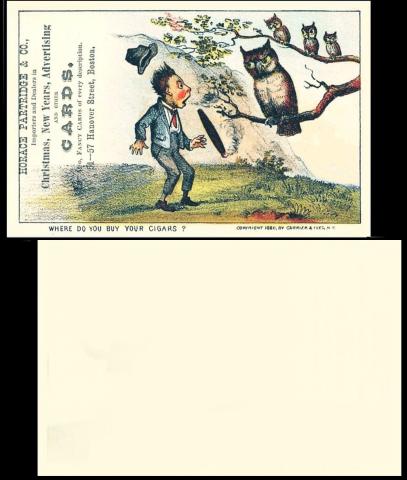
Horace PARTRIDGE & Co. [trade : novelties and sporting goods : O/S -Boston, Massachusetts, USA] "Cigar Advertising Card" (1881) Un/??
Despite my thinking this card was for a cigar seller, who may have issued cards, it turns out to be for a sporting goods store, Horace Partridge of Boston, Massachusetts.
Horace Partridge was born in Walpole, Massachusetts, on May the 27th, 1822, the son of a blacksmith, whose life was forever altered when the railroads came to town and he started working with them, as a surveyor, with a sideline of supplying things that the men, and their wives, could not get off site to purchase, or did not know where to get.
He next turns up in Boston, where his brother was already living, and started work at an auction rooms. In 1847 he was married, to a Miss Martha Ann Stratton, who gave him five children. Then, in 1848, he is suddenly recorded as the owner of a wholesale and retail shop, H. Partridge Fancy Goods. Now if you look at their advertising cards, one of which appears here, as our diary date, you will find this company at all manner of addresses, for he moved about a bit, which makes me think the shops were leased, rather than owned, and perhaps on short leases too.
In 1855, he seems to have got fed up with moving, and he had a huge building constructed in Lincoln Street, purely to house his Christmas stock, rather than having it housed for nine months of the year in storage. (Sadly, it burned to the ground, with all the stock, on March the 10th, 1893, but it was rebuilt.)
By this time he had taken his son as a partner, as well as the husband of his daughter, and, in 1880, he changed the name to Horace Partridge & Co. Sadly, or maybe not, his son was not that into the general and fancy goods, nor the Christmas novelties, he was into sport, and he was the driving force behind a whole sporting goods department being added, including fishing tackle and hunting supplies. And he also greatly increased the mail order business, making Horace Partridge & Co. one of the first specialist sport sellers to offer delivery throughout America. Not just that but on several advertisement cards he proclaims the company to be "America`s Oldest Athletic Goods Store".
Not just that, but they have rather an amazing claim to fame, for they were the official supplier of uniforms and equipment to the Boston Red Sox, the Boston Braves, and the Boston Bruins.
In 1900, Horace Partridge & Co, is said to have closed. We know that Horace Partridge died in 1902, but we think it kept going, and that in 1908 it changed its name to the Horace Partridge Company. Then, in 1931, the Wilson Sporting Goods Company is recorded as having taken over two smaller companies, Lowe & Campbell, and Horace Partridge Athletic Goods Company, though they seem to have used both the names thereafter. Then, in 1960 the company was sold. It did continue to trade until the mid 1990s, but then it closed the store and went over to purely mail order, which, sadly, did not last, and in 1994, the company closed for ever.
Now if you look at our card, and many others, you will see, along the bottom edge of the picture, the words "Copyright 1881, Currier & Ives, N.Y.". For lastly, but not leastly, we have Nathaniel Currier, who is the real subject of the day, having been born today in 1813.
Mind you at first we had something else, but as I was investigating that I thought it would make an excellent, and fun, subject for a theme of the week, so we had a last minute hurry to find a replacement for today. And you will find out all about that when the theme of the week is revealed on Monday...
Nathaniel Currier was born in Roxbury, which, coincidentally, is also part of Boston. He was apprenticed to a lithographer in Boston, called Pendleton`s Lithography, and run by two brothers, William and John Pendleton. They had started the business when our man was just twelve, and he would have known of them as they quickly made a name for themself, attracting many of the top artists of the day, so much so that their work won a silver medal for lithography less than a year after the company was founded.
Then, strangely, things went wrong, and in 1828 John Pendelton just upped and left the town of Boston. Mr. Currier continued after this, but in 1833 he moved to Philadelphia and started working for M.E.D. Brown. However, in 1834, the plot thickens, as Mr. Currier turns up in New York, quickly becoming involved with John Pendleton, by way of planning to start a business together. However, for some reason, John Pendleton pulled out of the deal, and Mr. Currier set it up with another man, called Stodart.
By all reports this business was not a great success, and within a year it had folded entirely. Then, in 1835, Mr. Currier set up on his own as a lithographic printer, mostly of stationery and office requirements. In his spare time he started a sideline, making illustrations of local places and current events. It is not sure whether his intention was to sell these to the papers, but in December of the same year his illustration of the Merchant`s Exchange, after it had burned to the ground during the Great Fire of New York, was published in the New York Sun. The paper expressed an interest in buying other pictures as well, and so the sideline took over.
In 1850, a partner, and native New Yorker, James Merritt Ives comes along. In fact there was a family connection between the two men, as Mr. Ives was married to a Caroline Clark, who was Charles Currier`s sister in law, and it seems that it was Charles Currier who recommended Mr. Ives, as a bookkeeper, when Nathaniel Currier was, by all intents and purposes, getting in a bit of a mess with his accounts. Mr. Ives, although eleven years younger than Mr. Currier, seems to have been more of a business man, and the two men hit it off immediately, so much so that in 1857 the two were partners in the newly renamed firm of Currier and Ives. Their stock in trade remained art prints, of all kinds of subjects, but especially with a link to engineering, which Mr. Currier was especially fond of. It is estimated that over seven thousand original prints were produced, and that is only counting the original engraving, not the prints that were made off each one. However they also had a very good reputation for making advertising cards, including the one we show here, which, with a nod to cartophily, shows a cigar. But more about that later.
Mr. Currier retired in 1880, and gave his share of the business to his only child, a son, from his first marriage, who kept it going after Mr. Currier`s death on November the 20th, 1888. Mr. Ives had also died by then, on the 3rd of January, 1895, and his son had taken over his holding in the business. However it was liquidated in 1907, simply due to "progress", because lithography was much harder, more costly, and took much more time and labour than newer forms of printing, though their quality could nowhere near compare.
This week's Cards of the Day...
This week, with the weather getting better, we are going down on the farm, just in time for #NationalAgricultureDay on March the 24th, though in actual fact this entire week is #NationalAgricultureWeek, starting on Sunday March the 15th and ending on Saturday March the 21st.
If you are reading this in a town, you may wonder what agriculture has to do with you, but the truth is that it provides your food, or a great proportion of it, cereals, vegetables, fruit, and, sadly, meat. It also, especially these days, provides a source of food for many and varied insects, and a home for wildlife.
Saturday, 14th March 2026
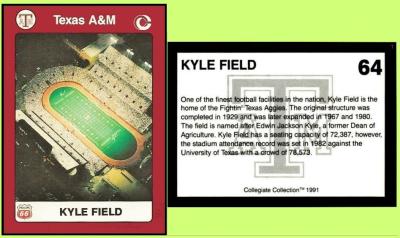
There are three links to this week`s theme on this card. The most obvious one is that this is Kyle FIELD, however, if you read the description on the back of the card you will find out that it was named after Edwin Jackson Kyle, a former Dean of Agriculture at the college. Whilst the third link comes in the name of the team whose home field this is, that being the Texas A&M University, for the A&M stands for "Agricultural and Mechanical".
You may have never heard of them, but the University opened in 1876, and was the first public institution for higher learning in the whole state of Texas. It was founded through the Morrill Act of 1862, which asked for public land to be donated in order that educational facilities could be erected thereupon, and, more than that, that those facilities should provide training in agriculture and mechanical arts, but also in military tactics. Four years later the Agricultural and Mechanical College of Texas was established, and the land, some 2,416 acres, was given over. It then took five years to build the premises and the first students, forty of them, arrived on October the 4th 1876 . Their football team was founded in 1894, and they were champions in the 1919, 1927 and 1939 seasons, though the first is still disputed.
In 1919 they added another speciality, still allied to agriculture, with a school for veterinary medicine. However the first African American and female students only arrived in the 1960s, and the military training was dropped at about the same time.
The 1960s also saw the name of the school subtly altered to Texas A&M University. It is said that they did that to get away from the idea that it was an agricultural college but this seems not to be the case as they still specialise in Agribusiness, Agricultural Communications & Journalism, Agricultural Economics, Agricultural Education, Agricultural Leadership & Development, Agricultural Systems Management, Animal Science, Biology, Biomedics, Coastal and Environmental Sciences, Ecology and Conservation, Ecotourism, Entomology, Horticulture, Marine Sciences, Maritime Studies, Microbiology, Ocean Sciences, Plant and Soil Sciences, Wildlife Management, and Zoology.
As far as Collegiate Collection, they seem to specialise in cards of College Football. In this case you got eight cards in a pack, but only the cards, no gum.
The earliest pack I have found is for North Carolina in 1989, at which time there seems to have been some link up with Coca-Cola as there is a trifold card inserted in each pack which said that if you needed cards to complete your set you could include proof-of-purchase from Coca-Cola products and a dollar and in exchange they would send you five cards of your choice - though that was limited to four orders only.
Notably though, there is also a logo to say that they were "Officially Licensed Collegiate Products", and on that trifold card it actually says "University of North Carolina has recently authorised Collegiate Collections Inc of Louisville Kentucky to produce a College set of basketball/football trading cards." That seemed to support the theory that this set came first, until I found earlier ones. And we also know that in the same year as our set, 1991, they issued a set about Indianapolis Motor Speedway, so it could be the case that they were already producing cards and branched out into College Football.
There was also a binder available for our set, for three packet wrappers and $2.75, plus $1.75 shipping and handling
The sets we know of so far are :
- Arizona
- Auburn Tigers 1989
- Florida State
- Georgia
- Kentucky`s Finest 1989
- Louisville
- LSU Tigers 1990
- Michigan State - 1st edition
- Notre Dame 1990
- North Carolina - 1st edition 1990, 2nd Edition 1991
- Oklahoma State
- UCLA 1991
- Legends of Indy 1991
Sunday, 15th March 2026
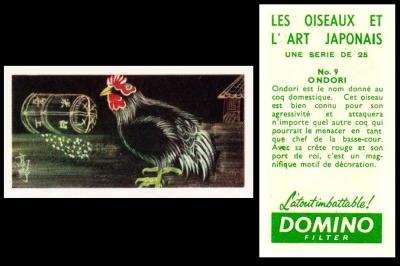
Our second clue showed this curious set, supplied me many moons ago by my chicken connoisseur Malcolm Thompson, and it is definitely the least known of all the "Domino" branded sets. As for why we have a chicken, they are the most common agricultural bird, and they actually outnumber the human species by four to one, which makes it rather a shame that they cannot rise up and use this power to demand a lot better treatment for some of their non-free range brethren.
This chicken is called an Ondori, a name we have now slightly altered to Jidori, and it means `local chicken`, in other words a chicken that was bred in the local area and has not travelled far to meet its fate. It also, pleasingly, usually means that the bird has been well bred, looked after, and lived a free range life, which, according to the Japanese, makes the meat taste better and have health benefits for the consumer. Now we just have to convince the rest of the world of that.
There is one problem with this set, to my way of thinking, and that is that there is no mention of the art or artist which the pictures were taken from. That would have been most interesting and allowed for further research.
As for the set, we now have a new home page for the British American Tobaco "Domino Filter" cards as mentioned above - but to save you returning you will find it in our newsletter of the 21st of October 2023, as the diary date for Saturday the 21st of October, so first up, with the entry for "Animaux et Reptiles", the first set if we work in alphabetical order. However none of these sets are listed in our original World Tobacco Issues Index, because it was printed before any of them were issued. We have to wait until the updated version of that work to find this set, where it is listed as :
2.J. "DOMINO FILTER". French language issues, without name of firm, in Mauritius. 1960-63. All small size, 68 x 37.
- LES OISEAUX ET L`ART JAPONAIS (Japanese Birds and Art). Sm. Nd. (25). ... B705-560
Monday, 16th March 2026

And thirdly, we had this card, which shows the home of agriculture, the farm house, and that means any type of house located on a farm, it is not restricted to any specific type of house. In fact the word comes down from a ninth century Old English, "fearm", which meant an estate, or household, and is technically nothing to do with having any fields.
This is believed to be the first series of these lovely cut-out cards ever issued, if only because there is no actual series number - though we are now not so sure that these were issued as a trial run and then the rest, with the series number, came along later. That is because on the back of the cards in this set it already lists "Nos Autres Series", which means our other series, and those are listed as Le Champ d`Aviation (the airfield), Le Chemin de Fer (the railway station), L`Ecole (the school), Le Course d`Autos (the motor car racetrack) and La Chasse (the hunt). These are indeed the first six sets, and we know that the second six sets are listed at least on set seven, which seems to point to them being issued in two batches.
Anyway we still think this was first, and so it becomes the home page for all time for these intriguing cut-out cards, some of which we have already featured (click the titles in bold for the link) - a full list of which is as follows :
- La Ferme [the farm - not identified as series one anywhere on the card.]
- Le Champ d`Aviation [the airfield]
- L`Ecole [the school],
- Le Chemin de Fer [the railway]
- La Course d`Autos [the motor race]
- La Chasse [the hunt]
- Premiere Traversee du Sahara [first crossing of the Sahara] - diary card for Tuesday 3 December 2024
- d`un Paquebot [leaving by boat]
- Un Match de Rugby [a rugby match]
- L`Exposition Coloniale [the 1931 Colonial Exhibition, held in Paris]
- Les Regates [the regatta]
- `Escadre [the Navy]
On our card, and all the other series, it gives the title of the set, and "Collection de 10 Sujets" - this is not entirely correct as though there are ten cards, there are often more than one cut out figure on each card, and they are individually numbered, on the tab at the bottom, with those numbers corresponding to the drawing/plan on the back of all the cards as to where the models should be placed after they have been cut out - though it ought to be, of course, entirely up to the owner where they do this, allowing for scale, of course. On all the other sets there is also a large number on the front of our card, which is the series number, and this appears on all the cards in that series.
In our series the figures are, for the most part, not individually named or numbered on each cut out figure, they are only numbered once on the card, either on the white, or in the tab. And on the reverse the figures are not numbered at all, which means that I can only enter the ones I have personally seen in the actual list, the others are below, to be fitted in as I find them, or as you let me know what number they are and how they are combined
- the farmhouse
- (a) chickens by a cart (b) chickens pecking the ground
- two cart horses, tacked up
- two cows by a trough
- (a) woman feeding chickens (b) three ducks
- (a) pigs at a trough (b) pigs running
- (a) shepherd with four sheep (b) two sheep
- the stable (probably number 2)
- a dog and a kennel
- a child with a chicken
- two single chickens
- five ducks
Tuesday, 17th March 2026
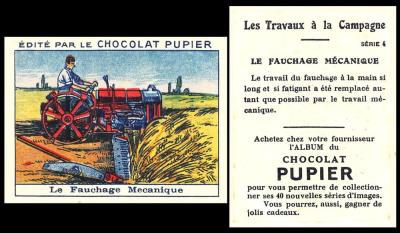
Here we have two things that many people seem to associate with agriculture, a ploughed field and a tractor. However, though the derivation of the word "tractor" comes from Ancient times, it just meant "to pull", which would have applied to man, horse, and oxen power.
The actual mechanical tractor is a very recent item, starting with steam powered ones, which were usually more of stationary engines, a machine mounted on a solid base which you pushed things into in order to render them smaller or cut them to size. It was not until 1839 that a William Tuxford, of Boston, in Lincolnshire, produced a mechanical device which could travel out and work on items in the field.
This set comprises the following cards :
- Epandage Mecanique du Fumier
- La Batteuse Mecanique
- La Herse
- La Vigne - La Vendange
- Le Fauchage Mecanique
- Le Fouloir
- Le Labourage
- L`Elevage (Bovines)
- L`Elevage (Ovides)
- Le Rateau Faneur
- Le Semoir
- Les Forets
It may not say on them that they were a set of twelve, but we do know that we have already featured two other sets with a "serie" number that were issued by Chocolat Pupier, and they are also of twelve cards. The confusing bit was the wording on the back of the card, below the lower line. That translates to "buy the album from Chocolat Pupier from your supplier which will allow you to collect their new series of 40 images. You could also win some lovely prizes". But the problem is that forty is not divisible by twelve.
Then I had a brainwave and started to record the numbers of any series I could find, and that did the trick, for there are forty sets, numbered and identified as so....
- Serie 1 - Les Jeux d`Enfants
- Serie 2 - Les Sports Modernes
- Serie 3 - Les Sports d`Autrefois
- Serie 4 - Les Travaux a la Campagne
- Serie 5 - Les Instruments de Musique
- Serie 6 - Les Blasons des Villes de France
- Serie 7 - Les Ponts Celebres
- Serie 8 - Les Phenomenes de la Nature
- Serie 9 - Costumes provinces Francaises
- Serie 10 - Les Costumes Civils aux Diverses Epoques
- Serie 11 - Les Moyens de Locomotion
- Serie 12 - Les Chateaux Celebres
- Serie 13 - Les Costumes Militaires aux Diverses Epoques
- Serie 14 - Les Costumes de Divers Pays
- Serie 15 - Les Monuments Antiques
- Serie 16 - Les Habitations Style Diverse
- Serie 17 - Etandards et Drapeaux du Francaise
- Serie 18 - Les Drapeaux Etrangers
- Serie 19 - L`Aviation
- Serie 20 - Les Bateaux Diverses Epoques
- Serie 21 - Les Poissons
- Serie 22 - Les Animaux Domestiques
- Serie 23 - Les Animaux Domestiques
- Serie 24 - Les Animaux Sauvages
- Serie 25 - Les Animaux a Fourrures
- Serie 26 - Les Oiseaux
- Serie 27 - Les Oiseaux
- Serie 28 - Les Oiseaux Sauvages
- Serie 29 - Les Chiens
- Serie 30 - Les Chevaux
- Serie 31 - Les Vaches
- Serie 32 - Les Poules
- Serie 33 - Les Papillons
- Serie 34 - Les Legumes
- Serie 35 - Les Fruites
- Serie 36 - Les Fruites Mures
- Serie 37 - Les Fleurs
- Serie 38 - Les Fleurs
- Serie 39 - Les Fleurs
- Serie 40 - Les Fleurs
And thanks to Mr. Pearks for adding in the missing names of Serie 8, Serie 12, and Serie 32.
Wednesday, 18th March 2026
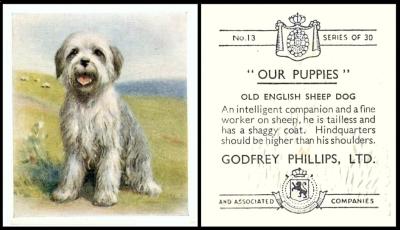
When I looked up the first animal to be domesticated, there was much variation, but the most popular answers were the dog, and the sheep, so here, on this card, we have the both of them, though the dog is at least a dog, whilst the sheep are rather far away on the hillside.
Sheep were descended from an Asian animal whose Latin name is Ovis gmelini, a kind of mouflon. They were probably chosen because they provided skins and wool for clothing and bedding, milk to drink, and meat, and their domestication seems to have begun in Mesopotamia between 11,000 and 9000 B.C., spreading to Greece and Italy, then spreading into Europe.
It seems most likely that the dog domesticated itself the moment the first human threw a bit of meat to a wolf. It provided companionship, early warning of incoming friends or foes, and, eventually, help with herding livestock. No wonder that Carl Linnaeus classified the domestic dog as Canis familiaris.
To our card, this is going to be the home page for the several sets issued by Godfrey Phillips along the titles of "Our Dogs" and "Our Puppies", simply because of the listing which appears in our original reference book to the issues of Godfrey Phillips, for that reads ;
- 110. OUR DOGS. Fronts printed by letterpress in colour. Backs in black, with descriptive text. The series was issued in three sizes :-
A. Titled series of 36. Small cards, size 67 x 37 m/m. Subjects selected from Medium Sized B below, and from "Our Puppies", item 113. Issued 1939
B. Titled series of 36. Medium cards, size 60 x 53 m/m. Home issue, 1936. cards of this series are found with numbers interchanged, i.e. same cards under different numbers.
C. Untitled set of 30. Post card size, 128 x 89 m/m. Backs in post card format. Home issue 1936. Fronts of series B and C are embossed, but unembossed cards are known.
It will be too long a job to list the permutations tonight, but the cards in our "B" series are as follows :
- The Gordon Setter
- Sealyham Puppy
- The Cocker Spaniel
- The Pekingese
- The Sealyham Terrier
- The Cairn Terrier
- The Irish Setter
- The Springer Spaniel
- Wire-haired Fox Terrier
- The Chow Chow
- The Labrador
- The Mastiff
- The Borzoi
- The Bulldog
- The Irish Wolfhound
- The Pointer
- The Dalmatian
- The Airedale
- The Greyhound
- The Bedlington Terrier
- The Foxhound
- The Deerhound
- The Border Terrier
- The Great Dane
- The Beagle
- The Golden Retriever
- The Dachshund
- The Bloodhound
- The Scottish Terrier
- Otterhound
And if anyone has any cards with different numbering do please let us know.
By the time of our original World Tobacco Issues Index, the listing was reduced, to just :
- "OUR DOGS". Nd. ... P50-117
A. Small (36)
B. Medium (30). Some number variations.
C. Postcard size and format. (30). Without series title. Adult dogs, back format identical with Set P50-120.B
Two things need adding from that listing, the first is that the "(30)" listed after our set is correct, they were wrongly entered as a set of 36 in the original Godfrey Phillips reference book, and the second is that "Set P50-120.B" is "Our Puppies", which you can read more about as our Card of the Day for the 6th of October 2024
The listing in our updated World Tobacco Issues Index is pretty much identical to the above, save new card codes, and it reads :
- "OUR DOGS". Nd. ... P521-462
A. Small (36)
B. Medium (30). Some number variations.
C. Postcard size and format. (30). Without series title. Adult dogs, back format identical with Set P521-468.B. See RB.113-110
And RB.113 is our new Godfrey Phillips reference book.
Thursday, 19th March 2026

When we speak of most important, this plant takes the crown for the plant kingdom, and I would have had it earlier except for the fact that every card of sugar cane I found was based on slavery. It`s quite an indictment for the industry, and the worst thing is that things have not changed much since, for it is still heavily involved with human trafficking, forced labour, low wages, long hours under baking sun, and hazardous conditions. However, if you buy your sugar in a packet with a Fairtrade mark, you are certain not to be contributing to this sorry state of affairs.
Anyway I mentioned my plight and Mr. Evans came up with this card, which shows the cane without the controversy. So now I can tell you that sugar cane is the most farmed arable crop in the world, even more than rice, and corn. And it has another use too, as a vital ingredient of bioethanol, which is, ever more, powering vehicles instead of petrol.
Our sugar cane is Saccharum officinarum, which was first grown in the region we today call Papua New Guinea, but which today is the most productive and most intensely cultivated type of all.
These cards were issued between 1929 and 1934 and there were ninety six cards in all, in sets of twelve. The series list was
- Series I - Earth, Air and Sky
- Series II - Man`s Closest Friends and Most Inveterate Enemies
- Series III - Trees and Other Plants Useful to Man
- Series IV - Some Common Wild Flowers
- Series V - Among Our Feathered Friends
- Series VI - Native Wild Animals
- Series VII - Life in and Around the Water
- Series VIII - Insects, Helpful and Harmful
The cards that make up our series, Series III, are as follows :
- The Essential Parts of Trees and Other Plants
- Wheat
- Rice
- The Potato
- The Sugar-Cane
- The Grape
- The Apple
- The Orange
- The Cotton Plant
- The Oak
- The Pine
- The Rubber Tree
Friday, 20th March 2026

Now I wanted to end with a spot of culture, so I looked up "who was the father of agriculture", that led me to Demeter, the Greek Goddess of Agriculture, and her Roman counterpart, Ceres. But it also led me to this man, Norman Ernest Borlaug, and the more I read about him the more interested I became. But I never expected I would find him on a card...!
He was born in Saude, Iowa, on March the 25th, 1914, into a family of Norwegians, who had come to America in 1854. In fact Saude turns out to be a settlement of Norwegian people. Much like at home, the primary industry was farming, and education was basic, only, pretty much, that which would be needed to maintain the farm your family ran.
His grandfather knew different though, and he encouraged the young boy to read and then to go off and apply to college. This he duly did, to the University of Minnesota, but was rejected, though he was accepted to their lower site, the General College, which brought him to the attention of their College of Agriculture, which he joined after just two semesters.
His interest in agriculture led him to join the CCC. This was a bit like the Peace Corps, started by President Roosevelt to give purpose to unemployed and unmarried men. It was advertised as being "for work, play, study and health" and they were also paid, thirty dollars a month. This ran for nine years, between 1935 and 1942, and it was also extended to women, on separate camps, with assistance from Mrs. Roosevelt. The men could be sent anywhere in America to work on forestry, wildlife, housing and other construction, plus assistance during and clearing up afterwards in cases of floods, fires, famines, etc. And it only ended in 1942 because Pearl Harbour occurred in December 1941, at which point all those unemployed young men were seen as being more useful in the forces.
The placement changed our man`s life in more ways than one, and the most important factor in that change was a plant disease called rust, which he encountered at a lecture. This disease preyed on cereal crops, barley, oats, and wheat, and it caused much famine worldwide. The lecture was delivered by a man called Elvin Charles Stakman, who was a professor at the University of Minnesota, and he asked if our man would like to go there to study under him. Of course he said yes, and that led to a Masters of Science degree and a Ph.D in plant pathology.
With that he got a job at DuPont Industries in Delaware, ostensibly to work on biological warfare. Instead of that he was sent down to Mexico, to work on improving their soil and preventing crop failures. Here he did the start of his work into using genetics to make better, but smaller, cereals, ones which would repel diseases such as rust, and which would not leave people hungry, and which would not be affected by wind and rain. He even developed a system whereby wheat began to learn to cope with ever changing environments, something that will be vital in years to come.
And he stayed in Mexico, eventually becoming the director of the International Wheat Improvement Project, a founding members of the World Cultural Council, and a Professor at Texas A&M University, which you may remember all the way from Monday`s card. He also renovated and saved the little one room school that he first attended, back in Saude; it is now owned by the Norman Borlaug Heritage Foundation.
In 1970 he was awarded the Nobel Prize for Peace. And he died on Seotember the 12th, 2009, aged ninety-five, at his home in Dallas
This card is by Kakawow, a company which makes toys, character merchandise, and cards, and somehow managed to get the licenses to Marvel and Walt Disney. There is much debate as to whether they are Chinese or Japanese or even American-Asian, but it turns out they are part of Suplay Group which is based in Beijing.
Kakawow "Diverse", simply means a set of all sorts of things, starting with famous people, in a historical sense, over the first 98 cards, and then moving to the animal kingdom from card 99 to 134, when they go into modern sporting personalities from the world of basketball. In total there are a hundred and forty eight cards, but there are also a lot of insert sets. These include autograph cards, bookplates, canvasses, and what we would call silks, but they call "Art Extraordinary Embroidery", as well as holofoils, cards with differently coloured borders, and sub sets including "Biological Traces", "Echoes of Mastery", "World Wonders", and, in a nod to another of their products, "Hey Dolls".
And there we have it, for the most part all in place, for which I am most pleased and of which I am most proud. Thank you for reading, and I hope it gave you pleasure, as well as whetted your appetite to find out more about some of the subjects I introduced you to for the first time.
Tomorrow I will be adding these cards to the index and also trying to go back in time for hopefully another month, and maybe more. Next week I will reveal the links to those I have indexed, but if you cannot wait, you can find them listed on the index itself for I record the dates and links as I add them in and then extract that list for the next newsletter to be done.