
So I hope you did not burn all your midnight oil to read this at its arrival, and are instead doing it on the train, or bus, on the way to King`s Lynn, where in just a few hours our annual convention will open to display its wonders....
One very important thing to note is that our brand new reference book, to modern, post 1970 trade issues, will be available at the convention for purchase. So don`t go home without one, and do note that stocks are limited.
Another thing is that you ought to make time in your day to go and celebrate the thirtieth anniversary of the Pokémon phenomenon, as we have several specialist dealers attending our convention for the first time. So do go along, say hi, and investigate their world. You never know, you may like it.
website news :
I didn`t do so well with indexing the back issues of the newsletters this week, only managing to add the cards from the issues dated 3rd of February, 2024, 10th of February 2024, 17th of February 2024, 24th of February 2024, and 2nd of March, 2024.
On the plus side, that was thirty-five more cards - and it also means that there are less than five newsletters before we are into 2023, and that only leaves two years and three months to index.
In what I call the current side project, the listing of the first series of Guerin Boutron`s "Celebrites Contemporaines - 1e Livre d`Or (1900)", which you can see as our Card of the Day for the 3rd of December 2025, I have great pleasure in being able to announce that I just added the title of card 404, leaving only ninety six cards to add. In the process, we also sorted out the oft quoted fact that there are two cards numbered as 102 - in fact it is a false fact, for there are not, the true number 102 showing Prince Royal de Suede, the card of Monseignor Darboy actually being number 402, but the front of that initial four is often missing, or much lighter, and it does really look like a one..
this week`s meeting dates :
If you are not on the way to King`s Lynn, it is on today, Saturday the 25th of April, at Alive Lynnsport, Greenpark Avenue, Kings Lynn PE30 2NB. Remember that all CSGB members go in, for free, from 9.30 a.m. whilst non members just have to wait until 10.30 a.m., and pay £5. The doors close at 5.30 p.m. But its also on tomorrow, Sunday the 26th of April, when there is no admission charge for anyone, and it is open from 10.00 a.m. until 4.00 p.m.
Then on Saturday the 2nd of May our Lincolnshire Branch will be holding an event from 10.30 a.m.at Kirton Leisure, 31a Willington Road, Kirton, Boston PE21 1EP.
And now for our regular excursion into the anniversaries and awarenesses of the forthcoming seven days, to amuse and educate, and also assist with all forms of social media...
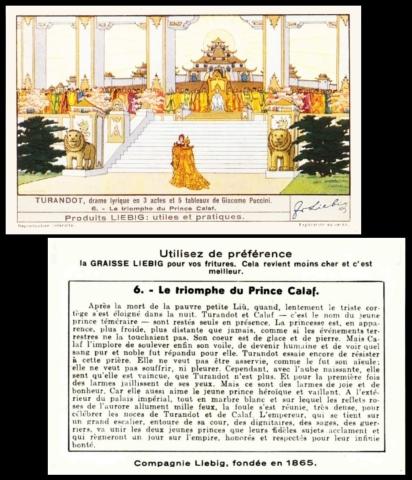
LIEBIG [trade : meat extract : O/S - South America] "Turandot, drame lyrique en 3 actes" (1939) 6/6 - F.1405 : S.1402
Let us start our week with a centenary, today in 1926, of the first performance of an opera called Turandot by Giacomo Puccini, and a posthumous performance, too.
You may know it, without knowing it, for one of the arias, "Nessun Dorma" was performed by Luciano Pavarotti at the 1990 Football World Cup, in Italy.
It is a strange subject for a musical. Briefly, a prince is smitten with a beautiful but cruel lady, Princess Turandot. She is intent on staying single, and so she poses a trio of riddles to any prospective suitor. If they get the riddles right she will allow herself to be wooed into marriage - but if they do not, they must die. Our prince, Prince Calaf, manages to solve all three riddles, but she refuses his hand in marriage, so he turns the tables on her, and says if she can answer just one question, before the next day dawns, he will gladly go to his death. The question he poses is that she must guess his name. But eventually he tells her, giving her the dilemma of whether to kill him or not because the name is known, but she did not guess it. Anyway she decides she loves him, and he is allowed to live to marry her. It does seem to end very quickly, for all the time the ending took to write, and there are many people who claim that Puccini wanted it to end differently, and left clues in his notes, but they were either not seen, or ignored
Now Puccini did not dream this all up in his own head. It all started with a twelfth century Persian poem by a writer called Nizami Ganjavi, all about a Russian princess. This was then embroidered upon by Francois Petits da la Croix for one of his collection of stories, supposedly taken from the folklore of the Middle East, which he called "Les Mille et un Jour", or a Thousand and one Days, and he was the first to name the princess as Turandokht. This was then anglicised to Turandot, in a play, of that name by Carlo Gozzi, in 1762, and this was then updated and altered by Friedrich Schiller in 1801. And we think it likely that the last of these versions was the one which so inspired Puccini, though, for whatever reason, he made her a Chinese princess and not a Russian one.
He began writing notes of the new opera in March 1920, and we know that by March 1924 he had written almost all of it, save the final duet, which he rewrote several times. In October he seems to have settled on what he called the final version, but he was diagnosed with throat cancer on the 10th of October, and died, of a sudden heart attack, on the 29th of November 1924. The music was then completed by Franco Alfano, who had already written many operas.
The premiere took place at La Scala in Mila, today in 1926, seventeen months after the death of its original writer. The part of Turandot was played by Polish-born Rosa Raisa, a very talented artiste, and whom, so rumour has it, was selected by Puccini as his leading lady right at the start of his writing it. The role of Prince Calaf was played by Miguel Fleta, a Spanish tenor, though after the premiere it alternated between himself and Franco Lo Guidice, an Italian Tenor. By all intents and purposes it was a dramatic premiere, and was abruptly halted, right in the middle of Act III, to mark where Puccini had reached at the time he died, and the curtain was lowered as a mark of respect. It was only in subsequent performances that the opera continued, with the additions by Franco Alfano.
The opera has been performed all over the world, but, because the cruel princess was depicted to be Chinese, it was not allowed to be staged in China right until 1998.
Card wise it is rather a shame that William Ruddell`s "Grand Opera Series" was not delayed, as it was released in 1924, for it already contains three cards of Puccini operas - Madame Butterfly, La Boheme, and La Tosca. And Wills`s "Musical Celebrities" was released in 1912, way too early, though it is, as far as we know the first cigarette card of Signore Puccini. As for the first trade card, that honour probably goes to Felix Potin`s third series of celebrities, issued in 1908.
Our card actually comes from a set devoted to our opera. It was issued in 1939, in
- Dutch - as "TURANDOT : Lyrisch drame in drie bedrijven en vijf tafeleeran van Giacomo Puccini")
- French - as "TURANDOT, drama lyrique en 3 actes et 5 tableaux de Giacomo Pucchini
and tells the tale from start to finish in six cards, which are :
- Dutch - Aan den voet der muren van de keizerlijke stad
French - Sous les murs de la Cite Violette
- Dutch - Ping, Pang en Pong
- French - Dans le cour de Palais Imperial
- Dutch - Welk is de naam van den onbekende ?
- Dutch - De Dood van Liu
- Dutch - De triomf van Prins Cafar
French - Le triomphe du Prince Cafar
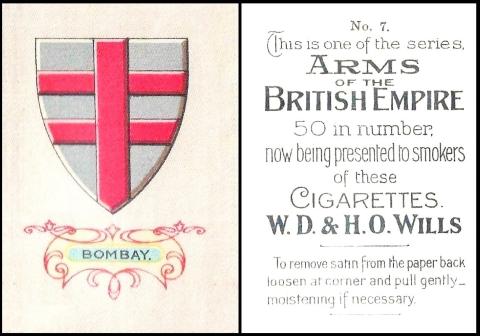
W.D. & H.O. WILLS [tobacco : UK - Bristol] "Arms of the British Empire" (1910) 46/50 - W675-391 : W62-55 : X21/200-126.2 : RB.21/200-126.2 : W/126.A
Today`s event was chosen simply because I get so few opportunities to show silks, but it turned out to be a fascinating tale too.
It all starts in 1789, with a newspaper, the `Bombay Herald`, which lasted until 1791, when the name was changed to the `Bombay Gazette`. It was the most respected local paper in the area, and in much of India, and its only rival was the `Bombay Courier, which had first been published in 1790. Though perhaps rivalry is not the right word, as both papers were published by the same man, William Ashburner, and both, it must be said, were published entirely in English.
In 1825 the Bombay Gazette went to a weekly paper. And today, in 1841, it started to offer the facility of having the papers printed on silk, not newsprint.
We are not entirely sure why, but some types of silk are lighter than paper, and stronger, and so we imagine using it would have reduced the costs of postage, especially to other parts of the continent, or maybe even other parts of the globe.
In fact we still use silk for printing today, and not just as silk screen, as in the case of fabrics and t-shirts. And a good stationer will have a range of silk papers, which are a combination of paper and silk, and gives a better finish for important legal documents, plus more strength for flyers and brochures.
This set, with the anonymous version, first appears in the fourth part of our original Wills reference books, that being RB.16 – The Cigarette Card Issues of W.D. & H.O. Wills Parts I, II, and III (revised) and Part IV. This book was not published until 1950, which seems a very long wait to record a set issued in 1910, until you find out that this version of the set was printed not in England, but in Australia. More curious still is that the card version of this set, issued as two sets of fifty, were not circulated until November 1931(for the first series) and April 1932 (for the second series).
The medium sized silk version, which we show today, is catalogued in that book as :
- 126. 50. ARMS OF THE BRITISH EMPIRE. Fronts printed on satin in colour. Backs on thin board, with instructions for removing satin. Many of the subjects are based on similar originals to those used in Item 40 (see page 90). Australian issues, between 1910-1915 -
A. Medium cards, size 70 x 48 m/m. Backs in black, inscribed "W.D. & H.O. Wills." Numbered on backs
We know that there is also a large sized set, one version of which appears in our newsletter for the 3rd of August, 2024 - just scroll down to Tuesday August the 6th. At the moment that has no write up in the way of data from the reference books, but it will, asap. I have only had time so far to do the standard and medium sizes. That set is anonymous, and does not mention Wills. The numbering differs in the two sets, and although they are said to be similar, they have not been compared card for card so there may be differences.
Now before we rocket on, let us return to "Item 40", which is the standard sized set, also entitled "Arms of the British Empire". We used that as the Card of the Day for the 19th of December 2021, which is the home page for the entire group. Or it will be asap....
Our version next appears in our original British American Tobacco Company Booklet, RB.21, published in 1952, where it is RB21/200-126. The text there reads :
200-126. ARMS OF THE BRITISH EMPIRE - Silk-Fronted.
The recording in W/126 requires to be amended as follows :-
- A. Wills Overseas issue. Size 70 x 48 m/m. Back in black
In our original World Tobacco Issues Index, the set is listed under Wills section 3.B, devoted to "paper backed silks. Issued 1911-17. When detached from their backings, all silks are anonymous." The entry for our set reads :
- ARMS OF THE BRITISH EMPIRE. Md. 70 x 48. Nd. (50). See X21/200-126.2 ... W62-55.
This is more or less the same in the updated version, but the X21 code has been replaced by RB.21/200-126.2, and the card code by W675-391.
The "X" code is actually for the handbook to the original volume, and the entry in there reads as follows :
- ARMS OF THE BRITISH EMPIRE. The recordings under W/40 and RB.21/200-126 are summarised and amended below.
Set 2. Medium paper-backed silks, 70 x 48 m/m. Front per No.2 at Fig.X21/200-126. Wills Australian issue. Numbered series of 50, different numbering from Set 1 [the small sized cards]. The subjects are similar to those in Set 1 in 43 cases, but the designs are mostly altered and all redrawn. Nos. 20, 34, 43, 44, 45, 48 and 50 differ entirely from any in Set 1.
To save you hunting, here is a list of those seven numbers, along with a comparison to the arms which appear on the cards - which was entirely supplied by my Wills Specialist, because I failed to find a satin version of any of these numbers online. Six of these are indeed different, but number 45 is Sierra Leone in both the satin and the card version, so it is possible that this was either a typing error in the original listing, or more likely, that lists of numbers were supplied by more than one collector and amalgamated, but the hand writing was hard to decipher and on one list a 43 or a 48 was mistaken for a 45.
| No. | Standard card | Medium Satin |
| 20. | Natal - | The State Badge of South Australia |
| 34. | Alberta - | England |
| 43. | Madras - | Union of South Africa |
| 44. | Gibraltar - | Tasmania |
| 45. | Sierra Leone - | Sierra Leone |
| 48. | Canada - | New Zealand |
| 50. | South Australia - | The Bermudas |
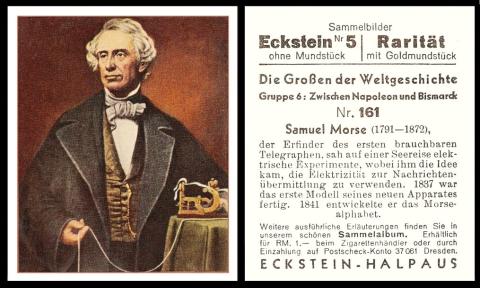
ECKSTEIN-HALPAUS [tobacco : O/S - Dresden, Germany] "Die Grossen der Weltgeschicte / great figures in world history (1935) 161/252
Today is "Morse Code Day", and the birthday of its inventor, Samuel Morse, after whom it was named.
In fact his full name was rather a handful, being Samuel Finley Breese Morse, and he was born in Charlestown in Massachusetts. His father, Jedidiah, was into lots of things, he was a Calvinist pastor, a teacher, a school founder, and a geographer, responsible for the widely used "Universal Geography of the United States". However he also believed in the powers of the Illuminati, and had several views about men, women, and religion, that thankfully are not seen as so acceptable today.
Now I have touched on Mr. Morse before, on a day which was "learn your name in morse code day), but that will be altered to speak more of the actual morse code, some time in the hopefully not so distant future.
Samuel Morse went to Yale, ostensibly to study religion, but he was most inspired by science, and he started painting. He painted his own father, and also a painting that his father much liked, showing the landing of the Pilgrim Fathers, for fifteen years later the first Morse in America had come across in a similar way. In fact Samuel Morse sailed back in the opposite direction and studied painting in England, even joining the Royal Academy in 1811.
He married a lady called Lucretia Pickering Walker in 1818, but she died, shortly after the birth of their third child in 1825. I am not sure what happened to the children, but he seems to have gone to New York, where he became the President of the National Academy of Design, which he helped to found. Then, in 1830, he was off to Europe, painting.
On his way back to America, he struck up a friendship with Charles Thomas Jackson, who lived not so far away from his own home in Boston. Mr. Jackson had a grand passion for electromagnetism, and it was catching, so much so that Mr. Morse abandoned his current painting to help with experiments and later to go off on a tangent and work on the idea of using electricity to make a telegraph system. Later on this would be improved by his assistant, Alfred Vail, who added a device for recording the messages that came in. It worked by using electricity in short bursts, which made a dot on the paper tape, or in longer ones which made a group of dots close together that looked like a straight line, but which was called a dash.
The first message sent, to Mr. Vail, on the 24th of May 1844, seems rather odd, for it was "WHAT GOD HATH WROUGHT", but when you learn more of his father`s religious beliefs, and maybe even fervour, you understand it more. This took place from the basement of the U.S. Capitol building to Mount Clare Railway Station in Baltimore, the site of America`s first railroad.
What seems even odder, though, is that as that date is known, and so well known, why did they not make it Morse Day, instead of today, which is just the birthdate of Samuel Morse himself. And there is another day too, which we celebrate as "Learn Your Name in Morse Code", which is on January 11th, and marks the day that the first public demonstration of the machine was given.
In 1848 he remarried, a Sarah Elizabeth Griswold, and had four more children. He seems to have become embroiled in lots of lawsuits, trying to be proven as the sole and only inventor of the elecromagnetic telegraph, though he had in no way done the work alone. and even the idea was not his, as we have shown.
Strangely, though he received public and professional acclaim from many overseas countries, America was less forthcoming. He also received few royalties, and he died, of pneumonia, in New York City, on April the second, 1872, aged eighty. He did, however, live to see a statue of himself erected in Central Park, which was unveiled on June the tenth, 1871.
His first cartophilic appearance came after his death, too, in the 1887 set of "Inventors and Inventions" issued by Lone Jack - but there is no biography on the reverse. It used the picture of him which shows him with a full beard and his medals, all of which were from Foreign Governments, which was taken by Mathew Brady, famous for his photography of the American Civil War. This picture is used for all his early American cards, just with different backgrounds, and sometimes with an inset of his telegraph machine.
It is not until 1924 that a different picture turns up, and I am not entirely sure it is not the same one, slightly tweaked, and with the removal of his medals, and that was issued by Bucktrout, as card 3 of their "Inventors" series.
Three years later, the original picture, and the medals gets restored, but the picture is reversed, that is for the 1927 series of "Heroes of History" issued with Gridley Butter and I`m just looking into the theory that it was a rehash of the original American Tobacco version, but I will have not time to do that any justice until the Convention is over.
The most curious card of all was issued by Post Cereal, in 1930, for it looks nothing like him, and more like Lord Nelson, for one thing he is suddenly clean shaven, though there is an image of someone using a telegraph in the background. And the back of the card is completely blank.
Ours comes later than that, and it first appears in our original World Tobacco Issues Index, as
ECKSTEIN-HALPAUS Cigarettenfabrik G.m.b.H., Dresden, Germany
Amalgamation about 1939 of A.M. Eckstein & Sohne with Halpaus Cigarettenfabrik. German language issues, period 1930 -42. Special albums issued.
- DIE GROSSEN DER WELTGESCHICHTE (Great Figures in World History). Md 62 x 52. Nd. (252) ... E10-7
Now unusually there is no other code with this set, like with the great majority of their sets, denoting that it was also issued by someone else. In fact only four of their sets were not issued by someone else. But perhaps they were before the merging, I have not yet fathomed that out yet.
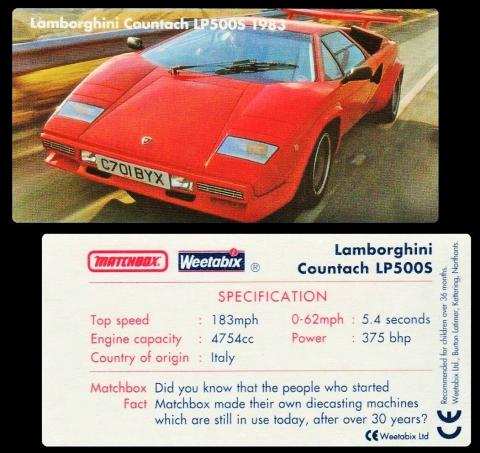
WEETABIX Ltd [trade : cereals : UK] "Car Facts Cards" / "Matchbox Sports Cars" / "Performance Cars" (1994) Un/12
Today in 1916 saw the birth of Ferruccio Lamborghini. Now his parents were grape farmers, which almost certainly accounts for the fact that his first business, Lamborghini Trattori, actually made tractors.
Before that, he worked on the vineyard, and started helping out with the machinery. That piqued his interest and he went to a technical institute in Bologna. But in 1940 he was drafted. In one way his skills were useful, as they got him a posting with the Italian Air Force, where he was a mechanic, in Rhodes, rising to become the supervisor of the whole unit. In 1943, Rhodes was captured, by the Germans, and most of his unit were rounded up. He got away that time, but later managed to go back to the workplace and convince them he was just a worker, not part of the forces, and they let him stay on. However, once the British forces took over Rhodes, in 1945 he was arrested, for collaboration, which is a very grey area, for technically it is true, he had worked, willingly, at a factory for the Germans, but in most ways is not true. Anyway he was not allowed to leave Rhodes right until 1946.
In that year he married, a girl he had met in Rhodes, but she died in childbirth in 1947. The following year he married again, to a teacher. In 1948, he opened a garage, bought an old Fiat and converted it into a two seater race car, which he actually entered in the famed Mille Miglia race, later in the same year, but he crashed and did not complete the course. And he also started a tractor business, as a sideline, buying a few of the many now surplus military vehicles, many of them British, and using their parts to make tractors. The wheels, and heavy chassis were perfect for farm work, but there was a problem, that their engines were thirsty, and fuel was still rationed and expensive, so he tinkered and made a device which allowed them to be started with petrol, then change to the much cheaper and more readily available diesel.
His love of cars still persisted though, and he used the profits from the tractor sales to buy himself a sports car.
He moved on to making air conditioning equipment in 1959, and then in 1963 started making cars. However in the 1970s he decided to retire, and, dare I say, go back to his roots, buying a country estate in Umbria and making wine. He died, aged seventy-six, in hospital, of the effects of a massive heart attack suffered over a fortnight earlier.
Now I am sure you are wondering why we have three titles for this set - and the truth is that no title appears on the cards. However, on the packets of cereals it shows the cards and says "Plus Free Inside Card Facts Card. 12 to collect". The title of "Matchbox Cars" refers to the fact that you could send away for matchbox model cars, and also that the Matchbox logo appears twice on each card, along with a Matchbox Fact about the company, so its pretty easy to see how that word got associated with the set title. As for "Performance Cars", that also appears on the packet, but in respect of the models, because it says "Free Matchbox Performance Cars from Weetabix", and its also the biggest wording on the cereal box advert, so that phrase seems to have become connected with the cards as well.
The twelve cars are
- Alfa Romeo S2 1990
- BMW 535i 1988
- BMW 850i 1992
- Ferrari F40 1988
- Ferrari Testarossa 1984
- Ford RS200 1980
- Jaguar XJ-220 1992
- Lamborghini Countach LP5005 1983
- Mercedes Benz 500 SL 1989
- Porsche 944 Turbo 1987
- Porsche 959 1987
- Thunderbird Turbo Coupe 1987
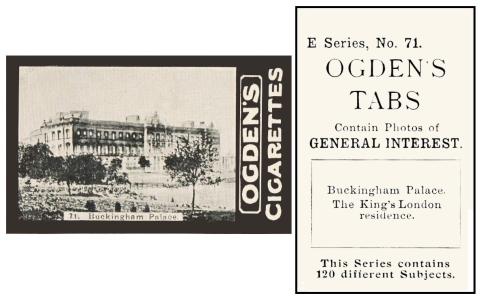
OGDEN`S Ltd [tobacco : London & Liverpool] "Tabs - General Interest - Series E" (1902) 71/120 - O/2-34.5 : O/93 [RB.15/93]
Today in 1993 it was announced that Buckingham palace was going to open its doors to tourists, for the first time since it was built. The reason for that was the disastrous fire which raged through Windsor Castle on the 20th of November 1992, destroying a hundred and fifteen rooms - and which needed to be rebuilt, hence the need for extra funds.
Buckingham Palace is a building of many parts. It started with the bit in the middle, which was built in 1703 on the site of another house. In 1761 that new build was bought by George II for Queen Charlotte to move into. Somehow, and we do not know how, in the early 1790s, it became known as Buckingham Palace.
If we move ahead, the work raising the small service wings to the same height as the main house, and making a unified front, was done by John Nash and Edward Blore. And in 1837, Queen Victoria moved in, which is the first time it became the official residence of the Royal Family. There are only two architectural features to have been added since - the balcony, and East Front, in 1913, purely to bring the family closer to their subjects - and the King`s Art Gallery, which was on the site of the former chapel, destroyed in 1940 by a German bomb.
As for the opening of the doors to the general public, that did not take place until later in the year, when the Royal Family was not at home. The first day of opening was on August the 7th, 1993, and entry cost £8. There were rears that this was too expensive, but it was an immediate success, with the gift shop almost selling out, and queues right around the block.Today you have to prebook, for that reason. Most of the reason for this was novelty, but although it had been stated that the palace would open every Autumn for five years, it was well known that the purpose of the opening was to raise funds to rebuild Windsor Castle, and it was felt that it might only take a single year. Later this was revised, and it was to be for a period of five years, then that was revised too, and it continues to open, during the Autumn, when the Royal Family are not in residence, to this day - but the tickets now cost £43.20.
Now I cannot lie, I struggle with the identification of the Tabs and Guinea Golds, but one day I will sort them all out.
I did find our set listed in our original Ogdens reference book, as :
- 93. 120. E series. Numbered on fronts and backs. Backs inscribed "Ogden`s Tabs contain Photos of General Interest", with descriptive text and "This Series contains 120 different Subjects". There are two printings, with very distinctive differences in caption lettering :
(a) letters closely spaced
(b) letters widely spaced
There are slight differences in some of the portraits, and in the placing of the caption panel as between the two printings.
And that helped me find it in the original World Tobacco Issues Index, as :
- GENERAL INTEREST. Sm. 60-63 x 37-39. The numbered series. See RB.15/89-94 ... O/2-34
5. "E Series". Printed back (120)
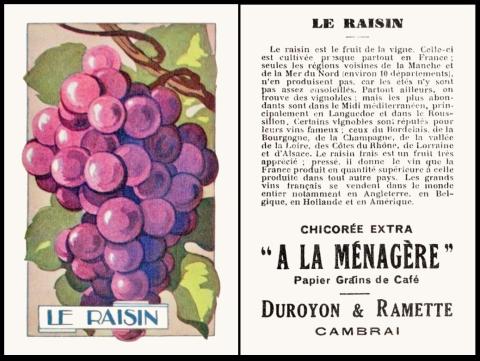
DUROYON & Ramette [trade : chicory coffee : O/S - Cambrai, France] (1920s?) Un/ ?
Almost at an end now, time for a drink, and that is a neat link to #NationalRaisinDay, which is today.
You see a raisin is a grape, by another name, also, as shown here, in France, by the same name. But to us in the British Isles, a raisin is a grape, but only after it has been dried. And, even stranger, a sultana is a grape, but only after it has been dried - and a currant, guess what, is also is a grape, but only after it has been dried
Confused? Well they were indeed, at one time, all grapes, but of different sorts - a raisin was a dark coloured grape - a sultana was a dark yellow grape - and a currant was from a black grape.
You do have to be careful with the Muscat raisins as they may look larger, and they are sweeter, but they can contain seeds, so avoid those if you have tooth trouble.
The only other one you have to be a bit careful of is the sultana, as it is cheaper to treat them with sulfur dioxide to wither them than it is to dry them, so that is why some are cheap and some are more expensive. But you can also tell this with the colour, as the sulfur dioxide makes them much more yellow.
And I close with a warning, as raisins, sultanas, and currants are toxic to cats and dogs, as are the grapes they once were.
To cards, you will mostly find raisins being advertised on cereal cards, for instance Kellogg`s, and others`, Raisin Bran. They also feature in sets lke Topps "Wacky Packages". Our set is very attractive but hard to track down. However I do know of
- La Figue
- La Grenade
- La Groseille
- La Mandarine
- Le Raisin
and if anyone knows any more names do please send them along.
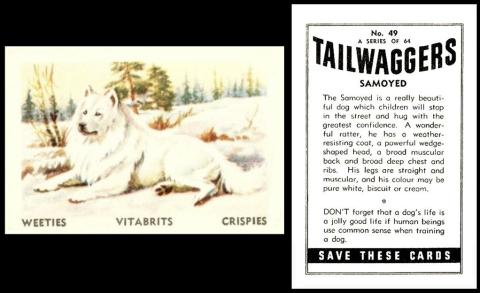
CEREAL Foods [trade : breakfast cereal : O/S : Australia] "Tailwaggers" (1958) 49/64 - CE2-35.C
And so we end with #SamoyedDay, in tribute to these magnificent monotone canines. They come from Siberia, hence the lightness in colour and thickness, for warmth, of their fur, and they are named after the people who live in almost the same place, the Samoyeds, which is a name given them by Russia. At one time those people spread over an extensive area, but now they are not so many, and the people who speak the native language has dwindled too.
The first time they hit the news was when they were used on several Polar Expeditions. Sadly many died on the journey to the Pole, and the few that survived were often abandoned, or killed. Some were sent off to zoos, but they had to survive the long periods of quarantine, which few did.
However, that few, which somehow did, led to the popularity of the breed on two continents, as the first dog brought to England, Sabarka, was given to London Zoo, and it did bring the breed a lot of interest. Now Sabarka is sometimes called a brown dog, but he was actually light brown, and some are. And we know he had a puppy, who was darker still, called "Peter the Great", who was born in 1897 and went on to win several dog shows. But that must have been before Sabarka was entombed in London Zoo, maybe for just being a dog, and a bit too wilful, as male dogs do tend to be.
Another dog had even more luck, for he was found languishing boredly in Sydney Zoo, and rescued by Mr. & Mrs. Kilburn Scott. He was rechristened "Antarctic Buck", because he had actually been on that continent, with Carsten Borchgrevink in 1899 and 1900 - and he obviously made up for lost time because he went on to sire a great many puppies, and is cited as one of the major foundation dogs for the breed.
Strangely, their first appearance on a cigarette card seems to have been number 15 of Moustafa`s "Leo Chamber`s Dogs Heads", issued in 1924, and we base the idea of this being their "rookie" card on the fact that the name of the breed is spelt wrong, as "Samoyedes", not just on the front but three times on the reverse. The text tells us that they are "..both intelligent and beautiful, hailing from North-East Siberia. The male Samoyede should stand 19-22 inches to the top of shoulder and weight 45-48 lb."
Now that seems to be a breed standard wording, so I looked it up. It turns out that breed standards were not set in England until 1909, a few years after the American Kennel Club had admitted `Moustan of Argenteau` to their books, that coming in 1906. Nevertheless, there are many who think the first Samoyed in England was simply not recognised as such; he was presented to the Prince of Wales (later Edward VII) in 1866 by Otto von Bismarck, the German Chancellor, having acquired him in Russia, and this is given a lot of credence by the fact that Queen Alexandra would go on to breed what to our eyes are definitely Samoyeds, though they were known then as "Russian Dogs". And we also know that in 1920 `The Samoyed Club` joined forces with `The Ladies` Samoyed Association`, which then welcomed members of the `Siberian Club` in 1930. Sadly the breed has never won Best in Show at Crufts, though one did make the final, in 2019, from the Pastoral Group. The winner that year was a Papillon.
Anyway, I have now had a better look, and I think there may be a Samoyed, hiding in plain sight on card 15 of John Player`s Polar Exploration, first series, there are definitely two brown dogs and two white ones. But I don`t have that card, I saw it online.
This card is rather interesting too, for it seems to be listed several times in our original Australian and New Zealand Index, under Cereal Foods, section two, cards without name of firm. Now the first one I found says "Favourite Dogs, 63 x 39. Nd. (32). Three front wordings. Issued 1949. A. "Crispies - Vita-Brits" B. "Crispies - Vita-Brits - Kornies" C. "Weeties - Vita-Brits - Crispies", That seemed to fit, but not the title or the number in the set. Then I found another possible, which was "Weeties Tailwaggers Dog Cards, 96 x 67. Nd. (48). Front and back "Weeties". Issued 1960." Our card says "Weeties", but not on the back, and there are other brands of cereal on the front too, so I looked again, and found this one :
- Tailwaggers. 74 x 48. Nd. (64).Three front wordings. Issued 1958. ... C82-35
A. "Crispies - Vita-Brits"
B. "Crispies - Vita-Brits - Kornies"
C. "Weeties - Vita-Brits - Crispies"
so what that means is that will be a lot more dog cards popping up in the future!
This week's Cards of the Day...
saw us starting by getting the kettle brewing for a lovely, and well earned cup of tea - then we can have a chat about International Tea Day, which I tried to bring you once before, on the wrong date. But fear not, for with the addition of a bit of lemon, and a trip to the refrigerator, you can see how I coped with turning a disaster into a fairly reasonable week by going to our newsletter of the 27th of May, 2023
Saturday, 18th April 2026
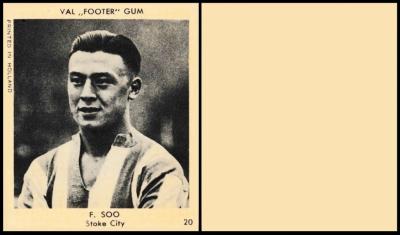
Our week began with this man, Frank Soo, who was the first Chinese footballer in the English Football League. It seemed fitting that we did so, not because his is a tale that much deserves the telling, but because China gives us the birthplace of tea, and also its biggest producer - and it was Chinese scholar, Chen Entian, who set up the International Tea Day, in 2019, with the first coming in 2020. Though research proves a form of International Tea Day had been celebrated in Asia and Africa since 2005, albeit in December.
Frank Soo was the son of a Chinese sailor and an English girl. They had married in 1908, in Manchester, and relocated to Fairfield, near Buxton, a short while later, with their son, Norman, where they opened a laundry. Frank was born on the 8th of March, 1914, and when he was six they moved to Liverpool. There the family expanded, ending up with seven children. Frank had a liking for football, and played for three of the local teams, Norwood, West Derby Boys Club, and West Derby proper. There he was spotted, and offered a trial by both Everton and Liverpool but he turned them down and got a proper job, as a clerk, to help support his family. This may have been at British Insulated Cables, in Prescot, as he started playing with kind of their works team, The "Cables", in 1932, when he was eighteen. His play was such that a scout came down to watch from Stoke City, and seems to have convinced him that he could support his family and still play football, because he signed for them in January 1933. He had to wait a while for his first match, right until November of that year, against Middlesborough, but that was a pretty important match, even though Stoke lost, by six goals to one, as it brings him the honour of being the first player of Chinese parentage to ever play for the British Football League.
By the mid 1930s he was playing for the reserves, and scoring most of their goals. He was also sidelined through injury, after he broke his leg in 1935, during pre-season training. And he started a relationship with the owner of a hairdressing salon, whom he had met when she asked for his autograph; this led to marriage, in 1938, and is probably why he turned down the offer of moving to Brentford F.C.
He had plenty of other offers, Stoke City were all set to tour Germany and Poland the following year, and he was also hopeful of getting the nod to play for England.
However, neither the tour nor the England match ever took place, due to the outbreak of the Second World War, though he did play in several unofficial England wartime matches. Perhaps he imagined that this would lead to getting an official game, after the end of the war, but it was never to be. And the war brought other changes too, including the sudden death of his brother, Ronald, whilst serving in the Royal Air Force.
In 1945 Stoke City let him go, whilst he was still serving in the Royal Airforce, and he moved to Leicester City, where he did not play a single match, possibly because he had not yet finished his military service. They sold him, to Luton Town, in July 1946, only two months after he was demobbed, where he stayed for two years, before ending his playing career, in 1950, at Chelmsford City,
In 1949 he had started a second career, as a manager, which he did successfully, and worldwide, starting with teams in Finland, and Italy. It was about this time that his marriage started to show signs of fracture, though they did not officially separate until 1951. Then another shock, for his ex-wife died, and not so long after, through an overdose of barbiturates, in March 1952.. At that time he was in Italy, with Padova, but came back to England.
What raised him from his despair was an offer to coach the Norwegian Olympic football squad, and that brought him back to managing again, starting with a Swedish team called Eskiltuna, and moving to several other teams in the same country, right until 1959, when he was given the chance to come back to England and manage Scunthorpe United. Sadly that only lasted less than a year, and he returned once more to Scandinavia, where he practically saw out the 1960s. There was an offer of going to Hong Kong in the 1970s but it never happened, for various reasons, including the fact that it was to be for no longer than a single year.
The next decade saw him back in Stoke, and I have no idea what he was doing, until he is reported as having died, of dementia, on the 25th of January 1991.
Some time later, his importance seems to have been realised, and in 2016 he was immortalised with a Foundation which aims to promote the story of his life, and encourage more Chinese and Asian footballers into the game. He was also added to the Stoke-on-Trent Sporting Hall of Fame in November 2023 and the National Football Museums Hall of Fame the following year. And in 2025, after much lobbying, his participation in those so called "unofficial" wartime England matches led to his being posthumously presented with an honorary England cap.
Sadly, he appears on relatively few cards.
His "rookie" card is the 1934 double-sided set of "Run for the Cup", which is a kind of game, issued with D.C. Thomson`s "Adventure" magazine, starting on Monday March the 5th. He was not in that batch though, only the first thirteen cards being included. Two years later saw him in colour for the first time, on the "Topical Times" long card set of "Footballers". And two years after that comes his cartophilic claim to fame, his only cigarette card, number 41 of Churchman`s "Association Footballers", which is also the first to have a descriptive text on the reverse, namely :
For five years, Frank Soo has been one of the most consistent and valuable members of the Stoke City team, being one of those players of whom it is said that they never let their side down. Born at Buxton, he played as a youth with Prescot Cables. He soon gained a place in the Stoke side, making his first appearance in November 1933, on the same day as Tutin. At this time, however, Soo was a forward. He displayed clever craft in this position, but later became a wing half and, with the knowledge of the support a forward requires, he has been very successful. Strong in tackling, he is also a tireless worker throughout the whole game.
Our card was issued the following year, in Holland. It came in a wrapper titled as "VAL "FOOTER" Chewing Gum, and there seems to be an English connection which I am still investigating - suffice to say that the wrapper says "VAL CHEWING GUM MADE IN ENGLAND", and that there is a redemption scheme in which if you collected a whole set you could exchange them for free footballs or table tennis sets, the submission address being "VAL 19, Bridge Street, Manchester 3".
The tale of tea begins in China, too. It is where the plant that gives us tea originated and where, probably unsurprisingly, the drink was first mentioned in a written text. However, at first, it was consumed for its health benefits, and not because it tasted great; the first record of it being drunk for pleasure was in the 3rd century A.D. It spread to Europe by way of Portuguese traders in the sixteenth century, and then slowly, to the British Isles. And the British East India Company is supposed to have taken it to India.
Sunday, 19th April 2026
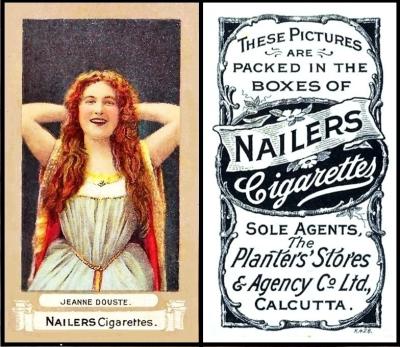
This amazing card gave us the second most prolific tea-producing country, India, the bulk of whose tea is grown by and for Brooke Bond, who launched their "Red Label" brand in India in 1903. However the card also gave us "Planter`s" - a planter being the proper name for a person who owns, or manages, a tea estate And, even more than that, the card was originally issued in India, in Calcutta, which today, renamed Kolkata, is the tea capital of the entire country - as well as the site of the first ever tea auction to be held in India, on the 27th December 1861.
To continue our tea tale, there is conflict about how I ended yesterday. We know that in order to attempt to break the Chinese monopoly on tea, the British East India Company took some seeds, from the same plant that grew Chinese tea, and grew them in India. How they grew them was with a bit of a bribe, because they offered free land in Assam to any European who agreed to grow the seeds on it - and they would provide the seeds and all the advice they could (which they also copied from the Chinese). This seems to have worked, to a fashion, because only the Europeans drank it, it never gained popular acceptance with the Indians until the 1950s. The truth behind that, though, is that the Indians had their own sort of tea, from a totally different plant, the Sanjeevani, which they had been happily consuming for many centuries, and which also has health benefits. In fact a version of it, now long lost, is quoted in the Ramayana, as having brought Lakshmana back to life after she has died of her injuries.
India was once the top tea producing country in the world, but China crept back in front. This seems to be because most of the production is used within the country, rather than being exported.
Now the lady on our card today may not be known to any of our current readers, but she is not only an actress, as you may believe. Her full name was Jeanne Douste de Fortis, and she was born on the fourth of December, 1872, in London, her name coming from the fact that both her parents were French. Her childhood was unremarkable until one day, when she was about four years old, and she started to play the piano, very well, without any knowledge of music. That brought her to the attention of a lot of people, and soon she was appearing in concerts all over London. When she was only five she was asked to go to Buckingham Palace and play for the Queen, who presented her with a golden pearl cross.
At the age of seven, she toured America, with her older sister, Louise, who had been born in 1864; then they toured Europe, for a long time. She also appeared in "Hansel and Gretel", as Gretel, at the Gaiety Theatre in 1895. And it looks like this costume possibly comes from "The Gay Pretenders", a stage production, from 1900, in which she played Lady Katherine Gordon.
Her showbusiness life only seemed to stop in 1901, when she got married, to a singer, Eduoard Garceau.
The only other thing I have been able to find out is that in 1935 he wrote a book about his wife and her sister, called "The Little Doustes".
And that Jeanne Douste died on the 12th of July 1968
This card is quite a rarity, and it is the first time that I have ever used a card from any of the FROGA series as a Card of the Day, (and now, after typing what follows, I know why !). However as I go back further through the newsletters, I will definitely be hunting for a card which could be replaced with the Faulkner version of this set which provides the initial letter, F, of FROGA. But until that time this version will be pressed into service as the home page for what is quite a fascinating and widely issued set of cards.
Our version of the set is listed in our original World Tobacco Issues Index as :
The PLANTER`S Stores and Agency Co. Ltd., Calcutta, India
Cards indicate the firm was agent for "Nailers Cigarettes". Issued about 1900-3
- ACTRESSES - "FROGA" (A). Sm. 70 x 38. Unnd. (36 known). See H.20 and Ha.20 ... P68-1
Their only other issue of our company was another set issued by many companies in many different places, and that is known as Actresses FECKSA, but you can read more about that with our Card of the Day for the 8th of January, 2026
The handbooks, to which the H. numbers refer, were produced by the two leading cartophilists of the time, Charles Lane Bagnall of the London Cigarette Card Company, who published them, uniform with the company catalogue, and Edward Wharton-Tigar of the Cartophilic Society. H.20 refers to the first volume, covering cards from 1888 to 1919, in which all four series of this set are catalogued. However as it is a really lengthy list, and our issuer only issued sections A and B, I shall confine this listing to just those first two sections as :
H.20. ACTRESSES - "FROGA" (adopted title). Code letters taken from Faulkner, Richmond-Cavendish, Ogden, Goodbody, Archer. Fronts per Fig.20, in colour or unicoloured. Unnumbered series.
There are FOUR different series, all basically similar in style to the card illustrated in Fig.20; in some cases the lower scroll is missing, or is replaced by a plain oblong. The Ogden miniature playing card issue bears the portraits shortened and reduced, and there is no scroll. Some actors occur in Groups C and D.
The original series of 26 subjects (Group A) has previously been listed as "Eminent Actresses" (as titled in the Goodbody issue). Two of the Groups (B and C) have previously been recorded together as a Series of 50 - as will be seen from the detail given, some firms did in fact issue cards from both B and C as one series, but other firms seem only to have used cards in one or the other. There are other instances where firms have made up series from two of the Groups, and in all cases where doubt exists as to the make-up of the series full detail is given of the cards seen.
GROUP A - ACTRESSES - SERIES OF 26
pre-1919
Anonymous - Unicoloured, plain back. Nos. 1-26 Archer - Coloured. Two series, both made up from cards in Groups A and B :- 1. "M.F.H." back - Group A : No.4 seen. Group B : Nos. 1, 8, 11, 12, 18-20, 23, 24, and 26 seen 2. "Golden Returns" back - Group A : Nos. 17-19 and 22 seen. Group B : Nos.2-7.a, 9, 10, 13-17, 22, and 25 seen Biggs - Coloured, "Two Roses" in white on front. Nos. 1-26 Cadle - Unicoloured, "Sweet Lips" back. Nos. 1-26 Churchman - Coloured, "Ask for and Smoke ... " back. Nos. 1-26 Cohen Weenen - Unicoloured, "Houseboat" back. Nos. 1-26 Cope - Unicoloured, black scroll back. Nos. 1-26 Faulkner - Coloured, "Golden Whiffs" back. Nos. 1-26 Goodbody - Coloured, titled "Eminent Actresses" on back. Nos. 1-26 Hignett - Coloured, "Golden Butterfly" back. Nos. 1-26 Hill - Coloured, "For a Delightful Smoke..." back. Nos. 1-26 Hudden - Coloured, "Hudden & Co. Ltd." back. Nos. 1-26 L. & Y Tobacco Co. - Coloured, "Smoke Bull Dog Flake" back. No.21 seen. Morris - Unicoloured :- 1. "Borneo Queen" back. All seen except Nos. 20 and 26. 2. "Gold Seals" back. Nos. 2-12, 17, 21, 23, and 25 seen. 3. "Morris`s Cigarettes" back. Nos. 5, 6, 9, 11, 15, 16, 18, 20, and 26 seen 4. "Tommy Atkins" back. Nos. 1, 7, and 12-16 seen Muratti - Coloured : - 1. Small cards, "To the Cigarette Connoisseur" back. Nos. 1-26 2. Small cards, "Zinnia" back. Nos. 1-26 3. Cabinet size, brown and yellow ornamental framework, "Neb-Ka" back. Nos. 1,5,6,9, 11-13, 15-18, 20, 22, 23, 25, and 26 seen. Ogden 1. Unicoloured, dominoes on reverse side :- (a) Domino with corners mitred. Nos. 8, 13, 15, 17, 22, 23 and 25 only (b) Domino with plain corners. Nos. 2, 3, 9, 16, 18, 20, and 16 only. In both cases the seven portraits are found each with several different domino values 2. Coloured, miniature playing cards on reverse side (Numeral 46). Nos. 1-26. Quinton - Coloured, "Quinton`s High Class...." back. Nos. 7, 9, 15, 17, and 24 seen. Richmond Cavendish - Coloured, "Pioneer" back. Nos. 1-26 Roberts - Coloured, "H.A.C." back. Nos. 7, 9, 13, 17, 19, and 20 seen Trade :
Ellis Davis (tea) - Coloured, rubber stamp back. One card seen Dunn (hats) - Coloured, "Messrs. J. A. Dunn & Co." back. Nos. 3 and 25 seen overseas
Chas. J. Mitchell, Toronto Canada - Coloured - A. Brown back, "Sole Export Agents, The Imperial Cigarette and Tobacco Co., Canada. Nos. 19 and 20 seen. B. Green back, "Sole Export Agents..." 12 brands listed. Nos. 7, 19-21, 23-26 seen Planter`s Stores, Calcutta India - Coloured, "Nailers Cigarettes" back. No. 15 seen (See Group B)
- Esme Beringer
- Miss Cynthia Brooke (full face)
- Miss Constance Collier (hands in hair)
- Miss Fortescue (short hair)
- Violet Friend
- Miss Hetty Hamer
- Annie Hughes
- Agnes Huntington
- Miss Ellis Jeffreys
- Miss Winifred Johnson
- Miss Kelly
- Miss R. Kennedy
- Flo Levey
- Miss Florence Levey
- Millie Lindon (gazing upwards)
- Millie Lindon (hands in front)
- Millie Lindon (fan at back)
- Millie Lindon (mantilla)
- Miss May Palfrey (flower on hat)
- Ida Rene (hand to shoulder)
- Ide Rene (with hat)
- Miss Sedohr Rhodes
- Miss St. Cyr
- Miss Sylvester
- Miss Blanche Vaudon
- Miss Keith Wakeman
GROUP B - ACTRESSES - SERIES OF 26
pre-1919
Archer - Coloured. "M.F.H." and "Golden Returns" back (see Group A) Biggs - Coloured. "Two Roses" in black on front. Nos. 5-7.a, 8, 9, 13, 14, 19, 21, and 25 seen. Cadle - Coloured, "Straight Cut" back. Nos. 1, 3, 4, 7.a, 8, 10-15, 17-22, and 25 seen Churchman - Coloured, "For the Pipe..." back. Nos. 1, 2, 5, 7.a, 8, 15, 17, and 25 seen Mitchell - 1. Coloured scroll oblong at base of front. Series made up from cards in Groups B and C :- Group B - Nos. 1-7.a, 8-12, 14-18, 20-22, and 24-26 seen. Group C - Nos.1-25 seen - 2. Unicoloured, plain oblong at base of front, Nos. 1-4, 6, 7.a, 8-13, 15-17, and 19-26 seen Morris - Coloured large cards, "Smoke Morris`s High Class Cigarettes" on front. Nos. 5, 17, 19 and 26 seen. Ogden - Coloured, minature playing cards (no numeral). All seen (including No.7.b, not 7.a). Captions differ from other issuers at Nos. 1, 4, 7.b, 23, and 24. Ogden captions appear in quotation marks, in parenthesis, in the listing. Group B - Nos. 1-3, 5-7.a, 8-10, 13-22, 24, and 26 seen. Group C - Nos. 1-25 seen Pritchard & Burton - Coloured, "Smoke Pritchard & Burton`s Cigarettes" back. Series made up from cards in Groups B and C : - Trade
Edmondson (confectionery) - Unicoloured, "Ask for Edmondson`s..." back. Nos. 16, 19, 22, and 23 seen. Overseas
Chas. J. Mitchell, Toronto Canada - Coloured, with Playing Card inset. "Chas J. Mitchell& Co. Sole Agents, The Imperial Cigarette & Tobacco Co., Canada" back. Nos. 20 (2 Hearts), 21 (K Clubs), 22, (7 Clubs) and 23 (2 Spades) seen. Planters Stores, Calcutta, India - Coloured, "Nailers Cigarettes" back. Series made up from cards in Groups A and B ; - Group A - No. 15 seen Group B - All seen, including 7.a, NOT 7.b)
- Madame Albani ["Albani"]
- Dorothea Baird
Miss Cynthia Brooke (see 7.b)- Clara Butt
- Madame Calve [Calve]
- Mrs. Patrick Campbell
- Cavania
- (a) Constance Collier (side face)
(b) Miss Cynthia Brooke ["Cynthia Brooke"]- Constance Collier (full face)
- Kate Cutler
- Jeanne Douste
- Miss Elton
- Lettice Fairfax (half length)
- Lettice Fairfax (three quarter length)
- Helen Ferrers
- Miss Fortescue
- Evie Greene
- Lilly Hanbury
- Millie Legarde
- Eveline Millard
- Nordica
- Miss Palfrey
- Ida Rene (pendant necklace)
- Kate Rocke ["Kate Rorke"]
- Mrs. E. Terriss ["Ellaline Terriss"]
- Mrs. Tree
- Violet Vanbrugh
NOTE : Card 7.a is an error, for Cynthia Brooke.
Now some of this was corrected quite quickly, and in the accompanying handbook for card issues from 1920 to 1940, issued just four years later in 1954, the following update appears :
Ha.20. ACTRESSES "FROGA"
GROUP A
Anonymous, plain back - This printing is found (A) Unicoloured (B) Coloured Archer - 1. "M.F.H." back. Nos. 1 and 10 in Group A seen. Chas. J. Mitchell, Toronto - Both printings (A) and (B) consist of Nos. 1-26. GROUP B
Biggs - "Two Roses" in black on front. No.21 seen, with caption "Miss May Palfrey" Pritchard & Burton - Series believed to consist of 50 subjects - Nos. 1-3, 5-7.a, 8-26 in Group A, Nos. 1-25 in Group B Chas. J. Mitchell, Toronto - The detail under H.20 is incorrect, as fronts do not have Playing Card insets, but backs have playing cards in centre. Series believed to consist of Nos. 1-26 (excluding No.7.b), each front being found with each of two playing card values on back. Planter`s Stores, Calcutta - Following now seen in Group A : Nos. 4, 6, 12, 15, 17, 20-22, 25 and 26.
By the time of our updated World Tobacco Issues Index, there has been a bit of a change, more cards having been discovered, for it is recorded as :
The PLANTER`S Stores and Agency Co. Ltd., Calcutta, India
Cards indicate the firm was agent for "Nailers Cigarettes". Issued about 1900-3
- ACTRESSES - "FROGA" (A). Sm. 70 x 38. Unnd. (47 known). See H.20 and Ha.20 ... P628-100
Now these sets also appear in the modern handbook, but there is not time to add that tonight. But hopefully I will find some time to do so by the weekend....
.
Monday, 20th April 2026
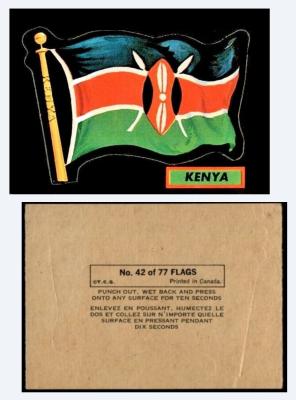
Our last clue card gave us the third most prolific tea producing country, Kenya.Their tea is very different, darker, and much stronger, because the plants are grown at a higher altitude, where the soil is composed of spent lava and ash. And it is usually taken as a breakfast drink in Great Britain, to wake you up.
Tea was first introduced at Limuru, Kenya in 1903, but it was not grown commercially until 1924, when Brooke Bond, again, sent a man out there to set up tea growing estates. His name was Malcolm Fyers Bell, but that is all I can find out about him. However, there may be one of our readers, into Brooke Bond, who can enlighten me a bit more.
Anyway, well done if you guessed that this was the Canadian O-Pee-Chee version of this set from the outset, and not just after we showed the reverse. Though even then you had to hunt for it, for the reverse starts by saying the number of the card, the total number in the set, and then has the copyright symbol and "T.C.G.", for Topps Chewing Gum; it is only after this that "Printed in Canada" pops up. Though the rest of the text, outside the box, is a bit of a giveaway, as it is bi-lingual, in French and English, whereas the Topps cards only had the square panel on the back, but saying "Printed in U.S.A" with the instructions just two lines of small text immediately below that panel.
This Canadian version is much scarcer here in the British Isles, mainly because we had a set of identical cards, issued by A & B.C. Gum, in 1971, though they had blank backs, with the instruction panel printed on the front. You can see one of those as our Card of the Day for the 18th of July, 2023. In fact, both the Canadian and British sets were originally produced by the American company, Topps, and then licensed to overseas.
The Canadian packets tell us this was a true trade set, with "one stick bubble gum" - and, just like in the A.& B.C. version, they had "extra inside - foreign style money".
Tuesday, 21st April 2026
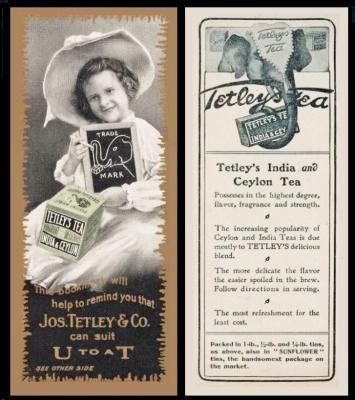
Today we are going to look at the fourth largest tea producer, but the third largest tea exporter, in the world, which is Ceylon/Sri Lanka. Though they are a relative newcomer, tea only arriving in the country in 1867
Like Kenya, their tea tends to be dark and strong, but Kenya seems to market theirs better, and is slowly taking over the lion`s share of sales. Strange then that if you want to buy Sri Lankan tea, you need to look for the Lion; this is a logo, owned by the Sri Lanka Tea Board, which means the contents are pure tea, meeting regulated standards, and entirely picked and packed within Sri Lanka.
To its credit, Sri Lanka is trying to turn this around, with better advertising and also in sponsoring sporting events, as well as their men`s and women`s cricket teams. And in 1995 it exported more tea than any other country, however the next quarter of a century saw them dropping back in the ratings table.
Our card for today comes from Tetley, which at one time was owned by two Yorkshire brothers, Joseph and Edward Tetley, though it was only ever called "Joseph Tetley", and they added the "& Co" in 1837. In 1856 they moved to London. Then there was a falling out, and the brothers split up. In 1871, Joseph Tetley again took on a partner, his son Joseph Tetley junior, and he took over on the death of his father in 1889.
Whilst researching this we were told that they were the first company to sell tea in teabags. This is not strictly true, as the invention of the tea bag was an accident, or rather a misunderstanding, in 1908, when a man called Thomas Sullivan sent samples of tea out to his prospective customers in silk bags, but with no instructions as to the fact that the user had to remove the tea from the bags. This mistake led to a brief flurry in the popularity of using tea in bags, but it died out. However it does seem to have been Tetley who brought the custom back, in 1953 - and we also discovered that Tetley invented the round teabag, in 1989.
By that time, they had been sold, to J. Lyons & Co; that happened in 1973. Then, after several changes of name and ownership, they became part of the giant Indian company Tata.
Our bookmark card makes no appearance in our original British Trade Index parts one or two, in fact Tetley only appears for the first time in part two. In part three, published in 1986, however, it suddenly pops up, as :
TETLEY Tea - TET in II
1. Issues about the 1900s.
- Book Mark. 147 x 60. Old lady drinking tea, caption "Old Friends are Best" ... TET-0.5
Now we need to explain that curious card code. The problem is hinted at by the first line of that entry, the "TET in II", because that means that Tetley have an entry in British Trade Index part two, which they do, a set of die cut "Tetley Tea Party" models, issued in the 1950s. But at that time it was the only set known, so it got the card code of TET-1. Then along came our bookmark cards, which dated from half a century earlier and therefore needed to go in front. Online, you can just do a bit of tweaking, but in a book that`s not so simple, hence our bookmark cards got coded as TET-0.5.
As the the bookmark card we show today, well that must have turned up in the forty years between that work, and the revised British Trade Index, published in the year 2000, in which it is catalogued as :
TETLEY Tea
Issued in 1900 - 1970
- ADVERTISEMENT CARDS (A). 1900s, 147 x 60, bookmarks. ... TET-030
1. Old woman drinking tea, `Old Friends are Best`
2. Girl in hat holding slate, green pack of tea on her lap.
In actual fact, I am told by a reader that there are actually three bookmarks, the third being another small girl - but they doubt that the old lady is part of the same set.. Their reasoning, and I agree, now I have seen their cards, is because of two reasons. Firstly, the frame on the old lady is straight, whilst the frame on the two girls is an inverted comb shape, jagged into the picture, on the picture side. Secondly, the wording below the picture is different, the old lady reading "Old friends are best TETLEY`S TEAS Stand the test of time always satisfactory (BOOK MARK)", whilst the two girls both read "This bookmark will help to remind you that JOS. TETLEY & CO. can suit U TO A T. SEE OTHER SIDE."
We also know that there are two different backs. Back one is ours, which is also found on the card of the old lady, but not on the other girl. Back two is found on both the girls but not the old lady, yet, and it has a picture of a box of tea near the top, which I will add as soon as the scan arrives.
Wednesday, 22nd April 2026
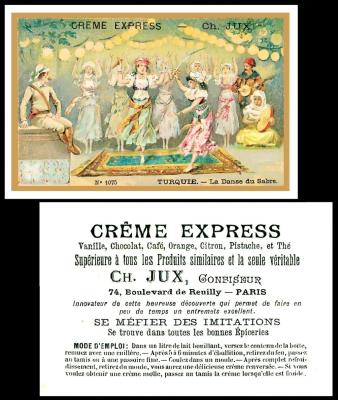
Now you might be wondering about this card, but it turns out that despite the popularity of Turkish coffee, tea is pretty big in Turkey, as well as their part of Cyprus - and the country drinks more tea per head than anywhere else on the globe. Even odder is that they also manage to make enough tea to be the fifth largest exporter to other countries as well.
It all began late though, towards the end of the nineteenth century, when Russia introduced tea to the Turkish to expand their own customer base. Russia had got their tea from China, as little plants, and they had prospered, so the Russians did what we today call a taste test, picking a town, Bursa, and sending them a few seedlings. It was pretty unsuccessful though, as the area was very unsuitable - which suggests that the Russians had perhaps merely stuck a pin in a map rather than travelling to Turkey. Although we do know that the Bursa area was well known to the Chinese, who used to buy and sell silk there, so maybe that was part of the reason for the selection.
More recently things have not been going so well though. Global warming is quite severely affecting Turkey and making it much hotter and wetter, and these are both fatal to tea plants, they cannot abide direct sunlight, and if the roots get too wet they just wither away. All the countries we have mentioned so far are in the same position. However, of them all, Turkey is the one which is spending lots of effort in combating the problem, including importing other varieties of tea plants from hotter areas.
Here we have another set from the mysterious Chocolate Jux. And it was chosen because unlike the other two sets we have featured before ("En L`An 2000", our Card of the Day for the 11th of April, 2025, and "La Vie du Soldat" which appeared on Thursday the 11th of September in our newsletter of the 6th of September, 2025), our card today actually adds a new item to their top line menu "et The" which means and tea. At least that is what I thought originally, but now I`m not so sure, because if you look at those other two cards, without the mention of the tea, they could well be later. For one thing, they both call Monsieur Jux a "Confiseur - Chocolatier", which mean confectioner and chocolate maker, whilst our card only has the first word. They both also mention "Usine a Vapeur", which means steam power, and also an award, "Medaille d`Argent, Exposition Universelle 1900". That all makes me think today`s card is earlier, before the 1900 Exhibition.
There is also something else rather intriguing, because I started to make a list of the cards, and recognised one, "ECOSSE - La Gigue", and I was right, we showed that card before, our Card of the Day for the 10th of September, 2024 - but it was issued by Liebig, as part of a set called "Danses Nationale", coded F.621, or S.620.
In fact, and I`m really surprised at this, all four of the Jux cards I have tracked down so far are also in that set, and they are :
- ALLEMAGNE - Danse Rustique
- ECOSSE - La Gigue
- FRANCE - Le Cotillon
- TURQUIE - La Danse du Sabre
the missing ones from the Liebig set are
- Italy - La Tarantelle (tarantella)
- Tirol - La Rapide (no idea!)
so does anyone have these in the Jux printing, which would make it a set of six cards, or any different dances in the Jux printing?
Thursday, 23rd April 2026
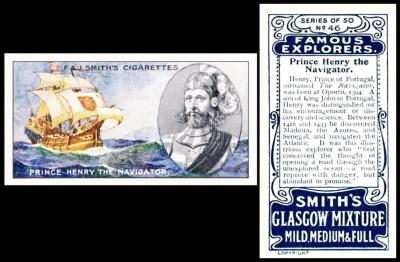
You may be wondering why we have Henry the Navigator, so I will tell you that he discovered The Azores, off Portugal - in fact, it says so on the back of this card.
Now The Azores are nine islands in the Atlantic Ocean, and they have a unique claim to tea fame, as tea was first grown there in the 1820s, using plants, once more, from China. Those plantations are long gone, but Cha Gorreana, which was founded in 1883, is still going strong, making it the oldest tea plantation in Europe.
Something else that is special about the tea from The Azores is that no pesticides are used, because the natural heat and humidity of the islands, along with their volcanic soil, mean that few pests want to live there. Growing in these conditions mean that it can be a bit restricting. and the teas that do best are either black or green, so they are what is known as "robust". However it can be blended successfully, and if you are a fan of Earl Grey it is almost certain that tea from The Azores is in your cup. Also, if you are more of a fan of herbal teas, these are again grown in The Azores, at another factory, but not so far away called Porto Formoso, and that was founded a bit later, in the 1920s, though it did close in the 1980s, only to be discovered and brought back to life by new owners, who have made it into a tourist attraction, complete with a museum.
As for our card, this is another set which we are starting to work on. It currently has a home page in a newsletter, but that is going to change, and I`m not sure how, because the set, like most Smith cards, is vari-backed, with eleven different adverts, but unlike others it only has one possible back per card, in alphabetical order, and card number one, along with cards advertise "Albion" Gold Flake, which is really what I want for the home page, but not in a newsletter and especially not buried at the bottom of one, as it currently is. That might take a lot of wrangling, and so it will be left until I have added all the newsletter cards to the index, at which time I will work through an issuer at a time and find the best card to carry the home page, and adjust if I have to.But to make life easier for readers and researchers the table of backs has been moved across to here as well and it is as follows :
The entry in our original World Tobacco Issues Index reads :
- FAMOUS EXPLORERS. Sm. Nd. (50). Vari-backed, 11 wordings - see C.W. page 268 or N. & N. Vol. 8, page 89 ... S84-7
These two abbreviations lead to magazines, "C.W." being "Cartophilic World", which was our official magazine, and "N. & N." being "Notes and News", which was the name of the magazine belonging to the Cameric Cigarette Card Club. In 1965 both these card collecting communities merged, and it was decided to immortalise both magazines into one, by calling the next edition "Cartophilic Notes and News". Now I only have a few editions of the Cameric Notes and News, but I do have a complete run of "Cartophilic World"s, so I will fetch that edition in a minute.
These magazines were true ephemera, designed to be read but not entirely to be kept forever. They also suffered much from the rusting of the staples. So when the World Tobacco Issues Index was updated, for the Millennium, it was thought to be unlikely that too many collectors would have access to those early magazines. And so this listing reads simply :
- FAMOUS EXPLORERS. Sm. Nd. (50). Vari-backed, 11 wordings. ... S548-180
After writing this I went to "Cartophilic World" and looked. Page 285 is in Volume 3, No.34, dated December 1945, and it is part of a series by Charles Lane Bagnall, which reads :
Smith`s Issues - By C.L.B. (continued from page 264).
FAMOUS EXPLORERS
Series of 50. Issue date approx. October, 1911.Advertisements on backs.
- Albion Gold Flake Cigarettes - see Newsletter for 11 January, 2025 (Friday 17th)
- Albion Gold Flake Cigarettes
- Albion Gold Flake Cigarettes
- Albion Gold Flake Cigarettes
- Albion Gold Flake Cigarettes
- Albion Gold Flake Cigarettes
- Albion Gold Flake Cigarettes
- Albion Gold Flake Cigarettes
- Albion Gold Flake Cigarettes
- Albion Gold Flake Cigarettes
- Glasgow Mixture Cigarettes
- Glasgow Mixture Cigarettes
- Glasgow Mixture Cigarettes
- Glasgow Mixture Cigarettes
- Glasgow Mixture Cigarettes
- Pinewood Cigarettes
- Pinewood Cigarettes
- Pinewood Cigarettes
- Pinewood Cigarettes
- Pinewood Cigarettes
- Pinewood Cigarettes
- Pinewood Cigarettes
- Kashan Cigarettes
- Kashan Cigarettes
- Kashan Cigarettes
- Studio Cigarettes
- Studio Cigarettes
- Studio Cigarettes
- Studio Cigarettes
- Studio Cigarettes
- Studio Cigarettes
- Studio Cigarettes
- Studio Cigarettes
- Studio Cigarettes
- Studio Cigarettes
- Sun Cured Mixture
- Sun Cured Mixture
- Ancestral Mixture
- Luxury Mixture
- Luxury Mixture
- Cut Golden Bar "Twilight"
- Cut Golden Bar "Twilight"
- Orchestral Cigarettes
- Orchestral Cigarettes
- Orchestral Cigarettes
- Glasgow Mixture. Mild, etc
- Glasgow Mixture. Mild, etc
- Glasgow Mixture. Mild, etc
- Glasgow Mixture. Mild, etc
- Glasgow Mixture. Mild, etc
A cursory look through the internet seems to support this list, and point to the fact that this set had one back per card, as listed above. There is an error, for cards 43-45, which ought to read "Orchestra" not Orchestral.
The end of the article says "Will any reader with variations of the above please make a point of reporting them, as the information now published is to form the basis of a reference book." Now this was written in December 1945, and there was, indeed, work done on this book. In fact it was even mentioned at the back of the Lambert & Butler Reference Book, RB.9, which was published in 1948, as part of a "Suggested grouping to complete Part 1 of Programme - British Issuers", section 8 of which reads "Mitchell, Smith". And the reason for teaming the two was that in 1927 the two Glaswegian companies of F. & J. Smith and Stephen Mitchell & Son were combined.
But sadly, this book never came to fruition.
Friday, 24th April 2026
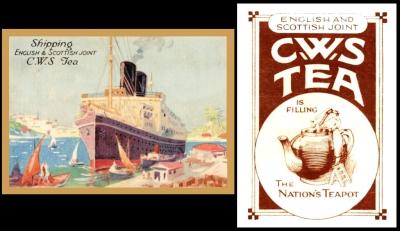
I was going to look for another tea producing country, but a reader sent me a scan of this, and it is a fitting end to the week, as well as a very evocative one of how tea used to, and still does, come by ship, in tea crates, from the docks, from all over the world. So it is probably the most international card we featured all week.
This set does not seem to appear in any of our trade indexes. At first I thought it might be from "Rose of the Orient", but those cards are titled in white boxes on the front of each card, have a different back, and a silver border.
We believe our card today comes from what is a complete set of twelve cards, each measuring 85 x 60 m/m. They are unnumbered, and it is rather an odd set, as it seems to be split into sub series, but all have that same back, of the lady on the ladder filling a teapot of sizwe which could indeed "fill the Nation`s teapot" - and probably several other Nations besides.
The cards are titled as follows, following the journey from the planting to home -
- Tea Planting for ENGLISH AND SCOTTISH JOINT C.W.S ( a man putting a plant in the soil)
- Tea Picking for ENGLISH AND SCOTTISH JOINT C.W.S (three ladies with baskets plucking tea from a bush)
- ENGLISH AND SCOTTISH JOINT C.W.S. Tea Estate (a large building viewed across a brown field of tea bushes)
- ENGLISH AND SCOTTISH JOINT C.W.S. Tea Factory (a red building with palm trees to the left hand side as viewed)
- ENGLISH AND SCOTTISH JOINT C.W.S Tea Blending (a machine with two drums, and two men)
- ENGLISH AND SCOTTISH JOINT C.W.S Tea Packing Machine (a large green machine, no operators)
- ENGLISH AND SCOTTISH JOINT C.W.S Tea Consignment (packing crates at a dock)
- Shipping ENGLISH AND SCOTTISH JOINT C.W.S TEA (a giant ship at the same dock)
- ENGLISH AND SCOTTISH JOINT C.W.S Tea Warehouse, Ordsall Lane, SALFORD and ENGLISH AND SCOTTISH JOINT C.W.S Tea Warehouse, Leman St. LONDON (a double card with two pictures of buildings, one atop the other in vertical format)
- ALWAYS BUY ENGLISH AND SCOTTISH JOINT C.W.S TEA (a scene in a shop with a lady in pink sitting down just off centre)
- ENGLISH AND SCOTTISH JOINT C.W.S Tea in the Home (a family indoors at a table)
that is eleven cards, but there is an odd man out, literally, a caricatured man running with a box of pure Ceylon Tea. He is not like any of the other cards, but he does say CO-OPERATIVE No.11 Ceylon Tea - and he is generally found with groups of these cards