
Lets start by welcoming you all to a new month, and hoping that it MAY be a good one.
I hope that you all managed to get to the Convention, and well done if, like me, you came up Saturday morning, by train, at least as far as Cambridge, when the railway replacement bus was pressed into service. For all that, I loved the journey, through the Fens, past Ely Cathedral, and up into Kings Lynn, though I agree that it was a bit far for a day trip, as I came home that night, just after the AGM.
I also hope that, just like me, you left with something new, or maybe that should be something old, but new to you - I succumbed to several books and booklets, which will be pressed into service with adding to these newsletters, plus a copy of our latest reference book, covering Trade Issues after 1970. It is a really excellent work, and I am sure that you will join me in thanking the editors and compilers for making such a super, and much needed, volume. And you will soon be able to read more about that book on a dedicated page.
website news

Firstly, the Guerin-Boutron checklist for the first 500 cards of "Livre d`Or des Celebrites Contemporaines" is now complete, with our Card of the Day for the 3rd of December 2025. Now whilst doing this, I found some of these cards have a different, vertical, back. The earliest I can find is card 451, so they may have only reissued the last 49 cards - unless you have any vertical cards with earlier numbers?
I didnt do so well with the newsletters, only managing to index four, those for the 6th of January, 2024, 13th of January 2024, 20th of January 2024 and 27th of January 2024. However that does mean that the next newsletter, really excitingly, will be for the 30th of December 2023.
What`s On This Week :
our regular round up reminder of our club and branch events...
- Saturday the 2nd of May - Lincolnshire - from 10.30 a.m. at Kirton Leisure, 31a Willington Road, Kirton, Boston PE21 1EP.
- Thursday the 7th of May - North East - from 6.30 p.m. at Dunston U.T.S., Wellington Road, Dunston, Gateshead, NE11 9JL
Diary Dates :
And now to some other celebrations that are taking place over the next seven days, namely a Premier player, a puckersome pitcher, or two, some perfect pitching, several peckish plants, some polling picks, and a pin planner....
So lets start with...
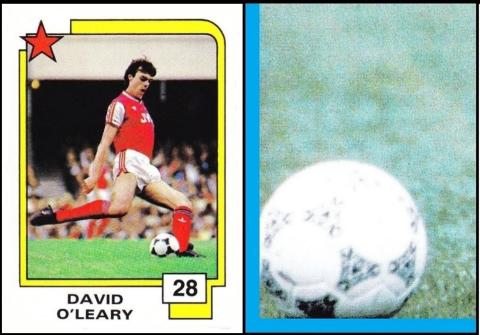
Panini [trade : cards and stickers : O/S - Italy] "Soccer Superstars" - Ruud Gullit sectional reverse (1988) 28/72
We seem to have two Saturday Soccer Stars this week, as our "Premier Player", David Anthony O'Leary was born today, in Stoke Newington, in 1958. Then, when he was three years old the family moved back to Ireland, where his father had been born, and they lived in Dublin. This is how our man came to represent the Republic of Ireland, between 1976 and 1993.
As David Leary, he is mainly known for his time at Arsenal, some twenty years, between 1975 and 1993, though he did play for a team in Dublin, called Reds United, and he had a couple of weeks on trial at Manchester United, before he signed as an Arsenal apprentice in 1973, playing his first match on the 16th of August, 1975. Not long after that he appeared on his first card, or, more correctly, sticker - number 28 of FKS`s "Soccer Stars" issued in 1976. That has no biography, because it says on the sticker that one was printed in the album - however, it is not, and beneath the card is only the name.
Actually, in 1981, Manchester United tried to get him back, but he chose to stay with Arsenal. But in 1993 he joined Leeds United, only to suffer several injuries and retire after two years, though he went on to manage them, as an assistant from 1996 and a full manager from 1998 until 2002. There is a sticker of him as a player in the Leeds United strip as number 144 of the 1993 Merlin`s "Premier League" stickers, and he also appears in Futera`s set of "Fans Selection" cards, issued in the year 2000, as manager, which you can also get in a parallel version, foiled.
The following year he managed Aston Villa, and again he appears, as a manager, on a card, but only one, and that is Merlin`s "Premier League" stickers, number 55.
In 2010 he signed up to manage Al Ahli Saudi F.C., in the United Arab Emirates, and was there for one year. Since then he has appeared on television, as a commentator and pundit, and he is also a popular after dinner speaker.
This set is first recorded in our original British Trade Index part three, as follows :
Editizioni PANINI, Modena, Italy
Cards sold in batches in wrappers, 1970s - 80s. See also sets TNX and ZB9-81.
- Series with backs in English only
(a) Games Series. Card fronts in form of board for playing card game, with silver panels to be scratched off to reveal game moves. Number of cards in series not known, probably 25, each subject without caption being the same until silver panels are scratched off . Each card was issued in wrapper with a joined pair of anonymous plastic picture cards in style of Fig, PAP-1, forming a series for which display folders were available.
• Football Super Stars. 98 x 76. Plastic picture cards, 76 x 49, are Footballers and Country Badges, see Fig. PAP-1 (72) ... PAP-1
The other sets in this series are
- "Goal", a set of 50, split between footballers and club badges
- "Grand Prix", a set of 48, split between cars and drivers
Now I have already had an email about this set, and its sectional backs, which are shown, as a completed puzzle on the reverse, or maybe the front, of the four separate checklists .Our card`s reverse is part of the picture of Ruud Gullit, but there are four different sectional puzzles - as well as in a plain backed version.
Those sectional puzzles are as follows :
- picture 1 - Bryan Robson - appears on the back of cards 1 to 24
- picture 2 - Ruud Gullit - appears on the back of cards 25 to 48
- picture 3 - Peter Shilton - appears on the back of cards 49 to 72
- picture 4 - Gary Lineker - appears on the back of cards 73 to 88
The person who added this info is going to send me a checklist showing Ruud Gullit, and, with their assistance, we will also feature the other three puzzled players in due course.

H. SCHLINCK & Cie [trade : plant butter : O/S - Mannheim, Germany] "Kleiderwechsel in der Tierwelt" / changing clothes in the animal kingdom (19??) 6/12?
In this current spell of hot weather, its a good time to celebrate #NationalLemonadeDay. And to hope that by the time this day comes round in actuality that it is not freezing cold or raining, and all you want to do is have a coffee.
Lemonade in its basic form is lemon juice, water, and some kind of sweetener, usually syrup, or honey. In America the sweetening agent tends to be sugar, so much so that if you try to find an unsweetened one to drink you have to look for it by another name entirely, which is lemon water. And beware of cheap lemonade, which is often very yellow, simply because to reduce the price they don`t even use lemons, they use either citric or tartaric acid.
You can also make it with soda, in which case it should technically be called Fizzy Lemonade. And you can even get Pink Lemonade, which is simply made by adding cranberry juice, grape juice, raspberry syrup, or strawberry juice. This can make it less sweet, though, especially the strawberry, hence the "puckersome pitcher"
It is thought that the drink, in its basic form, started in Egypt, in the 12th or 13th century. In fact, it first came to England from Egypt, in the mid seventeenth century.
It was not made fizzy until the early nineteenth century, and shortly after that, in 1845, it was first made by a Mr Robert White, with his wife Mary, as an addition to their ginger beer stall. It did so well that they started a company, called R. White`s, in 1845.
We featured Palmin before, as our Card of the Day for the 6th of February 2026, but today`s offering is very different, for one thing its serrated edges take it into the field of stamps. And I have not been able to find any others, but once I have finished the newsletter I will have another hunt.
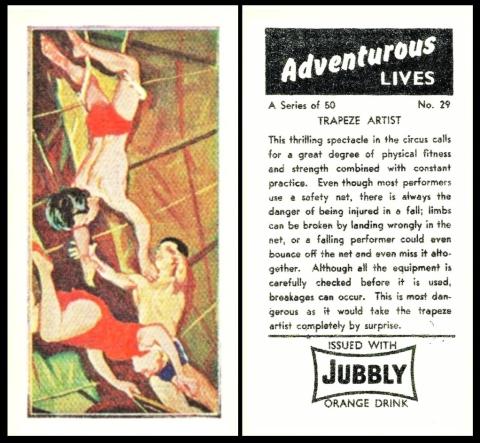
FRESHMAID Ltd [trade : drinks : UK - London, N.17] "Adventurous Lives" (1966) 29/50 -JUB-030 : JUB-1
Lemonade may not be to everyone`s taste, that`s probably why today is yet another "puckersome pitcher", in honour of #NationalOrangeJuiceDay.
Like lemonade, you can get various forms of orange juice. The most basic is if you pluck an orange from your tree and put it straight in the juicer - the only problem is that the resulting liquid can be grainy, because the juicer does not always remove the pulp when it squeezes the orange. But if you make it, and then you drink it, then and there, you get the best, most orangey flavour of all.
If you buy your orange juice, it has often had a long journey, and has been artifically converted by removing the oxygen. However, along with the oxygen goes the taste, and the vitamins,, and so the drink is then re-plumped with artificial ingredients, and massively sweetened with sugars. That means that though orange juice is often seen as a very healthy drink, with high Vitamin C levels, it does depend on which orange juice you have in your glass; for the truth is that the more you pay the less likely it is that you will get substitutes.
Now I was sure I had featured this set before but cannot find it and there is no picture in the gallery under that name. But "Jubbly" was actually a brand of orange drink and that fits the theme exactly - though I am slightly confused as to why in our British Trade Index part two "Jubbly" is given as the issuer, immediately followed by the name of the actual producer. And there is not even a link to that name elsewhere in the book. That entry, in the British Trade Index part two, reads as follows :
JUBBLY
Freshmaid Ltd., London, N.17. Orange drink. Cards issued 1966
- ADVENTUROUS LIVES. Sm. 66 x 35. Nd. (50) ... JUB.1
The only difference to this entry in our updated British Trade Index is the card code, which has become JUB-030
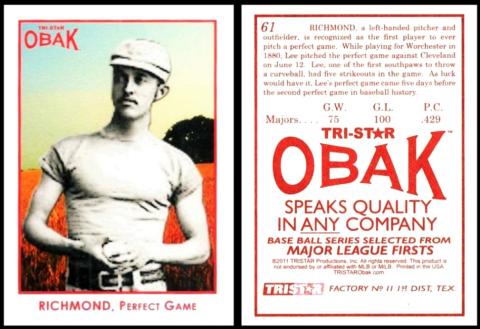
TRISTAR Obak [trade/commercial : O/S - Texas, USA] "Base Ball Series" - orange (2011) 61/120
Now whilst hunting for interesting snippets I read the following, that today, in 1857, was born a man called J. Lee Richmond, and he threw the first perfect game (our "perfect pitch") in Major League Baseball history. That was on June the 12th, 1880, and, just because I know you are wondering, a perfect game is one in which there are no hits, no walks, and no errors.
He was born in Sheffield, Ohio, into a staunch Baptist family, with several generations of ministers. He was raised on a farm, with his eight older siblings, and went to college in 1873, and there was the first time he ever played baseball.
In June 1879 he was paid ten dollars to pitch in an exhibition game against the Chicago White Stockings. He signed with a very oddly named, and almost forgotten, baseball team, the Worcester Worcesters in July. They were better known as the Brown Stockings, or the Ruby Legs, from which we can deduce that their long socks were a reddish shade of brown. They played in what was called The National Association, but only contained teams from the North East of America. However they had some good players, so good that the National League even waived the fact that Worcester had way too low a population to be technically allowed. However they still had to find the entry fee, which they did by selling what we now know as a season ticket. It looks like it may have been the first ever season ticket as well, because at that time you thought about where you wanted to go that night for some entertainment, picked baseball and paid at the gate. They even became the first professional baseball team to visit Cuba
Anyway, back to Mr. Richmond, he seems to have been one of the players that the National League was keen to get, and on June 12th, 1880, he went down in history as playing that first ever perfect game. It was at the Worcester Agricultural Fairgrounds, and their opponents were the Cleveland Blues.
Four days later he graduated from Brown`s University with a medical degree from the City of New York. And he retired from baseball in 1883, to set up a private medical practice. He did return to baseball, in 1886, with the Cincinatti Red Stockings. but did not do so well, soon having a recurrence of the arm troubles which had plagued him in 1882.
He then seems to have given up his medical practise and gone to work as a chemistry teacher, in Ohio. This brought him joy of another kind, as he married one of his former students and had three children. And he lived for some time, only dying on October the 1st, 1929, aged 72.
Strangely I cannot find a single contemporary card of Mr. Richmond, despite his world beating perfect game. But, thankfully for me, he does appear as part of the TriStar Obak cards, issued in 2011, as a standard card, number 61, from the base set, and in orange, which is what we show here, and which refers to the colour of the frame (and that saves me hunting out another card for Jefferson Burdick). Strangely, there are other frameline colours, but not for our man, as they were only issued for the lower numbers - as this table shows :
- No. 1 only - blue, brown, green, orange (numbered to ten or to seventy five), purple
- Nos 2 - 5 - blue, brown, green, orange (numbered to ten or to seventy five)
- Nos. 6 - 10 - brown, green, orange (numbered to ten or to seventy five)
- Nos 11 - 25 - brown, green, orange (numbered to seventy five)
- Nos 26 - 50 - brown, orange (numbered to seventy five)
- Nos. 51 - 75 - orange alone (numbered to seventy five)
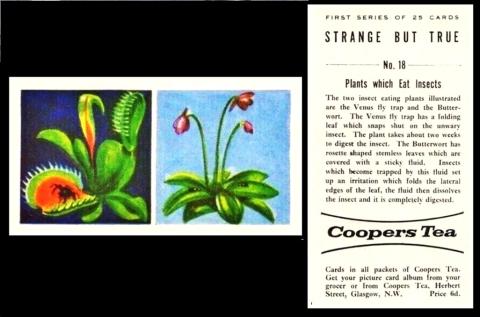
COOPER & Co. Stores Ltd. [trade : tea : UK - Glasgow] "Strange But True" - first series (1962) 18/25 - COO-150 : CPD-1
Something frivolous now, but not for flies, for today, and every first Wednesday in May, is #WorldCarnivorousPlantDay, when we celebrate those "peckish plants". The idea of this event seems to have started in 2020, but the first was not held until the 5th of May, 2021.
Now carnivorous plants are not something dreamed up by moviemakers, they do exist, but they do not, as yet, prey on humans. Mostly they eat insects and spiders, but sometimes they do get large enough to eat small mammals and birds. Most of them live in swamps and bogs, though they do like a bit of sunlight from time to time; and they can be found on every continent, except Antarctica.
In total there are about a thousand different species which are carnivorous, to a greater or lesser degree; the criterion for acceptance is that they have to trap their food, kill it, digest it, and use the nutrients from that prey to provide their own main form of sustenance. The simplest form is a long tube with an attractant smell on top, which the flies etc simply fall in to and cannot climb out. Then there are ones whose leaves are too sticky to allow the fly to get free, ones with a kind of internal suction mechanism which pull them in past the part of no return, and others which have a network of hairs that allow the fly in but prevent them getting out.
The most spectacular is the Venus Fly Trap, which has two open jaws that slam shut when they feel a fly has landed in between them. They do this by means of trigger hairs, and they even know when it is something inedible that has landed, like a raindrop, or pollen or even a dead fly, falling in by accident. However they have not learned to regenerate, and after a few flies have been caught they gradually need more stimulation, eventually failing to close at all.
Strangely, one of these plants has had enough, and gone vegetarian. That is a type of pitcher plant called Nepenthes ampullaria, or rosette pitcher, and it now gains its sustenance entirely from leaves, which fall in to the long tube and are digested. And it seems to suffer no ill effects from its change of lifestyle, which is rather exciting.
The set first appears in our original British Trade Index part two, as :
COOPER & Co. Stores Ltd., Glasgow
Cooper`s Teas. Cards issued 1958-66. Small size 68-69 x 36 m.m. Albums issued.
- DO YOU KNOW? Sm. Nd. (50). See D.260-1 ... CPD-1
Now, that "D" code means that this set was issued by someone else, and this turns out to be a set with many permutations, for there were three sets in all, each of fifty cards. And you can see that list with our Card of the Day for the 12th of May, 2022. The most exciting thing about that is that it seems to support the theory that when this set was issued, Coopers was intending to issue a second set as well, hence the wording "First Series", and they could easily have done so, because the cards were there for the taking, or rather for the overprinting, in their name, but for whatever reason they chose not to in the end.
Now by the time of our updated British Trade Index, there are a few changes to the header, and a new card code. So that entry reads :
COOPER & Co. Stores Ltd., Glasgow
Tea. Issued 1955, 1961-66. Size 68-69 x 36 m.m. Albums issued, unless stated.
- DO YOU KNOW? 1966. Nd. (50). See HX-166.1. No album available ... COO-150
The reason why 1955 had been slotted in was that it had been discovered, since the publication of our British Trade Index part two, that Cooper`s Tea had also issued "The Island of Ceylon", in 1955.
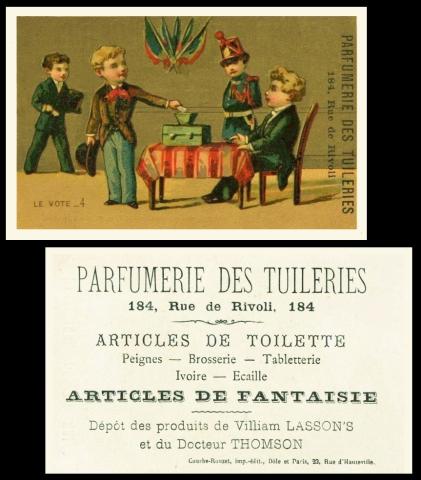
Parfumerie des TUILERIES [trade : chemist store : O/S - 184, Rue de Rivoli, Paris, France] "Le Vote" (1900?) 4/4
A little reminder, here, that today is Voting Day, in other words, time for your "polling picks". So make a note on your calendar and also remember to pack your passport, or other form of ID, or you will not be allowed to mark that all important X.
Briefly, voting is when a group of individuals pick one of a selection . It is generally connected with politics, but it can be also done at clubs, and courts. Informally it can be done by hands up, or by agreeing with an aye, or disagreeing with a nay. In political terms it is generally done more secretly, by pencilling a large cross beside the name you like best of several which are on a printed sheet, then inserting it in a ballot box. At the end of the day, all the crosses for each person are counted, and the person with the most crosses wins, at least if the election is fair and honest and truthful - which is not always the case.
Most countries see voting as a matter of personal choice, and it matters not if you turn up, though this tends to lead to low turnouts and closer elections. However in some countries voting is enforced, mostly in South America, but also in places you may not expect, including Australia, Belgium, Singapore and Thailand.
Whatever your opinions, it always seems a shame that some people protest by spoiling their ballot paper or by refusing to mark an X, when in many countries people are prevented from voting through their gender, age, or bank balance. It is better to pick a candidate from a party not expected to win, with whom your views align, even if only slightly, and give them heart to carry on.
This chemists store had a vast range, peignes (combs), brosserie (brushes), tabletterie (small items like buttons, fans, and cases, often adorned with precious metals), ivoire (the same things, but decorated or made in ivory), ecaille (the same things, but decorated or made of skins, scales, shells, and tortoiseshell), and articles de fantaisie (novelty items, fancy goods, sometimes even costume jewellery).
The card also mentions two men, Villiam Lasson and Docteur Thomson. Villiam Lasson made hair restorer, starting in about the 1890s, but I can`t find a Docteur Thomson, yet.
As for the card, it is from a set of four, and they were issued by many, so far I have found :
- Binet au Raincy Mme Bouchier (lingerie, costumes - Paris)
- Cleuvenat (lingerie, trousseaux - Paris)
- Compagnie Generale des Chocolats (chocolate, Paris)
- Parfumerie des Tuileries (chemist - Paris)
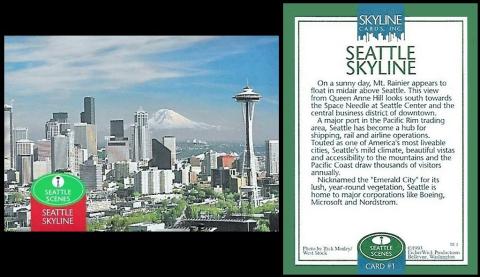
Skyline [trade/commercial : O/S - Seattle] "Seattle Scenes" (1993) 1/28
Today, in 1908, John Graham, Junior, was born.
However, let us start our tale with his father, John Graham Senior, who was born in 1873, and the architect of a number of notable buildings in Seattle, though he was actually born in Liverpool, England, only moving to Seattle in 1901. Some say the highlight of his career were the buildings for the Alaska-Yukon Pacific Exposition, whilst others cite the commercial buildings which transformed the business district of Seattle. And then there are people who believe his greatest claim to fame was that he was the supervising architect for the Ford Motor Company, which took him all over America, as one kind of horse power was replaced by another.
It is not known whether his son really wanted to follow in his father`s footsteps. He left Yale University with a degree in fine arts, and started working in merchandising and design. However, after the end of the Second World War, when his father retired, John Graham Junior was given the reins of his company. In many ways, he was able to combine his great love with keeping the company going, for he sought out clients who were also merchants, and in 1946 he changed the face of retail for ever by designing the Northgate Shopping Centre, out of town, with easy highway access, parking on site, and a range of different shops, run by different companies, under one roof. This was the first shopping mall, which today seem to be everywhere, and he made many more, right across America and Canada.
Few people know him for that though - they know him for designing what is on our card, on the far right as viewed, namely the Space Needle, which is where we get the "pin", our man being its architect, or "planner" - with its revolving restaurant/s, for at first there were two restaurants, and now, since the dawn of the Millennium, there is one huge one, taking the space of both. The needle was originally designed for an exhibition, called Century 21, part of the 1962 Seattle World`s Fair, and at one time it was the tallest building west of the Mississippi River.
Today, it also has a light, a beam, which shoots skyward and is illuminated on high days and holidays as well as times of national mourning - this was shown in the original posters for the exhibition, but was not in place until the last day of the last month before the Millennium. Sadly our man never got to see that light, for he retired in 1986, and died relatively shortly after, on January the 29th, 1991, aged eighty-two.
This is an interesting set, and it seems to be sold online in all manner of permutations of different cards but I have seen a packet and that says that there are twenty-eight cards, though the last card is actually not a card it is a checklist. Now a checklist suggests that they were not all sold as a single item, that you had to collect them slowly and cross them off, so that is an avenue I will explore later. The cards are :
- Seattle Skyline
- Chief Sealth
- The Ferries
- Evergreen Point Floating Bridge
- Opening Day
- Mount Rainier
- The Museum of Flight
- Pike Place Market
- International District
- The Space Needle
- Kingdome
- Seattle Coffee
- Waterfront Streetcar
- University of Washington
- Pike Place Fish
- Seattle Waterfront
- Pacific Science Center
- Ballard Locks
- Pioneer Square
- Seattle at Dusk
- Fisherman`s Terminal
- Arboretum
- Westlake Mall
- Monorail
- La Conner/Skagit Valley
- Olympic Rainforest
- Bellevue
- Checklist
This week's Cards of the Day...
...were devoted to sets which were issued in May, and we thought we would see how many large sized sets we could find, though we have already changed the first card, and I cannot find where I got the May date from for the third. Anyway, we did manage to find a different, large sized, card for each day, which was rather fun.
In total we currently know of eighty-eight sets which were definitely issued in May - the earliest being the 1902 set of Wills "Vanity Fair", first series, and the latest being the 1939 set of Cope`s "Cathedrals". The year with the most March sets was 1912, with seven, and the runner up was 1930, with six. And you can see what they were on our cartophilic year blog
As to this week`s cards of the day they were :
Saturday, 25th April 2026
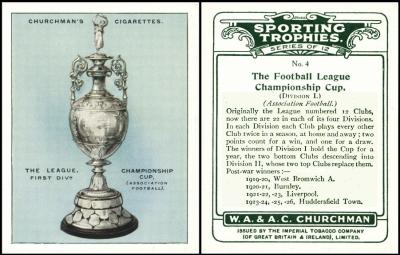
Our week saw us start with this card, or it didn`t, because I had already used this set. However, the other time was only to give the clue of a cup, for a sort of mushroom, so that has now been altered to a slightly different cup, but still football. And you may have noticed that this is also a slightly different card, because I took the whole lot of the duplicated one, the text and the description, which made it another whole lot, easier for me.
And as for the May link, there are again two, that the final seems to have been played in May, and that this set was definitely issued in that month
This sporting trophy arose out of rather a confusing situation as to whether or not English football ought to be professional or amateur. The problem was that though the new Amateur Football Association hoped for the latter, many of the clubs that claimed to be amateur, would pay better players to come along and play from time to time in important matches. Then, in 1888, one of the directors of Aston Villa F.C. set about sorting this out. He wrote to several clubs, suggesting an annual competition which would set rules and guarantee that every club played against each other twice in a season, one match being at each of the club`s home grounds.
The first season saw twelve clubs compete, all from the northernly part of England, these being Accrington, Aston Villa, Blackburn Rovers, Bolton Wanderers, Burnley, Derby County, Everton, Notts County, Preston North End, Stoke, West Bromwich Albion and Wolverhampton Wanderers. The first winner was Preston North End, who successfully defended their title in the following year. The other two winners were Everton (in 1890) and Sunderland (in 1891). Now you are probably wondering where Sunderland came from, as they are not in the list above, and the answer is that for some reason In 1890, Stoke were not re-elected to the league, but rather oddly Sunderland were drafted in.
Then, in 1892, a second division was formed. But that is a different cup to ours.
This card tells us that the trophy is currently held by Huddersfield Town, for the 1926-26 season. The following season saw it go to Newcastle United, then to Everton, and then to The Wednesday, who are indeed Sheffield Wednesday but would not be called so until 1929.
Now as for when this trophy was replaced, that is a strange story. The original cup, which is not this one, was made in 1871 by Martin, Hall & Co., of Sheffield, for £20. In 1895, after it had been won by Aston Villa, the cup was being displayed in the window of a shoe shop in Birmingham when it was stolen. There was a reward offered, of £10, but the cup was never found, so the Football Association fined Aston Villa £25 in order to get a new cup made. Now eventually someone did come forward, in the 1950s, and claim to have stolen it and had it melted down - though there were several inaccuracies in their story and the claim was dismissed.
That cup was then re-made almost identical in 1895, presumably with Aston Villa`s money, and it was given between 1896 (to Sheffield Wednesday) and 1910 (to Newcastle United, who finally beat Barnsley after a replay).
Then it gets confusing as it says that in 1911, a new cup was designed, but in the design which is still used today, though the cup has been replaced several times - and it looks nothing like the one on our card either. So if anyone knows this cup we show today do let us know!
Anyway this set, along with its smaller sized sibling, which was our Card of the Day for August 5 2023, is first listed in our original Churchman reference book (RB.10), published in 1948, as :
- 131. April 1927. 25 SPORTING TROPHIES (titled series). Size 2 11/16" x 1 7/16" or 67 x 36 m/m. Numbered 1-25. Fronts printed by letterpress, 4-colour half tone process. Backs in dark green, with descriptions. Printed by Mardon, Son & Hall.
- 132. May 1927. 12 SPORTING TROPHIES. Similar format to (131) but size 3 5/16" x 2 9/20" or 80 x 62 m/m
Our original World Tobacco Issues Index shortens this to
- SPORTING TROPHIES. Nd. ... C82-80
A. Small (25)
B. Large (12)
And this text remains the same, though all on one line, in our updated version - though there is a new card code, of C504-655.
As for the twelve cards that make up this shortened set, they are :
- small card no.1
Front - The King`s Cup (Air)
Back - The King`s Cup (Air)
- small card no.4
Front - A "Lonsdale Belt" (Boxing) -
Back - A "Lonsdale Championship Belt" (Boxing)
- small card no.6
Front - The Football Assocn. Cup
Back - The Football Association Cup (Association Football)
- small card no.7
Front - The League First Divn Championship Cup (Association Football)
Back - The Football League Championship Cup (Division I) (Association Football)
- small card no.9
Front - The F.A. Amateur Cup (Association Football)
Back - The Football Association Amateur Cup (Association Football)
- small card no.12
Front -The Calcutta Cup (Rugby Football)
Back - The Calcutta Cup (Rugby Football)
- small card no.15
Front - The Open Championship Cup (Golf)
Back - The Open Golf Championship Cup
- small card no.16
Front - The Amateur Championship Cup (Golf)
Back - The Amateur Golf Championship Cup
- small card no.18
Front - The Grand Challenge Cup (Rowing)
Back - The Grand Challenge Cup (Amateur Rowing)
- small card no.20
Front - The King`s Prize (Rifle Shooting)
Back - H.M. The King`s Prize (Rifle Shooting)
- small card no.24
Front - The Davis Cup (Lawn Tennis)
Back - The Davis Cup (Lawn Tennis)
- small card no.25
Front - The America Cup (Yachting)
Back - The America Cup (Yachting)
Sunday, 26th April 2026
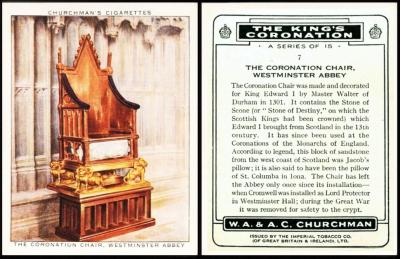
On Sunday, we had another large card, which suddenly set the theme for the theme of the week. And once more this set was again definitely issued in May.
So here we have the Coronation Chair complete with the Stone of Scone. And we featured the chair before, on a 1911 card issued by Salmon and Gluckstein, which you can see in our newsletter of the 6th of May, 2023, as the diary card for Saturday the 6th of May.
However, in between the issue of these two cards, both the chair and the stone had been forever altered. You see, on the 11th of June 1914, some suffragettes planted a bomb next to the chair, which was loaded with shrapnel, metal nuts and bolts, and it exploded, when the Abbey was open to the public. Estimates report that about 80-100 people were present at the time but it seems that there were no major injuries, except to the chair, because that lost a corner of the woodwork. Now though the damage to the chair was immediately apparent, it was never realised that the stone had also suffered, actually much worse, for it had been completely split in half. But that fact was not known even at the time of this card; it was only discovered in 1950, when the Stone was stolen, in a daring raid by Scottish Nationalist sympathisers, who wanted it returned to Scotland, the legal owners - for it had been stolen once before, in 1296, by the army of King Edward I, when he invaded Scotland.
Anyway, this is another large sized set with a smaller counterpart, and the pair are described together in our original Churchman reference book, RB.10, published in 1948, as :
- 83. Jan 1937. 50 THE KING`S CORONATION (titled series). Size 2 11/16" x 1 7/16" or 67 x 36 m/m. Numbered 1-50. Fronts printed by letterpress, 4-colour half tone process. Backs in dark green, with descriptions. Printed by Mardon, Son & Hall.
- 84. May 1937. 15 THE KING`S CORONATION. Similar format to (83) but size 3 5/16" x 2 9/20" or 80 x 62 m/m
Now the curious thing about this set is that it was originally issued as a small set in January 1937, which was almost four month`s before the Coronation, for that did not take place until the 12th of May. Then, in the month of the event, but presumably afterwards, it was reissued as larger cards. What that means is that because the two sets are the same, both of them were artist`s impressions, rather than photos taken at the time and transformed into cards.
Our original World Tobacco Issues Index shortens this to
- THE KING`S CORONATION. Nd. ... C82-60
A. Small (50)
B. Large (15)
And this text remains the same, though all on one line, in our updated version - though there is a new card code, of C504-655.
As far as what the fifteen cards were, this is a list :
- H.M. King George in Imperial Robes (small card 1)
- The Champion of England (small card 6)
- The Scene of The Coronation, Westminster Abbey (small card 11)
- Westminster Abbey : Presbytery prepared for the Coronation (small card 12)
- The Confessor`s Chapel prepared for the Coronation (small card 13)
- Westminster Abbey, showing Coronation Annexe (small card 14)
- The Coronation Chair, Westminster Abbey (small card 15)
- The Coronation Ceremony : Taking the Oath (small card 16)
- Returning from The Coronation (small card 20)
- The Regalia at the Tower of London (small card 22)
- The Jerusalem Chamber, Westminster Abbey (small card 23)
- Bearing the Regalia from the Jerusalem Chamber (small card 25)
- St. Edward`s Crown (small card 26)
- The Imperial State Crown (small card 27)
- The Royal State Barge (small card 48)
Monday, 27th April 2026
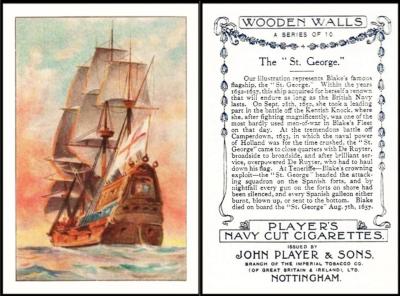
Our third card has a difference of opinion as to the date. I have it in the London Cigarette Card Company catalogue for 1950 as May 1908, whilst in our original Player reference book it appears as February 1908. Sadly I have no card magazines for that date, so I can`t check it out in the New Issues column.
Anyway, this is the St. George, the flagship of Admiral Robert Blake, on which he actually died.
We know little about Admiral Blake, and for that you can blame the Stuarts, for he was Oliver Cromwell`s favourite, and many of his exploits were expunged from official records in order to hide his truth. However, we still know that the modern navy owes a lot to him and his changes, and that some claim him to have been a better sailor and tactician than even Admiral Nelson.
He was born in 1598, we known not when, but he was baptised on the 27th of September 1598, which is oft quoted as his birthdate. However it must have been no more than a week earlier as his parents were good religious folk. He attended school, and then Wadham College, in Oxford, but he left when his father died, and he took over the estate. In 1640 he was elected as the MP for Bridgwater in Somerset, but then the English Civil War broke out and he joined the Parliamentarians. They installed him as the MP for Taunton in 1645, and he remained MP of both places on and off until 1656, when he went back full time to his great love, the sea.
He had already been closely involved with the building and maintenance of the English Navy, and in 1649 had written and published what is considered to be the first ever Navy Manual, "The Laws of War and Ordinances of the Sea". It is to him we owe courts martial, and the single line battle formation, as well as our readiness to attack unremittingly despite opposing fire, both from the coastline and other ships.
In March 1655 he had written his will, we are not sure why. That left £100 to each of the towns at which he had been the MP, for poor relied, and money to his brothers, one of whom also was to take over the estate. At the time he also owned a diamond ring, given him by Cromwell, but this seems to have disappeared.
His death came on the 7th of August, 1657, but not in the heat of battle, for it is recorded that he simply died "of old wounds", on board this very boat, his favourite. And he was buried at Westminster Abbey, with Oliver Cromwell looking on. Unfortunately, after that, when King Charles II took over the throne, he was dug up, and in 1663 the remains were uncovered and transported to St, Margarets, along with twenty other Parliamentarians, who seem to have been tumbled in together, and are recorded only by a carved stone plaque, erected quite recently, by the Cromwell Association.
Now this card, unlike our previous two cards. was issued only as a large sized set, it was never reduced to a standard one. And I am not sure why, as the paintings are superb.
There is another puzzle too, for the name does not suggest shipping to me, and it is seldom explained in catalogues that it is actually of that subject.
It is even described in our original John Player reference book, RB.17, issued in 1950, as simply :
- 202. WOODEN WALLS. Extra large cards. Fronts in colour. Backs in blue, with descriptive text. Home issues, February 1908
A. Thick card
B. Thin card
However, it turns out that "Wooden Walls" was actually a Naval name for the oak-built battleships, and that any sailor of the time would have known that. It would have only been to us landlubbers that the puzzle would have occurred. In fact there is a silent film. by the Hepworth Company, called "Wooden Walls of Old England", filmed in 1899, which can be watched, to this day, online, courtesy of the British Film Institute
By the time of our original World Tobacco Issues Index, the description is reduced, and there is not a word about the two thicknesses. All it says is :
- WOODEN WALLS. Extra-Lg. Nd. (10) ... P72-57
Whilst in our updated World Tobacco Issues Index, the text remains the same, only the card code is different, and s now P644-124
As far as the ten ships in the set, they are
- An Anglo-Saxon Ship
- The "Victory"
- The "Prince George"
- The "St. George"
- "The Last Fight of the "Revenge""
- The "Powerful"
- The "Henry Grace a Dieu"
- The "Sovereign of the Seas"
- The "Queen"
- The "Formidable"
Do note that the number is really hard to see, being right in the middle of the looped garland above the title.
Tuesday, 28th April 2026
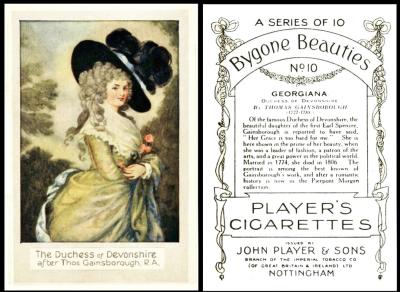
Our "Bygone Beauty" is actually Miss Georgiana Spencer, born on the 7th of June 1757, at Althorp House, in Northamptonshire, which makes her a long distant relation of Diana, Princess of Wales.
On her seventeenth birthday she was married to William Cavendish, reputedly the most eligible bachelor of his time, and the Duke of Devonshire, though he was older than her, by nine years. It was hardly a love match, he needed an heir, and fast, and he pretty much went back to his bachelor lifestyle, spending weeks away at the card table. As both her parents had been gamblers, this ought to have rung the alarm bells, but instead it seems to have made her a gambler as well, though some say, and it does seem logical, that this was perhaps just so she had something in common with her husband, something they could talk about to fill the short time they were together. Also, the heir did not appear, only two miscarriages. Actually the Duke already had a child, but not a legal one, and only a daughter, by a milliner, called Charlotte Spencer, no relation to the Spencers of Althorp, and to make matters worse later on, when the mother died, this child was taken in by the Duke, though it seems that Georgiana loved the girl deeply. The Duke also had two more children, later on, with a woman called Lady Elizabeth, who moved into the same house with them.
It took until 1783 for Georgiana to have a child, a daughter, and two years later another child, also a daughter, came along. Her first son, and heir, waited until 1790 to turn up, who was christened William George Spencer Cavendish. He never married, though had plenty of romances. And after his birth her marriage kind of ended, she took a lover, a Charles Grey, and had another daughter, who his family claimed as their own, though they did allow Georgiana to stay in touch and visit. However in 1796 she had problems with her eye, and lost the sight in it. She gambled, heavily, and she died on the 30th of March, 1806, aged just forty-eight.
Then her husband married Lady Elizabeth.
I`m sure we have had the small size of this set before but can I find it, no. They both first appear in our original John Player reference book, RB.17, published in 1950, as :
- 40 BYGONE BEAUTIES. Fronts in colour. Backs in grey, with descriptive text. Home issues.
25 Small cards, issued February 1914
10 Extra large cards, issued May 1916
Their next appearance is in our original World Tobacco Issues Index, much the same, as :
- BYGONE BEAUTIES. Nd. ... P72-21
A. Small (25)
B. Extra large (10)
As for the ten cards, they are :
- (as small card 6)
Front - Miss Linley after Thomas Gainsborough R.A.
Back - Eliza Linley Mrs Sheridan by Thomas Gainsborough
- (as small card 24)
Front - Louise de Keroualle after Varelst
Back - The Duchess of Portsmouth by Varelst
- (as small card 10)
Front - Lavinia Bingham after Sir Joshua Reynolds R.A.
Back - Lavinia Bingham Countess Spencer by Sir Joshua Reynolds
- (as small card 4)
Front - The Marchioness of Salisbury after Sir Thos. Lawrence R.A.
Back - Frances Mary Marchioness of Salisbury by Sir Thomas Lawrence
- (as small card 25)
Front - Lady Louisa Manners after John Hoppner R.A.
Back - Louisa Manners Countess Dysart by John Hoppner
- (as small card 8)
Front - Lady Hamilton after George Romney R.A.
Back - Lady Hamilton by George Romney
- (as small card 2)
Front - The Duchess of Richmond after Sir Peter Lely R.A.
Back - Frances Stewart Duchess of Richmond by Sir Peter Lely
- (as small card 20)
Front - Lady Blessington after Sir Thomas Lawrence
Back - Marguerite Countess of Blessington by Sir Thomas Lawrence
- (as small card 5)
Front - Mrs, Siddons after Thos Gainsborough R.A.
Back - Mrs Siddons by Thomas Gainsborough
- (as small card 17)
Front - The Duchess of Devonshire after Thos. Gainsborough R.A.
Back - Georgiana Duchess of Devonshire by Thomas Gainsborough
The curious thing here is that though all the backs say "by", the front actually say "after", which, in the art world, mean a copy by another hand. So it seems that John Player took that literally, because they did not paint the pictures, only reproduce them. However they still say "by" on the backs!
Wednesday, 29th April 2026
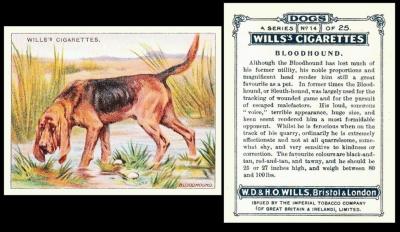
Our dog of the day is the bloodhound, or at least it is in the British Isles, for in Europe it is called Le Chien de Saint-Hubert, after the Abbey of Saint-Hubert, in Belgium, where it was first bred, in 1000 AD. Though we think the monks got the first pair from France.
Strange then, that to this day it has a reputation for hunting and tracking people, and is most connected with being the dog the police send out after criminals.
What we do not know is where its extraordinarily great ability to follow a scent, sometimes mant moons after the person who left it has moved on. But today it also has a more pleasing use, finding people who have wandered away or lost their bearings, and sometimes reuniting straying pets with their worried owners.
Our card shows a liver coloured dog with a black marking on its back, which is amusingly called a saddle. Here the saddle is dark, but genetics can make it lighter, or not present at all.
So confusion reigns but I think this is the right set, do tell if not. It is described in our original Wills booklets as :
- DOGS (1915-16) - Dark backgrounds. Large cards, size 79 x 62 m/m. Fronts lithographed in colour. Backs in grey. with descriptive text. Home issues.
182. 25. "A Series of 25" . issued 1915
183. 25 "2nd Series of 25" Issued 1916.
We get the May 1914 issue date from Wills themselves from that handy list which was printed in their "Works Magazine" and reprinted by us in a hardback version of all the Wills reference books as a single volume. The second series was issued in June, 1915
Thursday, 30th April 2026
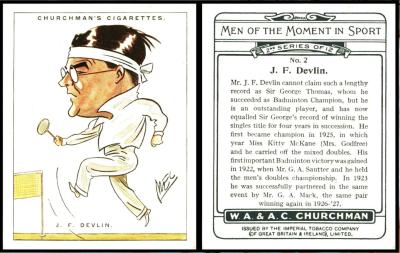
This is Mr. Joseph Francis Devlin, and you may not have guessed it from the card, but he was a badminton player, and a jolly good one.
He was born in Dublin on the 19th of January, 1900, and at the time of writing this he remains the second most successful player ever to compete in the All England Open Championships, though his active years were relatively short, only between 1925 and 1931. Strangely his introduction to the sport came quite young, when he had a bone infection, and underwent surgery to remove part of his heel. Because he was not allowed to walk, his mother, who had been, by all accounts, a pretty decent badminton player in her youth, found one of her old racquets and some shuttlecocks, and he would play that, against the wall, to amuse himself.
During the First World War he was sent to England, where he joined the Royal Air Force. They had all kinds of sporting facilities on the bases and when he saw a mention of badminton it awakened old memories, and pleasant ones, and so he had a go. He turned out to be rather good, and took part in many on base and inter-base tournaments.
After the war he started to play in other tournaments, sometimes paired with a friend, Gordon Mack, and in 1922 he first appeared at the All England Championships, which, at that time, was held at Lindley Hall, in Vincent Square, London. His partner that time was Guy Sautter, and they won the men`s doubles title. The following year he won the same class, but partnered with Gordon Mack, who would go on to win the men`s singles title the following year. Then, in 1925 our man won the men`s singles, starting a run which would see him win it every year until 1930. He also won the men`s doubles twice during that run, with Gordon Mack, in 1926, 1927, 1929, 1930, and 1931 - and he also won five mixed doubles titles, the first of these, in 1924, seeing him partnered with Miss Kitty McKane, the second, in 1926, with Eveline Peterson, and the third in 1929, with Marian Horsley
In 1925 he was invited to join an English team that was off to tour Canada, and he loved it out there. He returned in 1930, and his mind was made up, so in 1931 he turned professional and moved out there, to Winnipeg, where he became a coach and author. His daughters also shared his skills, and both were excellent players, one of them, Judy, winning the women`s singles under her maiden name in 1957 and 1958, and under her married name, of Hashman, from 1961 until 1965, and then again in 1966 and 1967.
In 1976 our man moved to Ireland, where he died, on the 27th of October, 1988, aged eighty-eight.
Oddly, he seems to have only ever been cartophilically celebrated by Churchman, in this set, which was also issued in the small size, and in the 1931 set of "Sporting Celebrities", which also tell us he was a well known lawn tennis player. All of these cards are caricatures, and curiously all by one cartoonist, "MEL".
There are actually three sets, which appear in our original Churchman reference book as :
96. 50. MEN OF THE MOMENT IN SPORT (titled series). Size 2 15/16" x 1 7/16" or 67 x 36 m/m. Numbered 1-50. Front printed by letterpress, 4-colour halftone process. Backs in dark green, with descriptions. Printed by Mardon, Son & Hall.
97. 12. MEN OF THE MOMENT IN SPORT. Similar format to (96) but size 3 5/16" x 2 9/20" or 80 x 62 m/m
98. 12. MEN OF THE MOMENT IN SPORT. Inscribed "2nd series of 12". Other details see (97), but different subjects.
This is much truncated by our World Tobacco Issues Indexes, and only appears in the original as :
MEN OF THE MOMENT IN SPORT Nd.
A. Small - (50)
B. Large - (1) "1st Series of 12" (2) "2nd Series of 12"
In the updated version it is but a two line description, with the title at the top and A and B combined on the second, accomplished by shortening the sizes to "Sm." and "Lg".
Friday, 1st May 2026
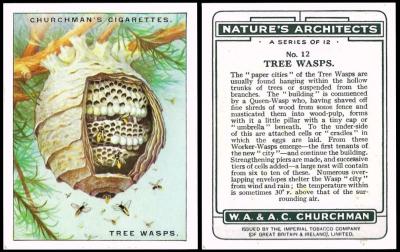
This set is different from all the other sets we mentioned over this last week, because it was actually issued before the small sized version, five months later, in October 1930. So it was not a case of finding out which cards were omitted from the smaller series, because none were.
Despite this, though, it is listed after the small sized, later version in every one of our reference books, starting with our original Churchman volume (RB.10), published in 1948, where it is listed as :
- 104. May 1930. 12 NATURE`S ARCHITECTS. Similar format to (103) but size 3 5/16" x 2 9/10" or 80 x 62 m/m
And C/103 is the smaller sized, later, set.
Our original World Tobacco Issues Index lists the sets, in the same reverse order, but without listing the months, reinforcing the idea that the small cards came first So the text reads :
- NATURE`S ARCHITECTS. Nd. ... C82-69
(A) small (25)
(B) large (12)
and this is repeated in our updated World Tobacco Issues Index, with a new card code, of C504-600.
And, to close, the cards in this large size set are as follows :
- The Harvest Mouse
- The Orang-Utan
- The Tailor Bird
- The Baya Weaver Bird
- Flamingoes
- The Hornbill
- Coral Polyps
- The Basilica Spider
- The Fairy-Lamp Making Spider
- The Trap Door Spider
- Termites or "White Ants"
- Tree Wasps
and there you go, all complete, even the write ups from the reference books. And I did have time to add the diary cards to the index so that we can close the book on 2024, then begin working backwards through 2023 as of tomorrow. This newsletter is slightly shorter than usual, because I was out all day on Saturday, and I hadn`t time to complete last week`s edition when I got back here, it was too late at night. I also planned to finish that whilst I sat at a table in the hall, but I didnt get there until the AGM was almost starting, and I had been too excited by the countryside to whip out my chromebook and stare at that instead as I travelled.
Anyway normal service will now be resumed.
And now I`m off to turn in. Thanks for popping by, hope you enjoyed it, and see you again next Saturday morning....