
Ah how the seasons come around, and change, without us even noticing. But suddenly it's getting colder, and damper in the mornings, and I even bought some slippers, which I have not retreated into yet - but sometimes wonder why not.
Now last week, just as we closed, we asked for assistance. and received in reply an email, with a scan, for which we are very grateful, as it allows us to pursue our theme of firsts with the first colour card ever to be featured on a cover of our Society magazine.
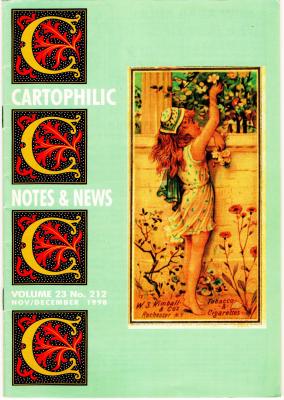
So lets start with the magazine, this one, Volume 22, Number 212, copy dated Nov/December 1998 - though if we refer to our list of proper whole numbers, it turns out to be edition number 442, more than two hundred more editions than readers probably realised.
More than that, though, the card turns out to be just the beginning of a truly fascinating tale.
This begins with the picture itself, which is actually taken from a painting, called "Gathering Flowers" by William Stephen Coleman, an English artist born in Horsham, West Sussex, some time in 1829; one of twelve children born to the surgeon William Thomas Coleman. it was originally planned that our man would become a surgeon too but it proved unsuccessful and he turned instead not to the delicate operation of the scalpel but of the paintbrush, and you can see that his works are full of minute detail, with intricate backgrounds. In fact he started off painting wildlife, in watercolour, and he also illustrated several books on that subject, until 1861, when he was suddenly engaged to work on a volume called "A Treasury of New Favourite Tales" by Mary Howitt. That seems to have set him to painting figures in landscapes, and it is true to say that he definitely favoured the elegant ladies of Greek and Roman days, but then he came to realise, inevitably, that paintings of young children were more saleable.
He was also, as you might imagine, a talented etcher, which relies on the definition and thickness of the lines to create the picture - but he did also paint in the, shall I say, rougher, mediums of pastel and oil. He also has a claim to ceramic fame as he was a director, and one of the founders, of the Minton Art Pottery. But towards the end of his life he was ill for quite some time and he died at home on the 22nd of March, 1904.
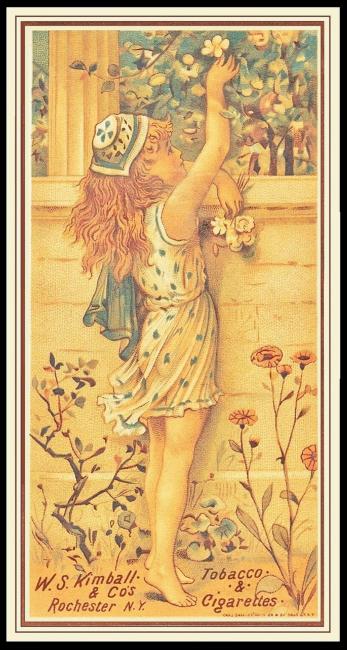
However, here comes the twist. You see, if you look at the actual painting - which you can do, quite easily, at lots of places online, we just picked most-famous-paintings.com/WSC-GF, because it just showed the painting and didn`t ask for anything from us in exchange - its not quite the same.
The most obvious of these differences is that the girl in the painting is facing the other way, but she is also wearing light blue sandals, and the dress is shorter, as well as altered in colour and patterning, plus the flowers along the wall are not quite growing in the same way.
So that seems to suggest that the artist of the card used the painting for inspiration, maybe it was even a favourite of theirs, but they subtly altered it, and, just for good measure, then flipped it side to side.
As for describing the card, I have not been able to find it in any reference book of ours. So if anyone knows where it is please let me know. I can tell you that Wm. Kimball & Co. issued several advertisement cards with various backs, and that I have seen this card with a "Testimonial" back but the one supplied to me was a plain back and so I have just shown the front. If anyone has this card with the "Testimonial" back, however, I will be able, and delighted, to insert a scan of that fairly simply.
Anyway we featured a plain backed version of a card showing a lady with a mask in a library in our newsletter of the 10th of February 2023 as the diary card for Tuesday, the 14th of February, in order to celebrate International Book Giving Day. That`s kind of why I would like to show a printed back here. Mind you, on that page we are told that their first mention came from Jefferson Burdick, in his American Card Catalogues, where they are called "Kimball Girls", and he also says they are plain back. It is, indeed, very possible that they were intended as box labels and are therefore not strictly cartophilic. But he included them. citing that ten had been seen; and he valued them at 40 cents each.
I have been keeping a list, but some are colour and some are brown monotone and I am not sure if they are two sets. Jefferson Burdick never mentions anything about colour, so I have made a single list and am fully prepared to split it later
- Lady in library with mask (colour)
- Young girl picking flowers over a wall (colour)
- Lady with a hat holding the ribbons (brown)
- Lady with bobbles on her dress (brown)
As to Mr. William S. Kimball, he was born in Boscawen, New Hampshire, on the thirtieth of March 1837. He had no intention of becoming a tobacconist, he wanted to become an engineer, and he started out as an apprentice at the Lawrence Locomotive Works, along the Merrimack River in Lawrence, Massachusetts. His talent for engineering was evident right from the start and he was sent to study it at a more advanced level at the Rensselaer Polytechnic Institute, in Troy, New York.
He graduated with flying colours, but then followed the colours of another kind, enlisting in the Navy - or maybe being head hunted, as he served as an engineer officer, during the American Civil War. In fact he soon became disillusioned with the fighting, and actually resigned his commission in June 1863, before going back to Rochester, New York, where he had moved after his graduation, and where his wife, Marion Elizabeth Keeler, was living.
Now her father was pretty high up in society, and he had also been the mayor of Rochester, and we think that he exerted quite an influence on the newlyweds. He certainly tried to turn his new son in law into a man about town, but at first William Kimball was still an engineer at heart, and none more so than on his return from war. So instead of following the brief as it were, he looked around for employment and found a tobacco firm looking for someone to take over much of the responsibility. This had been founded by a Henry Suggett about twenty years earlier, when our man was but a boy. The arrival of William Kimball soon started to bring in modern practises and he was not only able to reverse engineer many of the processes, he also set up another company, with a former shipmate, Oscar Allison, which was called, after him, as the Allison Machine and Tool Company, and which pretty much invented a faster way of rolling cigarettes than could be done by hand.
In fact he improved the business so much that he quickly became a partner in it, though there are more than a few suggestions that this was at the request of, and maybe even funded by, his father in law, to take him off the shop floor and make him a business owner. There is also some question about the fact that just four years after he joined the company the owner decided to retire, leaving him as sole owner; not just that but he allowed the company to be renamed, to William S. Kimball & Co., and that also seems to suggest the involvement of the father in law once more.
Something else, though, is that not too long after Mr. Suggett`s departure an anonymous tip suggested that there were some shady goings on, and the tax office was called in. Now that could have been a mistake, but it grumbled on, for several years, and the matter also went to court more than once, so someone was aggrieved enough to be stirring the pot from behind the scenes.
By this time William Kimball was the father of two children, but in 1858 his wife died, aged just forty-three, of hepatitis. Her father also died, in 1875, of a massive stroke from which he never regained consciousness.
In 1880 William Kimball married again, a lady called Laura Page Mitchell, also from Rochester, and he would have two more children. But work was also going well, and by the time he married for the second time he had over a thousand workers and a new, purpose built factory at the corners of Court St. and Exchange Boulevard, complete with a smokestack topped by a giant figure of Mercury, some twenty-one feet high.
Then, in 1890 he sold up, to American Tobacco, who he had expected would keep the factory going, only to find that they did not. They wanted to move everything south, and did so, in just over ten years. They even sold the buildings, to a clothing manufacturer, then to the photographic company Eastman Kodak, and then, when Mr. Eastman died, it was left to the University of Rochester. They did not really have a use for it, so they rented it to the council, which remained the case until 1951, when it was demolished to make way for the War Memorial. One thing that remained was Mercury, but he had no place to go, and so he was put in storage, only to resurface twenty-two years later, atop the Lawyers` Co-Operative Building. And he is still there today.
William S. Kimball seems not to have missed his company too much; in fact he seems to have become the son in law his late wife`s father wanted, for he enjoyed dabbling in high society, was a great partygoer, and became the leader of the Rochester Chamber of Commerce, as well as being associated with many local companies. He also loved gardening. But on March 26, 1895, whilst in Virginia Beach, he was stricken with an infection in his ear and it was left too long, long enough to go into the delicate and spongy bone behind the ear, and then into his skull. And he died, on March the 26th, 1895, aged just forty-seven, because the infection had gone into his brain.
To newsletters past :
That`s a big ouch, as I have not managed a single one. The card which is next in line to be changed shows the cinema star Nazimova - and I do have a card of her to replace it, but I just never got the time to make the block. I`ll try to do that over the weekend
However what I did do was lay the foundation of a new blog about Odham`s Press and the Pictures Portrait Gallery, which will eventually list all the cards, not just the numbered matt photogravure ones, but the French photographic ones - as well as the very first version of the Picturegoer postcards, before they became black and white and photographic.
As for newsletters past which were published around this week, they are as follows :
And if you have any updates, comments, or suggestions for any of these, do please let us know, by emailing webmaster@card-world.co.uk
This Week`s events and meetings :
Saturday the 17th of October
-
East Anglia - from 8.30 am to 3.30 pm - with auction at 11 p.m - at Roydon Village Hall, High Road, Roydon, Diss, Norfolk IP22 5RB. East Anglia Club members free admission as part of their annual subscription, visitors pay £3 admission each time.
Thursday the 22nd of October :
-
London - from 5 p.m, with an auction at 6 p.m - upstairs at The Carpenters Arms” 12, Seymour Place, Marble Arch, Central London W1E 7NE. Note that this is our Annual General Meeting so please do attend so that your voice can be heard and your ideas can bring our club forward. And don`t forget, our meetings are free entry to all collectors.
Sunday the 1st of November
-
Winchester & Solent - from 10.00 a.m. until 4.00 p.m., with auction at 2.00 p.m. - at Botley Market Hall, High Street, Botley, near Southampton SO30 2EA. Four or five dealers, mixed between local and national names. And it`s free admission to all collectors
And so there the book is closed for another week. Hope you enjoyed it, and we look forward to hearing from any Kimball collectors about this week`s featured card. And if anyone wishes to add to Mr. Kimball`s biography, please do.
See you all next week, same time, same spot in the dial. And thanks, very much, for tuning in tonight.....